Israel's Good Name

Archive for 2015|Yearly archive page

Golani Junction

In Galilee, Israel on December 21, 2015 at 6:21 AM

The other week, before I got caught up with my sister’s wedding, I visited some interesting sites around the Golani Junction. Located between Haifa and Tiberias, the Golani Junction was and still is an important crossroads connecting various regions of the Holy Land. The junction, which is really an interchange now, has been revamped in recent years with extensive roadwork to streamline the traffic flows, costing some ₪300 million.

Golani Junction

Golani Junction

The first place I visited was the KKL-JNF nursery and neighbouring Lavi Forest where rehabilitation of Israel’s trees is done – in fact, there is a “plant-a-tree” park across Road 77 for visitors to take an active part in reforestation.
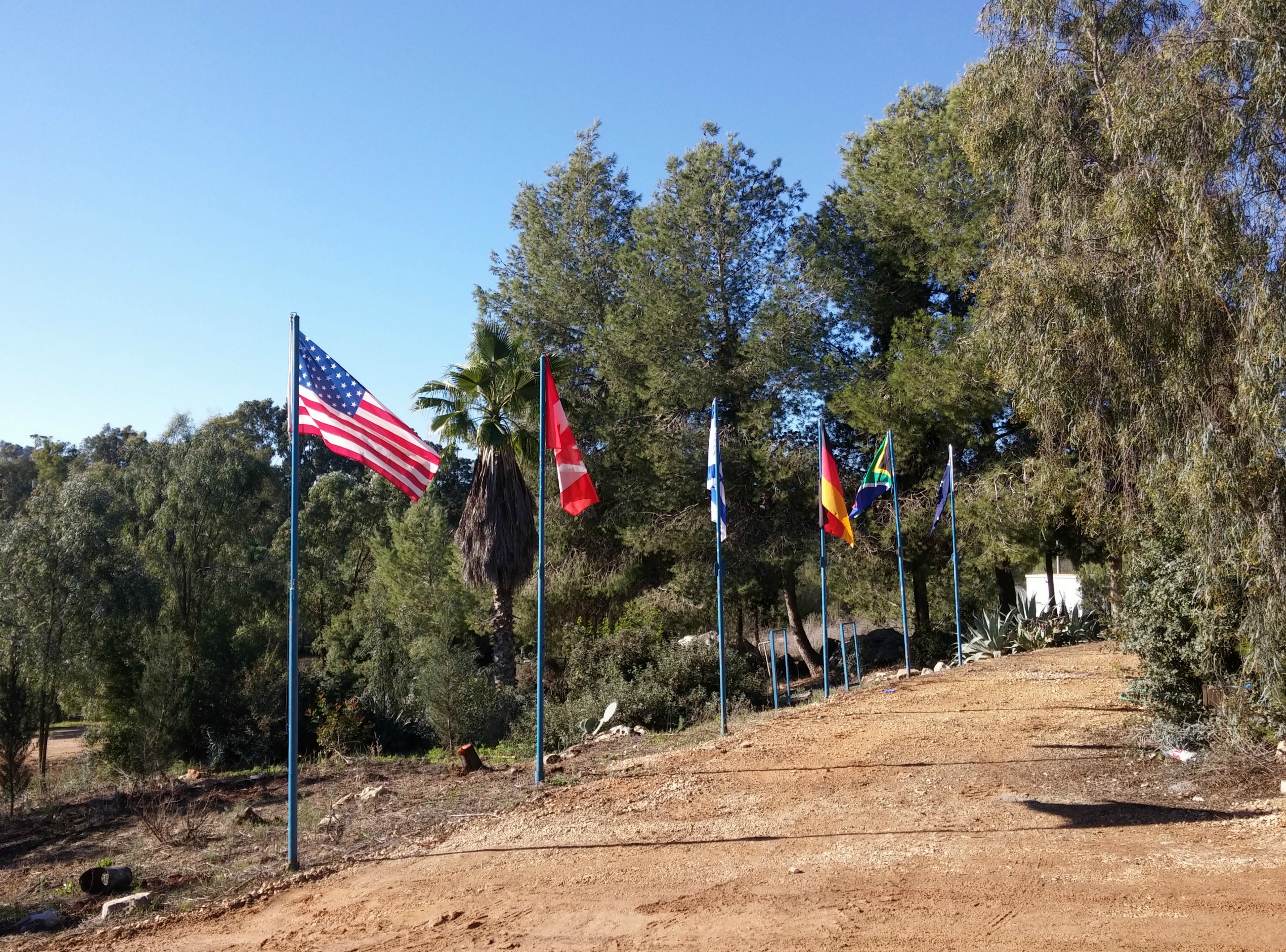
Foreign flags flying at the Tree Planting Centre

Foreign flags flying at the Tree Planting Centre

It was at one of these locations I had hoped to find an archaeological garden similar to the one at the Kabri KKL-JNF centre (see HERE) – but my search came up fruitless. At the Golani Junction itself is a place I partially visited once before while still in the army, the Golani Museum. Both a museum and a memorial, this site commemorates and sustains the ongoing legacy of the IDF’s most beloved brigade, the Golani Brigade.
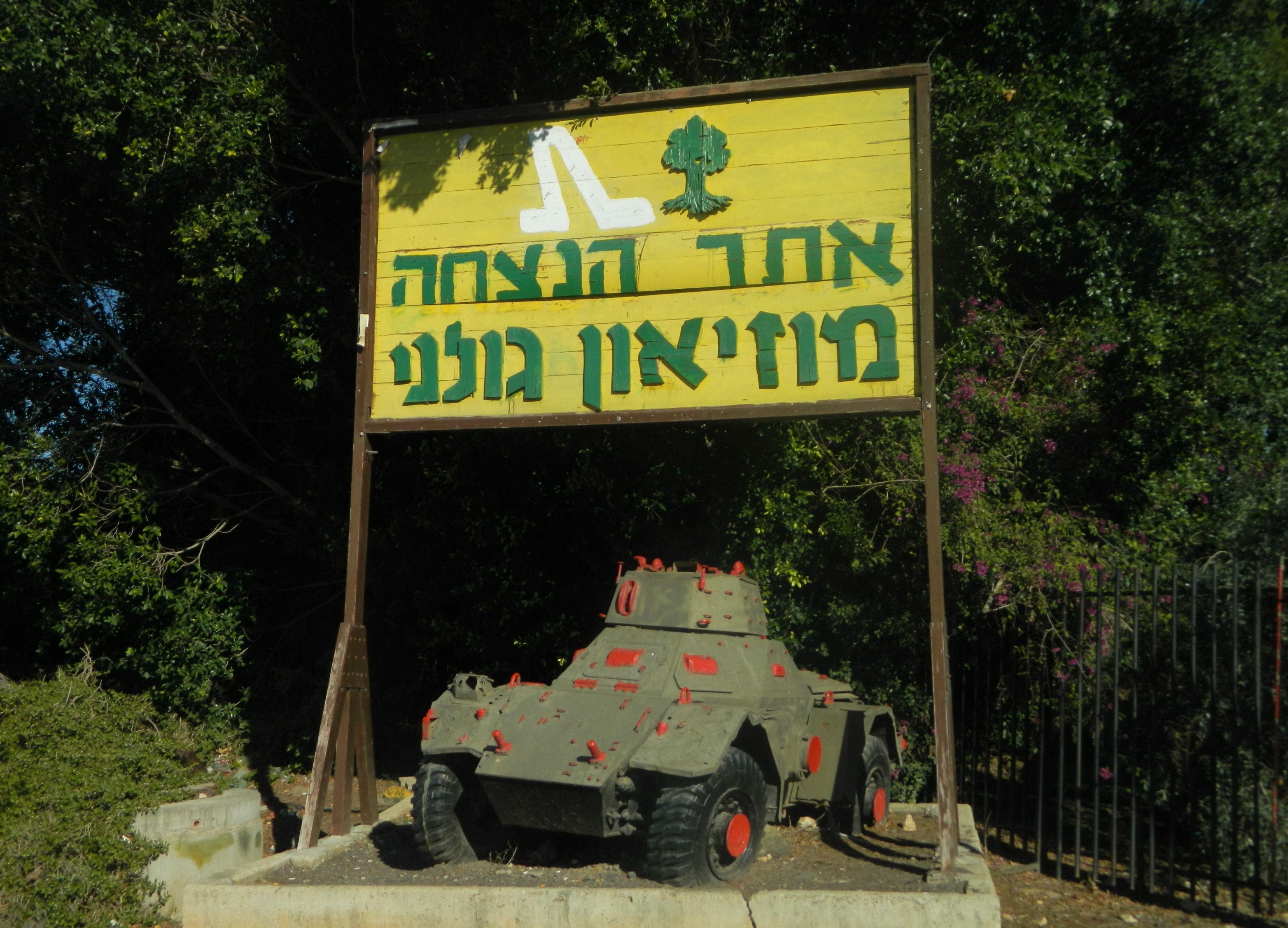
The Golani Museum

The Golani Museum

Within, I walked the beautifully shaded trail learning about the battle that took place at the Golani Junction which gave it its name. With various memorials and recreated battle scenes abound, there was an atmosphere of both the valour and the struggles that accompany all things military. I peeked into the Lecture Hall before stopping at the panoramic depiction of a northern border scene with metal soldier silhouettes dispersed among the pine trees.
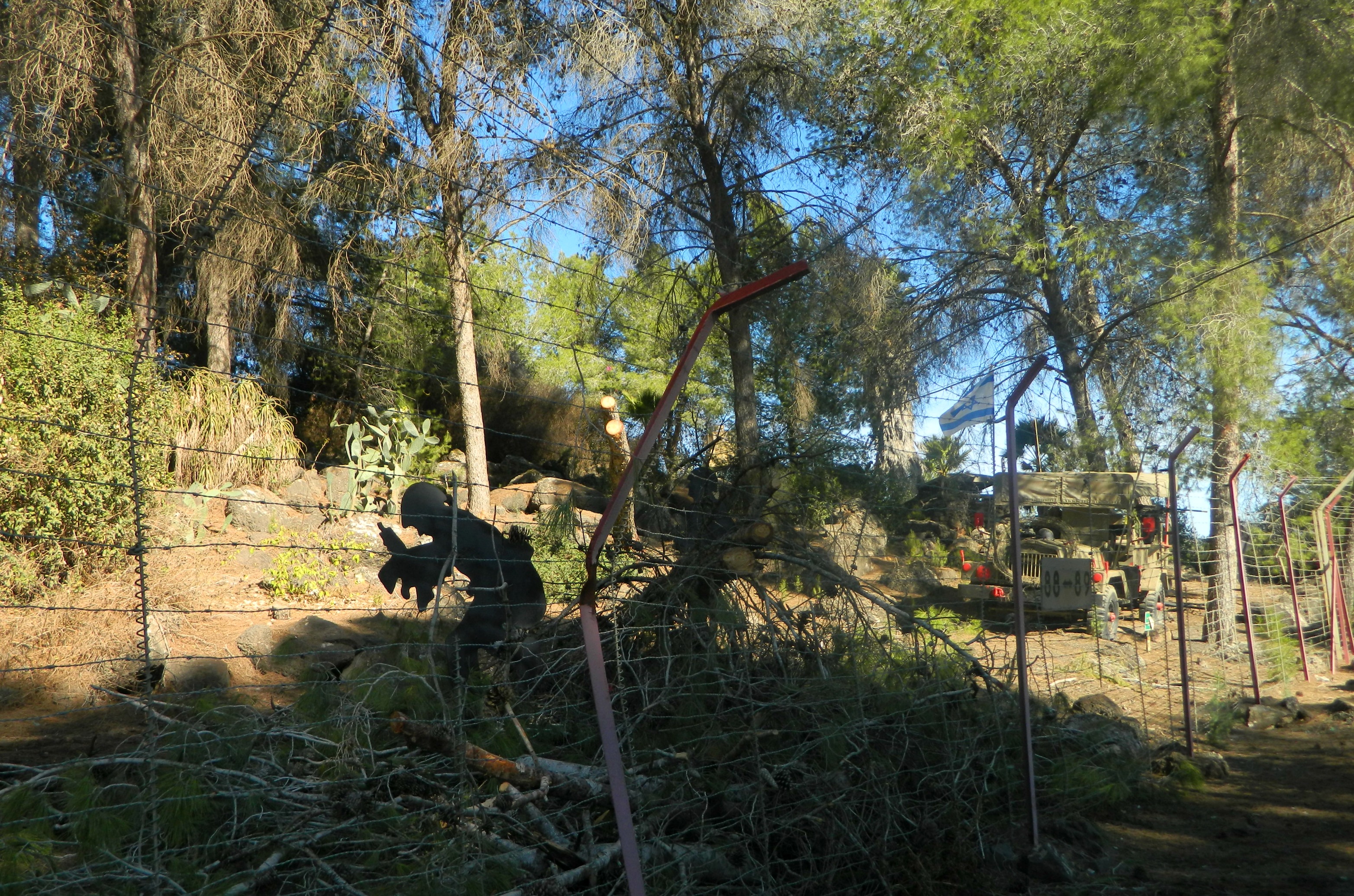
Border scene panorama

Border scene panorama

When I neared the arched room, two Golani soldiers who serve as guides spotted me and took me on a small tour. It amused me at times when they tried explaining some things to me as if I was a tourist when, unbeknownst to them, I have seen/done/lived these things in my own army service – firsthand knowledge. The soldier-guide reviewed the early history of the brigade, illustrating that the first Golani soldiers were farmers and thus the earthtone colours that identify the brigade helped solidify their deep connection to the land. The famous olive tree logo was drawn by one of the brigade’s early officers, denoting a deep-rooted longevity that Golani aims to emulate.

"After me!"

“After me!”

Inside one of the strangely shaped concrete bunkers that serve as exhibits for the brigade’s rich history I watched a short video spanning the years. One of the previous Golani brigade commanders, Tamir Yadi, is actually mentioned in an old blog post of mine – Hevron. Looking through old pictures and gear from 1948 onward, I examined historic battle plans and then found the Memorial Room. A small room lined with bookcases; each filled with faux leather booklets labeled with the name and ID number of each fallen Golani soldier. I searched for some of the more recent ones and saw very nice commemorations with mini biographies and personal photos. Beyond that room, back outside, is the Memorial Wall with each of those same names etched in stone. I looked over the recent names and remembered the losses we incurred as a nation last year in Gaza.

Golani Brigade's memorial walls

Golani Brigade’s memorial walls

Continuing along, I walked past the displayed military vehicles including APCs and jeeps that are parked on a ridge among fruit-laden cacti.
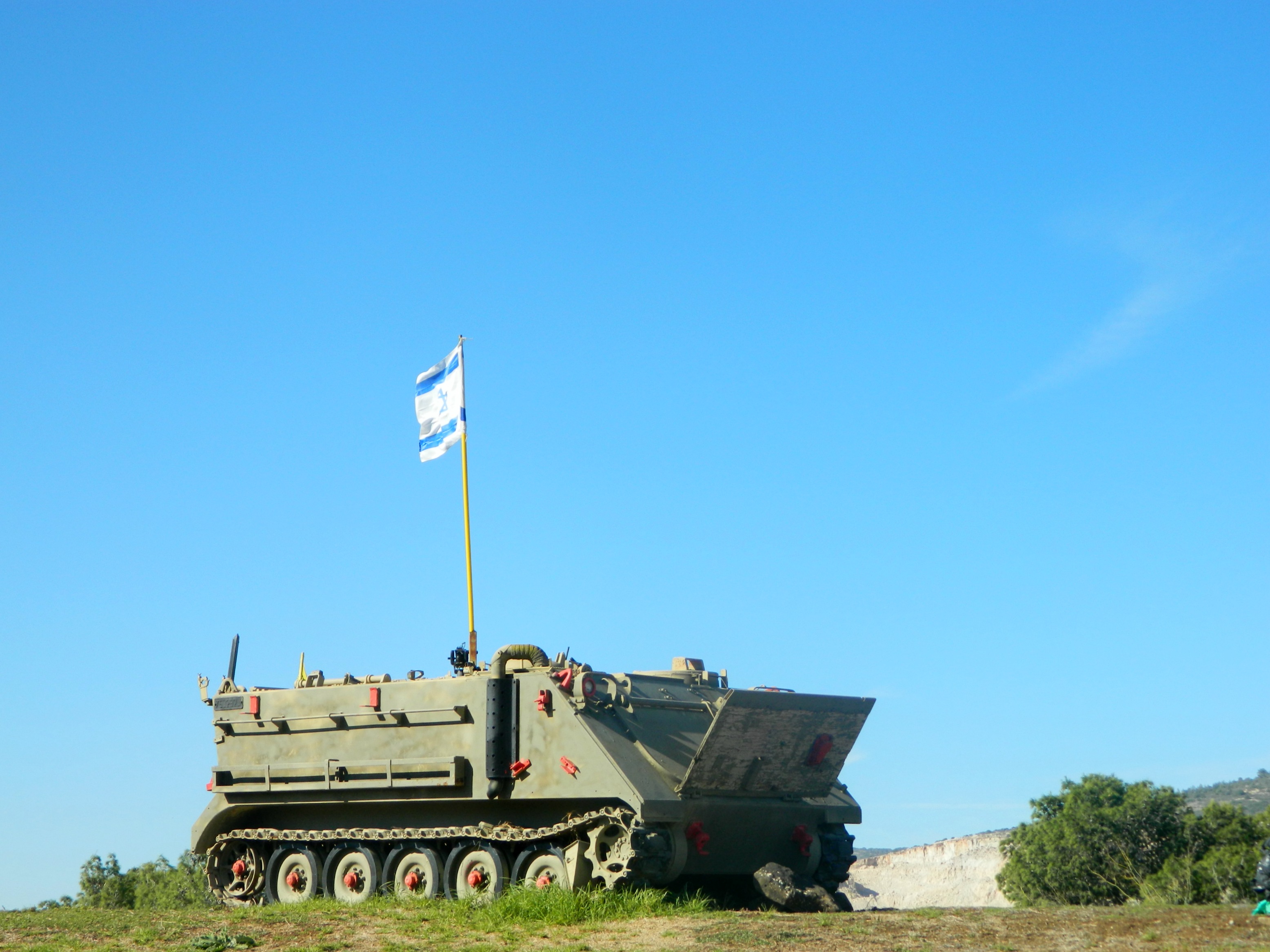
Armoured personnel carrier

Armoured personnel carrier

Leaving the Golani Museum I drove back towards Road 77 but stopped short and pulled onto a small dirt road where I parked among in a field of dead plants. I got out of the car and walked north, coincidentally the Gospel Trail, passing a dead cow on the way.
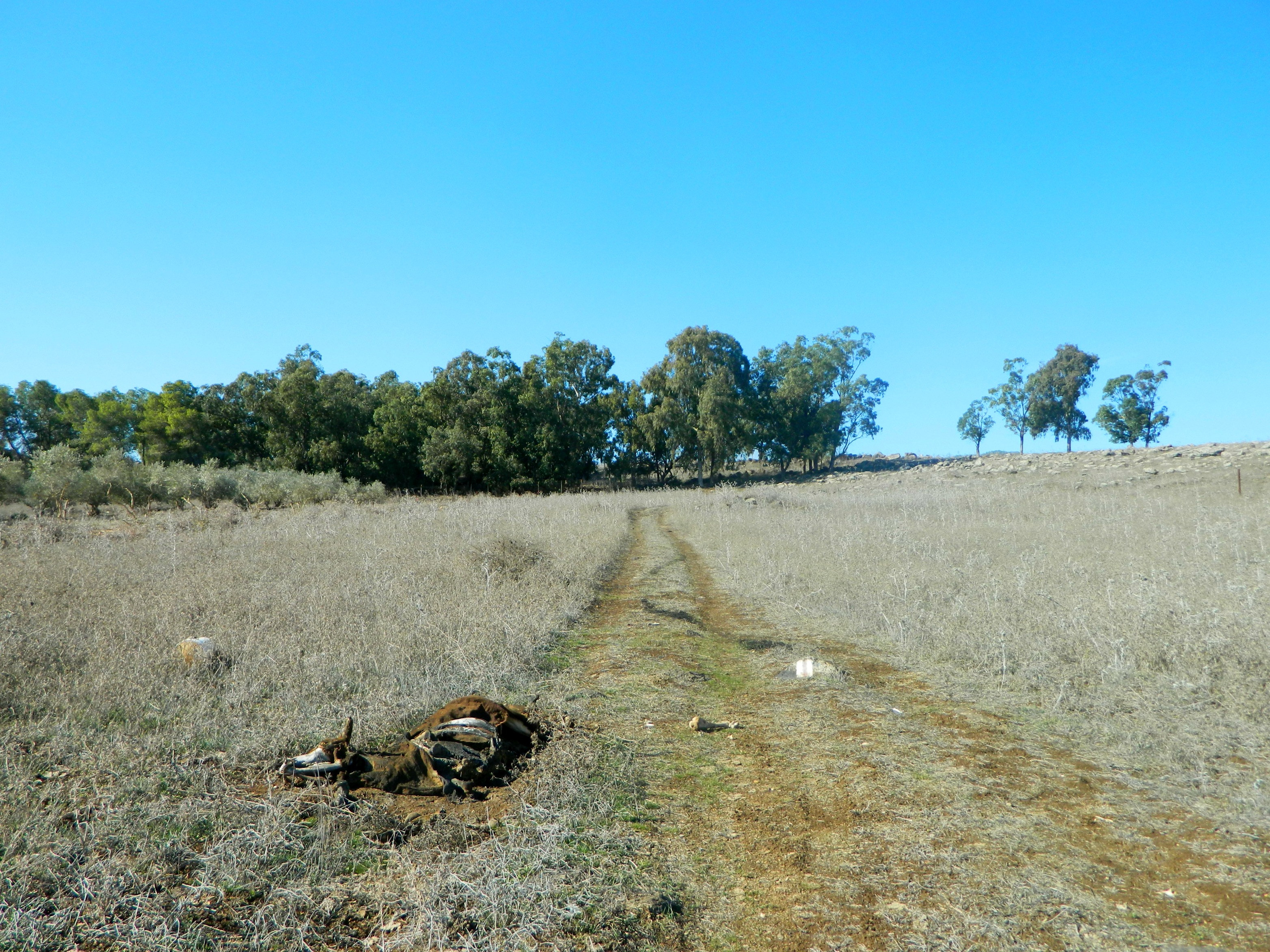
Dead cow on the Gospel Trail

Dead cow on the Gospel Trail

Suddenly, I caught the glimpse of a small songbird flitting about in the dead vegetation and patiently awaited his resurfacing. My patience paid off as I was able to get this photo of this particularly carefree graceful prinia:
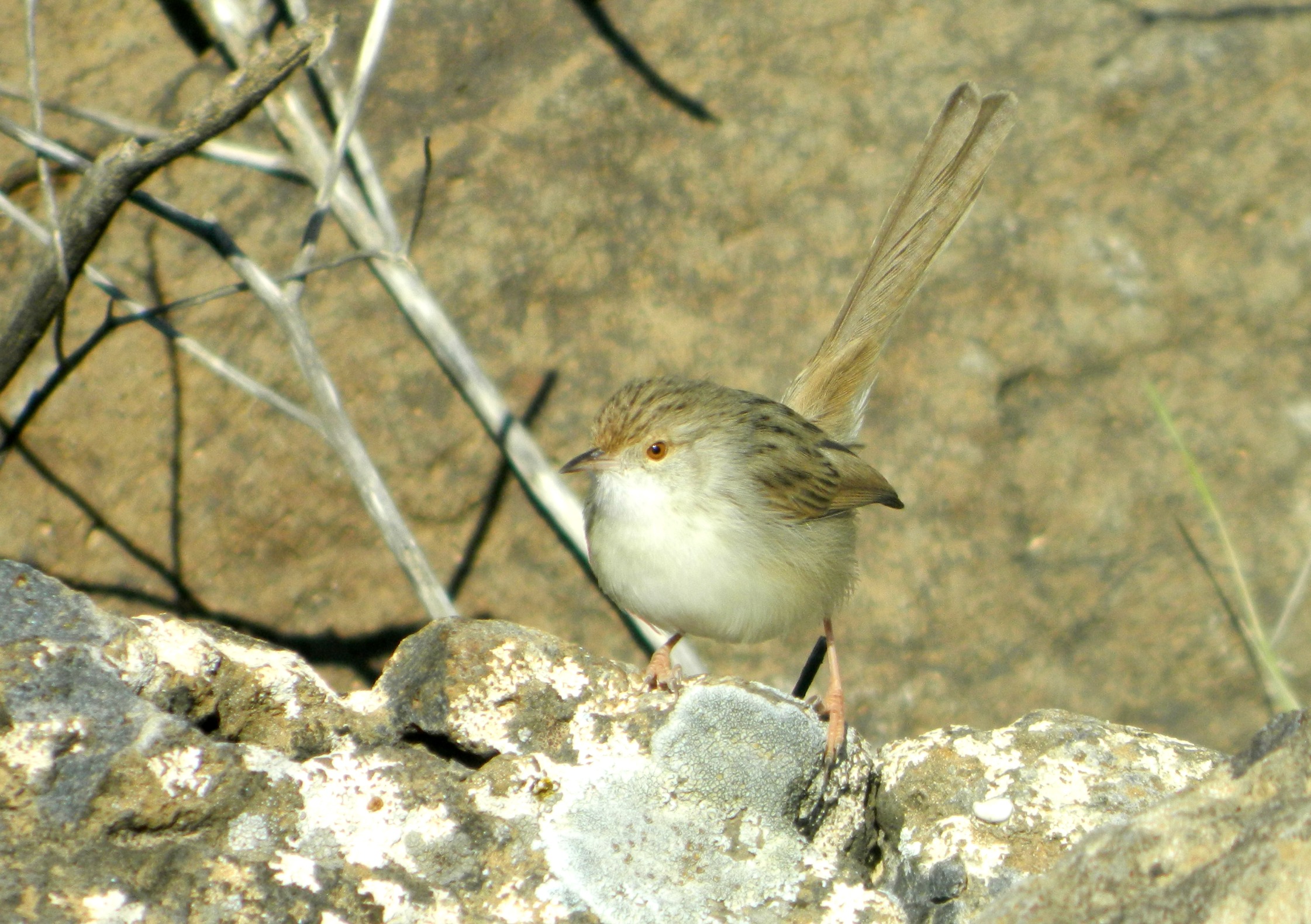
Graceful prinia

Graceful prinia

Satisfied with my photo, I walked towards the trees – the sounds of startled grasshoppers popping into the air like popcorn filled the quiet, still air. Just beyond the first few trees I found what I was looking for – the meagre remains of an ancient Roman road. A small section of the vast road network that criss-crossed the Roman Empire, the remnants are much more distinguishable in person.
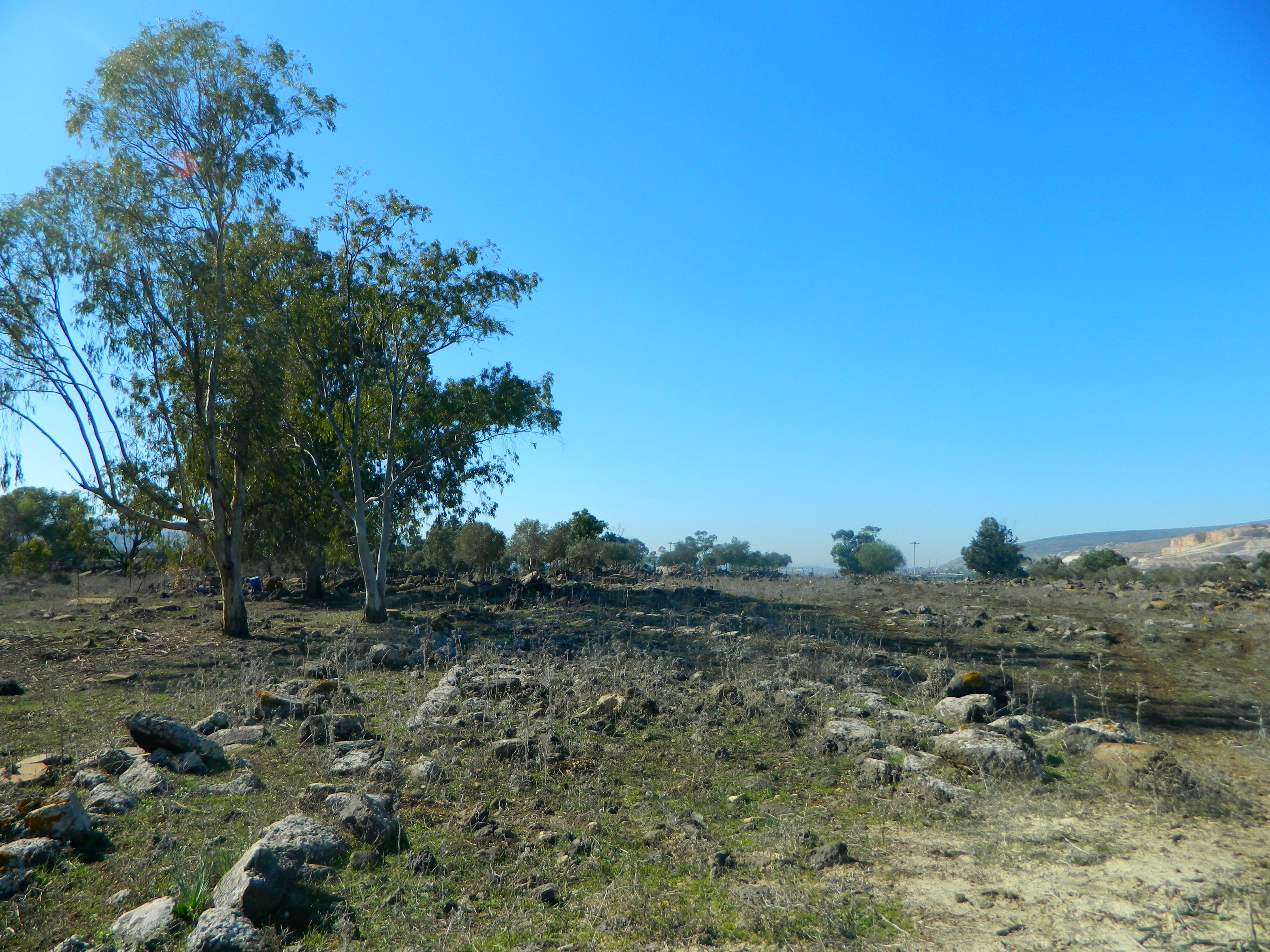
Old Roman road

Old Roman road

Leaving the old road and the Gospel Trail, I returned to the Golani Junction and drove north on Road 65. I passed Mount Nimra on my right and then pulled over, entering a construction site. My next stop was the Amudim ruins which I’ve been meaning to visit for ages. With an authoritative air I parked on the gravel and strode confidently towards the ruins, not waiting for the construction workers to stop me. I entered the fenced-off archaeological site and beheld the Amudim ruins, remains of a 1,800 year old synagogue which serviced the nearby Jewish village.

Amudim ruins

Amudim ruins

Today just one pillar stands tall with many broken pillars, ornate plinths and capitals strewn about in all directions. Even beyond the fenced-off area I caught sight of a fallen pillar laying on the ground amid a great mess of stone chunks. I like to imagine how these ancient synagogues might have looked back in their time and, in this case, I took particular interest in the shape of the standing column. Instead of being traditionally round, this pillar had a concave indention, like a rounded-bottomed heart – and I wonder why the craftsmen specifically carved that fanciful shape.

Interestingly shaped pillars

Interestingly shaped pillars

When I stopped wondering and took my leave of the holy ruins, I paused and admired the Netofa Valley across the road and then hopped into the car to visit the next site on the figurative horizon, the Mimla ruins. Alas, due to roadwork I was unable to reach the site and continued on to the kever (grave) of the prophet Habakuk – which was blocked off as well. And so, deterred but not ready to call it quits, I pressed onward towards Meron…

Hula Valley: Birding Tour

In Galilee, Israel on November 22, 2015 at 5:43 AM

One thing that fascinates me about Israel’s nature is the rich diversity of birds, particularly the Old World raptors – both resident and migratory species. One Friday several weeks ago I seized the opportunity to go on a birding tour in one of the world’s best bird-watching locations, the Hula Valley.

Hula Valley

Hula Valley

Leaving the house shortly after 5am I drove the dark mountain roads heading east and saw the early stages of daybreak just after passing Tzfat. I reached Agamon Hula, a KKL park, and prayed in the parking lot before meeting up with my tour guide, Lior Kislev. A popular birder, Lior’s website has helped me several times with bird identification and it was a joy to meet him at last. We entered the park with a few of the other tour members (including Yedidya Popper, a protégé of Lior who graciously shared photos with me for this post) and, equipped with binoculars, began with the barn swallows resting on electrical wires just outside the visitors centre.

Black kite perched

Black kite perched

Nearly immediately thereafter we were launched into full-scale raptor watching with a whole bunch of greater spotted eagles, black kites, black shouldered kites, marsh harriers and others who were flying about and resting on the side-roll irrigation system frame. We walked along the trail stopping now and then to watch aerial turf battles and the occasional hooded crow mobbing. At one point, while our collective eyes were pointed skywards watching the predatory commotion, I heard a loud squeak at my feet which was identified as a social vole – hide little fella!

White-shouldered kite mobbed by a hooded crow (photo Yedidya Popper)

White-shouldered kite mobbed by a hooded crow (photo Yedidya Popper)

During all this time, and for most of the tour, there was a steady flow of large migrating birds flying overhead including white pelicans, spoonbills (which I was very excited to see) and, of course, common cranes. I had always associated Hula Valley’s migration season with the cranes that are so heavily talked about but with an experienced ornithologist at hand, I came to understand that the cranes were just a very small part in the overall bird-watching experience. We stopped for breakfast at a picnic table, frequently interrupted by raptor activity on the other side of the Jordan River or by warblers (of which we spotted four species) and a beautiful bluethroat or two flitting among the reeds.

Lior Kislev and the tour

Lior Kislev and the tour

In addition to the birds, there were several resident nutrias – an invasive rodent from South America. In terms of migratory species, also the African monarch butterfly makes its way through the Hula Valley and we saw tons of them.

African monarch butterflies (photo Yedidya Popper)

African monarch butterflies (photo Yedidya Popper)

As we walked closer to the bodies of water, someone called out “black francolin” and we watched as the elusive gamebird dashed into the undergrowth. As we walked along the water’s edge we saw a good number of passerines including red-throated pipits, whinchats, larks and some species of the predatory shrikes – a bird that has interested me since childhood. Before long we were able to peer through the reeds at the numerous species of waterfowl and waders including grey and little herons, ibises, coots, moorhens and more.

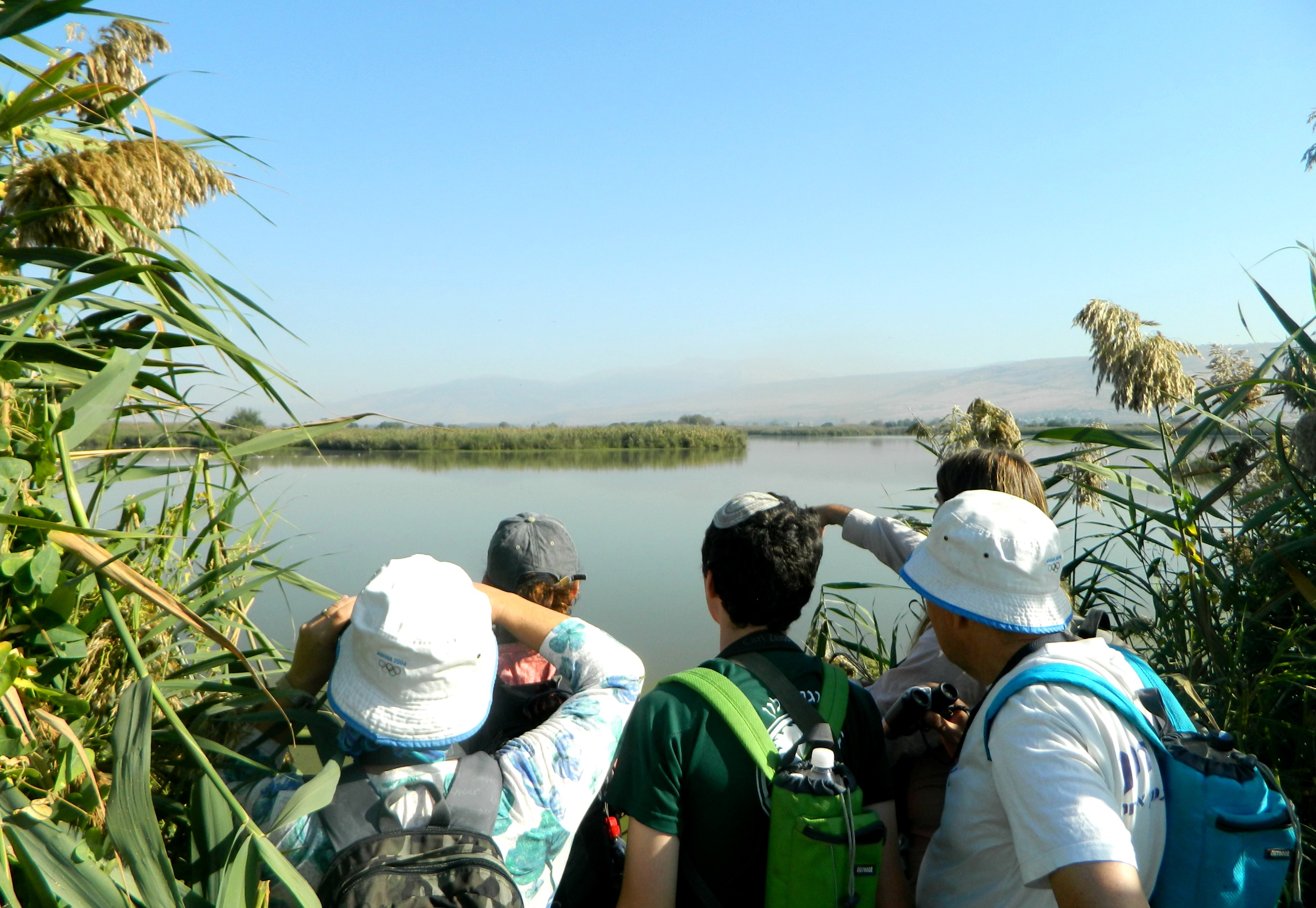
Peering through the rushes

Peering through the rushes

We arrived at the first platformed observatory where we met a Peruvian governor and his wife on a VIP tour of the nature park and then spied on something that excited me immensely – greater flamingos. Even while we watched the cormorants, common snipes, stilts, avocets and more in the shallow waters Lior would frequently direct our attention to the sky where soaring raptors circled overhead. It was during one of these sudden sightings that we saw something uncharacteristic – an immense griffon vulture was visible way out to the east. A bird with incredible range, and truly immense wings (boasting a 2.3–2.8 m (7.5–9.2 ft) wingspan), this particular vulture was likely searching for food over the nearby Golan plateau where they nest (see Gamla).

Lake Agamon observation deck

Lake Agamon observation deck

Reluctantly we left the observatory and continued on, stopping at a grassy area to lay on our backs watching the black storks, black kites and booted eagles wheeling above us while we snacked on fresh almonds and cookies. Along the trail up ahead we found two catfish that had been seized from their watery hole and were mysteriously untouched. We passed caspian turtles and a squacco heron before reaching the observatory most visitors are familiar with. Being as that we wanted to see all that there was to offer, we took the 11-km trail that loops around the lake in its entirety – not the path most traveled.

Booted eagle (photo Lior Kislev)

Booted eagle (photo Lior Kislev)

With one or two water buffalo off in the distance, we watched a small muddy pond packed with mallards, shovelers and common teals; a lone black kite circling ominously nearby. Suddenly the waterfowl exploded into the air, the sound of hundreds of wings beating, and we scoured the area for that black kite – perhaps he had succeeded in nabbing one for lunch.

Pelicans flying overhead

Pelicans flying overhead

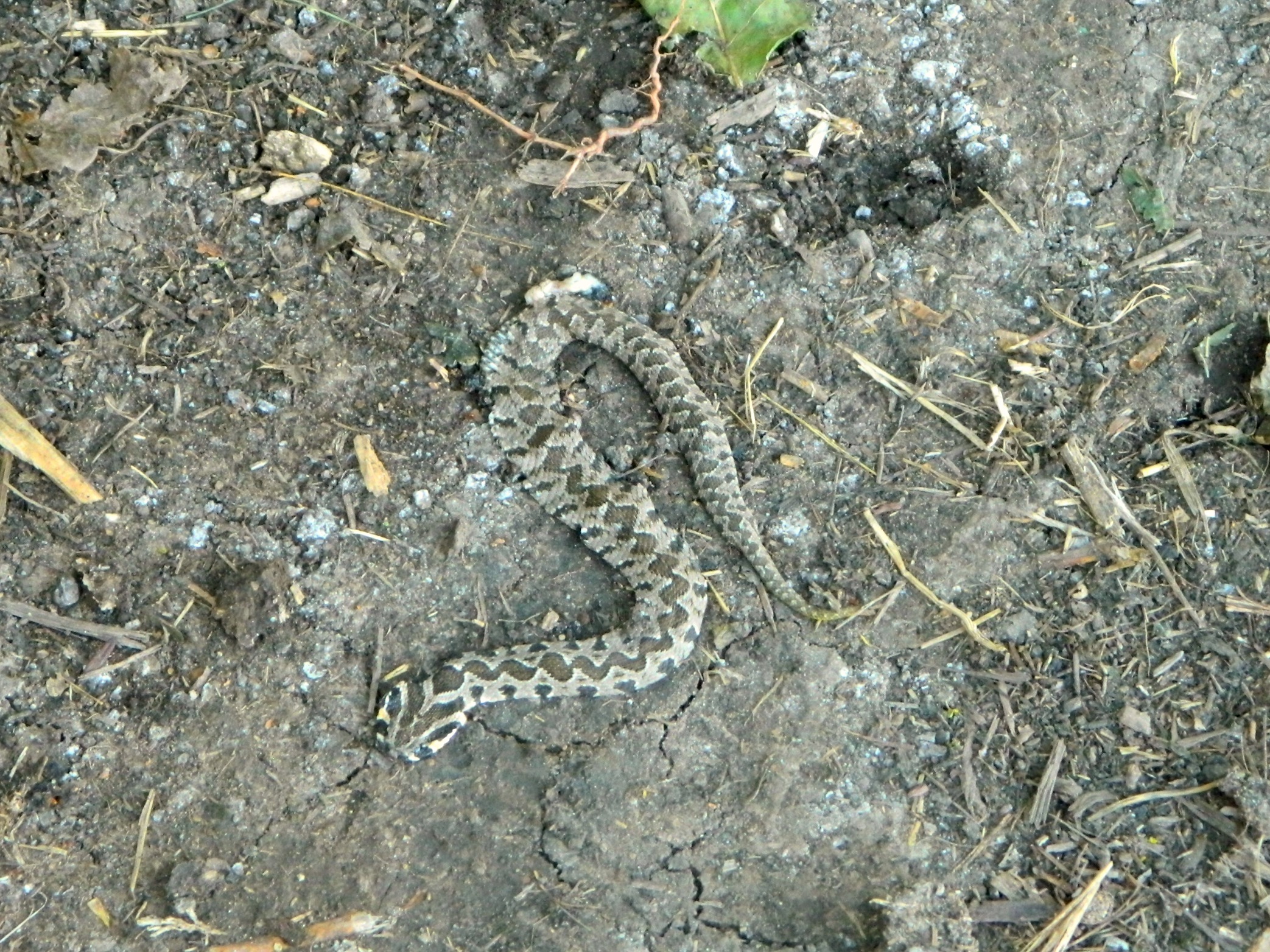
Finally on the home stretch, we walked and talked, pausing to discuss self-combusting peat which was a problem in the park several years ago. Shortly before we reached the visitors centre Lior showed us a dead young viper which looks to have been crushed – I have yet to see a living viper in the wild.

Dead viper

Dead viper

Back at the visitor centre we sat down with pen and paper to make a list of all the birds we had seen that morning. All in all, over the course of five or so hours, we succeeded in spotting 72 species of birds, far more that I would have ever imagined. I highly recommend taking this tour to all those who read this blog – it’s truly a treat!

Belvoir

In Galilee, Israel, Jordan River Valley on November 15, 2015 at 5:39 AM

Finishing off my day trip to the Gilboa and Bet Shean regions was a stopover at Israel’s best-preserved Crusader castle, Belvoir (or Kochav HaYarden, in Hebrew). Located just ten kilometres north of ancient Bet Shean, this Crusader fortress stood on an escarpment overlooking the Jordan River Valley – a seemingly impenetrable bastion. From Road 90, running parallel to the Jordan River, I drove up the single-lane access road that meandered its merry way up the mountainside.

Aerial view of Belvoir looking westward (photo Biblewalks)

Aerial view of Belvoir looking westward (photo: Biblewalks)

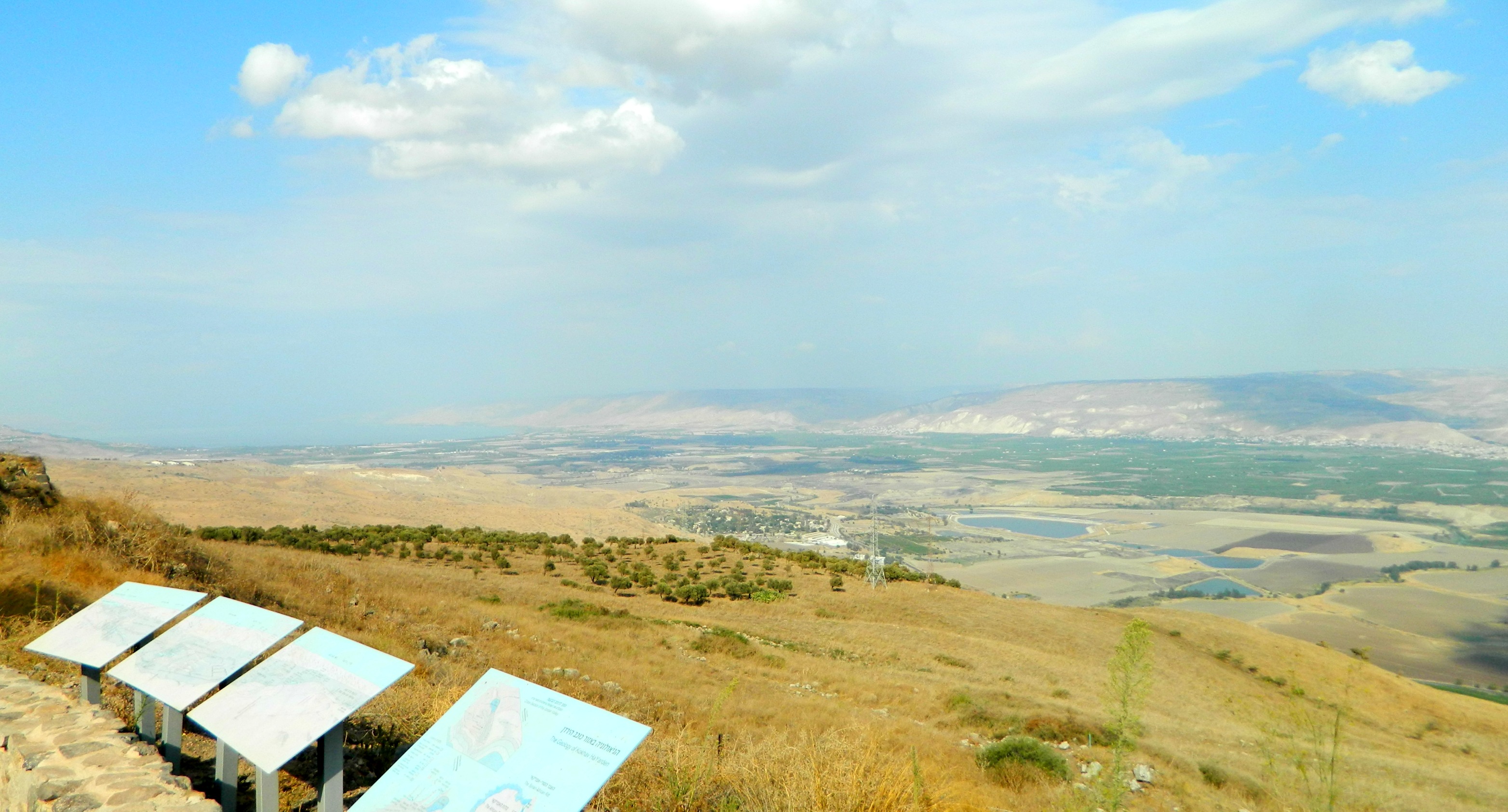
I entered the park and began what I thought would be a circular path to the castle, but I soon reached a closed gate with a view of the low mountains to the north and the seasonal Tavor stream. Turning around, I walked the short direct trail to the bluff’s edge passing a sculpture garden featuring the work of Yigal Tumarkin. The name Belvoir means “beautiful view” in French and they were’t lying when they named the castle – the view is phenomenal.

Lookout over the Jordan River Valley

Lookout over the Jordan River Valley

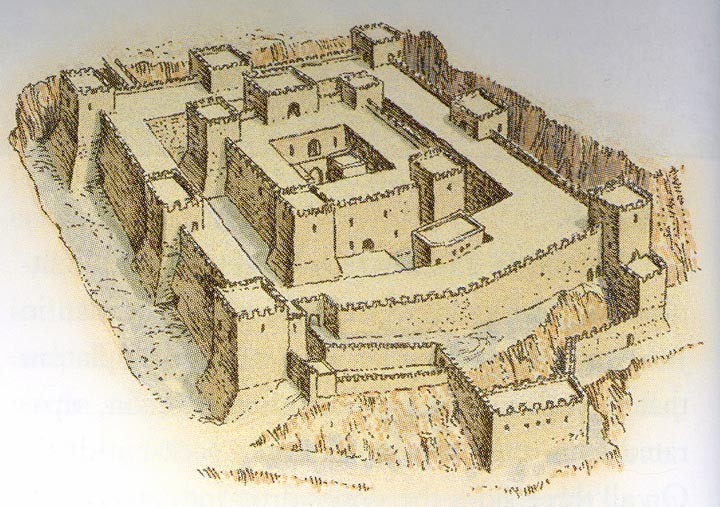
The suggested path for visitors starts at the main gate at the southeastern corner of the castle, leading past the once-heavily fortified barbican (now mostly in ruin). From there the route leads into the outer courtyard passing the corner towers and the cistern where water was stored, being as such there was no spring in the immediate vicinity. One thing that’s particularly beautiful about Belvoir is the symmetry used to build a succession of fortified structures, culminating in the small keep at the western end.

A drawing of what Belvoir might have looked like

A drawing of what Belvoir might have looked like

The history of Belvoir is rather brief beginning in 1140 as a fortified farmhouse owned by the Velos family and sold to the Knights Hospitallers in 1168 who, in turn, built the castle as we know it. In 1182-83 Belvoir was besieged by the Ayyubid sultan Saladin, the bane of the Crusaders, although the siege was a failure. Not intending to give up, Saladin returned with his army in 1187 after defeating the Crusader at the Horns of Hattin and laid siege once again. After two years the sultan’s sappers succeeded in undermining the barbican and the Hospitaller knights negotiated a truce in which they were afforded safe passage to Tyre, in modern day Lebanon. Frightened that the Crusaders would somehow return to occupy Belvoir, Saladin had it partially destroyed. The sultan’s fears were justifiable as the Crusaders did return in 1241 and, upon seeing the ruins, abandoned the castle, leaving it definitely.

Entrance to the keep

Entrance to the keep

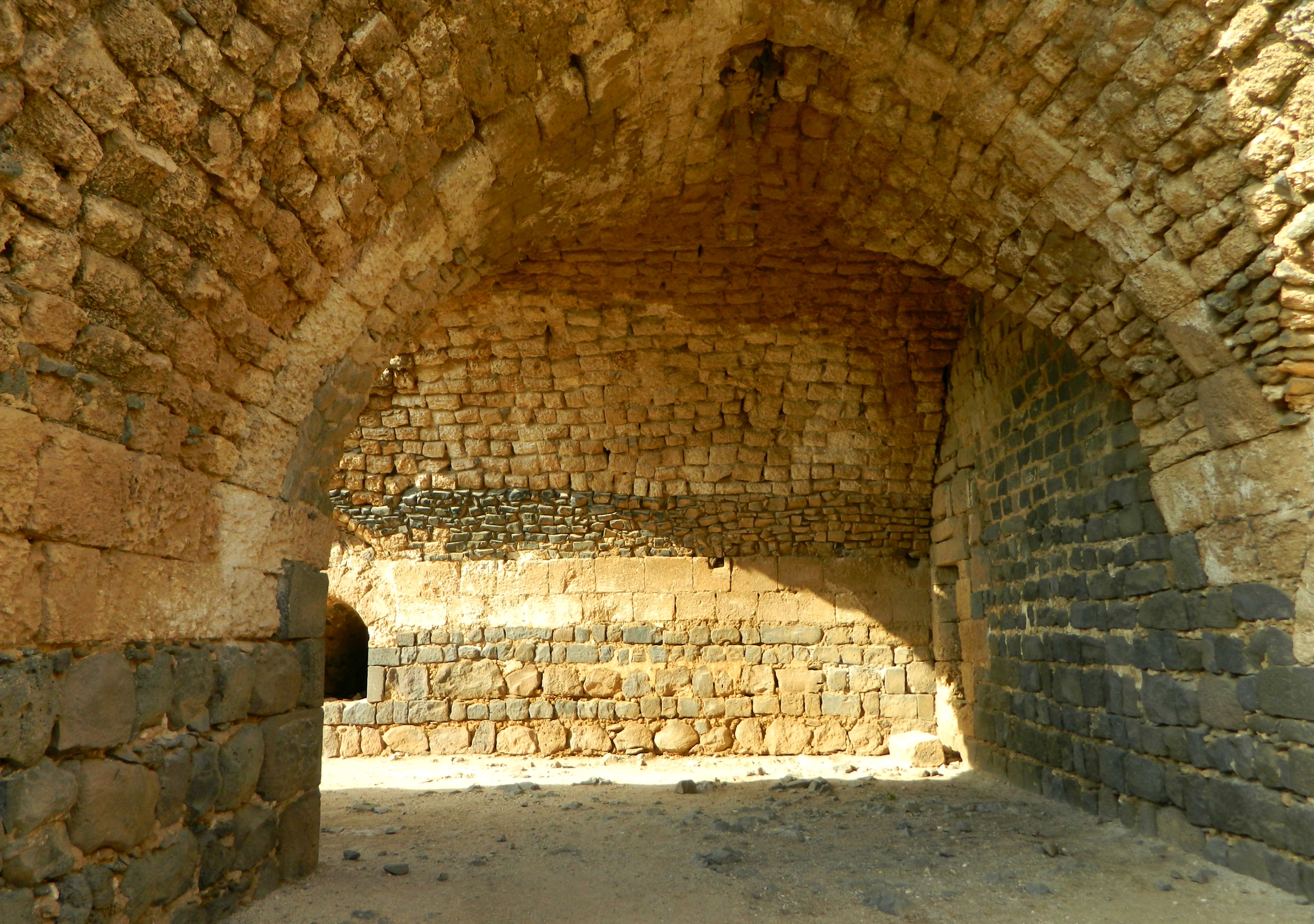
Walking into the inner fortress, I passed through the arched gateways of the keep (also known as a donjon in French). Inside the inner fortress I found the kitchens, dining hall and refectory as well as other smaller courtyards, accented by the four corner towers. The trio of ovens are of a very interesting design and I can almost recreate a scene in my mind where the bland European foods of wild boar and coarse bread were cooked up for the great feast in the nearby dining hall.

Barrel-vaulted dining hall

Barrel-vaulted dining hall

The special laundry basin, also located in the inner fortress, has an interesting lining of broken pottery bits, reminding me of the clay piping in Montfort Castle, the Teutonic Knights’ mountaintop headquarters. Outside the keep is the west gate where a drawbridge once stood, spanning the deep dry moat that was carved out of the basalt mountaintop. Interestingly enough, the castle’s construction was completed with both the local black basalt and a yellow-white limestone that was brought in – in fact there is a carved stone from an ancient synagogue that was recycled in an arched window. Before crossing the drawbridge, I followed the suggested route down a sally port (secret exit) in the southwest corner tower.

Sally port

Sally port

Down in the moat I was able to look up and imagine myself as an invader attempting entry into a seemingly impenetrable behemoth of stacked ashlars.

From within the dry moat

From within the dry moat

I reentered the castle via another sally port located in the central western tower. Crossing over the fixed metal drawbridge, I spotted two chukars (a type of partridge) on the far end of the moat and then headed for a small visitors’ centre of sorts where several curiosities are on display. While researching Belvoir online I came across something magnificent, a Lego reconstruction of the castle created by the lauded Lego castle builder Bob Carney. If you haven’t seen his work, you should definitely check out his site where he has nearly 150 real castles built out of Lego and properly documented (I linked the full Belvoir page in the photo caption below). You can see a stop motion video of Bob’s recreation of the medieval Rhuddlan Castle in Wales on YouTube (HERE).

Lego reconstruction of Belvoir (photo Bob Carney)

Lego reconstruction of Belvoir (photo Bob Carney)

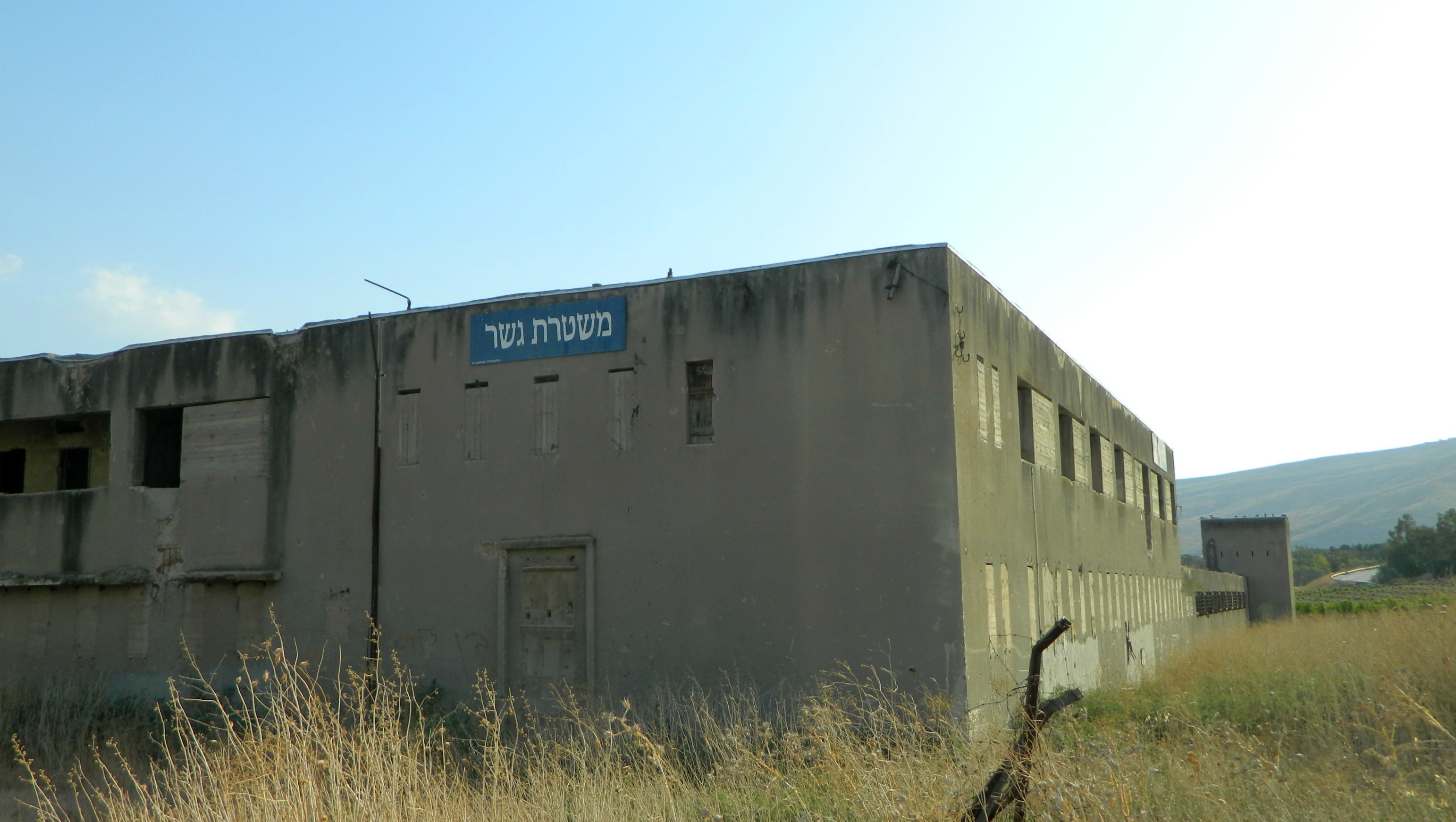
Wrapping up my visit to Belvoir, I drove back down the meandering mountain road, scouring the roadside for gazelles and hyenas (of which I saw neither), until I reached Road 90 once again. I turned north and stopped off at Old Gesher (Naharayim) where I first found an old British police station (yet another Tegart fort) which has since been pockmarked by bullets from a battle between Israeli and Iraqi forces in 1948.

Old Gesher police station

Old Gesher police station

I drove closer to the Jordan River but it was soon apparent that the site was already closed for the day and I would simply have to return another time. Heading back to Road 90 I continued north to my final stop before heading home, Tel Bet Yerach – a remarkable archaeological site which I neglected to mention when covering Jethro’s Cairn, as they both concern the same pagan deity. The tel is located on the southwestern banks of the Kinneret (Sea of Galilee), right at the southern mouth of the Jordan River. Unfortunately I was not completely sure where this site was so I estimated in planning and eventually realised that I was located on a plateau somewhere above it with no easy way down.

View of the Kinneret from above Tel Beit Yerach

View of the Kinneret from above Tel Beit Yerach

So I relented and just took the time to enjoy the view as the sun slowly began to set over my shoulder, content with seeing all that I had succeeded in seeing, but ever eager to explore some more.

Bet Shean

In Galilee, Israel, Jordan River Valley on November 8, 2015 at 7:36 AM

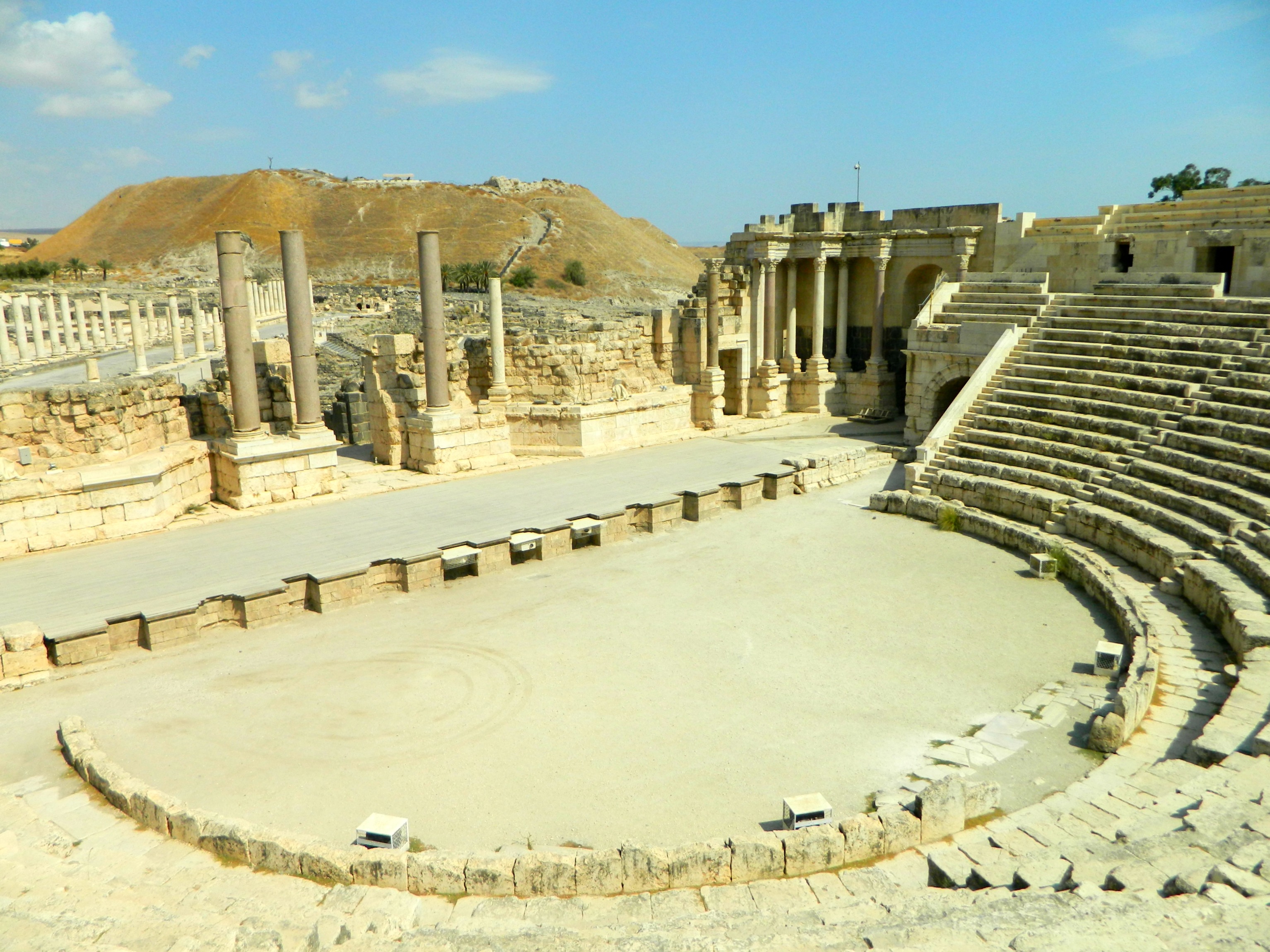
Continuing on with my trip that covered thus far the Gilboa Hot Air Balloon Festival and Beit Shturman and Beit Alpha, I left the base of Mount Gilboa and drove into the city of Bet Shean. I was headed for the national park which holds the ruins of ancient Bet Shean (or Scythopolis, as it was known in Roman times). Entering the park, I was absolutely overwhelmed by the magnitude of the ruins uncovered and on display- how have I taken so long to visit? Having to consult the visitor guide’s map to decipher the endless rows of broken structures, I began with the iconic Roman theatre.

Roman theatre

Roman theatre

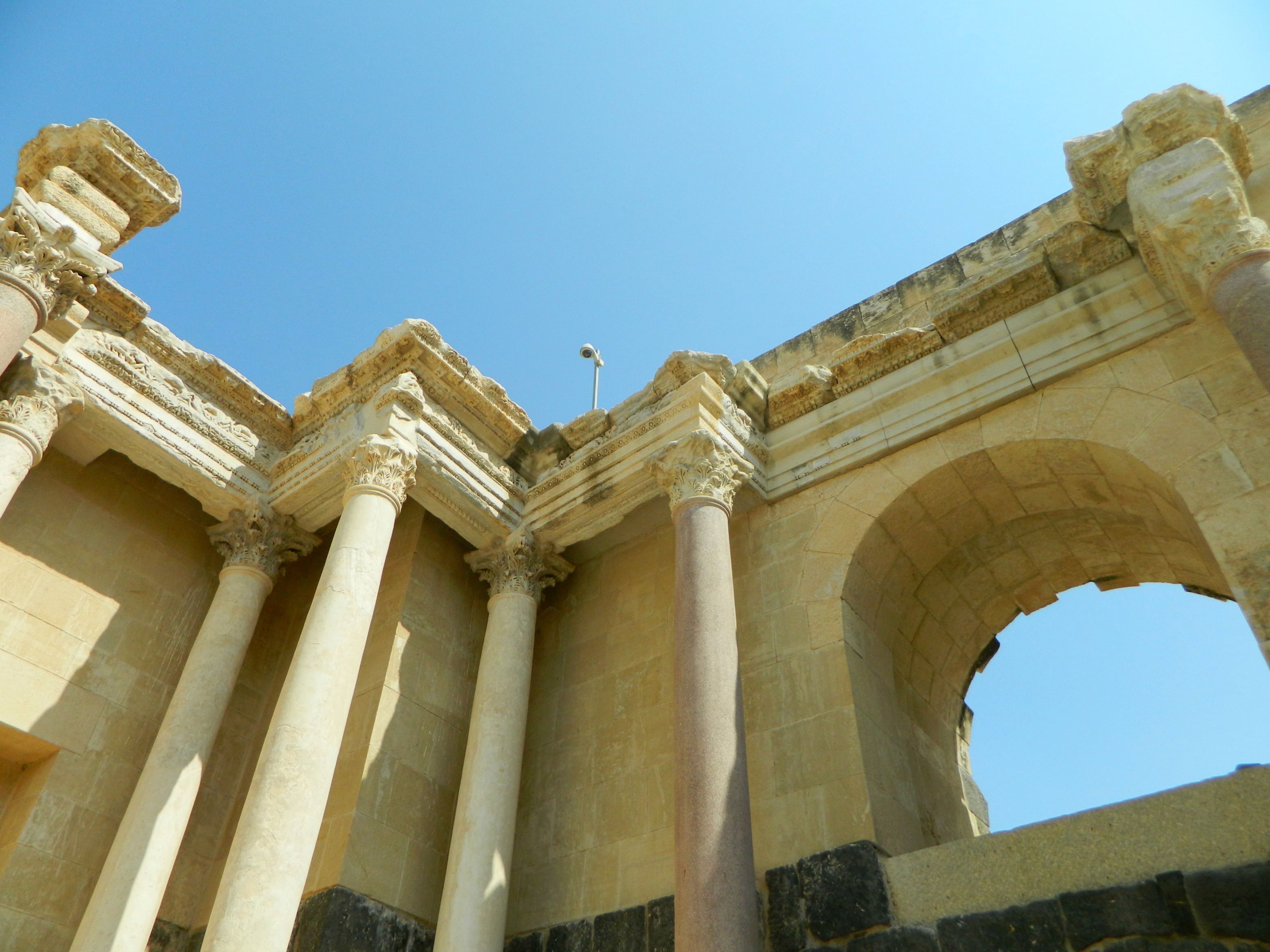
Built to seat some 7,000 spectators, the half circle rows of limestone benches face the stage which, during Roman times, was backed by a twenty metre-high scaenae frons, an elaborately decorated background which usually rose to the height of the ceiling. In the case of this particular ruin, the scaenae frons was mostly destroyed, as well as the upper rows of seats, so renovations are taking place to recreate the theatre to its original glory.

Recreated scaenae frons

Recreated scaenae frons

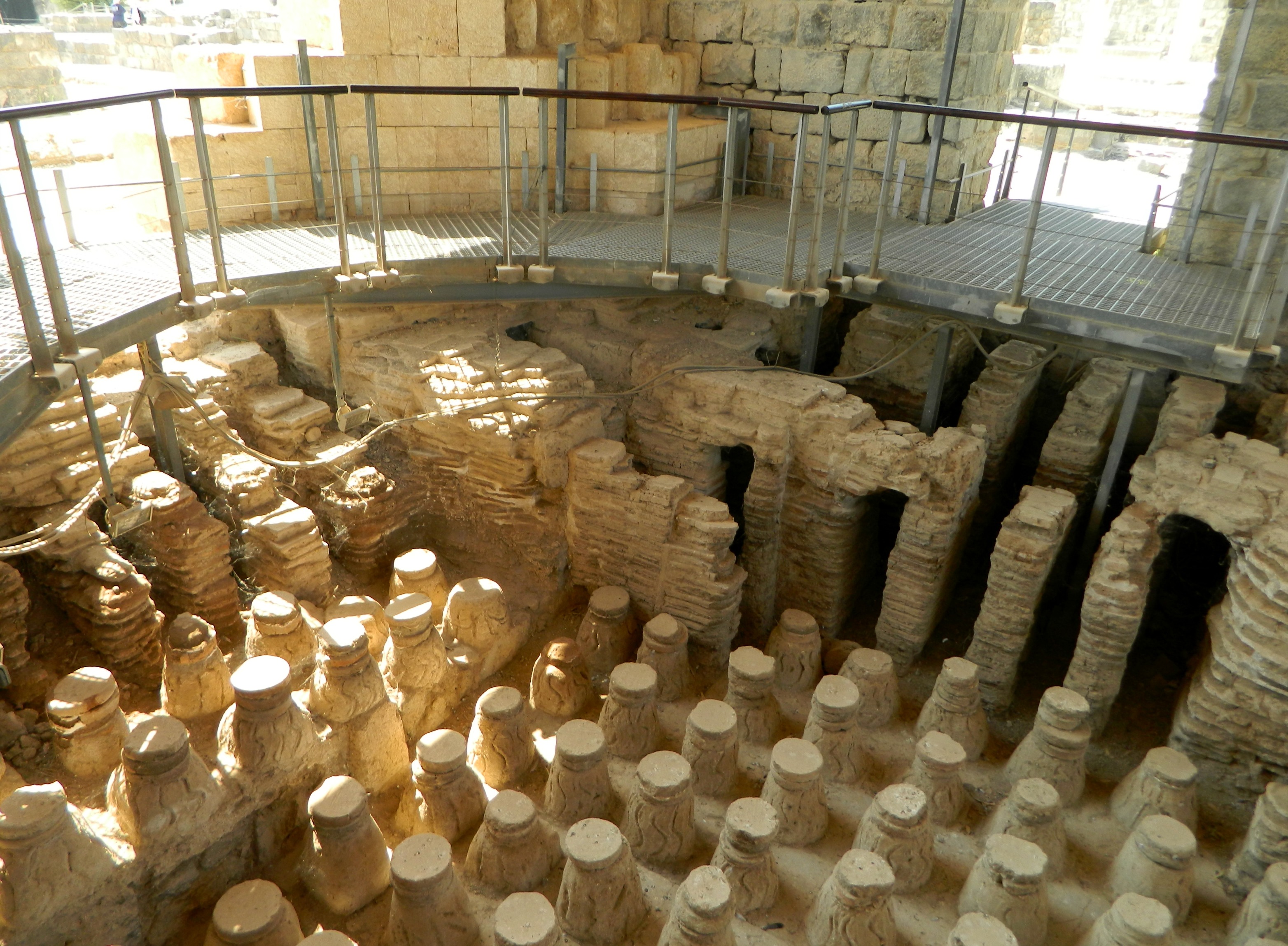
Leaving the theatre, I next explored the vast bathhouse which covers some 9,000 square metres of prime real estate. As in most large Roman cities, the bathhouse was a central public building where citizens would come to exercise, bathe and socialise. One thing that I noticed was the intricate mosaic work even in the large rooms, where simple floor tiles would have been easier. Another thing was the revolutionary hypocaust, an underfloor heating method which warmed the floor and the room itself. I had seen the same construction in a small Byzantine bathhouse outside the mountaintop ruins of Avdat in the Negev, and here the technology was explained in full.

Beneath the bathhouse's floor

Beneath the bathhouse’s floor

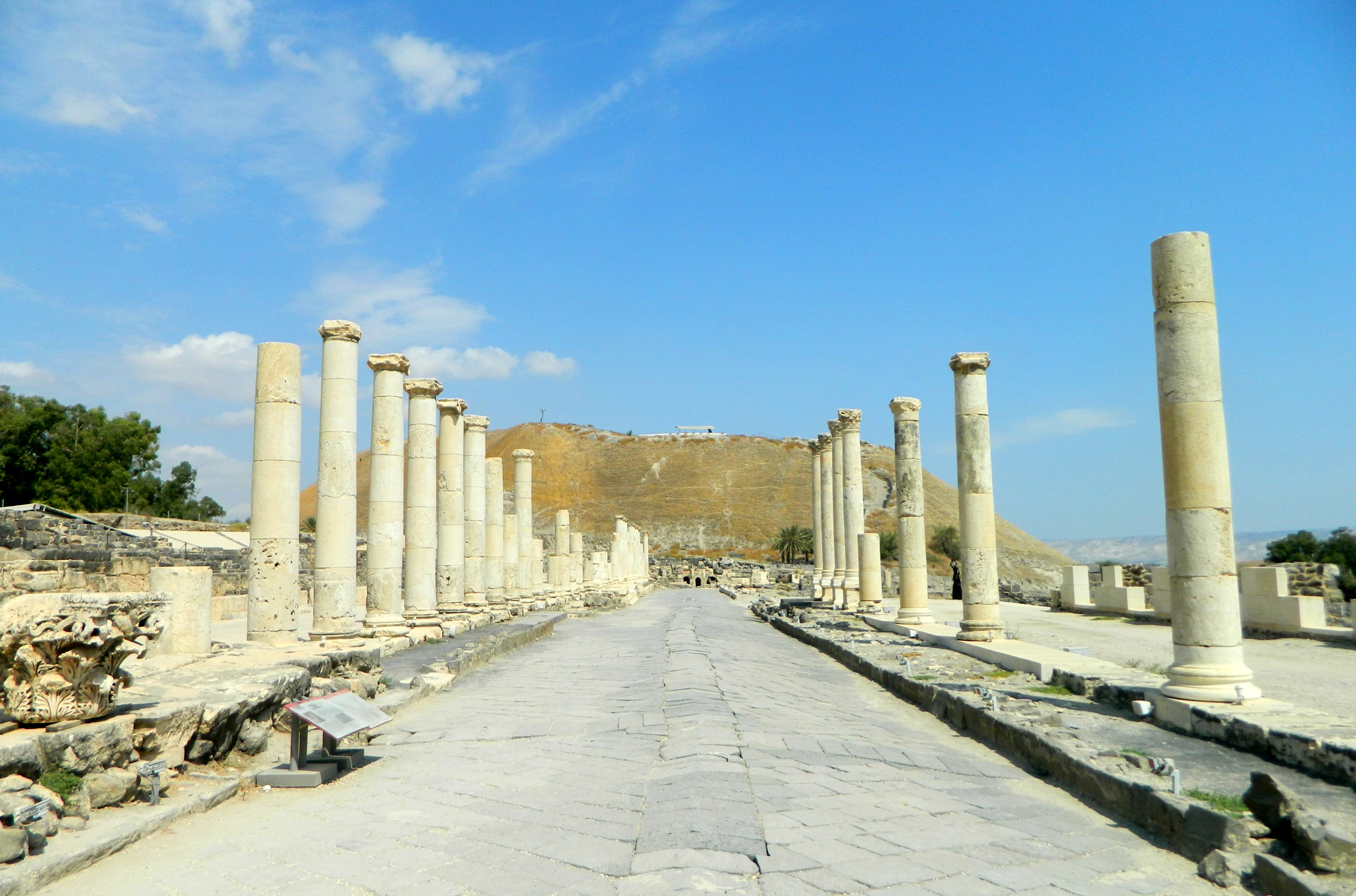
Leaving the bathhouse complex I began my walk down Palladius Street, a colonnaded road of large white columns dividing the bathhouse and “sigma” from the Byzantine agora. I paused to take a look at the sigma, a semicircular concourse lined with small mosaic-floored rooms – including one with a medallion of Tyche, the city’s guardian goddess.

Palladius Street with the tel behind it

Palladius Street with the tel behind it

Crossing the street, I looked at the agora which is relatively unadorned, having served as a commercial centre during those times. Continuing along the main road, I reached the junction between the Northern Street and the continuation of the city’s nucleus to the east. It seems as though the excavators and renovators have given up on the Northern Street, as it is absolutely littered with ancient rubble, including large building chunks and broken pillars. So I focused my attention on identifying the numerous structures before me, including the Roman Temple and Nymphaeum, an ornate public fountain.

Roman city of Bet Shean (Scythopolis)

Roman city of Bet Shean (Scythopolis)

It was about now, standing amid a chaotic collection of crumbled construction, that I realised I had made a grievous error not bringing any water along. The midday summer sun that permeates the valley was starting to dry me out. I wrapped my button-down shirt around my head and shoulders and forced myself to continue onwards. I walked along the Valley Street which leads to the northern end of the city, but I was headed not north, but up. Standing at the base of the tel (archaeological mound), I began my conquest of the harsh yellow hill. The stairs going up were tough indeed, but at the very top was a view that really captured the magnificence of the city sprawl down below.

Looking down on the ruins

Looking down on the ruins

However, it was only the Romans who occupied the ruined area, previous civilisations inhabited the summit of the hill, with their subsequent constructions one atop the other – a stratum of ancient foundations. Nearly as prolific as the glorious tel of Megiddo, some twenty layers have been uncovered at Bet Shean, including those of Jewish rule. It was at a lookout with an audio guide that I found a stout water fountain – the fountain of life for my parched lips. Drinking desperately from the weak flow of warm water, I listened to the tender voice informing me of the place I was kneeling upon, and the surrounding view. Following the trail, I saw a good number of ancient walls from Canaanite and Egyptian occupation, including the Egyptian governor Ramses-Weser-Khepesh’s palace with an uncovered stone lintel depicting him kneeling before his master, Pharaoh Ramses III, in hieroglyphics. If that’s not interesting, I don’t know what is.

The Egyptian governor's palace

The Egyptian governor’s palace

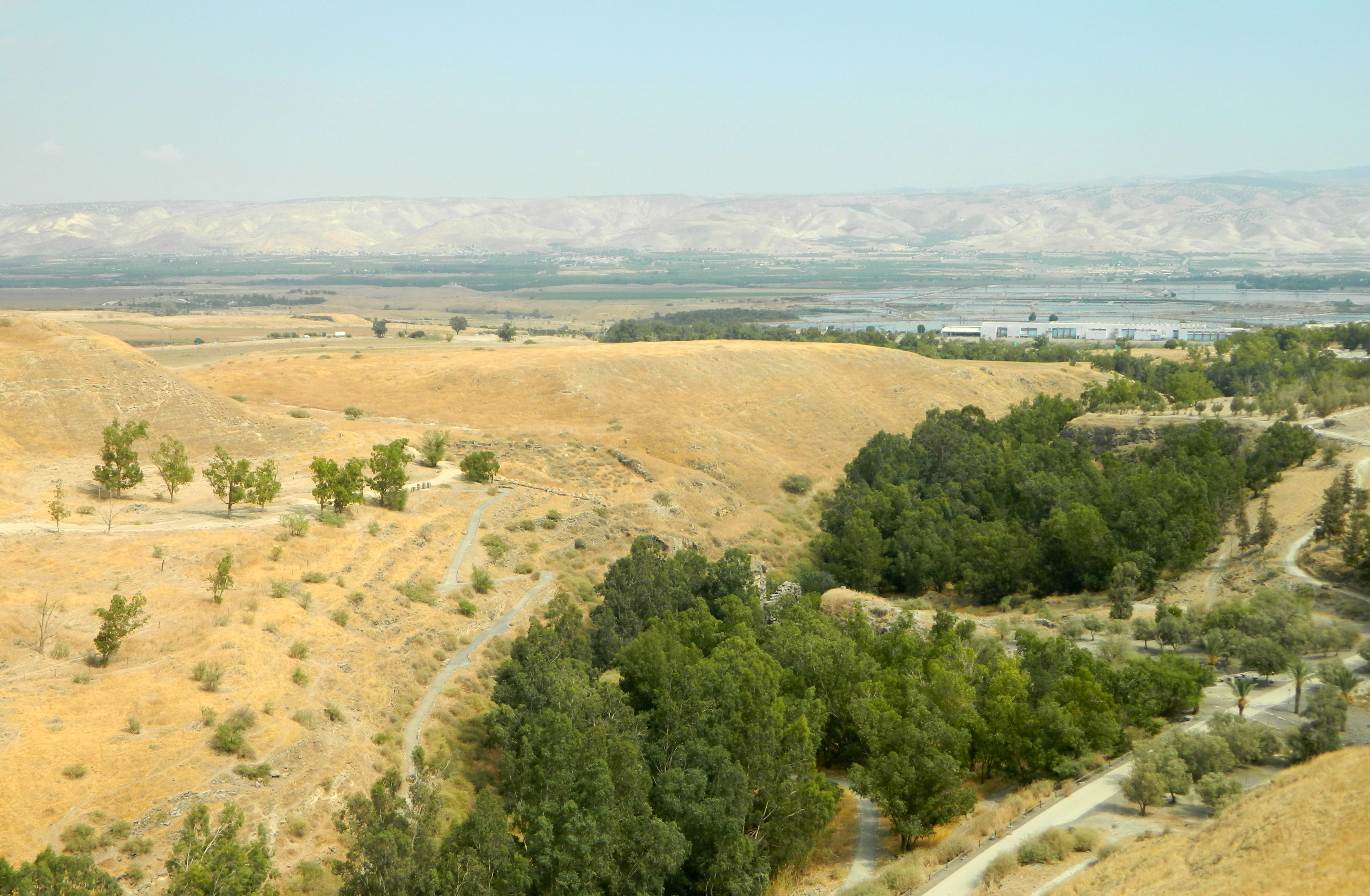
Perhaps of greater interest is the Biblical story of King Shaul, when he and his sons were killed in battle with the Philistines at nearby Mount Gilboa, and were brought to Bet Shean to dangle from the city walls as trophies. On a lighter note, to the north of the tel is Nachal Harod and the churning water can be both seen and heard way down below. A ruined Roman bridge is also visible, as well as the ruins of several Byzantine churches on the opposing hillside.

Nachal Harod with the Roman bridge and Jordan beyond

Nachal Harod with the Roman bridge and Jordan beyond

Passing the numerous excavated temples, fortresses and various buildings, I came to a lone skeleton of a tree, supported by rusted metal against the stark stone ground. It reminded me of a particularly absurd play/film called Waiting for Godot, which I was made to watch in high school.

Ruins of thousands of years upon the tel

Ruins of thousands of years upon the tel

Trotting back down the hill, I swung eastward, walking down Silvanus Street which is similarly colonnaded. When the street ended and a dirt path began, I passed another bathhouse and then public lavatories that serviced the theatre and bathhouse visitors. Just beyond that I found a cultic compound with an assortments of altars and similar structures amid a temple. I then re-entered the magnificent theatre where I began my tour of the ancient city and made my way back up to the visitor centre to watch a short film about the city in general in the comfort of shade and strong air-conditioning. Without too much time to lose, I decided to skip the Roman amphitheatre (oval as opposed to the mostly circular theatre) and the nearby Crusader/Ottoman fortress and other Ottoman buildings, uncharacteristic as that may be.

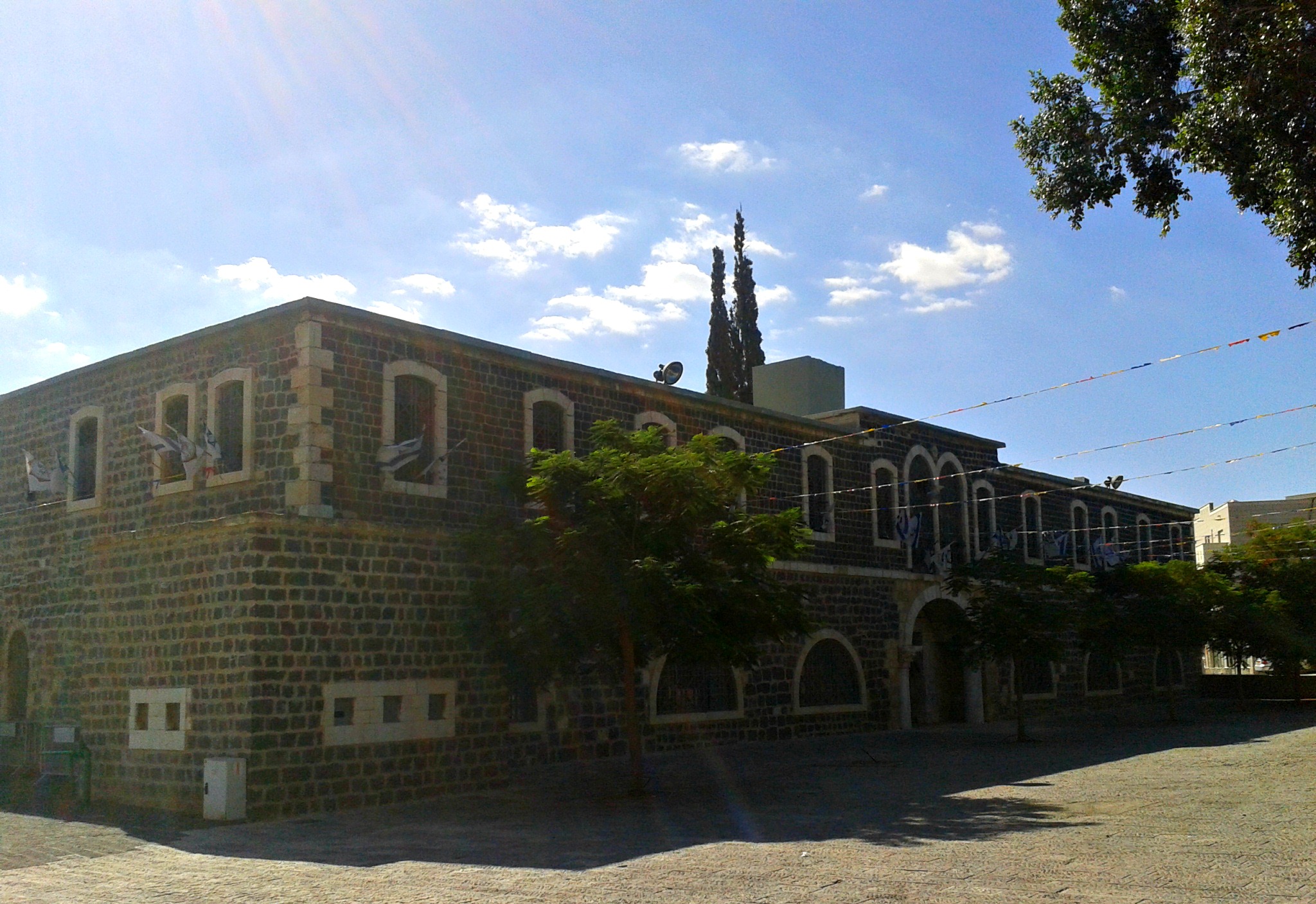
Basalt Ottoman building

Basalt Ottoman building

I had stumbled upon the fortress two years ago while driving through the city with my army truck and didn’t see anything of extreme interest. Plus, time was not on my side and I still had a few more places I wanted to visit including the Crusader castle of Belvoir just a few kilometres northward.

Beit Shturman & Beit Alpha

In Galilee, Israel on October 25, 2015 at 6:22 AM

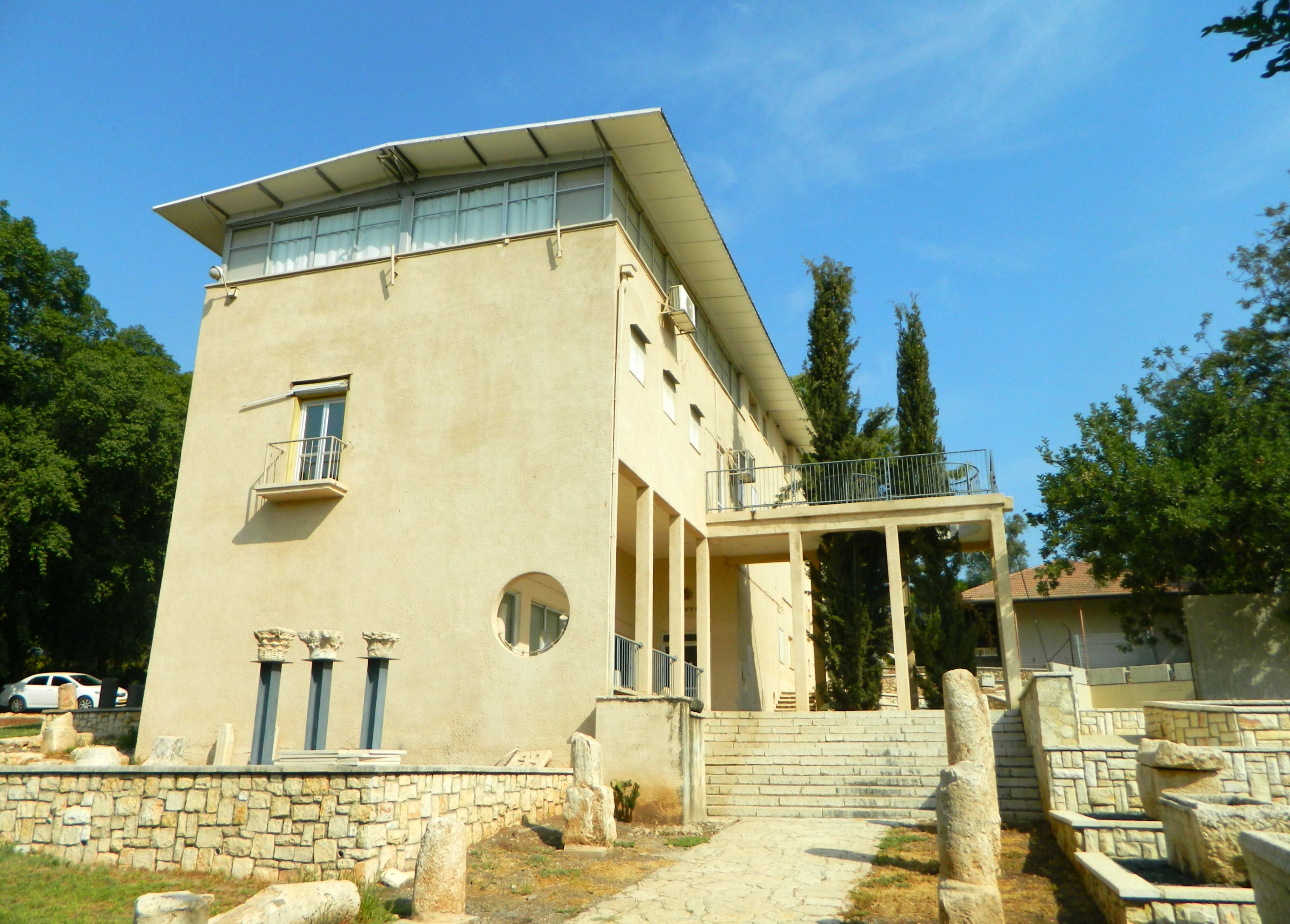
Continuing on with my trip that started on Mount Gilboa where I watched the dawn launch of the Gilboa Hot Air Balloon Festival, I had visited Tel Yizrael and was headed for my next site, Beit Shturman. Located in Kibbutz Ein Harod (of which there are two, side-by-side), Beit Shturman is a museum dedicated towards preserving the wildlife and archaeological remains of Israel. Built in 1941, the museum was one of the very first to be established in to what has become a country full of museums and art galleries, so much so that Israel is the country with the most museums per capita in the entire world.

Beit Shturman

Beit Shturman

I parked outside a school and sauntered over to the museum, the front door opening as a museum administrator greeted me by name. My visit began with a short film dedicated to the history of the museum, and more importantly, the personal history of the Shturman family. Named after Chaim Shturman, who was tragically killed by a land mine, the museum hopes to be a living reminder of the things that Chaim held dear as an important member of the settlement projects in the Holy Land. Subsequent members of his family also lost their lives fighting for the same cause and the museum renewed their dedication with each loss.

Mold art

Mold art

I then began my tour of the building with a quick look at the small art gallery, where I found something quite unique. I’m not one for modern art, but I found this particular piece to be compelling: a circular display of mold that had grown on a mixture of black coffee and sugar. Heading into the next room, I feasted my eyes on the myriad of stuffed birds, mammals and more – a taxidermist’s dream. I found the collection of stuffed raptors to be most interesting as it gave me a little further information on all the Old World birds of prey that I know too little about. The jars of preserved human and animal fetuses and embryos were a bit much, but the stuffed hyena reinvigorated me, as I had seen only a mere glimpse of one in the wild. I then learned something interesting about the teeth of the nutria (or coypu, an invasive species from South America) which will continue to grow unchecked if the opposing tooth is broken or extracted.

Nutria tooth trivia

Nutria tooth trivia

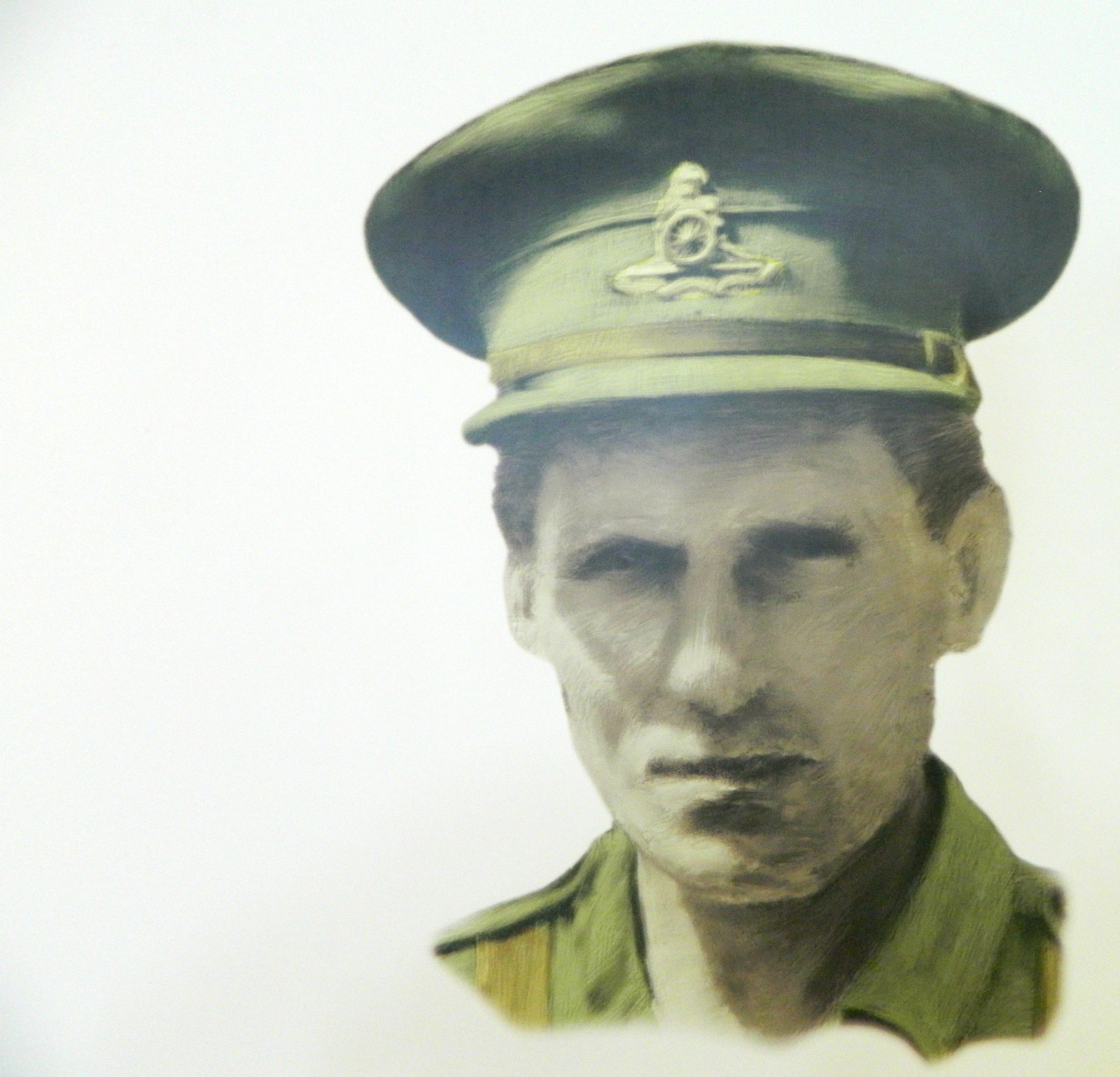
Leaving the room of animal wonders, I headed into the exhibition of Orde Charles Wingate, “The Friend”. Without delving too far into pre-Independence history, Wingate was a British officer who, upon reading the Bible, took great interest in helping the Jewish pioneers in their struggle for freedom. In 1938, Wingate established the Special Night Squads that were composed of both British soldiers and Jewish “notrim” or Auxiliary Police who were then trained as mobile ambush units. As the time went on, Wingate would fill his ranks with an increasing percentage of Jewish soldiers and his actions, controversial yet successful, began to show to his superiors in the field and back in London. There was a change of policy towards the Jews in 1939 and the SNS was disbanded, with Wingate being transferred to Burma. The success of the SNS left a deep mark in the Jewish pioneers and the unit itself has been thought of as a forerunner to the elite British SAS that we know of today.

Orde Charles Wingate

Orde Charles Wingate

Leaving the building, I walked the archaeological garden outside, stocked with pillars, presses, sarcophagi and more, all temporarily unlabeled due to renovations. Bidding farewell to the helpful guides, I took a quick look at the kibbutz’s derelict Founders’ Courtyard with the scattered farm tools and equipment which helped create the kibbutz, and then headed for my next destination: Beit Alpha.

Founders' Courtyard

Founders’ Courtyard

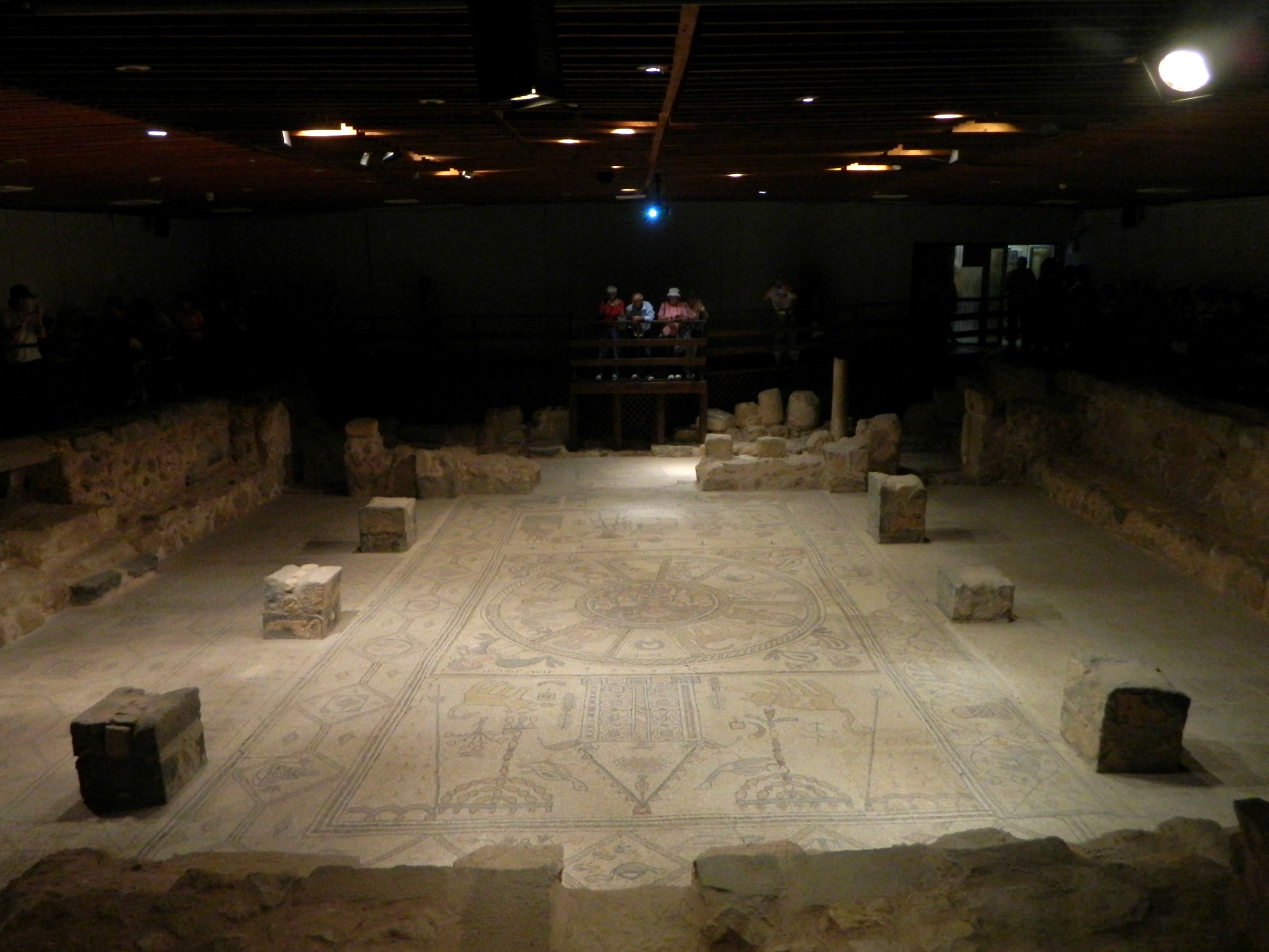
Perhaps the smallest national park, Beit Alpha is only one large room with a reception/gift shop and outdoor covered courtyard. But it’s the contents of that one room that gives the site its importance – the excavation of a 1,500 year old synagogue.

Beit Alpha Synagogue mosaic floor

Beit Alpha Synagogue mosaic floor

Notably the first Jewish excavation held in modern times, the synagogue was discovered by members of the Beit Alpha and Hefzi-Ba kibbutzim in 1928. Unearthing was done the following year and the elaborate mosaic floors uncovered are known to be among the most beautiful and best preserved in the country. Prior to seeing the whole floor bathed in light, a video is played with actors recreating the scene of what could possibly have been the thought process behind the synagogue’s design. As several of the mosaic details seem “off”, it is believed that sections or designs were simply copied from the ancient synagogues of nearby Tiberias, which was a centre of Judaism at the time.

Artist's imagination of the Beit Alpha Synagogue building

Artist’s imagination of the Beit Alpha Synagogue building

The artists who created the Beit Alpha mosaics, Marianos and his son Hanina, were also listed as the ones creating mosaics in neighbouring Bet Shean, which is logical as mosaic floors were all the rage during the late Roman periods. Even seemingly idolatrous constructions of Greco-Roman gods, such as Helios seen here in the centre of the zodiac, were also seen as something acceptable and perhaps even beautiful from a cultural point of view. With the different areas being illuminated by spotlight throughout the video, in-depth explanations of iconographic significance were afforded to the modern spectator. When the show was over, the lights went on and I took a full loop around the room, taking photographs from various angles.

Closer look at the mosaic

Closer look at the mosaic

With a new group entering to watch the video anew, I headed out and glanced over the information outside concerning ancient synagogues in northern Israel, predominately found in the eastern Galilee and the western Golan. Having eaten my lunch in the national park’s sukkah, I got back in the car and drove off to my next destination: Bet Shean.

Gilboa Hot Air Balloon Festival

In Galilee, Israel, Jordan River Valley on October 18, 2015 at 4:23 AM

Harkening back to Chol HaMoed of Sukkot, this blog post retells my trip to the Gilboa and Bet Shean regions. I left the house at a peppy 4:45am and drove down the dark mountain roads, through Druze villages and eventually out into the Harod valley. I drove up Mount Gilboa from the west and reached an outcropping known as Mount Shaul where I found an assortment of parked cars – apparently I wasn’t the only one with this idea.

Sunrise on Mount Gilboa

Sunrise on Mount Gilboa

What I had come to do so early in the morning was to watch the dawn launch of the International Balloon Festival which is held in two very different locations every year – the Gilboa area and the Negev. I walked through the pine tree forest on Mount Shaul, passing small plaques with biblical verses commemorating the fateful battle between King Shaul and the Philistines, which culminated in Shaul’s suicide as well as the death of three of his sons. At the eastern side of the ridge, I watched the beautiful sunrise over the valley and Jordan beyond, as can be seen in the above photo.

The crowds are waiting

The crowds are waiting

Following a path, I then walked westward until I reached the lookout where the crowds were already staking claims for the best view of the balloon launch. Far below, nearly out of sight due to the trees, the international group of aeronauts were filling up their hollow crafts with good hot air.

Gilboa Hot Air Balloon Festival

Gilboa Hot Air Balloon Festival

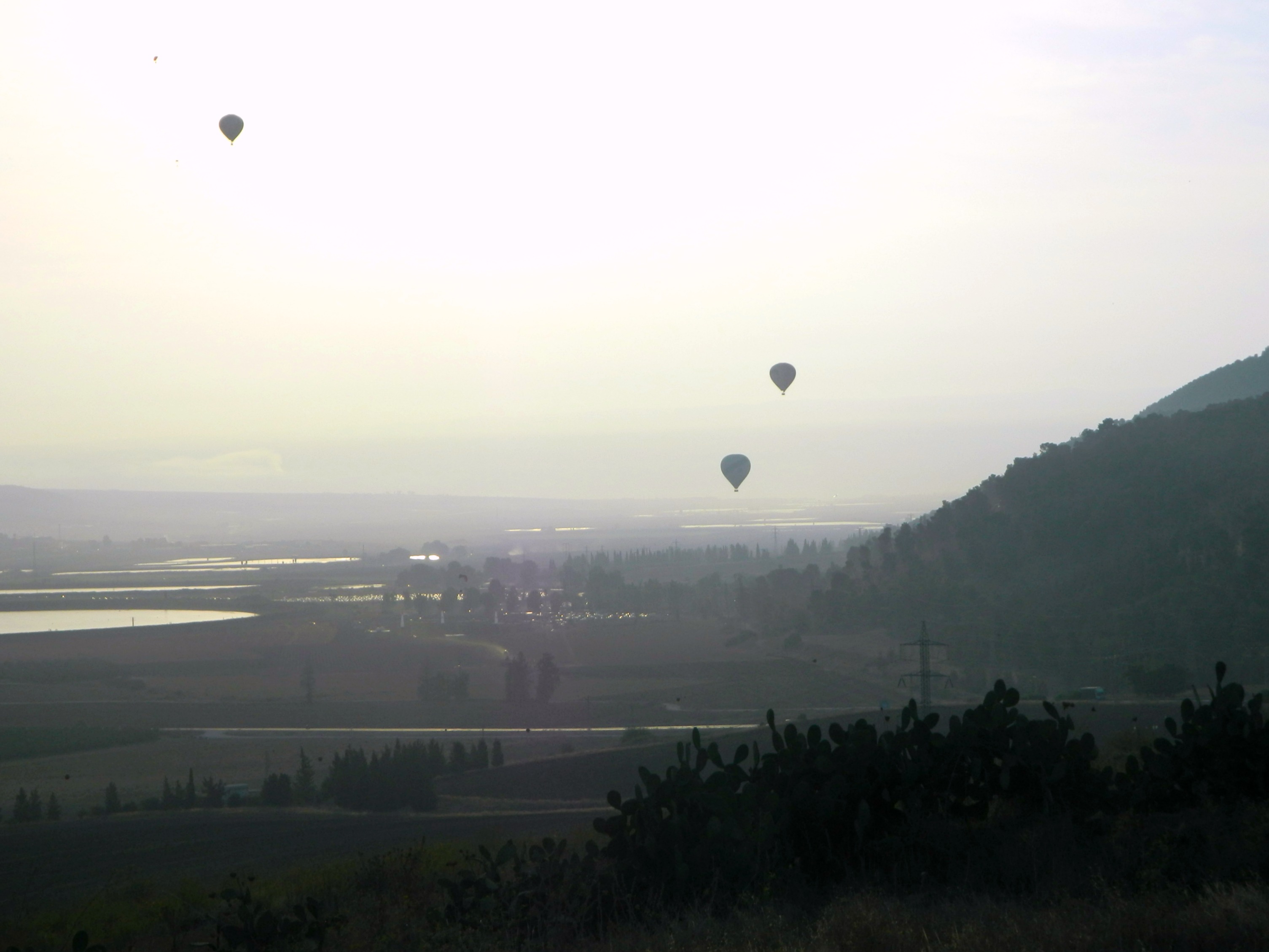
The first to take flight was a blue balloon of standard shape, but the next made the spectating children glee with adoration – a frog with a golden crown on its head rose into the clear morning sky.

Whimsical frog king balloon

Whimsical frog king balloon

Several others, both traditional and whimsical, soon took flight, including a white human head, an ice cream cone and a baby chick emerging from its shell. Interestingly enough, the rock I chose as my vantage point was right next to a man stretched out on a blanket playing with his children, and this man turned out to be a reservist officer I had worked with in the army – small world! I stayed for a bit longer watching the different balloons rise and fall and then decided it was time to move on to my next location. As I drove back down woodsy Mount Gilboa, I spotted the balloons from a southern angle, but the pictures didn’t come out nearly as scenic. At the bottom of the mountain I turned westward, heading for a site I’ve been meaning to visit ever since my army years – Tel Yizrael.

The balloons from Tel Yizrael

The balloons from Tel Yizrael

Located at the eastern end of the Jezreel Valley (the same name Latinised), the tel was once a major Jewish city and over the years saw the standard lineup of Holy Land invaders including the Assyrians, Romans, Byzantines, Crusaders and Ottomans. Due to the tall dry grass and the self-imposed time constraints, I only explored the eastern, northern and western sides of the tel, which is unfortunate because most of the excavations were done on the southern side. But I did see a handful of building remains and ancient water cisterns, as well as this khan from the Ottoman period.

Ottoman khan on Tel Yizrael

Ottoman khan on Tel Yizrael

Leaving Tel Yizrael I headed to the next site on my list: Beit Shturman in the nearby Kibbutz Ein Harod.

Rabin Centre & Ben Gurion House

In Israel, Tel Aviv on October 11, 2015 at 4:25 AM

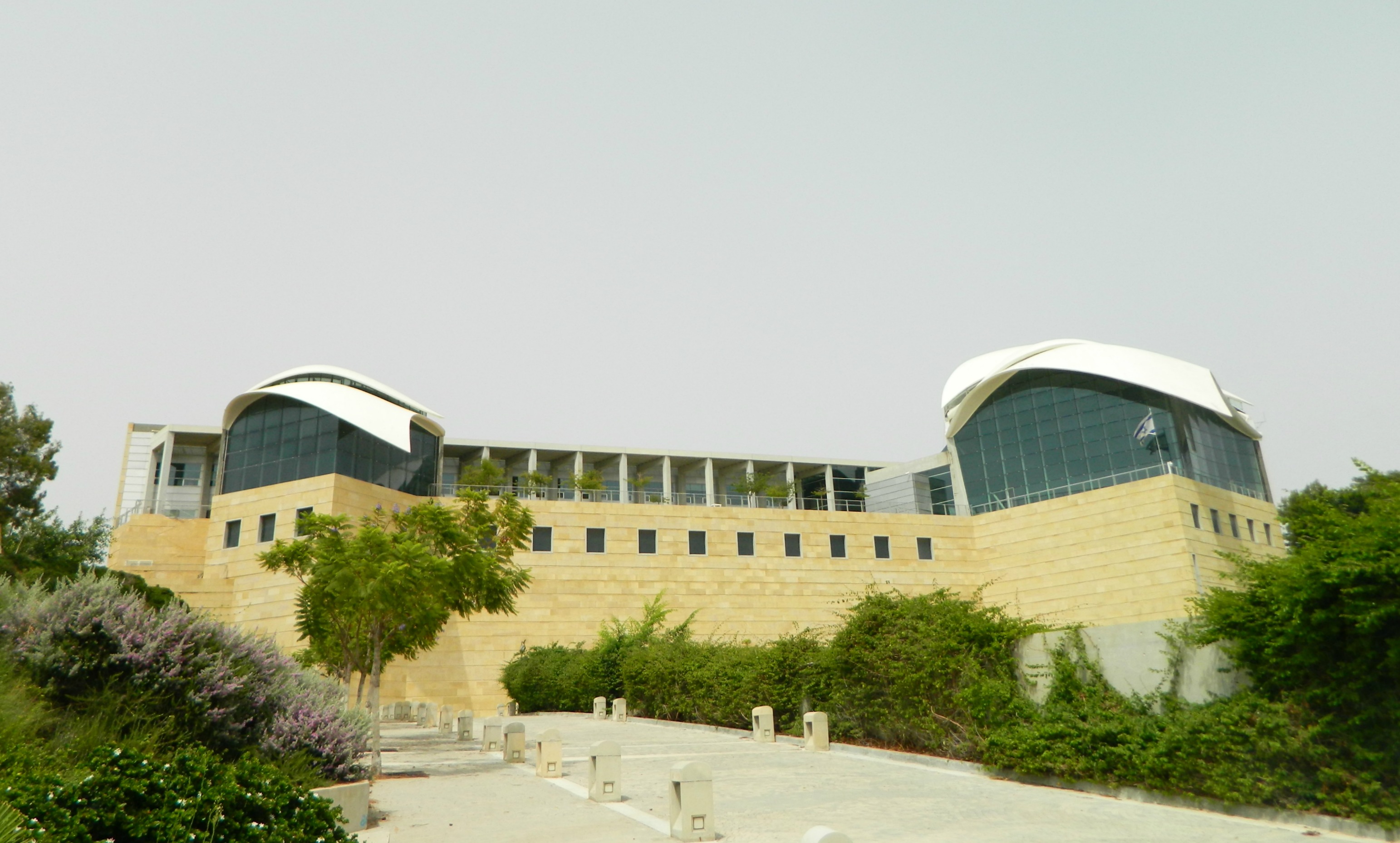
To finish off my quartet of Tel Avivian blog posts is this two-part trip to two sites lauding past prime ministers. The first one being Rabin Centre, just outside of Tel Aviv University’s train station, which I took the opportunity to visit on my to the Yarkon Park.

The Yitzhak Rabin Centre

The Yitzhak Rabin Centre

Inside the large centre filled with libraries, conference centres and more is a museum dedicated to the life and death of Prime Minister Yitzhak Rabin. Starting off with sombre video footage from the night of his assassination, poignantly portrayed in a large dark room, the exhibition then opened up to a chronological timeline of Rabin’s life.

Timeline of Rabin's life

Timeline of Rabin’s life

From childhood to his role in the Palmach, from his appointment of Chief of Staff in 1964 to his inauguration as prime minister in 1974 – the exhibit showed it all. Complete with numerous videos scattered throughout the timeline replaying historical footage, I will admit finding frustration keeping my sensor-triggered headset playing the right audio at the right time. A nice assortment of personal items were on display at increments, including various forms of identification, military paraphernalia and even the blood-stain paper he had in his pocket when he was assassinated, after a rally supporting the Oslo Accords. His living room, left exactly as it was the night of his death, was transferred to the museum, replaying the same soccer match he watched.

Rabin's living room

Rabin’s living room

After the lengthy timeline there was a whole slew of pictures, both family- and career-oriented. At the very end of the exhibition is a memorial room with electric candles and then a graffiti wall for guests to write on, sharing their sentiments. Looking into the whole matter of Rabin’s assassination, there seems to be quite a large number of irregularities and suspicious moments, particularly in the lone video recording of the event – known as the Kempler Video (see HERE on YouTube). I tend to take both official statements and conspiracy theories with a grain of salt, so I’ll let you be the judge for yourself. Outside the museum I found another exhibition dedicated to Operation Entebbe, the rescue mission of 106 hostages held in the Entebbe Airport in Uganda performed by Israeli commandos in 1976. Showcased are the behind-the-scenes of the top secret operation, formulated in the course of one day, as well as other thematic presentations. What I found most interesting was the short film about the hijacking of Air France Flight 139 and the subsequent rescue operation, as narrated by one of the mission’s commandos – the point man to enter the hostage room. The film is called Cohen on the Bridge: Rescue at Entebbe and the animation style reminded me a lot of a French film called Renaissance, I highly recommend it.

Cohen on the Bridge film

Cohen on the Bridge film

Outside the exhibit, parked on a balcony of sorts, is the black Mercedes Benz used in the operation to mimic a visit by Ugandan dictator Idi Amin.

Not Idi Amin's Mercedes

Not Idi Amin’s Mercedes

When I was done with those two museums, and after looking at a small photographic art gallery upstairs, I was ready to leave. I took some quick photograph of the view of Tel Aviv and the Yarkon Park in the foreground and then made my way to the port area to walk the length of the park.

Tel Aviv skyline

Tel Aviv skyline

The next day, after completing my exams, I headed over to a kosher branch of Aldo, eager to at last taste one of Israel’s premier ice creams. That particular day was unworldly dusty and turned into a sandstorm that lasted several days, even obscuring Israel from NASA’s satellites. All of the photos from that day have a weird orange-yellow tint to them due to the heavy saturation of sand in the air.

Aldo ice cream

Aldo ice cream

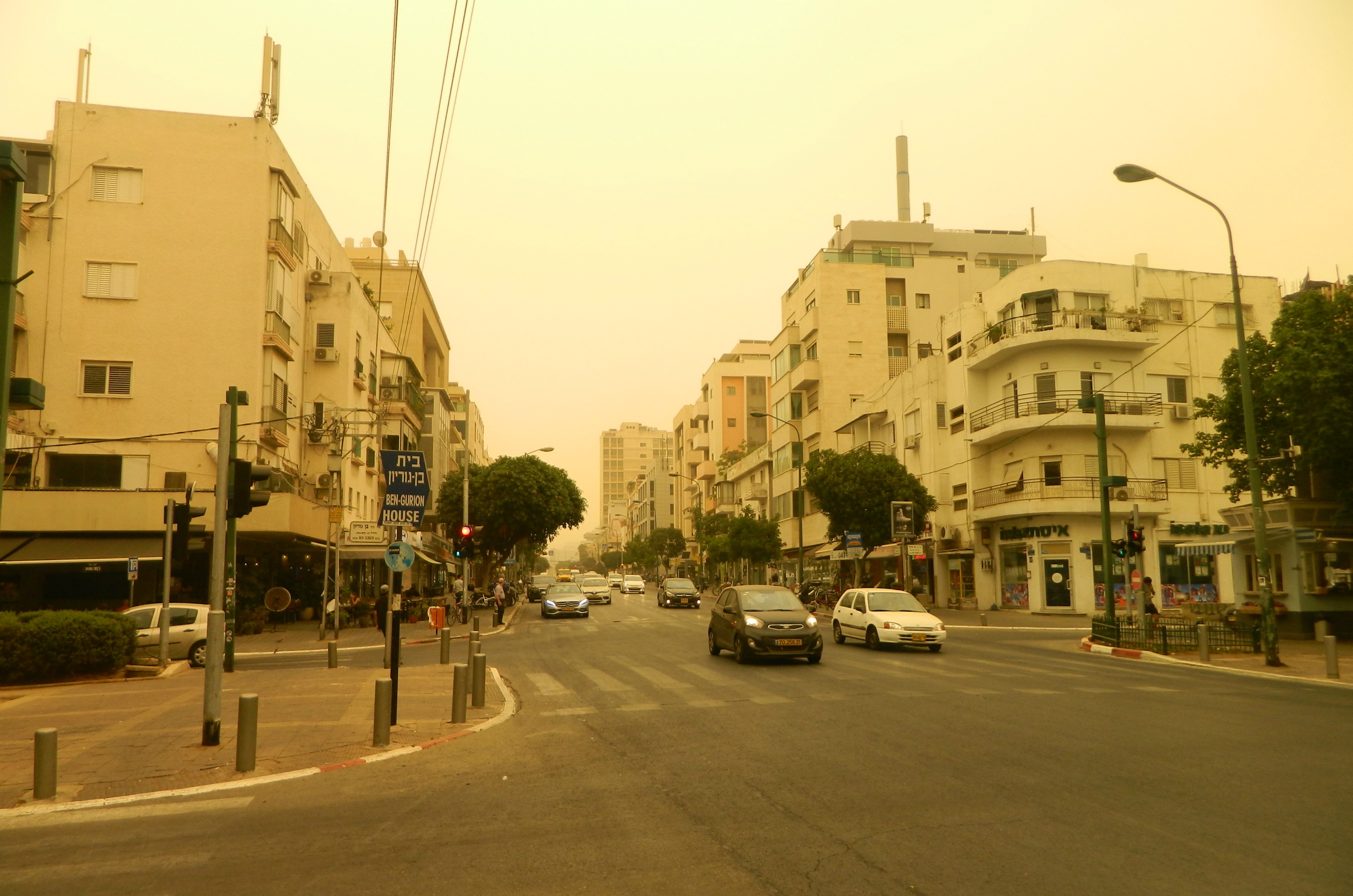
Of the three ice creams that I chose, only the Ferrero Rocher chocolate one impressed me – and just to justifiably complain, my ice cream was heavily melted by the time I paid and sat down to eat it. I then continued walking down Ibn Gabirol and then cut across to Ben Gurion to visit my next site: the Ben Gurion House. Just look at how strange it looked outside in this photo taken on the corner of Ben Gurion and Dizengoff.

Dusty street scene

Dusty street scene

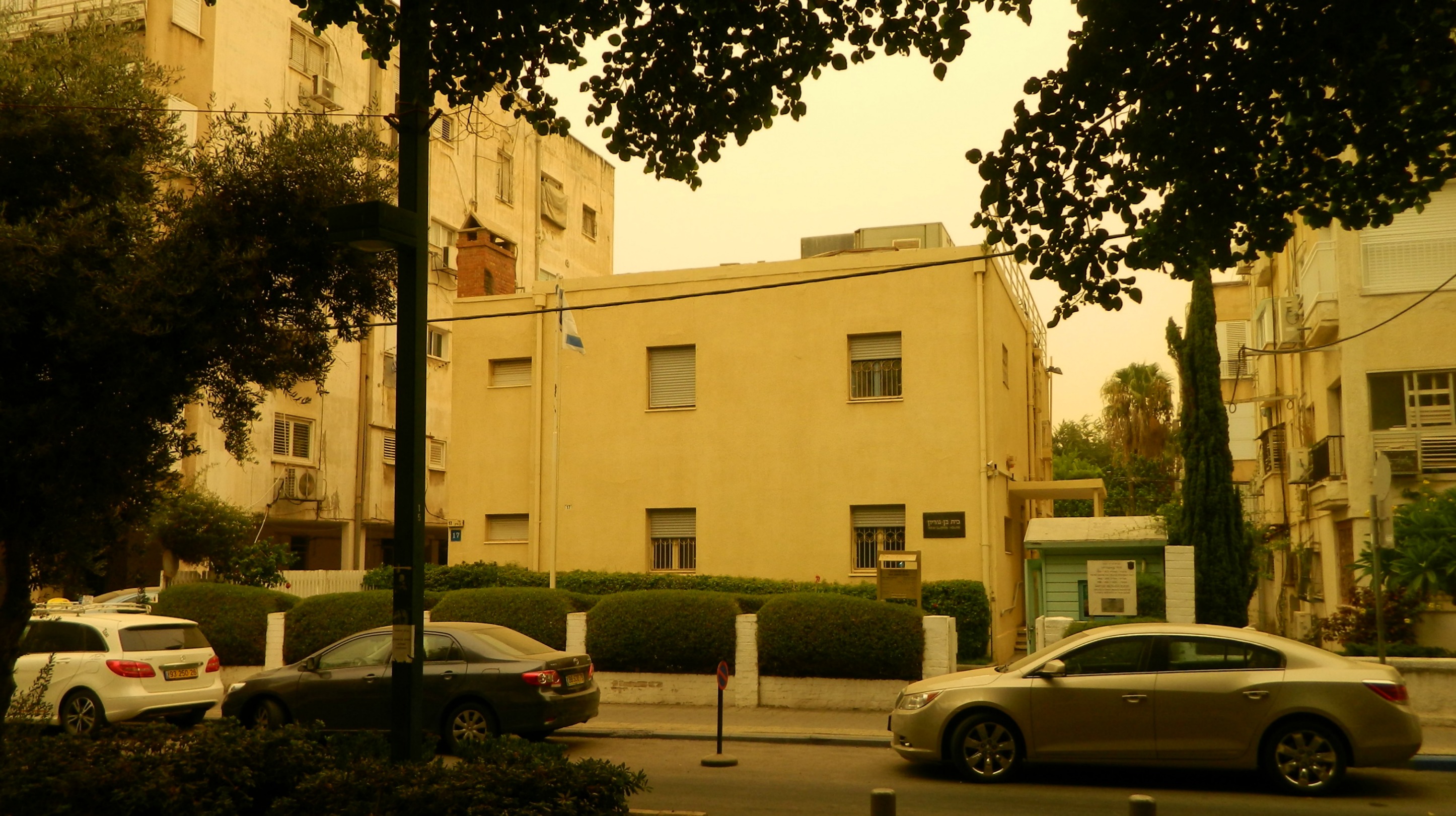
I arrived at the house sweating profusely (just like everybody else walking about in the orange gloom) and began my tour of the old house which offered both air conditioning and free admission. This humble house was the Tel Aviv residence for Israel’s first prime minister, and it was between here and his desert home in Sde Boker that he divided his time.

Ben Gurion House

Ben Gurion House

Built in 1930 with renovations done in 1946, the house is preserved and filled with original furniture but with decor set as it was in the later years. There was a huge amount of awards, gifts and the like from personages and institutions the world over, as well as a collection of photographs featuring David Ben Gurion and various heads of state. But what impressed me most was his personal library upstairs which boasts an astonishing 20,000 books in eleven languages.

Ben Gurion's library

Ben Gurion’s library

I gathered a lot of these facts and numbers from a very helpful docent whose name I forgot, if he in fact gave it to me at all. I found it interesting to see how many Judaica books he owned, and wonder how often he opened them. Finished with the museum I headed back over to Ibn Gabirol to visit a liquor store I had passed earlier and purchased some very interesting craft beers which I haven’t seen anywhere else in Israel (including a Noctus 100 and St Bernardus Abt 12, for those interested in details). With my precious liquid cargo safely double-bagged, I boarded a bus to the Independence Hall area just north of Florentin where I found an interesting Turkish restaurant called Turk Lahmajun to eat late lunch at.

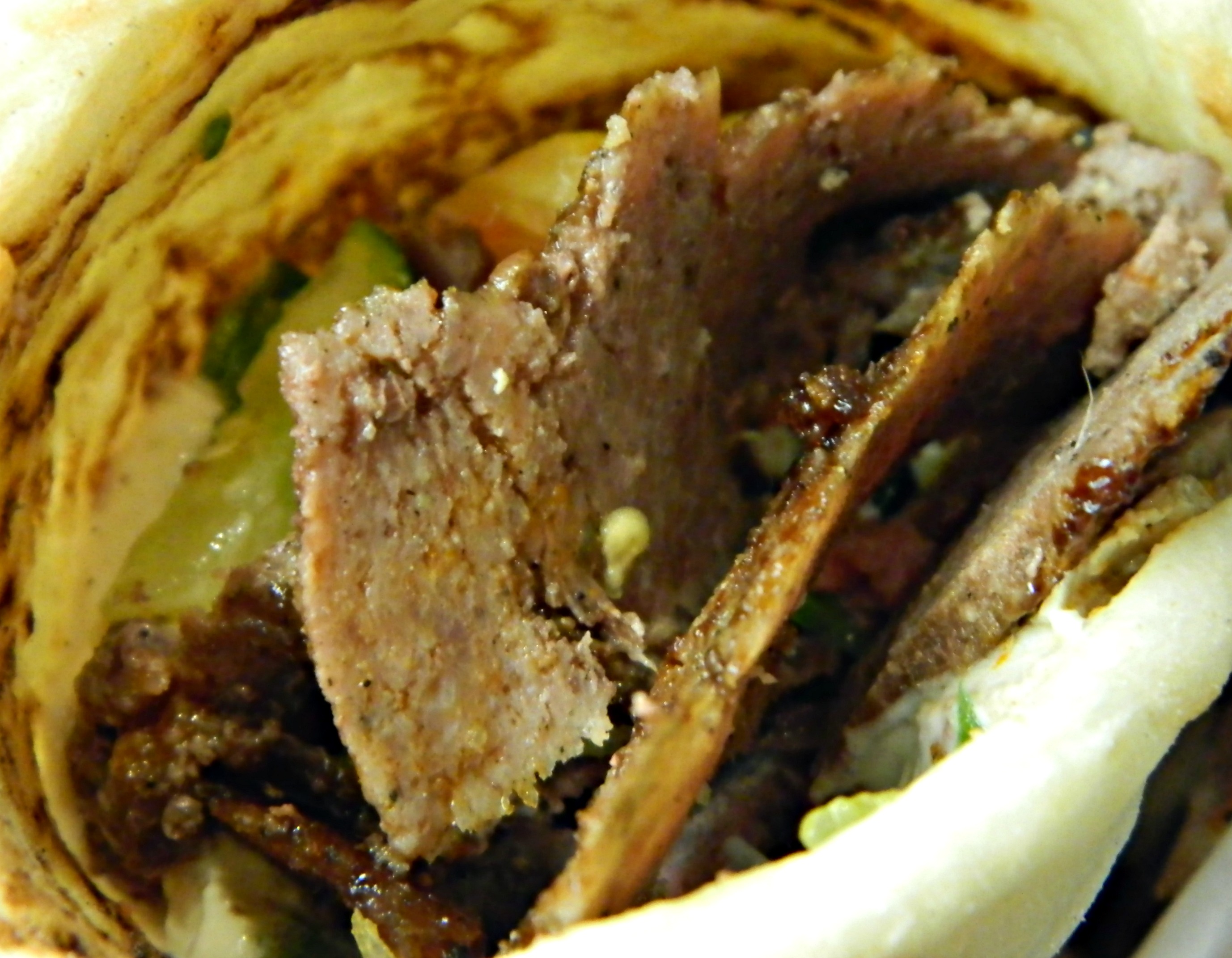
Döner

Döner

I enjoyed a very tasty lamb döner in a laffa, very similar to the classic Israeli schwarma, and then took a bus to the train for the long journey home.

Yarkon Park

In Israel, Tel Aviv on September 20, 2015 at 4:08 AM

After my trip to Tel Aviv a few weeks prior, I had to make the journey once again to complete some exams before applying to university. With the tests in the morning, I had the previous day to travel and sight-see – which I did! Getting off the southbound train at the Tel Aviv University stop I visited the Rabin Centre, but this post isn’t about that. Because this trip was book-ended by visits to historically-oriented places, I am relating my travels slightly out of order. So, after the Rabin Centre I took a meandering bus all the way back to Reading, a bus depot across the Yarkon River from the Tel Aviv Port, up against the Mediterranean Sea. I was embarking on a nice hike from one end of Tel Aviv’s Yarkon Park to the other, in Ramat Gan where I was to be spending the night.

Yarkon Park snaking across Tel Aviv

Yarkon Park snaking across Tel Aviv

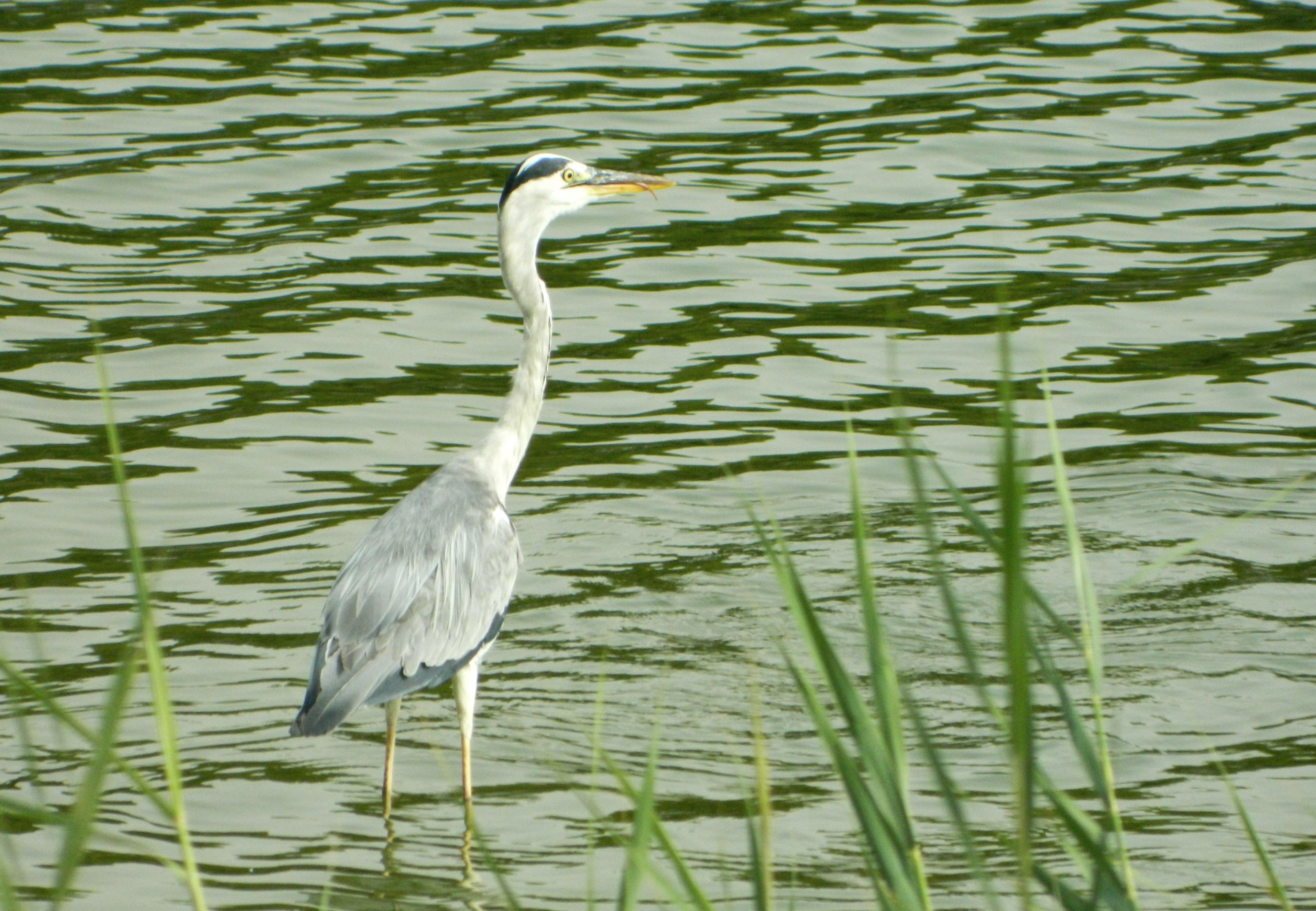
Somewhat comparable to New York City’s Central Park, the Yarkon Park is Tel Aviv’s greenbelt and attracts a healthy amount of both people and wildlife. And so I started walking the trail, passing a rowing club and noticing all sorts of birds all over the place almost immediately. Due to the large number of bird species, and their relative acceptance of human presence, the Yarkon Park has become one of Israel’s best places for birdwatching and bird photography. At any given moment I could turn 360° and see at least five species around me, be them in the air, on the ground or in the water. At first I saw common birds seen all over Israel such as hooded crows and mynas, an invasive species from India, but then I spotted a spur-winged lapwing and a grey heron.

Grey heron wading in the shallows

Grey heron wading in the shallows

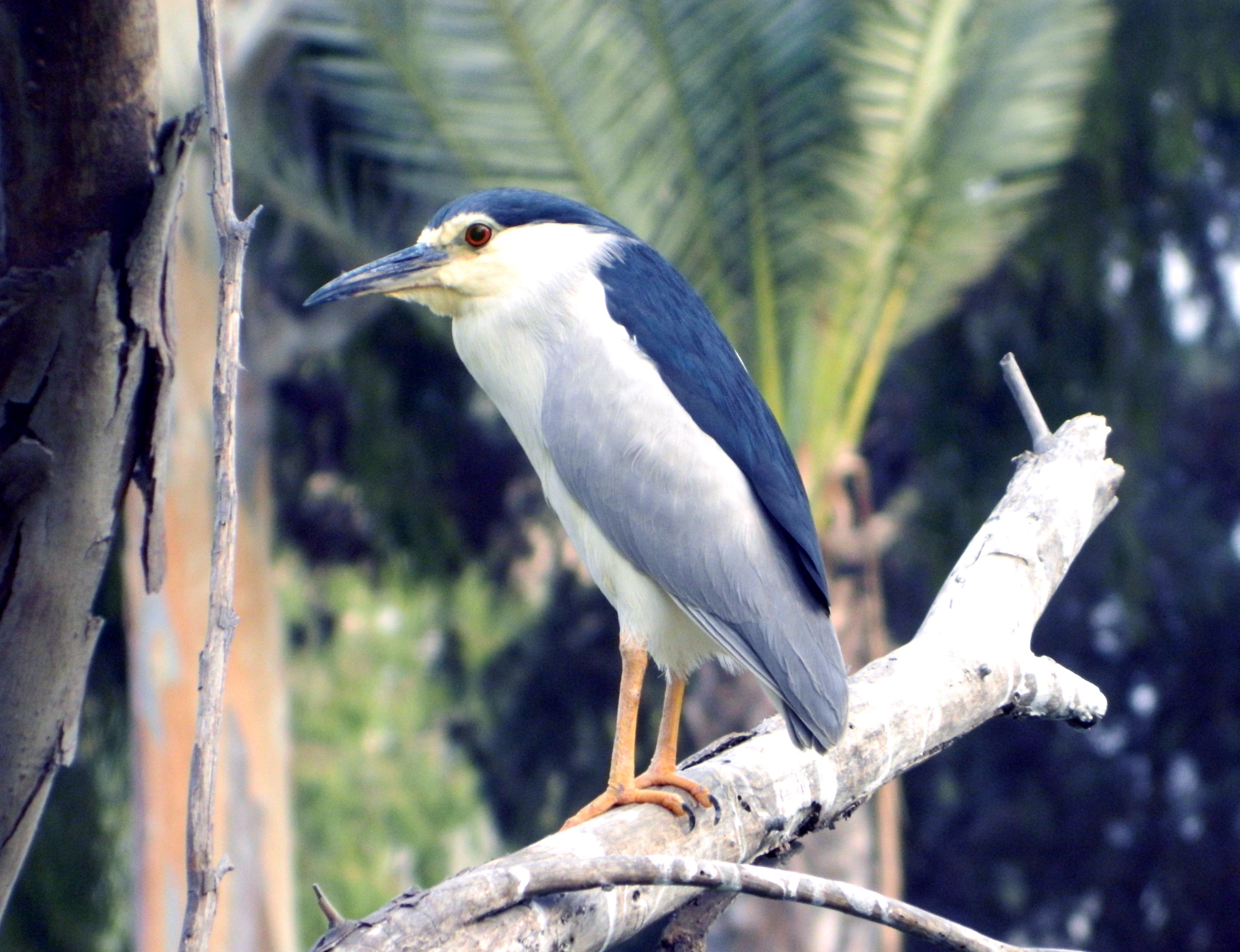
Moving along, I saw a hoopoe (Israel’s national bird) pecking about in the grass and a whole flock of monk parakeets causing a disturbance on the other side of the path – I got a video of it HERE. I stuck to the trail on the northern side of the river (which is actually part of the Israel National Trail), passing gardens and sports facilities, and, even with the myriad of people and their dogs and/or bicycles, there was still a healthy amount of wildlife mostly undisturbed.

Night heron

Night heron

Ever-accompanied by the shrieking of the ring-necked parakeets high up in the date and willow trees, I then witnessed something really cool. I spotted a white-throated kingfisher perched on a fence of sorts a ways away (I even had to use digital zoom). Suddenly, he dropped into the grass and came up with something in his beak. I can’t tell what it is but I watched him eat it and he seemed to like it. Throughout the day I merited to see all three of Israel’s kingfishers, each oddly in a different scientific family – the white-throated, pied and common kingfishers.

White-throated kingfisher with prey

White-throated kingfisher with prey

One thing that’s photographically cool about the Yarkon Park is the stark contrast between the idyllic riverbanks lined with robust trees and then the ultra urban background with Tel Aviv’s skyscrapers appearing over the treeline.

Yarkon Park

Yarkon Park

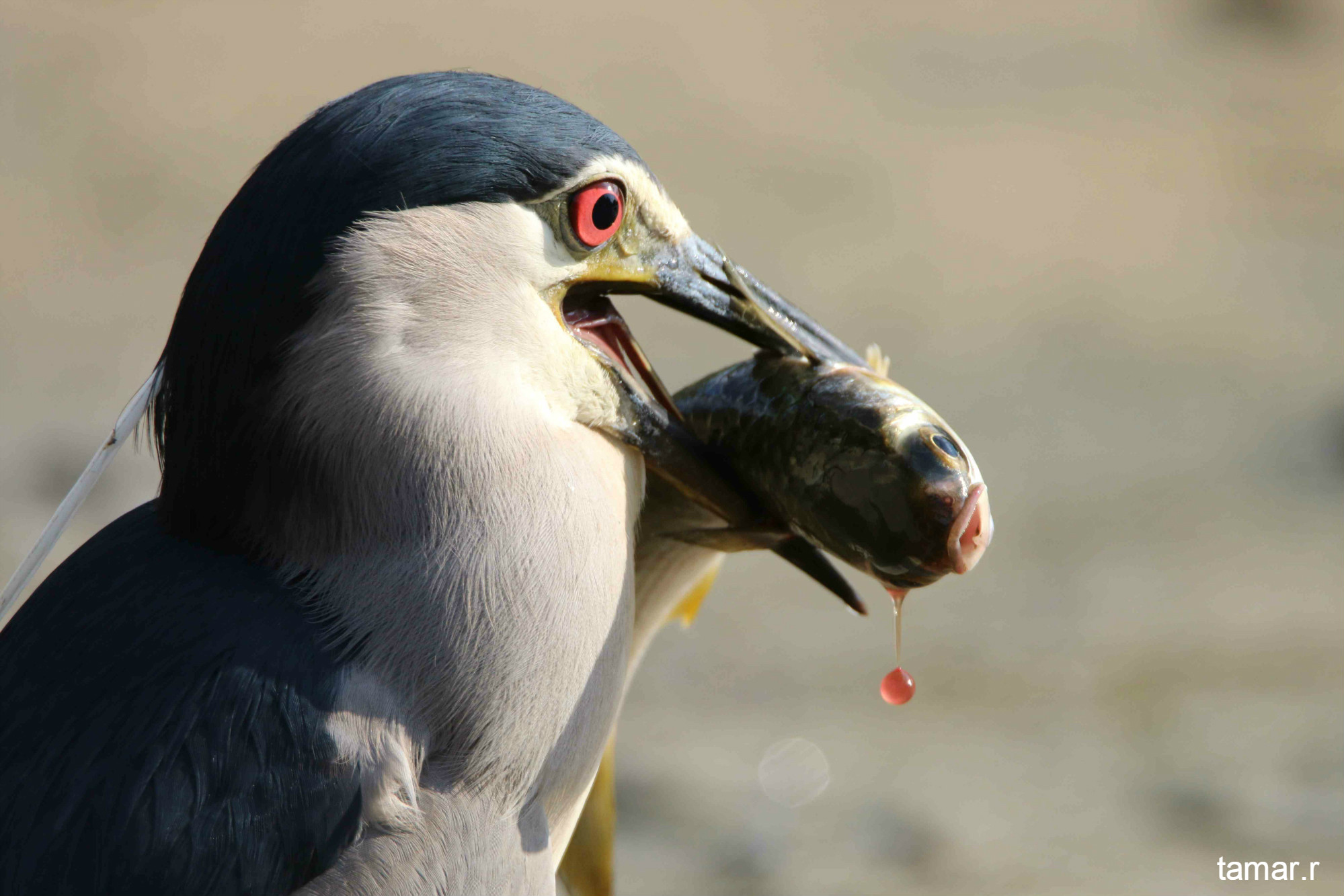
I continued to beat the pavement with my shoes, watching the herons and egrets wading calmly through the murky green shallows while the pied kingfisher hovers ten-twenty feet over the water’s surface, plunging in to catch an unwary fish. To help us humans enjoy the nature in ease and comfort, the park has benches and wooden platforms intermittently along the water’s edge – it’s a rather nice touch. It’s absolutely marvelous having this convenient window into nature’s circle of life, just feast your eyes om this photo of a night heron with its prey:

Night heron with fish (photo: Tamar Ron)

Night heron with fish (photo: Tamar Ron)

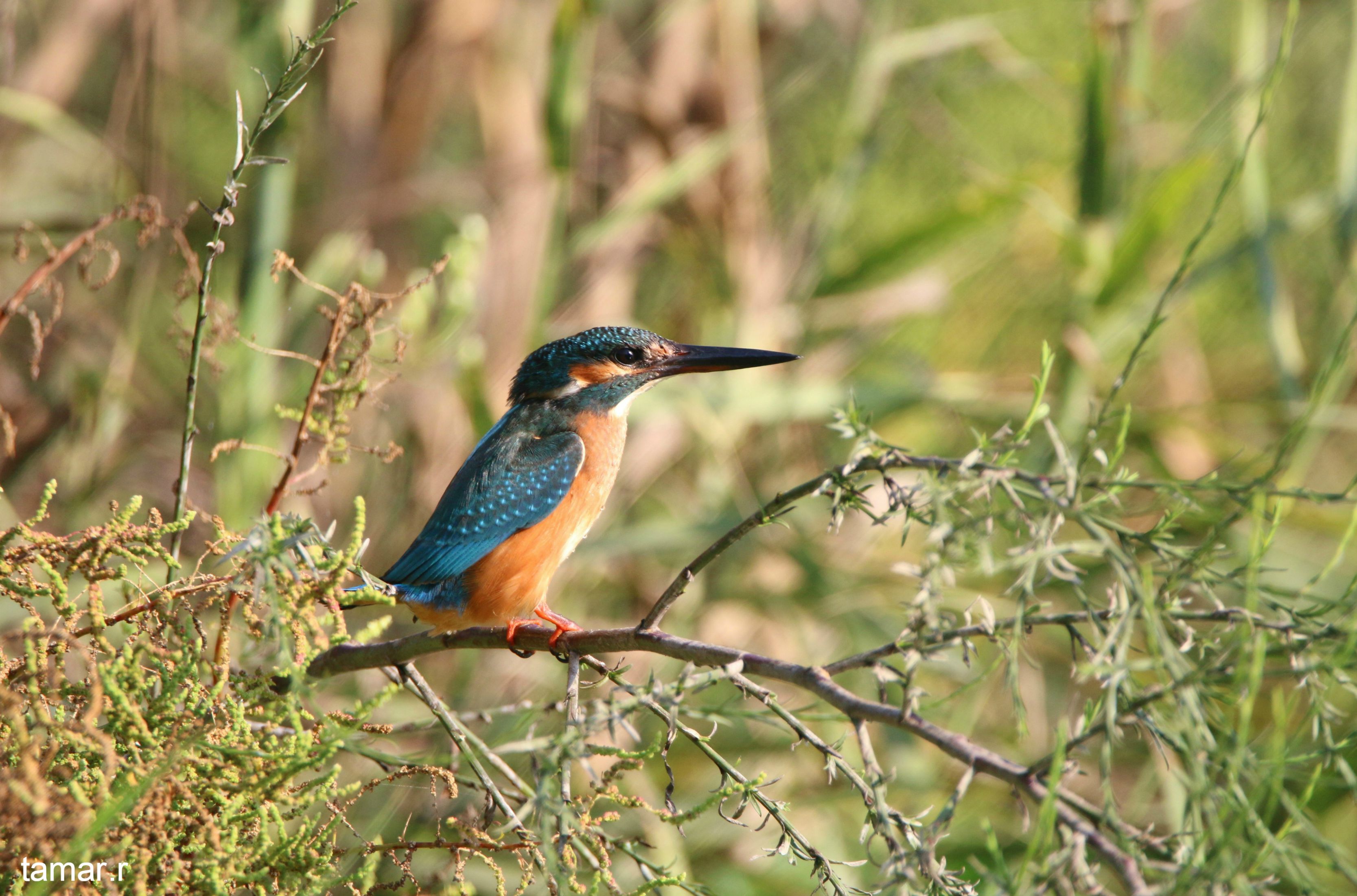
Before long I was passing the fork where the Ayalon stream and Yarkon River meet, the train and vehicular traffic thundering along on the large bridge overhead. I wrote all about the source of the Yarkon River and its initial tributary streams in my post about the Yarkon National Park – the Ayalon is the last of these to join the decantation into the sea. Continuing along the banks of the Yarkon, I then came across a small zoo with axis deer, emu, ostrich and several other birds and mammals. Just around the corner from the zoo and a closed aviary, I found one of Israel’s greatest birdwatching sites: Sheva Tachanot (or Seven Mills). The daylight was beginning to fade, and as it had been a rather overcast day, the poor lighting made photography rather difficult, no matter how hard I tried. Despite all that, I was amazed at just how close one can get to the many types of birds frequenting the old Ottoman flour mill ruins with its pools and lush overgrowth. A talented Tel Avivian photographer by the name of Tamar Ron graciously offered me the use of her photos to properly display the beautiful birds of Seven Mills, of which you see on either ends of this paragraph.

Common kingfisher (photo: Tamar Ron)

Common kingfisher (photo: Tamar Ron)

As night began to fall I found myself tracking a few jackal cubs that were frolicking not far from the trail. Having migrated from the hills of the Shomron several years ago, jackals are now a permanent fixture of the Yarkon Park – and especially at Seven Mills, where jackals can even be seen during normal daylight hours. As I crept up to the jackal cubs I heard a bone-chilling growl in the bushes mere metres behind me which sent shivers down my spine and adrenaline pumping through my veins. With that untimely distraction, the young jackals made their escape and so I continued on, sadly jackal-less, with my hike of the Yarkon.

Dusk settling over the park

Dusk settling over the park

Nightfall shrouded the tall trees and I could occasionally hear or see jackals in the distance as I walked, and shortly thereafter I think I heard the calls of a tree frog. The path kept going and going, often poorly lit with cyclists whizzing by almost dangerously.

Urban Ramat Gan

Urban Ramat Gan

I passed the Meymadion water park and then the Ramat Gan Stadium before reaching the Maccabiah Bridge. A name born from tragedy, the current bridge’s predecessor had a deadly collapse in 1997 – four Australian athletes were killed and another sixty injured.

Crossing the Maccabiah Bridge at the Ayalon Mall

Crossing the Maccabiah Bridge at the Ayalon Mall

Thankfully, the bridge took me safely across the Yarkon River where I made a bee-line for the Ayalon Mall. There I had a rather filling falafel and headed to my host’s place in Ramat Gan for a good night’s sleep in preparation for the following day’s exams.

Tel Aviv II

In Israel, Tel Aviv on September 13, 2015 at 9:41 AM

Continuing with my trip the other week to Israel’s coastal metropolis, Tel Aviv, I started my morning off bright and early. I made it to the exams building and did what needed to be done. On the way back to my host’s place, I stopped off at the Krinizi House, a museum on the history of Ramat Gan (a city in the Tel Aviv district).

Krinizi House

Krinizi House

Located in the old house of Avraham Krinizi, the first mayor of Ramat Gan, the museum retells the city’s rise from a small satellite town to a booming commercial city. After returning and subsequently saying goodbye to my host I took a bus back into Tel Aviv, getting off on King George street at Metzudat Ze’ev, a large Brutalist-style building also known as Jabotinsky House.

Metzudat Ze'ev

Metzudat Ze’ev

My first visit was to the Etzel Museum where I learned more about the paramilitary organisation’s activities over the years leading up to Israeli independence. One thing that really impressed me were the many detailed models that portrayed in miniature scale how and where the group’s violent activities took place – like the attack on the British headquarters in the King David Hotel in 1946.

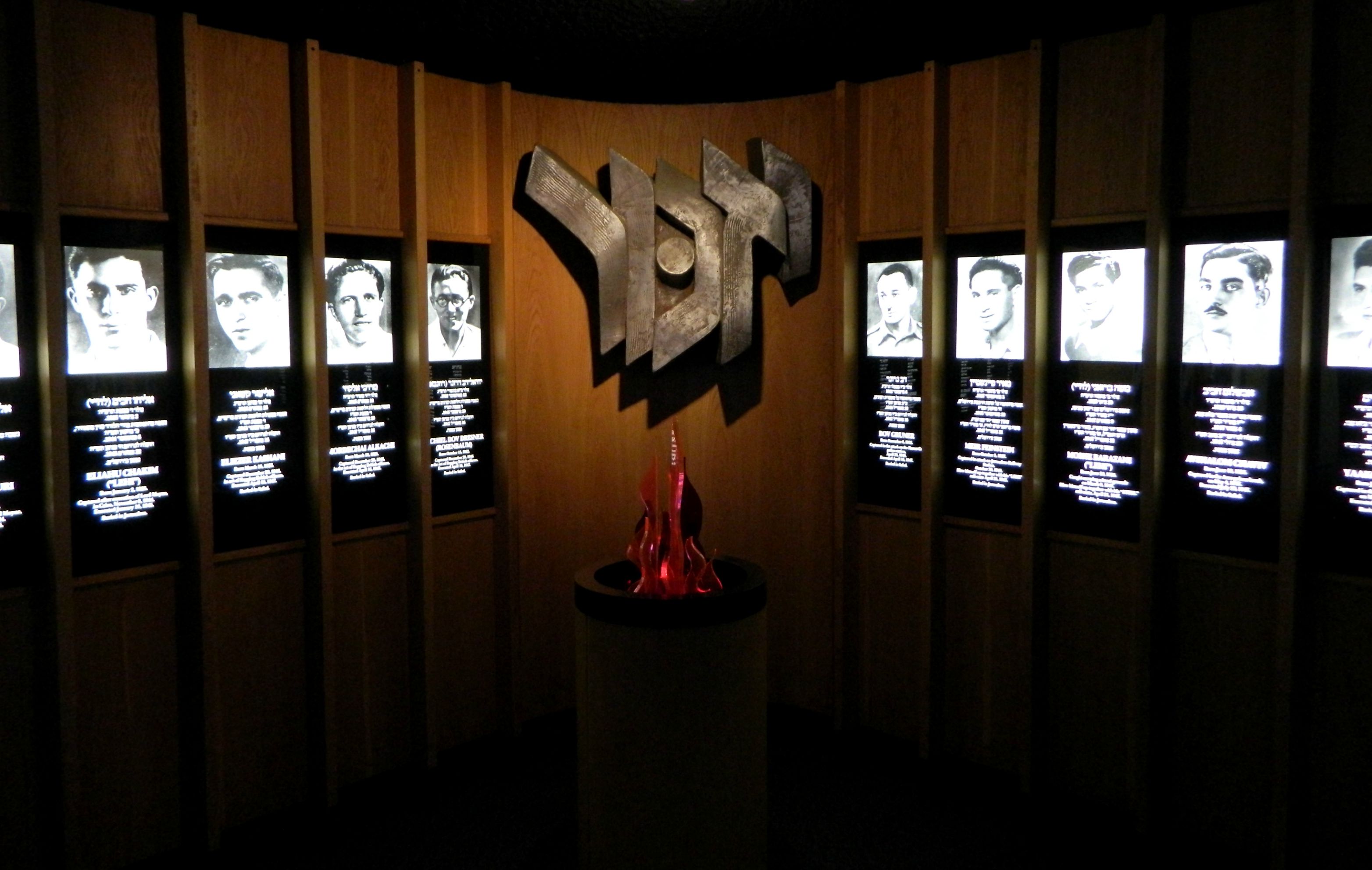
Memorial to the fallen Etzel members

Memorial to the fallen Etzel members

After browsing through the two floors of Etzel exhibits and having watched the video, I purchased a cheap book about “the Irgun” (another name for Etzel) and headed upstairs to visit the Jabotinsky Centre.

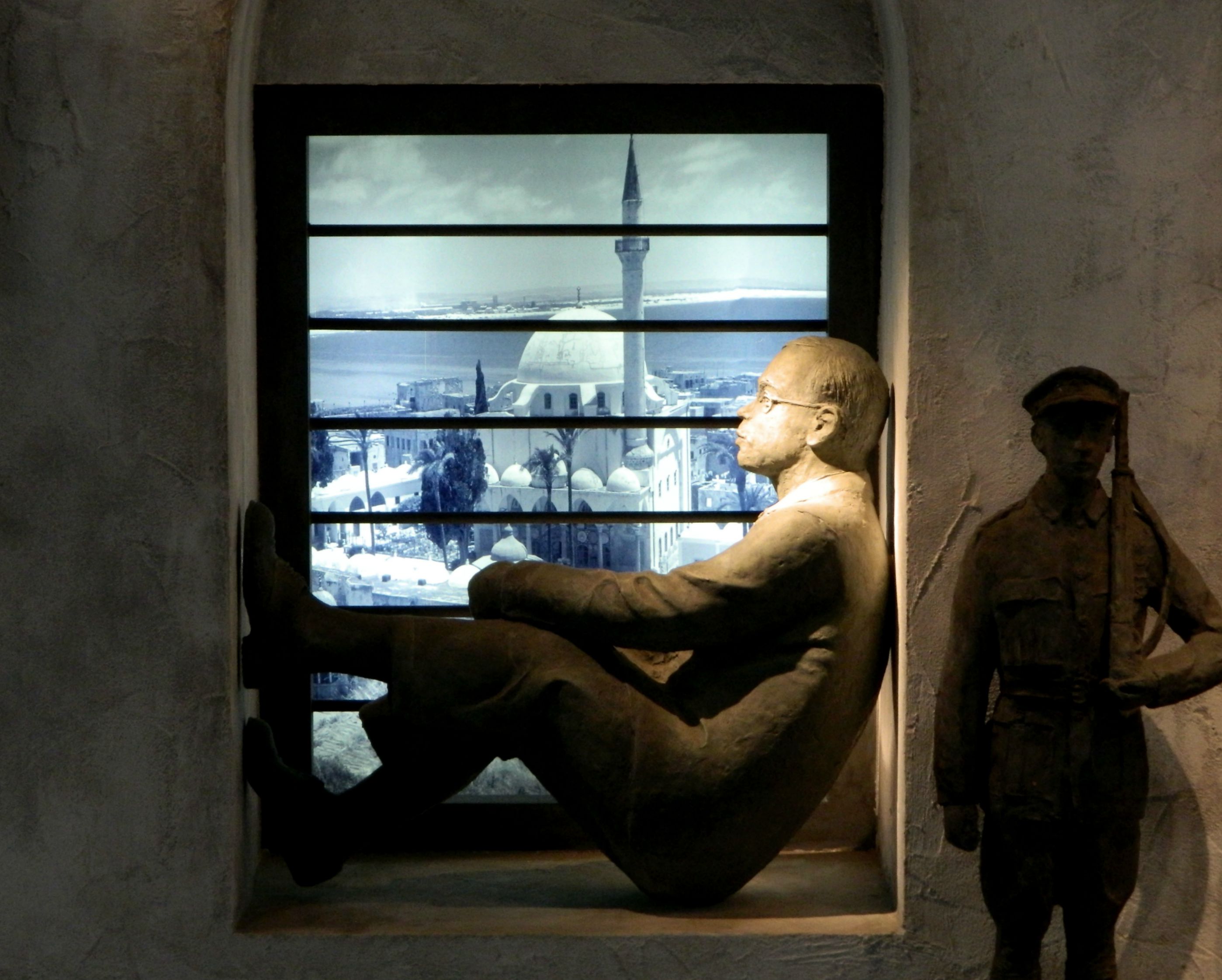
Ze'ev Jabotinsky sitting in prison

Ze’ev Jabotinsky sitting in prison

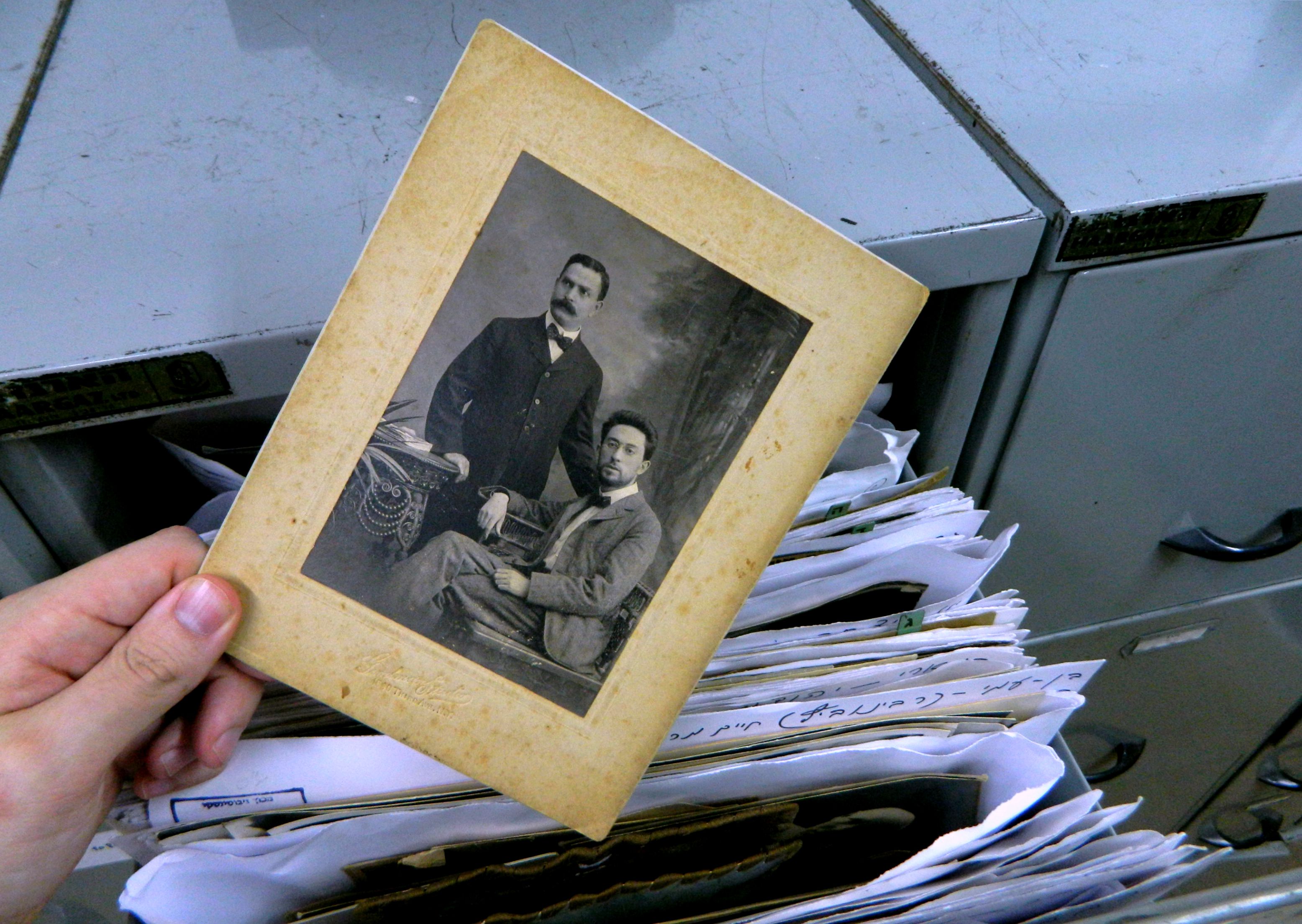
There I was treated to a rather interesting video about the life of Ze’ev Jabotinsky, told over by actors playing Ze’ev and his son, Eri. When I was done looking around l discovered the centre’s archives with an extraordinary amount of filed documents, photographs and more.

Perusing the Jabotinsky Centre archives

Perusing the Jabotinsky Centre archives

Leaving the fancy building I boarded a bus heading for the even fancier Rothschild Boulevard and Independence Hall. My bus dropped me off a few blocks south of Rothschild and so I found myself walking through the streets, with the alternate Bauhaus and modern buildings of steel and glass casting their shadows over me.

Upscale Tel Aviv

Upscale Tel Aviv

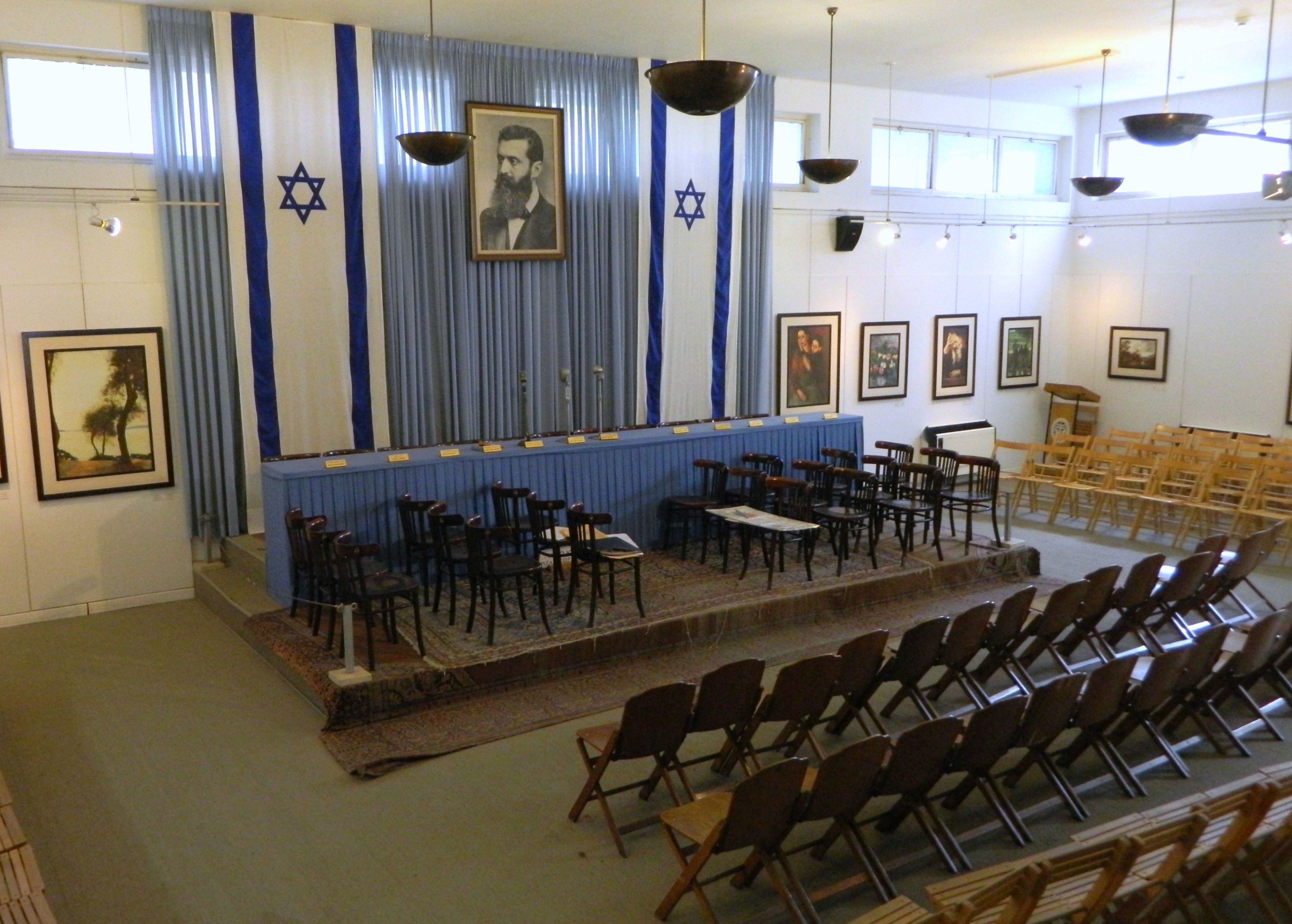
I then encountered the Herzlilienblum Museum of banking history on the corner of Herzl and Lilienblum, but unfortunately the museum is only open to groups with an advance reservation. With the guard not yielding to my cajoling, I turned the corner and found Independence Hall, originally known as Dizengoff House. After paying the rather steep entrance fee I watched a short film about the house and the signing of the Declaration of Independence, which, when aired on public broadcast to the world, sparked the War for Independence.

Inside Independence Hall

Inside Independence Hall

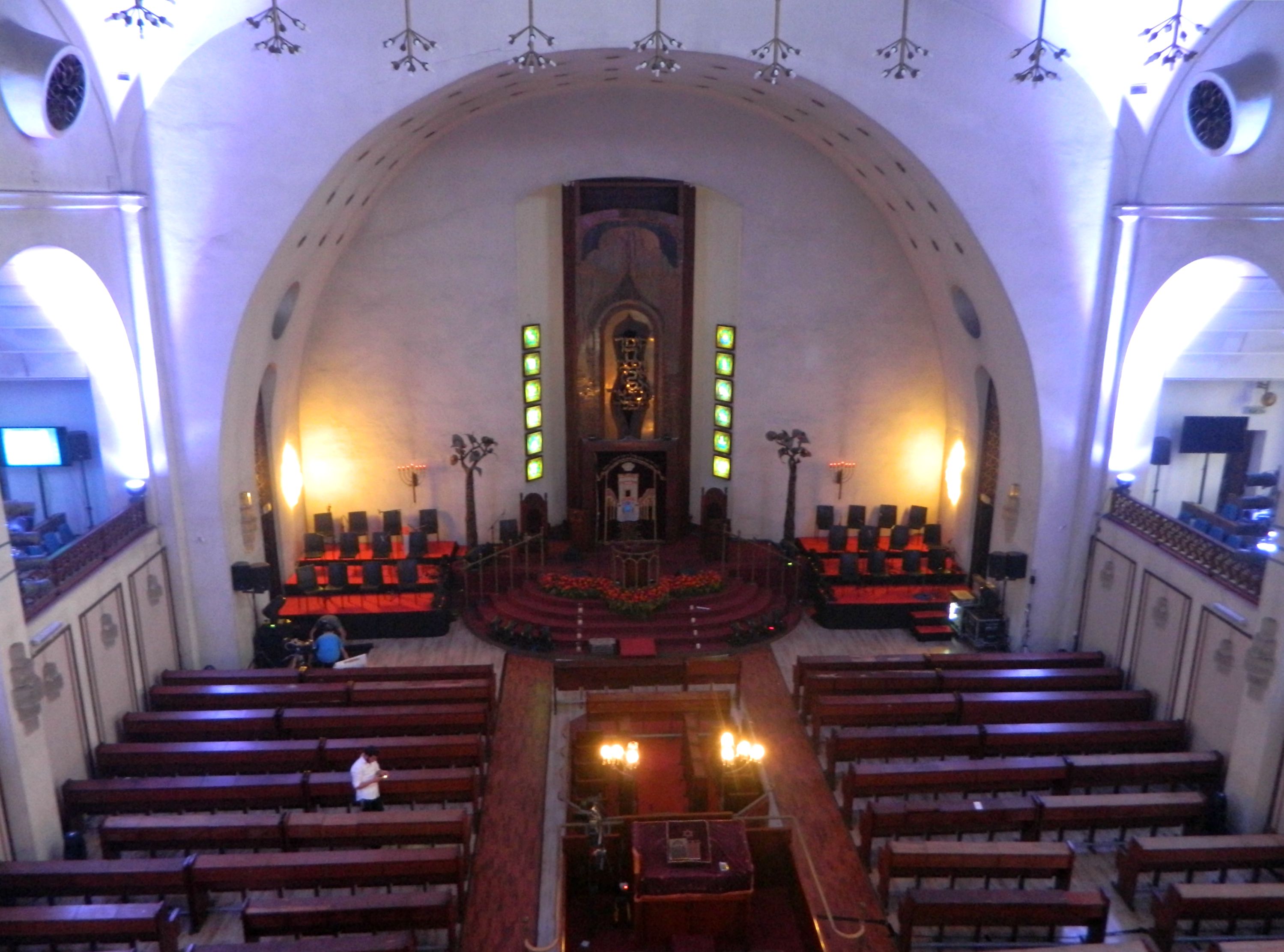
I thought the restored room which hosted the monumental moment was rather nice but that they should lower the cost of visiting – after all, it is a national heritage site and the museum is basically just that room. I walked around the area a bit, sight-seeing, and then headed to a restaurant I had passed a few blocks away for late lunch. After having their burger, which was considerably less interesting than the other more ethic choices in the area, I headed for Allenby street. Somewhat notorious for being rather seedy, at least by Israeli standards, Allenby does have one redeeming site – the Great Synagogue of Tel Aviv. Built in the 1920’s and renovated in the 1970’s, the Great Synagogue is a rather impressive building with its large arches and stained glass windows.

Inside Tel Aviv's Great Synagogue

Inside Tel Aviv’s Great Synagogue

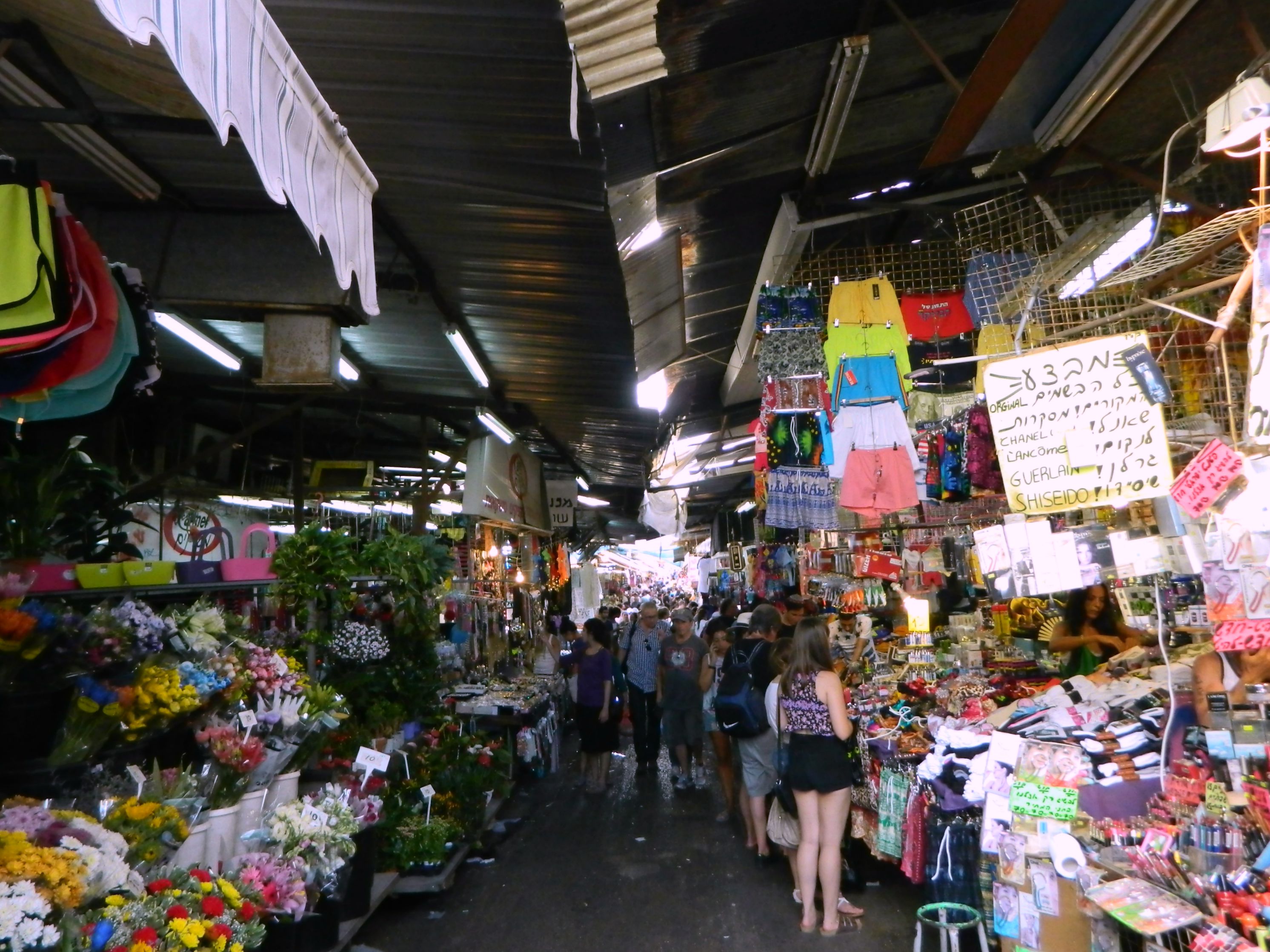
When it was built, the synagogue was in the centre of old Tel Aviv, but now the surrounding areas have become commercial and the building has lost some of its practical importance. I found the great doors unlocked and was overjoyed to finally step inside for the first time in many unsuccessful visits. I had chanced upon preparations for an important event – the Great Synagogue was celebrating 90 years and, in honour, four new sifrei torah (torah scrolls) were being dedicated. Unfortunately, the event was late in the evening and it would be problematic coinciding with the public transportation I was using to get back home. And so I took my pictures, prayed mincha (evening prayer) and bid the grand synagogue farewell. Continuing down Allenby I popped into the Carmel Shuk in search for the Beer Bazaar, a craft beer place with a great stock.

Carmel Shuk of Tel Aviv

Carmel Shuk of Tel Aviv

The man behind the counter was pleasantly knowledgeable and helped me pick out six new stouts and porters to try, all Israeli made. After having tasted them all and enjoying them to various degrees, I still prefer my favourite beer, Salara Smoked Stout from Kibbutz Ginegar (which I had the opportunity of visiting the following week). With the beers safely wrapped up I took a bus to the train and the train back to the north, wrapping up my two-day trip to Tel Aviv. But I was to visit again shortly after…
Tel Aviv I

In Israel, Tel Aviv on August 30, 2015 at 4:47 AM

Last week I took a trip down to Tel Aviv to take some morning exams the following day in preparation for university. Leaving Ma’alot in the late morning, I arrived in bustling Tel Aviv by train and immediately headed towards my first destination, the IDF History Museum. Located just outside the newly renovated HaTachana (old train station) with its cafés, restaurants and boutique shops, the IDF museum has been on my map for quite some time. I had visited once before, while in basic training, but didn’t really get the chance to see everything (post HERE).

IDF History Museum

IDF History Museum

Inside the museum’s confines I started with the rifle and machine gun exhibit, a large collection of firearms from all over the world and spanning hundreds of years. Considering today’s political situation, I found irony in seeing an Israeli-made Uzi sub-machine gun displayed as a weapon used by the Iranian armed forces.

Guns galore!

Guns galore!

Next I browsed the captured anti-aircraft guns and the extensive armoured units collection, ranging from American Shermans and Pattons to British Centurions and Soviet T-54s/T-55s all the way to Israel’s first tank, the Merkava I.

Tank pavilion

Tank pavilion

Next was a large room filled with pistols from the last three hundred years or so and from all over the world, including a few “VIP” pistols owned by various Israeli generals. Moving along, I passed a collection of armoured vehicles and then entered a building dedicated towards the War for Independence in 1948. It was in this room that an elderly woman, a fellow visitor, stopped me and told me a story about a Jewish man who lived in Yafo (Jaffa) in 1947-1948 and was killed by his Arab neighbours when Israeli independence was announced. Leaving that room, I passed artillery guns and entered the exhibits of each of the successive Chiefs of General Staff. My museum visit continued on for another hour or so, giving me time to look at the many exhibitions including this one called the IDF Equipment Centre Pavilion:

"Kitchens are important too"

“Kitchens are important too”

My visit ended with a look at a number of vehicles that made history including official cars of Defence Ministers and some famous military vehicles. One, a Fargo pickup truck made in the US in 1942 boasted quite a rich history. This particular vehicle was used by three separate armies and had seen battle in four wars – quite the veteran! Leaving the museum at closing time I headed towards the chic neighbourhood of Neve Tzedek, not really sure where to go next as museums were all either closed or closing shortly.

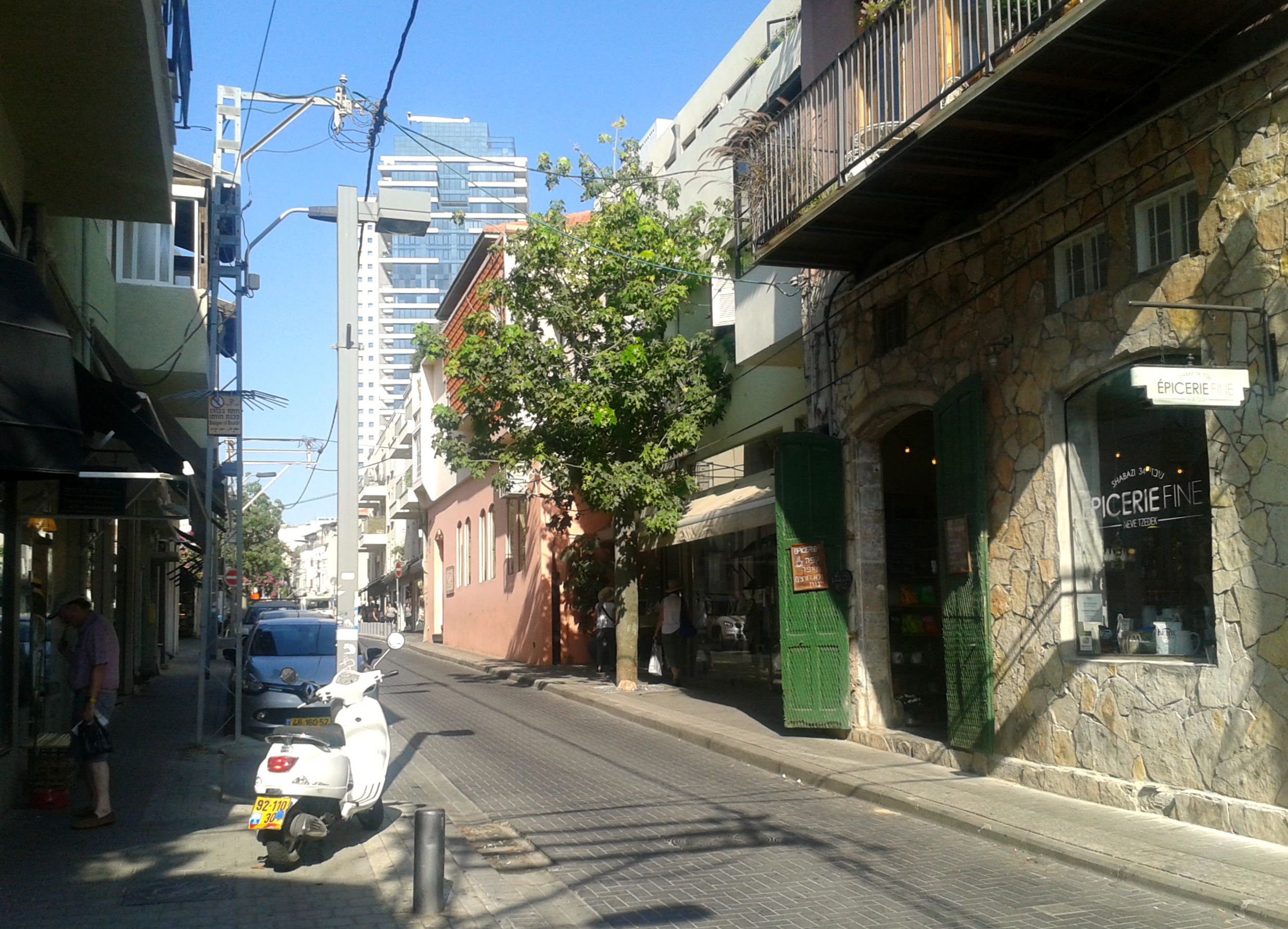
Neve Tzedek street scene

Neve Tzedek street scene

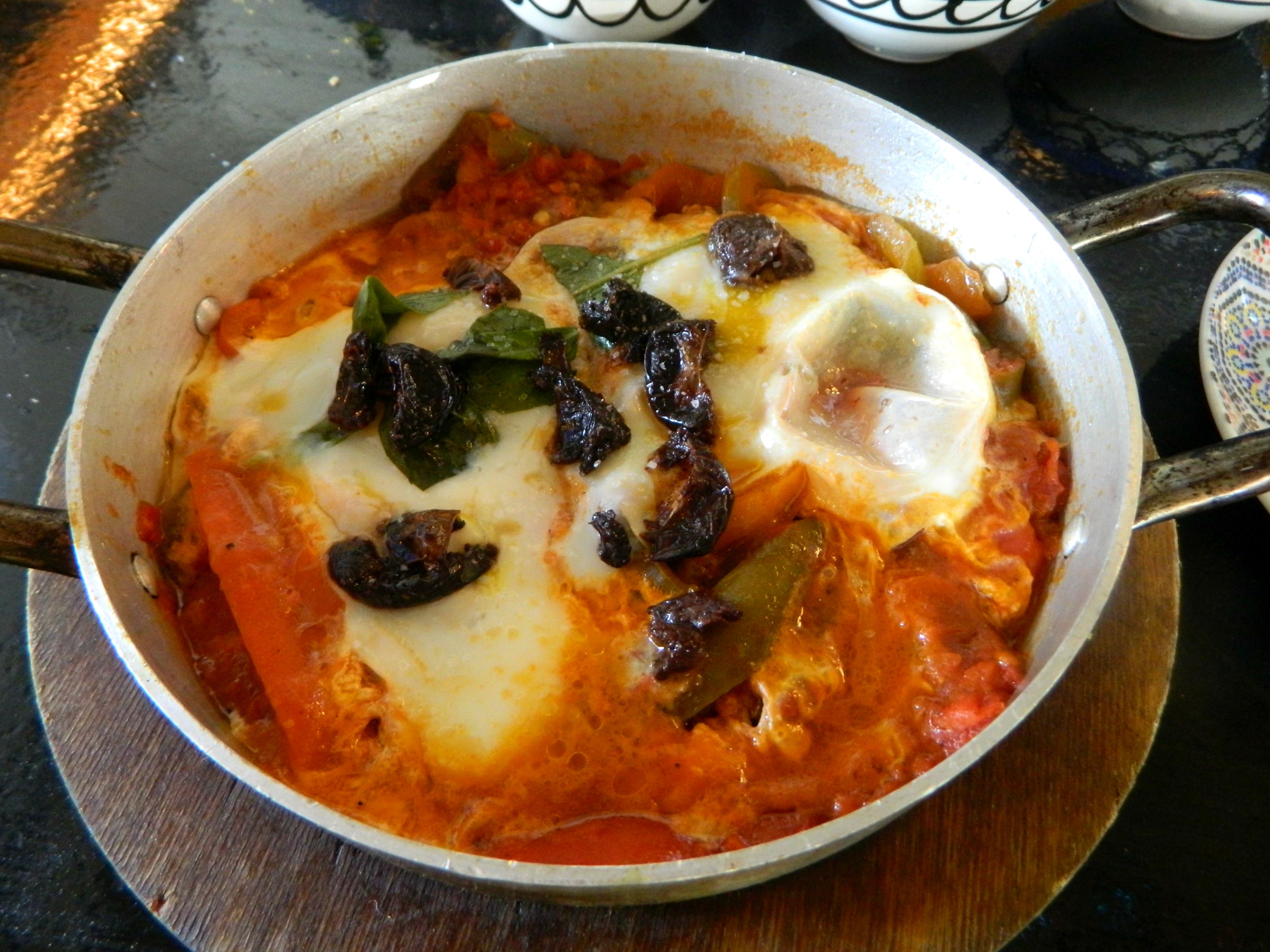
As I walked through the well-kept streets I was surprised to mostly hear English and French being spoken. When I stopped into a Tunisian restaurant, the menu was in Hebrew and French only – no English. It was at this restaurant, Jasmine, that I had a late lunch of (off-menu) shakshuka with a variety of Tunisian salads and some beer.

Tunisian shakshuka

Tunisian shakshuka

Leaving Neve Tzedek I bused to the Tel Aviv Port to watch the sunset and explore the area for the first time. Crossing the Yarkon River, I walked along the water taking pictures of the various birds hanging about. I saw kingfishers, mynas, a spur-winged lapwing and more, but it was these colourful Egyptian geese that captivated me most:

Egyptian geese preening on the banks of the Yarkon

Egyptian geese preening on the banks of the Yarkon

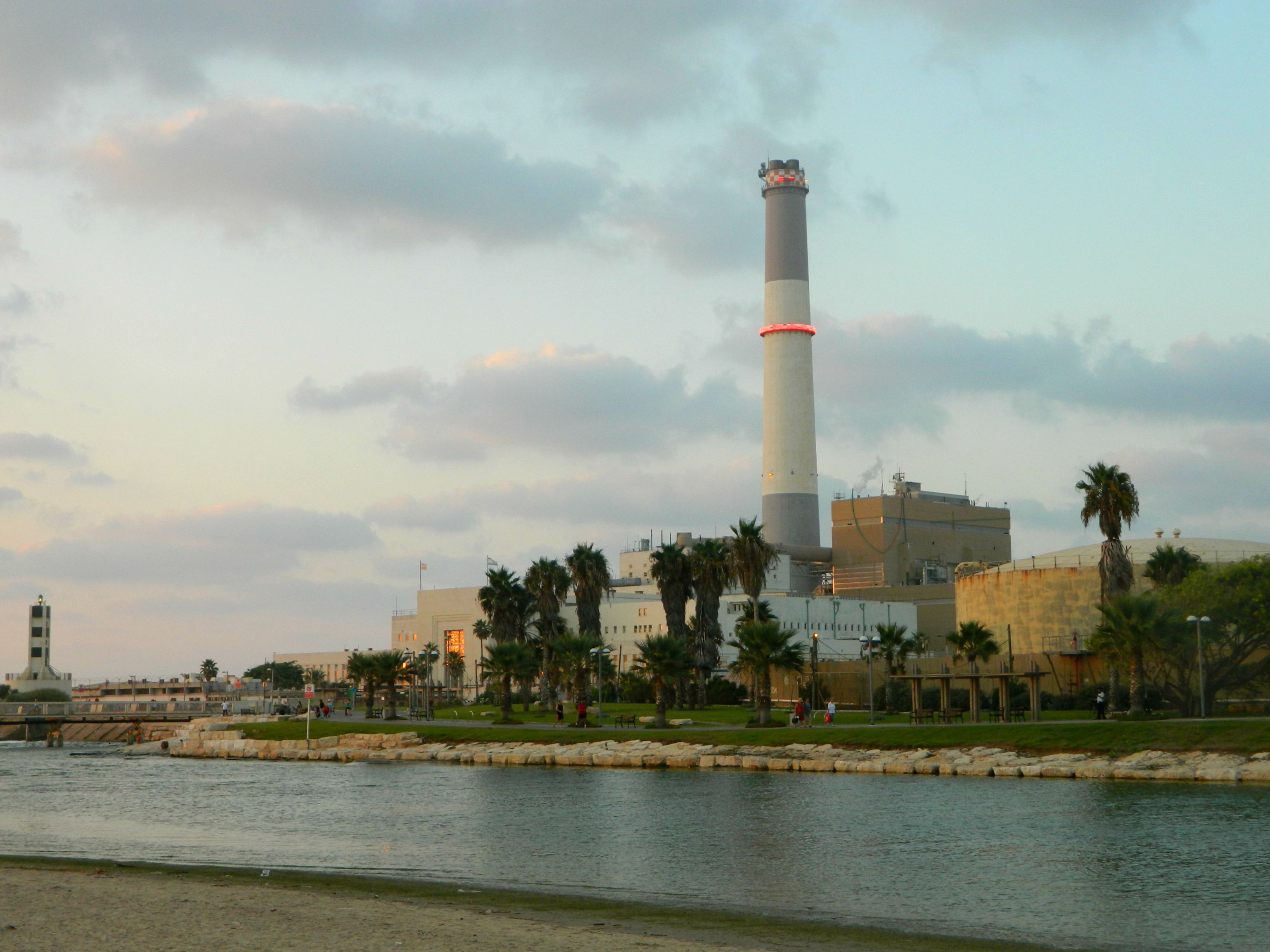
Unfortunately, the water at the mouth of the Yarkon is heavily polluted by the Reading power plant among other industrial culprits. In the picture below you can see the river and the power plant beside it, with a tiny lighthouse on the left-hand  side. This lighthouse was built in the mid 1930’s by the British and the ruins of two Assyrian fortresses were found at the base of it, known today as Tel Kudadi. The power plant was originally built in the late 1930’s, which made the lighthouse superfluous with its bright lighted chimney, and has been added to over the subsequent decades. Today the plant is only in partial use and the exterior was renovated to recreate its original 1930’s appearance.

Reading power plant

Reading power plant

I crossed over the Wauchope bridge, dodging the multitudes of pedestrians, bikers and rollerbladers to take pictures of the beautiful sunset.

Sunset at Tel Aviv Port

Sunset at Tel Aviv Port

Looping around Reading Park as the sun disappeared over the horizon, I then headed back to the Tel Aviv Port area to take in the sights. Surprising packed with visitors and locals alike, I jostled my way along the wooden deck overlooking the crashing waves as I paused here and there to take pictures. I then stumbled upon a concert waiting to start, but even when I left an hour or so later, the singer Avraham Tal had yet to show his presence.

Carousel at dusk

Carousel at dusk

I passed a wedding and an older couple who, upon seeing me with a camera hanging from my neck, asked me to take their picture. I dodged salty waves, saltier waiters (I jest) and the ever-present mob of people as I walked all the way down to the northernmost Tel Aviv beach and then back up to the Yarkon river where I found the buses and headed over to Ramat Gan to stay the night.

Tel Aviv Port at night

Tel Aviv Port at night

The next day proved to be just as adventurous, chock-full of museum visits…