Israel's Good Name

Archive for the ‘Eilat’ Category

Twitching Eilat and the Arava: Day II

In Eilat, Israel, Negev on July 29, 2024 at 9:26 AM

Following the resounding success of day one, my birding adventure to Eilat and the Arava resumed early in the morning at the Melio Hotel. I packed up my belongings, checked out and headed over to the crown jewel of Eilat birding, the International Birding and Research Center of Eilat. I had written about the site when I first visited back in early 2019 accompanied by my friend Adam Ota (see HERE), and I was eager to return.
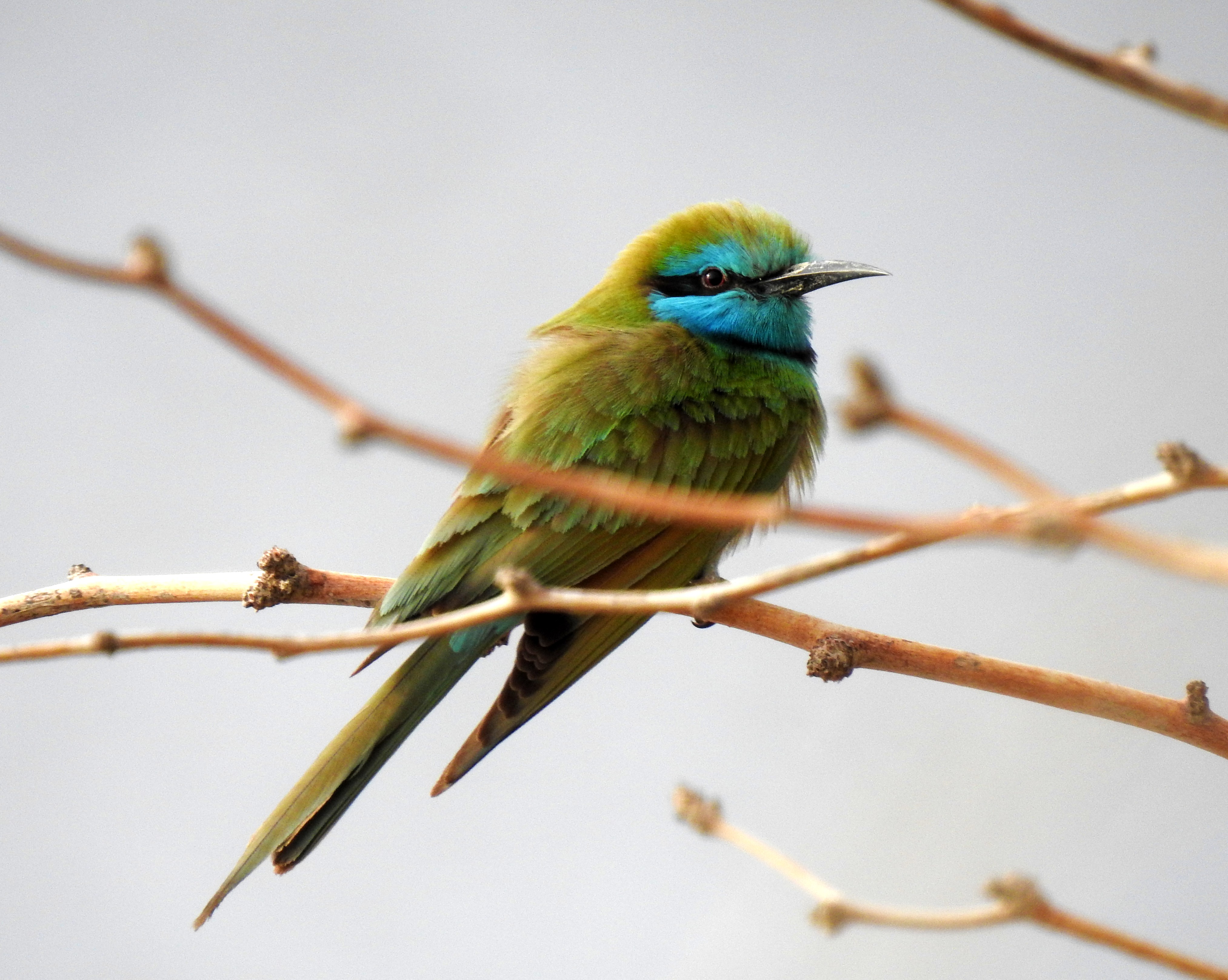
Little green bee-eater

Little green bee-eater

The first few minutes were exciting, with Noam Weiss (the director) spotting a crested honey buzzard circling over the Jordanian border. Then things got a little slower, and none of the targeted species seemed to be around. I explored the newer sections of the park, and saw a few nice birds, but nothing to really write home about.

Morning at the IBRCE

Morning at the IBRCE

Slightly dejected, I decided not to waste too much time and headed for the next hotspot – a few football (formerly soccer) pitches not far away. I was hoping to find a pair of lesser white-fronted geese, which were would-be lifers, who were hanging around in the grass with some local Egyptian geese. Much to my added dismay, that morning happened to be when there was maintenance work being done on the fields and no geese were to be found.
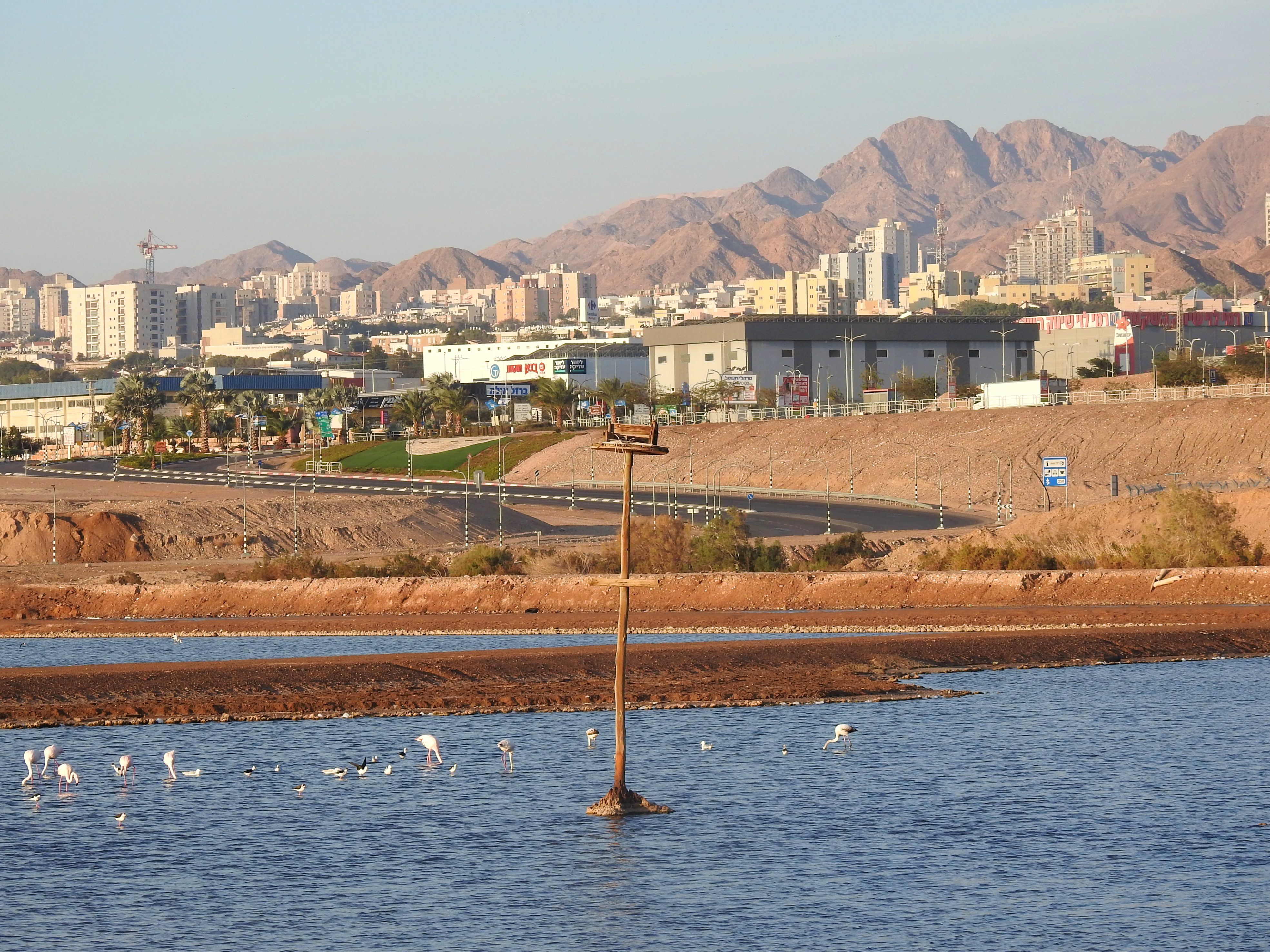
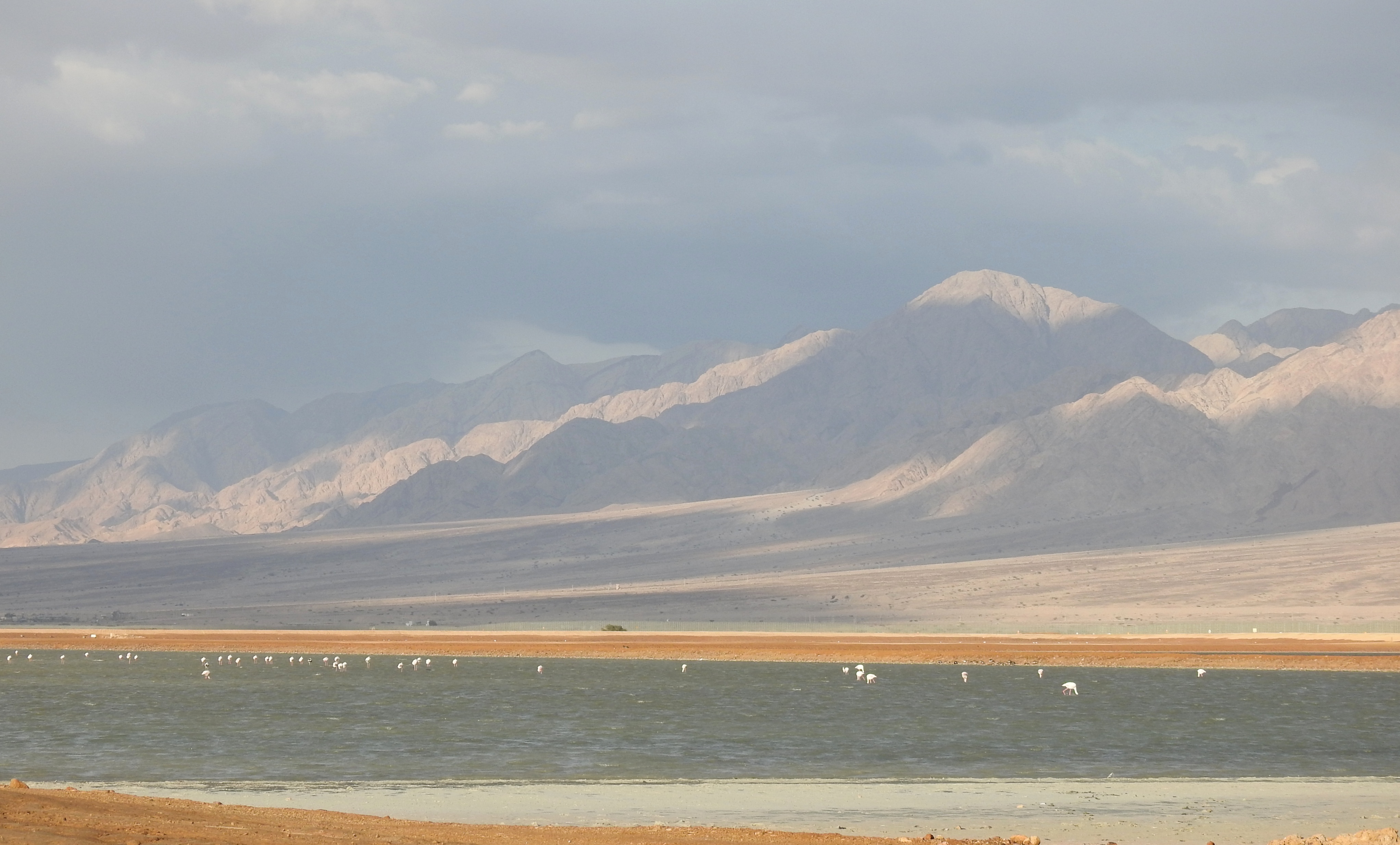
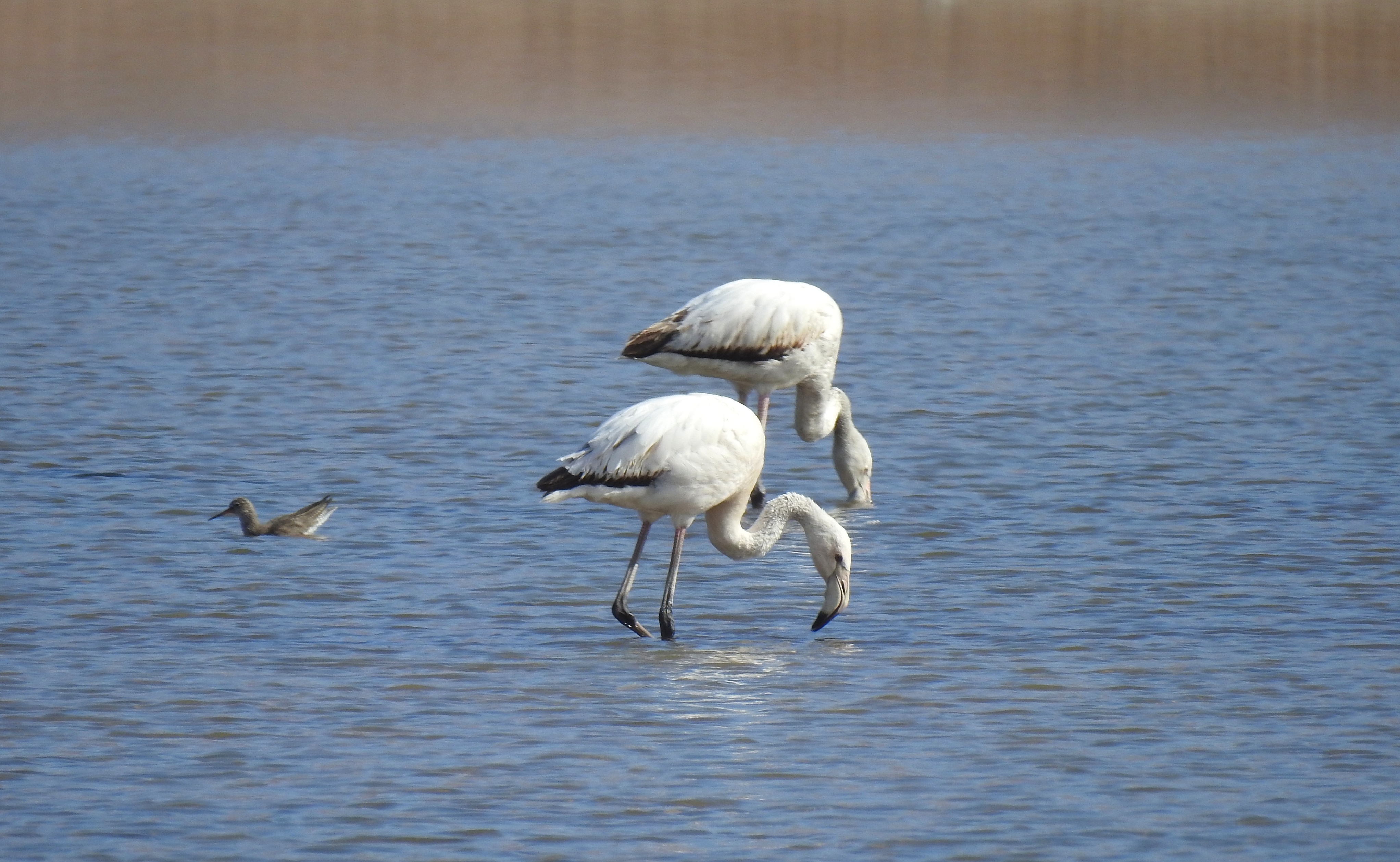
Flamingos in Eilat

Flamingos in Eilat

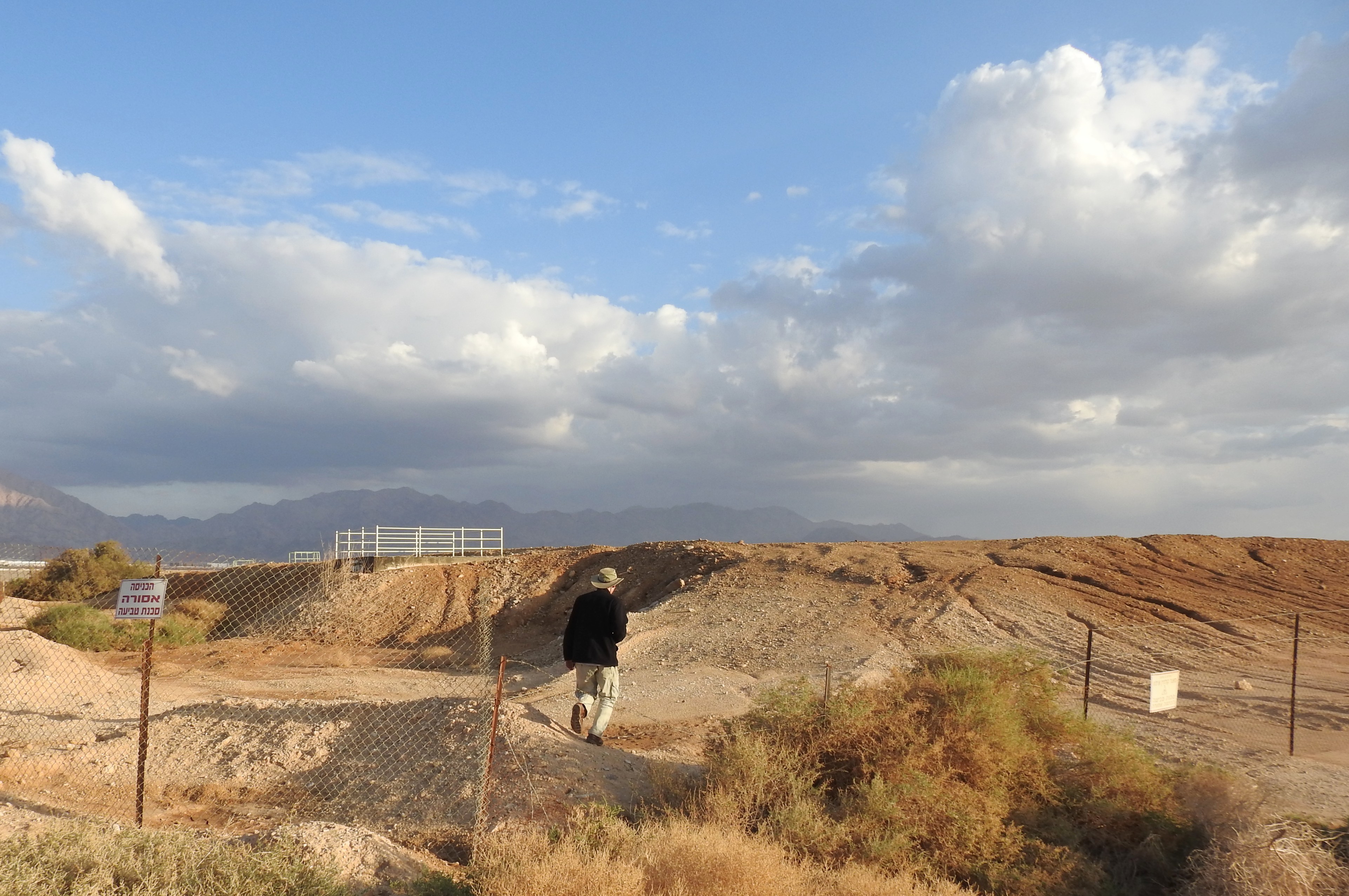
Slumping about, I made an accidental turn and found myself in a scrappy bit of land that was being used to discard construction material. To my delight, there was a little wagtail with a nice yellow head darting about in the rubble – a citrine wagtail, another expected lifer. My spirits soared as I watched the graceful bird, and then resumed my tour of the fields, finding a handful of grazing water and red-throated pipits
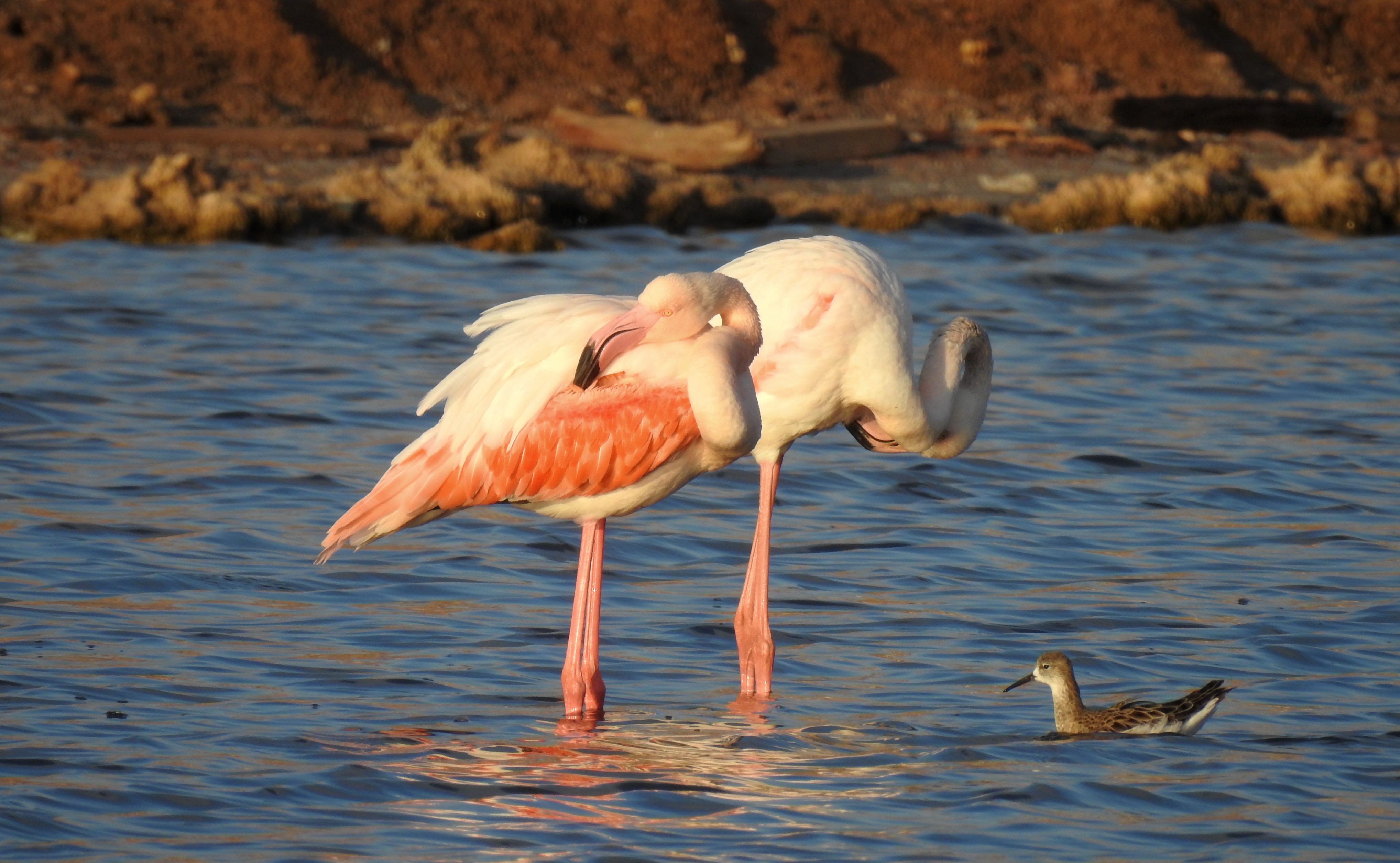
Preening flamingos

Preening flamingos

Driving around the area between the canal and the salt ponds, I spotted an osprey being mobbed by some Indian house crows. Thankfully I was able to pull over to take some pictures as it perched for a minute on a street light. To date, that was my closest encounter with an osprey, and my best picture as well.
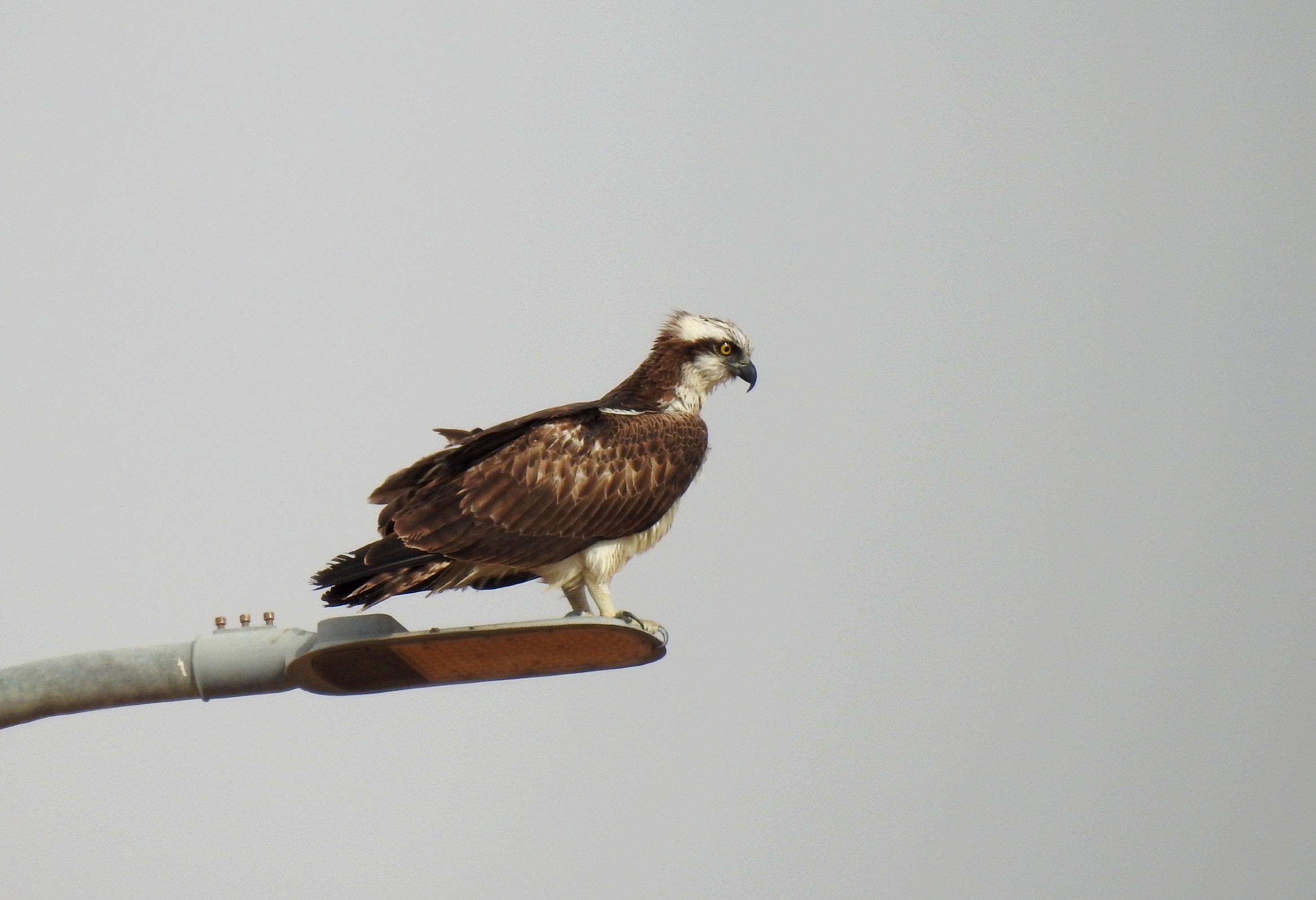
A perched osprey

A perched osprey

When I was done exploring that area, I drove over to Omer’s sandwich restaurant to pick up a nice schnitzel baguette for lunch, to be eaten at the shorebird lookout at KM 20’s salt ponds. I sat in the car and watched the scores of flamingos, waders, ducks and terns that congregated at the famous site. There was nothing of particular interest to me there, but it was nice to revisit a familiar site. So, when I was done with my lunch, I made my way to Kibbutz Samar where another special bird or two were to be expected.

A picturesque blackstart

A picturesque blackstart

Back in 2019, Adam and I attempted to find one of the local black scrub robins that lives in the kibbutz, but with no success at all. We had zeroed in on their famous haunt, the kibbutz “jungle” but nothing remotely black, scrubby or robin-like was to be found that day. I was determined to search again, this time armed with a few additional tips from fellow birders.

Spotting the imperial eagle off in the distance

Spotting the imperial eagle off in the distance

Finding myself back at the so-called jungle, a small copse of trees and shrubs with a shaded clearing inside, I begin with a search of the perimeter. I was distracted by other birds fluttering about here and there, including Spanish sparrows, a redstart and some blackstarts. Suddenly, I saw a large bird of prey soaring against the mountain backdrop to the east, and I recalled the reports of an adult imperial eagle wintering in the vicinity of Samar. I snapped off a couple of photos and confirmed that it was, indeed, the imperial eagle that I had hoped to see. Despite birding on and off for nearly ten years, I hadn’t much luck with imperial eagles (and Adam neither). All of my sightings were of individuals either black specks streaming across the sky in active migration or dark lumps perched on distant power pylons.
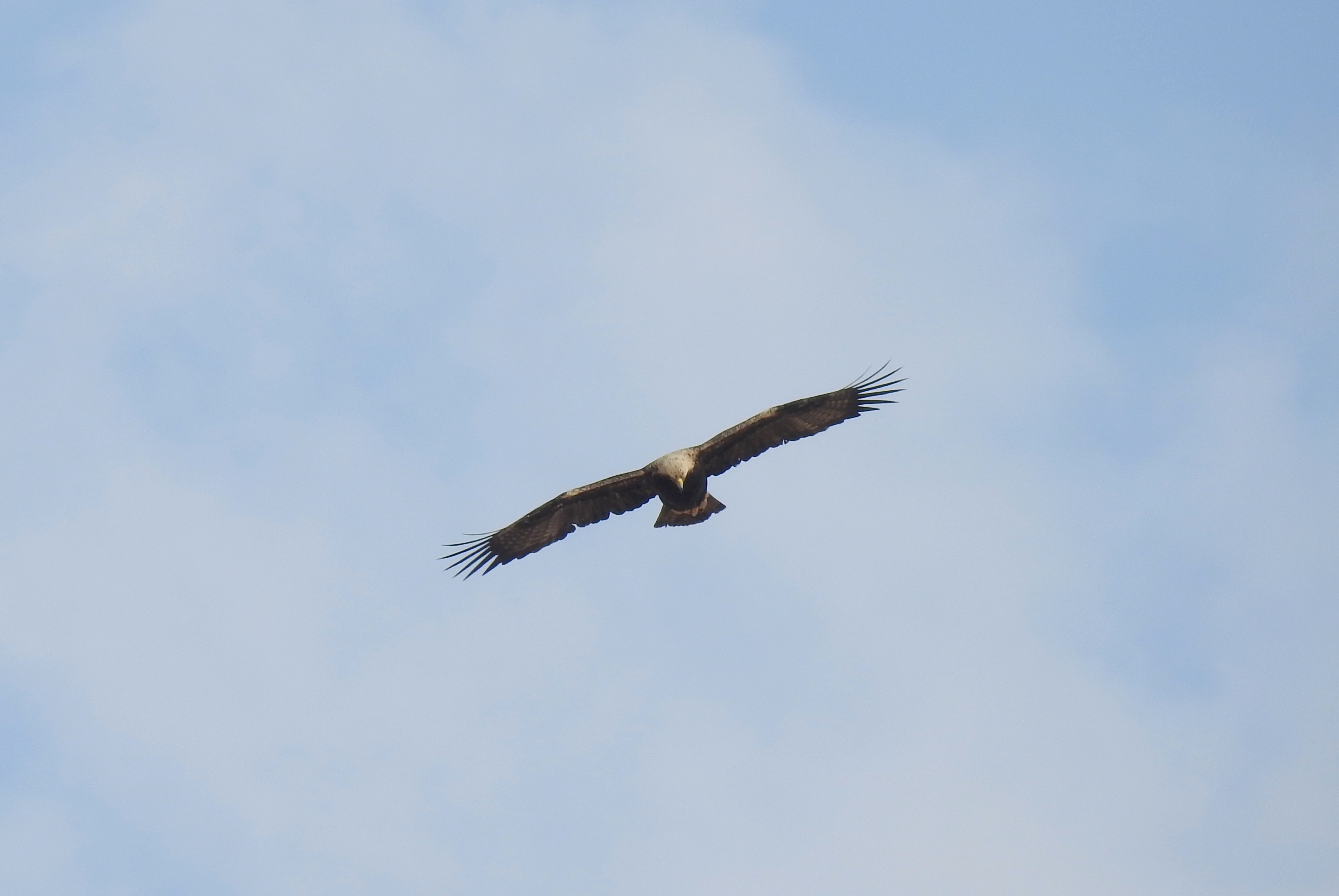
Imperial eagle inbound

Imperial eagle inbound

This beautiful specimen was soaring gracefully through the clear desert air, gliding its way towards me. When the eagle finally disappeared, I refocused my attention on the elusive black scrub robins and continued my perimeter scan. There was a brief moment where something that looked like the tail of one, distinct in size and markings, popped into a bush beside me – but it was far too quick to process properly. I looped around and then entered the “jungle”, ready to be pleasantly surprised. Not quite what I was hoping for, there was a man napping on a mattress inside the cave-like clearing, probably scaring off all the birds.
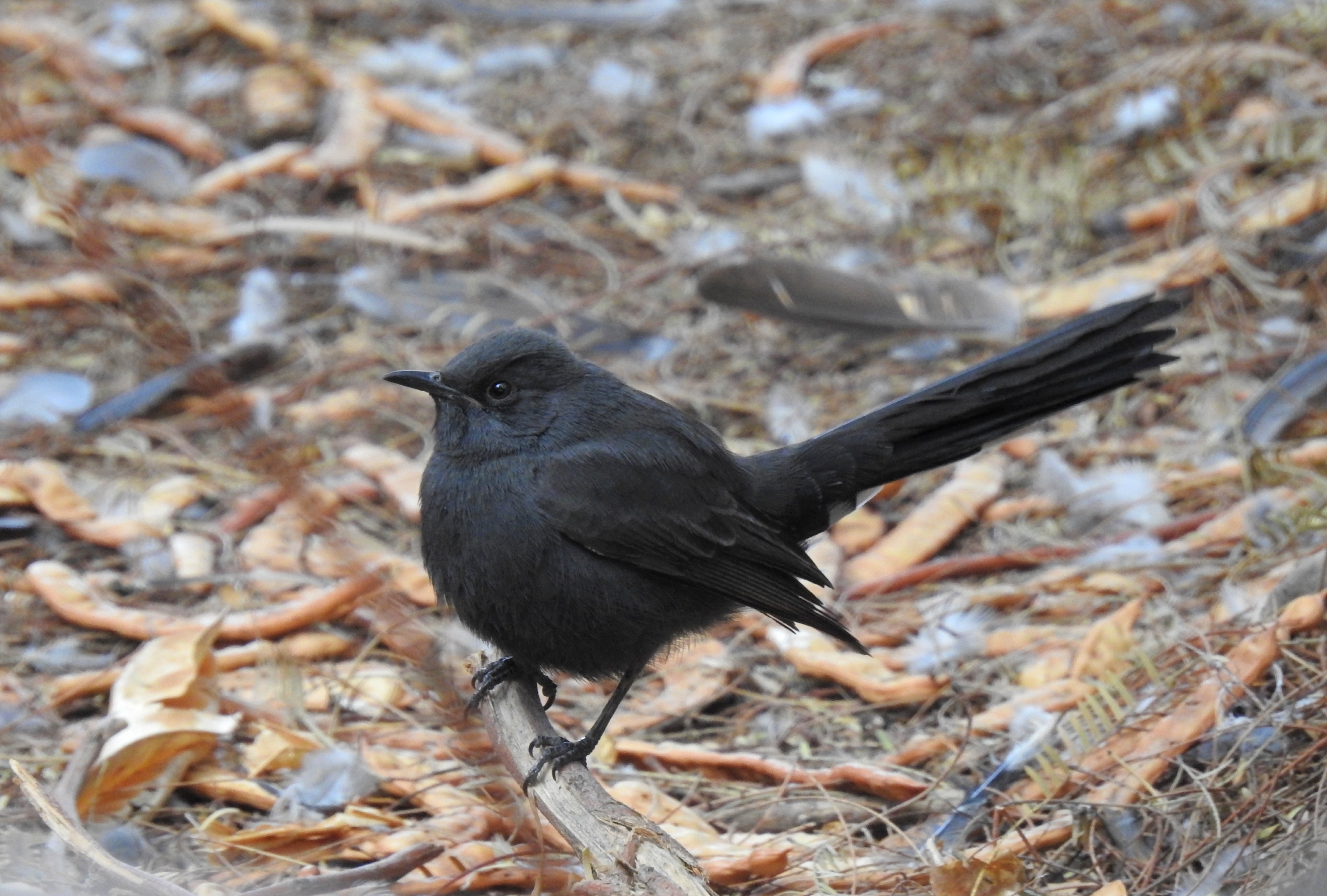
The black scrub robin posing nicely for me

The black scrub robin posing nicely for me

I made another loop of the copse and, when I re-entered, the man was gone. In his place was a black scrub robin, hiding behind a plastic chair. I froze, and slowly reached for my camera. The scrub robin took a hesitant hop towards me, and then disappeared behind the mattress. I gasped, and sidestepped, readying my camera for the moment when the bird would reappear. The drama was quite unnecessary because, once I relaxed, the black scrub robin bounced around happily, appearing, disappearing and reappearing again on the mangrove-like branches.

Lovely layers looking to the east

Lovely layers looking to the east

I was elated, this was yet another lifer – and a hard-earned one, at that. With that positive energy coursing through my veins, I decided it was time to have another go at the challenging birding at Nachal Hemda (KM 94). Driving back up Road 90, I pulled over at exactly the same spot as the day prior, and got out with determination and optimism. I scanned the scrubby streambed for that desirous black dot, and with that failing, I focused on other potential sightings.
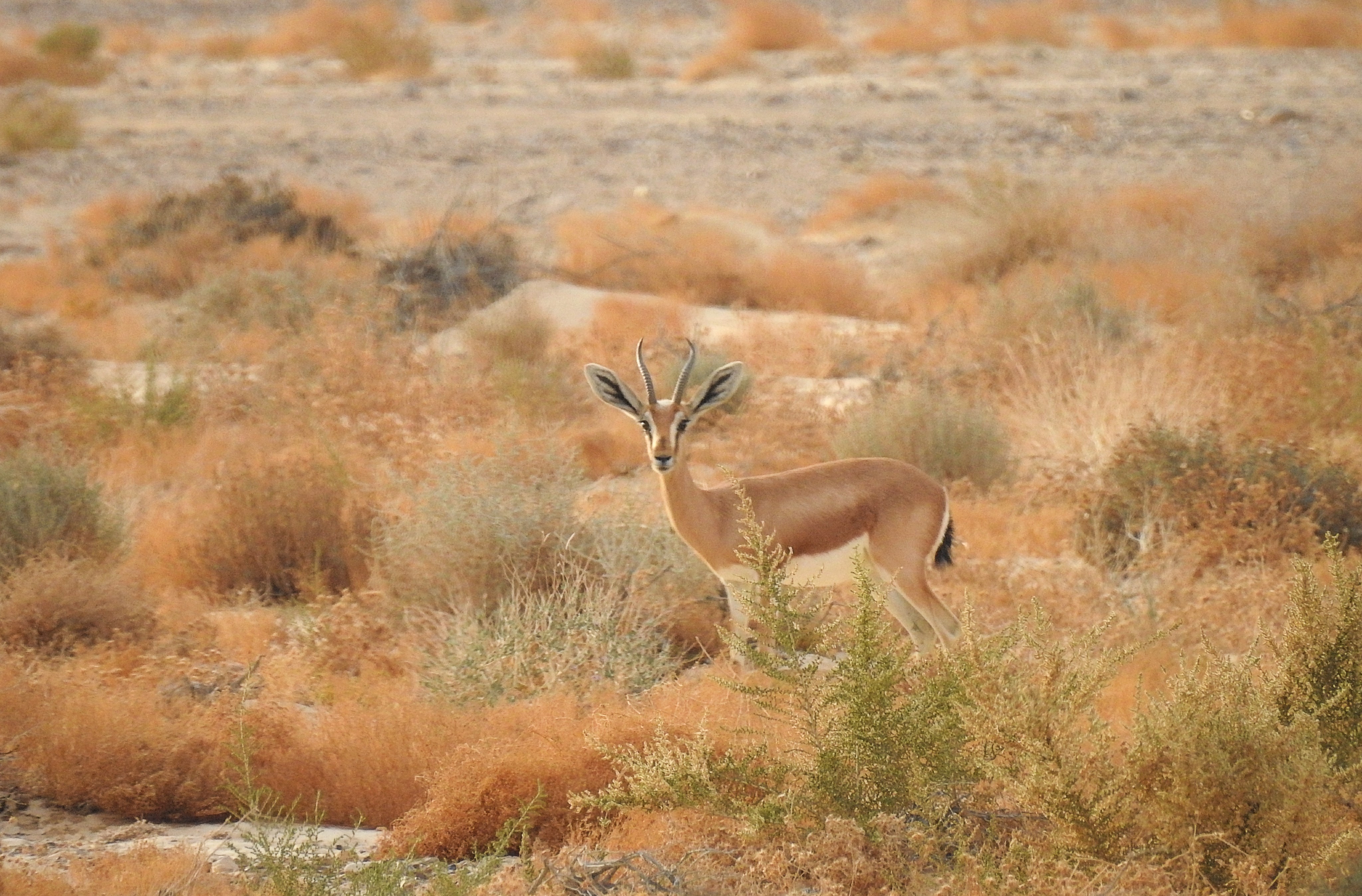
Dorcas gazelle at Nachal Hemda

Dorcas gazelle at Nachal Hemda

A dorcas gazelle surprised me as I began to traverse the streambed, netting a semi-decent shot of the timid antelope. This visit, I changed tactics and walked up until KM 95 before looping around and following the streambed to the west. There wasn’t much to see at KM 95, but walking back down on the western side of the road, I suddenly felt things come into play. I could see what appeared to be a black dot back down towards the KM 94 marker, but about 100 metres to the west.
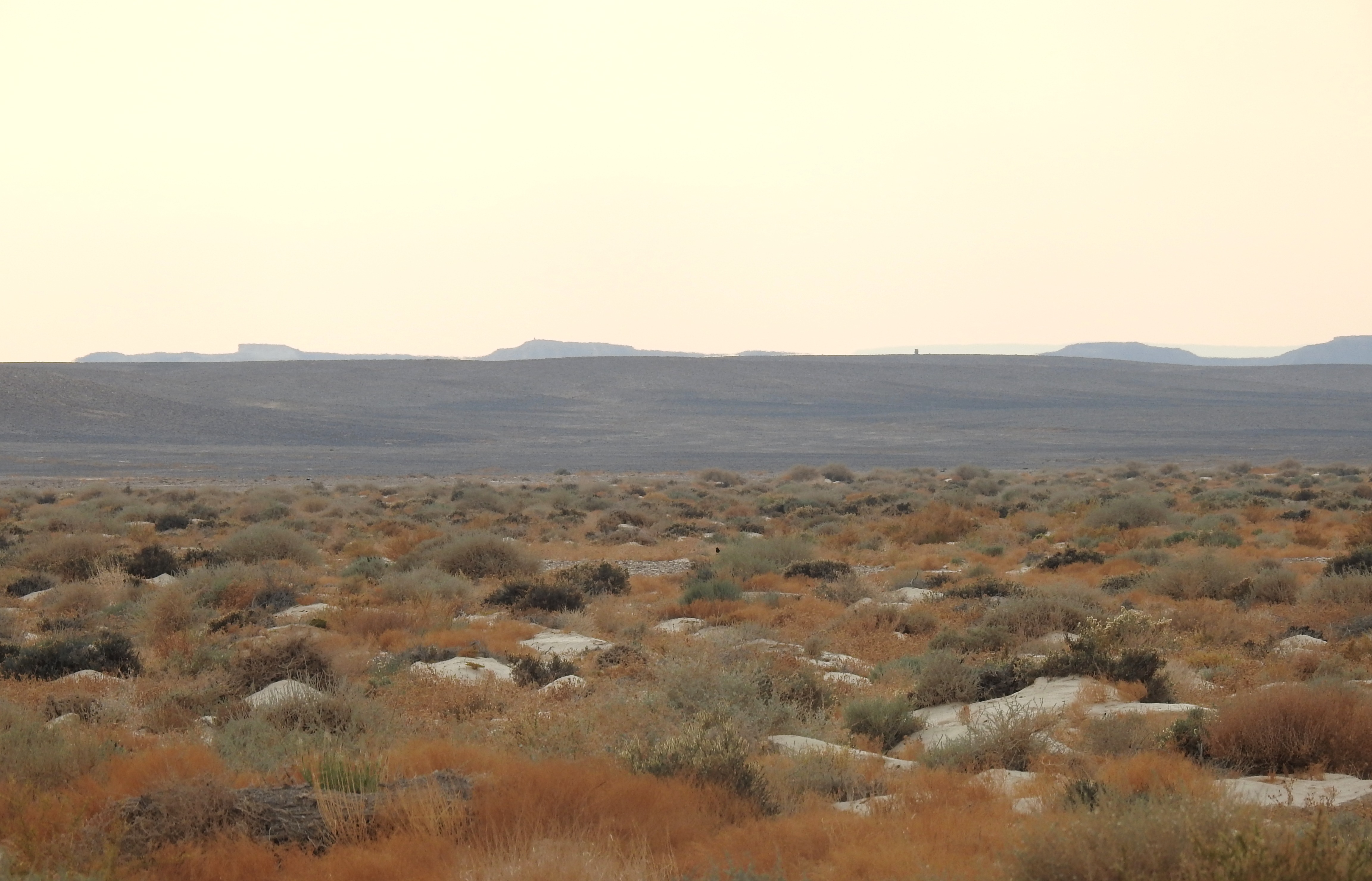
A black dot of a rare basalt wheatear

A black dot of a rare basalt wheatear

It was an eager and fast hike as I homed in on what I hoped was the rare basalt wheatear. If that wasn’t enough, a greater hoopoe-lark appeared out of nowhere in front of me, pacing along the pebble-covered land. I was torn and excited and took pictures with one eye cast towards the basalt wheatear. The greater hoopoe-lark was a lifer, and considered to be a “sensitive species” on eBird, so that there are no public sightings on the platform.

Greater hoopoe-lark as the sun sets

Greater hoopoe-lark as the sun sets

The hoopoe-lark zipped off and I resumed my hike, tracking down the basalt wheatear. Unfortunately, as I got closer, it got further and eventually I had to give up. I didn’t watch to harass the poor bird, being rare and all, and the sun was beginning to set. I still had quite the drive to get back home, and a short hike to get back to the car parked on the other side of the highway.

Mother and child

Mother and child

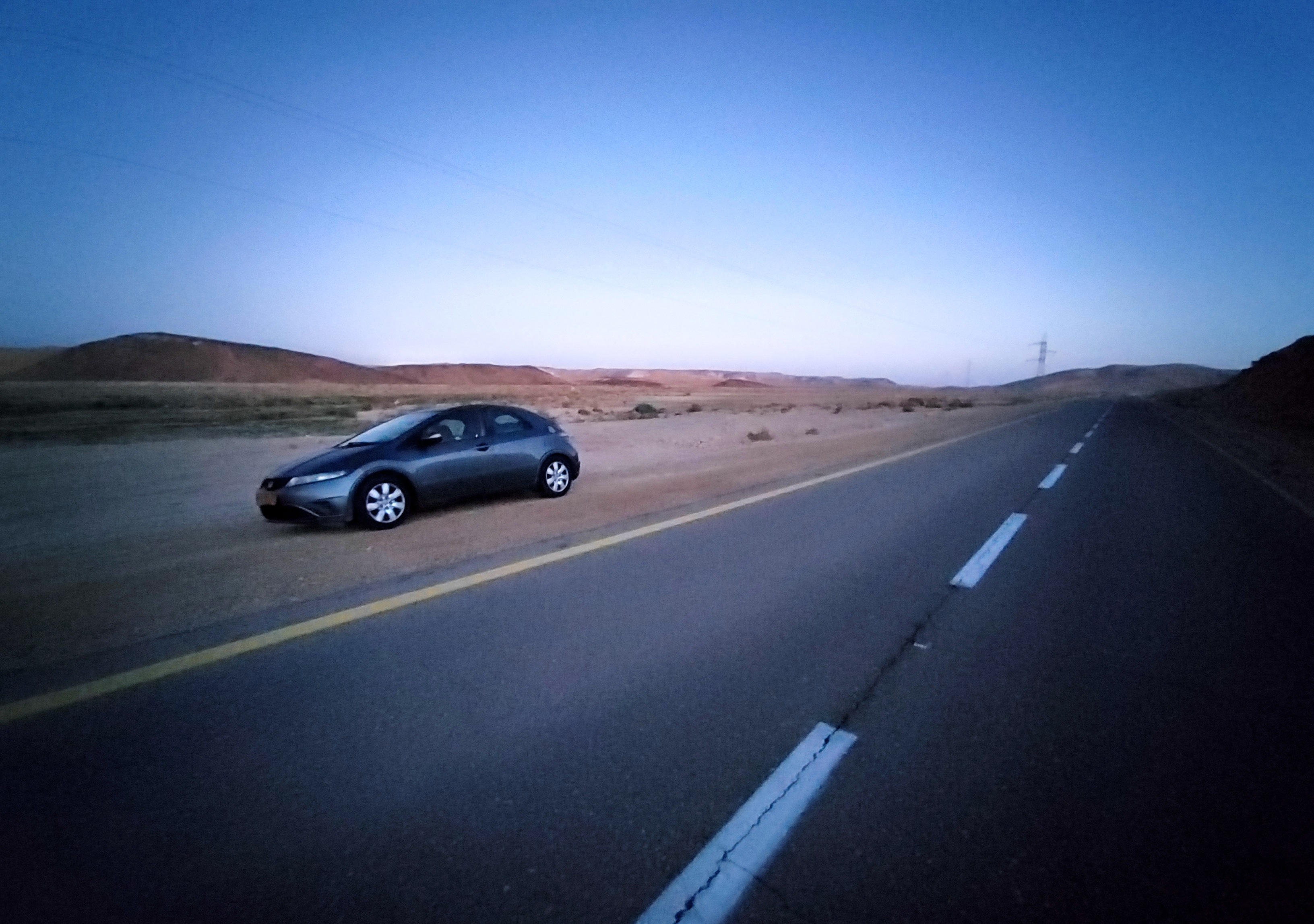
As I was getting to the car, I noticed a few dorcas gazelles on an arid strip of land to the west. I noticed quite symbolically that there was a mother and child present in the small herd. They looked out at me as I took their picture, perhaps representing my own wife and child who were figuratively looking out at me, expectant of my return that evening. With that happy thought, I revved up the dependable 1.8L VTEC engine and launched myself up onto the long black stretch of asphalt, heading nowhere but home.
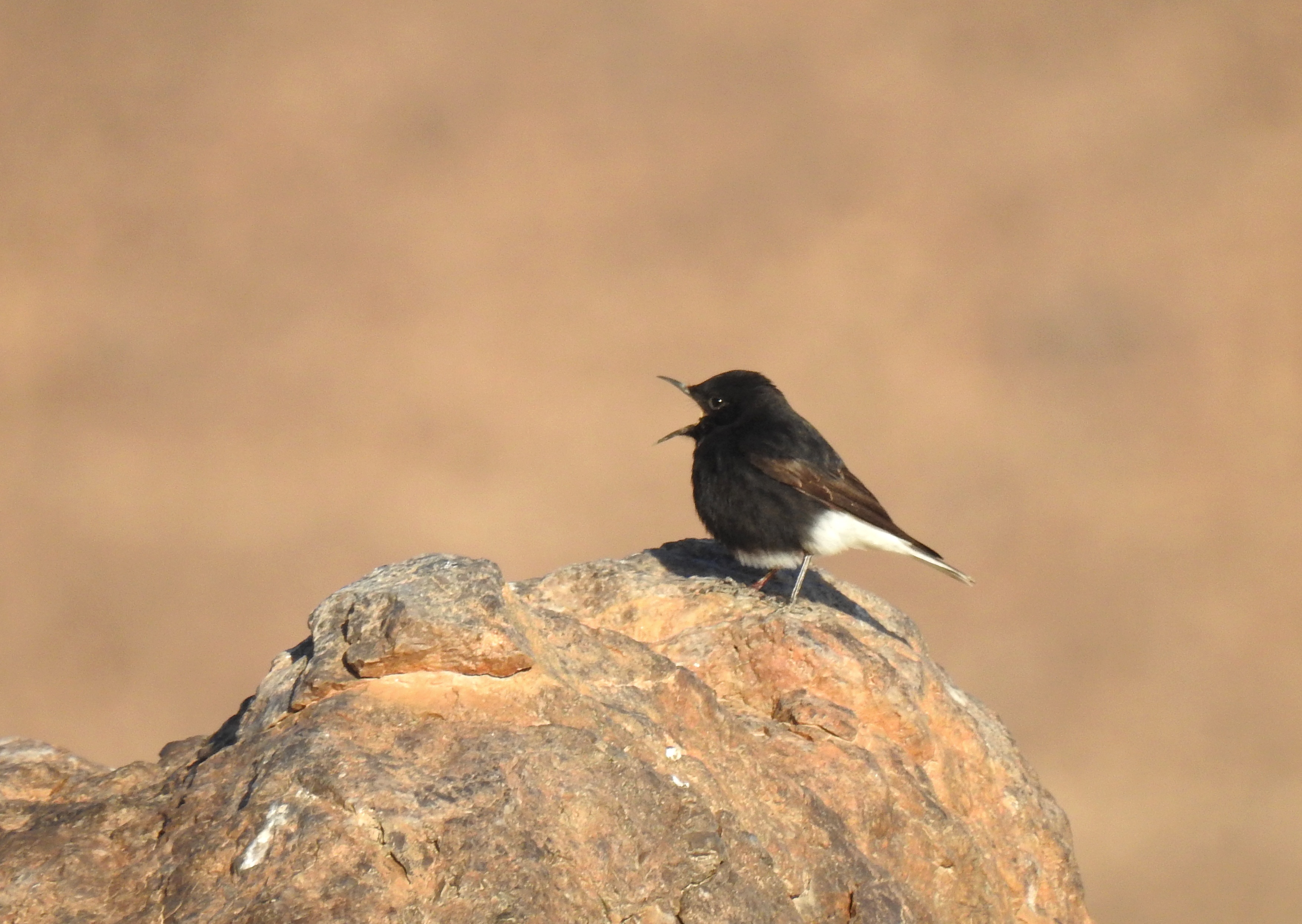
Twitching Eilat and the Arava: Day I

In Eilat, Israel, Negev on July 23, 2024 at 8:12 AM

Turning back the clock to October 7th of last year, the world as we know it took a tragic and heinous detour. I shan’t dwell on the much-discussed events of that terrible day, but the very next day I was called up for emergency military reserve duty – myself and hundreds of thousands of reserve soldiers like me. I spent the following two months or so in a few sections of the country, bouncing back and forth from my home base near Afula to my first station in Be’er Sheva, and my second station at the nearby Tel HaShomer base complex. Alas, during my service, I was minorly injured with a bulging disc in my lower back and was subsequently released from duty. I spent two weeks recuperating, and then returned to my job – certainly an easier transition from military to civilian life than many others have.
White-crowned wheatear

White-crowned wheatear

It was while I was stationed down south that I had a strong urge to have a vacation, to escape for a spell and ideally overseas. That didn’t pan out, but, knowing that I could use a breather, Bracha came up with an attractive alternative. There had been an influx of several interesting bird species further down south, mostly in the Arava and Eilat areas. This would be the perfect opportunity to combine a breath of fresh air with some twitching and quality birding, something that has been hard to come by in the last year or two. In birding nomenclature, the term “twitching” is used to describe one’s pursuit of specific, generally rare, bird species.

Dawn in the Uvda Valley

Dawn in the Uvda Valley

Once the dates were set, I began to do my research – this involved scouring eBird’s checklists and hotspots, reading up on fellow birders’ reports on social media and keeping close tabs on the location updates of some high value targets. I mapped out a series of sites that I could visit over a two day period, optioning in alternate travel plans that would be determined or tweaked in real time. I had a flexible itinerary and a few side missions to attend to in Eilat, including picking up a new laptop that I was ordering (may my trusty old one rest in peace).

My first Asiatic wild asses

My first Asiatic wild asses

With the preamble finished, the adventure began in the wee hours of the morning (approximately 2:45 AM) with a 300-kilometre drive down south to the Uvda Valley, my first destination hotspot. The drive was enjoyable, inky black as I entered the desert regions, and bitterly cold. First light was just cracking through as I turned into the Uvda Valley, and I pulled over on the side of the quiet desert road. The cold penetrated through my layers of clothing as I waited patiently for the light to strengthen. I could make out a few Asiatic wild asses not far off, my very first sighting of this horse species, as well as a few dorcas gazelles. At last, with adequate lighting and stiff fingers, I was able to scan my surroundings and photograph freely.

My first pied wheatear

My first pied wheatear

I took some photos of several species of wheatears, some of them being “lifers” – the term used by birders to indicate the first time seeing a specific species of bird. Wandering about and admiring the crisp desert scenery, I was joined by a handful of other birders who similarly wandered about alongside the road. As I looped back around towards where I had parked the car, I saw an irregular wheatear fly by and noticed that the other birders had taken a keen interest in it. Sure enough, it was a rare pied wheatear – one of the four highly sought-after rarities to grace the region over the winter months.

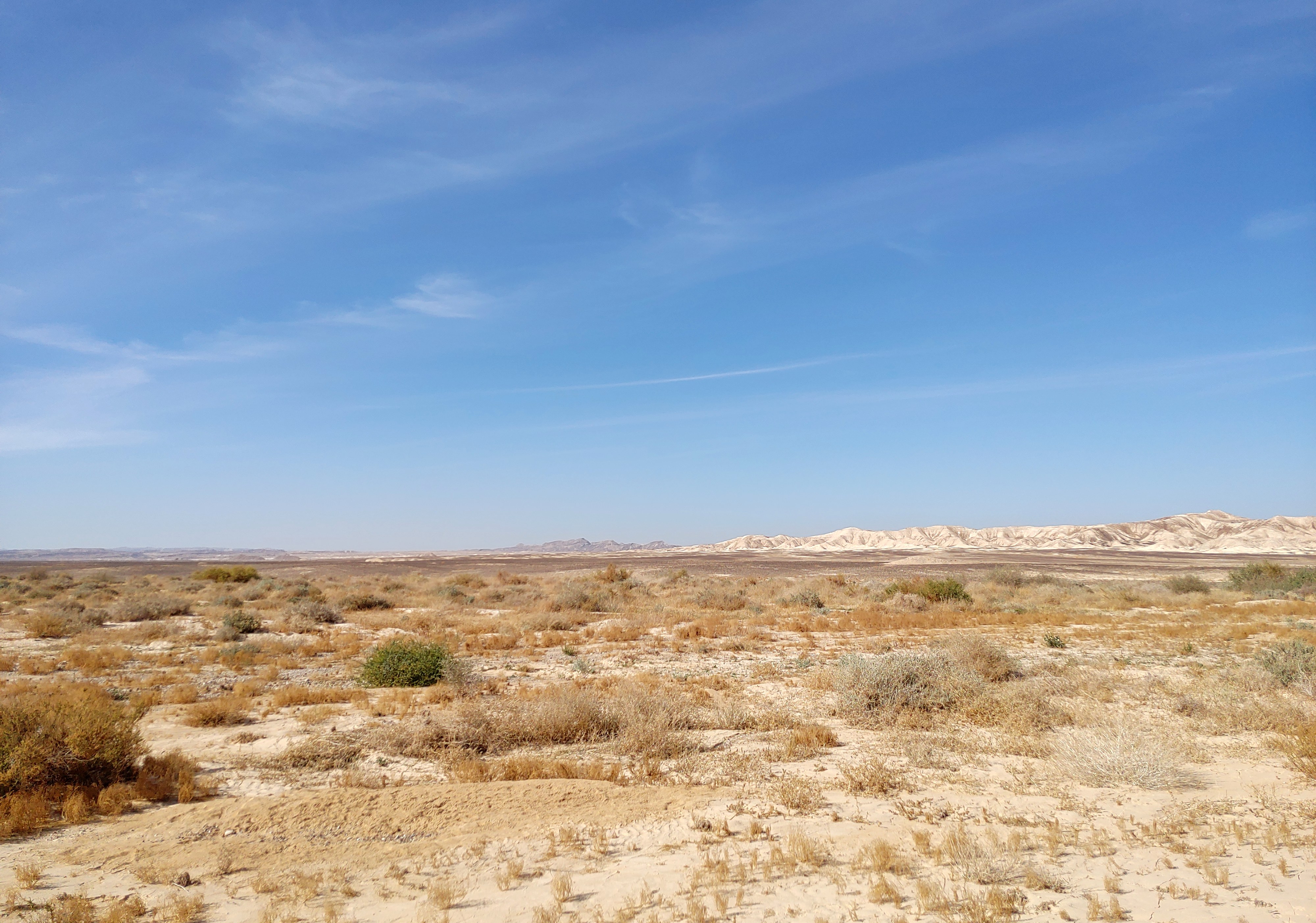
Exploring the drier parts of Uvda Valley

Exploring the drier parts of Uvda Valley

Having chatted a bit with my fellow bird enthusiasts, I took off again to roam about and find more target species. I walked along Nachal Hayyun’s dry streambed and kept my eyes peeled for more interesting species – not only birds. Unfortunately, despite being a hotspot for Arabian wolves, I didn’t merit in seeing any that day. I did, however, see a number of other lifers, which filled me with a deep feeling of joy. As I was watching a few hooded wheatears flutter about with some of their taxonomic relatives, I suddenly noticed a small flock of small brown birds feeding in a swath of grass to my left.

Record shot of my first Temminck's lark

Record shot of my first Temminck’s lark

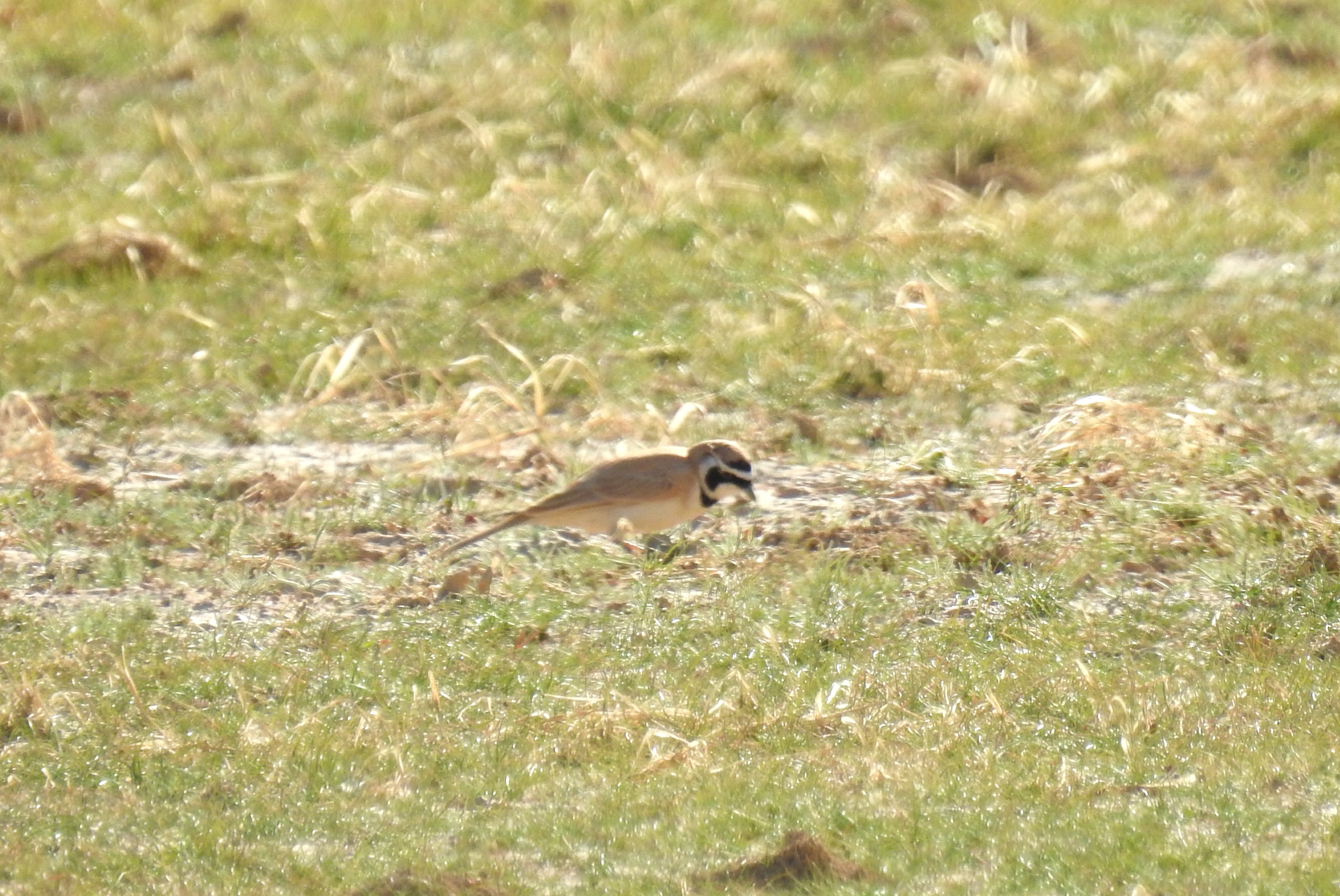
I was seized with excitement as I documented yet another lifer that morning, this time the beautiful, if demure, Temminck’s lark. Hoping to get a better angle, where the morning sun would not backlight the birds, I made a wide circle and then they all flew away. I was saddened, this too is true, but happy that I happened to notice them in the first place. Another high-profile rarity that had been spotted earlier in the month along the streambed was the Menetries’s warbler, but I was unable to find it no matter how hard I tried.

Nachal Hemda (or KM 94)

Nachal Hemda (or KM 94)

Not wanting to leave this vibrant valley paradise, but knowing that there was much more to be seen, I urged myself back into the car and headed for Road 90. I was headed for another birding hotspot, the roadside streambed of Nachal Hemda, known as KM 94 – being at the 94th kilometre marker from the start/end of the road at Eilat. Since it wasn’t the weekend, and the site being an active IDF firing zone, my birding activity was limited to the vicinity of the paved highway.

Open desert expanses at Nachal Hemda

Open desert expanses at Nachal Hemda

I pulled over near the kilometre marker and parked on the hard, dry soil, spotting a single dorcas gazelle which had the indecency of dashing off before I could get a decent photo. Scanning the streambed’s low shrubbery, I was predominantly in search of one prominent species – the globally rare basalt wheatear. While currently floating between the status of species or subspecies, the basalt wheatear is both very rare and very cryptic. The main population is believed to live in the basalt desert of northern Jordan, with individuals making their way down to the Arava every couple of years.

Terrible shot of a desert wheatear

Terrible shot of a desert wheatear

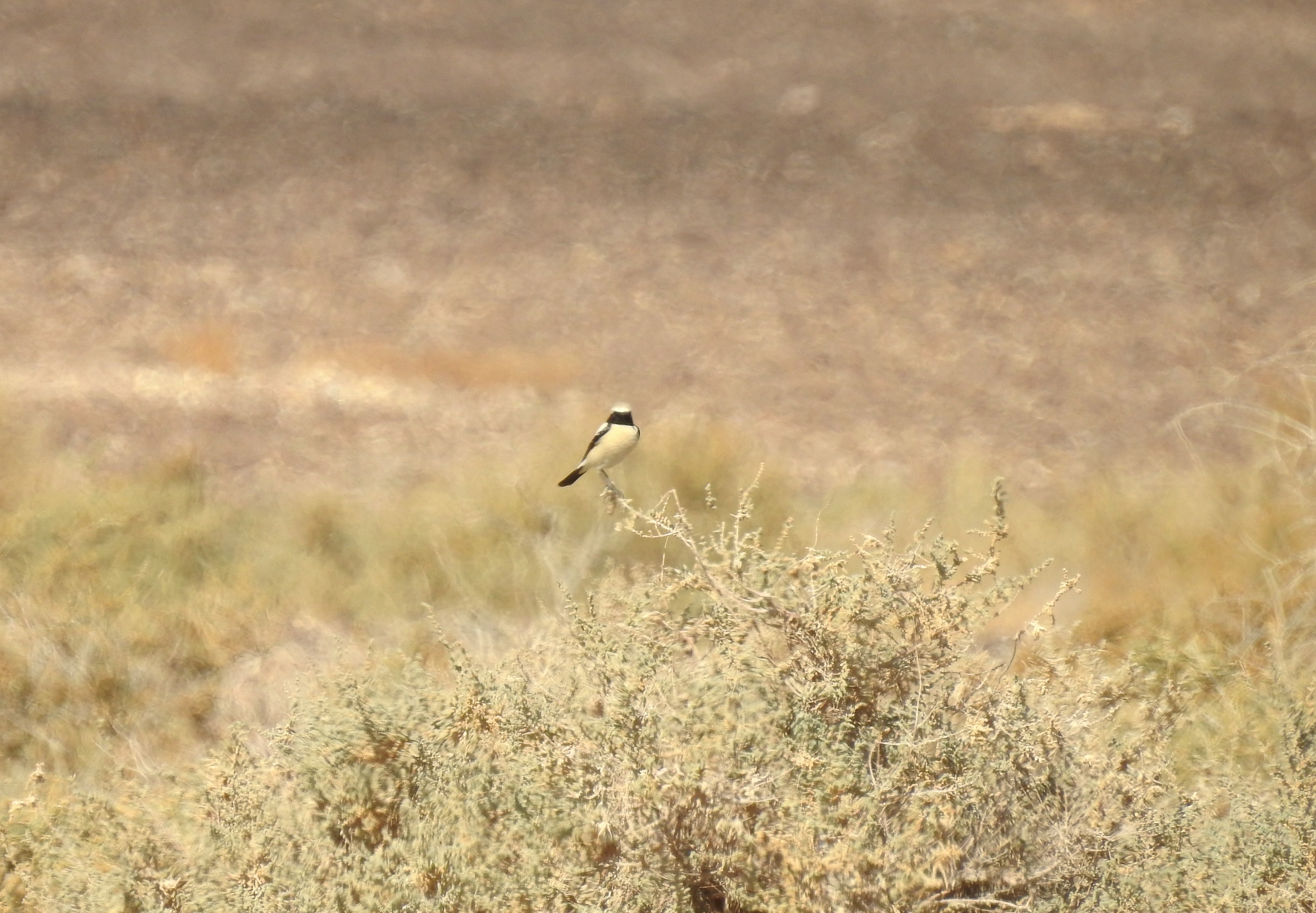
Overall, wheatears are relatively easy birds to spot – they perch conspicuously on rocks or bushes and generally stick to the same area for enough time to get acquainted. Basalt wheatears in the Arava are even easier, their jet black plumage easily noticed in the drab, yellow-brown environs. However, no matter where I looked, there was no tell-tale black dot to be seen – in fact, there were hardly any birds at all. My morale dipped a bit as I failed to find other target species, and the hot desert sun was making my birding a bit uncomfortable. I wasn’t entirely disappointed because there was a small flock of spotted sandgrouse and yet another lifer, desert wheatears, so who was I to complain. I gathered up my hopes and dreams and headed back to the car, ready to try another of my pre-planned hotspots.

Nachal Ketura

Nachal Ketura

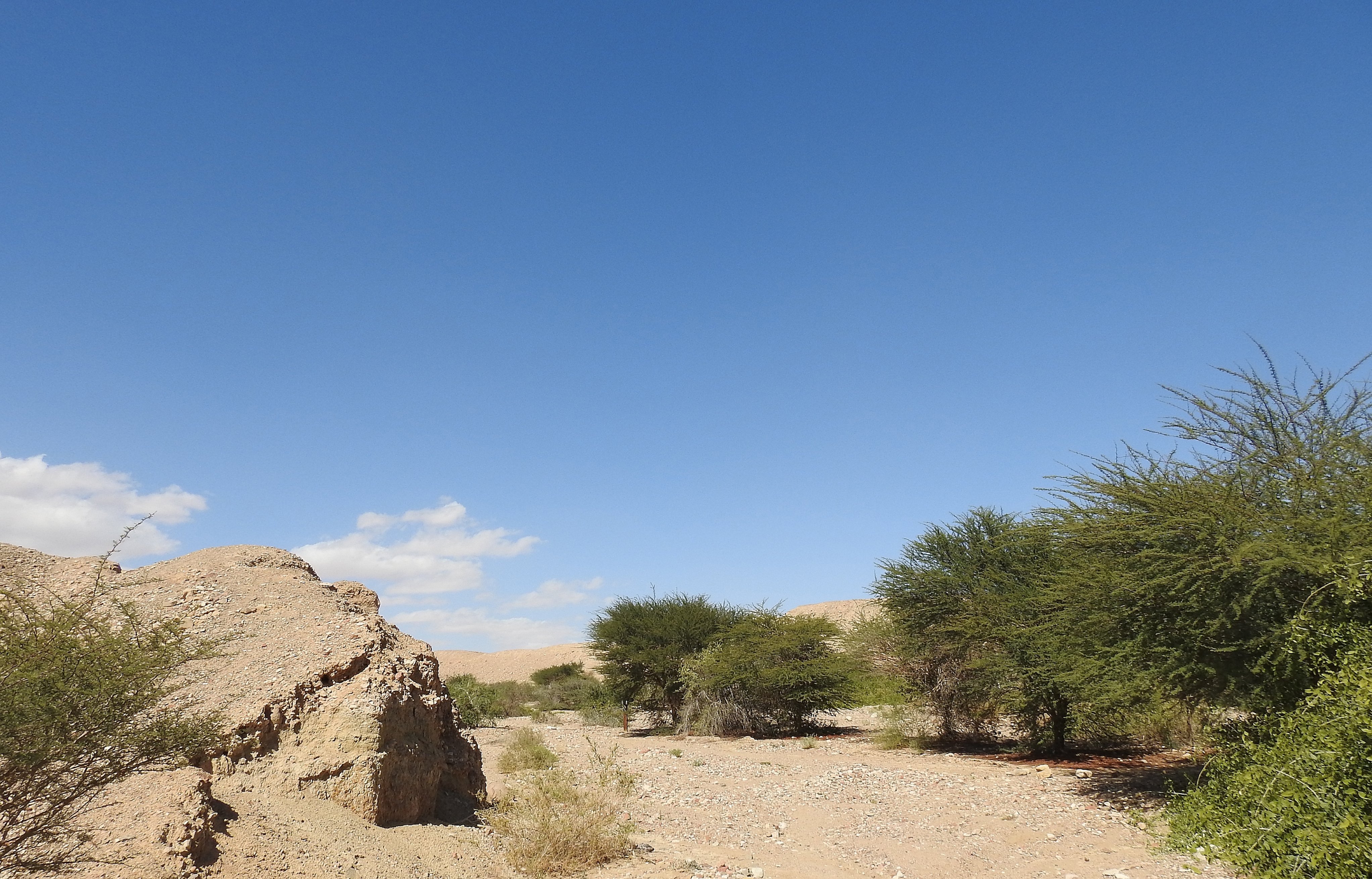
I drove back down Road 90 until I reached Nachal Ketura where I pulled over and parked along the highway. This time, I was in a construction site of sorts, but I had to leave the car and focus on the mission at hand. I needed to find my next target lifer, the rare Menetries’s warbler, which I had failed to find earlier that morning at Uvda Valley. Thankfully, throughout the trip I was able to receive tips and updates from fellow birders, some going so far as to telling me exactly where to look. I hiked a short distance to the dry streambed, dotted with shrubs and acacia trees, and began my searches.

Nice little green bee-eater pausing for a picture

Nice little green bee-eater pausing for a picture

In stark contrast to Nachal Hemda and its overall lack of avian fauna, Nachal Ketura was brimming with bird life. Rock martins and little green bee-eaters dipped to and fro overhead while blackstarts and bluethroats flitted anxiously in the bushes. I stalked around the small trees, one hand clutching my binoculars and one grasping my ever-ready camera, waiting for a warbler to come into view. It was the calls that gave it away, sounds that I had listened to in preparation for this important moment. I zeroed in on a small grouping of small trees and stood stock still, waiting for the grand reveal. My patience paid off and a graceful warbler fluttered into view. It dropped down to the ground and strutted about, looking like a Sardinian warbler but acting like a bluethroat. I watched it hungrily with my binoculars, looking for all of the right identification marks to confirm its ID, and thus, my photo op was missed. It was the only rare lifer of my trip that I failed to get a photo of.

Enjoying a milkshake at Yotvata

Enjoying a milkshake at Yotvata

Excited that my excursion was off to such a great start, I decided that it was time to cool down in celebration with a short stop at the renowned Yotvata visitor centre. Yotvata is famous for their milk and dairy production and the visitor centre boasts sweet dairy treats from chocolate milk to ice cream. I helped myself to a milkshake, a delicious beverage which is sorely missing in my day-to-day life, and had a look around the touristic complex.

The peaceful lagoon

The peaceful lagoon

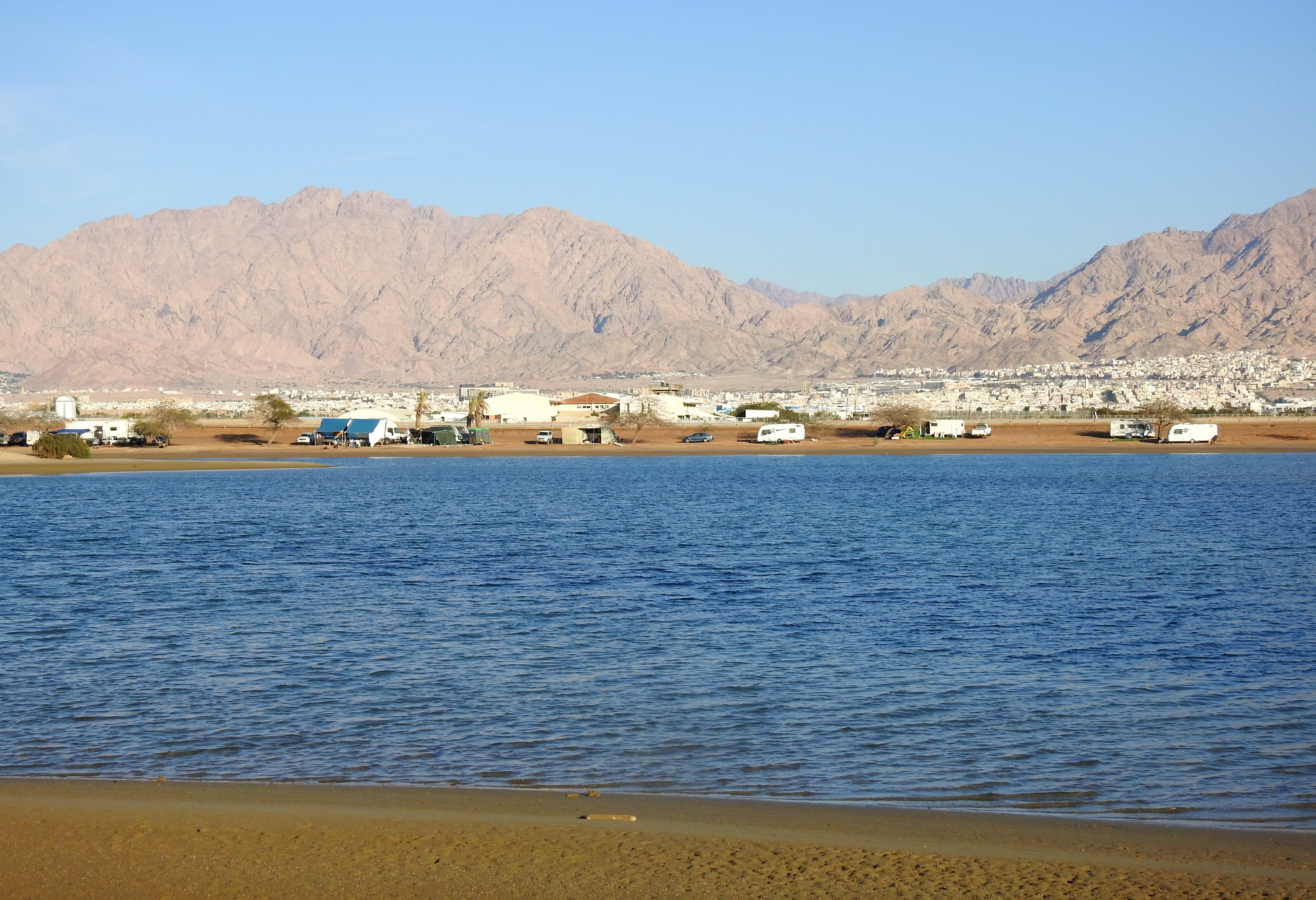
It was finally time to head down to Eilat where even more potential lifers awaited, one patiently bobbing about in a small lagoon just off North Beach. This was the rarest of the rare birds that winter, a first for Israel and an overall humdinger of a sighting. I speak of the Pacific diver, a bird that predominantly lives in the northern Pacific, and of which one has made its way all the way to Eilat. Another easy tick for most twitchers, the diver spent a month or two in the lagoon area, swimming about leisurely and snacking on the small fish that it caught.

The exciting moment captured in the moment

The exciting moment captured in the moment

Sure enough, it was an easy target and I found the Pacific diver bobbing sleepily in the gentle current, the late afternoon sun gleaming through its half-closed eyelids. There was a great feeling of ecstasy as I watched the graceful bird paddle its way around the little lagoon, the bustling resort town setting providing near comedic subtext.

Israel's first Pacific diver

Israel’s first Pacific diver

I wondered how many people around me, and surely all those looking out the hotel windows nearby, had any idea that this bird made its way all the way from Alaska, or some equally remote region of the north Pacific. How many of them knew that this was the very first of its species to have been spotted here in Israel. Surely some people noticed the attention it was getting, and I later saw a short clip that was filmed for national TV (and this delightful video on YouTube).

Looking over at Jordanian Aqaba

Looking over at Jordanian Aqaba

I walked on over to North Beach, just a few minutes away, and looked for some interesting birds and mammalian species. I saw some terns, gulls and some commercial airplanes, but nothing truly captivated my attention – certainly no Houthi cruise missiles. With the sun slowly setting, I made my way back to the car and turned my focus to the other aspects of my trip. I picked up my new laptop, which was a great purchase, and then off for some dinner, light shopping and an early night’s sleep. My initial dinner plans hadn’t been researched well enough, so I ended up just having a nice falafel around the corner from the Melio Hotel, an inexpensive hotel which served my needs perfectly. After an action-packed day, with over 18,000 steps recorded by my smartwatch, a nice warm shower and a good night’s sleep was the perfect ending.

Eilat

In Dead Sea, Eilat, Israel, Negev on July 27, 2020 at 8:50 AM

Just a few weeks ago, in the beginning of July, my wife Bracha and I went on a two-day trip down to Eilat, Israel’s resort town. The trip was organised and heavily-subsidised by Minhal HaStudentim, which offers trips and activities – in addition to tuition help – throughout the year to immigrant students. Being that we are both immigrants and students, we were able to snag this fun little trip for quite the bargain.

Is it a honeymoon or just a group trip to Eilat?

Early Sunday morning we sleepily lugged our bags over to Rishon LeZion, where our dedicated tour bus was waiting. Somehow we ended up being attached to the bus with students from the areas of Rishon LeZion and Rehovot, and not with our friends from Bar Ilan University, but we made the best of our predicament and made new friends. When we had successfully found our permanent seats – factoring in the safety guidelines during this strenuous time period with the coronavirus – our bus driver turned his vehicle in the direction of Eilat.

Our guide, Liran Gabay

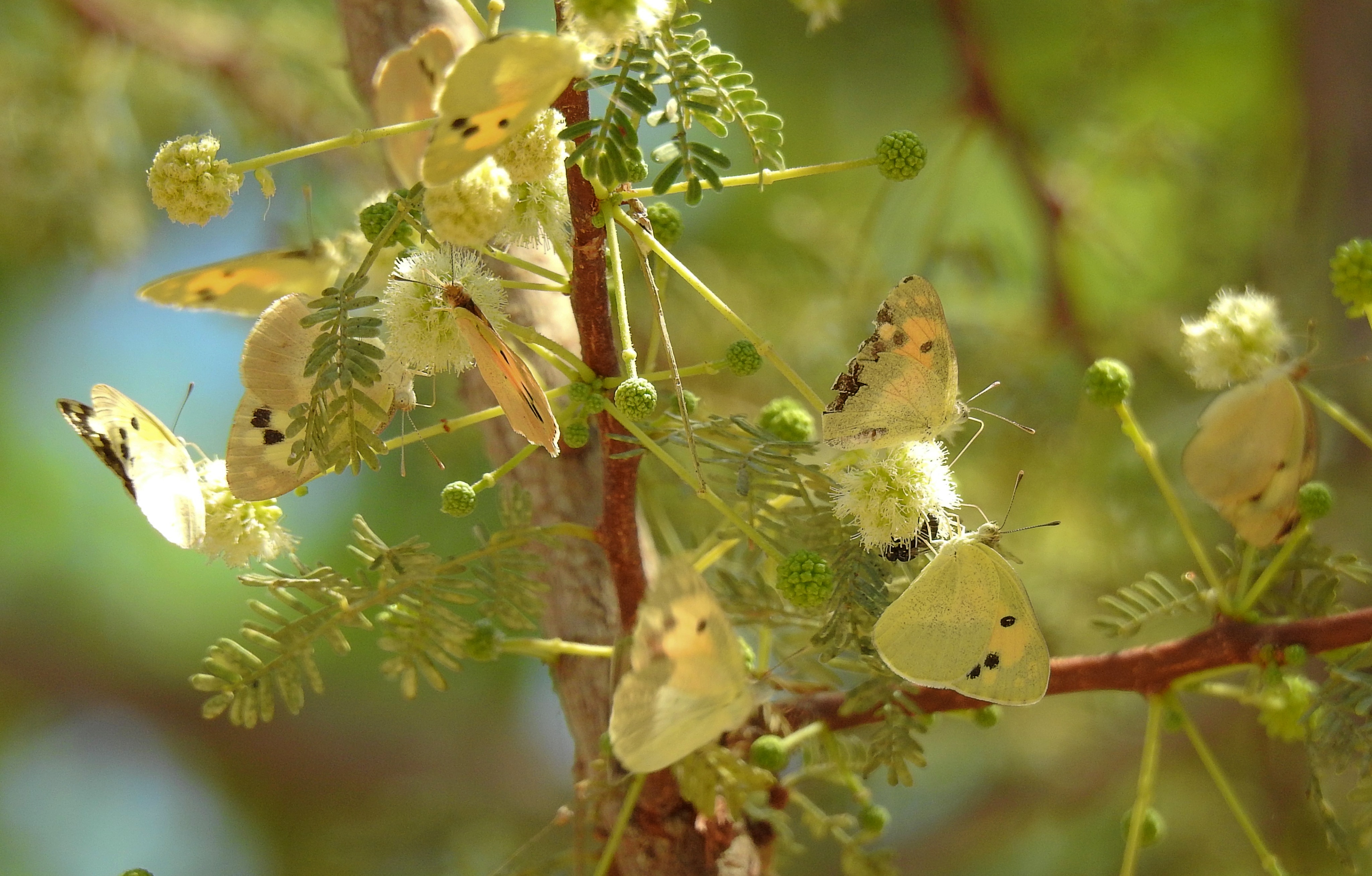
However, we had a quick stop along the way, and that was Ein Gedi off the coast of the Dead Sea. Our route took us through Jerusalem, and our tour guide, Liran Gabay, filled our ears with wordy explanations to the various sites that we passed. Upon arriving at Ein Gedi we were greeted by dozens of fan-tailed ravens and Tristram’s starlings, as well as a splendid number of blue-spotted Arab butterflies – truly astounding to see such concentrations of flappy, yellow wings.

Ten blue-spotted Arab butterflies at Ein Gedi

Due to time constraints, we just did the short walk to the lower waterfall, where we whet our appetite in the hot, dry desert heat. After sandwiches, which served as a pre-lunch, we got back into the tour bus and began the long, straight drive down Road 90 to Eilat. But no, there was still another adventurous stop to make, and that was an extreme park by the name of Top 94. There, we did a variety of activities including a shooting range, paintball and eating lunch.

Bracha firing the .22 sporting rifle

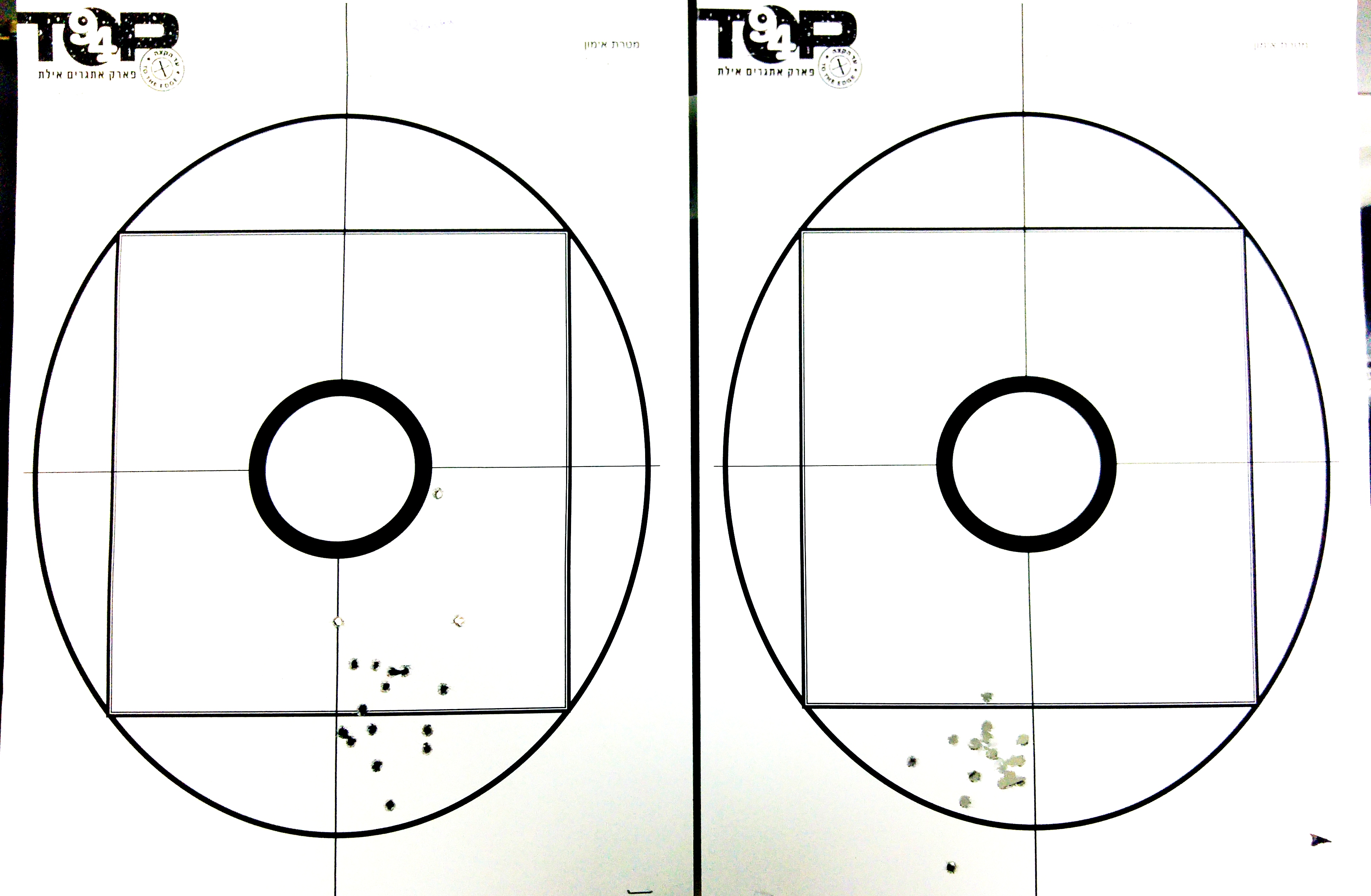
I was quite excited for the shooting range as we were going to be shooting .22-calibre bullets – a calibre-first for me, and Bracha’s very first time shooting any weapon. We stationed ourselves side-by-side and unleashed a succession of hot metal at paper targets pinned up downrange. To my delight, both of us had rather tight groupings, although both sporting rifles’ iron sights were quite inaccurate which led us to wildly miss our targets.

Targets: Bracha’s to the left, mine to the right

Paintball was also delightful, yet the splatters of orange caused a bit of pain and bruising here and there. Bracha and I were on opposing teams in a game format that meant playing just to shoot each other willy-nilly, all in a brown, garage-themed setting. Lunch was nice as well, a generous portion of schnitzel and rice alongside french fries. There was a small museum on-site, the Negev Warriors Museum dedicated to soldiering between the years 1917-1949, but unfortunately it was closed.

Getting ready for some paintball

At last, we boarded our bus and began the final leg to Eilat proper, arriving directly at our sleeping accommodations, the HI Eilat Hostel. The sun set over the mountains of Egypt and we got settled into our own room, a fortunate upgrade that we were able to secure. Continuing the theme of feasting, we headed down to the dining room for dinner – a mess of meatballs, schnitzel, rice, pasta and more. It was an interesting affair balancing a hotel experience with the necessary restrictions regarding serving, which had limited portions with minimised human contact and longer lines, but we made the best of our situation.

Looking out from our hostel balcony

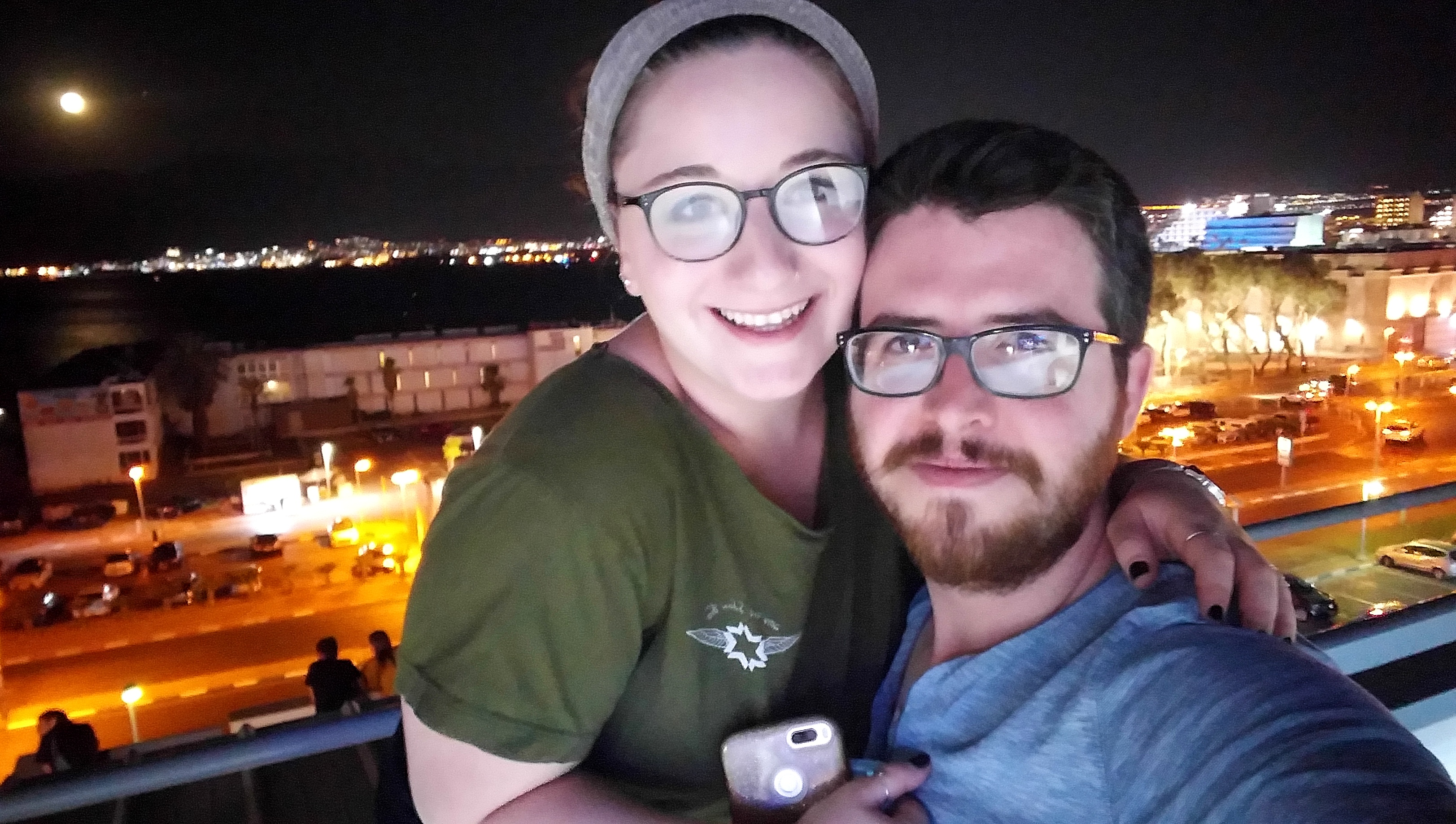
With the culmination of dinner we had a little bit of free time so we headed out to explore the boardwalk area with its plethora of shops, restaurants, bars and more. The gently lapping surf and the full moon’s reflection on the calm water beckoned us near, so we shed shoes and drank bottled cocktails in the coarse sand. It was a profoundly relaxing moment, even with the hubbub of nightlife behind us, and made the perfect ending to an action-packed day.

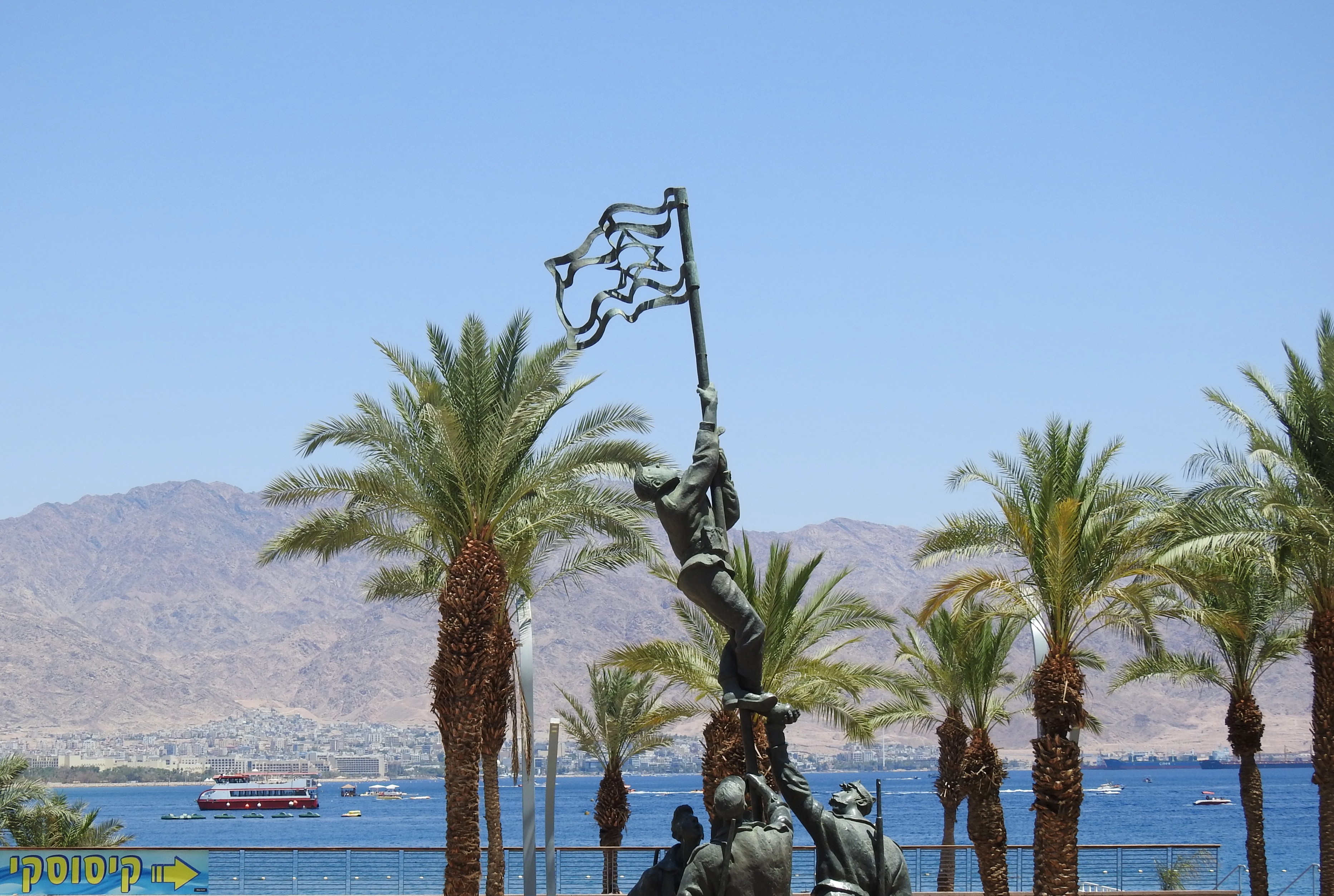
Sculpture commemorating raising the Ink Flag

The following morning greeted us with the hot Eilat sun streaming rays of warmth to heat up another day of adventure. Breakfast was served and then we headed out to our first stop of the day, the Umm Rash-Rash historical site just across the road from our hotel. It was the beginning of March 1949 and the Israeli government was bent on securing access to the Red Sea before agreeing to a ceasefire with the surrounding Arab nations. Two infantry brigades pushed south through the desert and reached the coastal area of Umm Rash-Rash which was being held by Jordanian forces. On March 10, 1949 the conquering Israeli soldiers raised an impromptu flag, known as the “Ink Flag”, a symbol of sovereignty over this tiny patch of coastal land linking Israel with the Red Sea.

Taba bording crossing

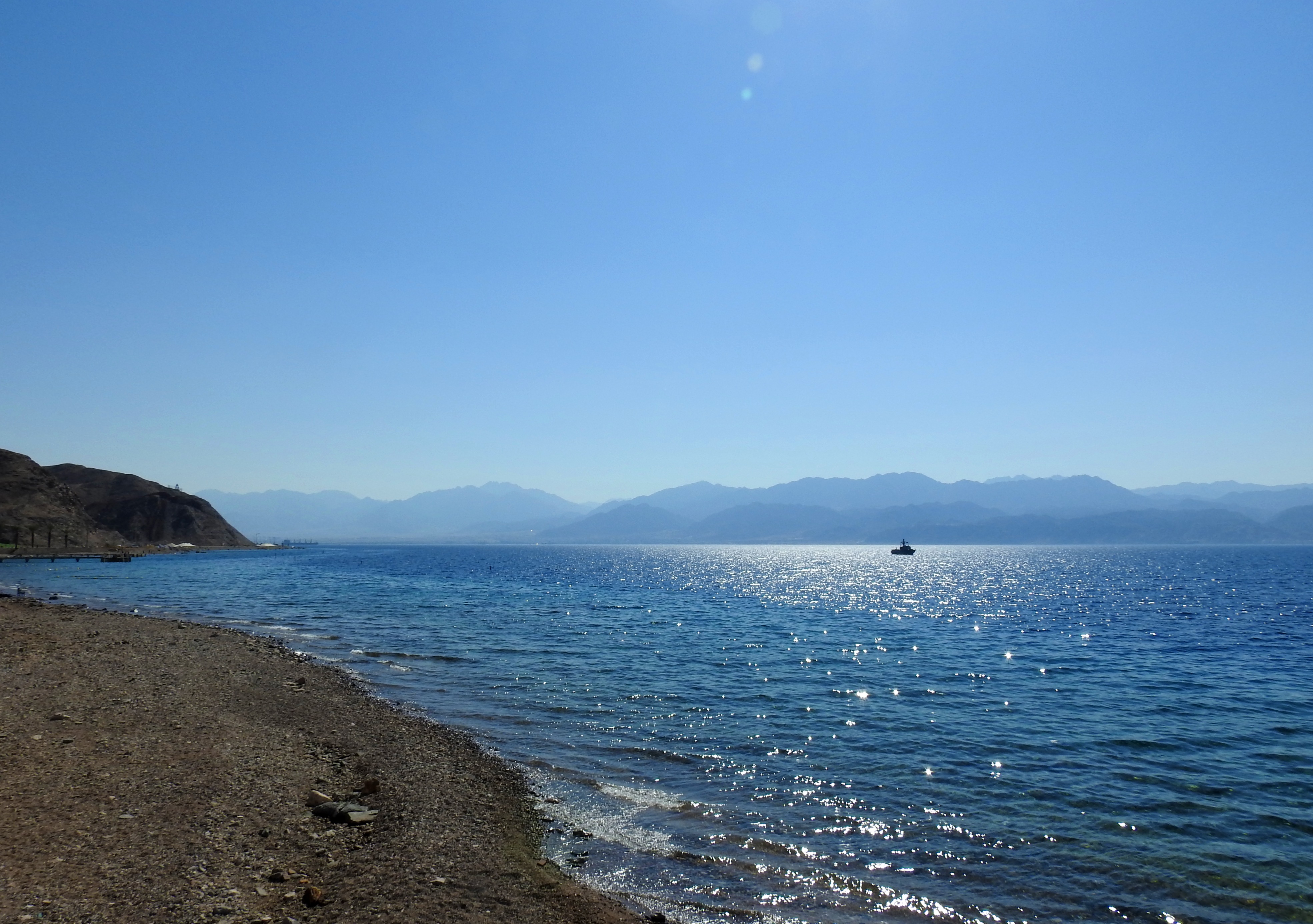
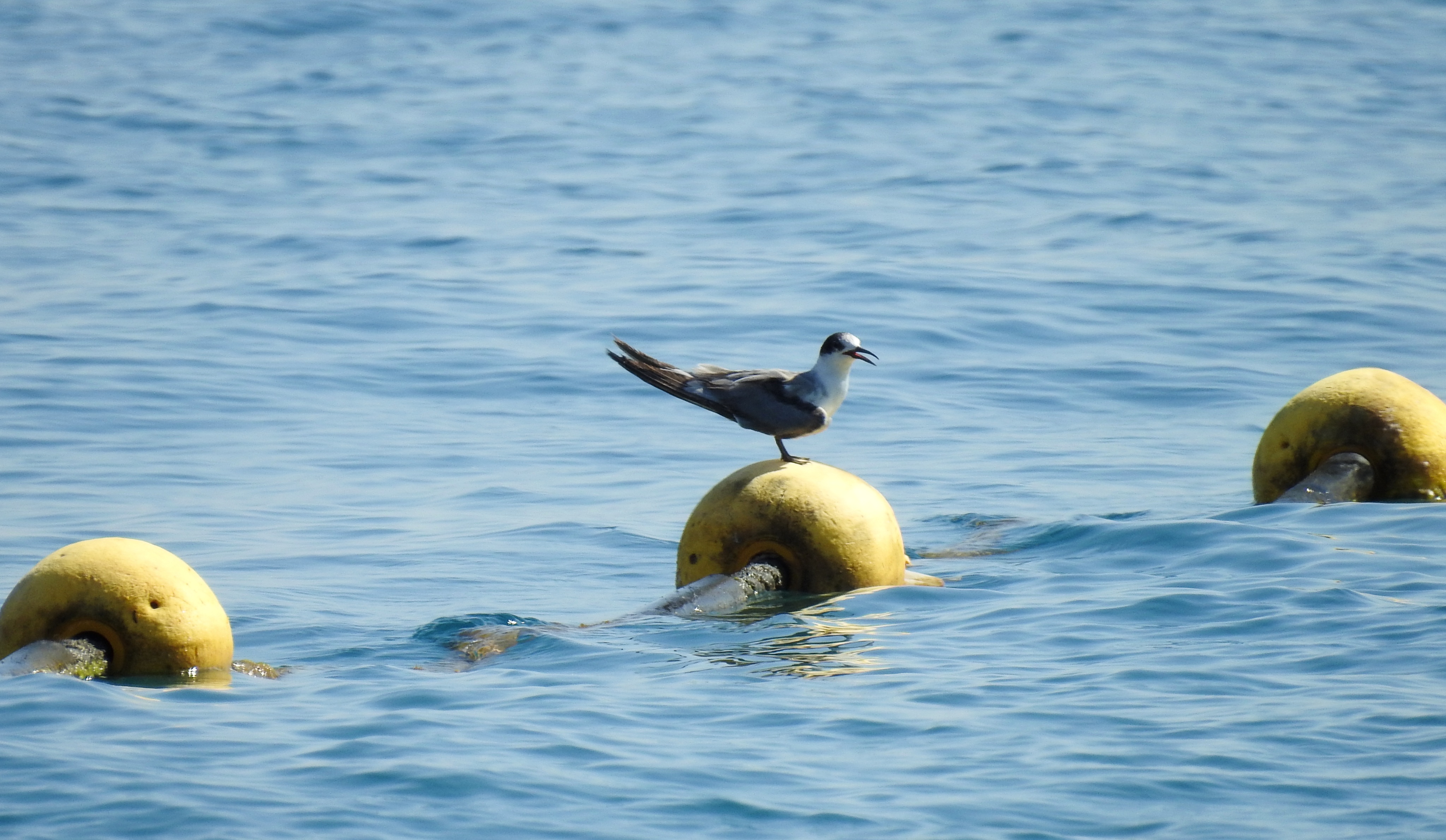
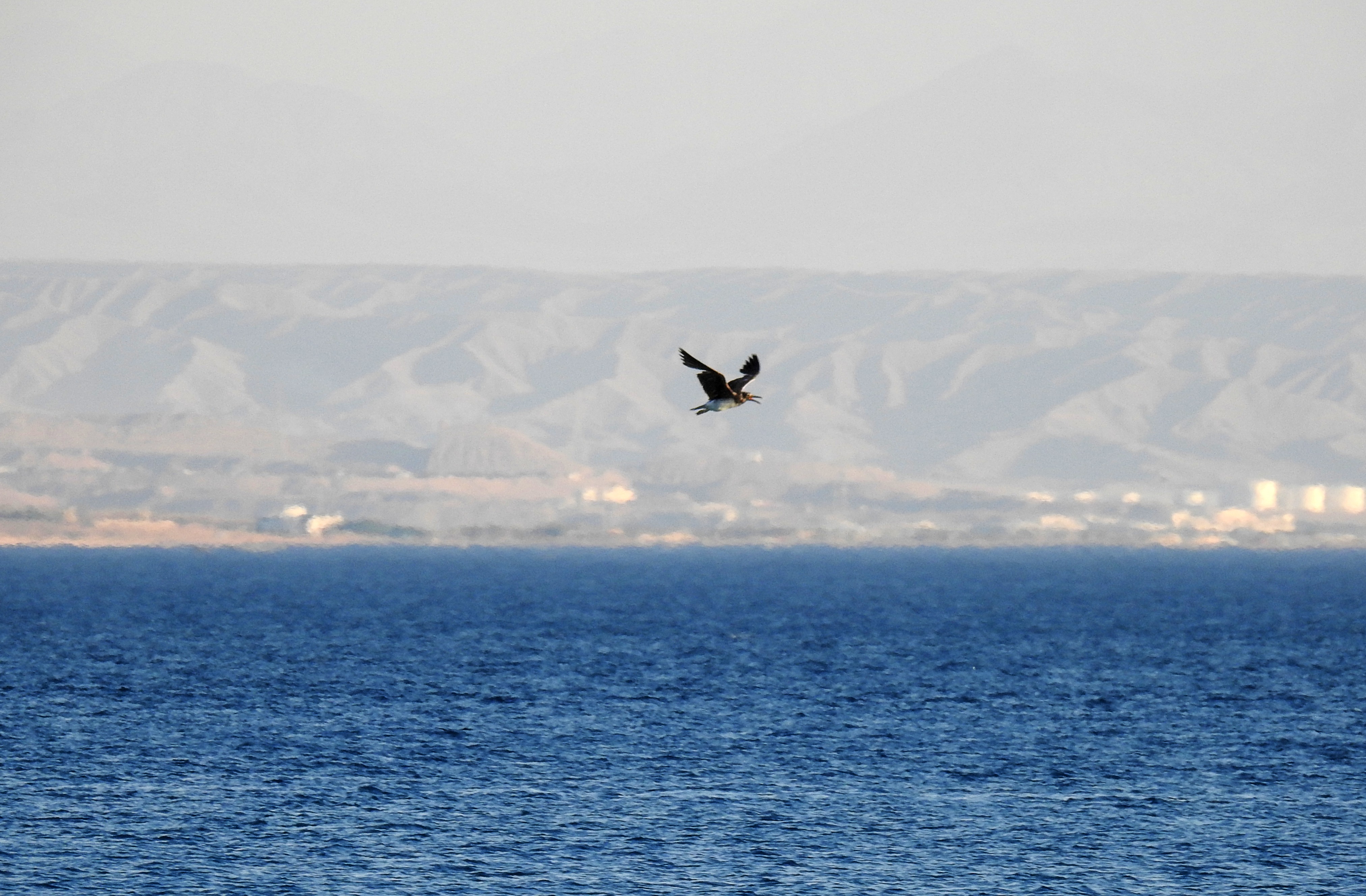
Getting into our tour bus, we were then driven down to the Taba border crossing which links Israel with Egypt. There, we got out to enjoy the expansive view of the Gulf of Aqaba and our neighbours, Jordan and Saudi Arabia. I kept a sharp eye out for terns, gulls and other interesting sea-going birds, and my efforts paid off. I was rewarded with my first ever white-eyed gull, as well as some white-cheeked terns.

The Gulf of Aqaba from the Israel-Egypt border

Our next stop was the Coral Beach Nature Reserve, where we slotted for some fun snorkeling in the reefs. Neither of us had ever been snorkeling, so we were both righteously excited to strap on some gear and plunge into the water, clear waters of the Red Sea. Terns flitted about over the low waves, we burnt our feet in the scorching sand, and the sun slowly ate through our protective layer of sunscreen. Eilat in the summer is truly a sauna, and we so badly wanted to just get into the cooling waters.

White-cheeked tern resting on a floater

At last our time to snorkel came and we walked our way out to the launch point of the snorkel route. For most people it took barely a minute or so to get the mask and snorkel tube affixed and ready to go, but I floundered in the shallows struggling to breathe normally as I peered into the underwater world with blurred vision. Unfortunately, the bespectacled among us couldn’t wear our glasses and with my prescription, I’d be happy if I saw any of the many fish species that live in and around the coral reef. Interestingly enough, this is the northernmost coral reef in the world, but alas, I have no pictures to show for it. When the snorkel activity was over, and I had seen a few colourful fish-blurs which shall remain unidentified, we got back into our bus and headed back to the hostel for lunch. When our bellies were full we were escorted back out to the waterfront, for even more watery activities. This time they were of the boating sense, as well as lounging about on the beach with the other beach-goers.

Coming back aboard after banana boating (photo Liran Gabay)

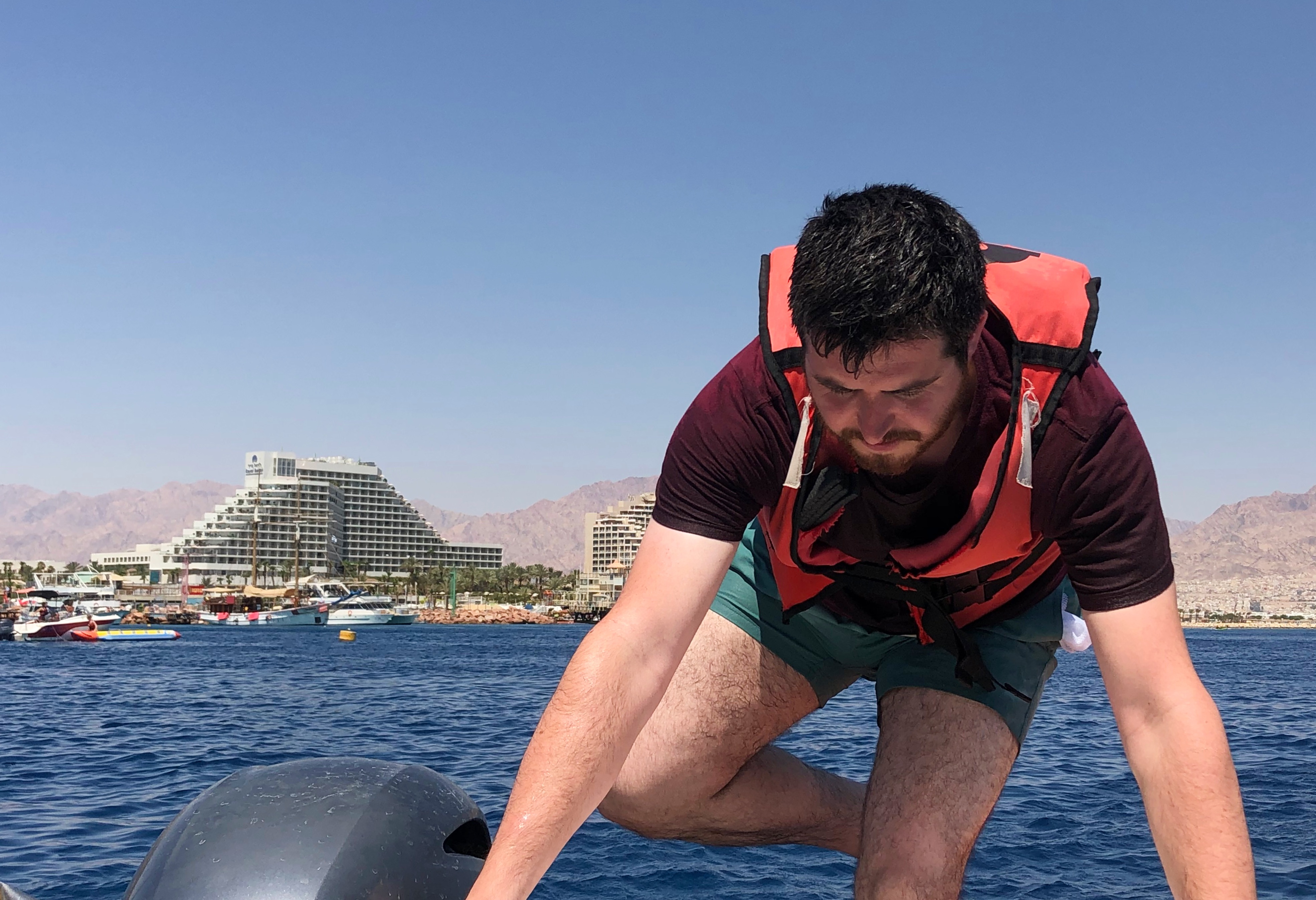
Our first option was the banana boat ride, where we and eight others were shipped out to sea and then marooned on a floating banana-like raft roped to the back of the boat. We hung on for dear life as the boat captain sped away, dragging us along in his wake, cool saltwater splashing our faces liberally. We clung as we laughed, the buoyant raft being swept along effortlessly as the captain throttled his engines.

The more extreme version of banana boating

There were some close calls but alas, nobody was fully capsized and we made our way back to the marina smiling and dripping under the hot midday sun. The next option was an even more extreme raft where the riders lay clinging to a rectangular float only to be flung about wildly. There’s a mutual understanding that those riding the rafts desire to be slightly drowned, and that the sea captain desires to do the drowning. Bracha and I decided that we’d rather watch the proceedings unfold, and I rushed to get my trusty camera.

Green sea turtle at Eilat

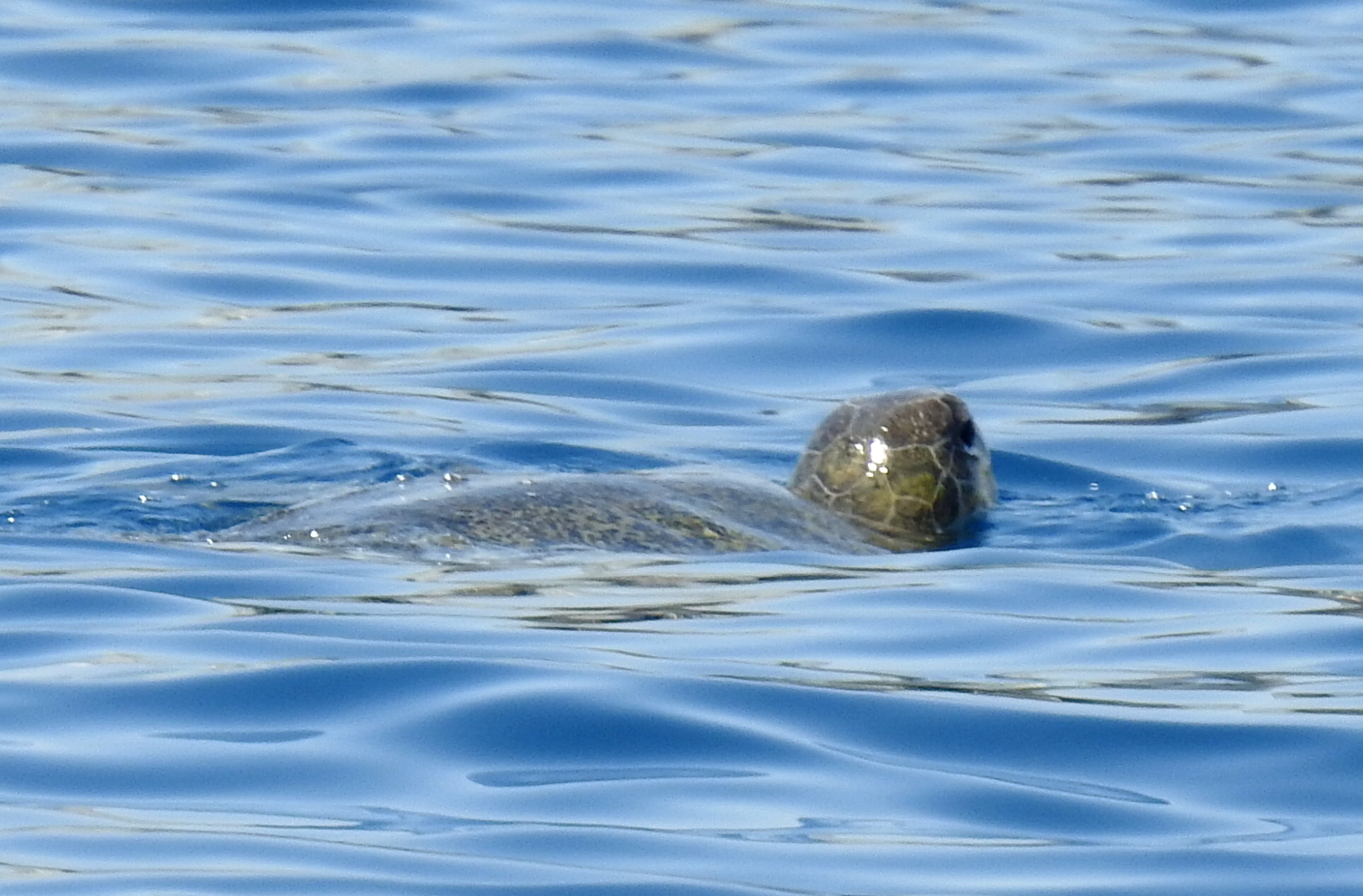
The eight riders flopped about in the foamy water, the spray dousing them with every turn. Bracha laughed heartily as the riders clung desperately to the raft, only to be thrown off every other minute. Indeed, everyone was laughing and a good time was had by all. One of my favourite moments, however, was when one of the fellow students spotted a green sea turtle coming up for air in the marina.

Eilat’s North Beach

After the boats we spent a bit of time in the water and then headed back to the hostel to change. I had been angling to pay a quick visit to North Beach, a famous birding haunt, where I was hoping I’d see some new and interesting terns, gulls, sea birds and the like. Bracha joined me and we walked along the beachfront boardwalk, replete with excessive tourist attractions. It was a longer walk than either of us had anticipated but at last we made it and we stood at the seashore as the sun began its daily descent.

Juvenile white-eyed gull flying over the sea

I scanned the seas with my binoculars, seeking flapping or soaring wings, but also made sure to check the far-out floating buoys. At first there were just more white-eyed gulls, but then a large tern appeared overhead – my very first Caspian tern, a true behemoth of his genus. That certainly was exciting, but I wanted more. I checked the drainage canal for birds, but there was nothing identifiable, so I scanned the seas again and again.

Some invasive house crows

One of the delightful aspects of birding is the unpredictability involved; sometimes, where you expect to see something you do not, and other times, sightings come as a wonderful surprise. Knowing that one day I’ll eventually tick off other, yet-unseen terns, gulls and other seabirds, we headed back to the hostel for a “barbecue dinner”.

Lantern tour at Timna Park

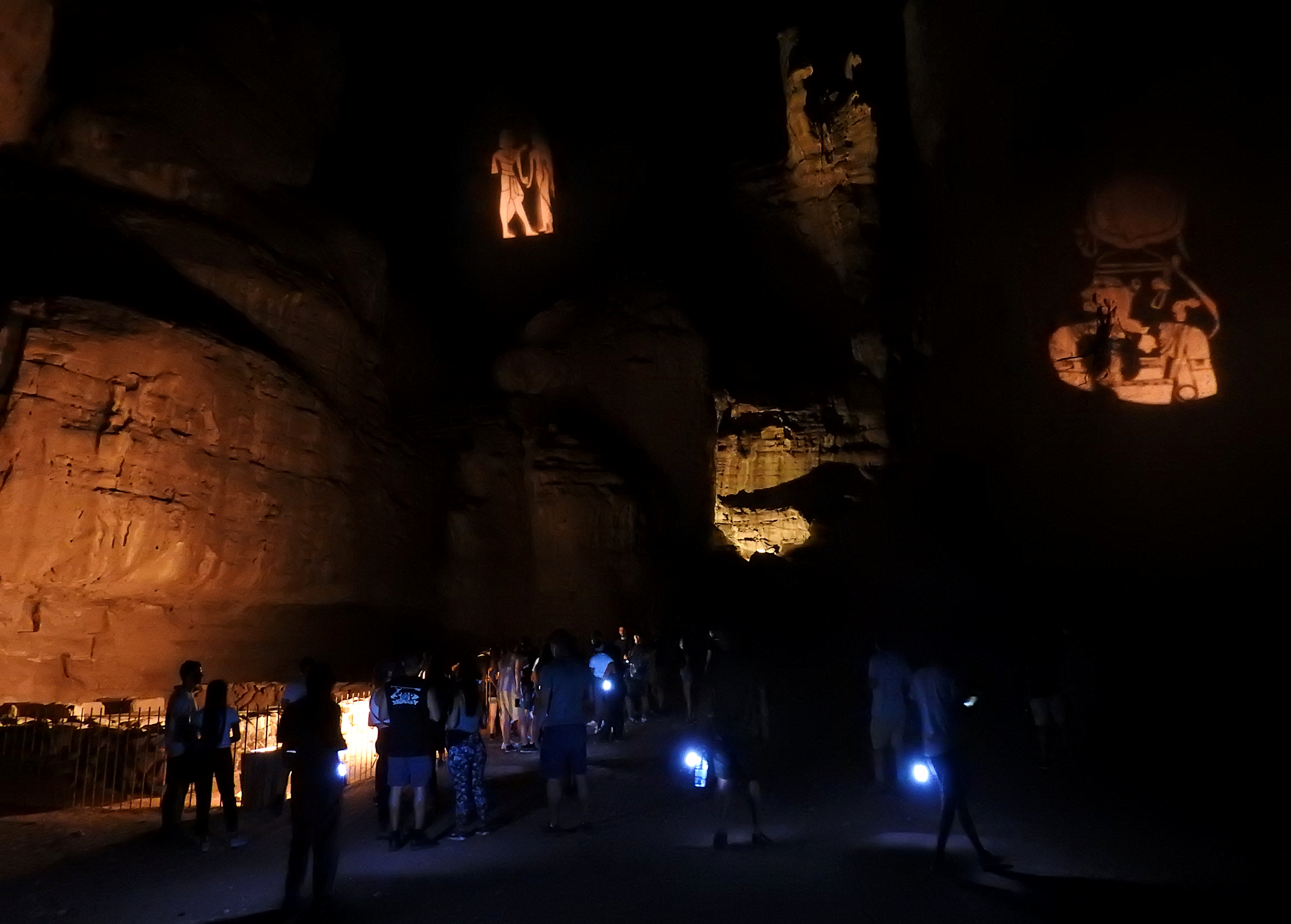
The government had convened once more to discuss the ongoing coronavirus pandemic and it was decided the restrictions be put in place once again. Therefore, our trip was being brought to a premature end, and some of the much-anticipated events cancelled. Hoping to give us one last hurrah, it was decided that we’d have a quick early night trip to Timna Park for a special “lantern tour”. I had been to Timna twice before, see HERE and HERE, so I was okay with the idea of going at night – despite the fact that the ground colour is one of the park’s finest features.

Egyptian influence at Timna

Our lantern tour was surprisingly picturesque, and certainly everyone made the most of it as we knew that we were to be heading back up north on the morrow. It was late when we returned, but that didn’t keep us all from enjoying one more night in Israel’s resort town. On the drive back the following morning we saw a few nice species of wildlife from our bus window – including one dorcas gazelle spotted by Bracha.

Mitzpe Ramon’s desert sculpture garden

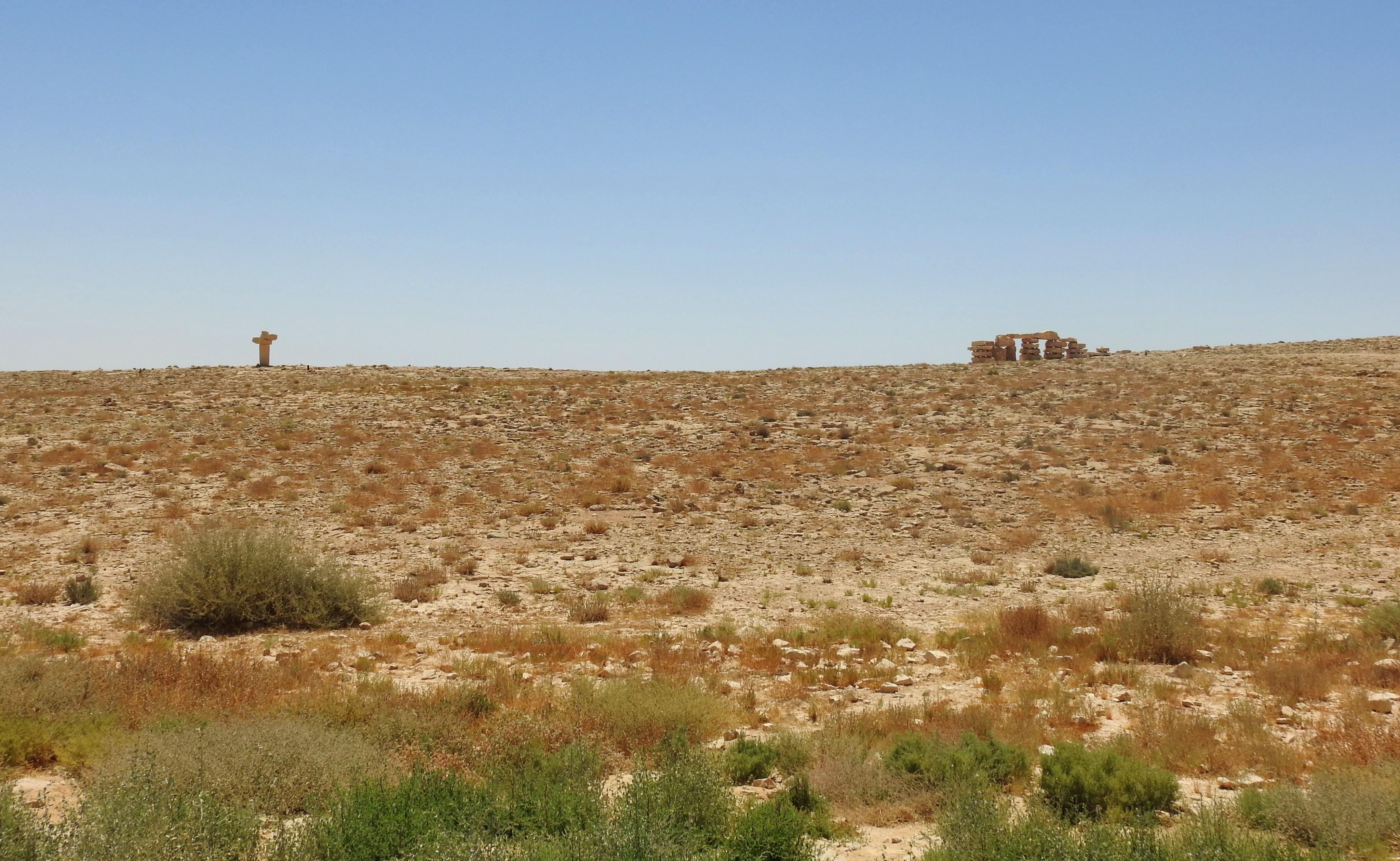
We also made a quick stop at Mitzpe Ramon where I took the opportunity to walk out into the Desert Sculpture Park along the Israel National Trail. We arrived back home safe and sound, thankful for our special little outing but also ready to get back into our daily routines.

Lovely bit of vacation

More trips were to be had shortly, as my friends were angling to get out and explore as well.

Southern Arava

In Eilat, Israel, Negev on June 12, 2019 at 10:02 AM

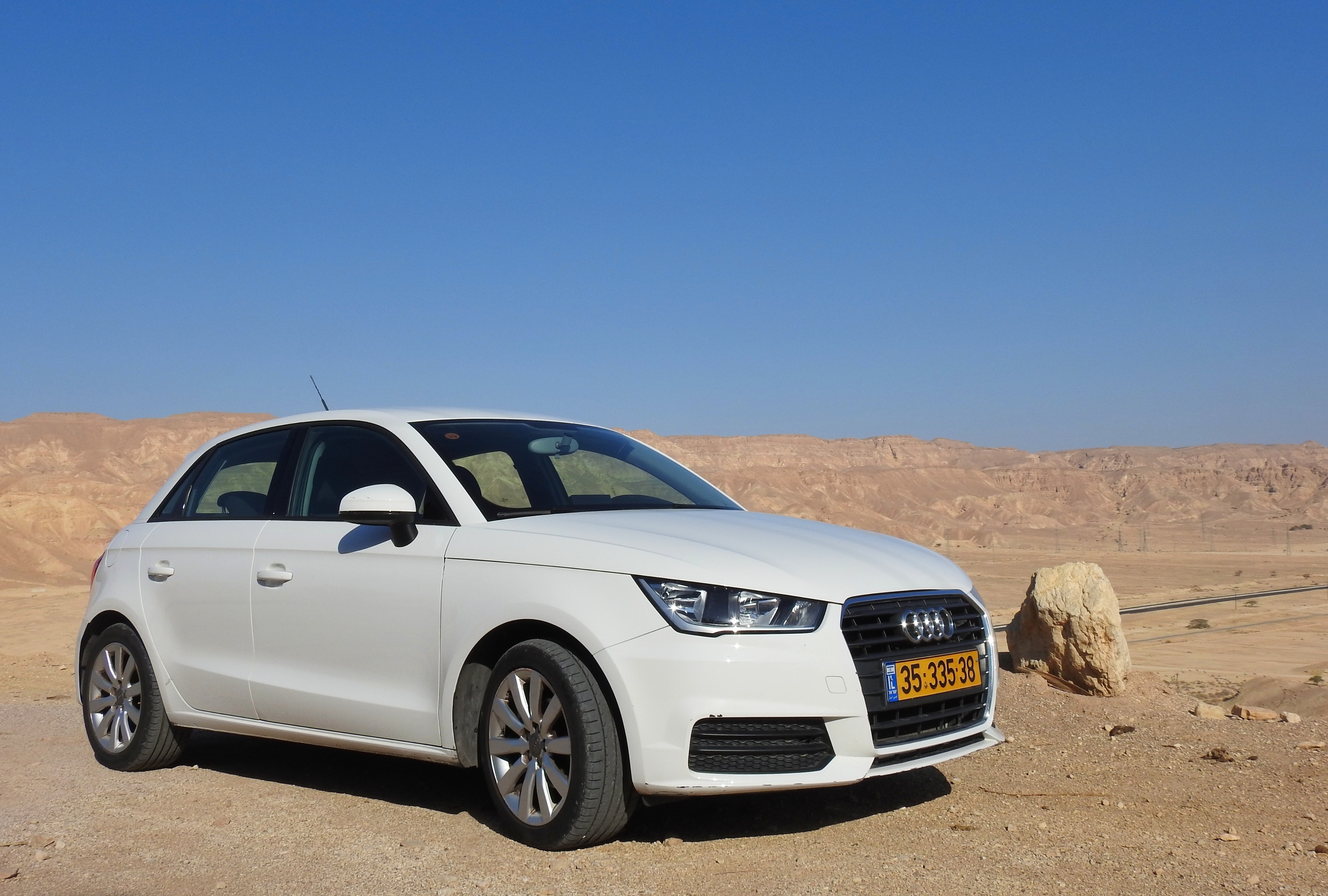
Continuing on with the saga of the trip to Eilat, my friend Adam Ota and I spent the night in a small house in Kibbutz Ketura after a day of birding adventure. The sun came up over the Arava and we felt the need to sleep in a bit. We had breakfast in the kibbutz dining room, and then packed up our belongs into our rental Audi for another adventurous day.

Morning in Kibbutz Ketura

We drove around Ketura for a bit, taking in all the sights and seeing where Adam used to work after his army service. As fun as it was in Ketura, time was ticking and we had many places to visit that day. Leaving Ketura, our first stop was the adjacent Kibbutz Grofit, built upon a lone hill in the homogenous desert landscape. We drove over to the northern end of the kibbutz and enjoyed the view of Ketura down below.

Looking down at Ketura from Grofit

When we had soaked up all of the glory of the view we got back into the car and drove south on Road 90. We turned into Kibbutz Samar, where we had received insider information from the International Birding and Research Center Eilat (IBRCE) that there were black bush robins to be found.

Our Audi A1 rental car

Locating the overgrown tree patch known locally as “The Jungle”, we set out to find the elusive black birds. It took some searching and some playing of the bird calls from the Collins bird watching app, and eventually we heard a reply.

Searching for the black bush robin

A black bush robin was calling to us from the groves outside the Jungle, and we set off to get a sighting. Unfortunately we didn’t end up getting any closer to it, and even lost the audio connection, but we did end up seeing some other nice birds. A few wheatears and blackstarts, as well as some warblers and a Tristram’s starling. There was no reason to linger, as the list of place to still be visited remained long. With that we departed, and drove side access roads in the direction of the Elifaz Sewage Ponds.

Searching for birds at the Elifaz Sewage Ponds

Most people would raise eyebrows at the idea of visiting a sewage pond, but birders know that oftentimes sewage ponds provide excellent birding. While sewage treatment primarily happens indoors and out-of-sight, there are also what is known as stabilisation pools where a more natural form of water purification occurs. These pools are outdoors and host a healthy plants and insect life, which bring the birds into the picture. Thus, some of the hottest birding sites in Israel year-round are often in and around sewage treatment centres.

Just another boring kestrel

The Elifaz Sewage Ponds proved to be relatively empty, with just a few common kestrels keeping us company. Dejected by not discouraged, we got back into our car and drove on to the next destination: Timna Park. I had visited Timna once back in 2017 with my university, but we hadn’t explored the park in its entirety. This time I was returning with wheels and an adventurous friend.

Timna Park map

We began with the short film about the site, which was very entertaining, and then we headed into the park along the main access road. Marvelling at Timna’s fascinating colour palette, we passed the first landmark, the Spiral Hill, and then turned right to a spot called The Mushroom, a natural sculpture created by wind erosion.

Timna: The Copper Road

Timna Park is a horseshoe-shaped valley located in a beautiful, craggy desert landscape, complete with a unique geological makeup that gives it its iconic look. The pink sand, and the cliffs of green- and yellow-hued fuchsia rock, complete the truly bizarre appearance. In ancient times Timna was the site of an aggressive multi-national mining operation, mostly extracting raw copper from the sandstone. Although King Solomon’s name has been tacked onto the site more than once, it was more than just the Israelites that thirsted for the valuable metal. The ancient Egyptians, with the use of Canaanite labourers, hewed giant mines out of the soft rock and even left their mark on the faces of the colourful cliffs.

Unedited photo of the “sand”

These copper mines began hundreds of years before the Jews returned from Egyptian bondage, and were actively mined on and off until the 600s CE when the copper ore started running out. Curiously enough, the modern Israeli government attempted to respark the copper mining industry starting in 1958, but that ended in 1985 due to economic reasons. The Timna Copper Mines company website is still running, due to their ventures elsewhere, but the old pictures of the mining are worth a look (see HERE).

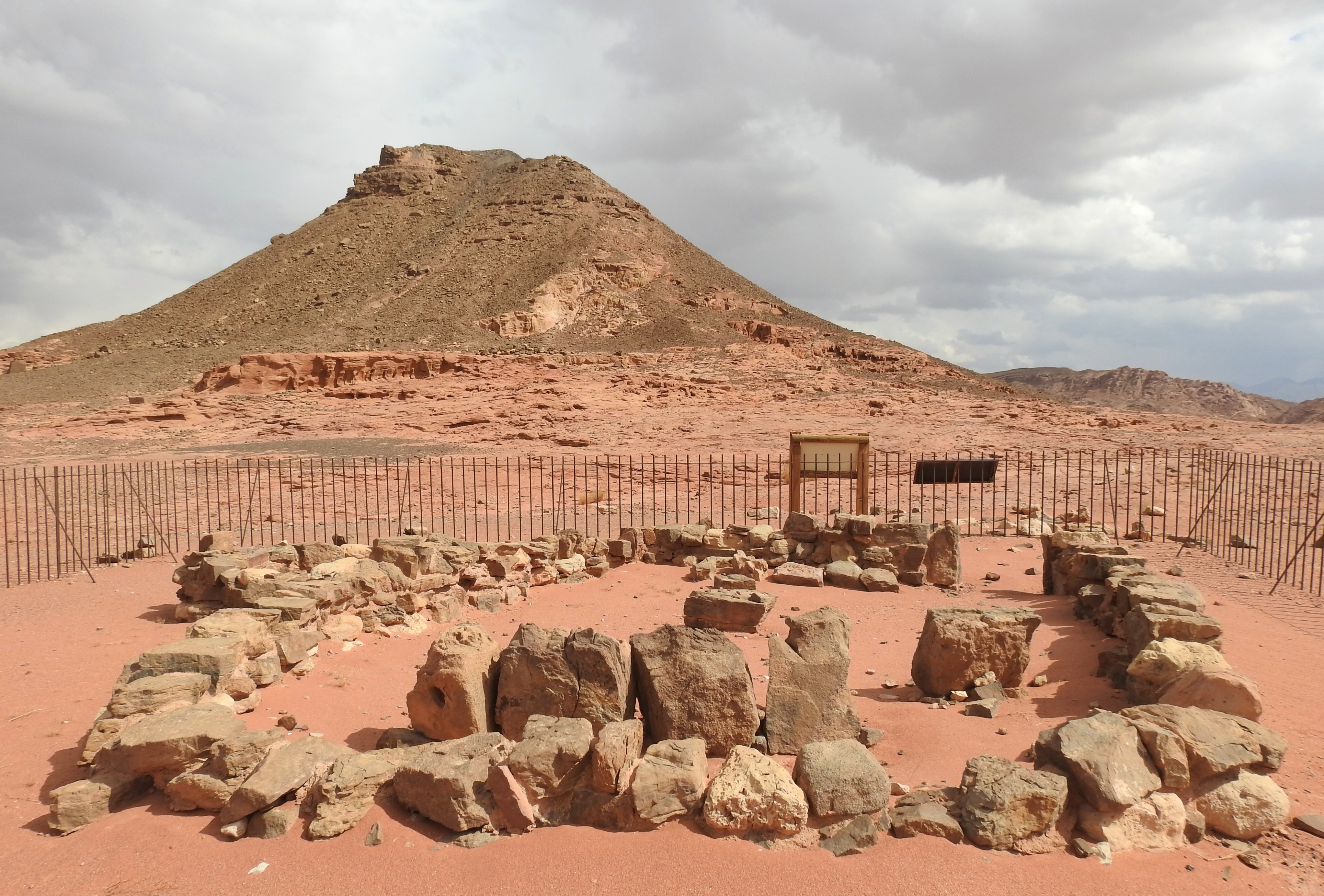
Ancient copper producing workshop

As we drove through the valley we spotted a few birds, notably a little green bee-eater and a few brown-necked ravens. Pulling over here and there to photographically capture everything of note, we eventually made it to The Mushroom – a fungus-shaped rock. Parking, we got out and walked towards two archaeological sites beside The Mushroom: a shrine and a smelting camp, dating back to the Egyptian period thousands of years ago. Despite that the ground is mostly a dark shade of pink, every so often there’s a glint of soft green. These are bits of oxidised copper, most often still affixed to broken pieces of pink sandstone. Leaving the smelting valley, we drove on to a place called The Chariots – rock engravings left behind by the ancient Egyptians.

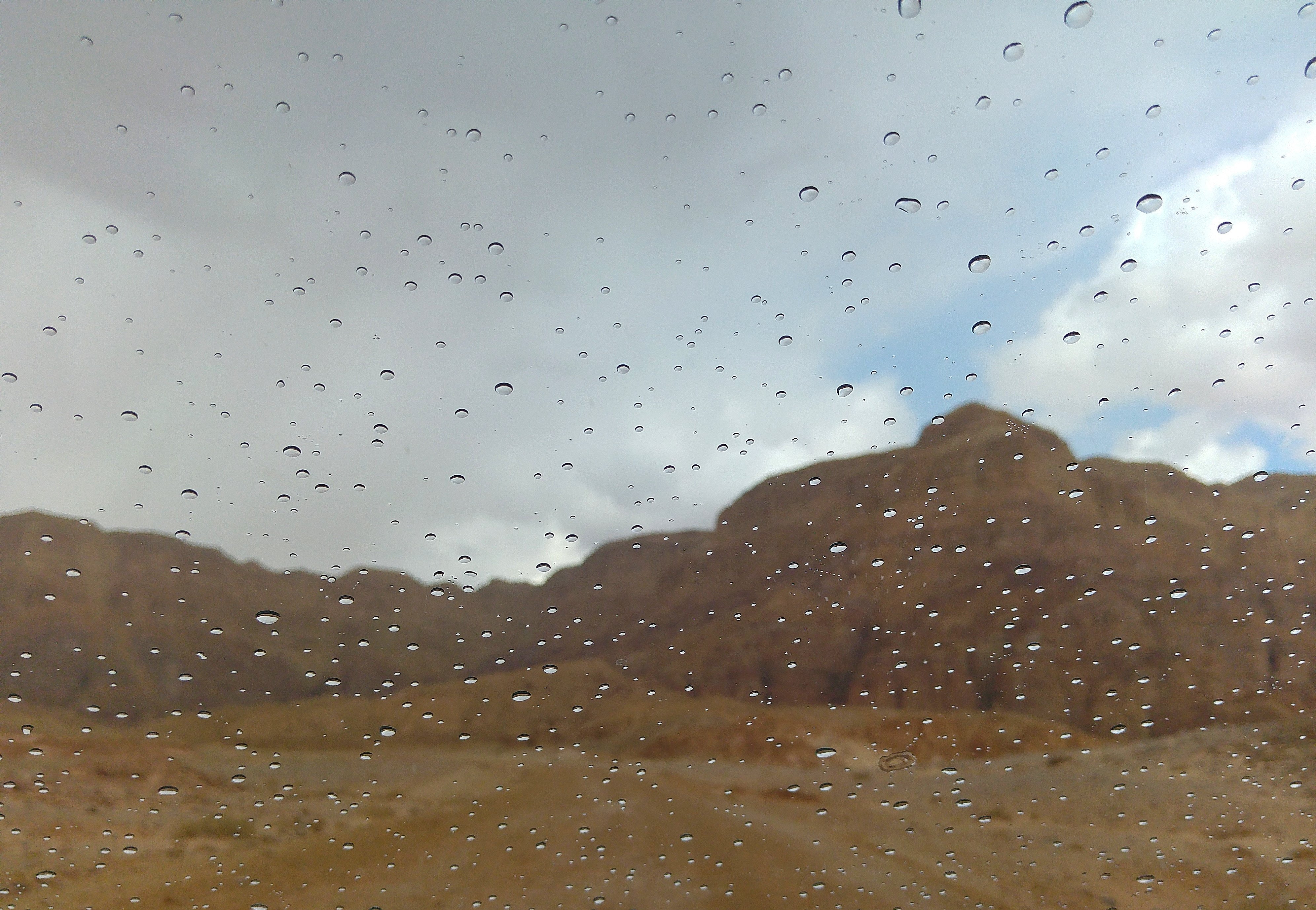
Raindrops in Timna Park

Much to our surprise, it began to rain as we approached the site, and rain is always surprising in the desert. Ten-fifteen minutes later the light drizzle ended and we got out of the car to examine the ancient engravings. The first was a collection of ibexes and ostriches being hunted by boomerang-wielding men. The second set of engravings were the aforementioned chariots, featuring warriors and their battle axes.

Adam searching for the wall engravings

Driving back towards the park’s centre, skipping some of the sites that I had already seen last trip, we made our way to Lake Timna. Man-made and nestled between the craggy cliffs, the tiny lake was designed to be a permanent watering-hole for animals and a fun place for humans. To my dismay, this potential paradise seemed to amount to neither of these. There was, however, a station for filling touristy bottles with coloured sand – always an interesting gift to loved ones.

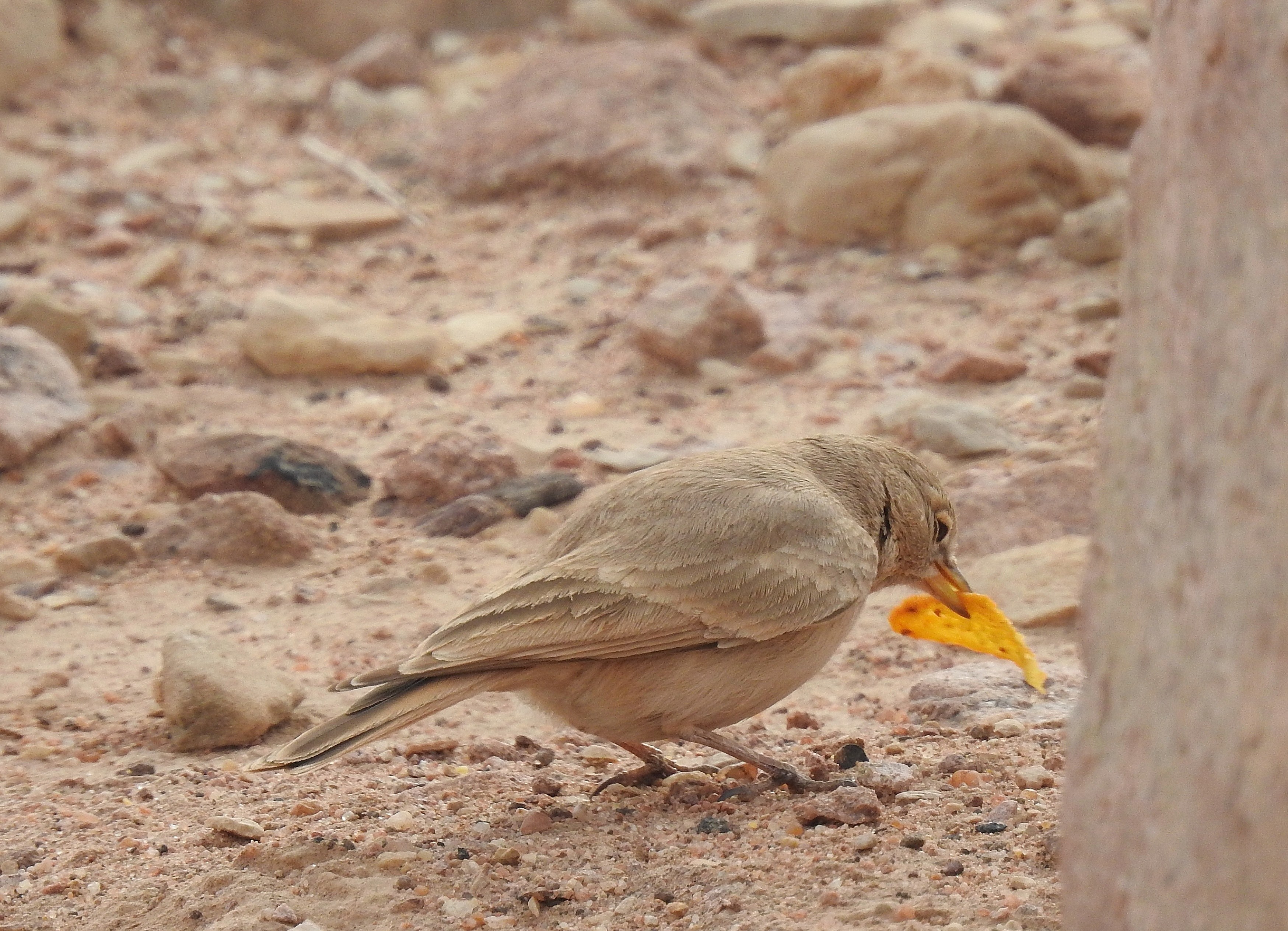
Desert lark eating discarded Doritos

From there we went to Solomon’s Pillars and Hathor’s Temple, basking in the glory of the truly awe-inspiring landscape. In the parking lot, of all places, we watched a few desert birds hop about, including a few desert larks. With that, and the time ticking away, we left Timna Park and headed for the next site on our list, an old water-filled quarry hidden from plain sight.

Cerulean quarry

It took a bit of driving about till we reached the correct access road, but when we pulled up at the quarry and got our first glimpse, we were amazed. The cerulean water contrasting with the red earth/rock made for quite the visual treat. Strong winds buffeted us, threatening to send us and our belongs into the picturesque abyss below. With nothing more to do than appreciate the view, we took some photos and got back into the little white car.

KM 20

Time truly was ticking, and we had only a few hours before we had to take the car back. Our next stop was also off the beaten path, the birding hotspot of KM 20 – literally the 20th kilometre from the end of Road 90 in Eilat. If time wasn’t the only adversary on that day, an unexpected muddy puddle kept us from reaching KM 20 by means of vehicular transportation. We were forced to walk the last bit, hopelessly muddying our shoes, but knowing that it was all worth it.

Flamingo at KM 20

Arriving at the large salt pools of KM 20, we were rather pleased to see at least a hundreds birds in front of us. The majority were greater flamingos, with some black-winged stilts and other waders hugging the edges of the pools. Even a mixed flock of northern shoveler and pintail ducks was spotted hunkering down on the far bank. While I engaged in photographic pursuits, Adam scanned for the famous black flamingo and successfully located the melanistic creature on the farther end of the closest pool.

The melanistic flamingo far, far away

Hurrying back to our car, we made our way to another birding hotspot a kilometre further south – KM 19. More of the bird-friendly sewage ponds, KM 19 didn’t deliver as much as we were hoping for. A flushed marsh harrier, a handful of waders and a bunch of flocks of waterfowl filled the few reed-lined ponds. It was fun scanning the water’s edge to try and find a small wader here and there, adding up the species as we found more and more. Next time, we’d need to revisit this site at a better hour of the day, and during a better time of year.

Climbing the banks of KM 19’s ponds

Alas, this was our last fun stop with the car and we drove back to Eilat feeling pleased with our efforts. We filled up the tank, went shopping and drove to the lodgings that we had booked in advance. With budgeting a priority we went with a relatively inexpensive hotel located in the residential part of Eilat. Our expectations were low, but we were pleasantly surprised with our lot at Rich Luxury Suites.

Getting the barbecue started

Zipping over to the car rental we gave back the beloved Audi with a few minutes to spare, and walked back to the hotel to settle in and have dinner. The evening continued into night, we filled our bellies with delicious foods cooked on a disposable grill and got a good night’s sleep.

Heading back home…

Early the following morning we gathered up all our belongings and made our way to Eilat’s central bus station for the long ride back to Givat Shmuel. Thus ended our exciting excursion to the southern tip of Israel this past February.

Eilat: Spring Birding

In Eilat, Israel on May 13, 2019 at 8:55 AM

Back in the end of February, during semester break, I took a two day trip to the south with my friend Adam Ota. This post covers the first day, which was spent nearly entirely in the resort city of Eilat. Our primary objective was to engage in birding, all over Eilat and the southern end of the Arava. February isn’t the best time to go birding in that region, but it was the only window we had factoring in classes and work, so we made the most of it.

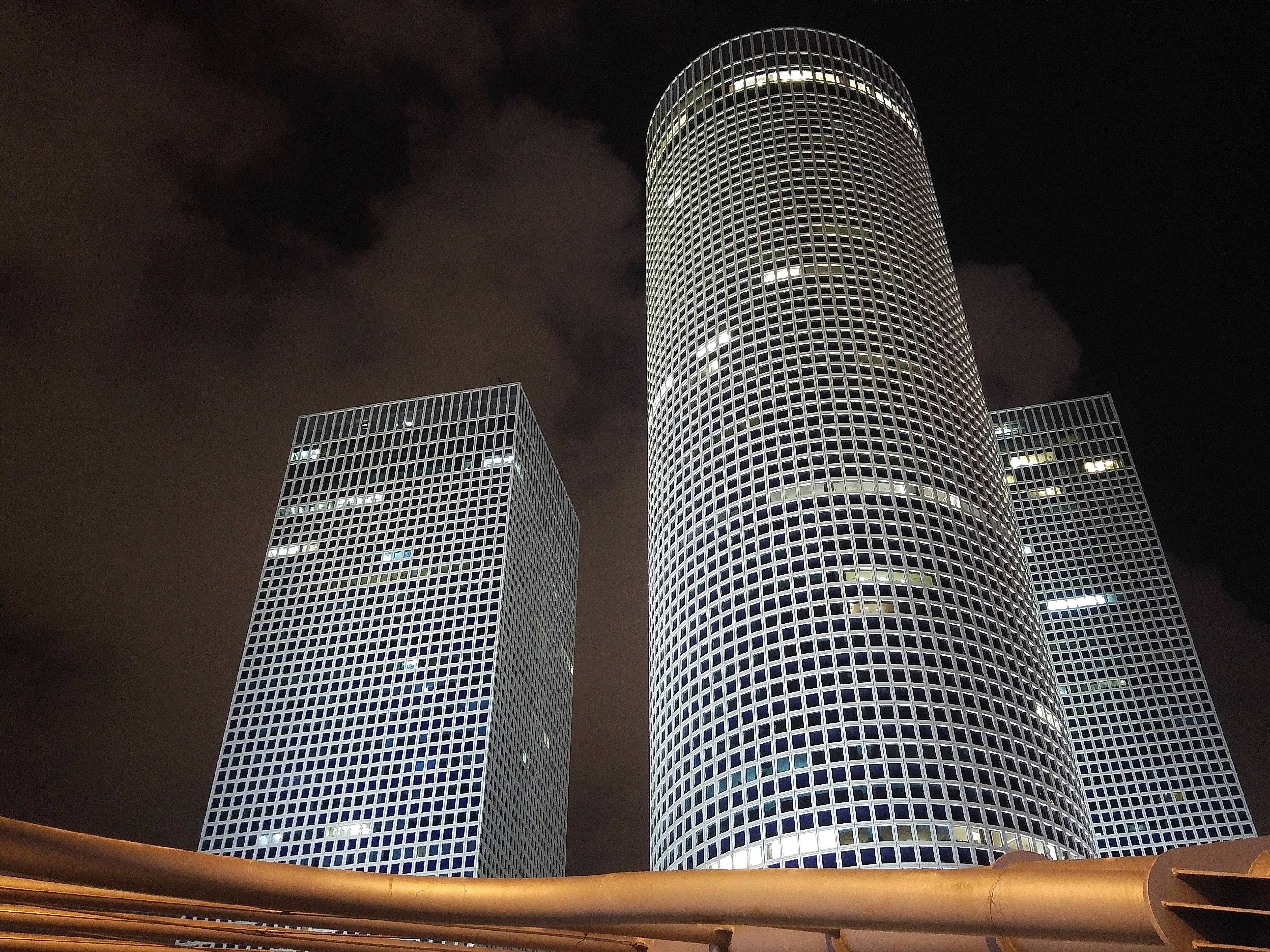
Azrieli Towers of Tel Aviv

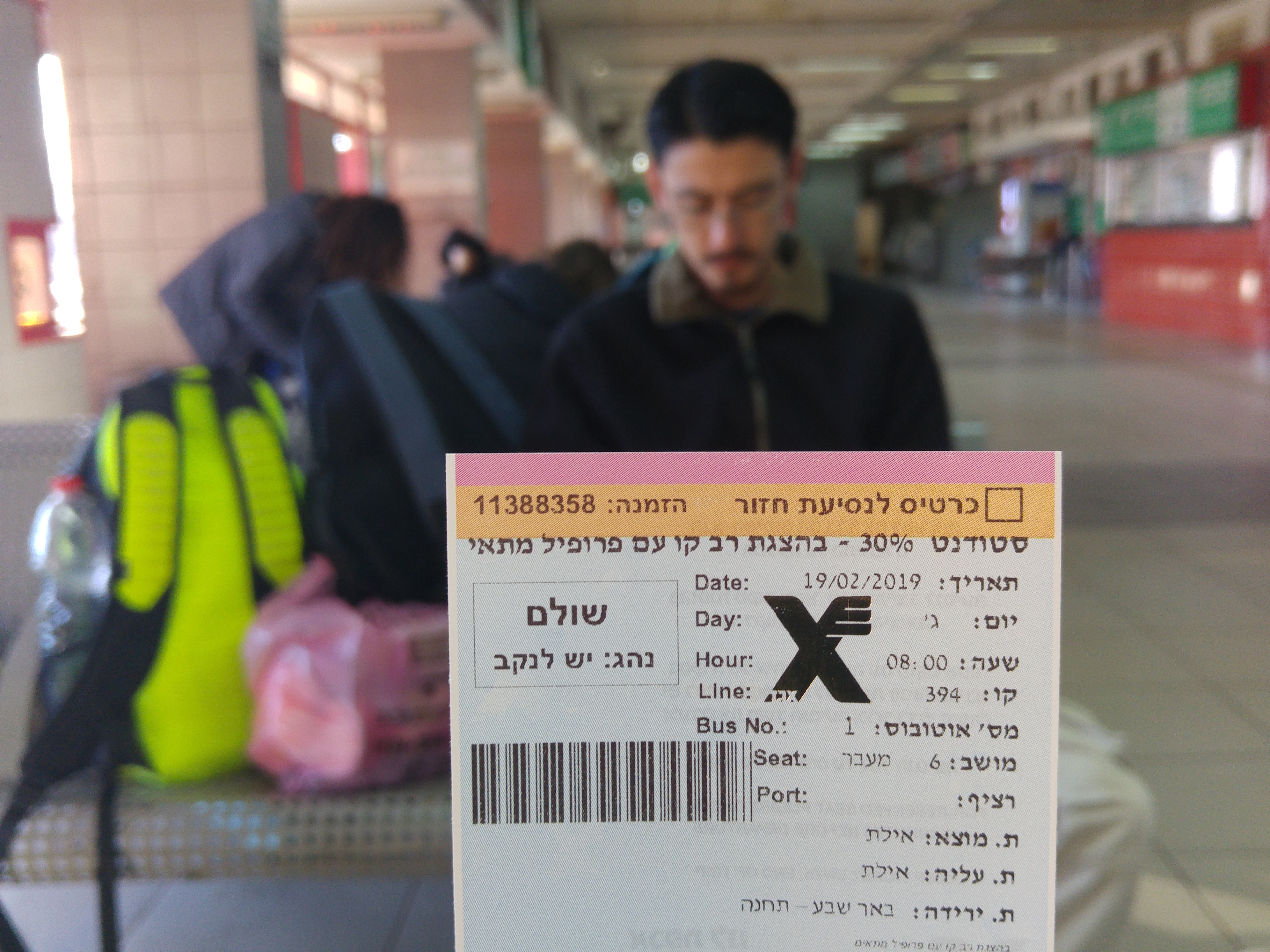
Our journey began several hours after Shabbat ended, Saturday night, and we made our way to the train station in Tel Aviv. We had some food, did some shopping for food supplies and waited for our train to Beer Sheva. Several hours later we were in Beer Sheva’s central bus station, settling in for the long wait for our bus to Eilat. Again, several hours later, we were en route to Eilat, driving through the moonlit desert on a long, lonely road.

On the road with Eilat behind me

We arrived at our bus stop outside Kibbutz Eilot at 4:30am and immediately began mapping our way to the nearby International Birdwatching and Research Center of Eilat, also known as IBRCE. Our plan was to spend the first hours of the early morning there, so it made sense to get there as soon as possible. We crossed Road 90 and made our way through the dark desert landscape until we reached a drainage canal, which we followed all the way to the IBRCE.

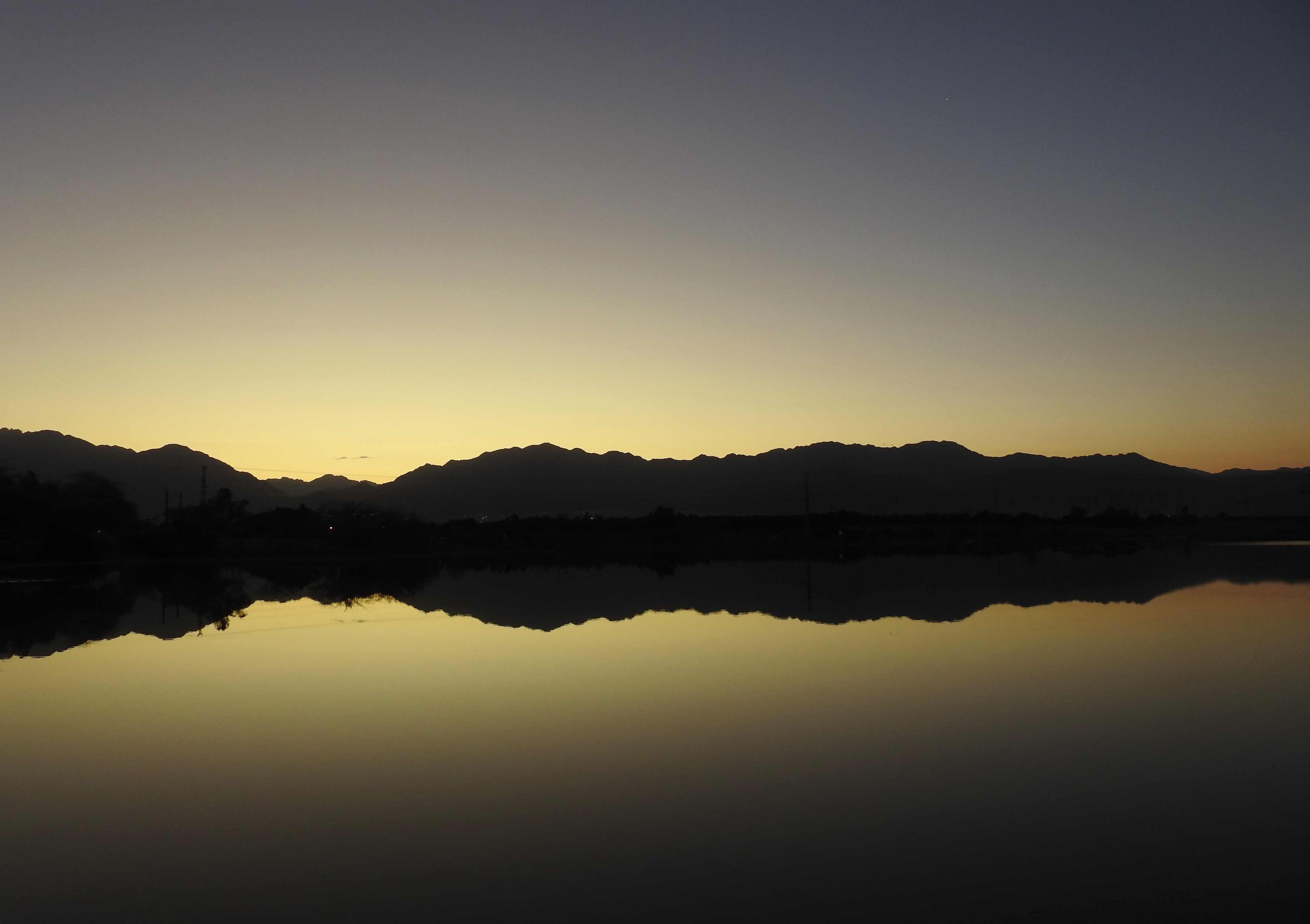
Daybreak over the mountains of Jordan

Strangers in a strange land, we sat in the dark on a bench within the park’s confines and enjoyed cookies and a can of stuffed grape leaves. The sounds of the marsh and the calls of the muezzin in neighbouring Aqaba, Jordan were the only things that broke the silence until shortly before daybreak. Cars approached and staff members and volunteers of the IBRCE arrived to get the day started.

Redshank perched on a handrail

Sunlight painted the skies over the Jordanian mountain to the east and the birds started stirring. Adam and I moved from blind to blind, trying to see what early risers we could find. Various waders started moving about in the salt pools just south of the IBRCE, including redshanks, black-winged stilts and great flamingos. Before long there were birds all over, including our very first Indian house crow and a juvenile marsh harrier trying to eat some carrion. Over at Lake Anita, the centre of the IBRCE, there were handful of great cormorants, sedge warblers and a single gull-billed tern all getting into action.

Grey heron in Lake Anita

It’d take hours to write about all the birds we saw, so to put it short we spent the next couple hours of the morning basking in the joys of oasis birding. We moved all around the park’s nucleus, spending time at the different blinds and taking it all in. Some of the highlights were: our first penduline tits in the reeds, scores of house martins circling over the lake and of course the flamingos.

Flamingos and a redshank

We had received excellent instructions where and when to bird locally from IBRCE’s director Noam Weiss, and some expert field guidance by local staffer Rei Segali, when we encountered a pair of Swiss birders on the canal banks outside. We made birding chit chat with Michael and Martin and then settled in for a joint mission, to spot a crested honey buzzard. There were a few of these locally rare birds spending the winter in and around Eilat, and we wanted to see one too. It took a while, but at least we spotted one of them flying over the date palm trees at the Israel-Jordan border. Not the best sighting, but at least we saw one!

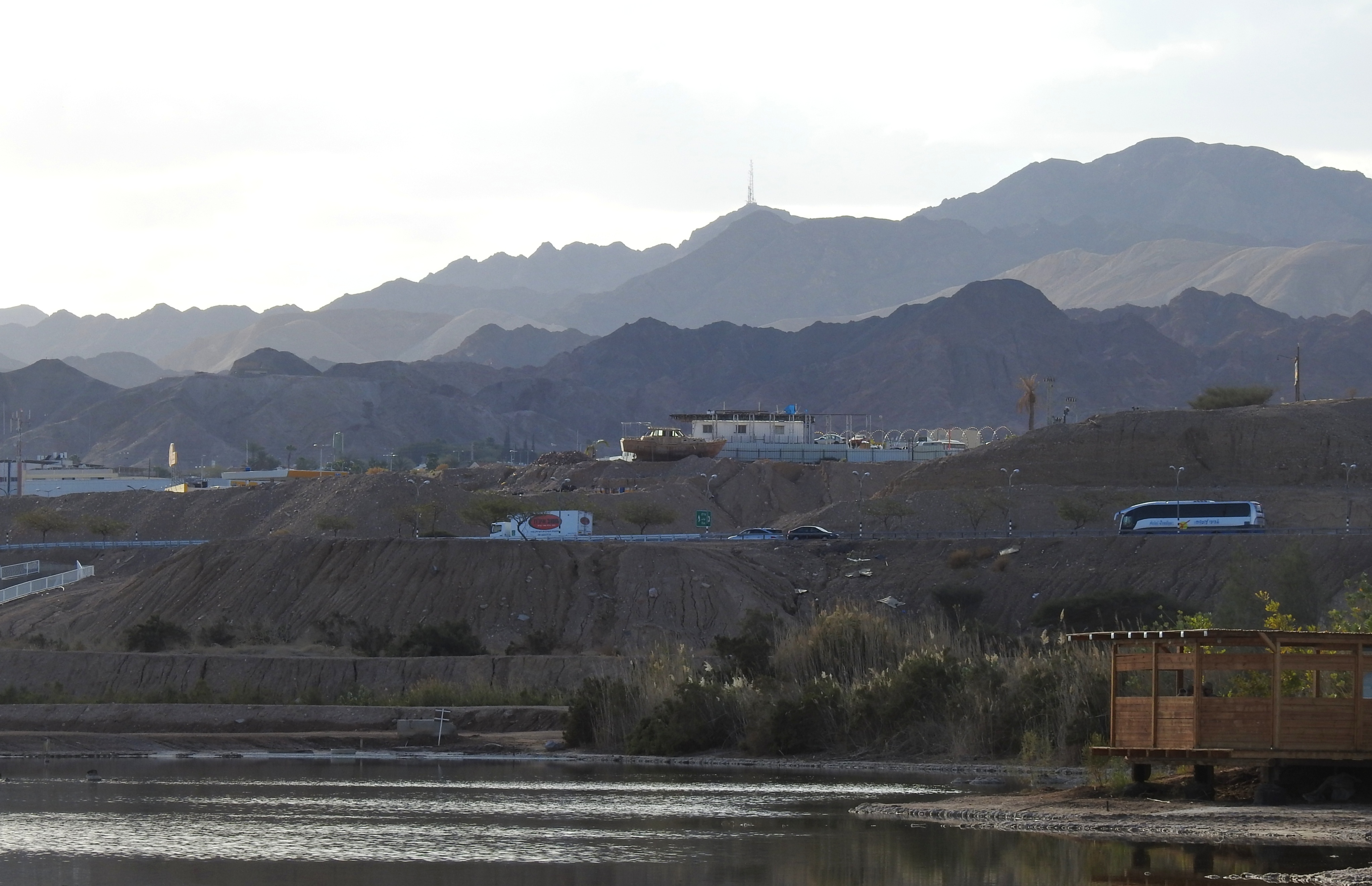
IBRCE from afar

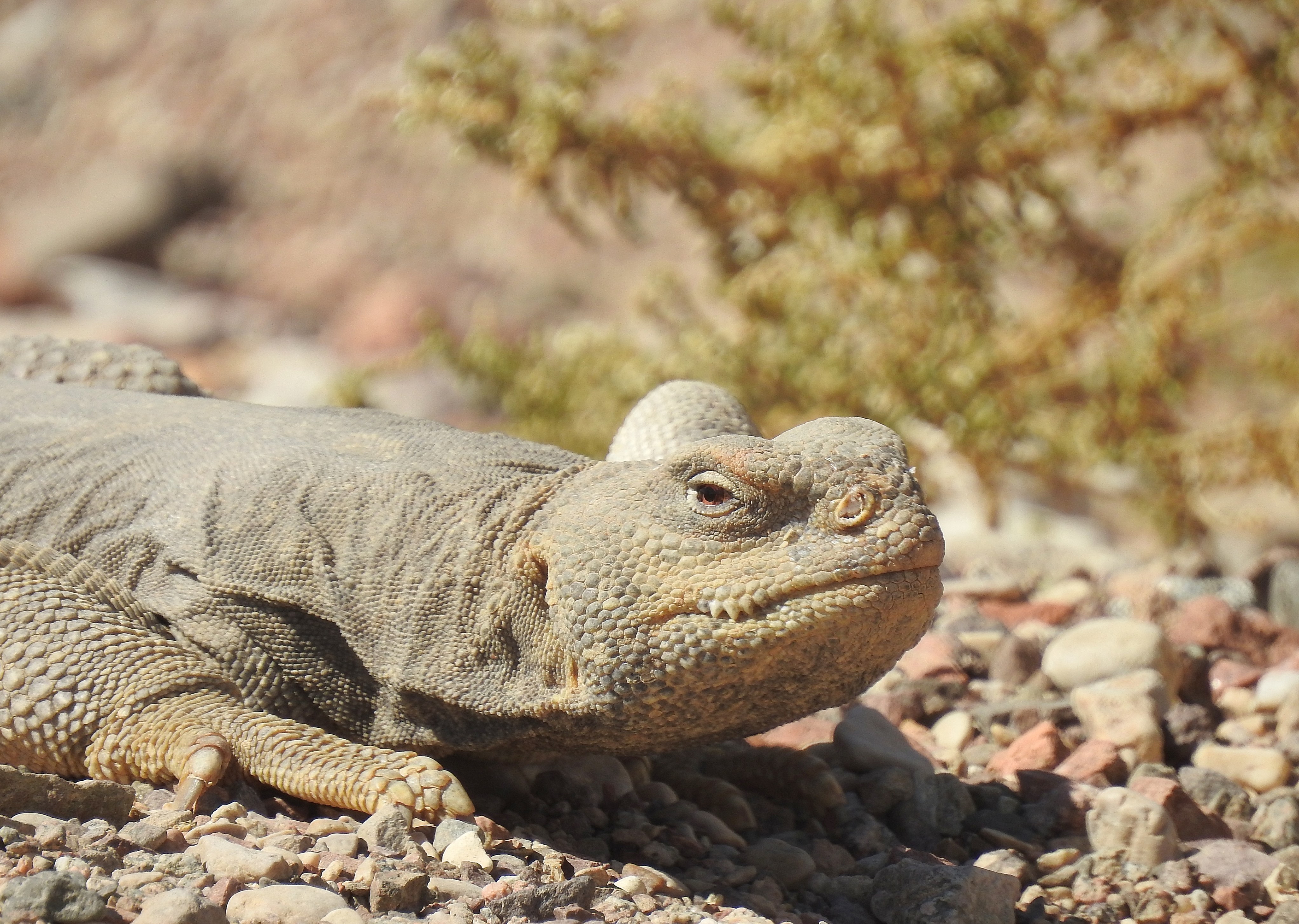
Feeling a bit antsy to explore Eilat a bit more, we gathered up our belongs and walked on over to Holland Park, located at the northern end of Eilat. Unfortunately, it was already getting pretty hot out and we had a bit of a walk ahead of us. Looping around the northern end of the IBRCE, we spotted a little green bee-eater and a few Egyptian mastigures sunbathing on the rocky ground.

Relaxing Egyptian mastigure

We arrived at Holland Park and began walking the western trail, somewhat seeking shade and somewhat seeking birds. At last we found both: blackstarts, warblers and a passing long-legged buzzard as we sat in the partial shade of an African thorn tree.

Within Holland Park

Even with the handful of birds, we felt like better birding could be found elsewhere and made our way back to the IBRCE. Coming from the southwest corner of the park, we approached the salt pools slowly, spotting more and more waders – mostly redshanks, but including a ringed plover and more flamingos.

Hard-to-see brine shrimp in the shallows

At the first blind along the way we examined the salt water closer to find that there are millions, if not billions, of tiny brine shrimp swimming around. This explained the large numbers of waders feeding in the seemingly hostile-to-life pools. Adam scooped up a bit of the sand, which contains brine shrimp eggs, and to this day he has a small colony of shrimp in a glass jar. Sample stowed safely away, we tucked ourselves into the wooden booth-blind and rested a bit on the benches inside.

Photographing flamingos in the salt pools

I spent much of the time leisurely trying to get the best photographs and video footage I could, and felt relatively pleased with the fruits of my efforts. However, we still had more to do and we needed to rouse ourselves out of our comfortable booth.

Depth of field at the IBRCE

Our next destination was Eilat’s North Beach, and we intended to walk along the drainage canal as per Noam Weiss’ recommendation. We said goodbye to the IBRCE and began the walk on the eastern side of the canal.

Eilat’s salt production

Keeping an eye out for crested honey buzzards, Dead Sea sparrows and other fun birds, we walked and walked, seeing a variety of birds but none of the above mentioned species. Interestingly enough, the two most interesting things we saw on the walk were not birds at all. The first was a squished and dried Schokari sand racer on the path, only identified with the help of experts. The second was the constant flow of pure, white salt pouring out of the machinery at the salt factory nestled among the salt pools.

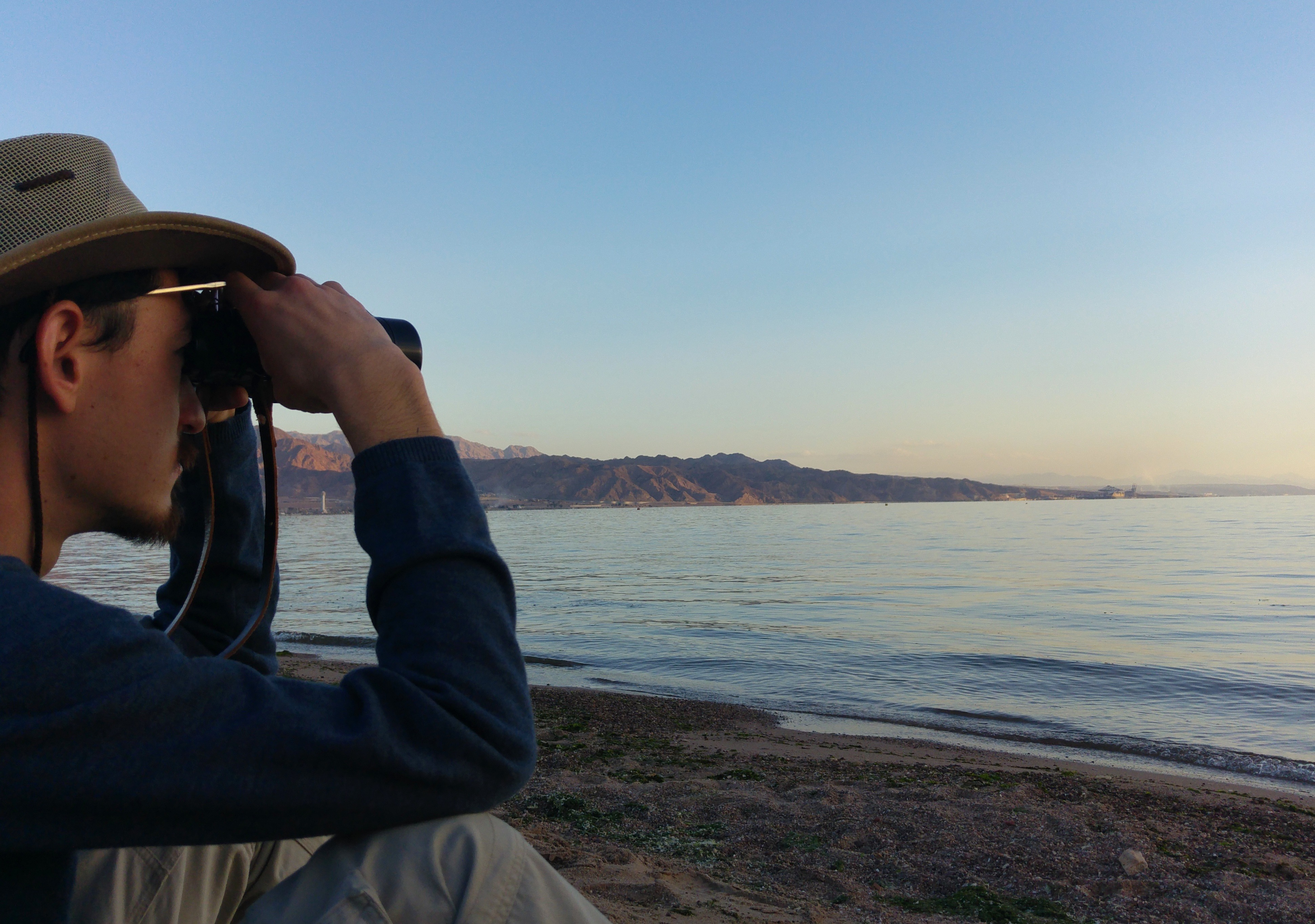
Adam scanning for seabirds at North Beach

We reached the North Beach and sat down at the water’s edge, the gentle waves lapping at the sand in front of us. We kept an eye out for interesting seabirds, and ended up seeing just black-headed and slender-billed gulls. The sun settled over the mountains of Egypt as we gazed out over the Red Sea, enjoying the international view that I loved when I last visited in 2014. When the sun was hidden behind the mountains we got up and made our way through the touristy hotel area and towards the airport.

Fiery sunset over the mountains of Egypt

Having planned our trip carefully, we were scheduled to pick up a rental car at 6:00pm and made our way there with alacrity. When we arrived we were greeted with a smile and the keys to a free upgrade – a sporty Audi A1. After the necessary paperwork and photographs we zipped out and headed over to a grocery store to pick up supplies for the evening. Eilat doesn’t have the national VAT tax that the rest of the country does, so the prices are lower and shopping gets weirdly tempting. We stocked up on supplies and drove out of Eilat and into the Arava, heading for the fields of Yotvata where Pharaoh eagle owls are known to live. Driving along the dark roads made for great fun, but when we scoured the field area – going as far as we deemed logical – we found no trace of the owls.

Looking for owls in the Yotvata fields

Abandoning the mission, we got back into the car and drove on to Kibbutz Ketura where we spent the night. Adam used to work on the kibbutz, after his army service, and so he had the necessary connections to arrange a room for us. In the end we received a small house, which more than suited our minimalist needs, and we enjoyed a lovely barbecue outdoors for dinner. Thus ended the first extremely long day of our trip to Eilat, and we slept knowing that we’d be waking up early the next day for round two – this time seeing sites all over the southern Arava with the help of the zippy little Audi.