Israel's Good Name

Archive for the ‘Jerusalem’ Category

Israel Aquarium

In Israel, Jerusalem on December 31, 2025 at 3:23 PM

At the end of July we took a family trip to Jerusalem, with our main goal to visit the Israel Aquarium. Both the aquarium and the neighbouring Biblical Zoo counterpart have been on our lists for a while, but we rarely make it to Jerusalem ever since Amir was born. As such, we hyped up the trip quite a bit and were rather eager to go. Despite it being summer, we found parking quite easily outside the complex and within minutes we were buying tickets and heading inside. The cheery ticket checker recommended that we start our tour with a visit to the butterfly house and gardens, an unusual addition to an aquatic attraction. 

Israel Aquarium

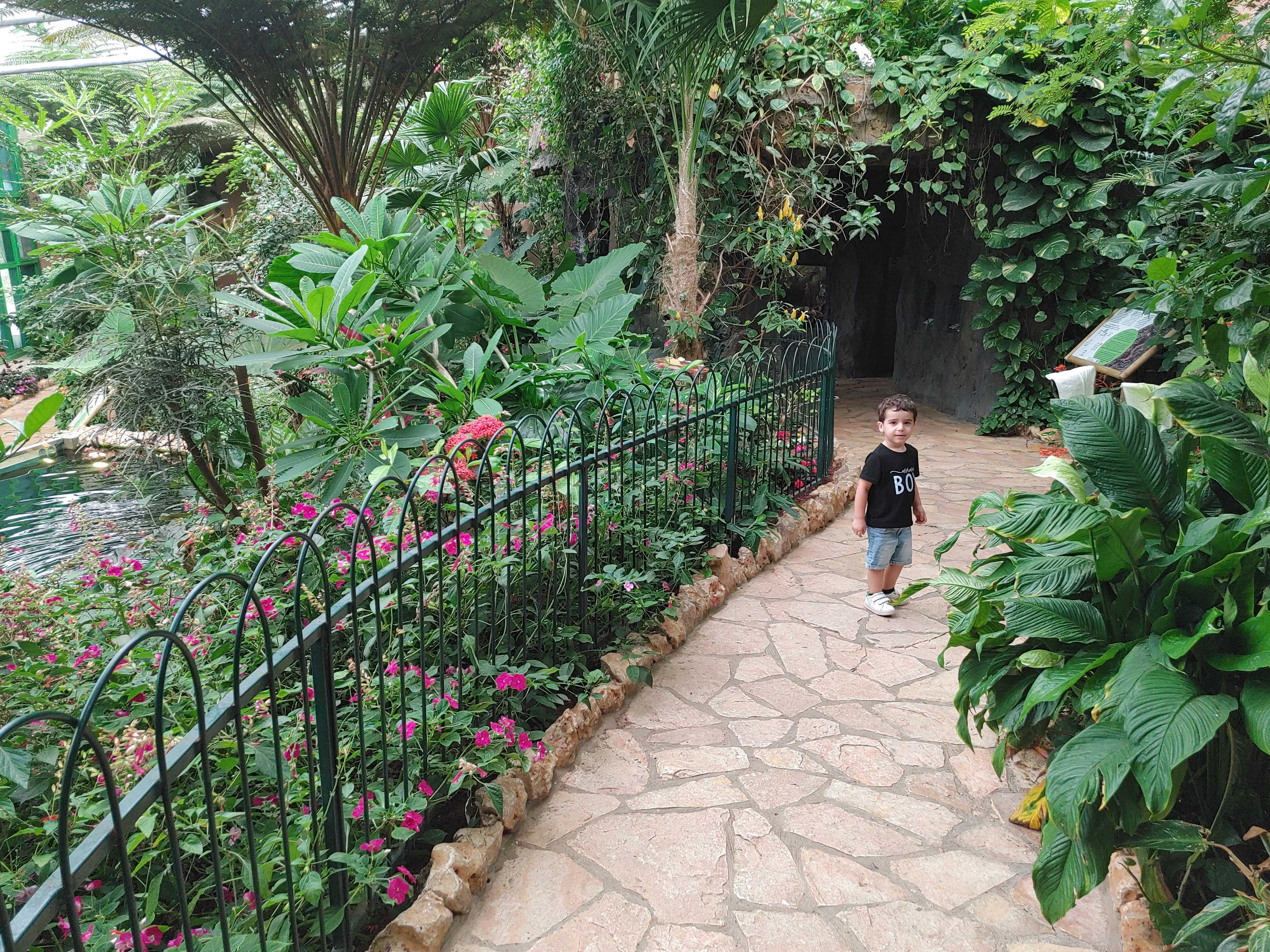
Passing through the double doors, we were dumbfounded by the size of the butterflies flapping languidly around us. Huge navy and cobalt wings operated in synchrony as the large blue morpho butterflies, native to Central America, fluttered around us. Amir was tempted to try and catch them, but we led by example and observed only. There were a handful of other species as well, flying or resting along the attractive “jungle” path. Overall, the butterfly addendum was an unexpected but welcome addition to our trip itinerary.

Amir in the butterfly gardens

Moving on to the main attraction, we left the butterflies and entered the main building which houses the aquarium. Darkness enveloped us, as did the dozens of other visitors who shared in our experience. Huge fish tanks greeted us as we passed into the first exhibit, filled with countless specimens of wriggly sea creatures all wiggling about in their aquatic environs.

Odd unicornfish

I appreciated how each exhibit followed a particular theme, all focusing on the fishy elements. That first gallery was dedicated to the four “seas” of Israel – the Mediterranean, Red, Dead and the Sea of Galilee – each with its marine life. I was pleasantly surprised to learn about the Dead Sea toothcarp, which can’t live in the intense salinity of the lake itself, but rather lives in the desert streams that feed into the Dead Sea.

Futile attempts at getting a cool picture of the Dead Sea toothcarp

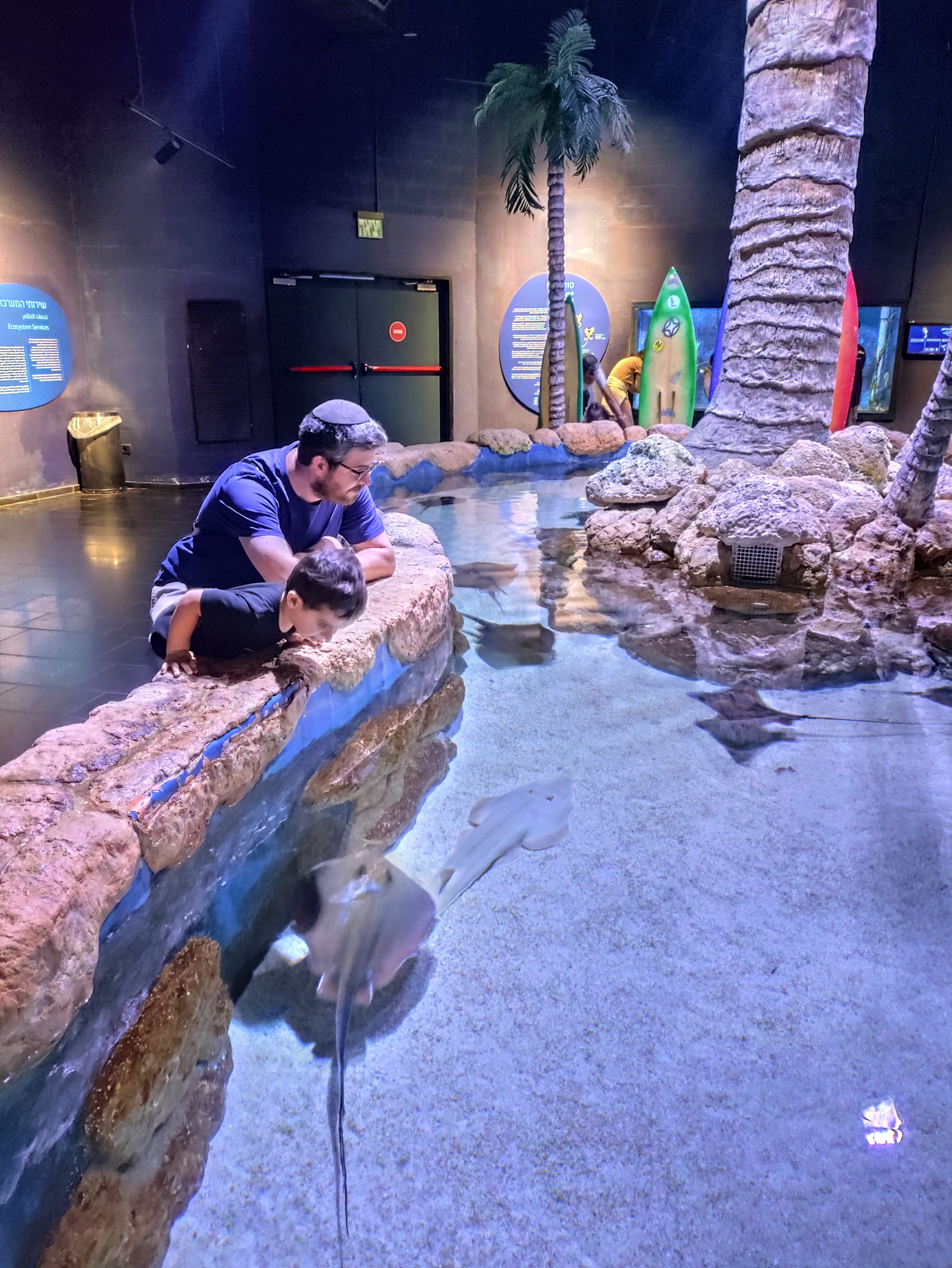
Naturally, much of the fish featured are native to the Mediterranean, so a few of the subsequent exhibits focused on Israel’s western seaboard. There was also an exhibition about fish in the Suez Canal, which has had an ecological impact on the Mediterranean with invasive species swimming over from the Red Sea. Within the darkened halls of illuminated tanks, fish of all varieties, sea horses, a one-armed sea turtle and a pool of rays and guitarfish really fleshed out the collection.

Amir and I examining the ray pool

There were a few aquarium tanks that were designed to look more realistic, matching the habitat’s general appearance with paint and sculpted rocks. The Mediterranean coast tank even featured choppy waters, mimicking the natural movement of the sea. I quite enjoyed this, feeling like I was looking at a living diorama, but ultimately the photographs failed to convey the joyous sensation.

At one with the fish

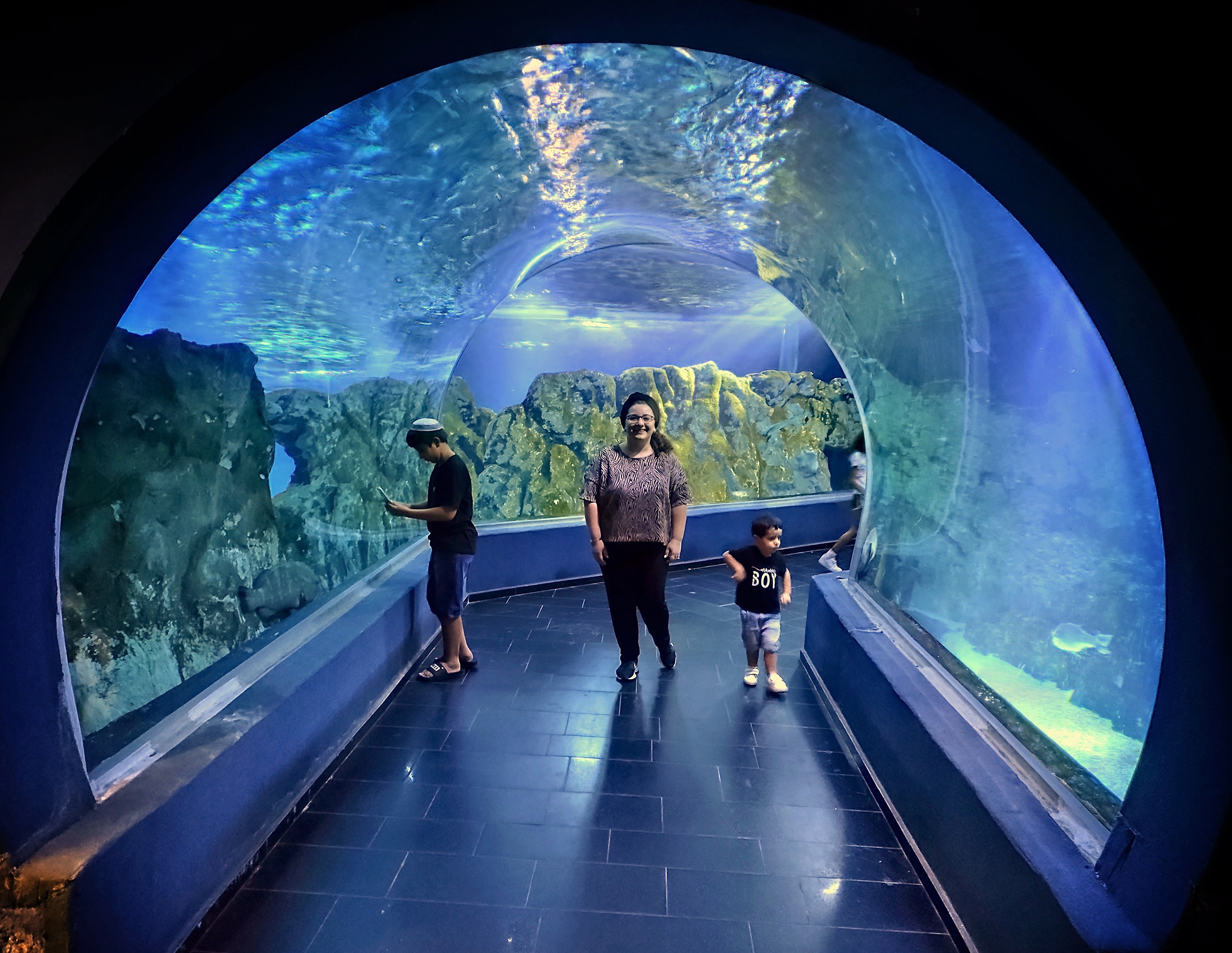
Speaking of dioramas, there were several exhibits which had special tanks featuring tunnels which allowed visitors to view the fish from the inside. These were naturally very popular with the children, so I had to be quite patient to get a picture of Bracha and Amir posing “underwater” with the fishy friends. The tank’s “actinic” blue lighting takes some getting used to in person, and some efforts to balance out when editing the photos (of which I’m not entirely satisfied by).

My favourites

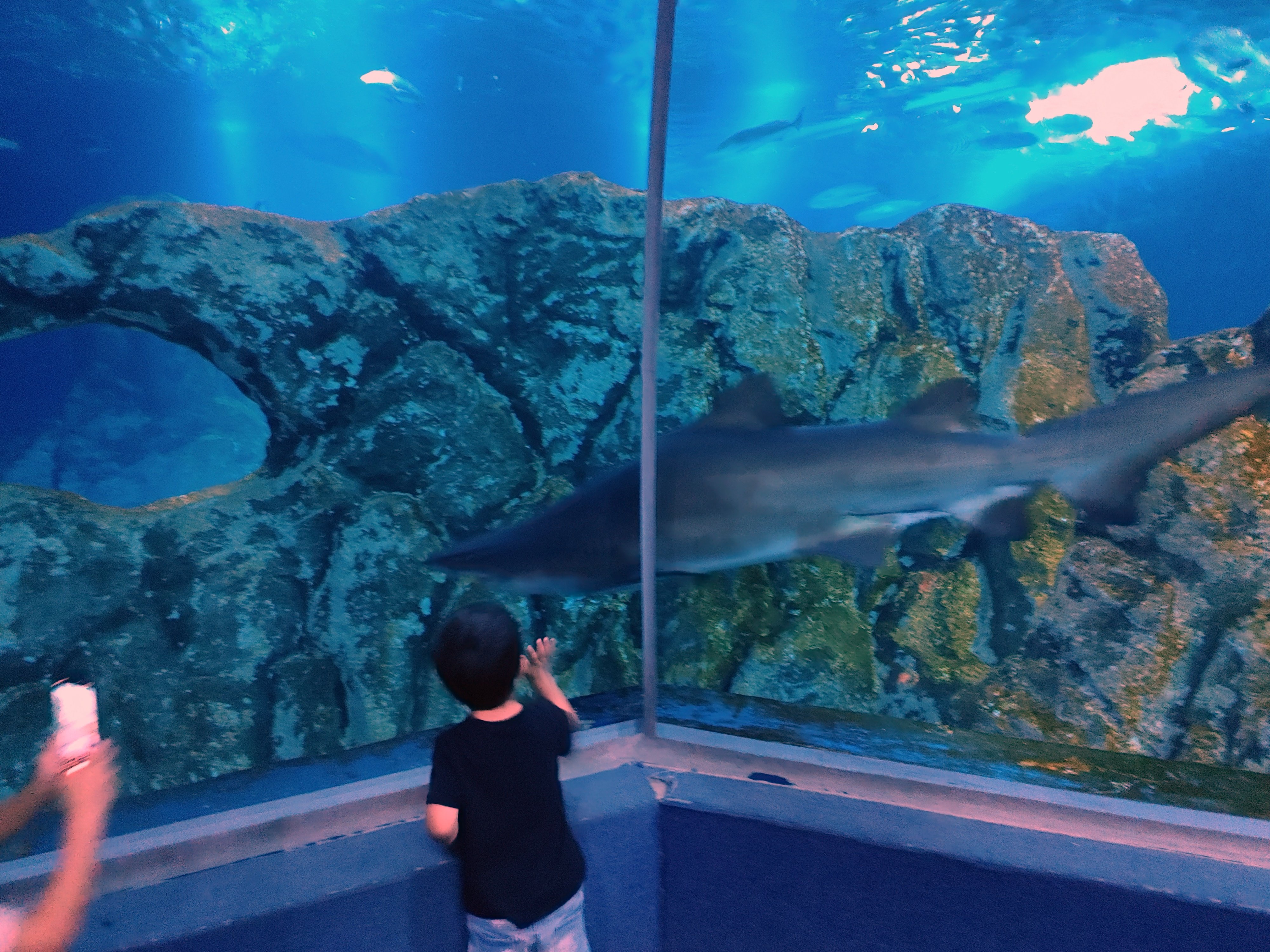
And then there were sharks! We reached a glass tunnel walkway under a big tank where sharks passed over, swiftly and with the fluidity apt for such apex predators. Amir tried befriending one shark, which appears to be a sand tiger shark, but it swam off without as much as a passing nod. Unfortunately, I didn’t see any signs identifying which shark species were in the large tank, but the marvels of technology today greatly helps.

Amir befriending a shark

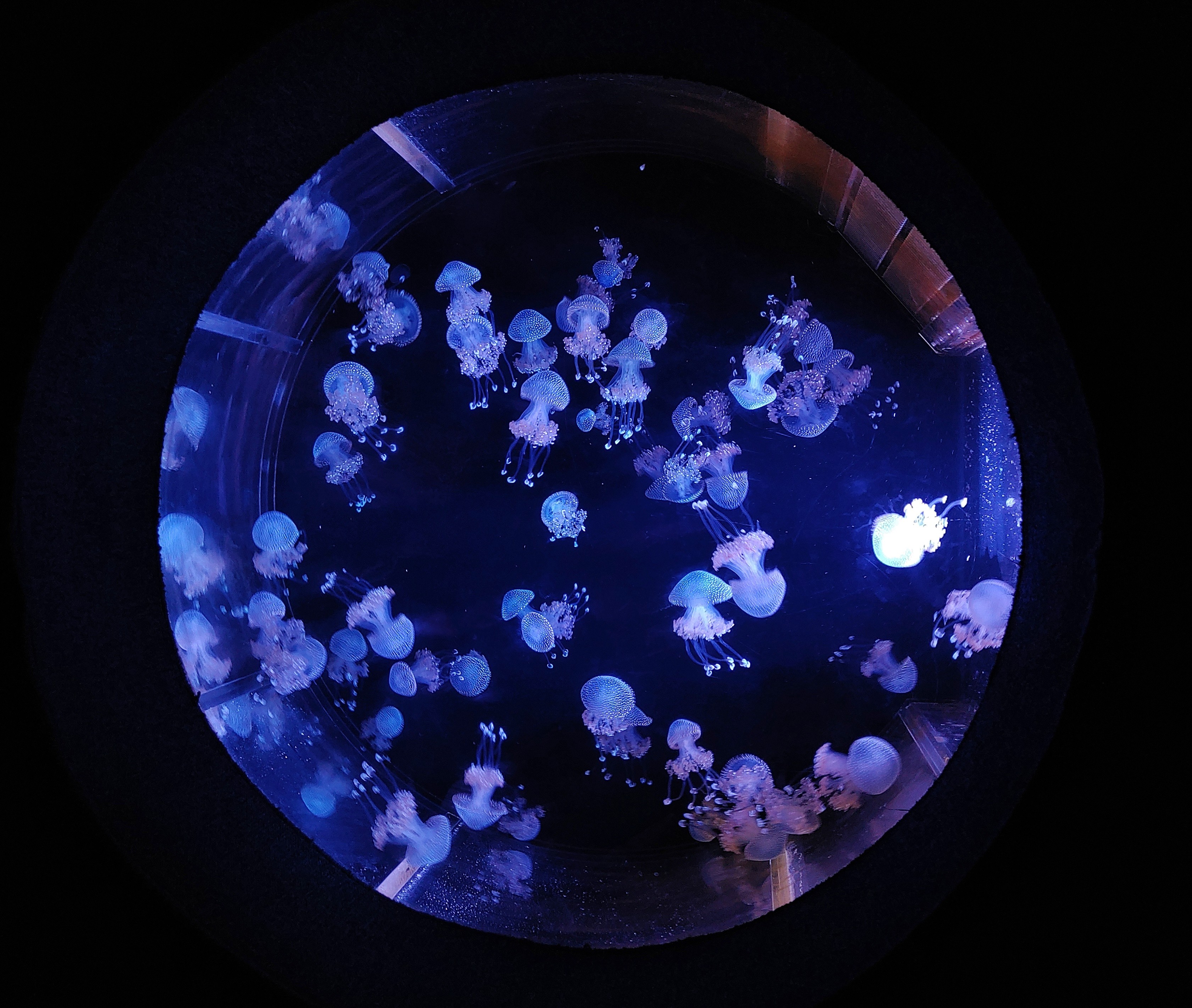
Around the corner we found a huge glass panel and stadium seating where people can sit and watch the wildlife as if it was a film in the cinema. We sat for a few minutes and had a bite to eat before continuing on to see some jellyfish. In fact, I was quite surprised at how many jellyfish the aquarium has, all drifting about in their little colourful tanks. Some like the moon jellies and Australian spotted jellyfish certainly made for easy, artsy photography.

Jellyfish galore

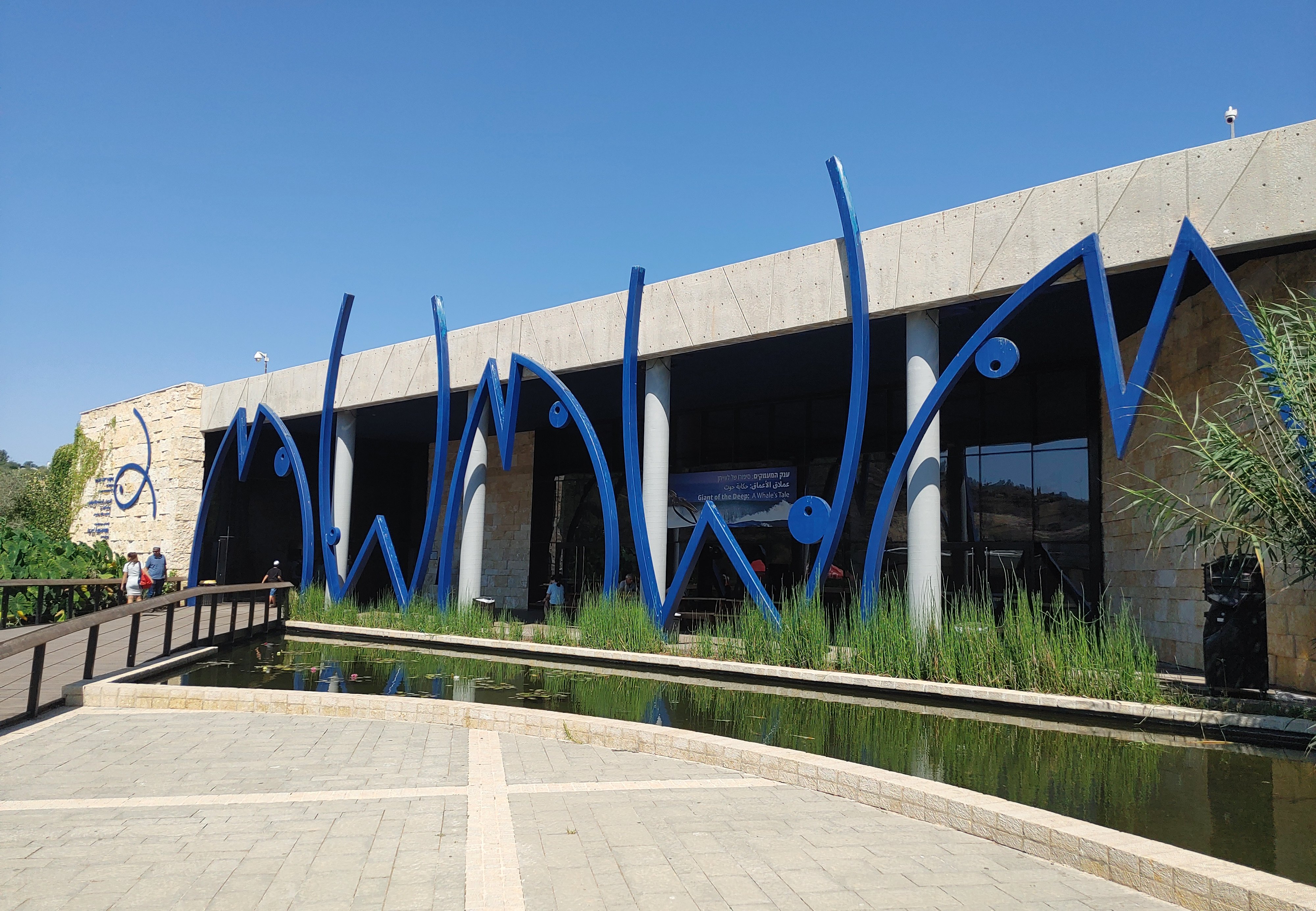
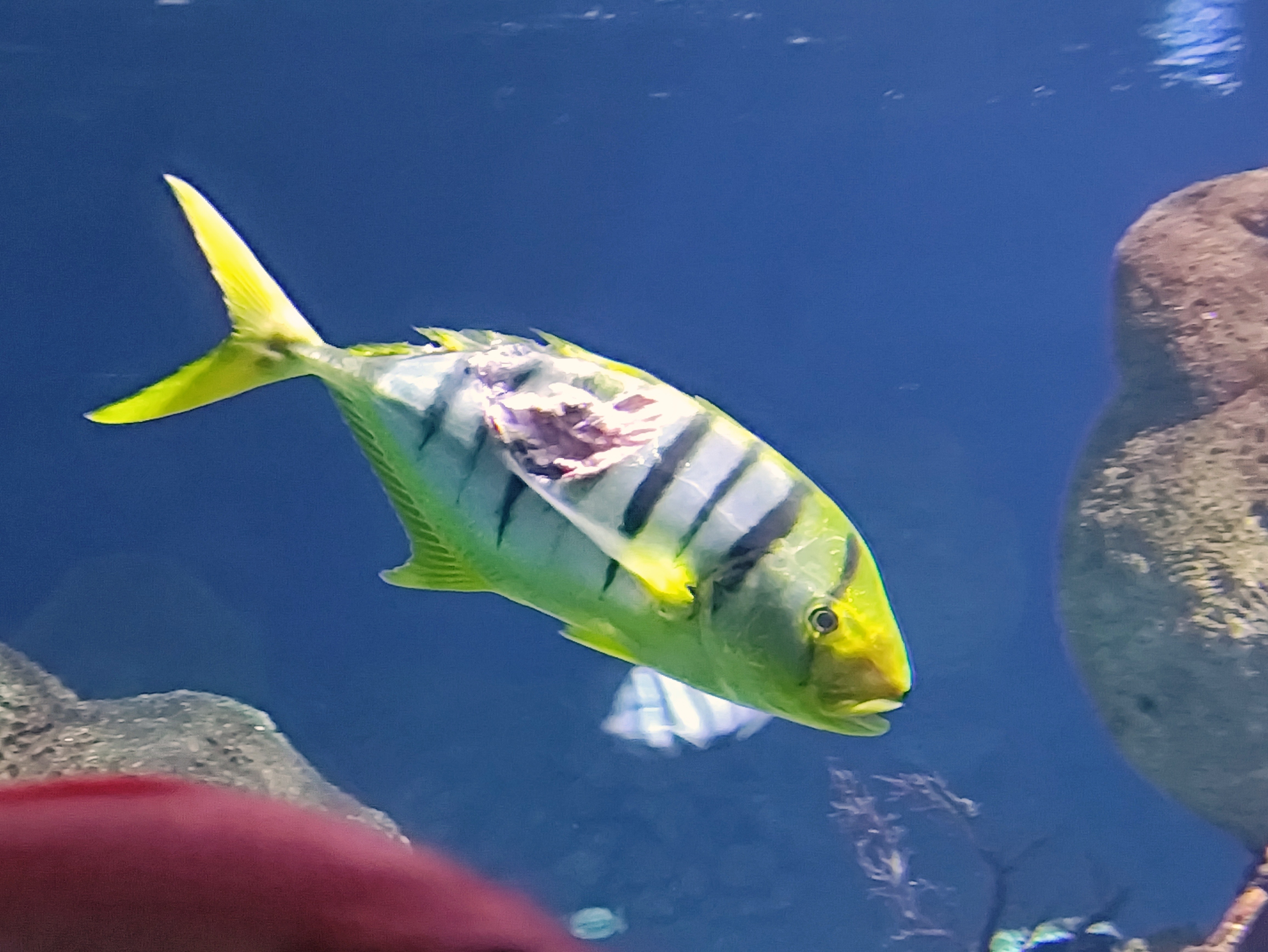
I would be amiss if I did not mention the fish-related art installations that decorated the entrance and exit of the aquarium circuit. There was even a little information regarding kashrut and kosher fish, for hungry visitors looking for a cheeky bite to eat in the darkened exhibits.

Someone bit this golden trevally

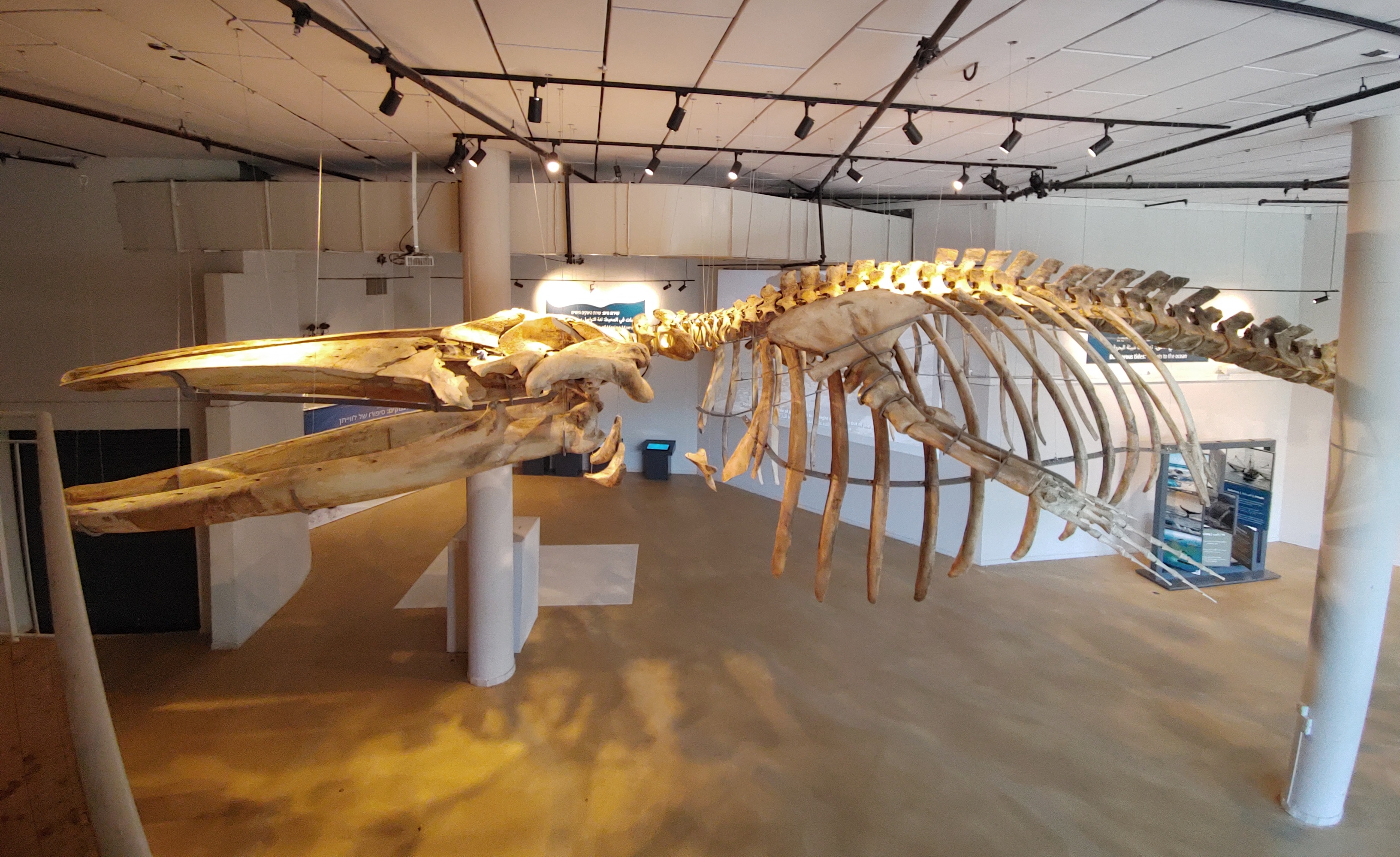
As we were leaving the building, I noticed that there was a side exhibit dedicated to the suspended skeleton of Sandy, a dead fin whale that washed ashore back in 2021. The huge skeleton, measuring 17.5 metres (57 feet), made the room feel small – and an elevated platform was needed to be able to get a good look at the alien-looking skull bones.

Fin whale skeleton hanging on display

When I climbed back down, we gathered our belongings and made our way out of the aquarium, feeling happy to have seen this long-awaited site. We then drove to get some lunch at one of Jerusalem’s acclaimed pizza shops and then the drive back home to Elkana at the edge of the Shomron.

The Sir David Salomons Collection of Watches and Clocks

In Israel, Jerusalem on June 15, 2023 at 7:11 AM

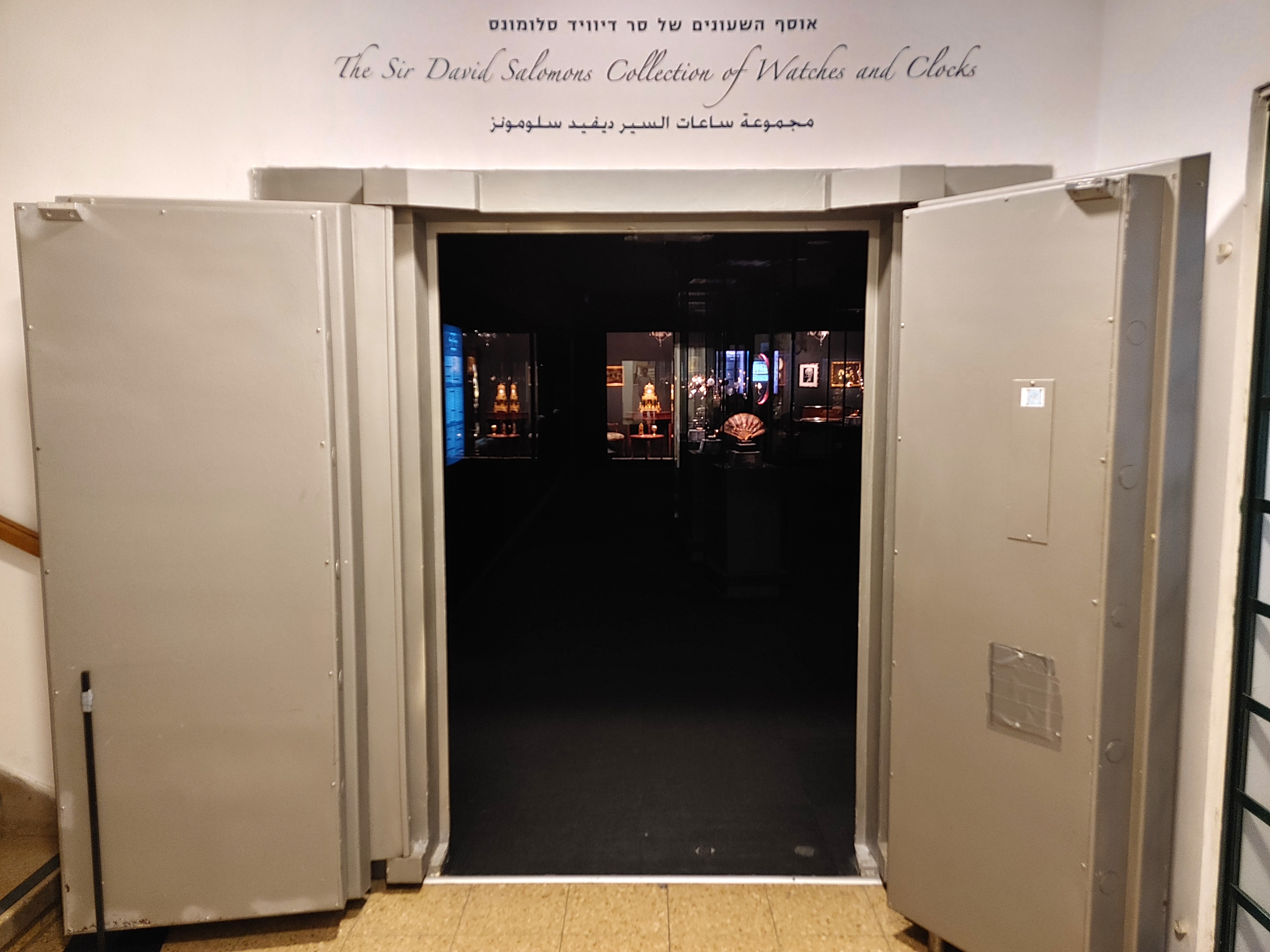
Resuming the report on the Museum for Islamic Art, our final destination was to a very special exhibit – one that deserves, and merits, its own blog post. I speak of the Sir David Salomons Collection of Watches and Clocks, hosted in a dark bomb shelter in the museum’s lower floor. Interestingly enough, I was unaware that this exhibit existed when planning our trip to the museum, but having a soft spot for horology, this came as quite the welcome surprise.

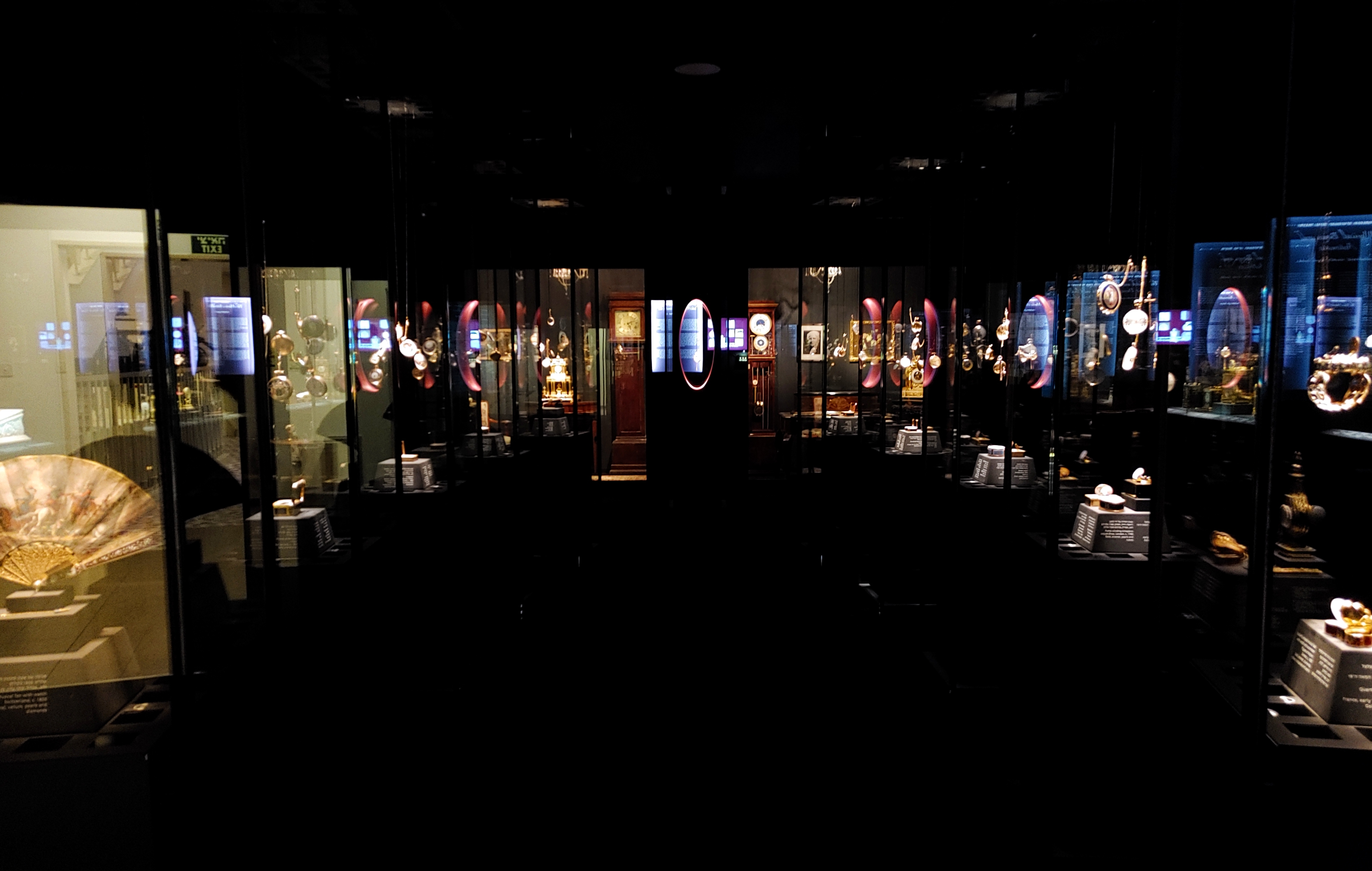
Rows of timepieces on display

Rows of timepieces on display

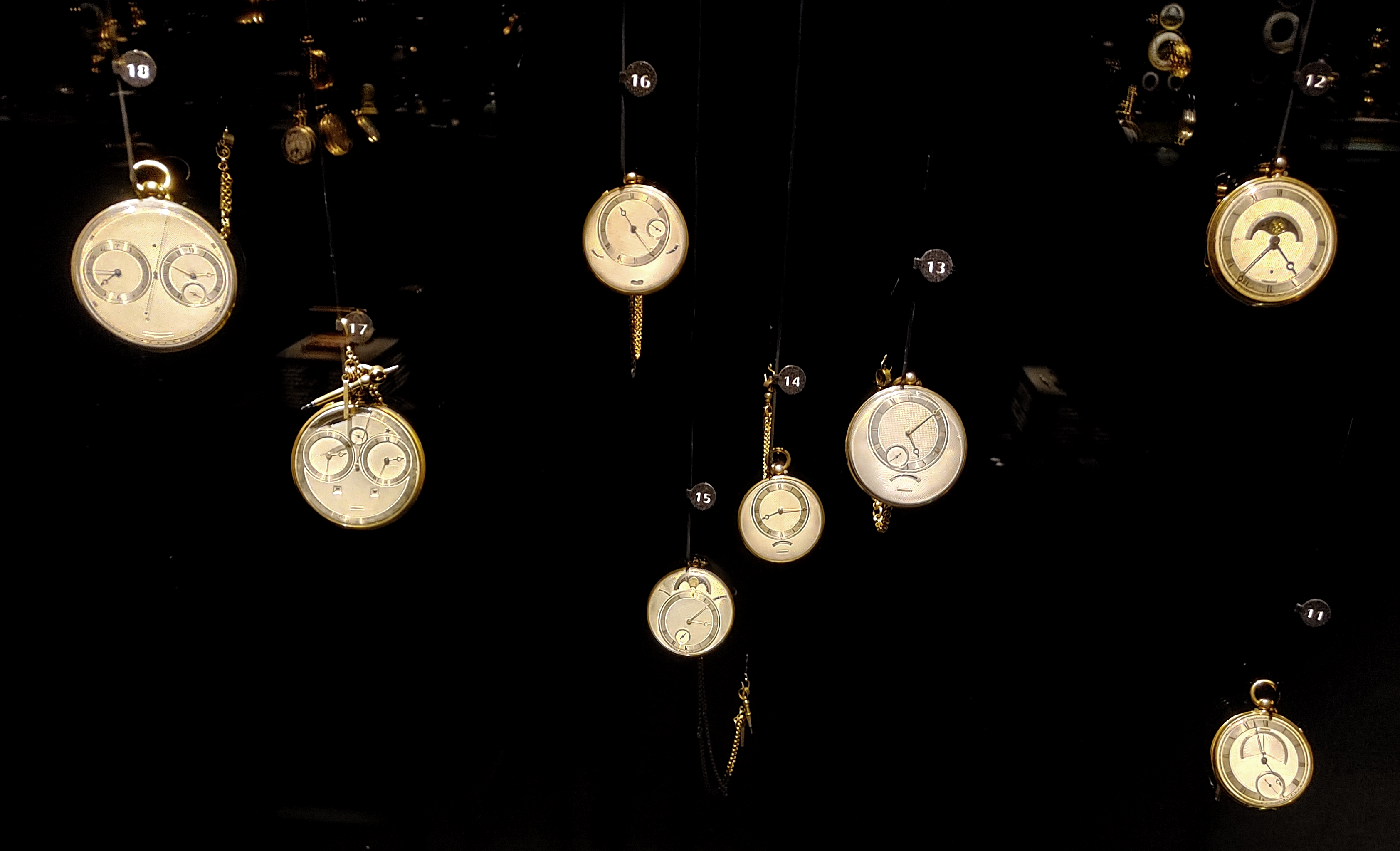
As stated before, we finished exploring the rest of the museum and came upon the open heavy bomb shelter doors that kept the watch collection safe in relative darkness. We crossed the threshold and began to examine the 200 or so timepieces in the collection. I was immediately struck by the simplistic beauty of the timepieces dangling in the darkness, perfectly illuminated as to give the appearance of time suspended indefinitely.

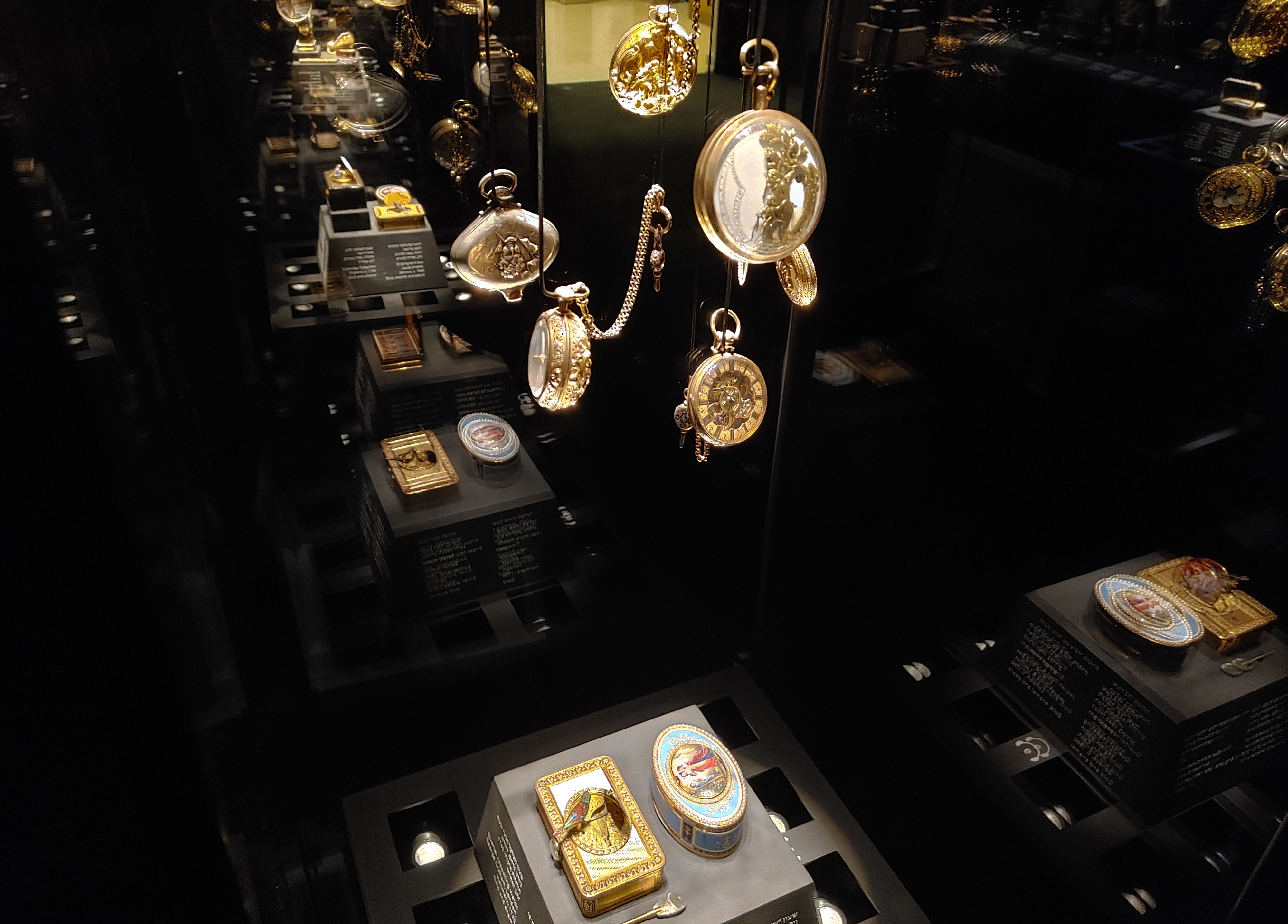
So many precious timepieces

So many precious timepieces

My perusal began with an assortment of gold French and Swiss timepieces from the 1800s, each one more magnificent than the next. It was hard not to marvel endlessly at the incredibly fine craftsmanship with each and every piece. The fine detailing that complimented the elegant and timeless designs showcased a mechanical marvel that ticked away ever so gently.

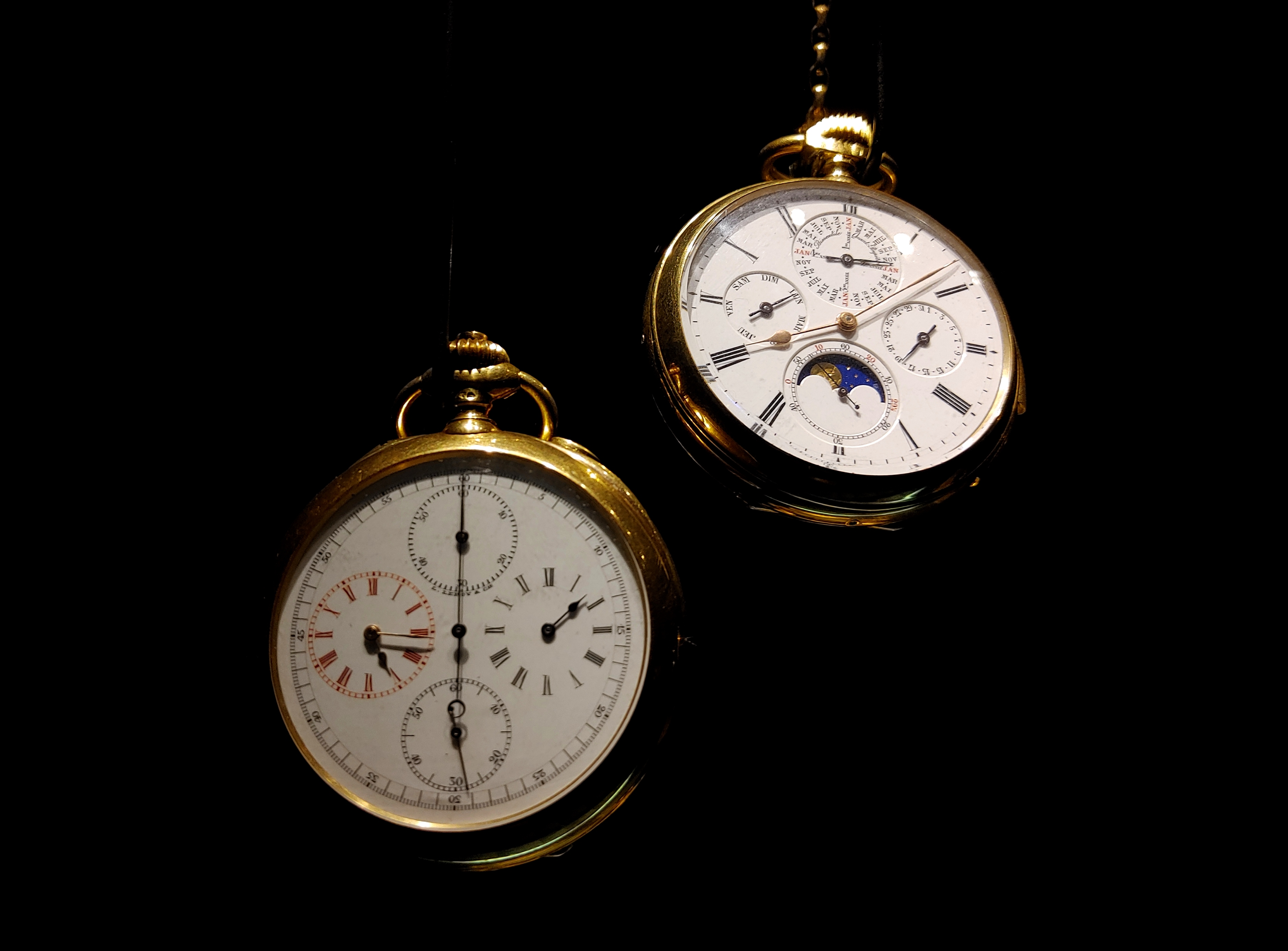
Two L. Leroy et Cie pocket watches

Two L. Leroy et Cie pocket watches

While the collection does feature a good number of stationary clocks, it was the handheld pocket watches that intrigued me most. Unbeknownst to many, my friend and frequent guest on this blog, Adam Ota, has been dabbling in the world of watch movement mechanics for a couple of years now. His speciality is in the timepieces that were crafted in the Soviet Union, practical and relatively inexpensive to source.

The rare exhibit's humble setting

The rare exhibit’s humble setting

Over these years he has gifted me two elegant Soviet wristwatches, both of which he personally cleaned, tuned and realigned to proper working order. The first, which I wore to my wedding (see HERE), was a gold-plated, 23-jeweled Luch timepiece from the 1970-80s or so. The second is a 16-jeweled Svet watch, dated to around the same time, which can be seen HERE.

A variety of Breguet pocket watches

A variety of Breguet pocket watches

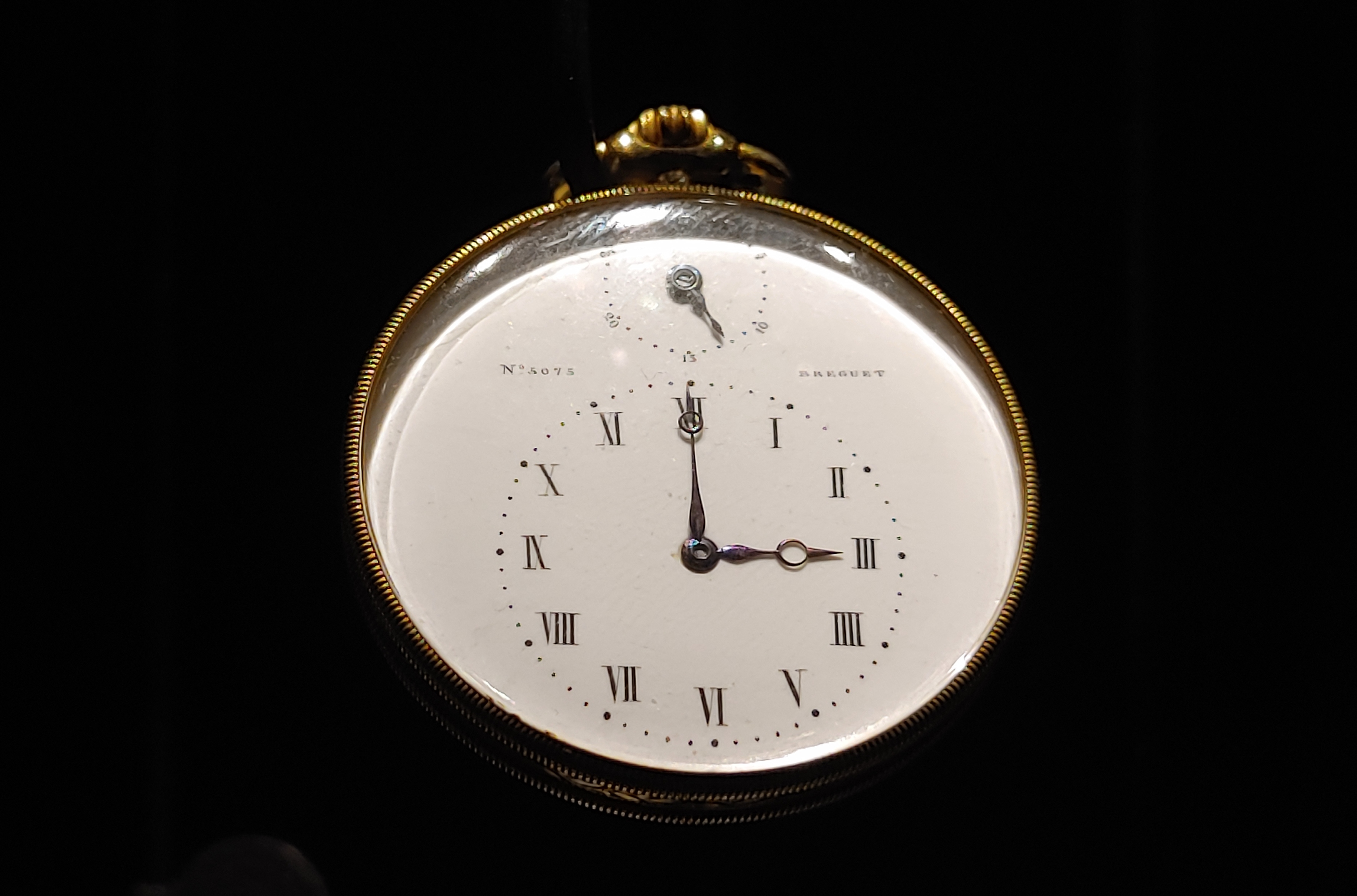
Needless to say, I can appreciate a fine timepiece, and so when we delved into the incredible masterpieces of Breguet, one of the foremost horologists of all time, I may have been slightly euphoric. Of the Breguets on display, the following two caught my eye the most: Breguet No. 148 from 1792 and Breguet No. 5075 which was sold in 1857, both tastefully crafted of gold and enamel.

Breguet No. 5075

Breguet No. 5075

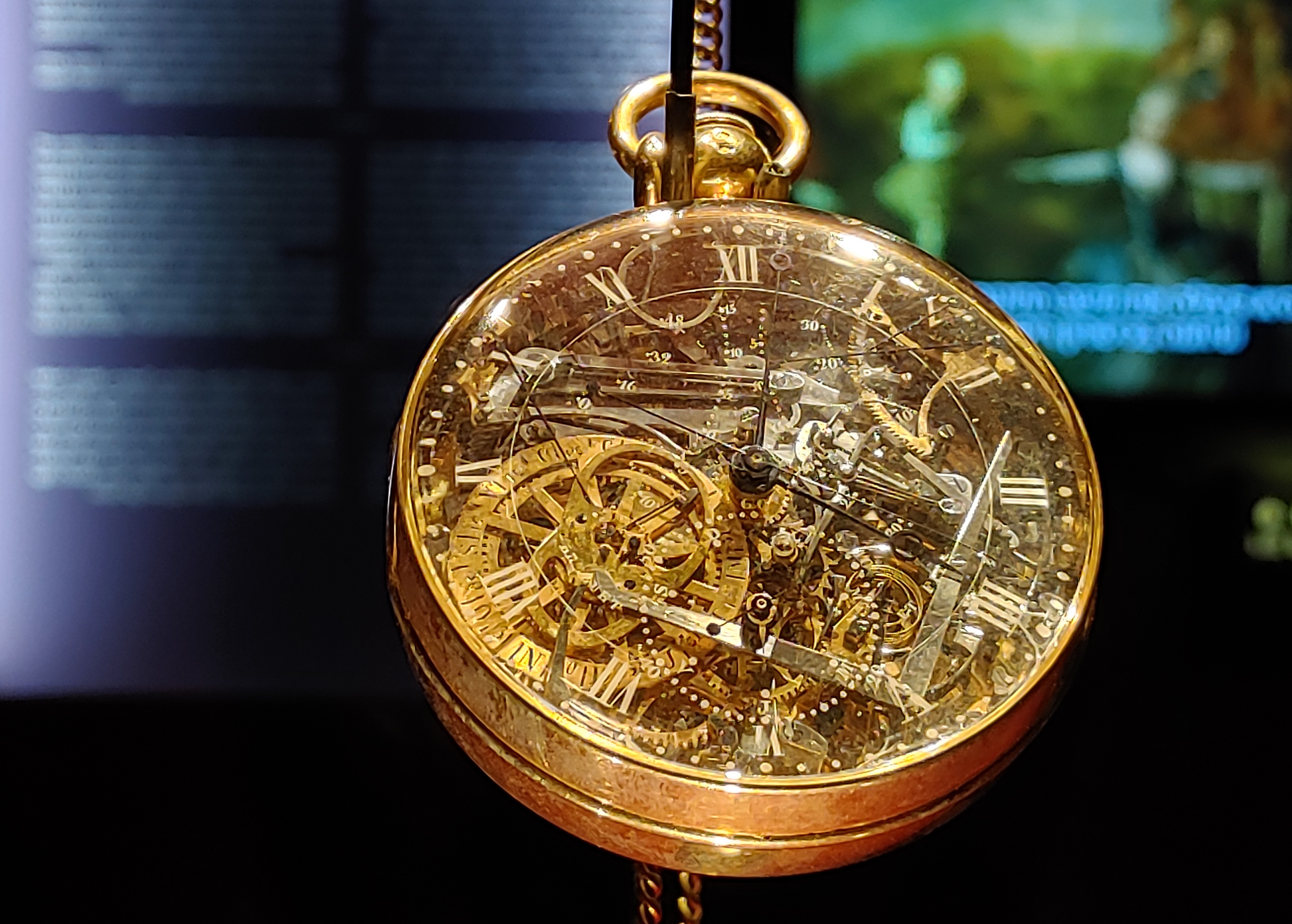
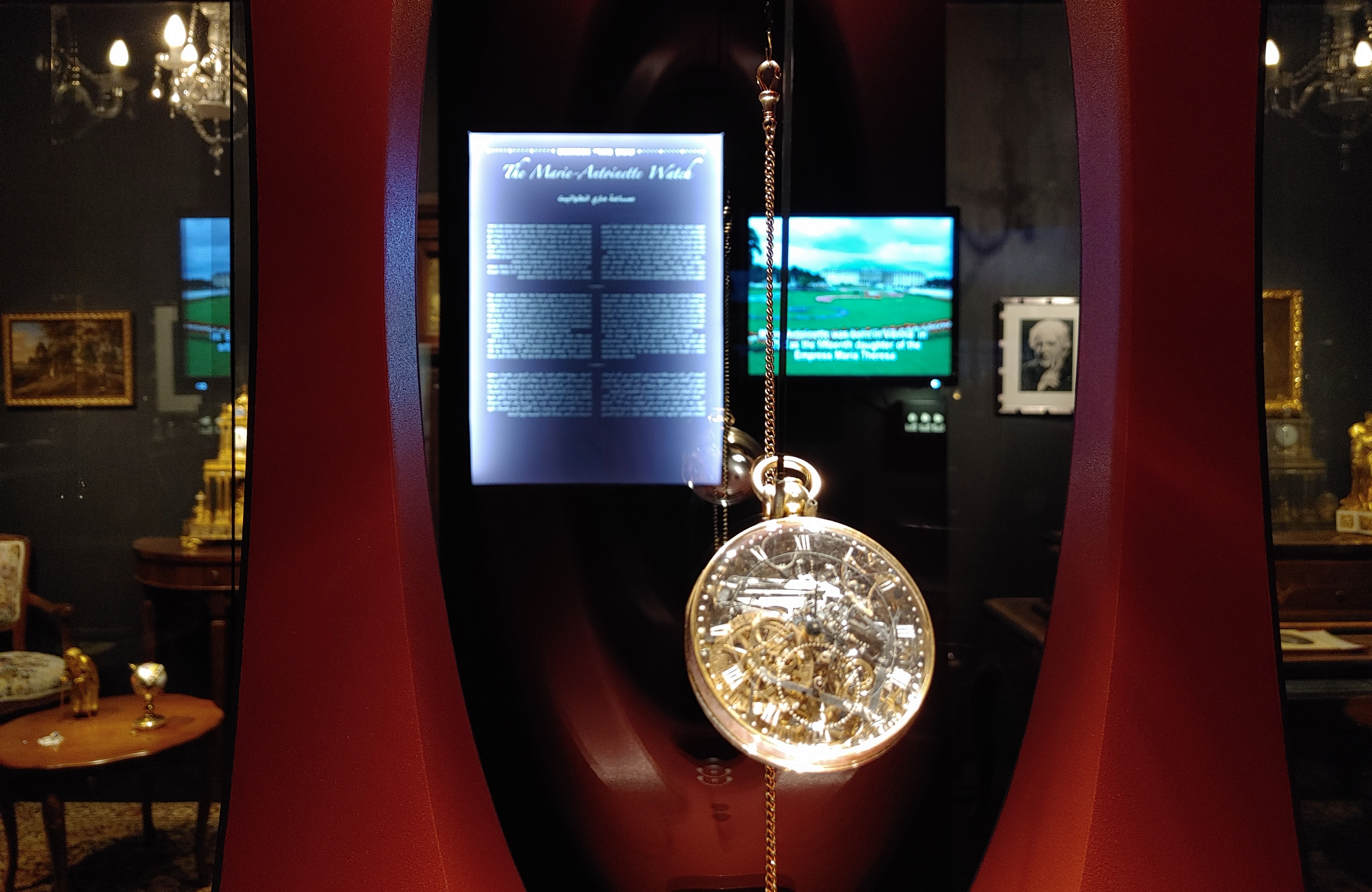
The pièce de résistance of the collection, and of Breguet as a man and brand, is the magnificent Marie Antoinette watch (or officially, the Breguet No. 160 “The Grand Complication”). To quote the BBC, it is “the most valuable and famous watch in the world” and it befuddles my mind to realise that it was relatively humbly displayed in the basement of an obscure museum, when put into worldwide proportions. But there it was, suspended and illuminated inside a special glass case, for all to see.

Breguet's Marie Antionette watch

Breguet’s Marie Antionette watch

It was commissioned in 1783 for Marie Antoinette, then-Queen of France, and wasn’t completed until 1802. The objective given to master horologist Abraham-Louis Breguet was to add every possible feature, or complication, to the watch, so that it would be the most fantastic timepiece ever. However, once finished, Marie Antoinette wasn’t around to receive it, having been famously executed by guillotine. The watch remained in the watch firm’s hands until the late 1880s when it was sold, and then purchased again by Sir David Salomons in the 1920s and eventually put on public display. 

The Marie Antionette watch on display

The Marie Antionette watch on display

Fascinatingly, and something that I had not known before, it and over 100 other invaluable timepieces were stolen in the 1980s in what is known as one of the biggest museum heists in history. In a sensational story which ended with the death of the thief in 2004, his widow’s attempt to resell the stolen contraband, a criminal investigation, and the eventual recovery of only some of the missing timepieces – sadly, some are still at large. 

A Swiss musical fan with watch

A Swiss musical fan with watch

After our trip to the museum I did a moderate amount of research to learn more about the Marie Antionette watch, and of course the infamous theft, and came across some rather interesting content. Topping the chart was a BBC piece from 2016 where nonagenarian watch enthusiast Nicholas Parsons goes on a journey retracing the life of the Marie Antionette watch from Abraham-Louis Breguet’s first workshop on Paris’s Quai de l’Horloge to Israel, the watch’s new home. This hour-long video is conveniently available on YouTube, and can be watched HERE.

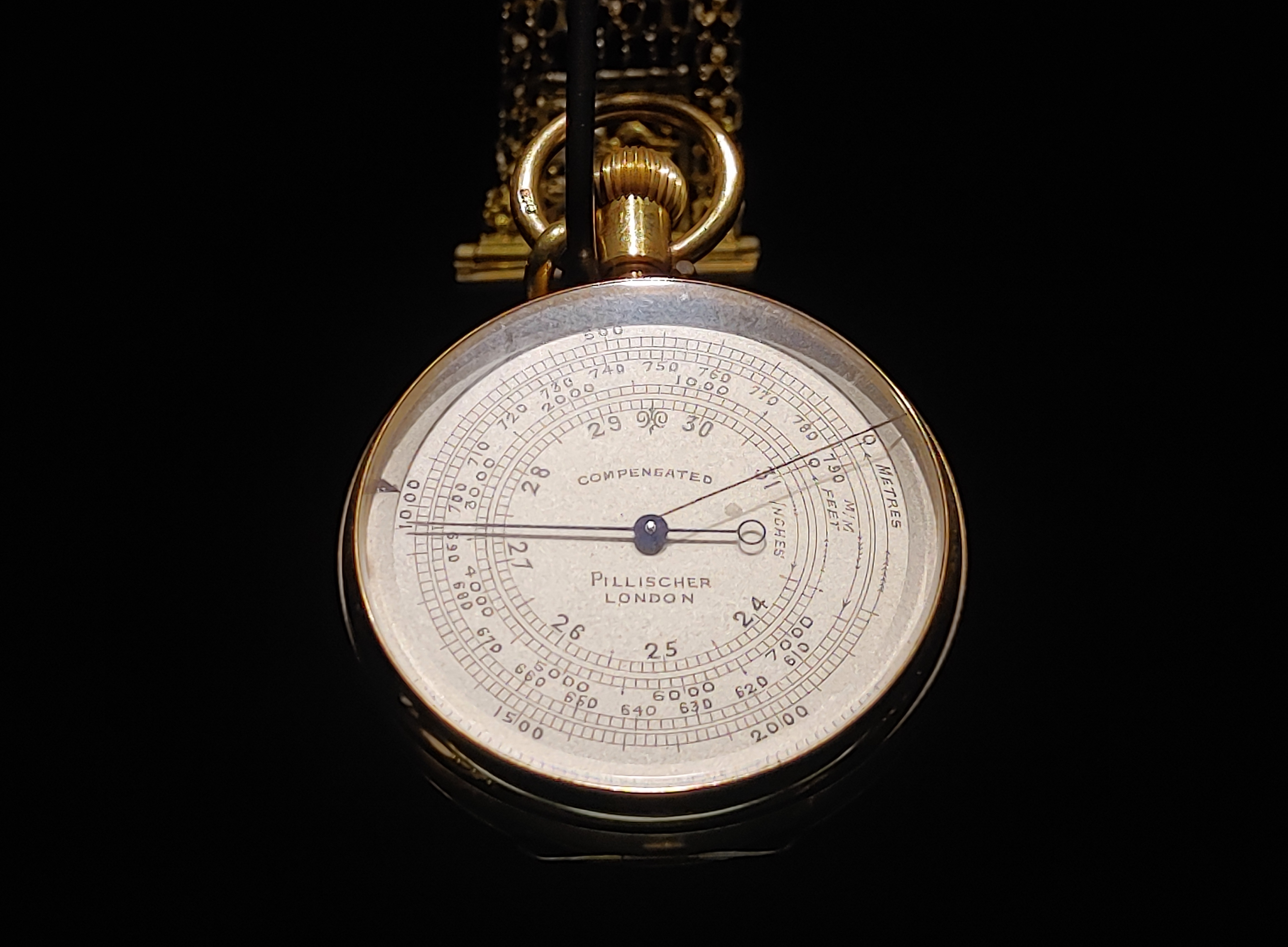
An aneroid barometre by M Pillischer of London

An aneroid barometre by M Pillischer of London

Moving along, I have always had an affinity for skeleton watches, the intricate movement laid bare to the viewer’s eye, so thankfully for me there were a few skeleton clocks on display as well. That and a good handful of obscure pieces such as barometres, thermometers, sundials, pocket telescopes and compasses were more than enough to diversify the impressive collection.

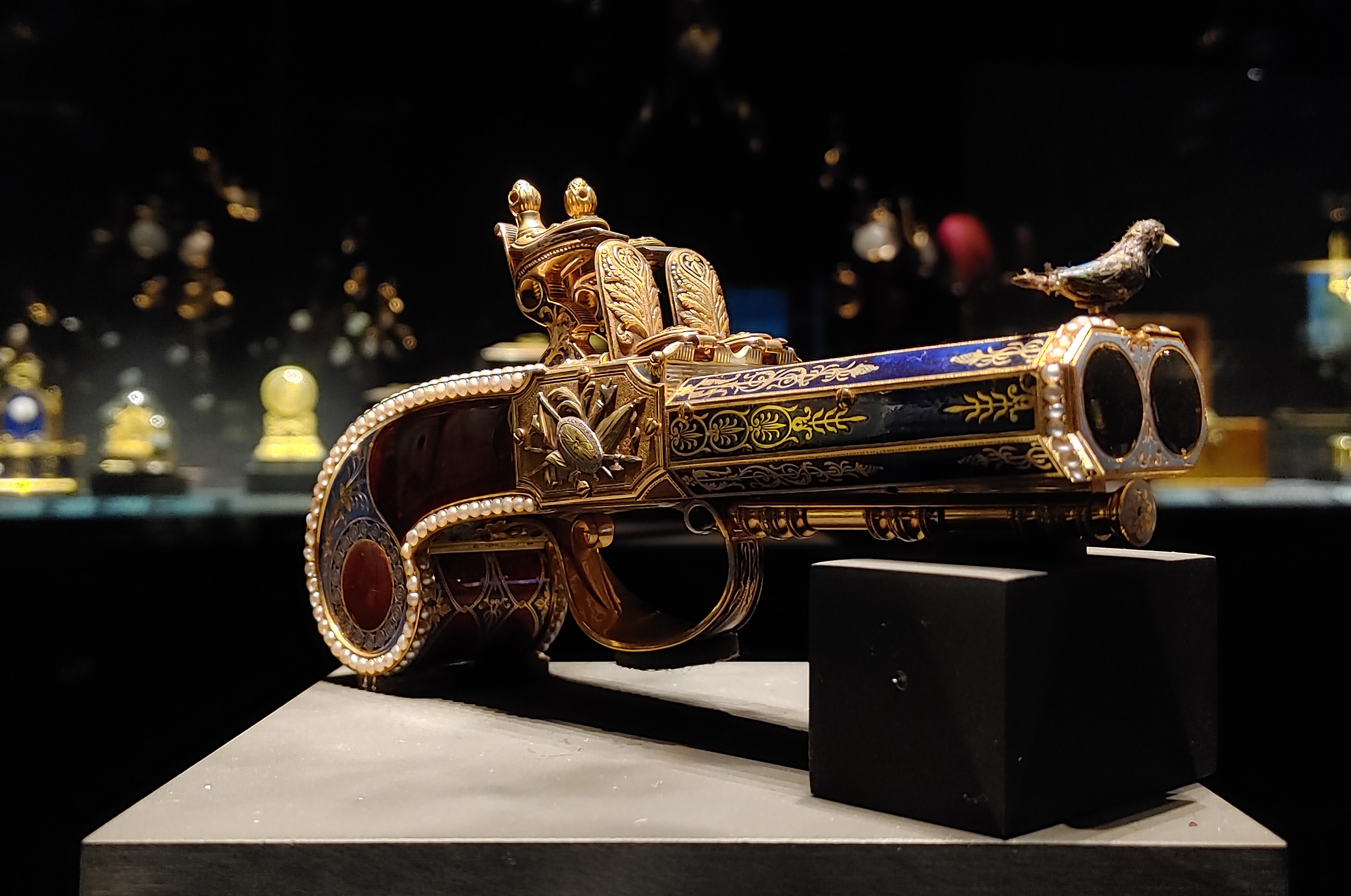
Frères Rochat's singing bird pistol

Frères Rochat’s singing bird pistol

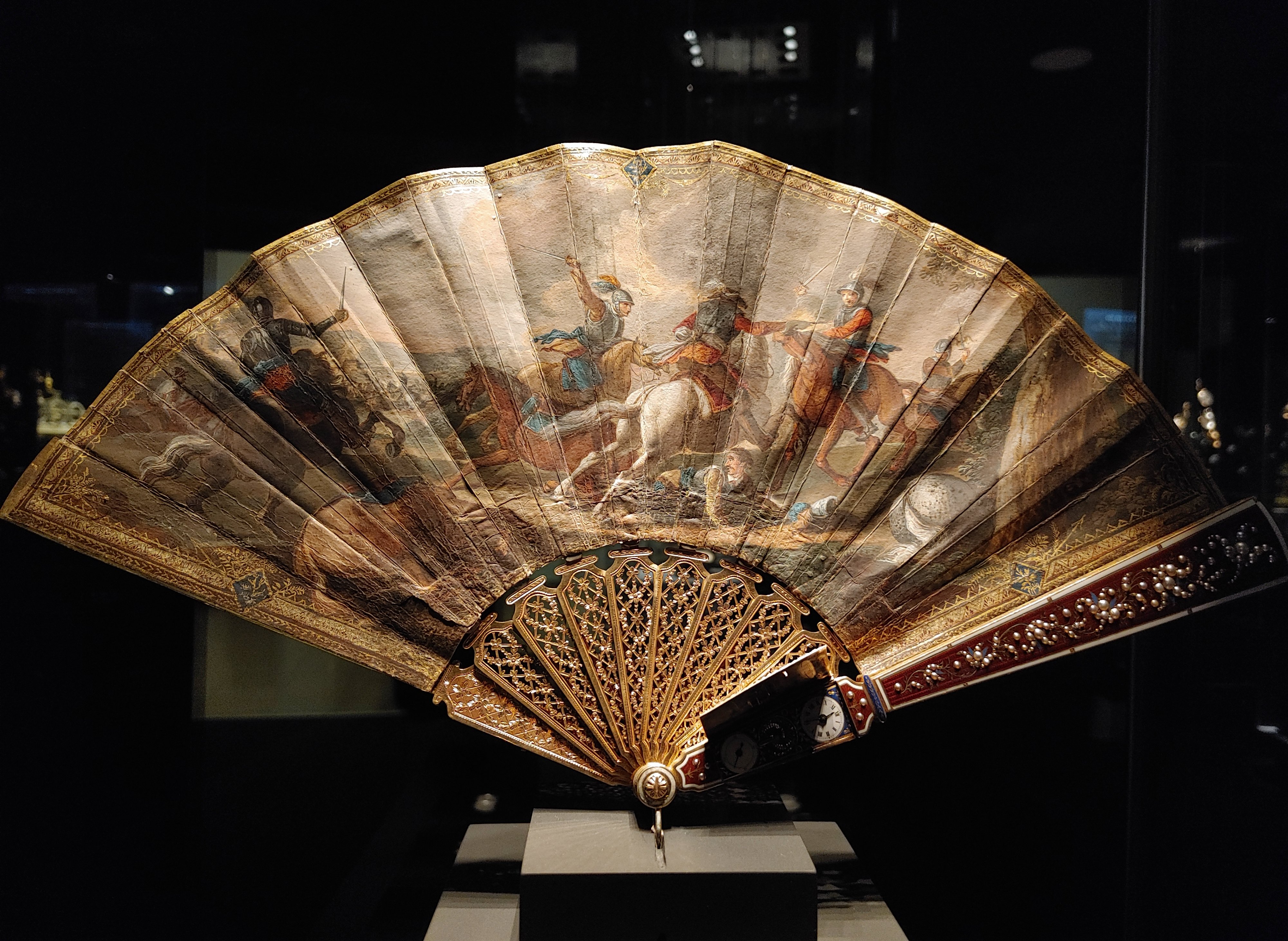
There were timepieces of all sorts, including astronomical clocks, mantel clocks and automated musical boxes. Yet, it was the still simple pocket watches that excited me most – particularly those with cleanly designed dials, such as a pair of L. Leroy et Cie pocket watches. Some of the timepieces were more on the creative side, such as a collapsible Swiss musical fan, adorned with pearls and diamonds. A singing bird pistol with a small watch embedded in the butt was the innovation of Swiss watchmaker Frères Rochat in the early 1800s. 

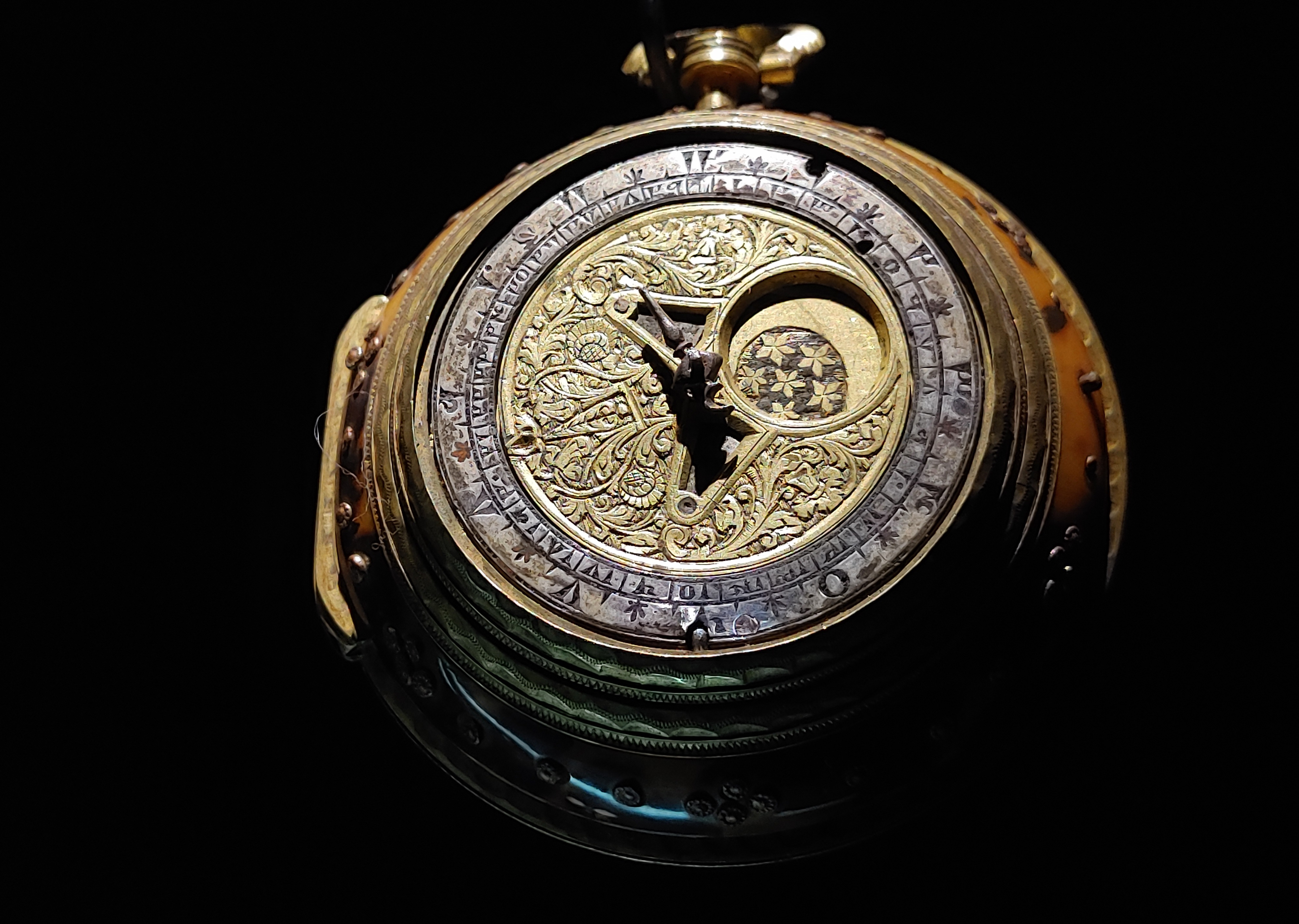
A Turkish calendar watch from the 1600s

A Turkish calendar watch from the 1600s

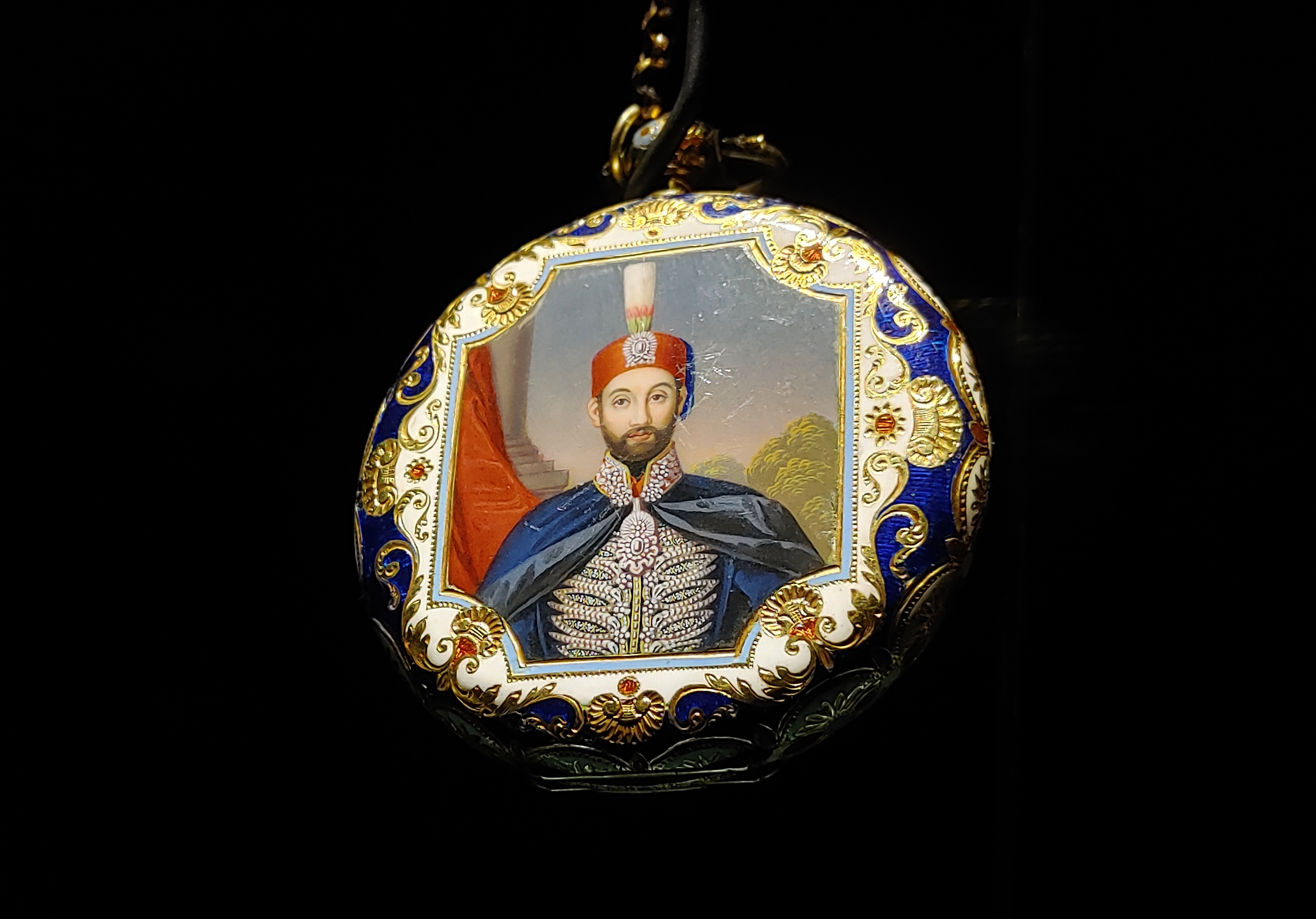
Fine craftsmanship was not limited to the French and Swiss, on display were representatives of timepieces from countries such as England, Japan and Turkey. Some were, in fact, Swiss-made for foreign markets, such as one featuring the portrait of Ottoman sultan Abd al-Majid, crafted by Augt. Courvoisier & Cie in around 1850.

Augt. Courvoisier & Cie timepiece for Turkish markets

Augt. Courvoisier & Cie timepiece for Turkish markets

It took but twenty minutes or so to peruse the priceless collection, but it was a moment captured in time that I should be hard pressed to forget. Never have I seen such an awe-inspiring collection of timepieces, and when will such occasions rise again. I left the museum feeling slightly odd, that the last – seemingly unrelated exhibition – had eclipsed the sensations created by the rest of the artefacts and collectibles on display. At least it was a good sort of odd, feeling thankful for my opportunity to visit at long last.

Museum for Islamic Art

In Israel, Jerusalem on February 3, 2023 at 9:44 AM

Exactly one year ago, the day after our second wedding anniversary, Bracha and I embarked on a short day trip to Jerusalem. Our adventure began with a gourmet lunch at famed pizzeria La Piedra, joined by our friends Adam and Vered. From there we journeyed to the main destination of the day, the Museum for Islamic Art, located in central Jerusalem not too far from the famed Israel Museum. I had been wanting to visit this alluring-sounding museum for quite some time, so it was a joy to finally carve some time out of our schedule for a nice visit. But first, dessert in the form of an ice cream cone from the popular Mousseline ice cream parlour, found just around the corner.

The museum's foyer

The museum’s foyer

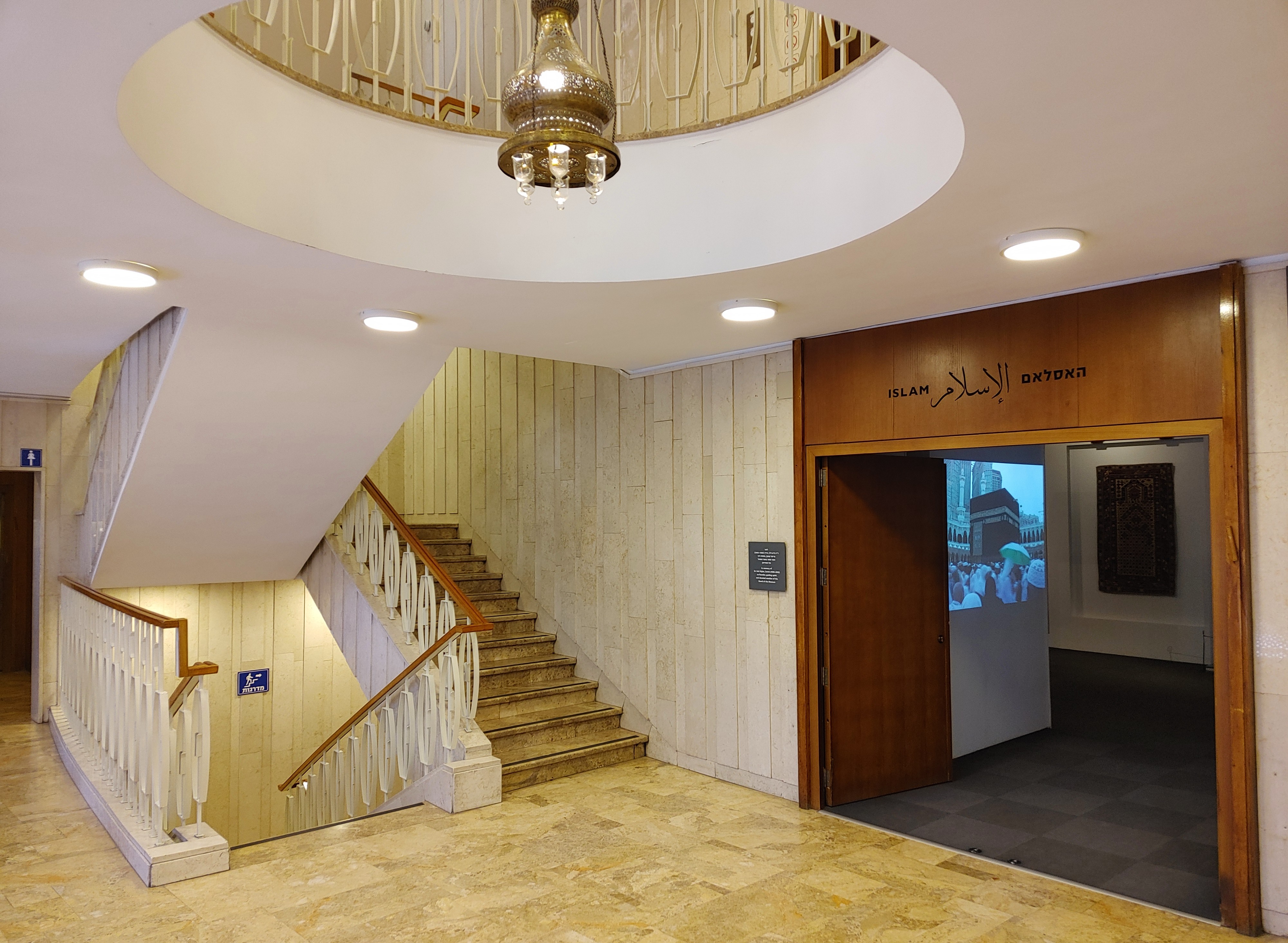
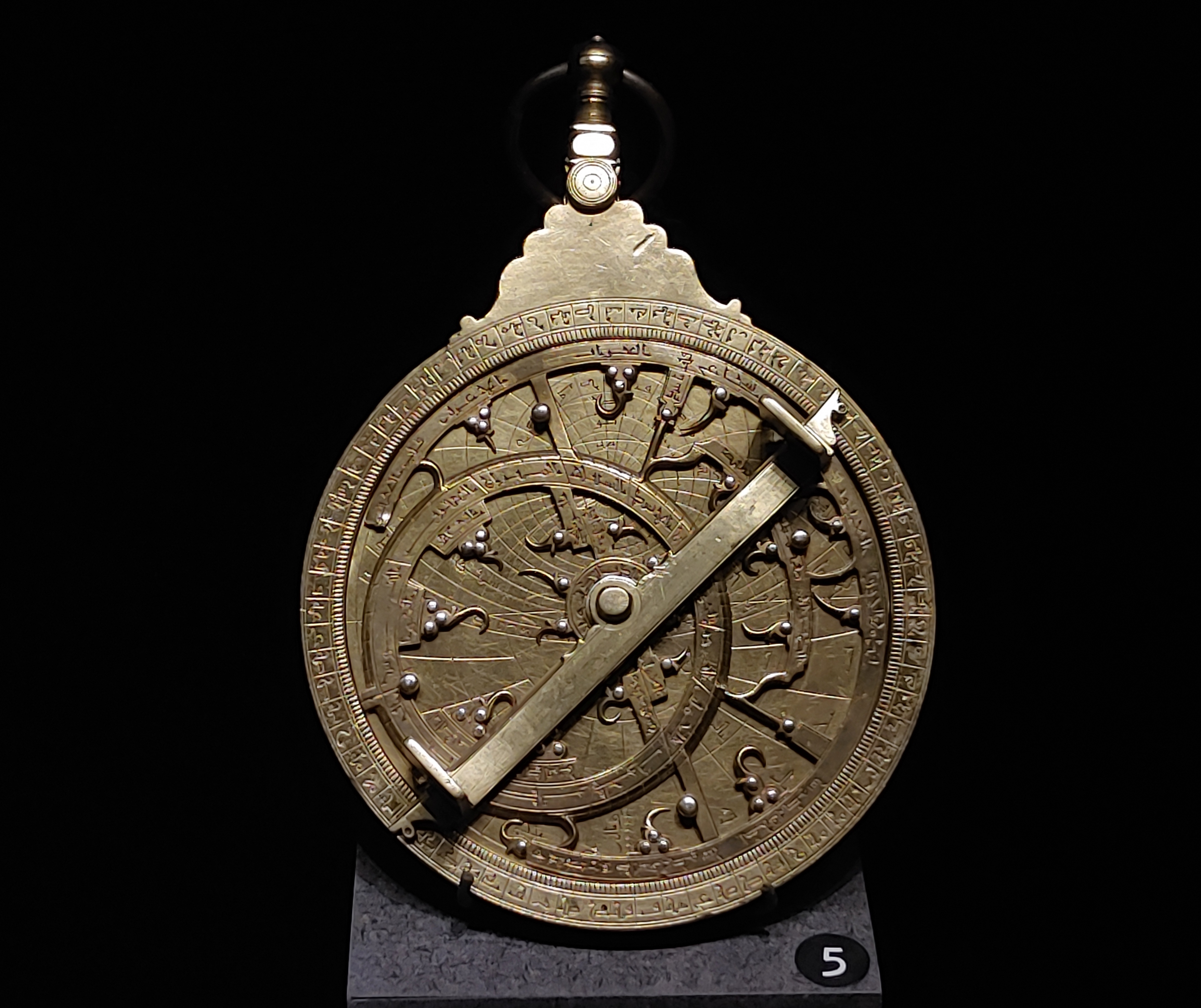
Admiring the large building on approach, we learned that the museum was created by Vera Bryce Salomons, who ultimately passed away before the museum’s opening in 1974. Its goal was to preserve and present collections of art and archaeological artefacts that represent the Islamic world. Eight permanent and one temporary exhibitions awaited us as we pulled open the glass front door, thus beginning our tour.

North African astrolabe from 1727

North African astrolabe from 1727

After confirming our tickets and hanging up our coats, we left the agreeable foyer and began exploring the first exhibit at hand – that of the early Islamic art. Now with my field of interest being the medieval periods, and my ongoing research dealing with the material (and written) evidence of the time, I naturally had quite the desire to align my archaeological knowledge with the physical displays of art that we were just about to see. While the more localised content interested me more, there was certainly a vast trove of foreign antiquities which delighted the eye. I can but point out some of the more interesting items that we were presented with, in hopes of giving justice to the experience that we had.
An ancient ivory domino set

An ancient ivory domino set

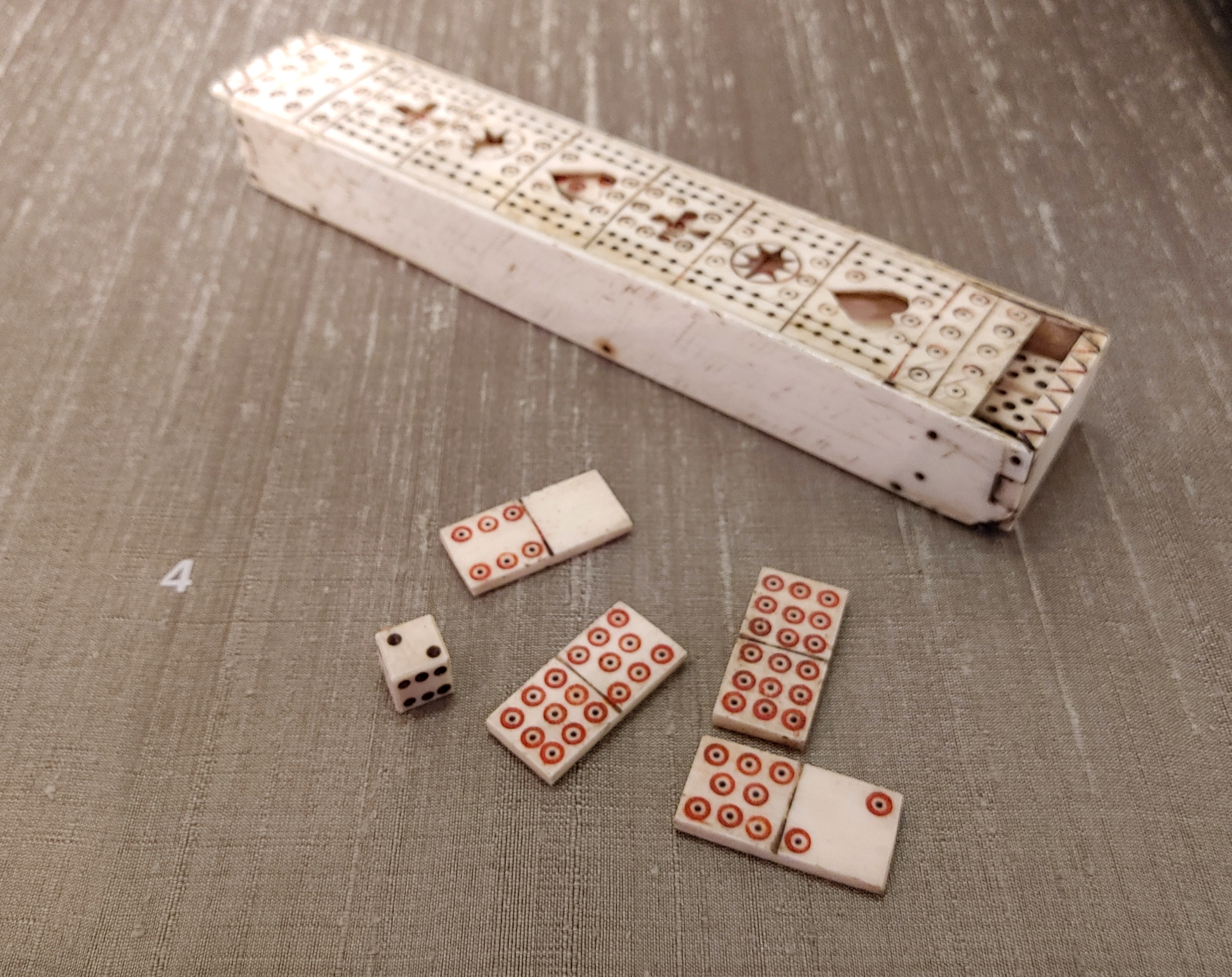
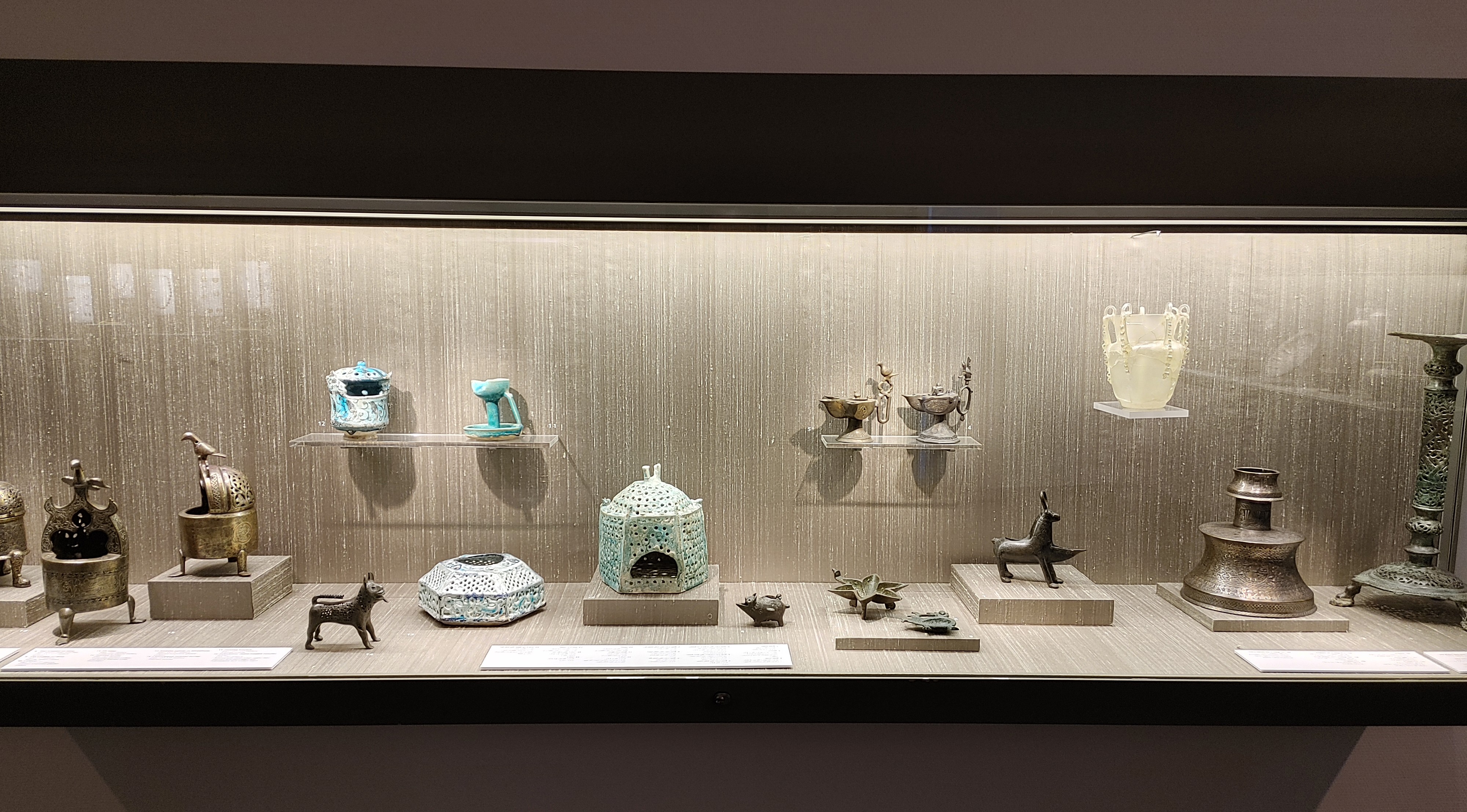
The first collection of items belonged to the Islamic empires that controlled the lands to the east, such as Persia/Iran, Iraq and more, and then slowly merged westward, covering the Islamic periods and communities from Asia Minor, the Levant and North Africa. Some notable artefacts include a leopard-painted ceramic bowl from eastern Iran, a collection of relatively simple oil lamps (quite similar to those I research), and a 6th-8th century ivory box of dominoes.

Posing at the mihrab

Posing at the mihrab

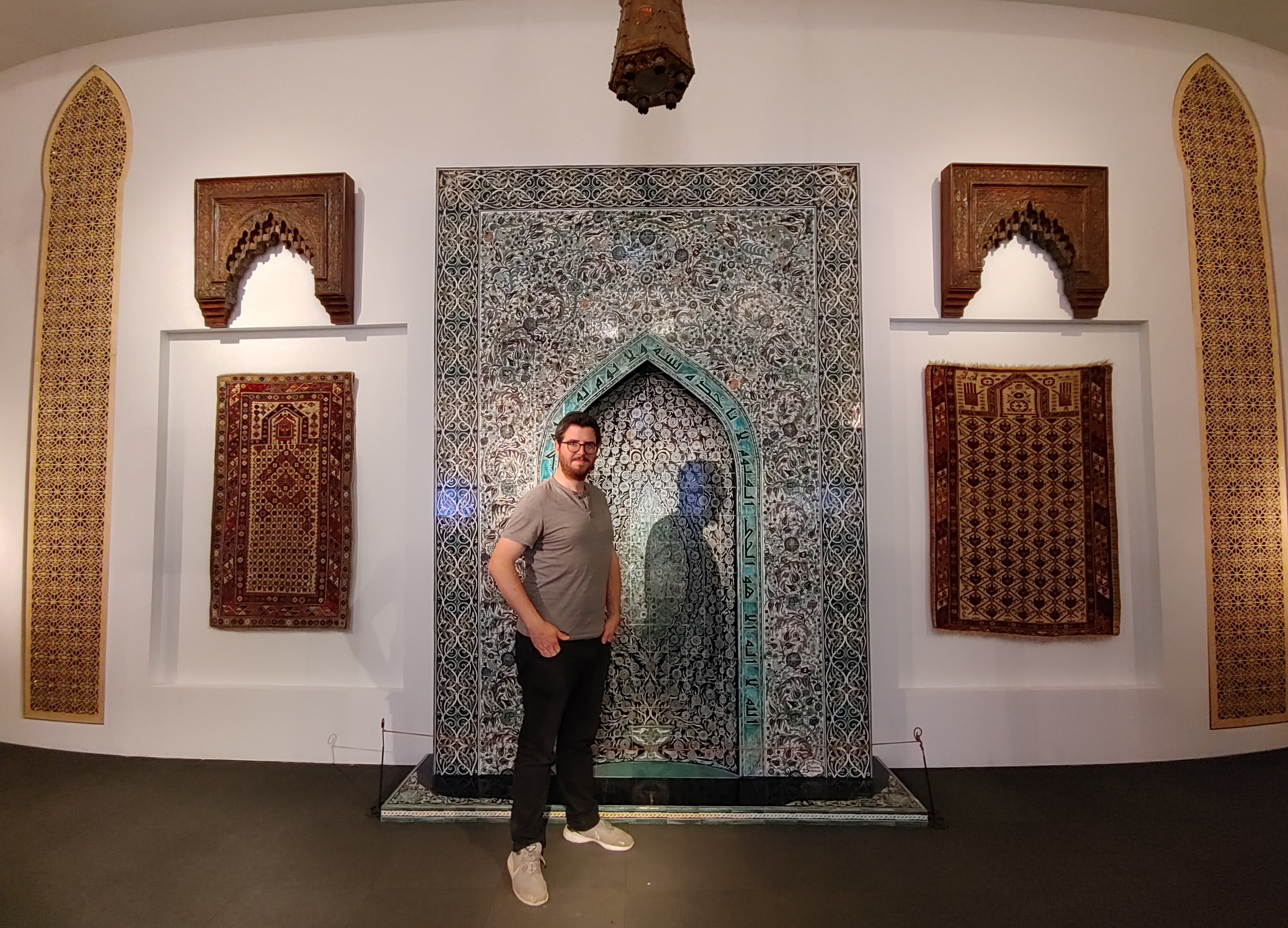
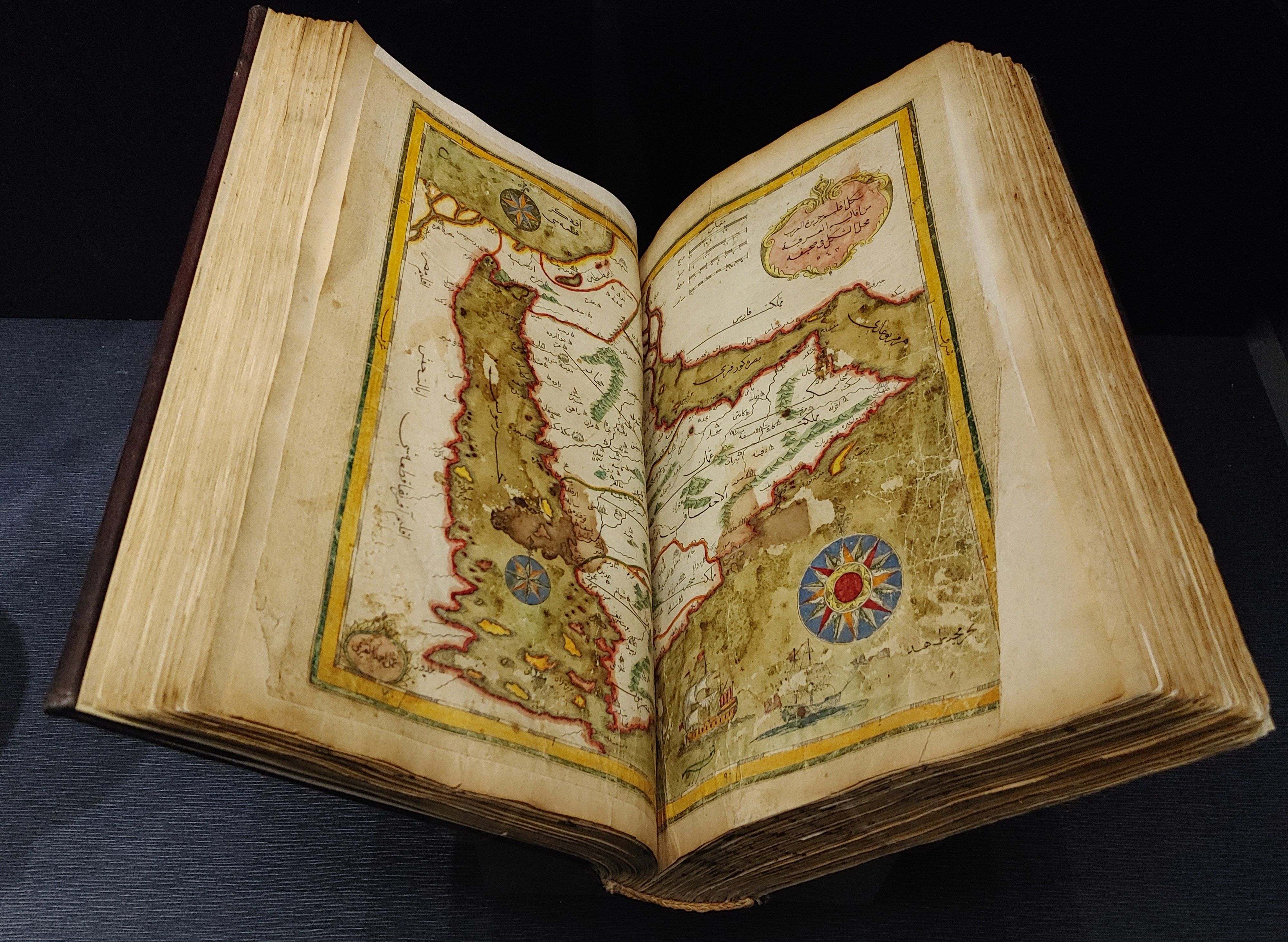
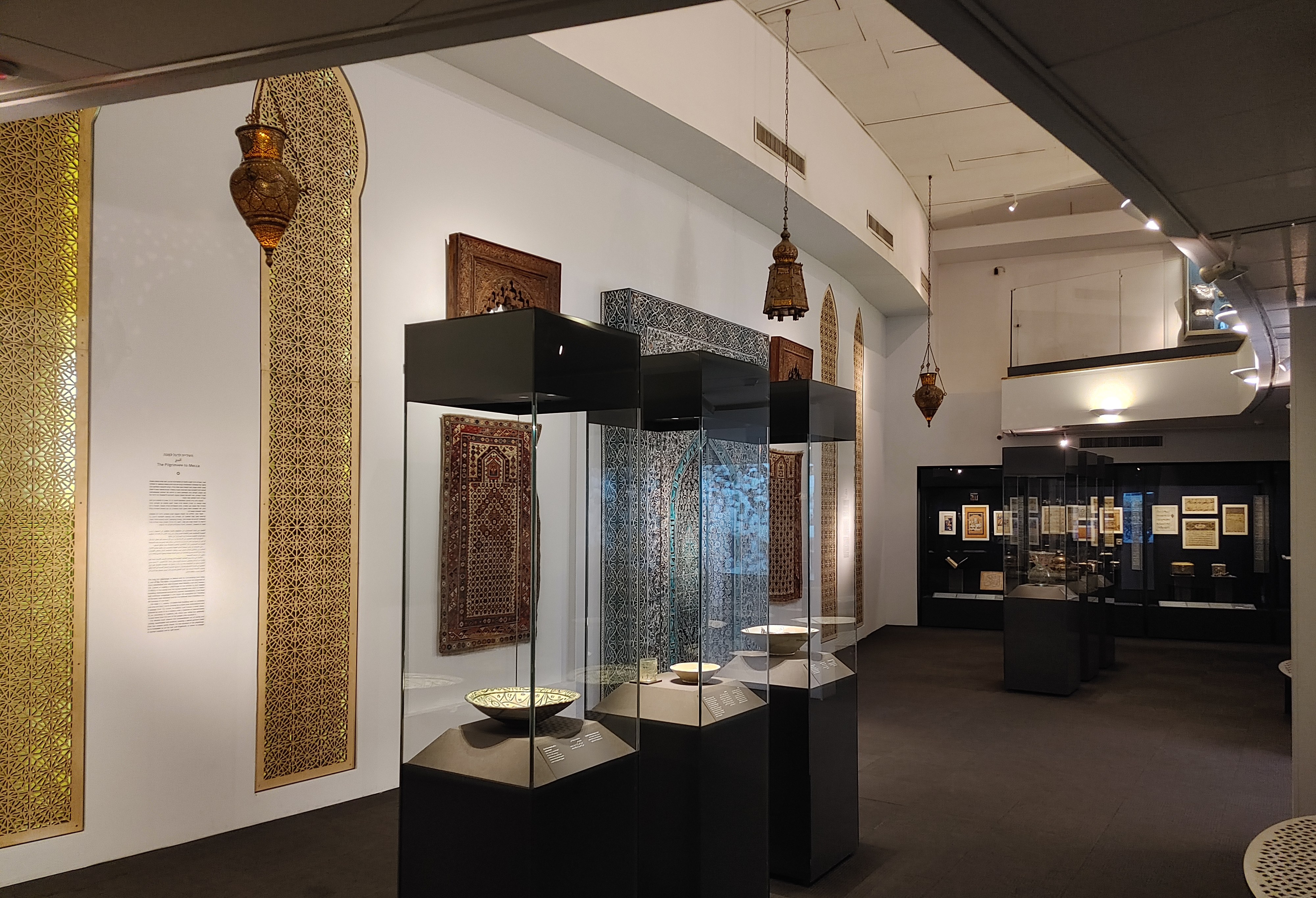
Moving on to an exhibit about artistic Islamic architecture, we admired a modern mihrab (prayer niche) flanked by 15th-16th century Spanish wooden architectural pieces and mid-19th century Daghestani prayer rugs. Next, I quite enjoyed inspecting a 13th century Syrian manuscript and 12th century Iraqi translations of the Greek Materia Medica. But it was the open pages of an ancient map from a 17th century manuscript that really tickled my fancy, filling me with hopeless wanderlust. 

17th century Ottoman book of travels manuscript

17th century Ottoman book of travels manuscript

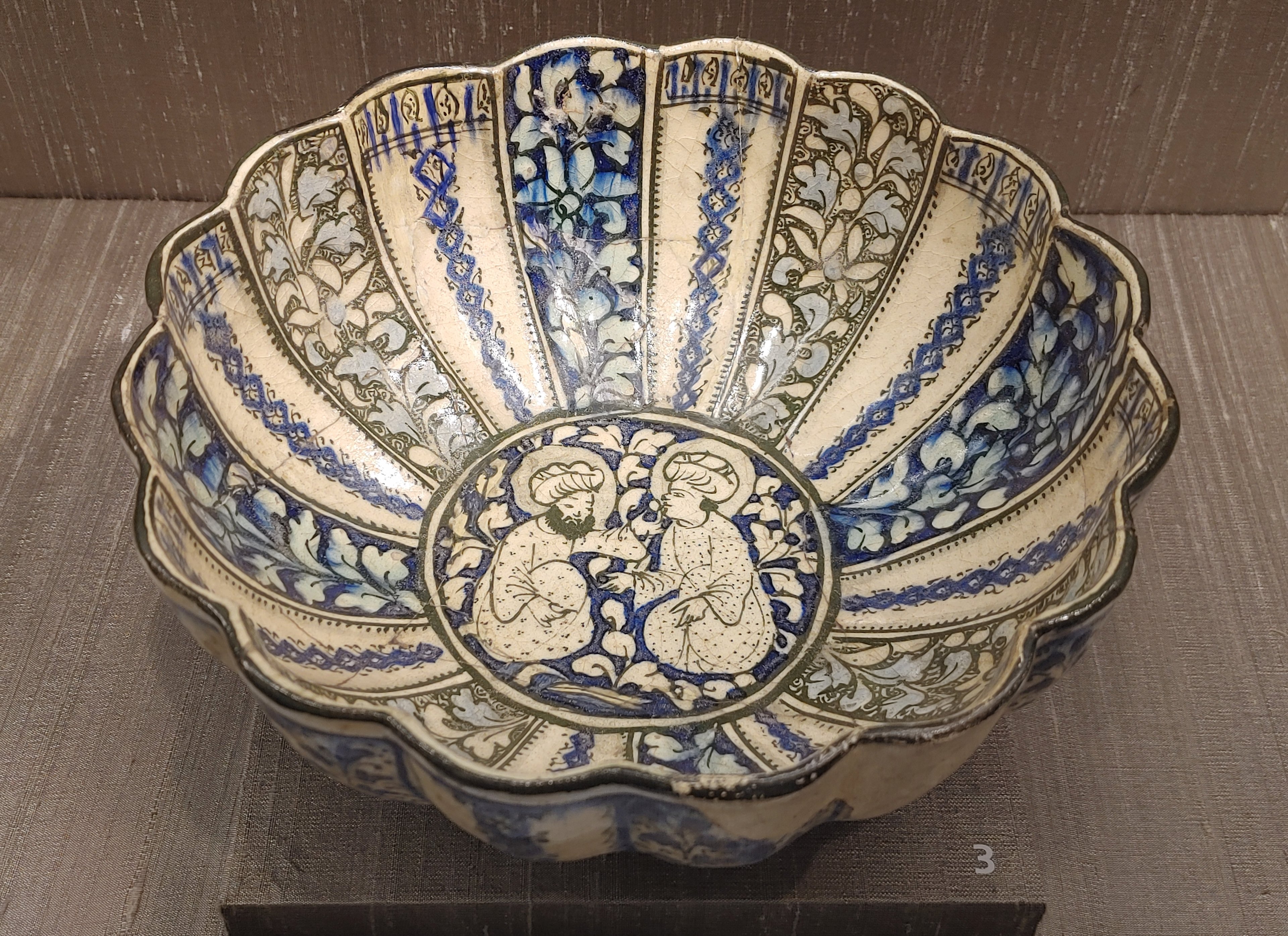
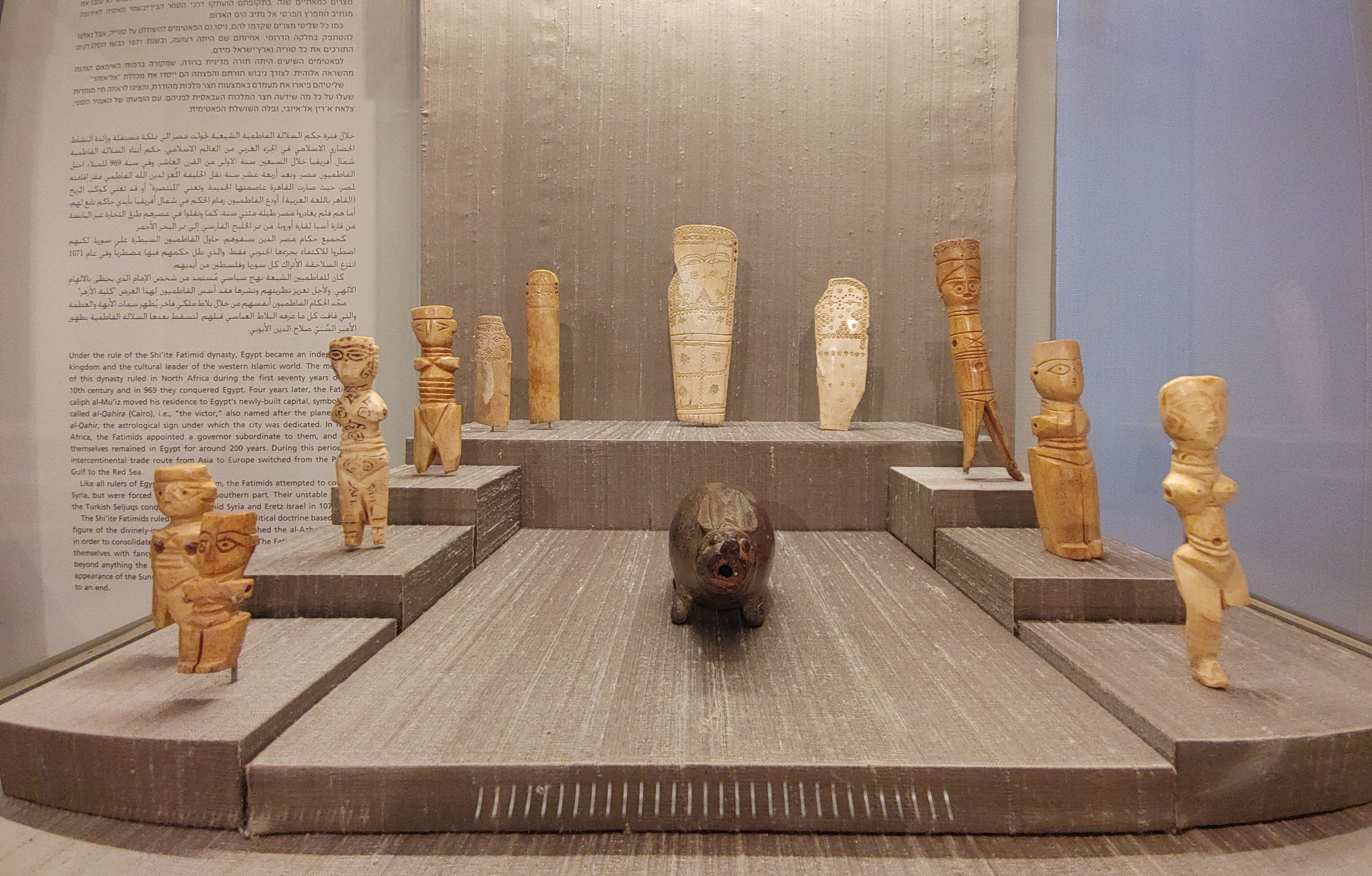
Many art pieces and manuscripts later we found ourselves in a quieter room with some exhibits on Islamic cultures from the Middle Ages. A few artefacts that gave me a reflective pause included a glazed and painted Mongol bowl from the 14th century, Egyptian Fatimid period carved bone dolls and ornate pottery, and a large collection of Fatimid jewellery.

Mongol glazed bowl from the 1300s

Mongol glazed bowl from the 1300s

Next, I was excited to see the Mamluk period addressed, as the majority of the ceramic finds in my research date to the Mamluk period. There is one key difference though, the finds I handle are generally simple, and often handmade, pottery pieces, whereas the museum showcases only the finest painted and glazed whole vessels. Nonetheless, it was interesting to set my eyes on the finer wares that the upper crust of Mamluk society would have been using in their day to day life.

Fatimid bone and ivory dolls and a rabbit

Fatimid bone and ivory dolls and a rabbit

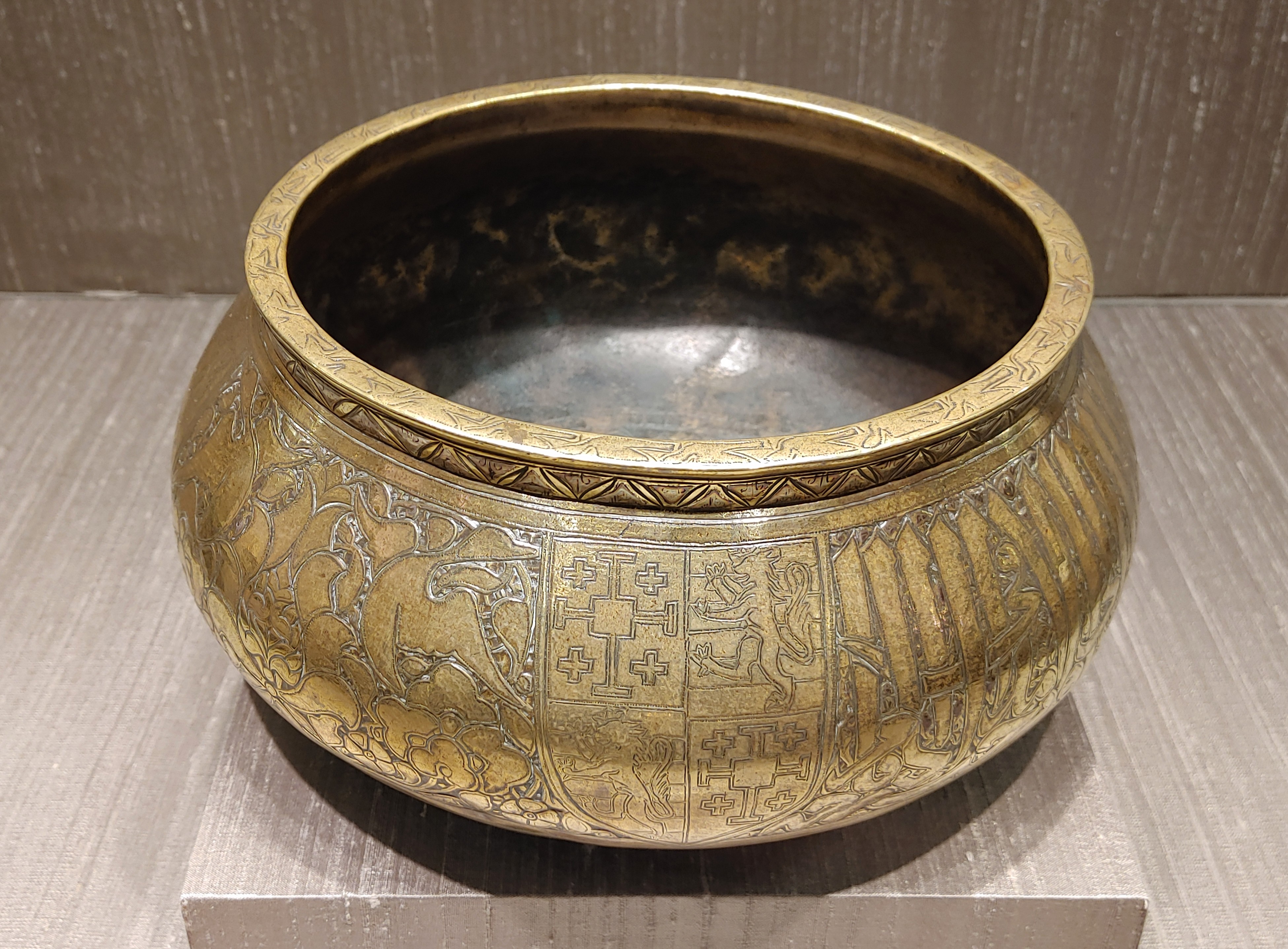
There was one vessel that struck me as rather strange. A brass and silver bowl, engraved with the coat of arms of Hugh IV of Lusignan (who died c. 1026), was listed as from Syria or Egypt and dating from the 14th century. I truly wonder what the history is behind that particular piece. Regardless, we continued by browsing some Ayyubid and Mamluk brass vessels and then made our way to the staircase.

Mysterious bronze bowl

Mysterious bronze bowl

Continuing chronologically, we resumed our tour upstairs in the hall dedicated to Ottoman (or Turkish) art. The exhibit covered glazed tiles and finely decorated pottery vessels, jewellery and art pieces, and of course, ornate Turkish articles of clothing. Thereafter, we had a quick look at intricate Damascus wooden furniture, taking me back to my visit to Akko’s Treasures in the Walls museum a decade prior.
A display of Seljuq craftsmenship

A display of Seljuq craftsmenship

Our tour resumed with an overview of Islamic art from the Moghul period, far east in the Indian subcontinent. Similar stylistically to the Ottoman art, at least to my untrained eyes, it was interesting to see such opulence in the form of fine jewellery, finely-carved and detailed boxes and even a painted wooden palace window frame from Gujarat, India.
Exploring the museum

Exploring the museum

From there we moved on to our last permanent art exhibit, belonging to the late Iranian period. At this point Bracha was feeling somewhat fatigued, being in the early stages of pregnancy with our son, Amir. We breezed through this section, pausing here and there to have a closer look at the displays, and then we headed for the ground floor to see the temporary exhibit titled “Coffee: East and West”.

A carven ivory powder horn

A carven ivory powder horn

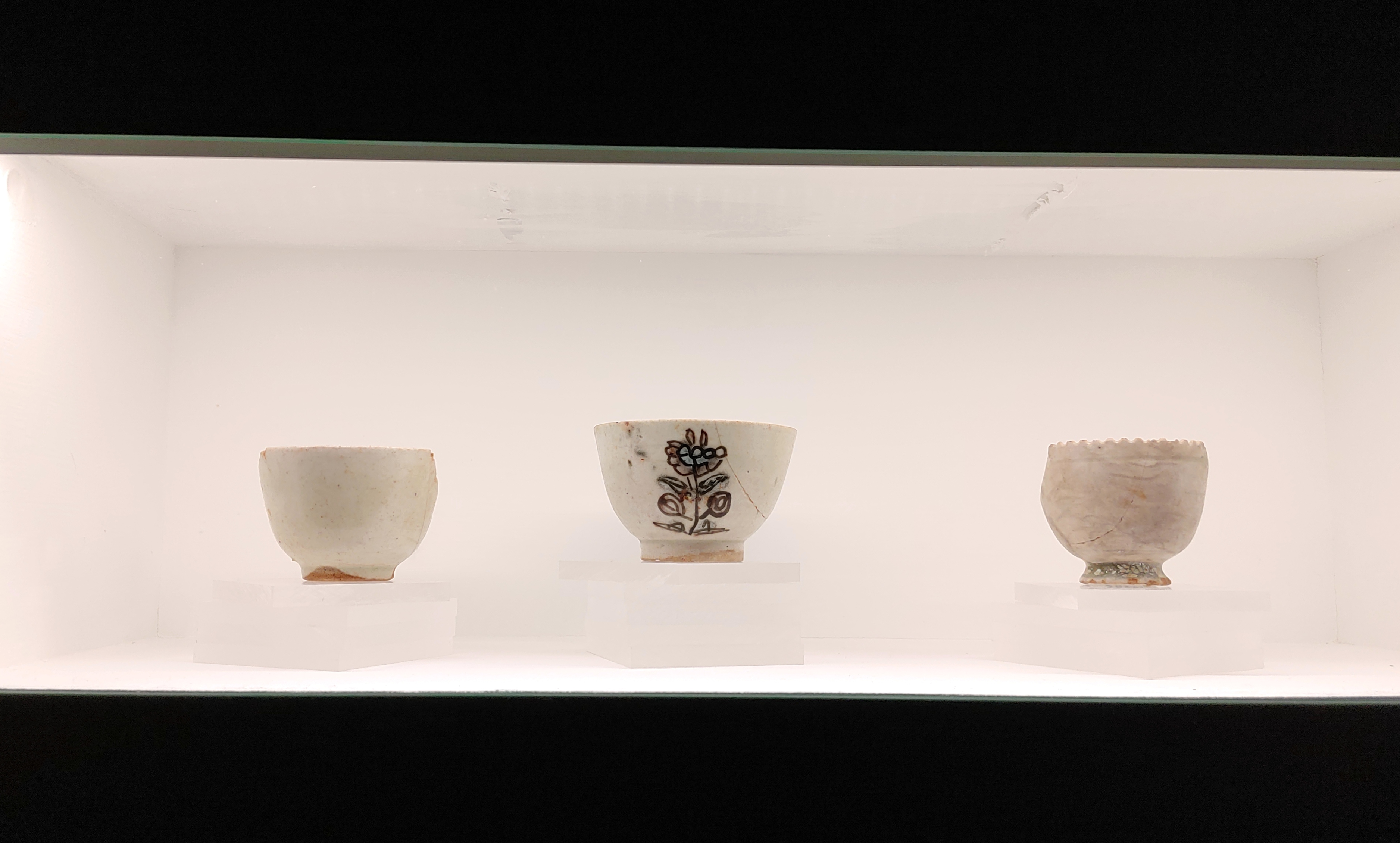
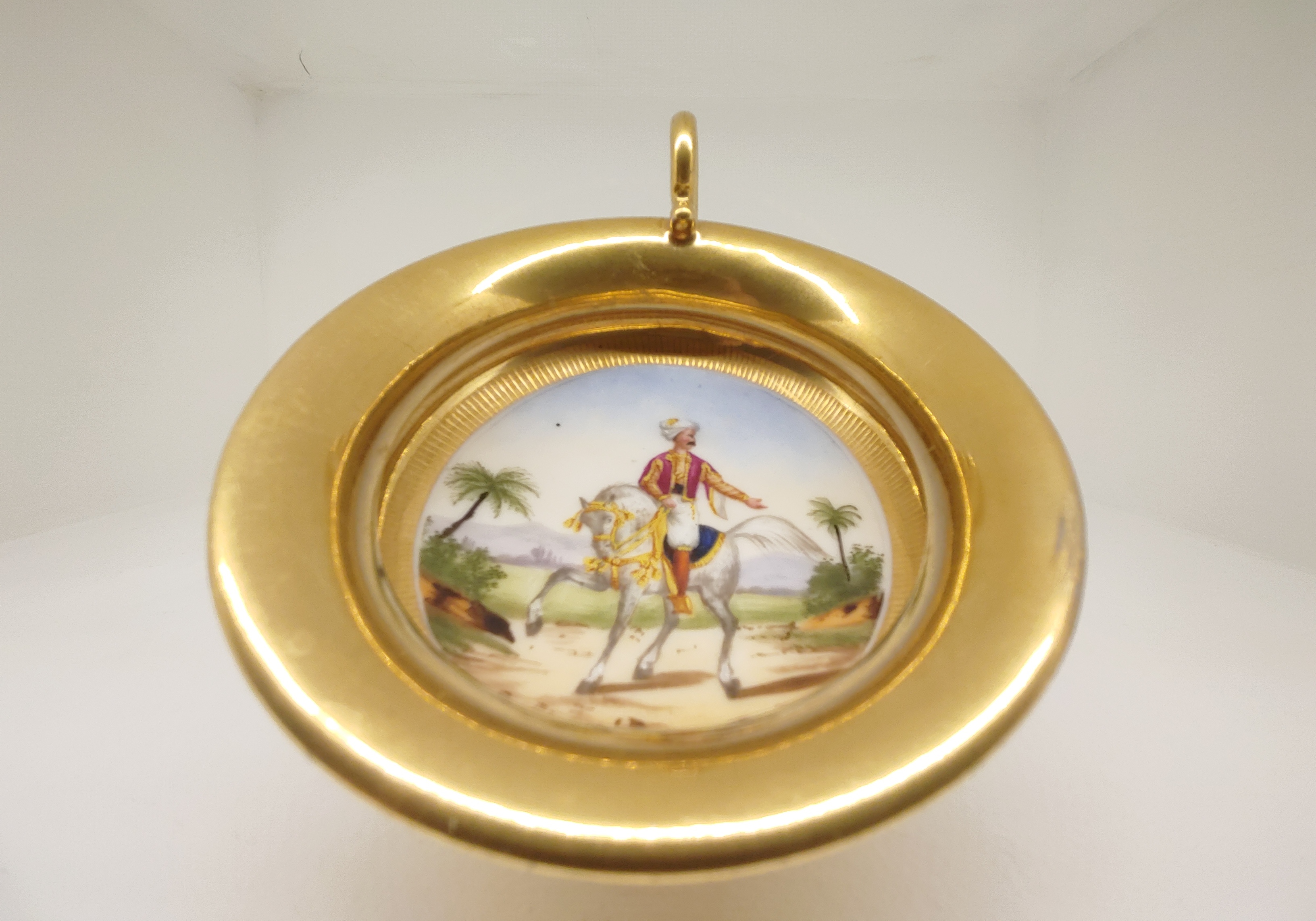
What I had anticipated in being a cute, symbolic exhibition turned out to be a full-fledged, comprehensive study of all things coffee. We started with a collection of coffee cups and sets, including one particularly charming 19th century European mug that featured a fantastic Ottoman scene of a horse and rider in the desert. The sheer magnitude of the displayed pieces was overwhelming, but there were a few other pieces that shined. One such example was a trio of restored Ottoman coffee mugs that were found in an archaeological excavation at Khirbet Hamsa.

Excavated Ottoman coffee cups from Khirbet Hamsa

Excavated Ottoman coffee cups from Khirbet Hamsa

A large collection of coffee machines filled one end of the room, many of them vintage and retro appliances that were made in Italy. Some were examples of mankind’s clever attempts at gadgetry, with fantastical spouts and vents. A look at coffee in Israel’s early days, and the production of coffee-related accoutrements, gave me a greater appreciation for the times that are now chapters in the history books.

Elegant European coffee mug from the 1800s

Elegant European coffee mug from the 1800s

Once we had sufficiently browsed all that there was to see, it was time to see the final exhibit that the museum has to offer: The Sir David Salomons Collection of Watches and Clocks. This timeless treasure trove of timepieces was so tantalising that I knew it must be a blog post of its own, and so it shall be. In the meantime, this concludes the visit to a very unique and interesting museum, one that sheds light on the artistry of the Islamic days of old.

Ruins around Givat Ze’ev

In Israel, Jerusalem on January 2, 2022 at 10:33 AM

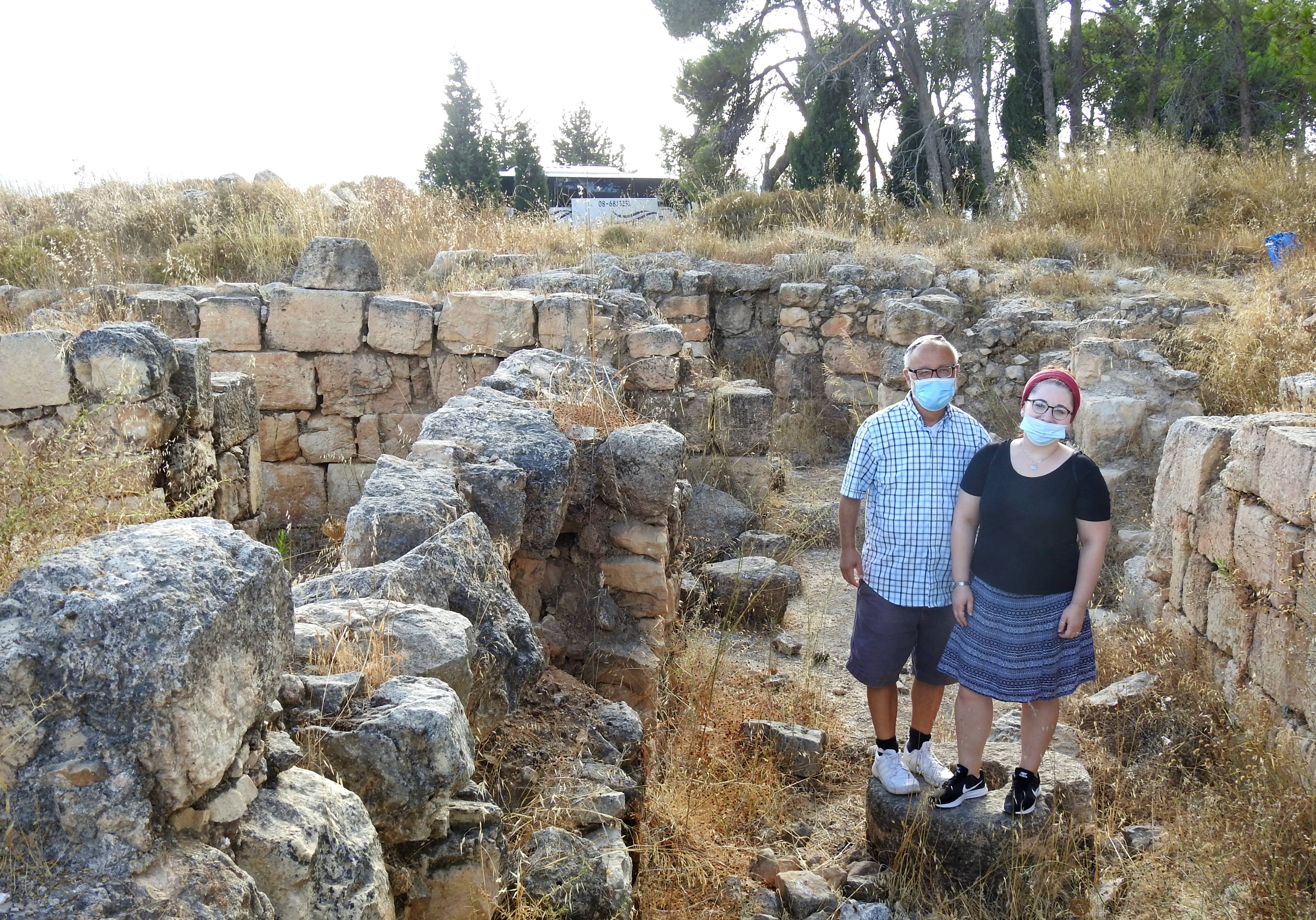
This post is about two documented excursions to the ruins in the outskirts of Givat Ze’ev, a small city nestled between Jerusalem and Ramallah. I’ve become somewhat acquainted with the city and its outskirts in recent years, as my in-laws are residents of the Neve Menachem neighbourhood on the eastern side of the city. Avid walkers, my in-laws took me out on several undocumented visits to the various archaeological remains in the vicinity, located in open garrigue scrubland. Then, in August of 2020, I had the opportunity to document a trip to some ruins, accompanied by Bracha and our local guide, my father-in-law, David Berman.

Satellite view of the area (photo Google)

Satellite view of the area (photo Google)

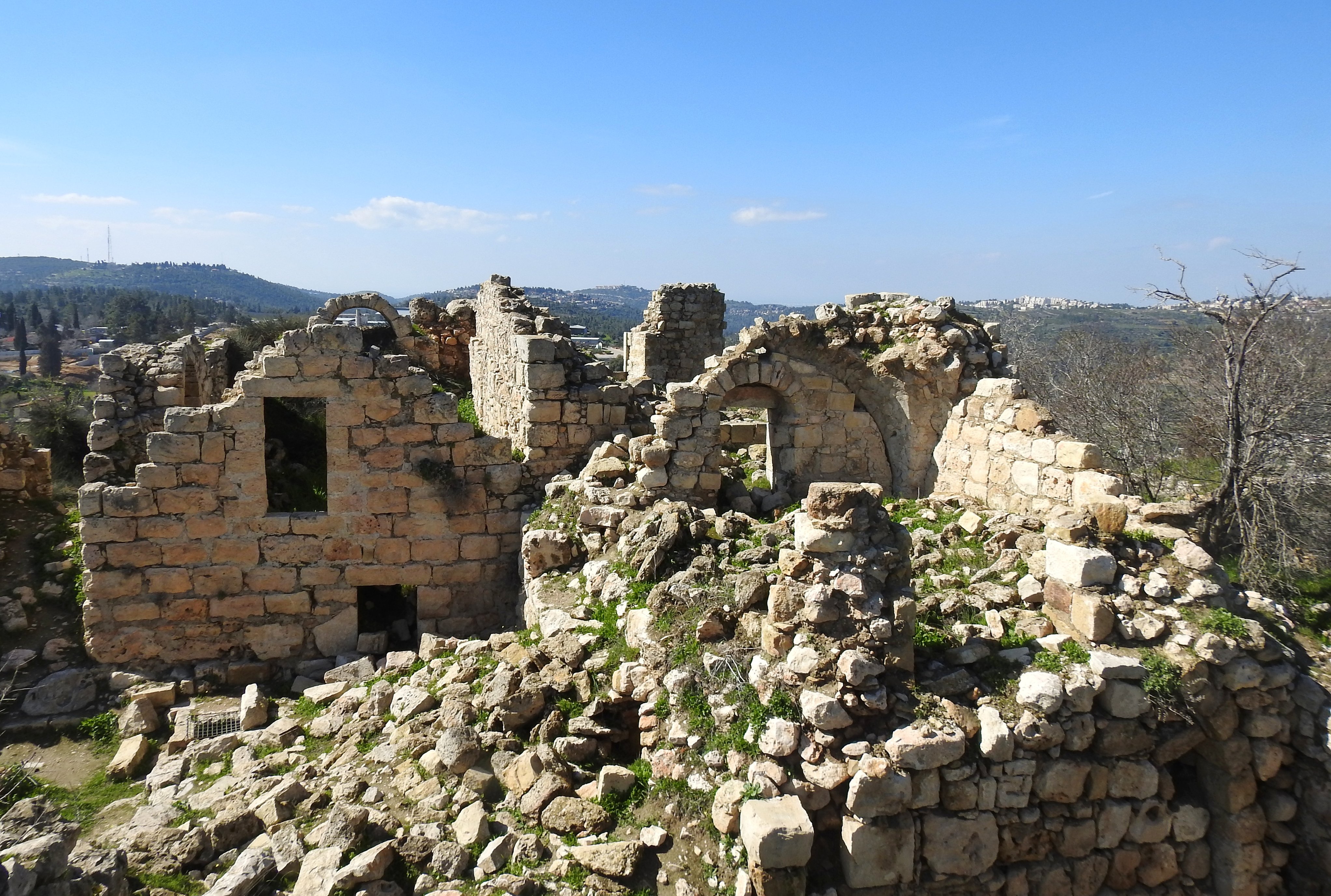
We made our way through the construction sites to a stretch of concrete was once the main road north of Givat Ze’ev, since replaced by a larger road and a security checkpoint. Our destination was the ruins of Khirbet el-Lattatin, the ninth mile marker north of Jerusalem which even appears on the famous Madaba Map from the 6th century CE. Due to the site’s locational importance in antiquity, a wayfarer’s station was built in the Byzantine period, complete with a basilica plan church. As time progressed and the Arabs took control from the Byzantines, the church was somewhat repurposed as an agricultural installment, yet travelers still sought shelter on-site. The complex seemed to have gone out of use in the 9th century CE, according to archaeological finds such as pottery and coins.

The ruins of Khirbet el-Lattatin

The ruins of Khirbet el-Lattatin

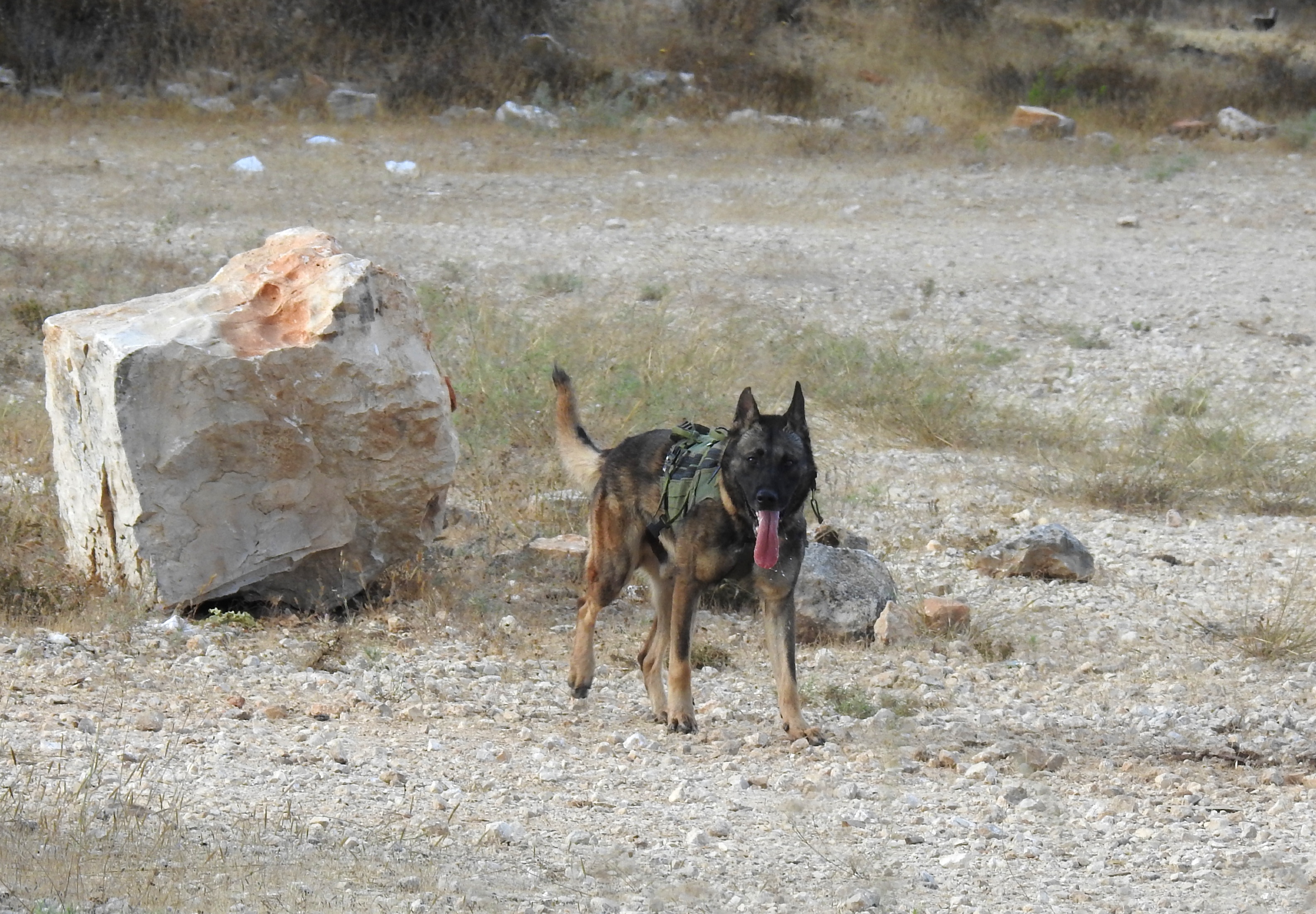
Upon approach we noticed two things: the remains of a nice ashlar wall, likely connected to the ruins, and a collection of IDF soldiers and dogs from the elite “Oketz” unit. Checking with the soldiers that we weren’t interrupting any important training session, we left the road and found the semi-concealed ruins of Khirbet el-Lattatin which were excavated in 1995. What we saw before us was a complex of rooms and partial walls, nothing quite discernable so we climbed down into the ruins.

Byzantine floor mosaic

Byzantine floor mosaic

A simple white mosaic floor from the Byzantine stage of construction was easily found, as were these round floor features which looked to have belonged to the Arab agricultural complex. We explored the rooms from below, walking in and out of the many rooms and making note of interesting things. I found a thickly plastered wall section, incised with a simple chevron motif, and of its origin and purpose I still don’t know. It was peculiar to the eye to see some different building styles, but due to the site’s dramatic change under new ownership, it only made sense.

What appears to be the apse of the Byzantine chapel

What appears to be the apse of the Byzantine chapel

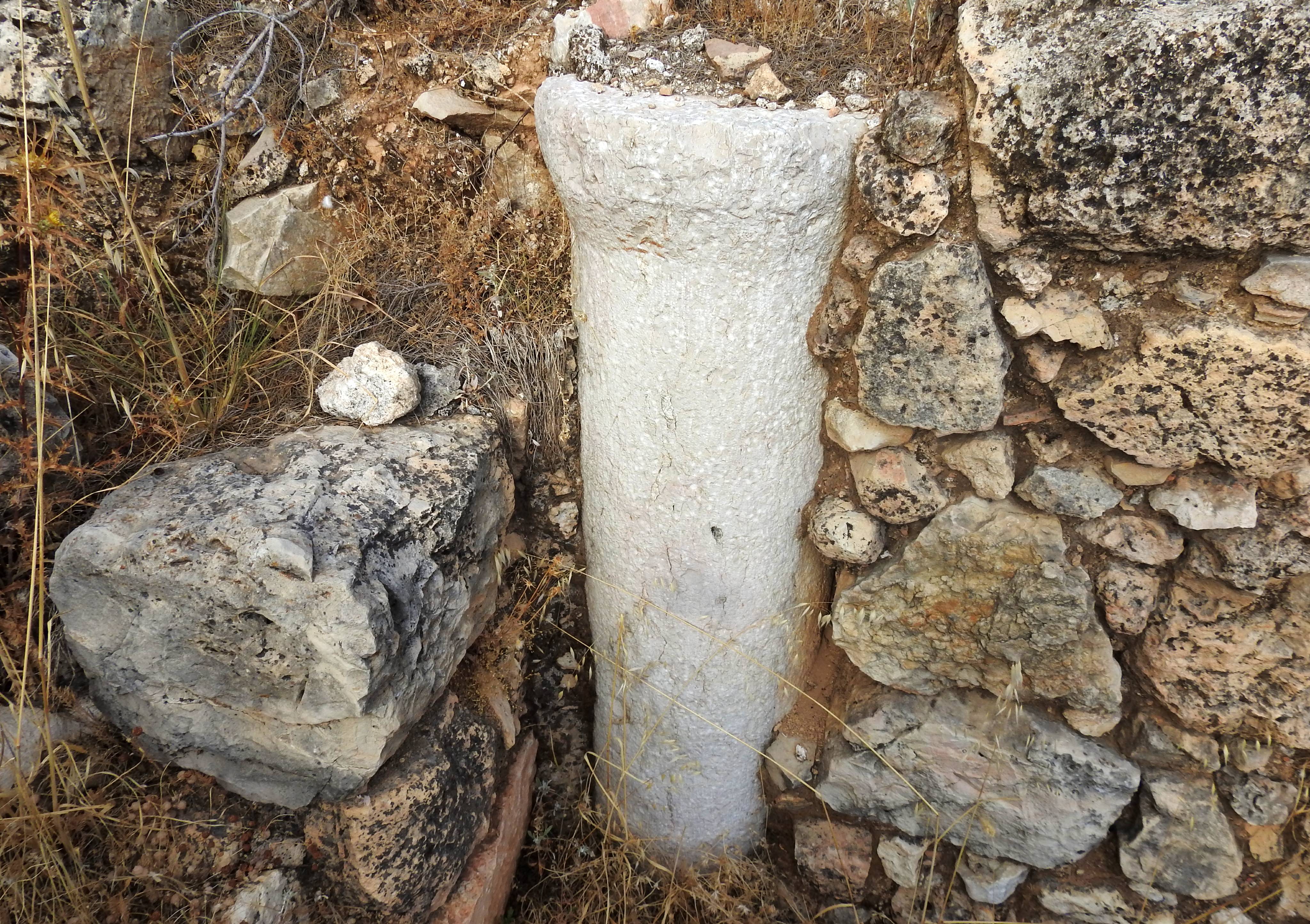
Also of interest were a collection of columns and bases, with one column still embedded in the sunken wall, which were originally part of the Byzantine church. In addition, we found the empty water cistern where a Sinai fan-fingered gecko was hiding, scampering away when I tried taking its picture. Overall, it was quite an interesting site, especially so close to home, so to speak. We headed back, finding a dried ram skull in the grass, bringing an end to the fun outing.

Basilica column still buried in the dirt

Basilica column still buried in the dirt

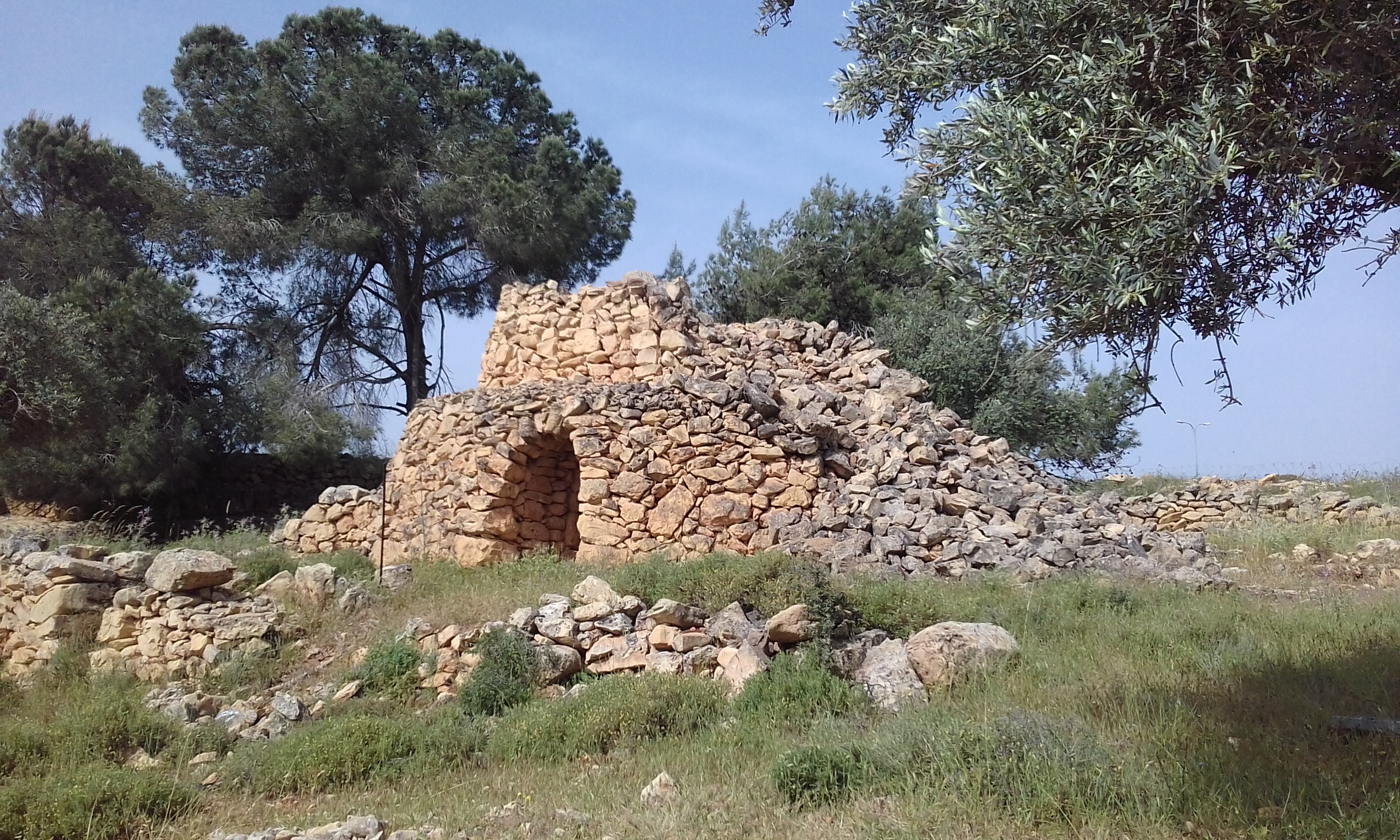
On a previous visit we had taken this abandoned road to the end, where a large agricultural watchtower is located, but this time it didn’t warrant the effort just for one photo (see HERE instead). There are other captivating ruins in the immediate area that we didn’t end up seeing, including other watchtowers, hewn mikvahs and a hewn burial cave.

Happy adventurers in the ruins

Happy adventurers in the ruins

When researching Khirbet el-Lattatin I found a fascinating document (see HERE) from the archive of the Department of Antiquities of Mandatory Palestine detailing a local villager’s visit when he reported finding antiquities in a local burial cave (which seems to be the same one that we missed). Within the report, written in the Queen’s English, it says that the villager found and presented to the British part of a limestone ossuary, several bracelets and other jewelry that were actually found and looted from the bones within the ossuary, one of which he had initially gifted to his daughter!

Happy "Oketz" dog

Happy “Oketz” dog

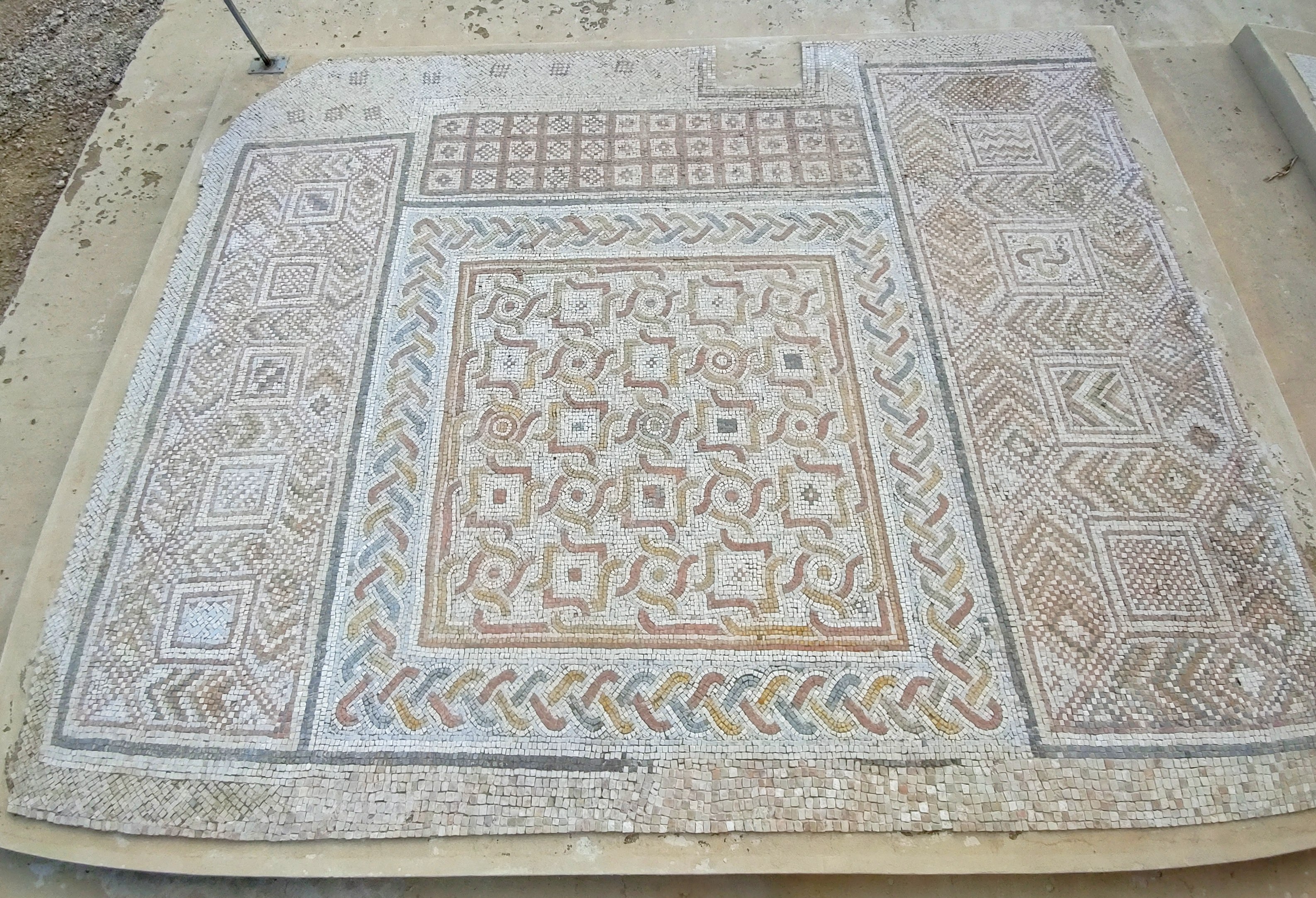
If that’s not enough post-adventure excitement, just after I had written this post I had gone on a field trip with my university department. Among the sites on the day’s itinerary was the Good Samaritan Museum, where assorted mosaics from around the country are preserved and displayed. To my surprise, one of the first mosaics that I saw there was one from Khirbet el-Lattatin – the original Byzantine church floor that was transplanted to the museum for safekeeping. Not having known of its existence in the first place, this finding was electrifying and so I’m adding a wide-angled photo of it to this post for maximum effect.

The fancy mosaic floor of Khirbet el-Lattatin displayed at the Good Samaritan Museum

The fancy mosaic floor of Khirbet el-Lattatin displayed at the Good Samaritan Museum

Excited by my first adventure, my next archaeological excursion took place only in the beginning of December, 2021, when I had a few hours on one particularly chilly afternoon to explore the local hill – named after a squad of Palmach fighters who set out on a mission only to fail and later be commemorated in various ways. The hill is just north of the Neve Menachem neighbourhood, and is home of a semi-active archaeological excavation, which I had tried to join two years ago, but it was being postponed due to the initial coronavirus outbreak.

Open garrigue scrubland outside of Givat Ze'ev

Open garrigue scrubland outside of Givat Ze’ev

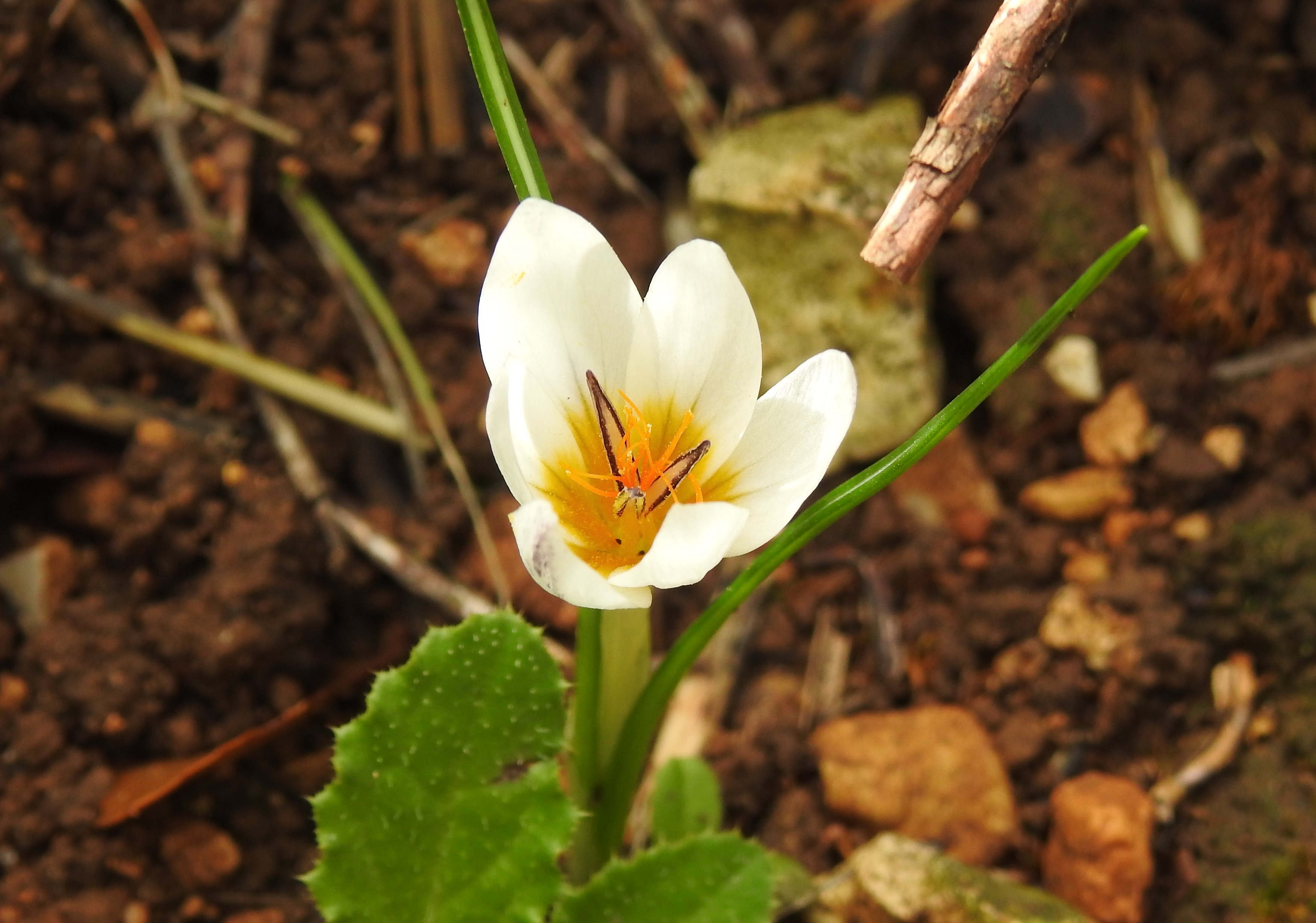
With camera and binoculars safely secured around my neck, I set out for the slopes, happily seeing my first signs of wildlife in the form of a male black redstart and a handful of chirpy chiffchaffs in the conifer line that borders the city. Entering the open garrigue scrubland, I encountered the many tiny caves and visibly quarried bedrock along the southern side of the hill. The Steven’s meadow saffron was in blossom, as was the winter saffron, both classic winter wildflowers despite it being so cold.

Hewn bedrock atop the hill

Hewn bedrock atop the hill

The walk up the hill is best taken along the flat bedrock that wraps around the southern side, decorated with hewn cup marks and agricultural installations that were full of the last rain’s water. As I walked along the unintentional path, I kept scanning for birds but only a few stonechats were to be seen. Then, climbing up on some rocks, I saw a medium-sized bird fly out from shelter and managed to get it in my binoculars before it disappeared over the ridge. I was elated as I had just seen my first (living) woodcock, a very elusive bird that can be seen locally in the winter months.

Kestrel in the cold wind

Kestrel in the cold wind

With a smile on my face I then reached the archaeological excavation area, where ongoing efforts to learn more about this hill’s role in history have been happening. Thus far, it was revealed that a fortress was built in the Middle Bronze age (some 4,000 years ago), and that the site was also in use in the Iron Age, during the time of the First Temple. Frankly, there’s not much to see at surface level, save some stubby wall bases and scattered potsherds.

Recent excavation efforts

Recent excavation efforts

As I walked around the northern side of the hill I noticed more excavation areas, some with exposed walls, as well as more modern simple rock walls that divided the slope up into designated areas. With not much to see, I continued around to the eastern slope and made my way down into the flat area in the direction of the nearest Arab village. The bird situation didn’t improve much at first, with just more territorial stonechats perched hither and thither, but then I saw a nice long-legged buzzard who soared off into the distance.

A donkey friend

A donkey friend

When I reached the easternmost point of Givat Ze’ev, located to my right, I discerned a small flock of corn bunting on a small tree, which gave me hope. I continued along the dirt road outside the city, where ploughed fields and chilly orchards provided a change in scenery. The birding improved, if only by a little, with some starlings, greenfinches and another black redstart. With my free time running out, I turned back around and headed into the city, making my way back to my in-law’s place. These trips served as a successful and joyous preliminary reconnoitering of the immediate surroundings, but there is still more to be seen and documented in the days and years to come.

Jerusalem’s Gazelle Valley

In Israel, Jerusalem on November 29, 2020 at 11:00 AM

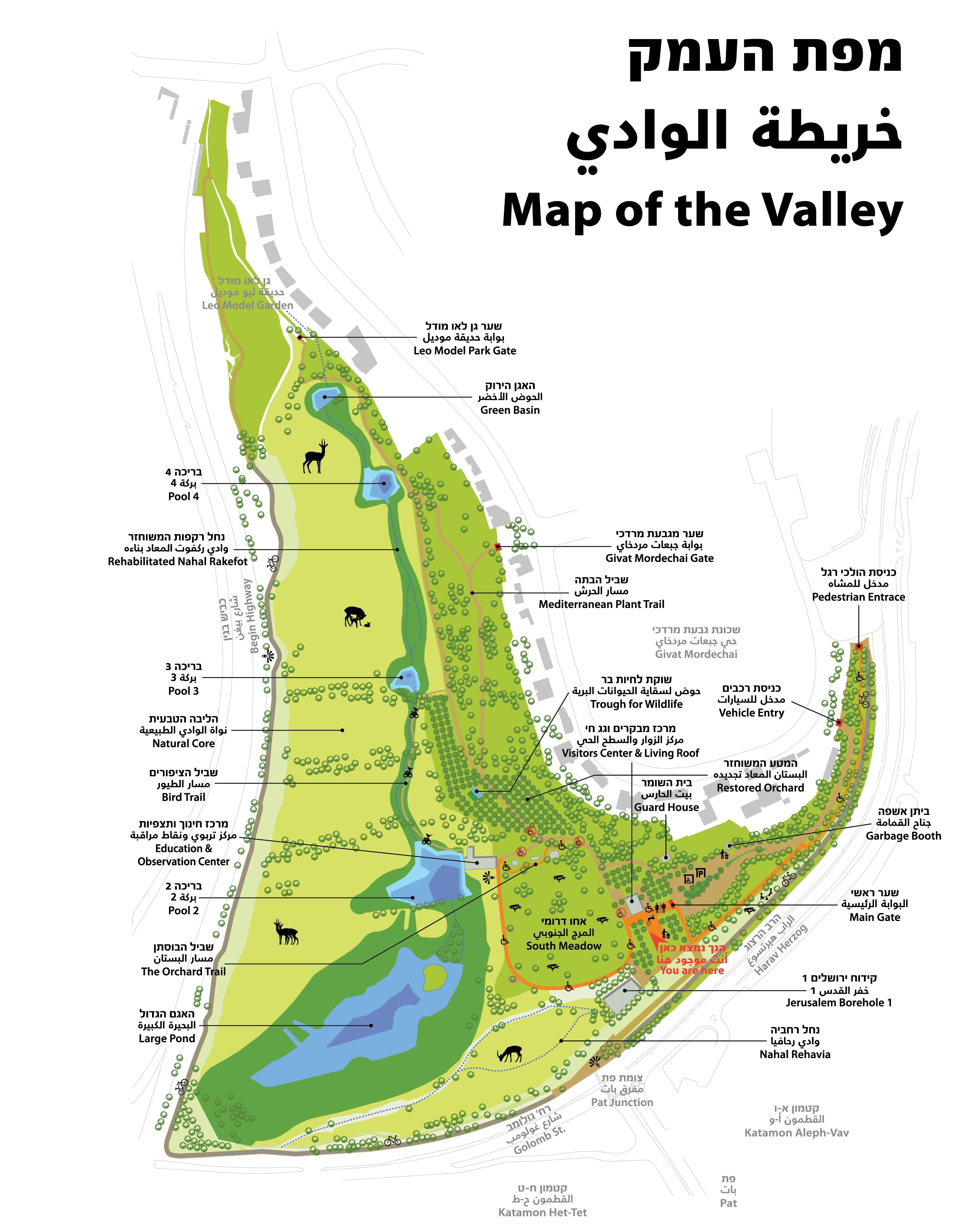
Practically every Monday I make the journey to Jerusalem for work at the Schocken Institute where I manage their social media accounts. Sometimes I have a hankering for some birding beforehand and so I’ll swing by the Jerusalem Bird Observatory before work. Usually it’s a pleasant time and during the course of a few visits I had seen a handful of nice new-to-me species, including the wryneck and orphean warblers. However, in early September, I began to see fantastic eBird birding reports coming from another Jerusalem location, the Gazelle Valley, and I knew my time to pay another visit had come.

Map of Gazelle Valley

I had been to the Gazelle Valley just once before, with friends Adam and Itamar in the beginning of 2018, and I hadn’t been all that impressed (see HERE). I decided that it was time to give it a fair chance, and to properly plan my visit at the earliest hour possible. A good rule of thumb for birding is to start early, because birds start early (as we all know from the popular phrase) and then disappear once the sun gets too high in the sky. Thus, armed with a good plan, I made my way to the Gazelle Valley for a nice morning visit.

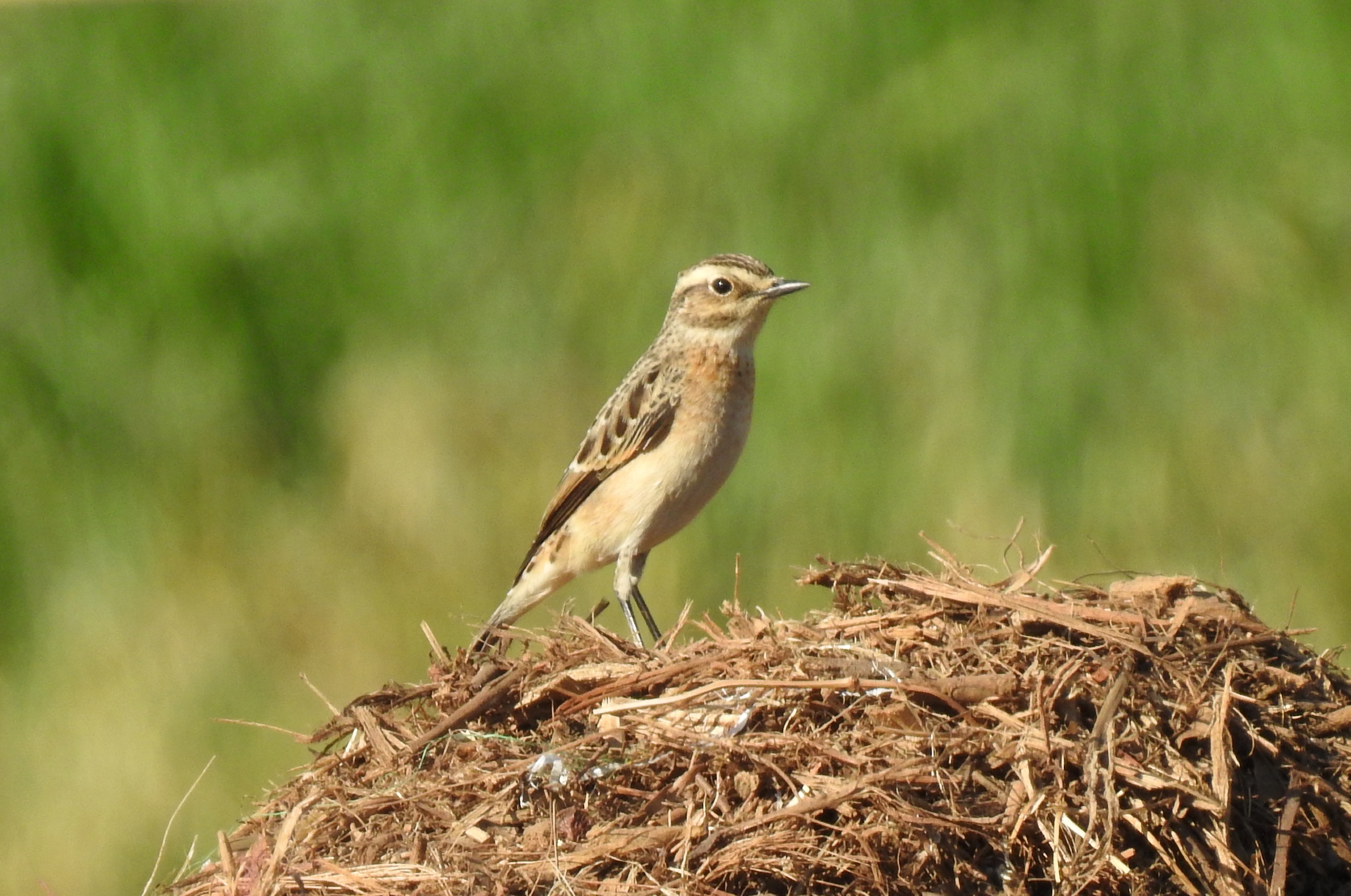
A faraway whinchat

Thankfully, my experience this time was significantly more successful, starting off with a whinchat or two just perched on some thistles waiting for me to see them. The weather was cool in the park, and the sounds of songbirds filled the air, so I figured I’d start exploring the park’s perimetres straight away. A fellow birder had given me a good tip, and that was to check the fig trees in the northern end of the park for some generally elusive golden orioles. I headed that way, passing through the sweet twittering of songbirds which darted in and out of the trees around me.

A gazelle coming at me from the undergrowth

I reached the fig trees, but there were no golden orioles to be found. I hid myself out of view, hoping that maybe one would pop out, but still nothing. There were mostly yellow-vented bulbuls, and a few warblers such as blackcaps, lesser whitethroats and Sardinian warblers. Abandoning the oriole haunt, I headed back down the trail until I heard some crunching in the thick undergrowth next to me. Lo and behold, a male gazelle appeared – quite close by and somewhat tame – and then another, and another. Afterall, I was in Gazelle Valley, I should be seeing gazelles.

A spotted flycatcher blending in with the tree

My walk continued until I noticed something fast and barred flying quickly right overhead. It disappeared into a grouping of pine trees, but I was pretty sure it was a sparrowhawk. Just when I thought I had lost it in the greenery, out of the corner of my eye comes another flash of movement. It was so brief, but it was clear, the sparrowhawk had just tried to snatch a songbird out of a small tree to my right. It’s one thing seeing birds of prey, which is amazing in and of itself, but it’s a whole lot better when you see them in action.

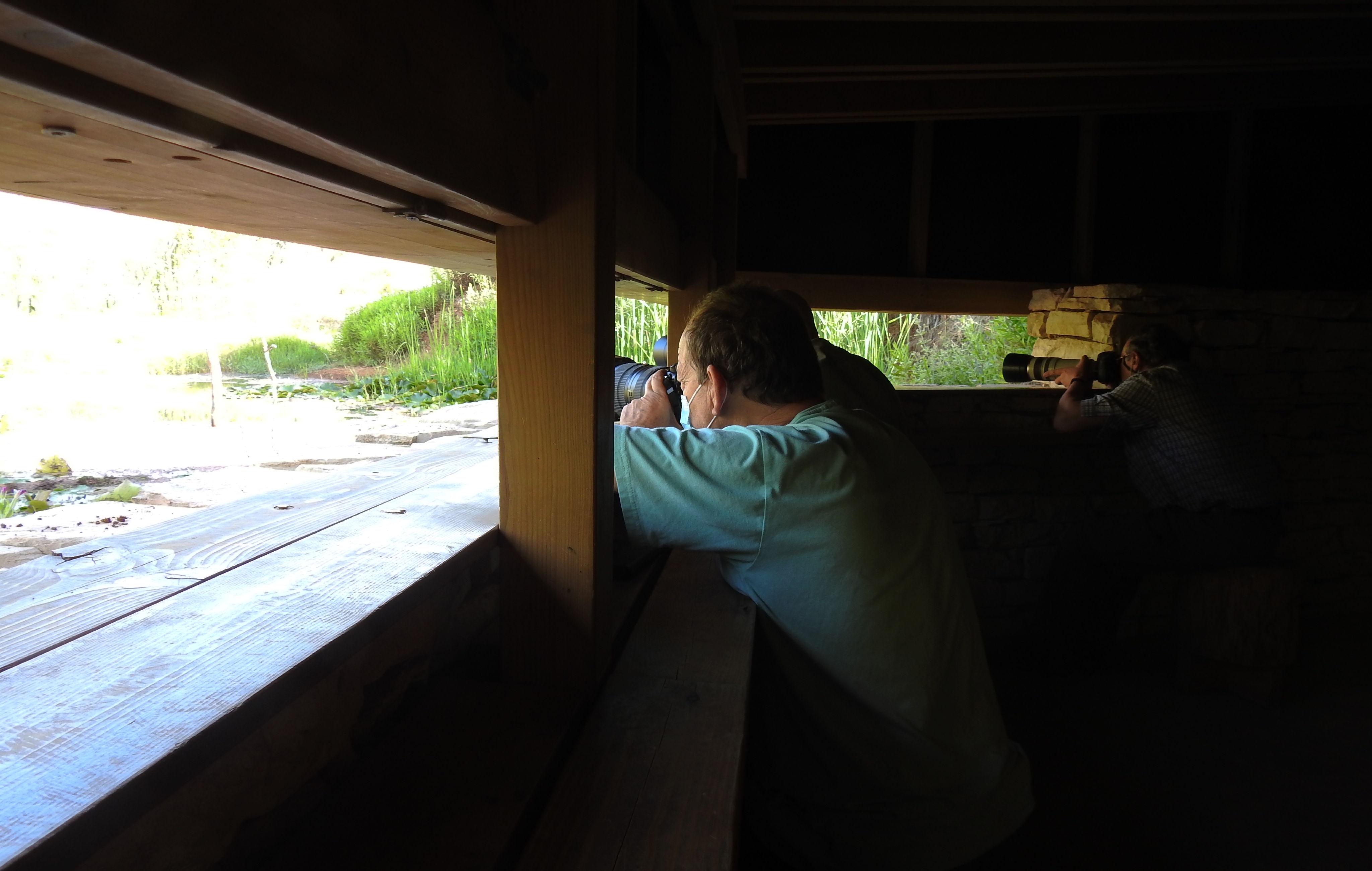
Photographers in the blind

I continued along the reconstructed Nachal Rekafot, along the aptly-named Bird Trail, until I reached the main pondside blind. Along the way I had seen more songbirds, including a spotted flycatcher, a reed warbler and a whole bunch of blackbirds. Within the blind were a few nature photographers, waiting like lions in the tall savannah grass for prey to come their way.

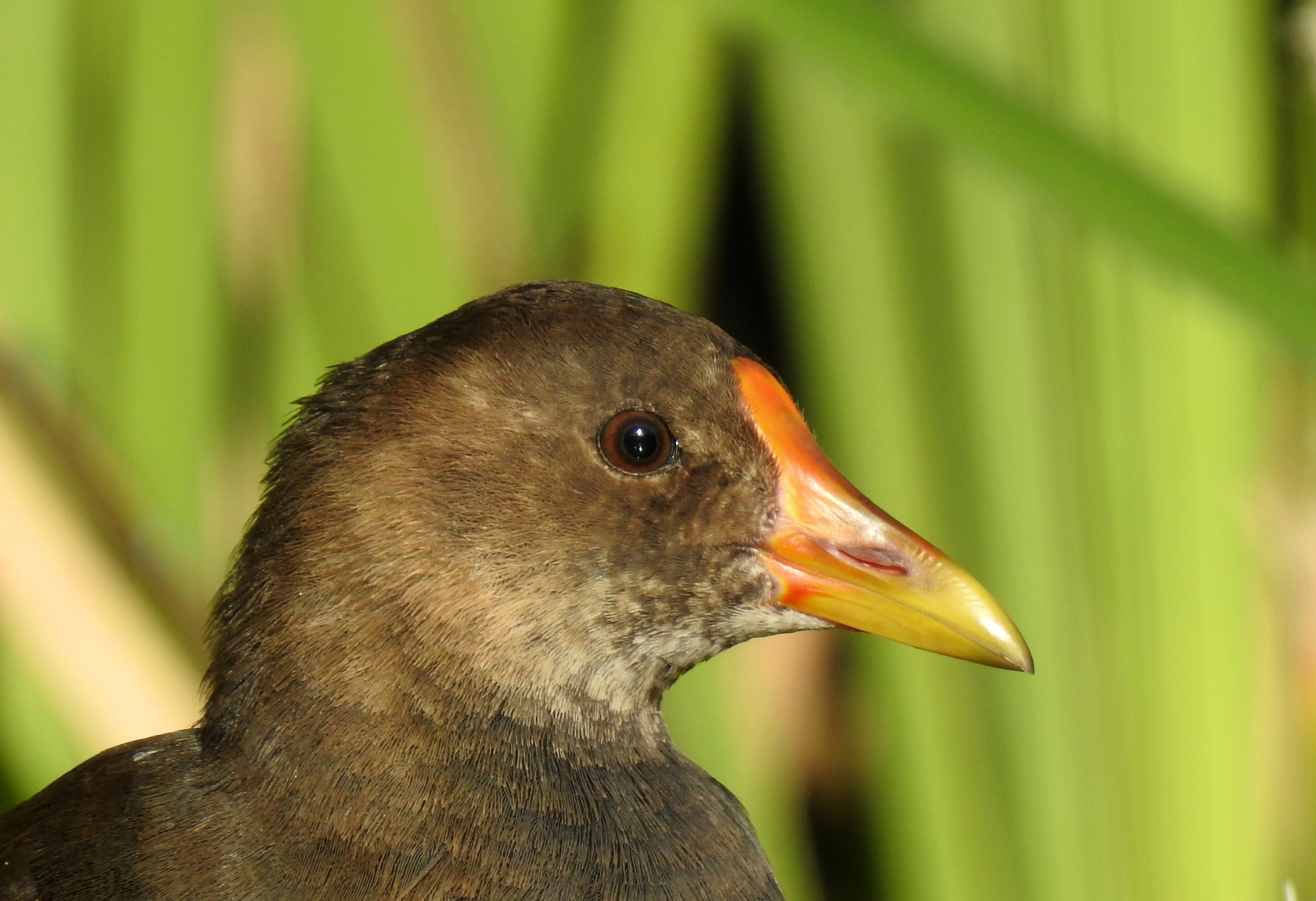
Portrait of the moorhen

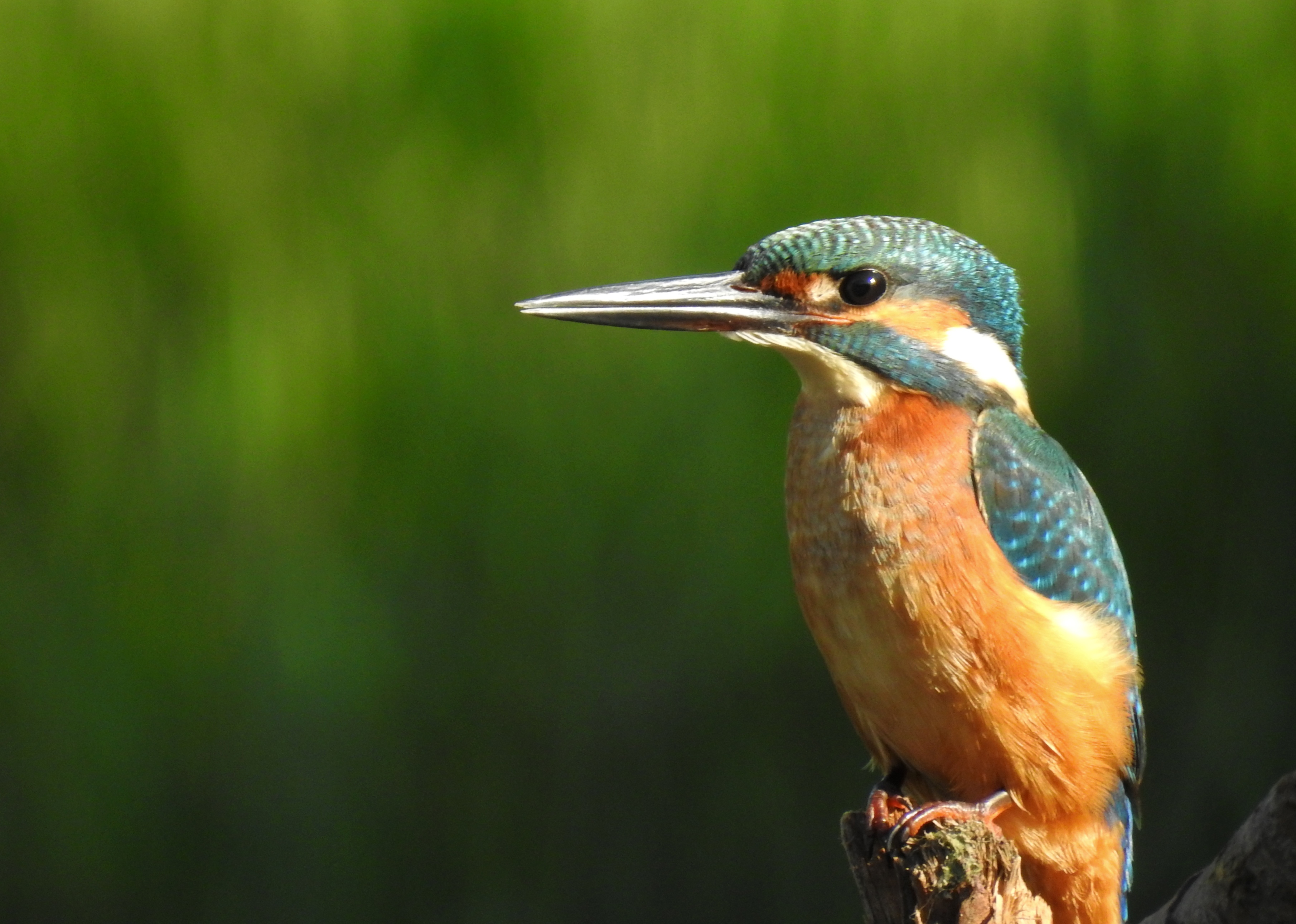
For the meantime, just a few moorhens dared make their presence known to us hidden in our special bunker, but then a common kingfisher came and all the photographers jumped into action, clawing at their expensive cameras as the clicking sound of the shutters filled the air.

A common kingfisher

When I looked at my own pictures later, I realised that when I had first entered the hide and started taking pictures of a moorhen that was making its way away from us, I had incidentally photographed it trying to eat a small river frog. Had the kingfisher been as successful it would have been delightful, but no, he gave up after a few minutes and flew away. I followed suit.

The moorhen escaping with the frog

My last stop along this tour of the park was at the big pond, where I could see numerous ducks and other waterbirds idling about. I pulled up a chair a safe distance away and began scanning the visible areas for one of the birds I was most hoping to see: ferruginous ducks. These medium-sized diving ducks are simplistically beautiful with their rich maroon-mahogany plumage and their bright yellow eyes. Alas, not a single ferruginous duck showed its face and I was left to photograph grebes and herons – and the occasional kingfisher.

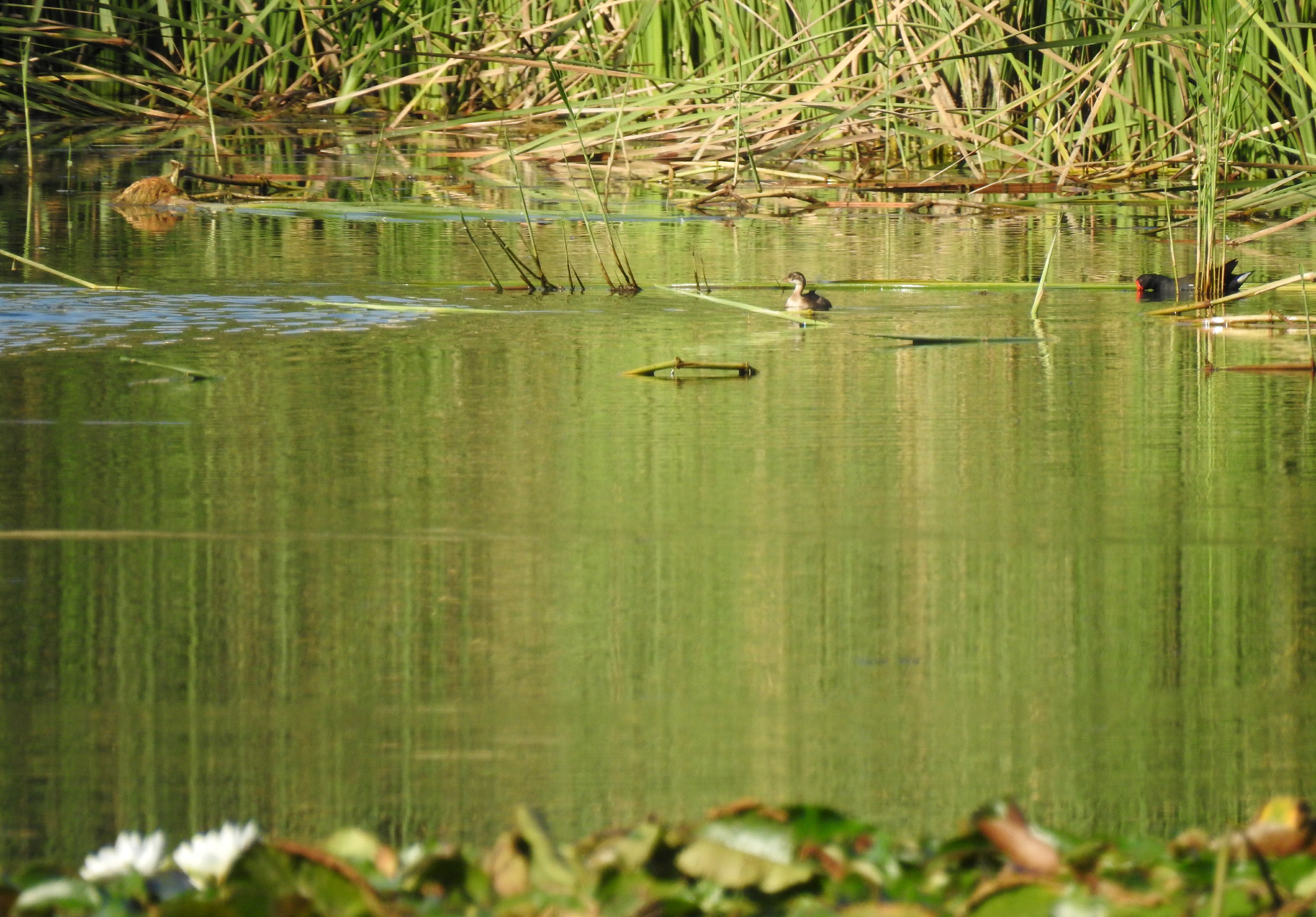
The tranquil pond-life

The hour was getting late and I had to get to work, so I began my walk back out of the park and to the nearest bus stop. As I walked I saw a few black-winged stilts flying by – an odd sight if not for Gazelle Valley’s bountiful sources of water for them to wade in. I packed away my camera and binoculars and headed over to work where, sadly, the birds are a lot less plentiful.

Beit Zayit Reservoir

In Israel, Jerusalem on June 3, 2020 at 6:21 PM

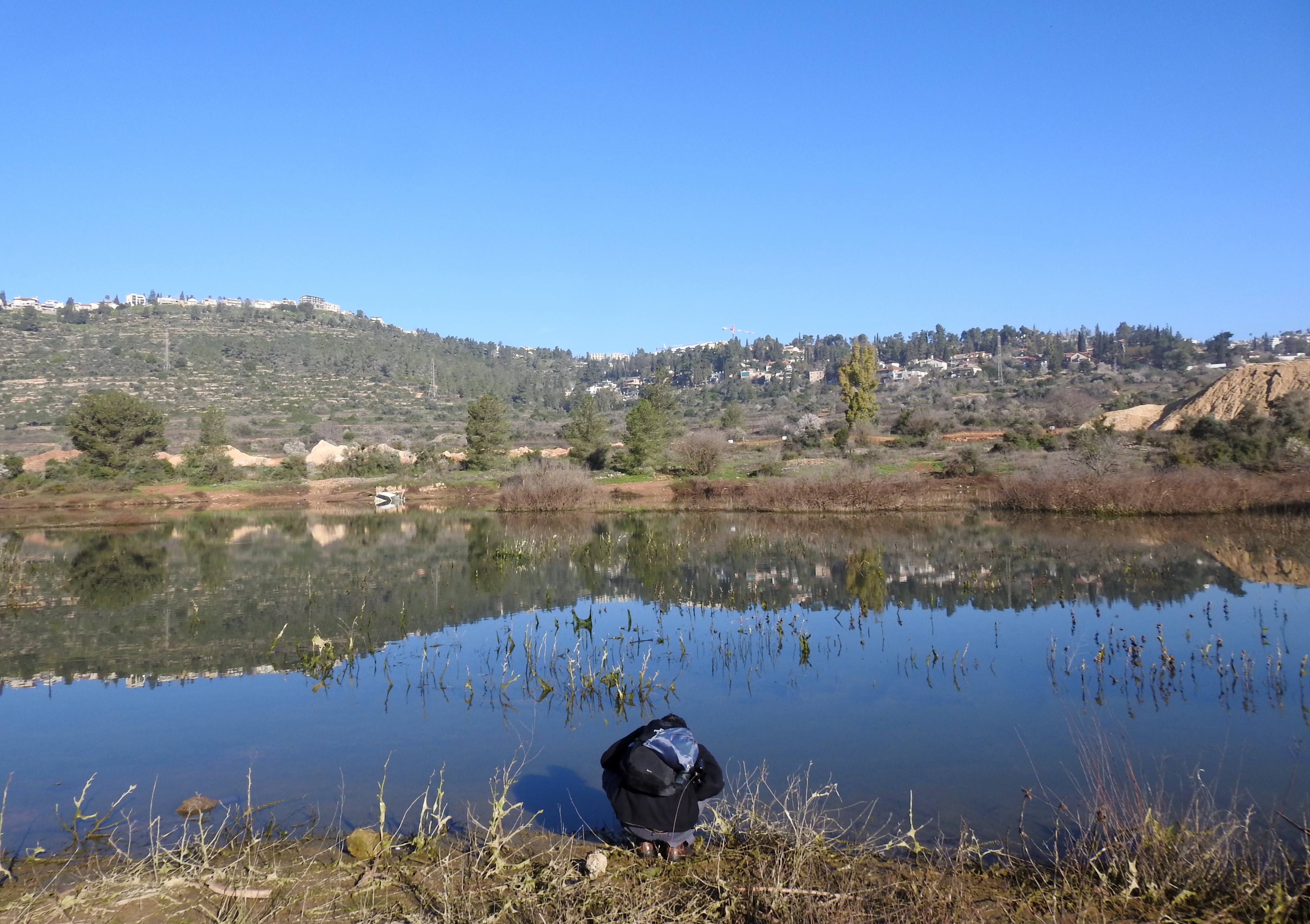
Back in the beginning of March, just as the winter was coming to an end, there was one particular place that piqued my interest. I had seen photos of it shared on various Facebook groups, and the picturesque appearance beckoned me closer. At last, someone posted that they found fairy shrimp and that sealed the deal. I contacted Adam Ota, the ultimate travel companion, and plans were made to go visit this wonderful place which is known as the Beit Zayit Reservoir.

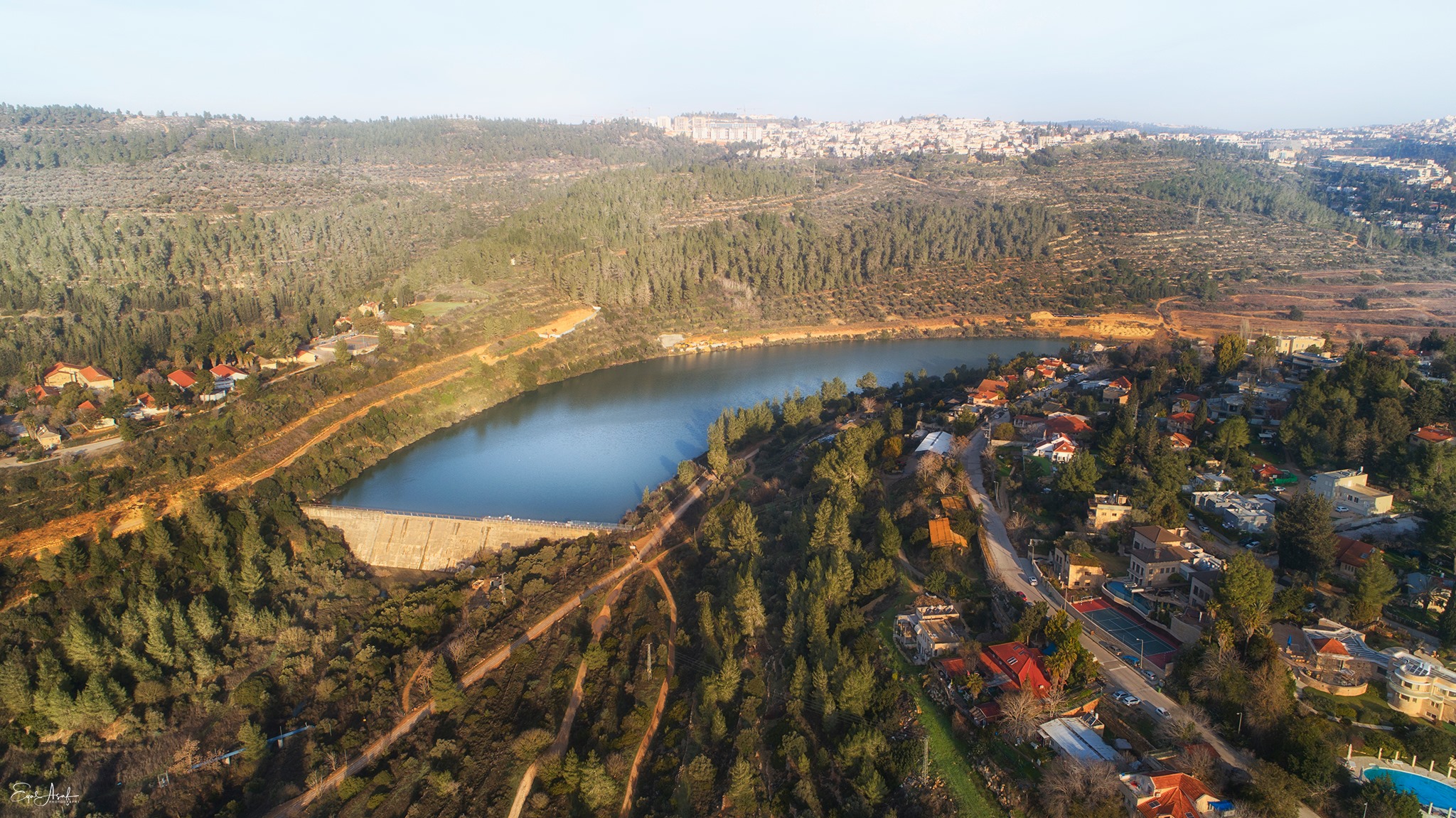
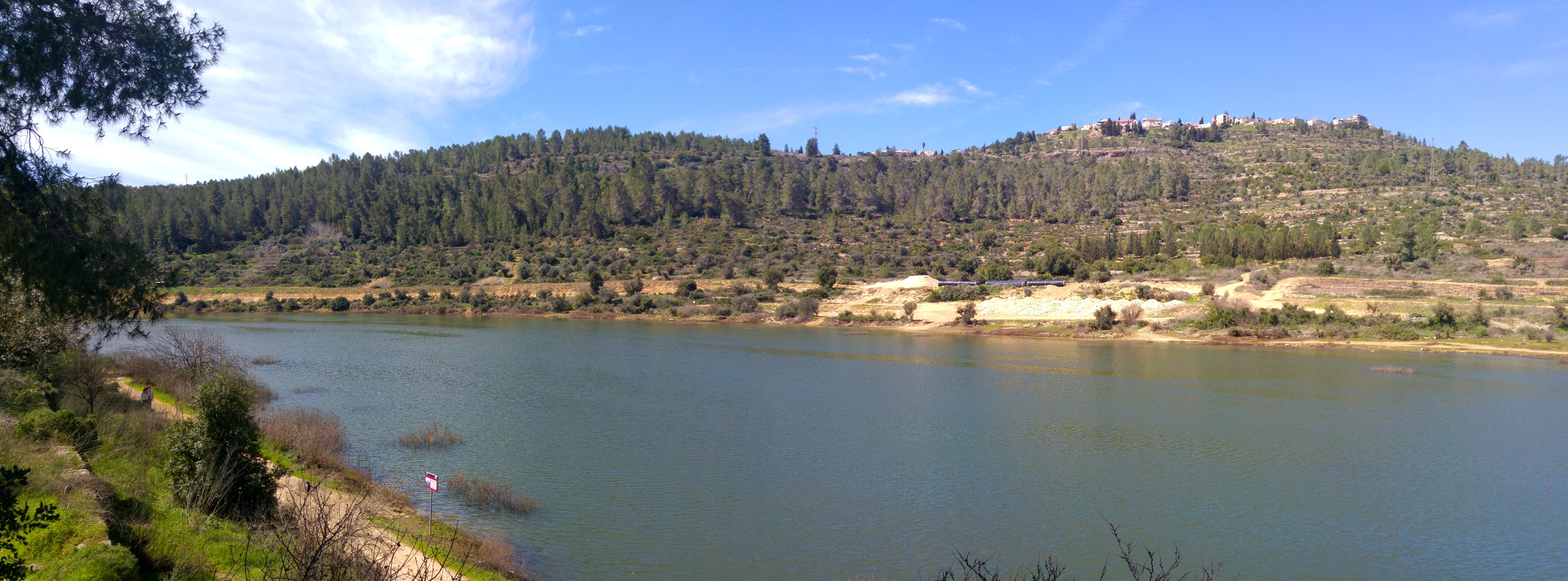
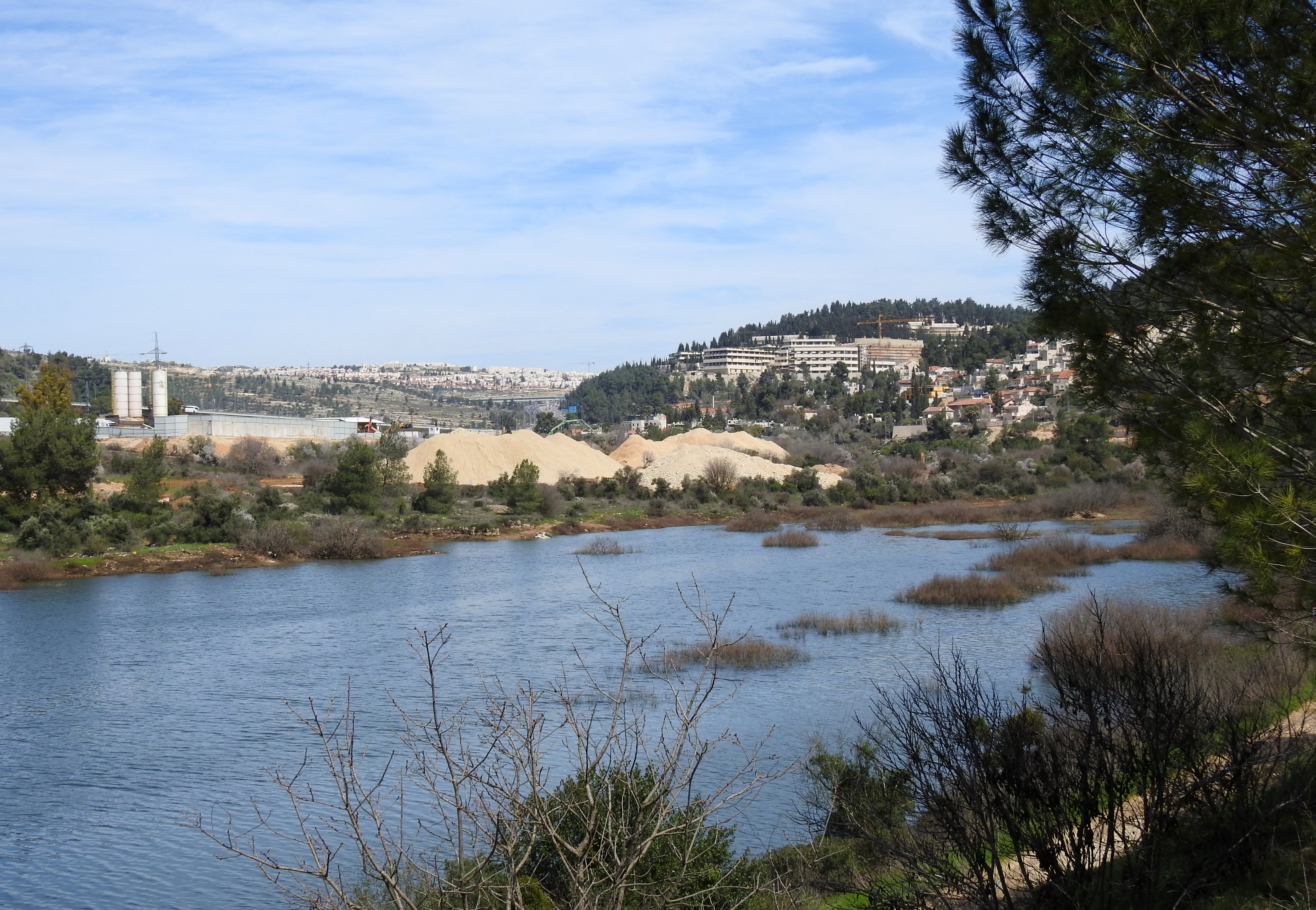
Beit Zayit Reservoir (photo Eyal Asaf)

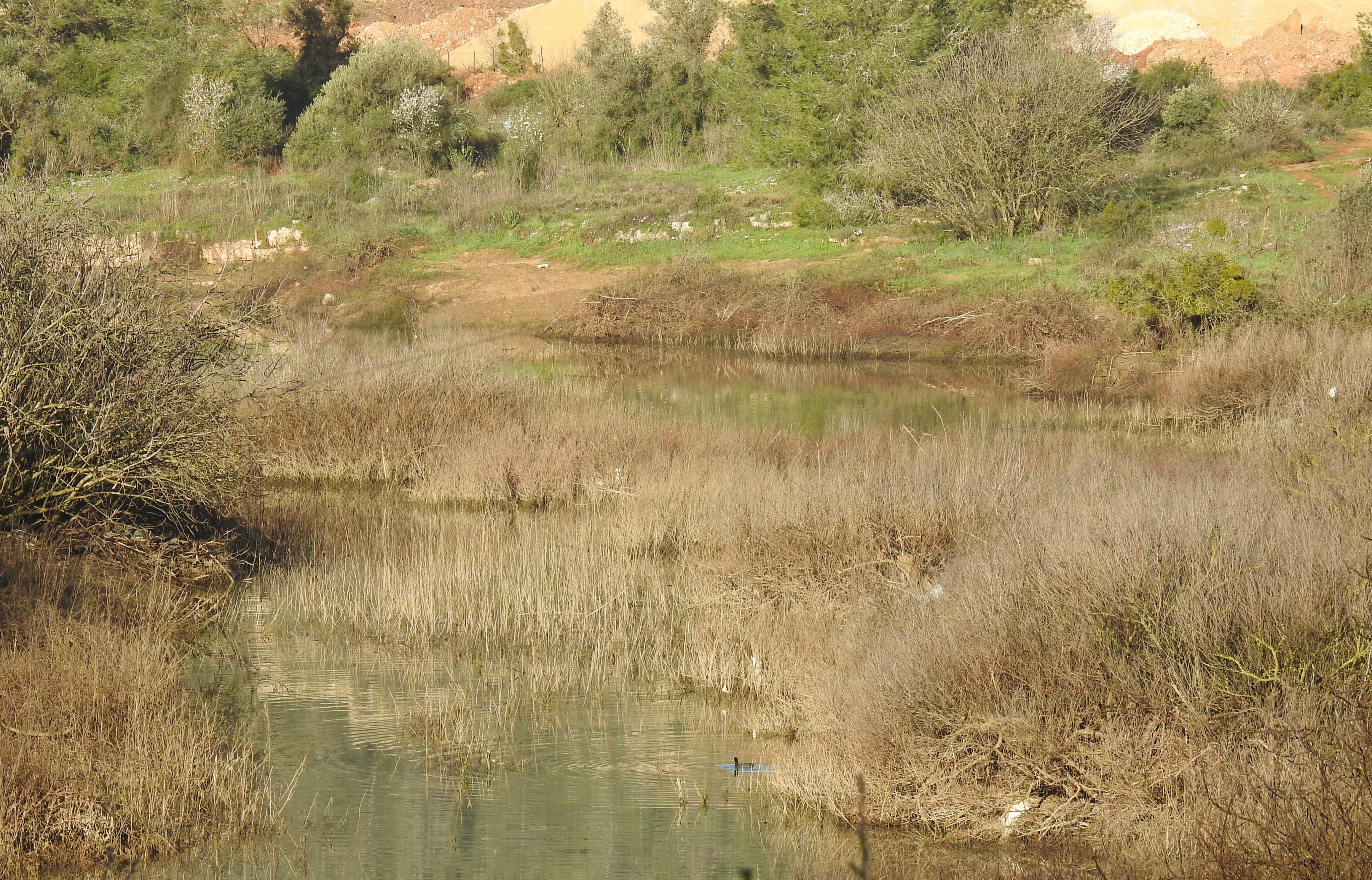
Located a few kilometres outside Jerusalem, this crescent-shaped reservoir was built in the 1950s following the construction of the Ein Kerem dam, which stopped the Nachal Soreq stream. This created a flooded area which has a fluctuating waterline. With this particularly rainy winter season, the reservoir swelled proudly with the rainwater run-off and even the usually dry northern end became marshy wetlands.

Marshy flooded northern end of the reservoir

Adam and I boarded our Jerusalem-destined bus in the morning and got off on Highway 1, where we transferred to another bus to take us closer. Alighting just metres from the trail, we first scanned the nearby groves, the crisp morning air abuzz with the singing calls of songbirds. Sure enough, there were handfuls of chaffinches and blackbirds, and then a nice little surprise: a few hawfinches perched on a large, bare-branched tree.

Posing blackbird

We were elated to have such an excellent start, and hurried along the trail, hoping to reach the reservoir as quickly as possible. Expectedly, there were distractions along the way, namely more birds and a fully-blossomed almond tree – a true sign of early spring in Israel. Urging ourselves on, we reached the reservoir from the north, and laid eyes on its flooded banks.

Scanning for interesting waterfowl

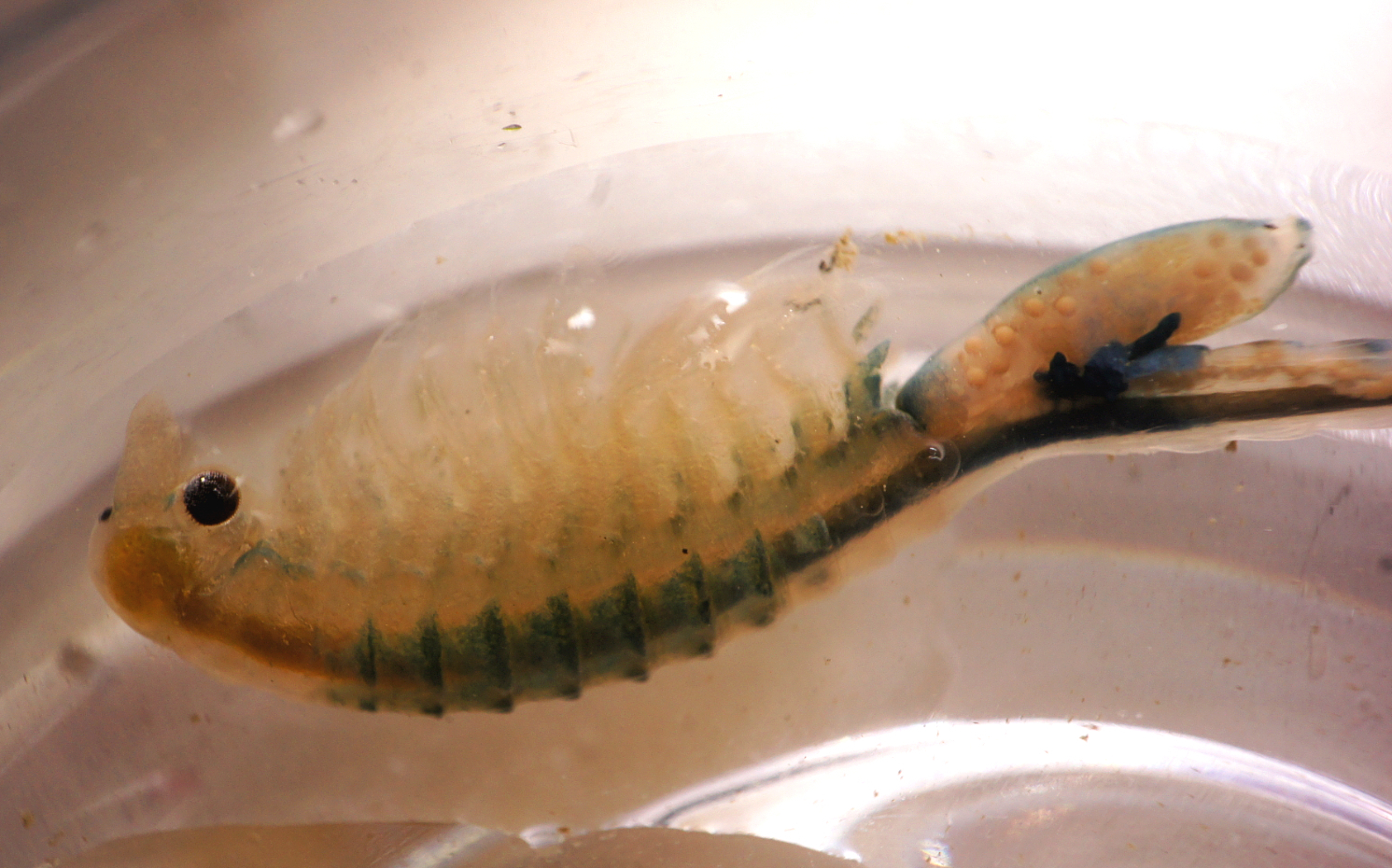
It was perfect. There were birds everywhere, including mallards, sandpipers, coots, moorhens and grebes, and the location was gorgeous. We made our way to the water’s edge, hoping to catch sight of these fascinating fairy shrimp. It was mere seconds before we spotted one, swimming upside-down in the shallow water. Then we saw another, and another, and then we realised that the water was absolutely filled with them.

Fairy shrimp (photo Adam Ota)

There were other invertebrates as well, tiny swimming creatures which added to the richness of the underwater ecosystem. The fairy shrimp dwarfed them all, themselves being only a wee couple centimetres long. It was exciting watching them, but we knew that we had to keep going to see more – and perhaps more fairy shrimp.

Macro shot of a copepod (photo Adam Ota)

We walked the nice trail that hugged the reservoir, stopping now and again due to pleasing distractions. A common buzzard landed on a tree across the water, and it was a challenge to get a decent picture. We walked and walked, thoroughly enjoying the weather and the charming location. However, with much walking comes great hunger and we knew that it would soon be time to feast.

Panoramic shot of the reservoir

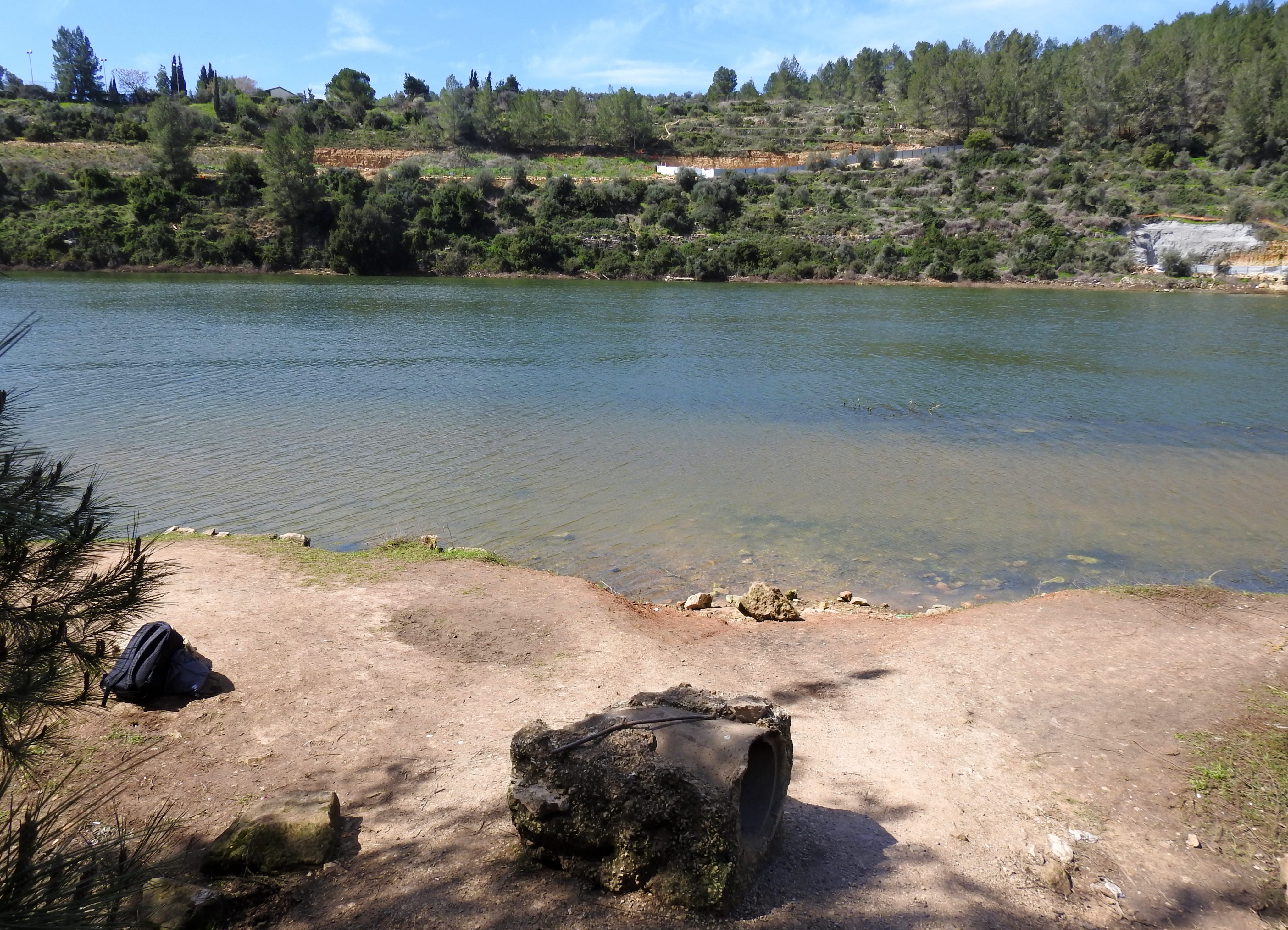
There’s nothing better than good, fire-roasted food and we came prepared with the necessary ingredients for a fine feast. Checking our location via GPS we understood that we were approaching the end of the reservoir and sought out a prime location for a fire. We needed to ensure that the spot that we chose both gave us shade from the sun to the east, but open skies to the west to watch for migrating raptors. It wasn’t long before we found the perfect spot, where a convenient broken concrete tube was waiting for us to repurpose it into a makeshift oven.

A prime barbecue location

We gathered some dead wood, and plenty of kindling, and got a fire going. Adam had thoughtfully packed some delicious spicy hotdogs, which we impaled on skewers to cook over the scorching heat. As we were eating we casted our eyes skyward from time to time, and then, our efforts paid off and we saw them.

A common buzzard far away

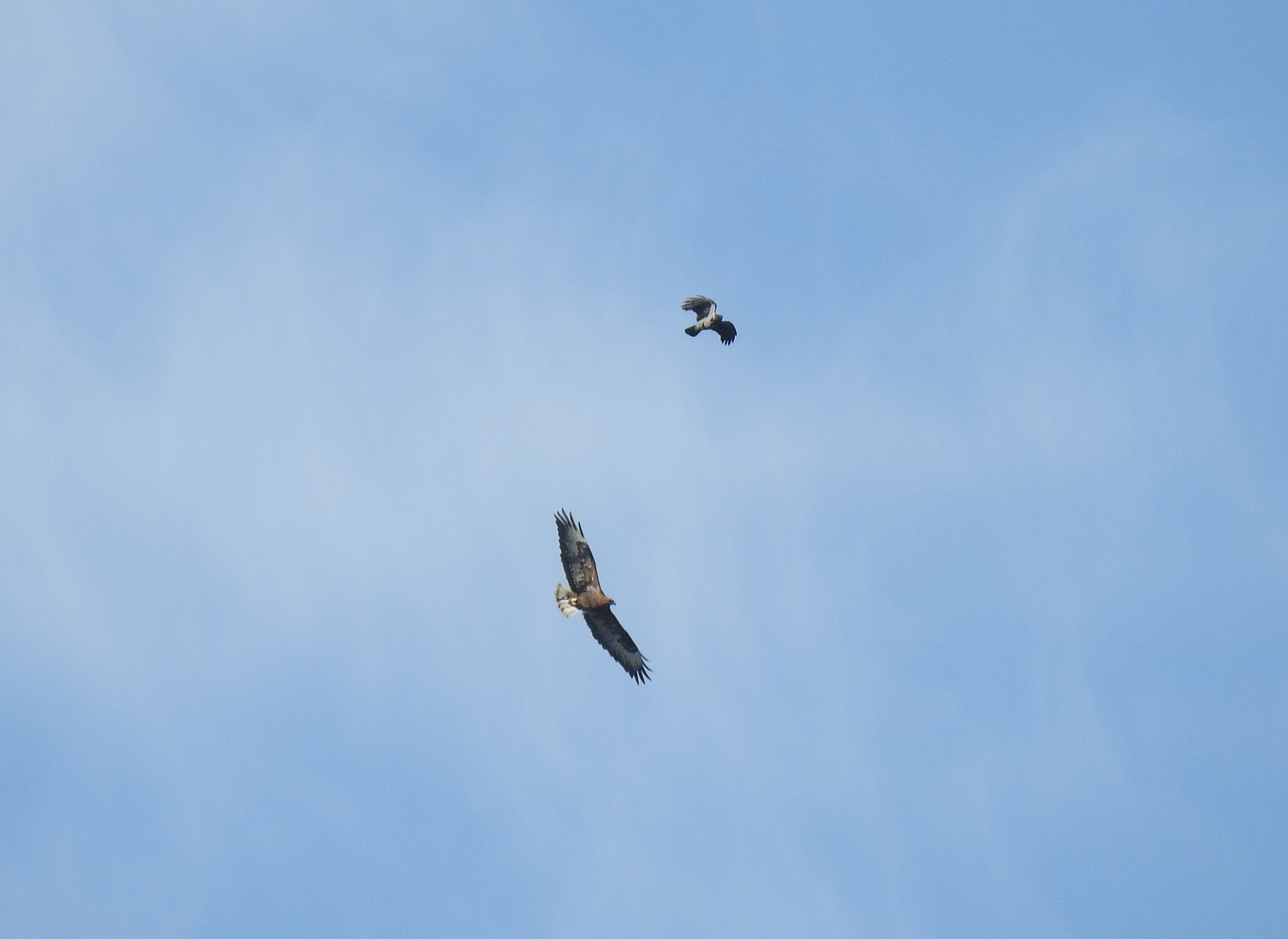
Migrating raptors began to dot the skies, making us dash for our camera and/or binoculars. It started with a few steppe buzzards seen over the faraway pine trees, and then some short-toed eagles were added to the mix. A few Eurasian sparrowhawks joined the fun, and then more steppe buzzards. They’d climb the thermals, reaching a favourable stream of hot air, and then disappear off to the north, to be replaced by others making the same moves.

Hooded crow mobbing a migrating steppe buzzard

Watching migrating birds of prey is a real treat, as you never know what you’ll end up seeing – and even if you see just the regular, expected species, it’s still an exciting time. We ate roasted hotdogs and drank cold water, taking in the experience. When the hotdogs were gone we got out the marshmallows that I had brought, and began a’skewerin’.

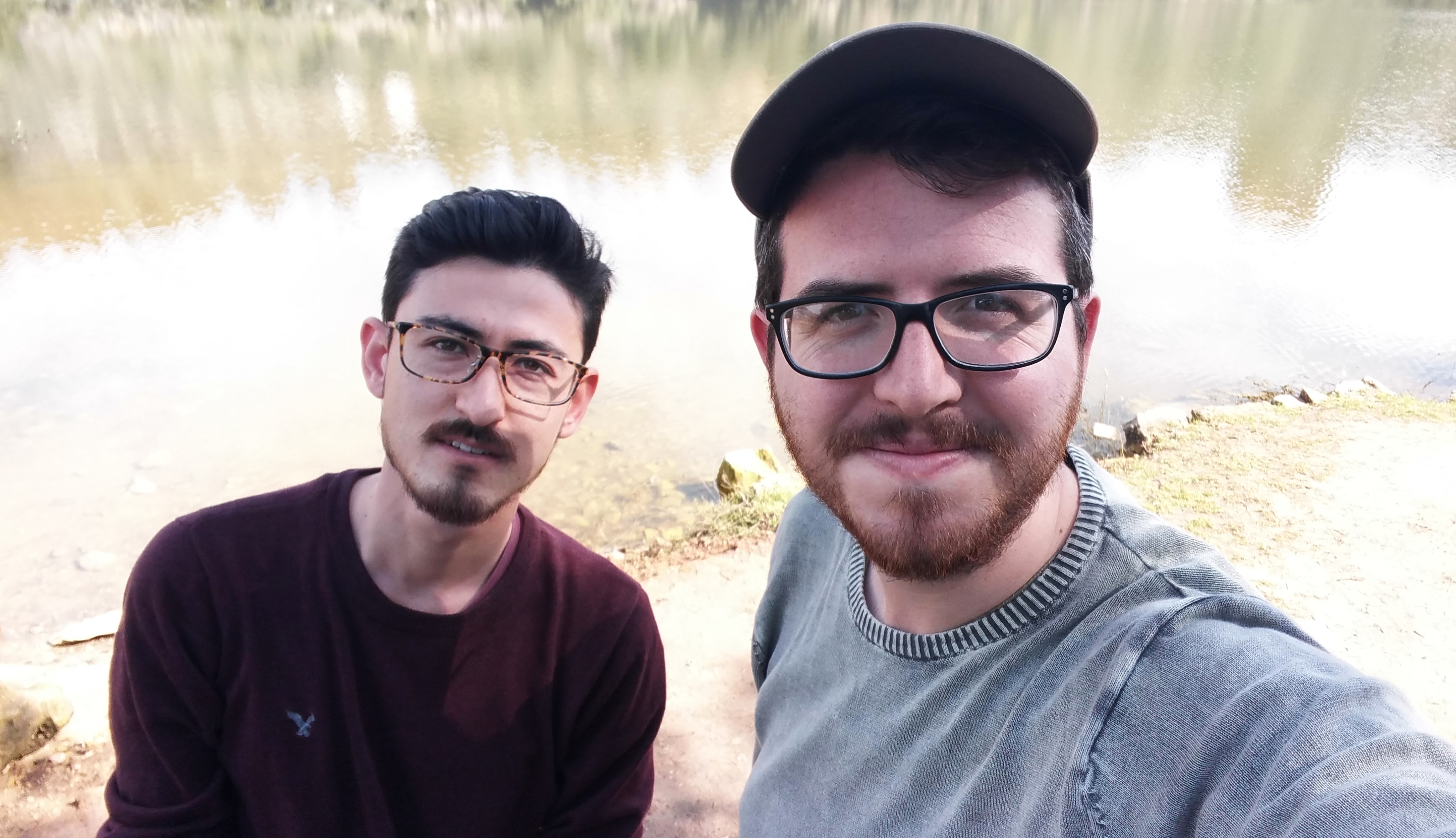
Happy adventurers

Sated from the delicious meal, we extinguished the burning coals and gathered up our bags. It was about 11am and large groups of people were starting to show up. We relinquished our prime, waterfront location to some picnic prospectors and struck out for the end of the reservoir. It was surprisingly close, and the big dam beckoned us to explore further. We ventured on, dipping down behind the dam and found a release pipe where excess water gushed out in a huge spray.

Behind the dam

It was tranquil behind the dam, with no crowds and the tiny Nachal Soreq just gurgling along underfoot. It was then that we went off-trail and Adam found something exciting. He shouted cries of jubilation as he raised his arm in victory, a single stem clutched tightly in his fist. It was wild asparagus and he had just harvested a single shoot. Adam had had a relatively bountiful some weeks prior when trotting about in Ben Shemen Forest, and now was time to harvest some more.

Wild aspargus with garlic

We scoured the undergrowth, searching for the precious little shoots. Unfortunately, there were only a handful of plants throughout the area we scanned, and the harvest was quite meagre. However, I was able to secure enough asparagus (approximately 8-10 shoots) to bring home as a treat to my asparagus-loving wife.

Making our way back to the marsh

With that we turned back, and walked the water-hugging trail that was now full of excited visitors. There was just one last raptor in the air, a sparrowhawk, and Adam needed to grab a few fairy shrimp specimens to take home. We reached the flooded marshy area quickly and set out to harvest some invertebrates. Adam used his nifty little net and scored a good number from the millions that were swimming before us. These treasures tucked away safely, we began the walk back to the bus stop.

In search of fairy shrimp

There was just one last surprise for us, a rock-hewn reservoir with a circular mouth at the side of the trail, which had gone unnoticed the first time we passed it. We got our bus after a short wait at the stop and made our journey home, bringing an excellent adventure to a close.

Adam has also written about this trip to the Beit Zayit Reservoir, long before me, in his new blog The Ota Files. Read his hilarious take on our adventure in his post HERE.

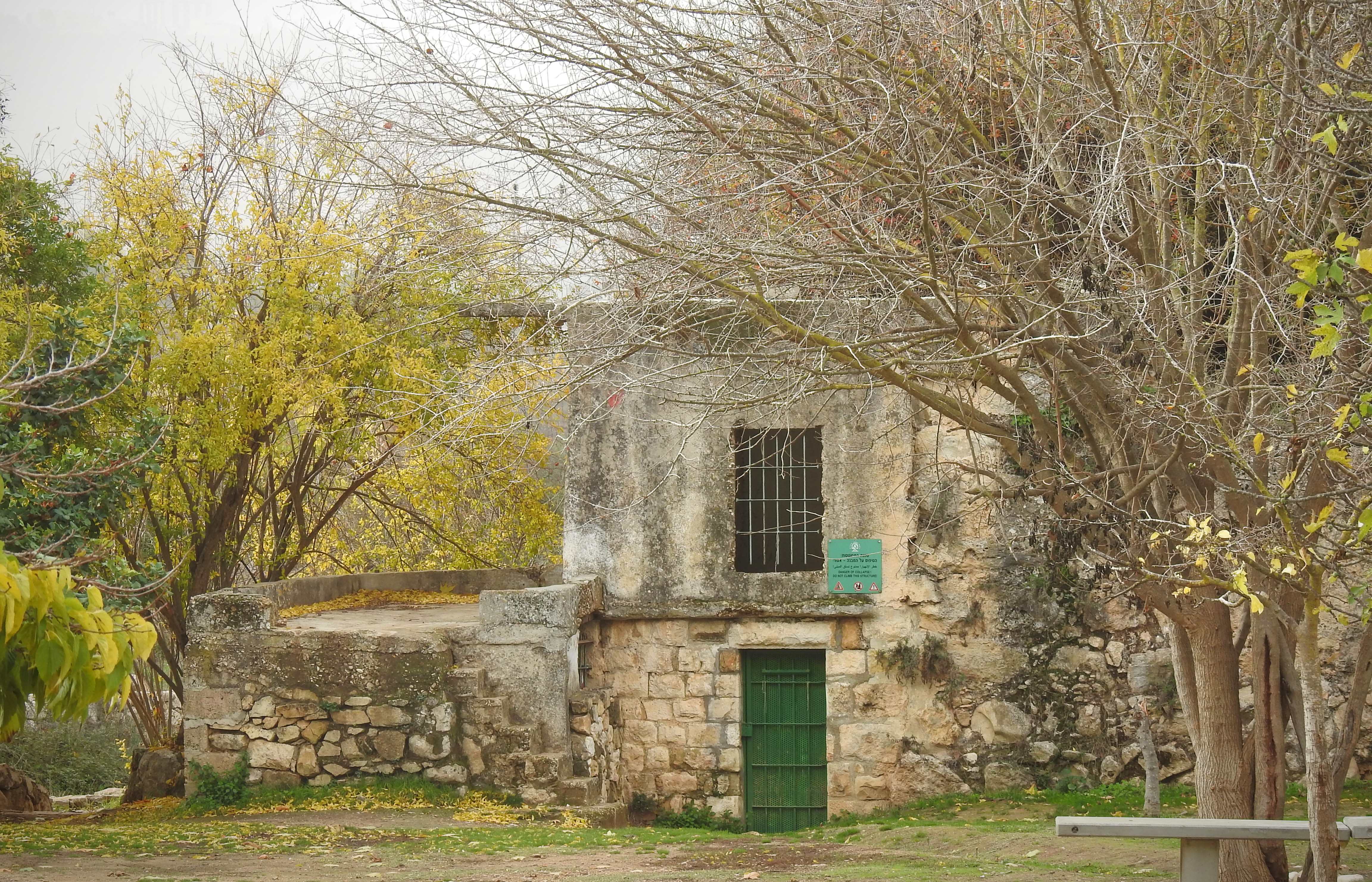
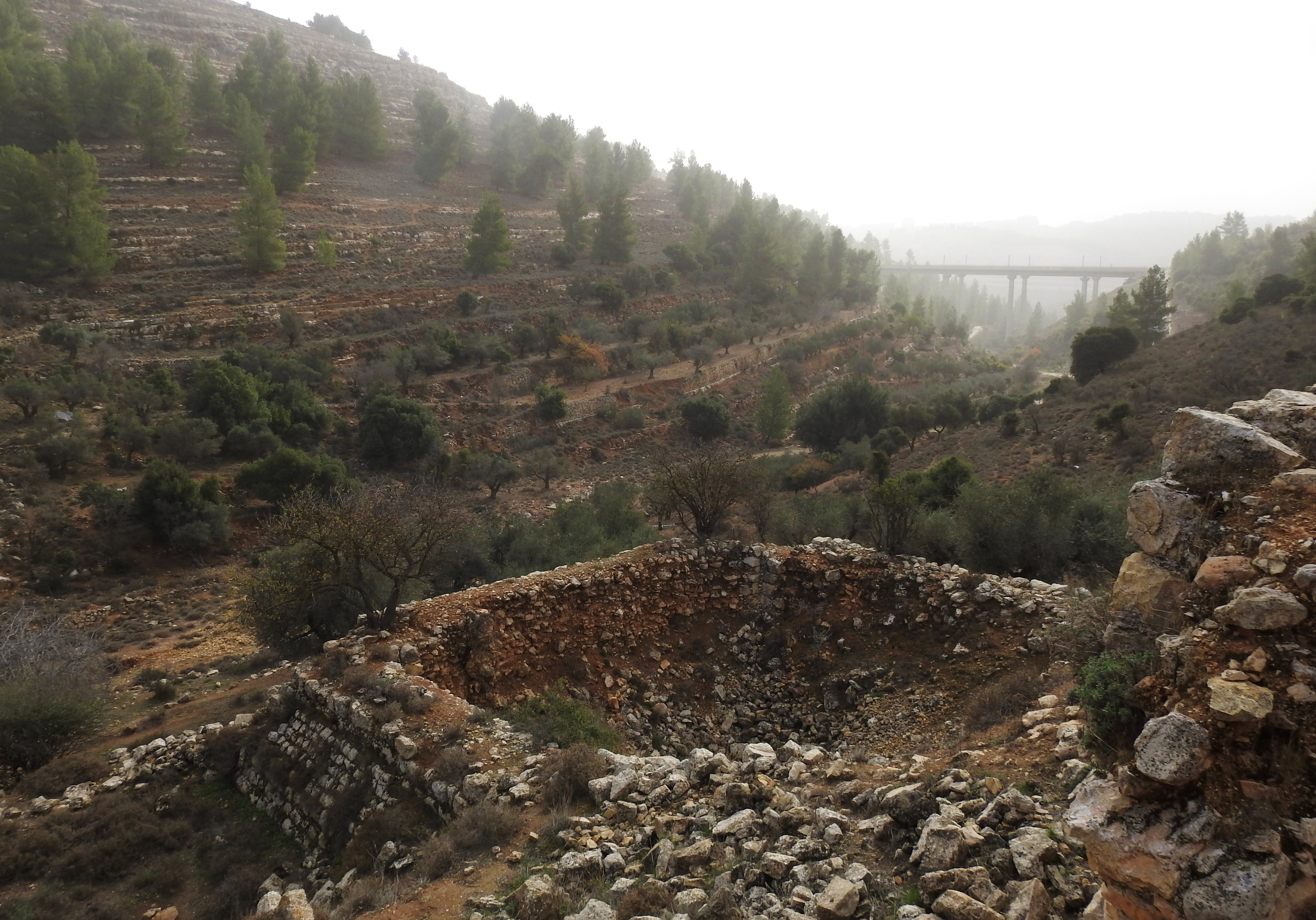
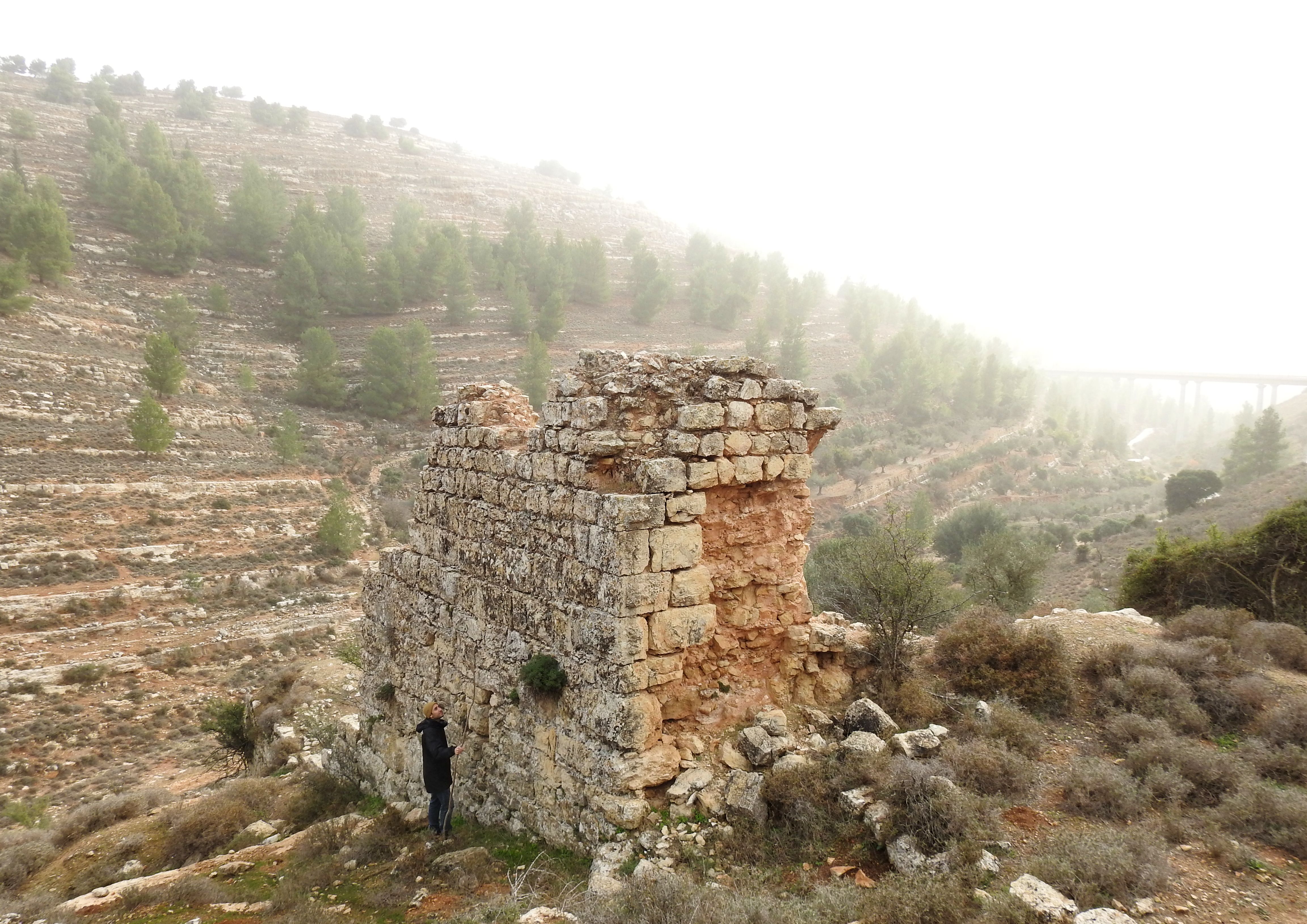
Khirbet Luza

In Israel, Jerusalem on March 29, 2020 at 8:45 AM

Continuing on with backlogged adventures, this post brings us to the mountains outside Jerusalem in the beginning of December. As part of our MA thesis project, friend and classmate Avner Touitou and I have been exploring our options. Being that we are both specialising in Crusader archaeology, we figured we’d best go out on a little adventure to hit up some lesser-known Crusader sites in the Jerusalem area.

Khirbet Luza

Avner picked me up in the morning and we drove over to our first destination, Khirbet Luza (or, al-Lawza), located not far from Moza. With a quick stop for coffee we made it to the nearest parking lot, at Arazim Valley Park, and continued on foot, all bundled up from the cold.

Join Avner on this adventure

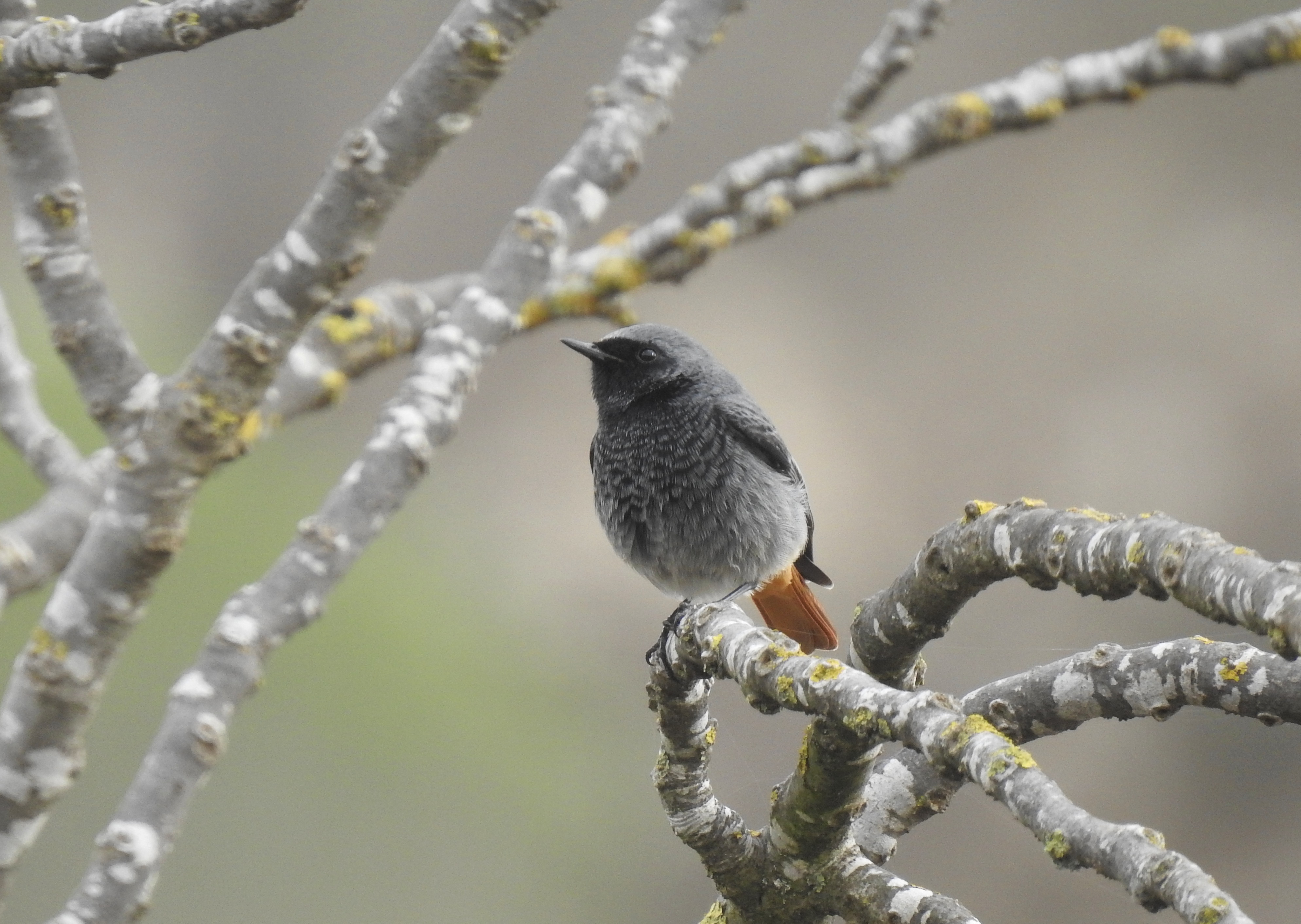
Trying to keep pace, I scanned the nearby trees and vineyards in search of interesting birds and found a decent selection, including chaffinches, black redstarts and a whole lot of blackbirds.

Black redstart

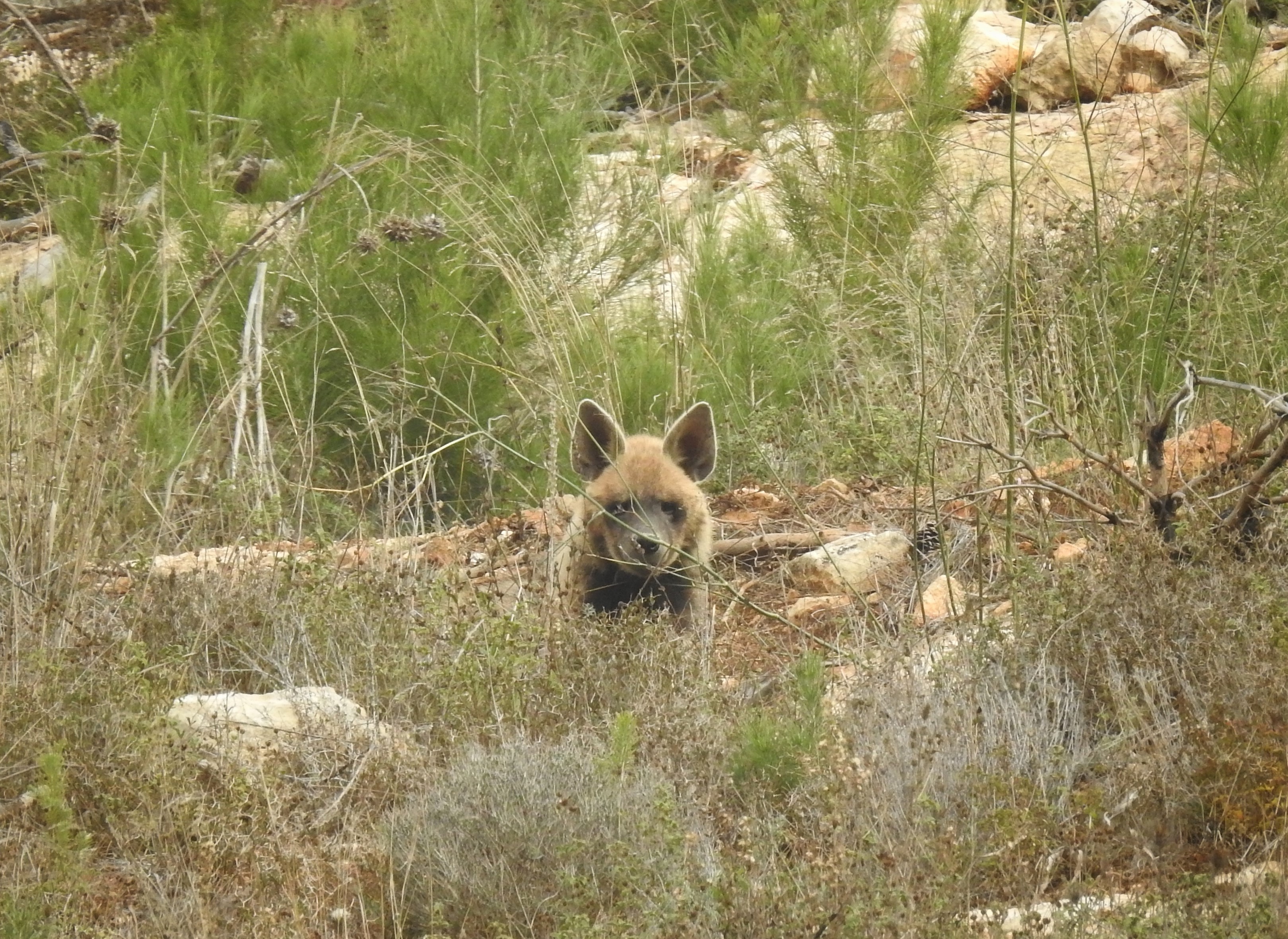
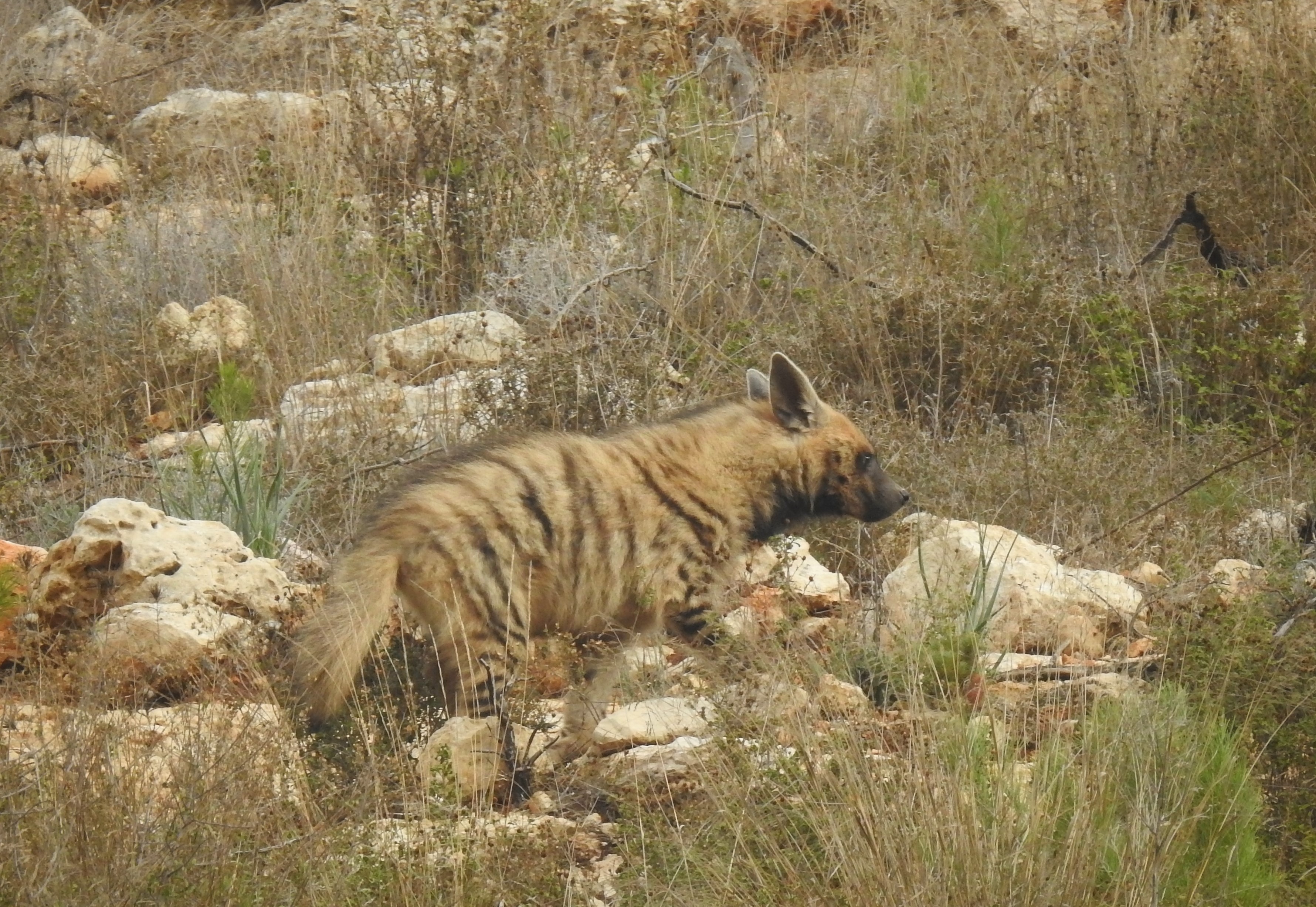
As we walked, Avner pointed out a few gazelle on the slopes in front of us, and sure enough the trailside slopes had what to offer. It happened so quickly, and so very unexpectedly. I saw a head peering out from behind the rocky vegetation, and immediately, instinctively knew that it belonged to a striped hyena.

Striped hyena head popping up

I nearly shouted with excitement, and hurriedly took photographs as I explained to Avner where it was hiding. Sure enough, it decided to move on, giving us a few seconds of a really great wildlife encounter. I had seen only one definite hyena, at night when I was driving in the army, and then another possible sighting near Tel es-Safi, which I wrote about HERE.

…and on the move

On a high, I reluctantly carried on as we continued walking our way along the trail in the direction of Khirbet Luza. We passed hundreds of trees with beautiful autumn foliage, unmarked ruins and a sign announcing the location as being Enot Telem National Park – a collection of natural springs, which were most recently used by the British. At last, after passing Ein Luz spring, we found it, the unassuming multi-leveled ruins on the left slope of the wadi-trail.

British pumping station

Leaving the trail, we climbed up on the damp rocky soil terraces, noticing the abundance of Steven’s meadow saffron, the delicate pinkish-purple flowers popping out of the soil. We explored the lowest level of the ruins, a large square chambre with thick walls, believed to have served as a pool of sorts.

Foggy Jerusalem hills and Khirbet Luza’s pool of sorts

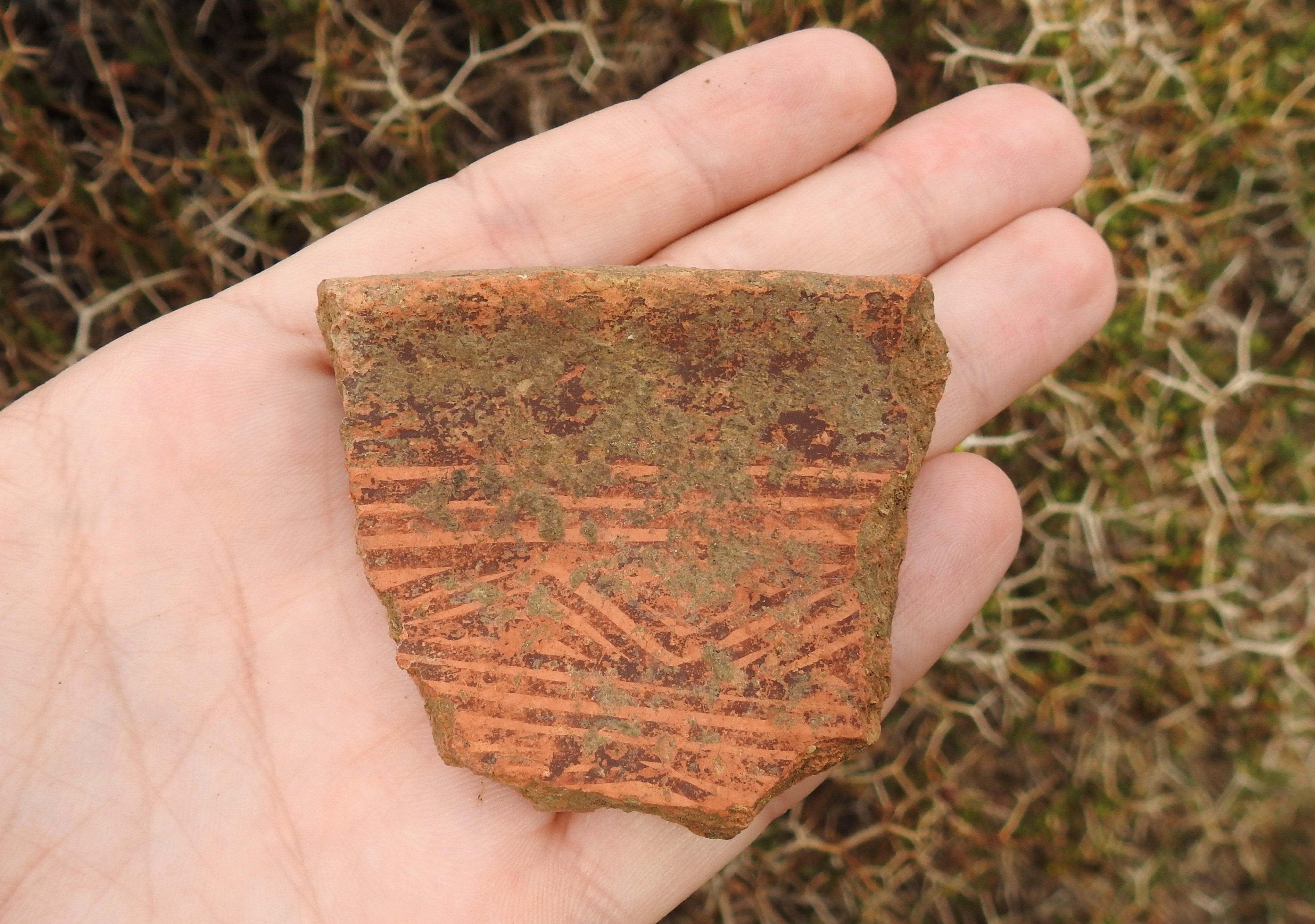
We climbed up to the next level, where the ruins were either partially filled in or collapsed. The atmosphere was rather foggy, as was our understanding of the site. A northern raven flew overhead, patrolling the opposing slope, and we found some decorated Crusader pottery and typically-masoned ashlars. Some other flowers, including winter saffron, added a bit of flora here and there.

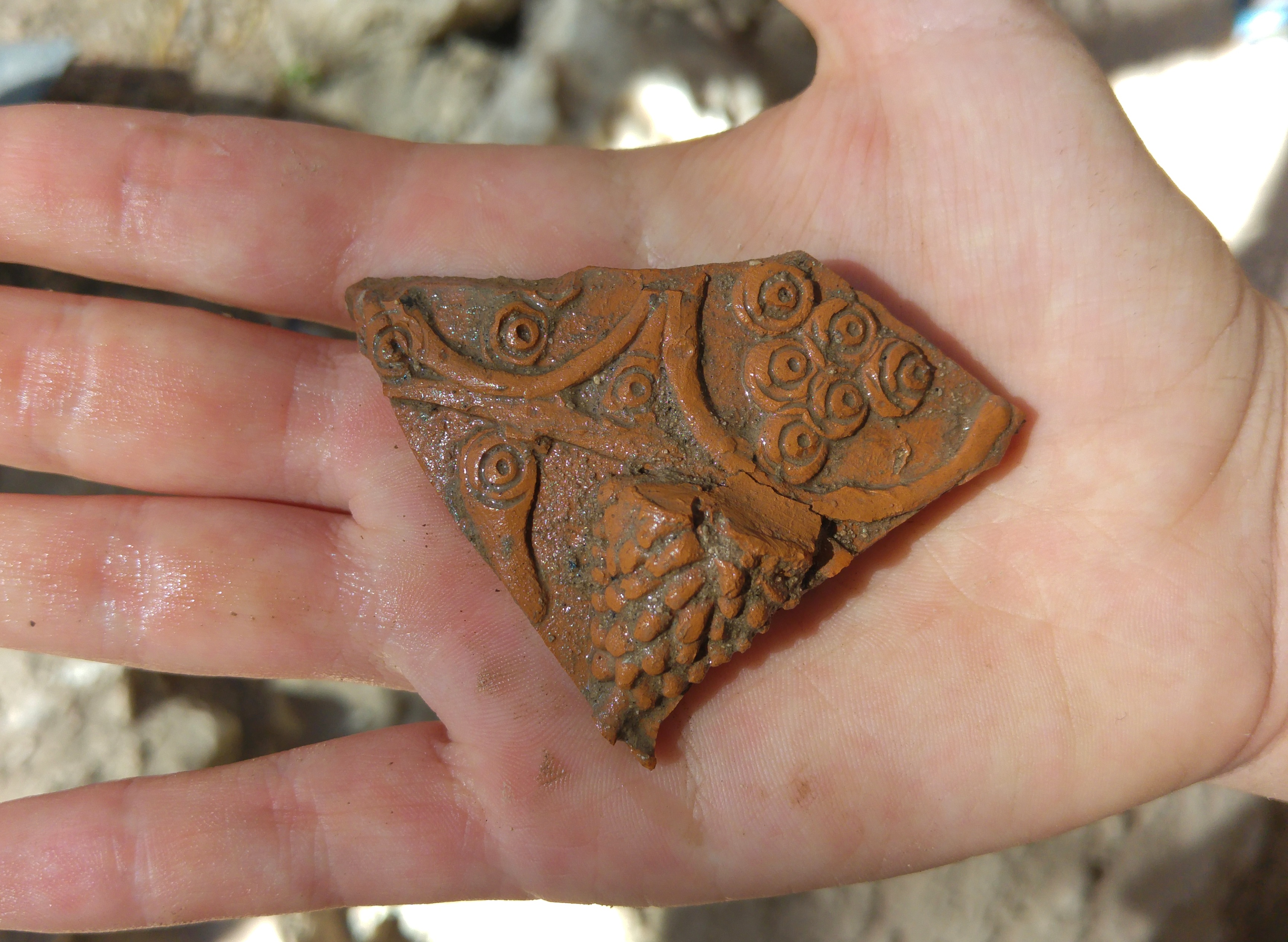
Decorated Medieval pottery

The second level of the ruins consist of a rectangular open room with added residential chambres closer to the natural slope. There are also several barrel-vaulted rooms, which are for the most part partially buried. We explored the toppled ruins the best we could, being wary of potential pits among the rubble.

Examining the high wall

Khirbet Luza was a rural estate built during the Crusader-era Kingdom of Jerusalem, situated on a rural road which connected other estates and monasteries. The terraces surrounding the building would have likely supported grapevines or olive trees during the Crusader period; today, these same terraces host olive trees, perhaps descendants of the Medieval ones.

Winter saffron

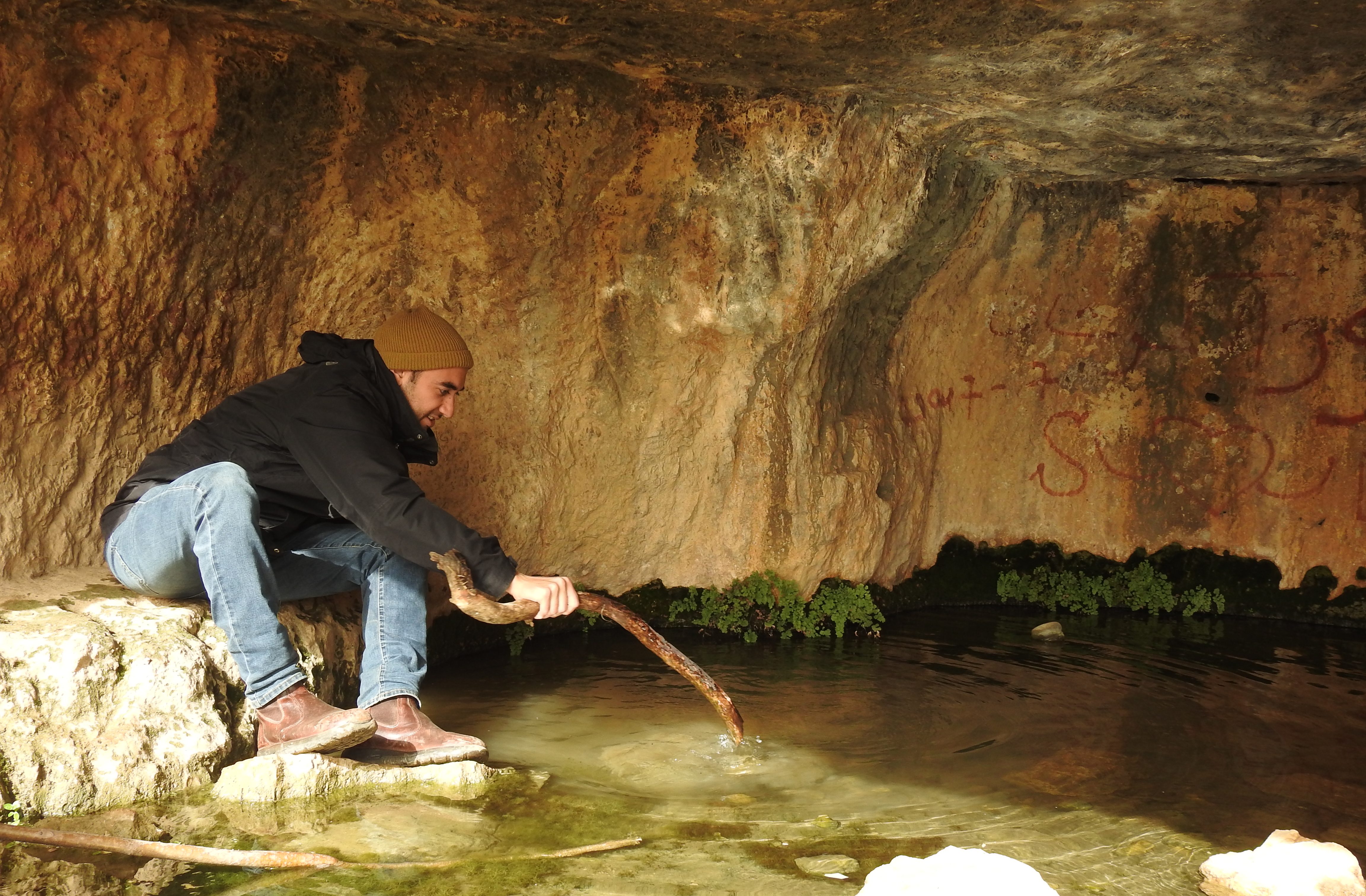
We continued on over to the nearby spring, where we found a huge blackberry bush just weeks from being ripe. We nibbled on a tart berry, just for entertainment’s sake, and then turned our attention to the spring’s pool where something sparkled at us from within the clear water. It was worth probing at it, in hopes of fishing out something amazing – but alas, ‘twas nothing exciting at all.

Exploring the spring

When we had finished our exploration of Khirbet Luza we walked back to the car, passing a whole bunch of common kestrels. From there we drove over to the next destination: Khirbet el-Burj, located in Ramot, a neighbourhood of Jerusalem.

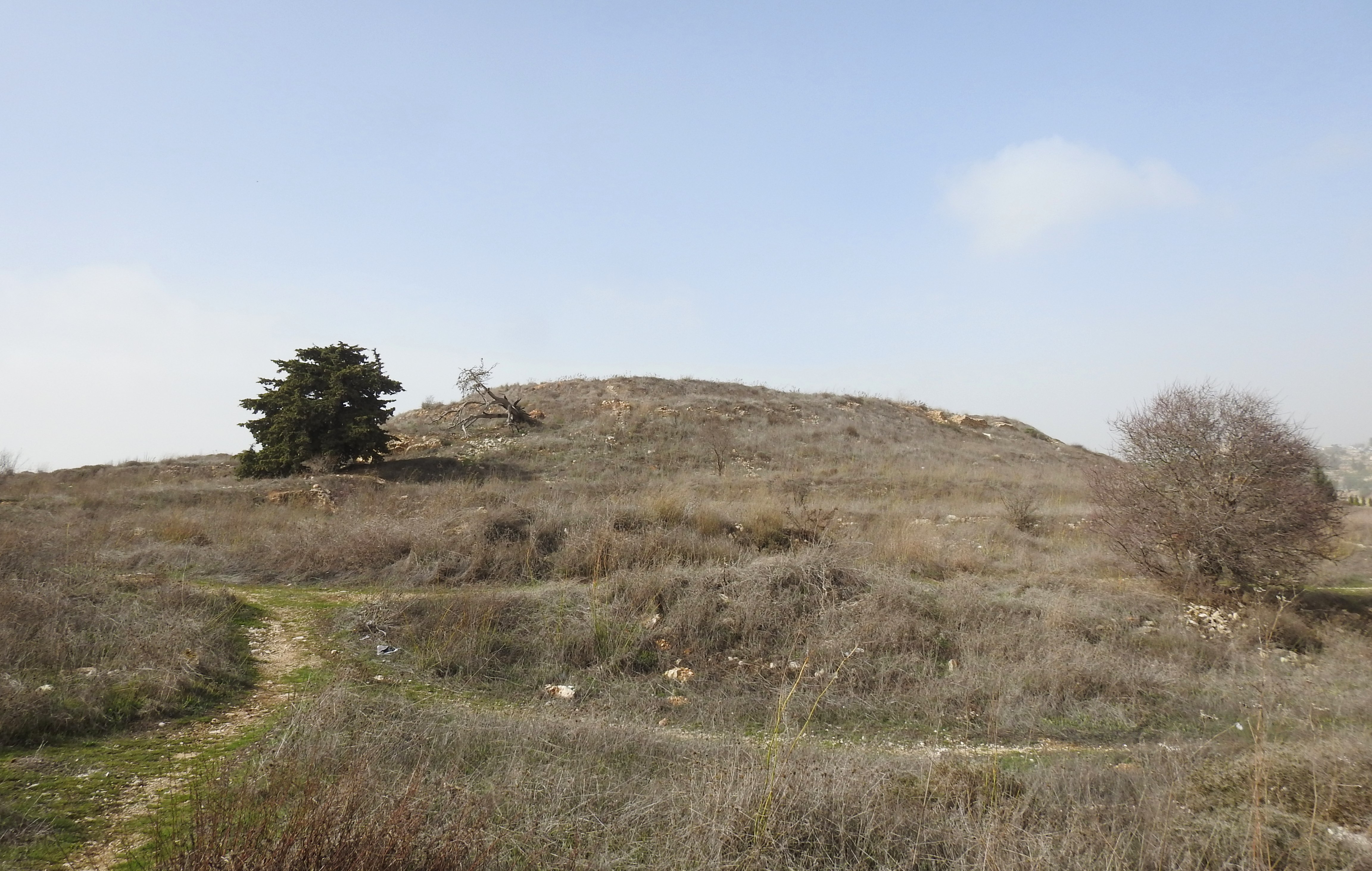
Dead grass-covered tel

Parking the car in a totally residential area, we found the hill associated with the site and climbed accordingly, seeing a few stonechats flying about. There was an overall cover of dried grass which made seeing any possible ruins difficult, yet we persevered. Yet, we did see a bit of architectural remains which seem to have dated back to the Crusader period.

Nabi Samuel nearby

Skirting the small hill from the south-side, we climbed up to the top from the east and saw a familiar landmark to the north. Nabi Samuel, a fantastic archaeological and religious site which holds some importance to me. My wife and I had gone there for our very first date, and thus already cherished, it was then the location of my marriage proposal – up on the rooftop with its view of Jerusalem.

Not much to see here at Khirbet el-Burj

But, up on the top of Khirbet el-Burj, there wasn’t much to see. We found some exposed walls, and the meagre remains of a largish building with a tower, destroyed in 1967 according to the IAA report. With not much to see, factoring in the passage of time and neglection, as well as the dominant grassy obstruction, we decided to bring our trip to an end. But first, two meadow pipits popped into view, giving me a nice sighting. We walked back down to Avner’s car and drove out to the main road, where we parted ways. Avner headed home and I waited for Bracha so that we could journey over to Ma’ale Adumim for Shabbat.

Mount Zion Archaeological Dig

In Israel, Jerusalem on November 6, 2019 at 2:22 PM

Way back in the end of June, at the start of the busy summer months, I had the pleasure of taking part in yet another exciting archaeological dig. Being that I have just begun my MA degree this autumn semester, I’ve been involving myself in the Crusader period more and more. This led me to meeting up with Dr Rafi Lewis, co-director of the Mount Zion Archaeological Dig, at his excavation site just outside the Old City of Jerusalem.

Beneath the Old City walls

Referencing from the expedition’s website, the ongoing mission of the excavation is to expose and preserve the many layers of civilisation found on Mount Zion, going back thousands of years. As with nearly everywhere in and around the Old City of Jerusalem, the veritable footprint of humanity is profound in both magnitude and multitude. Just glancing about the dig site at Mount Zion, one can see a plethora of different architectural elements seemingly stacked upon one another in a dizzyingly fashion.

Dr Rafi Lewis & Dr Shimon Gibson

Dr Rafi Lewis of Haifa University joined Drs Shimon Gibson and James Tabor, both of the University of North Carolina at Charlotte, who had been excavating at Mount Zion since 2007. Whereas Drs Gibson and Tabor have their primary foci on the Roman era and the parallel rise of Christianity, Dr Lewis focuses on the Medieval period, and even more interestingly, Crusader battlefield archaeology.

Looking around the dig site

I had scheduled a day to join the dig in advance and made my way to the Old City of Jerusalem that early Wednesday morning. Arriving at the site shortly after 7am, I found a fenced off area just below Zion Gate – outside the impressive Ottoman wall of the Old City. Entering, I found Dr Lewis and made introductions before we set out on a little tour of the site. I found the range of excavated sites to be quite fascinating, and very unlike older sites such as Tel es-Safi where I excavated only Bronze and Iron age layers. Here there was so many different levels, belonging to such a varied group of historical peoples, that the very concept garnered interest.

Looking up at the nondescript tower structure

It’s certainly hard to recall which pit belonged to which era, and which wall was built by which reigning group, but the overall picture was that there was plenty to go around for everyone will all their preferred historical periods. Dr Lewis led me over to a rectangle of brushed earth, bordered by earthen ledges and stone architectural features. He then explained that this was the floor of a Ayyubid structure, believed to have been a tower, and that we were now going to explore what lies below – presumably Fatimid ruins.

Ornate pottery piece

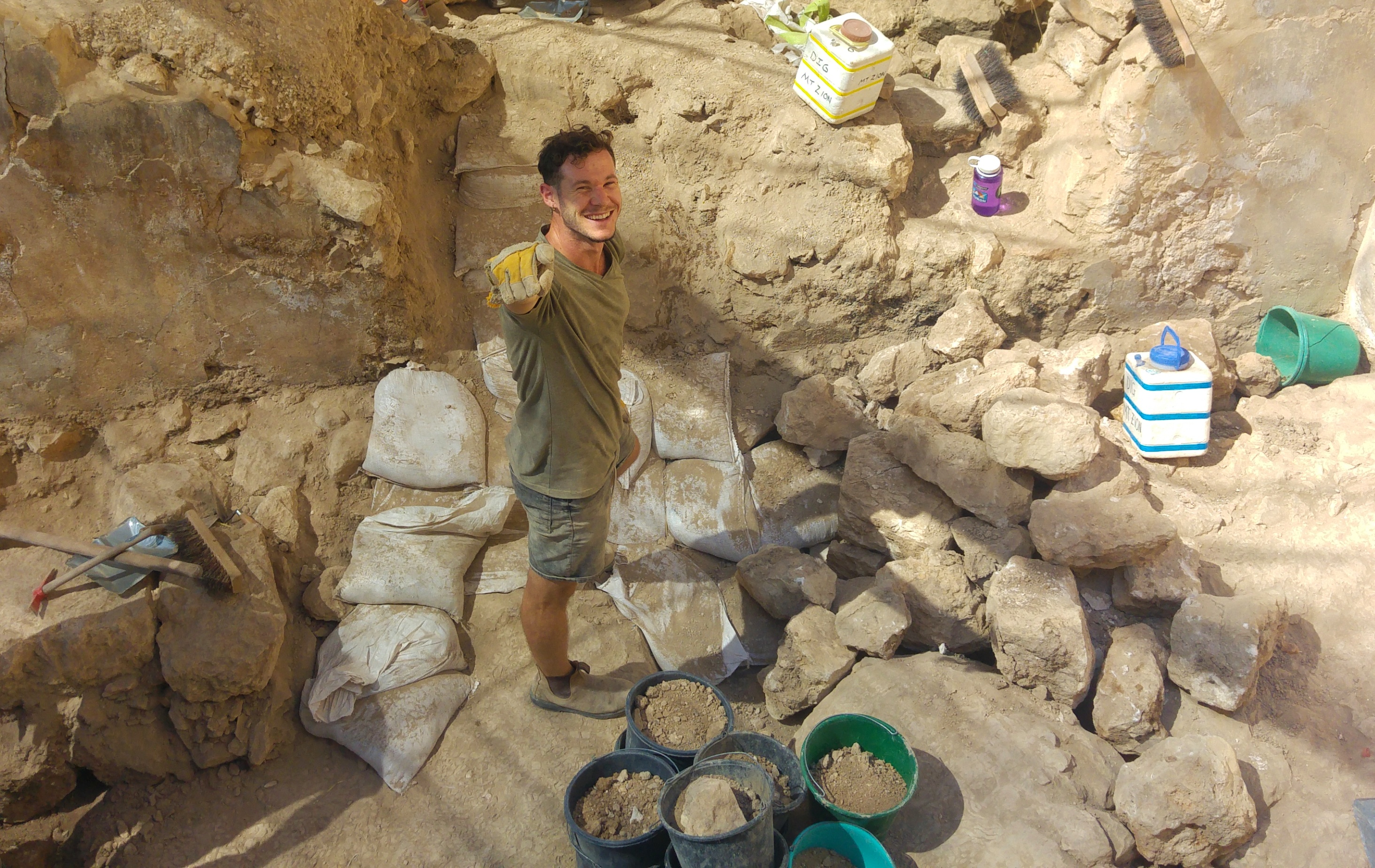
While there were dozens of people milling about the general Mount Zion dig area, there were only a handful in and around this Arab structure. We made introductions and settled down to start working, armed with the usual archaeological hand tools. Our first task was to take up the next couple inches of soil, looking out for the usual archaeological artefacts. Every so often someone would come over with a metal detector to check for coins, jewelry and other metal objects.

Some fancy glass

I was amazed at the amount of nice pottery, far nicer than the generally rough sherds I have found in the Bronze and Iron age sites I’ve traditionally excavated at. Likewise, glass was more plentiful and came in all sorts of degenerated colourations. What surprised me most, however, was a weirdly shaped hard organic item that eluded even my wildest guesses. When I asked the experts, I was informed that it was none other than the tooth of a parrotfish – imagine that!

Ancient parrotfish tooth

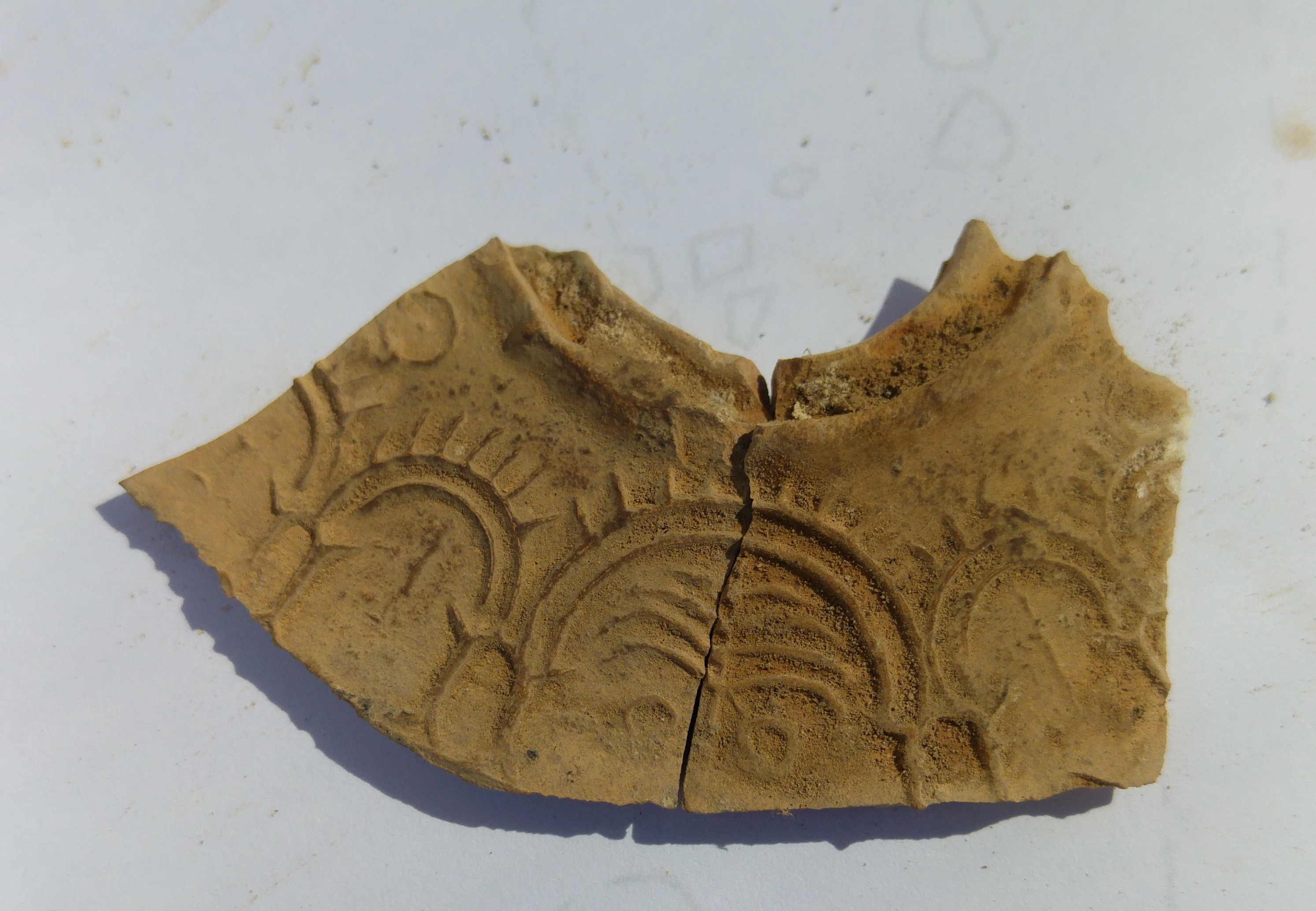
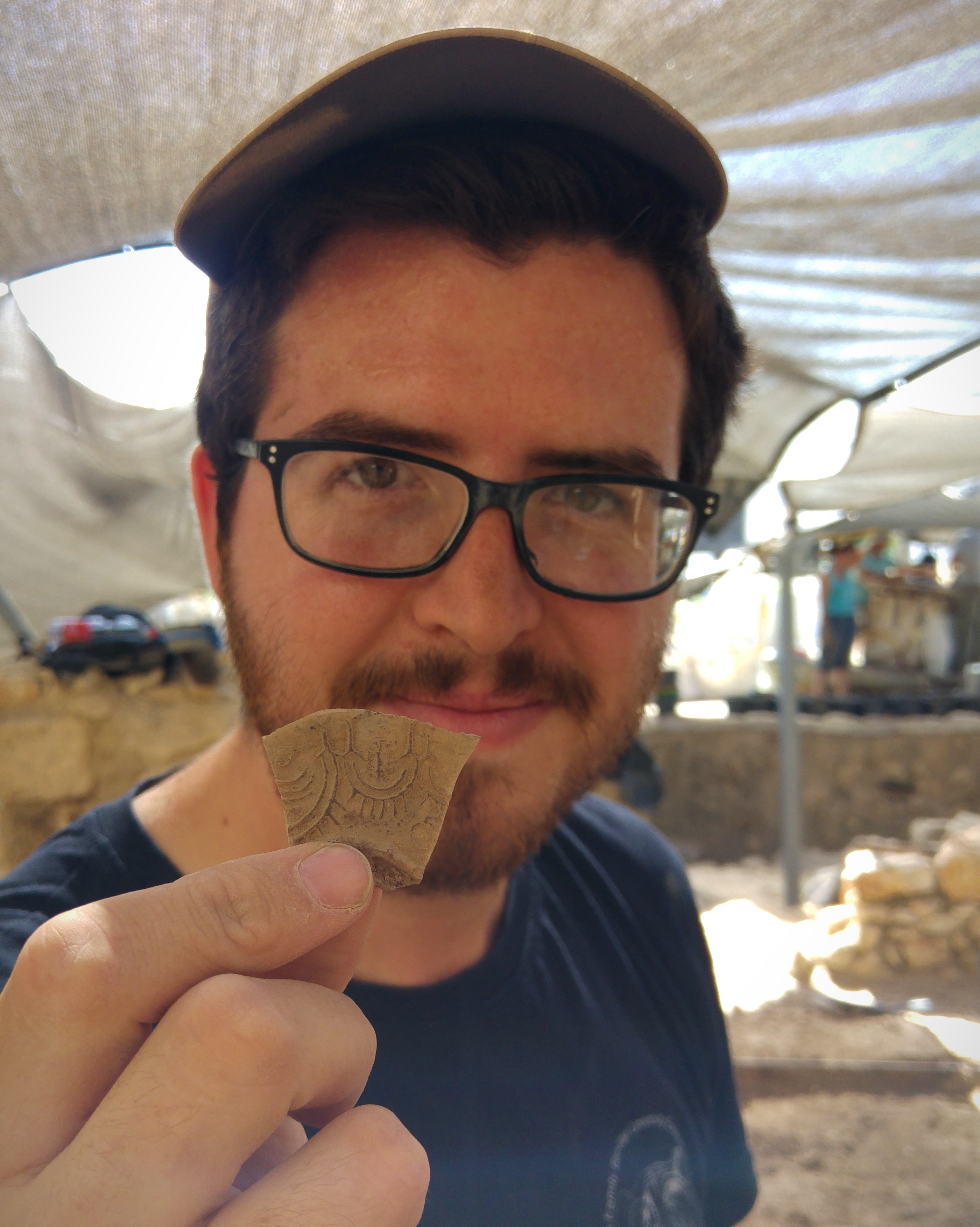
Every now and again a coin would be found – never by me, unfortunately. However, I did find a nice piece of a mould-made oil lamp with an ornate pattern that looks like bent palm trees forming arches, encircling the pouring hole. Shortly thereafter, once the excitement had died down, another two pieces were found – one being a match, and one from a different lamp.

Posing with the lamp sherd

Another fun aspect was the high number of tesserae (mosaic stones) that were interspersed quite like cookie dough chunks in my favourite ice cream flavour. Handfuls of cubed stones were gathered up and chucked into the tesserae bucket, to be bagged, registered and dealt with at a later date.

Scores of tesserae

At 9:30am we paused for breakfast, and gathered around the serving tables at the higher end of the dig site. I feasted on plums and halva, somewhat limited in what I’d eat due to the expedition’s unkosher status. It was then that I observed a familiar face working beside an excavated pit below me. This face’s owner, Ido Zangen, is comparable to the charming character Waldo in that he appears at every archaeological excavation – you simply have to search for him to find him!

Finding Ido!

After breakfast we got back to work, and we had a new manager in our Ayyubid/Fatimid tower floor: Dr Rona Avissar Lewis, the wife of Rafi Lewis. Rona had previously been a staff member at the Tel es-Safi excavation, years before my stint there. Delving back into our work, we cleared away a nice sized layer of soil, uncovering the usual ceramics, tesserae, small finds and more.

Rona and Gray clearing out the dirt

As the hour got later the sun’s rays began to punish us through the mesh shade net above us, and I sought shelter to rest. The work day was almost over, so when I was done resting and rehydrating I rejoined my digmates to do the finishing touches. I don’t know how much dirt we moved that day, but it was very exciting working on a medieval tower and I look forward to doing more.

A last look at the curious oil lamp

Before I left I bid farewell to my digmates Gray, Mel and an older couple from Chicago; staff member John (a spitting image of Captain Flint in “Black Sails”); and the dig co-directors Rafi and Shimon. Feeling a wee bit peckish, I got a nice schnitzel baguette at the Central Bus Station and continued on with the rest of my day.

Tel Tzuba (Belmont)

In Israel, Jerusalem on March 13, 2019 at 7:56 AM

One month ago, in the heart of February, I went on a short hike with my girlfriend, Bracha. We had decided to explore in the vicinity of Jerusalem, and one particular site stuck out to me: the Crusader fortress of Belmont. Doing a wee bit of research, we found a way to make a delightful little hike of it and, after meeting up in Jerusalem in the morning, set out to the trail by bus.

The start of the hike

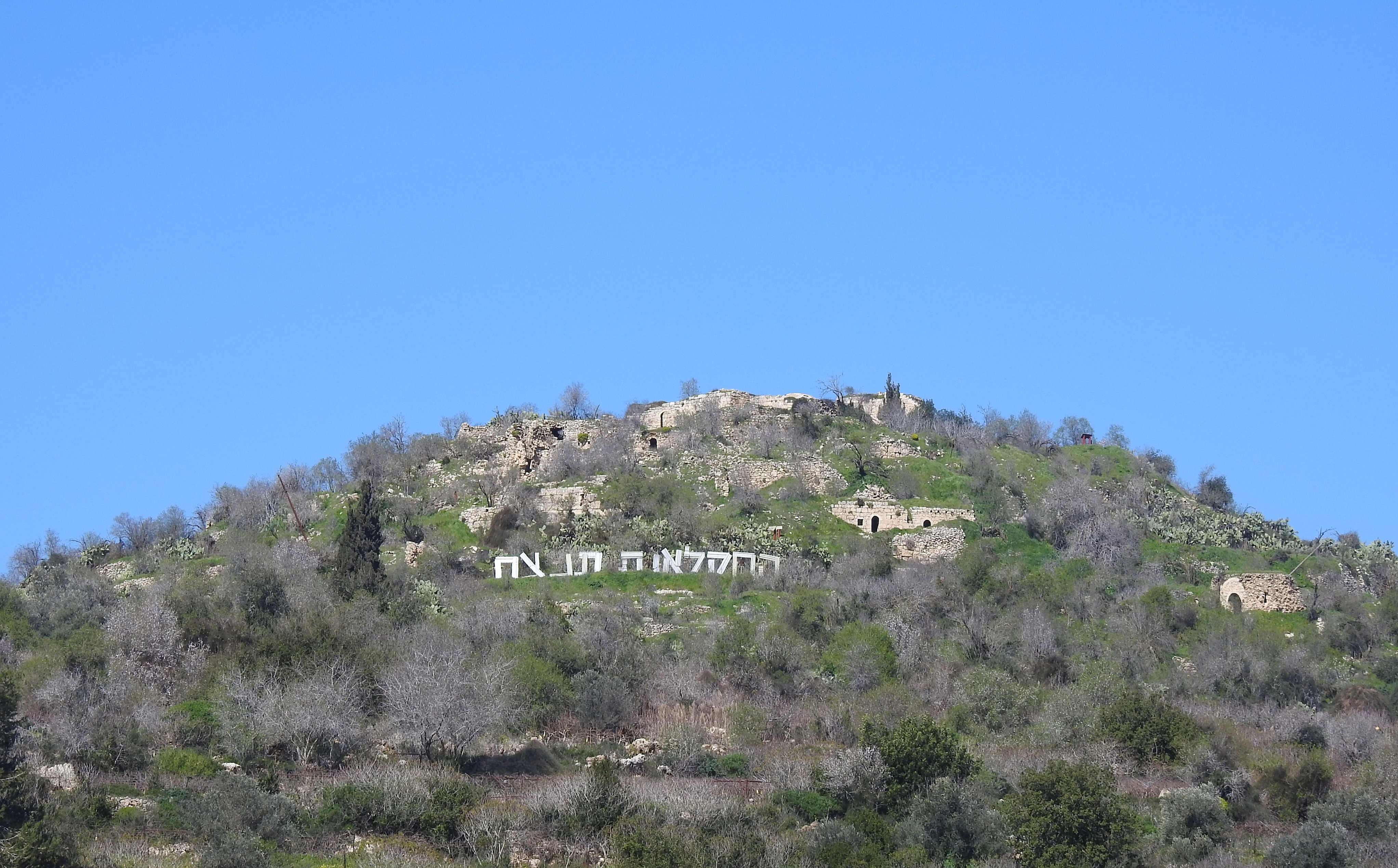
Our bus took us directly to the trailhead, marked by green and white paint, and we began at once. The hill of Tel Tzuba was visible from where we began, large painted letters shouting “agriculture will prevail” slightly marring the otherwise picturesque view. As we walked gradually uphill we paused now and again to admire the early spring wildflowers and the noisy birds all around us.

Tel Tzuba

Within a half hour we reached the first site of interest: Ein Tzuba, a rather complicated underground spring flow system beside a small vineyard. We paused at the first pool, where mostly stagnant water overgrown with algae and a dead tadpole greeted us wearily. But it was the rest that proved more interesting, with a series of walls, gated passages, reservoirs and more modern structures that tantalised with their mysterious purposes. Consulting the on-site cross-sections as well as a book on underground aqueducts, I learned that this extensive spring system was first constructed in the Iron Age, some 2,500 or so years ago.

Ein Tzuba

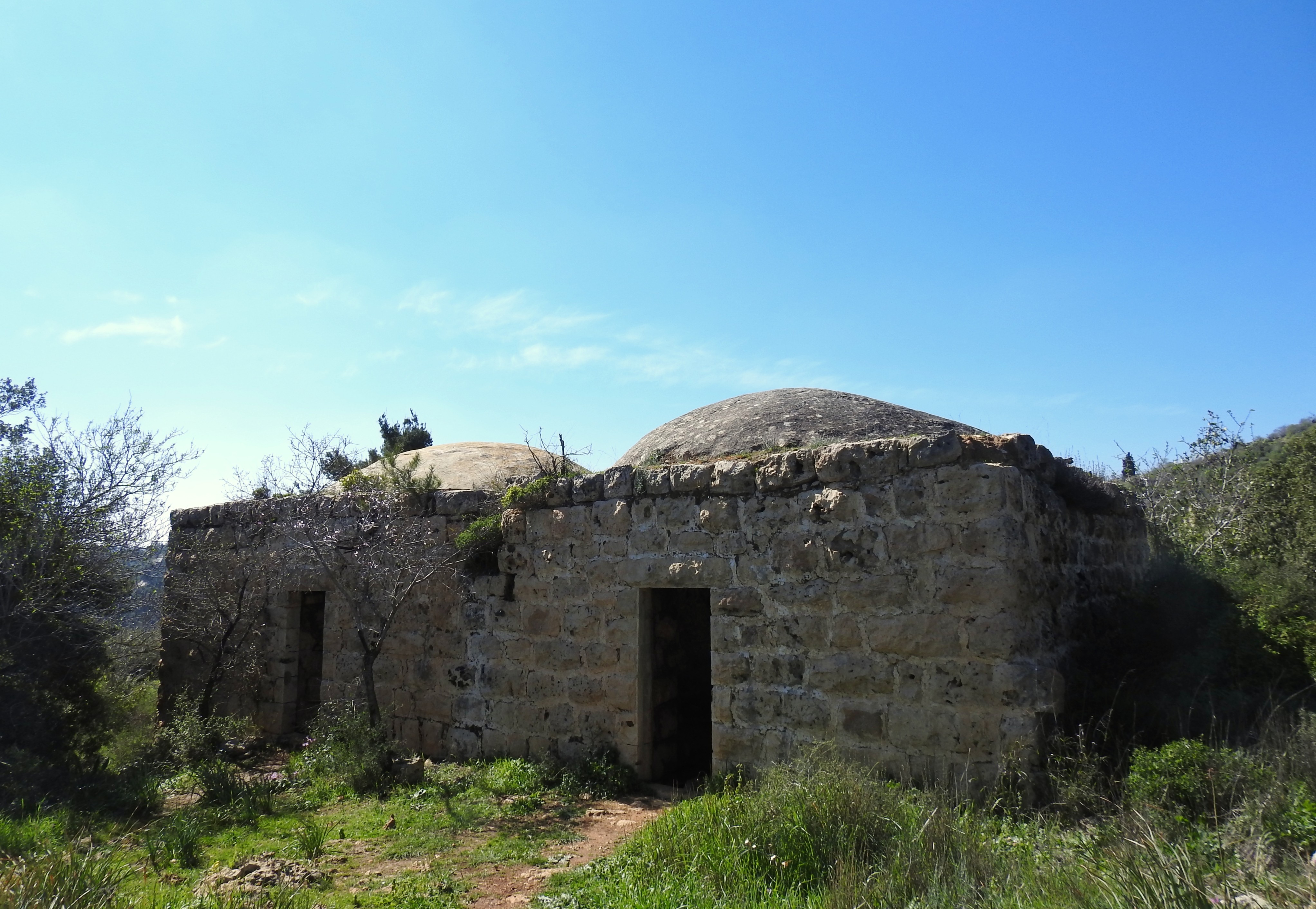
When we had seen all that there was to see, we continued along on the trail, seeing more songbirds, wildflowers and a wild mushroom of unknown identity. Up ahead we made out a structure partially hidden by the low trees and undergrowth. It was a double-domed sheikh’s tomb, and we entered it briefly to look around. After a short break at one of the nearby picnic tables we continued on, walking the dirt road up the tel.

Sheikh’s tomb

As we neared the top of the hill we found the first of many crusader structures that make up Belmont. The site was first constructed by an unknown Crusader source sometime in the mid-1100s, approximately fifty years after the start of the Kingdom of Jerusalem. Some years after, the military order of the Hospitallers acquired the structure and built a medium-sized castle. Despite its proximity to Jerusalem, the Kingdom’s capital, the castle was constructed more for agricultural production and mission work than for critical defence, which is evident in its construction.

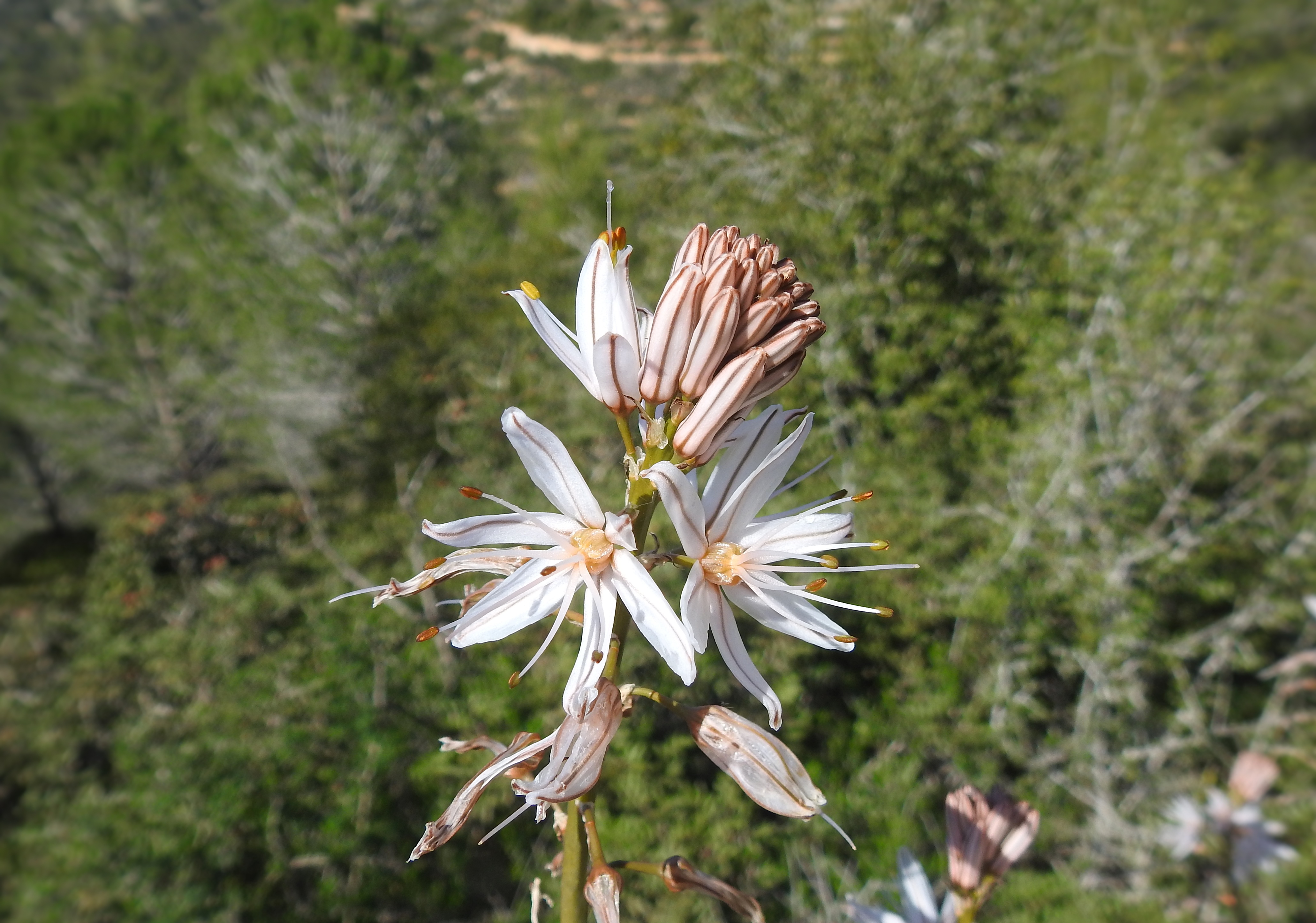
Branched asphodel

Archaeological excavations led by RP Harper and D Pringle in the 1980s helped establish the size and shape of the castle. The external walls, forming a polygon that accommodated the hilltop topography, enclosed a more traditional rectangular structure with a courtyard. The castle was destroyed only tens of years after it was constructed, by the Muslim leader Saladin in either 1187 or 1191, and has been only partially in use since then. In 1834 the Egyptian leader Ibrahim Pasha thoughtfully destroyed the more of the standing remnants of the Crusader castle and left the ruins for us to explore on this lovely spring day.

Entering Belmont

We entered the outer confines of the castle, typical Crusader masonry showing itself everywhere, from standing walls to fallen ashlars. The path took us from the southwest around to the northwest, where we saw fit to enter the more inner area of the ruins. Flowering Egyptian campion added a splash of colour to the green grass and the off-white stones as we surveyed our surroundings.

Belmont castle

Some of the structures were in better shape than others, and as we climbed higher, the complex’s layout became more clear. The central courtyard had a grated-over water cistern, and was surrounded by walls and fallen rocks. Windows still remained here and there, and the degrees of fanciness in the arched doorways told us more about the rooms inside.

A bed of yellow among the trees

It took us a good half hour to explore the ruined castle, and there was always the impressive view to admire from the more lofty fortress rooftops. As we were making our final loop of the castle, climbing up the overgrown ruins and returning to the western side from whence we came, we found a dead pigeon with rings on its legs – apparently a domesticated pigeon that escaped from its human master and found death on the hilltop.

Jerusalem hills

We circled the lower perimetre of Belmont and found a place to picnic with a great lookout to the east, and essentially where we had hiked on the way to the castle. Bracha had made food the night before, and so we feasted and enjoyed the relative tranquility of a springtime afternoon picnic.

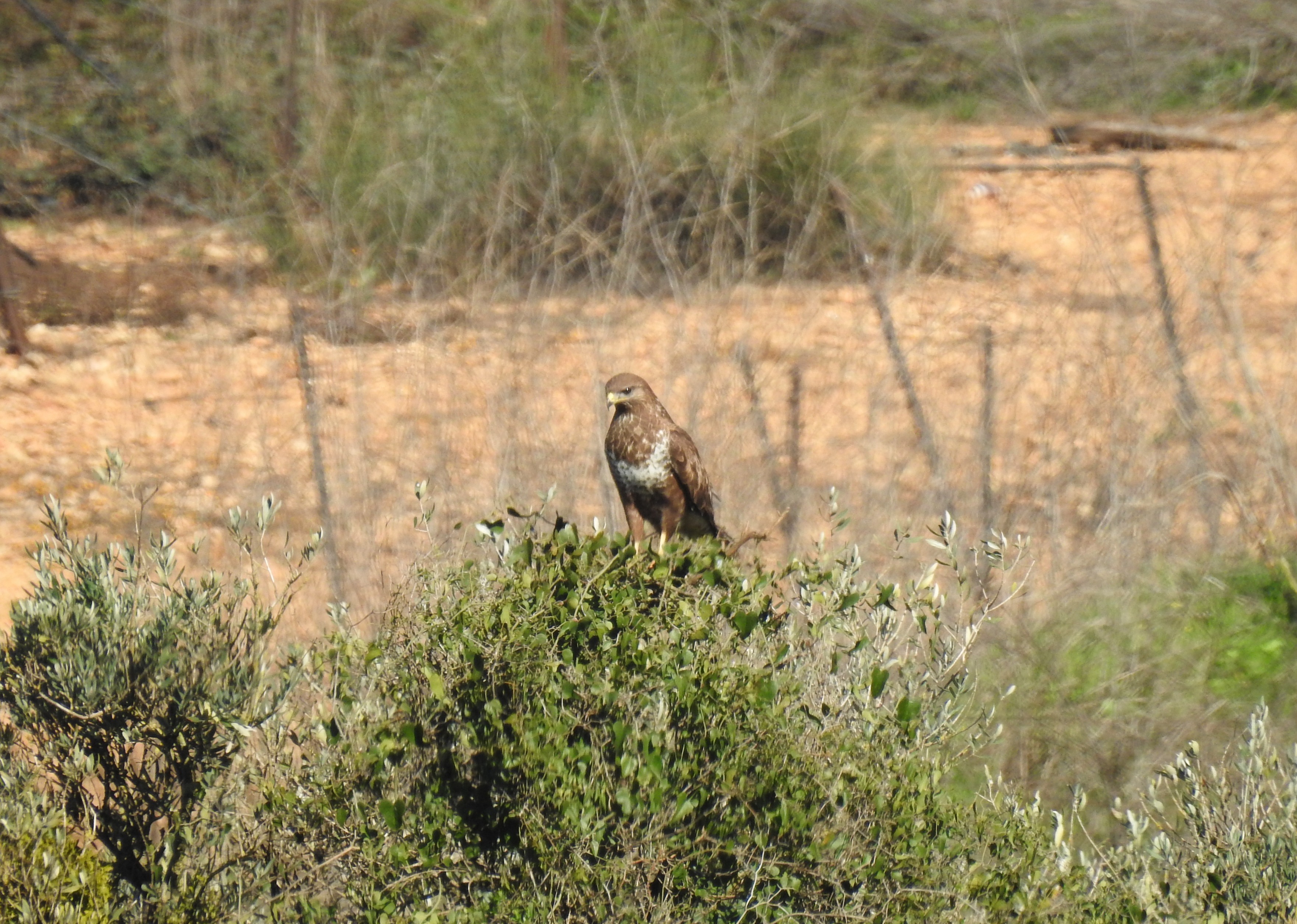
Common buzzard

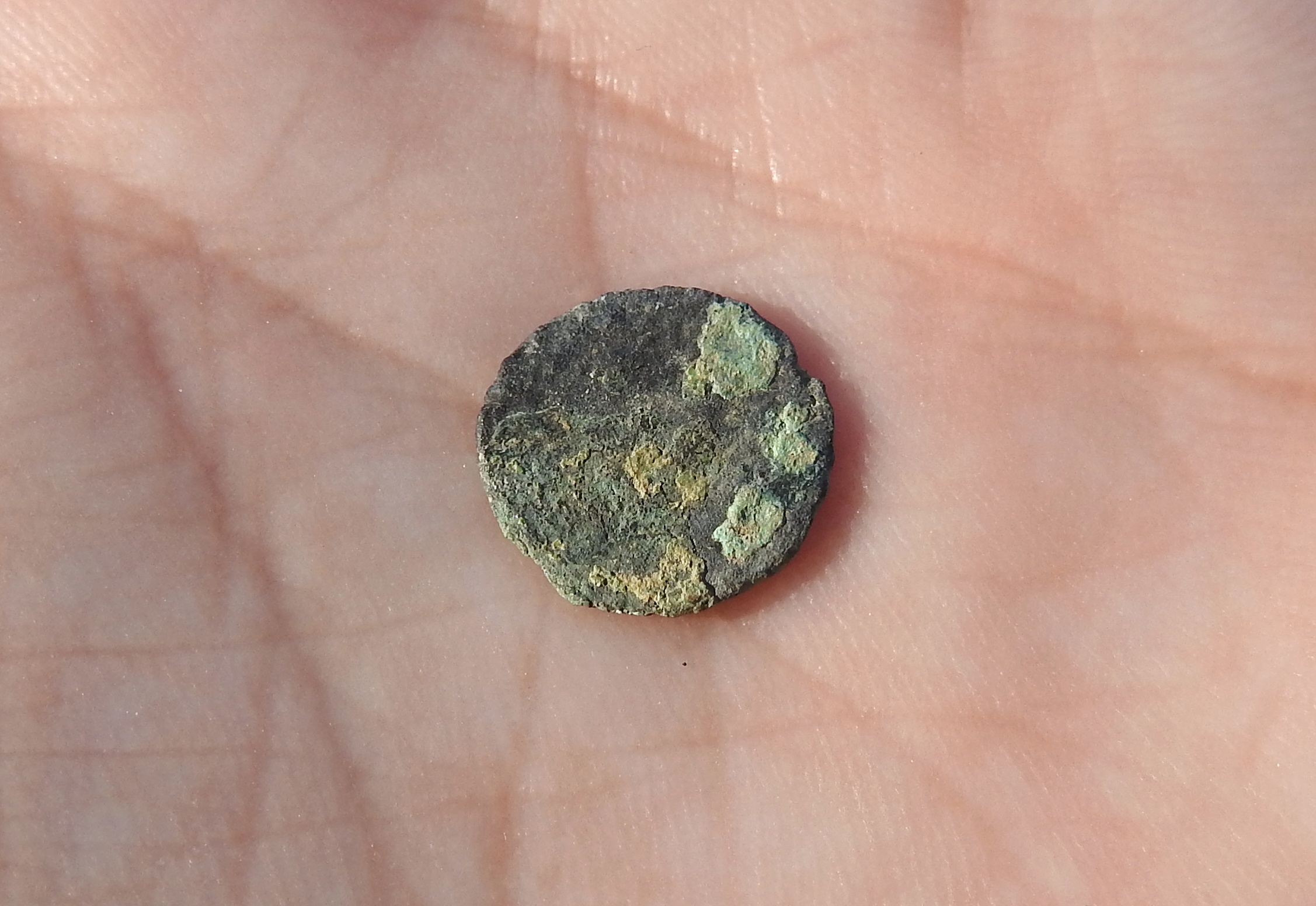
As we were getting ready to head back, a nice common buzzard made an appearance overhead and it flew westward in search for prey. The short hike back was similar yet quicker than the way up, and as we approached the road where it all began, we found what appears to be an ancient coin washed up by the winter’s rain. Hopefully I will have an update sometime in the nearish future.

Ancient coin

Our trip ended with a short melon break near the bus stop as we had a good while to wait. We enjoyed the fresh fruit as we gazed out at the magnificent view and the chaffinches in the nearby flowering almond trees. At last our bus came and we rode it back into Jerusalem, bringing the end to our lovely little hike.

Jerusalem’s Binyanei HaUma Archaeological Dig

In Israel, Jerusalem on May 27, 2018 at 9:43 AM

On Yom HaZikaron that took place a number of weeks ago, I participated as a volunteer at an ongoing salvage dig in Jerusalem. I had heard about it on Facebook, advertised by Amit Ararat, and made the necessary connections with the Israel Antiquities Authority. I was to be joined by three friends, all fellow students at Bar Ilan University, and together we’d make memories. Adam and I met up in Givat Shmuel and took the bus together to Jerusalem. Itamar had come from his home, and was the first to appear at the dig site that morning. En route, Adam and I passed the relatively new Ariel Sharon park, a landfill-cum-nature preserve, and saw a beautiful red fox standing between the harvested rows of wheat in a field near the road – it was quite the scene.

The digsite

We arrived in Jerusalem and made our way to the dig site, located roadside the International Convention Centre and between the Central Bus Station and Supreme Court. Just to the west, slightly uphill, ruins from the Roman period, including bricks and rooftiles with stamps of the Tenth Legion, were uncovered in the first salvage excavation, in 1949. A later excavation, in 1967, uncovered two potter’s kilns with a other ceramics and ceramic-oriented equipment. Eventually the site was built-over, now the home of the convention centre, and now a small sliver of land beside the nearby street became the target for a new salvage excavation in light of new roadwork-in-planning.

Itamar, Adam and Ido washing pottery

Approaching the fenced-off area, we were able to discern the digsite by the characteristic shade-tents that accompany all digs. Entering, we met up with Itamar and a fellow student from Hebrew University by the name of Ido, both of whom were engaged in pottery washing. They showed us some interesting rooftiles and other ceramics while we waited for Danit, the dig supervisor, to receive us.

Decorated rim of a vessel

We made the necessary introductions and then enjoyed a brief site tour, catching us up with what’s been going on the past year or so since the salvage dig has been opened. In addition to Itamar and Ido there were a handful of paid laborers, and the third BIU friend, Eitan, who was still en route. Danit showed us to an excavated room, with a plaster floor which needed defining, and we got to work. Facing the eastern baulk of the pit-like room, we began by scraping the baulk straight down, to give us clean edges and a defined joint with the to-be-revealed floor. There were all sorts of potsherds, mostly unmarked rooftiles, until I came across one that had production marks, which I thought was pretty neat.

Working in the corner of the pit

What I came across next was similarly interesting, a deposit of wet clay that had a black-grey appearance, and oozed an oil-like substance when condensed. This is easily explained as refuse of the Roman potters, the black substance being nothing but carbon. We enjoyed playing with chunks of the malleable clay, but responsibly got back to work on the wall and the floor. Before long a curious crystal formation was pulled out of the dirt, this item being more of a geological than archaeological curiosity, but interesting to us nonetheless. The buckets of dirt were filled up and emptied by our hands repeatedly as the sun slowly made its way overhead. A common kestrel passed by, giving us a moment of birding enjoyment, respite from the physical labour we were doing. At some point Eitan had joined us, and was working in a spot adjacent to us pulling rooftiles out of the ground.

Eitan posing where he was digging

We took a break for lunch, getting basic food supplies such as bread and hummus from a nearby shop. After our feeding and relaxing we returned to work, eager to finish off the floor now that the walls were adequately straightened. It was delicate work, and Adam proved himself a valuable team member with his deft chiseling of the dirt caked onto the ancient plaster. We removed the dirt, scooping it into buckets to be dumped nearby, slowing bringing the old floor back to life.

LEG X FR rooftile

Ido hopped into the pit to clear some rock and scrape around a bit at the western side of the room, and the great sound of laughter could be heard coming out of our pit. But the laughter broke when Eitan managed to find an exceptional piece of tile, featuring part of a Tenth Legion stamp. The “EG X” from the complete term LEG X FR (Legio X Fretensis) was visible, as well as most of the warship that symbolised the unit alongside the wild boar.

After a day’s work

It was an exciting find, one that we were looking forward to since the day began, and it gave us a form of closure that went well with the finished floor job that Itamar, Adam and I had worked on. As the workday was coming to an end, we cleaned up and took pictures, then gave thanks to Danit for hosting us at her digsite. However, Adam and I weren’t quite ready to leave Jerusalem and decided to pay a visit to the Jerusalem Bird Observatory and the neighbouring Rose Garden.

Jerusalem Bird Observatory’s pond

Itamar and Eitan decided to tag along, and we walked on over, starting with the rose gardens where we saw a lot of blackcaps and some Syrian woodpeckers. Approaching the bird observatory we saw a sparrowhawk fly directly over us, taking us by surprise and filling us with excitement. Sitting in the blind at the observatory, we watched the avian activity surrounding a small marshy pond, taking pictures here and there. There were a handful of somewhat interesting songbird species, including: greenfinches, whitethroats, willow warblers and tons of blackcaps. A single turtle dove made an appearance, as did a few thrush nightingales, a first for both Adam and I. Wrapping it up at the observatory, having said our farewells to Itamar and Eitan, we wandered around a bit looking for European nightjars which were spotted that very week. We didn’t find any, but instead saw a steppe buzzard flying over the neighbouring Gan Sacher.

Turtle dove (photo Adam Ota)

Back at the rose gardens, we watched the plentiful thrush nightingales flying about here and there, singing their complex song. In fact, the gardens were full of singing birds and the experience was most enjoyable. But the sun was soon to set and we were wanting for some food. Yom HaAtzmaut (Israel’s Independence Day) was about to start so we got some pizza and watched some of the national ceremony broadcasted on TV before heading back to Givat Shmuel – but not before ending off our exciting day with a pink blind snake slithering out in front of us on our way to the bus.