Israel's Good Name

Archive for the ‘Jerusalem’ Category

Lifta

In Israel, Jerusalem on March 5, 2017 at 6:27 AM

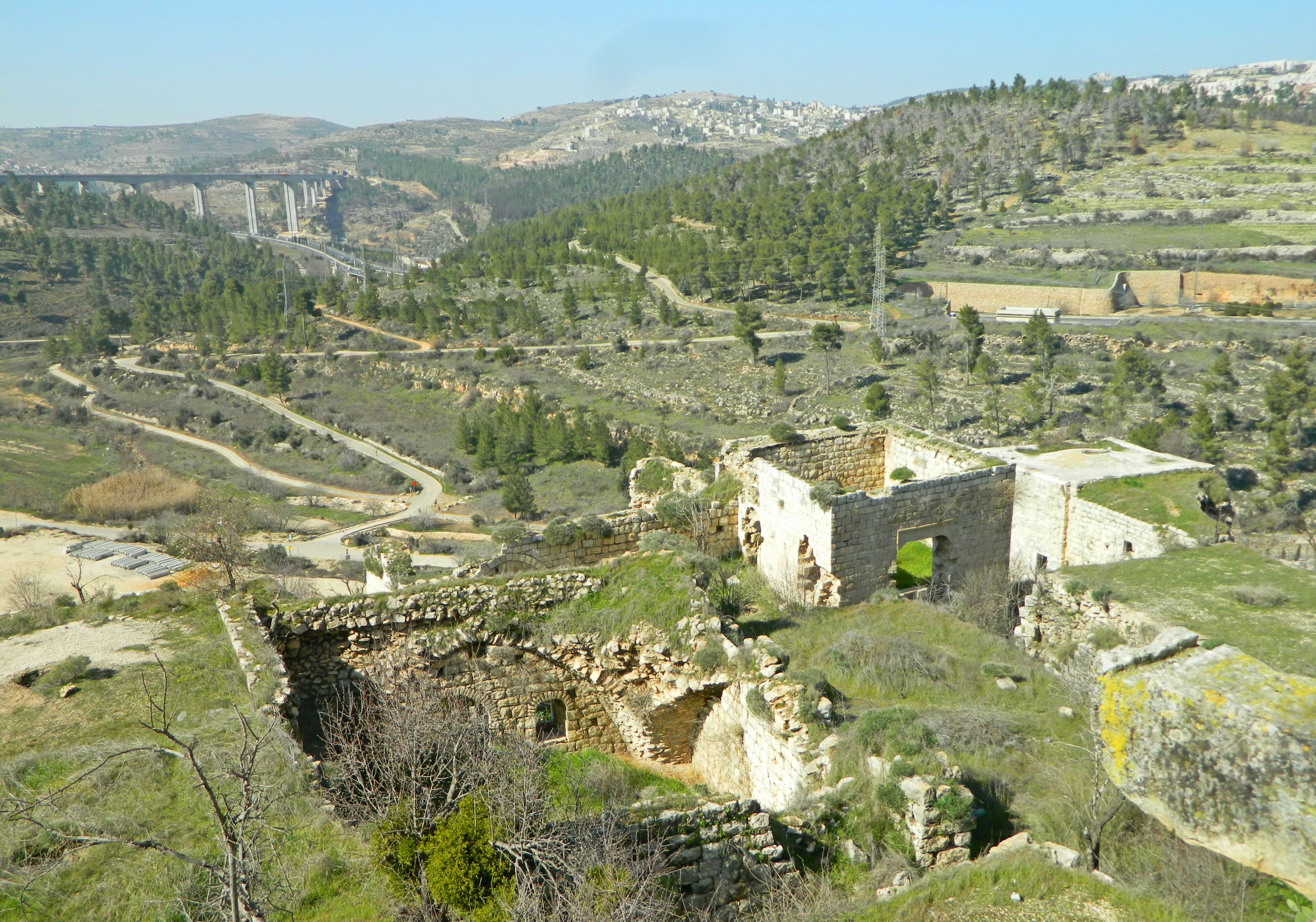
Continuing from our tour of the Ramot Forest in northern Jerusalem, where we saw gazelles and ancient winepresses, my friend Adam and I headed for the nearby ruined village of Lifta. Located just outside the main western entrance of Jerusalem, between Roads 1 and 50, the abandoned houses and buildings belong most recently to an Arab village.

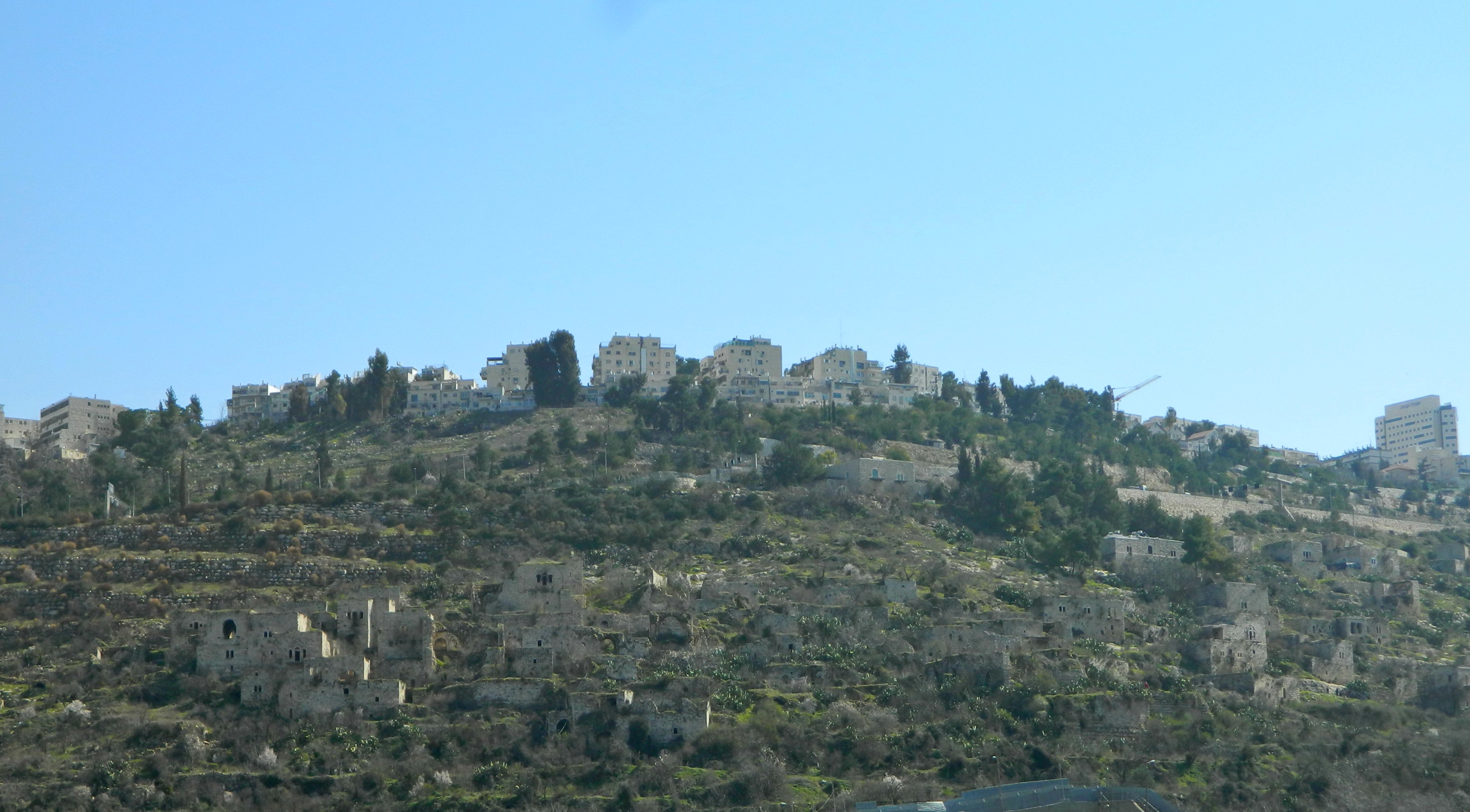
Lifta from afar

Lifta from afar below modern Jerusalem

First, the village was a Jewish one by the name of Mei Neftoach during the time of the First Temple, and was subsequently destroyed by the Romans under Titus and Vespasian. During the Byzantine period settlement resumed, the village going by the name Nephtho – changing to Clepsta under Crusader rule. Lifta reached its peak in the late 1880s and since the 1950s the ruins have just been a part of the landscape, good for both tourist and research purposes.

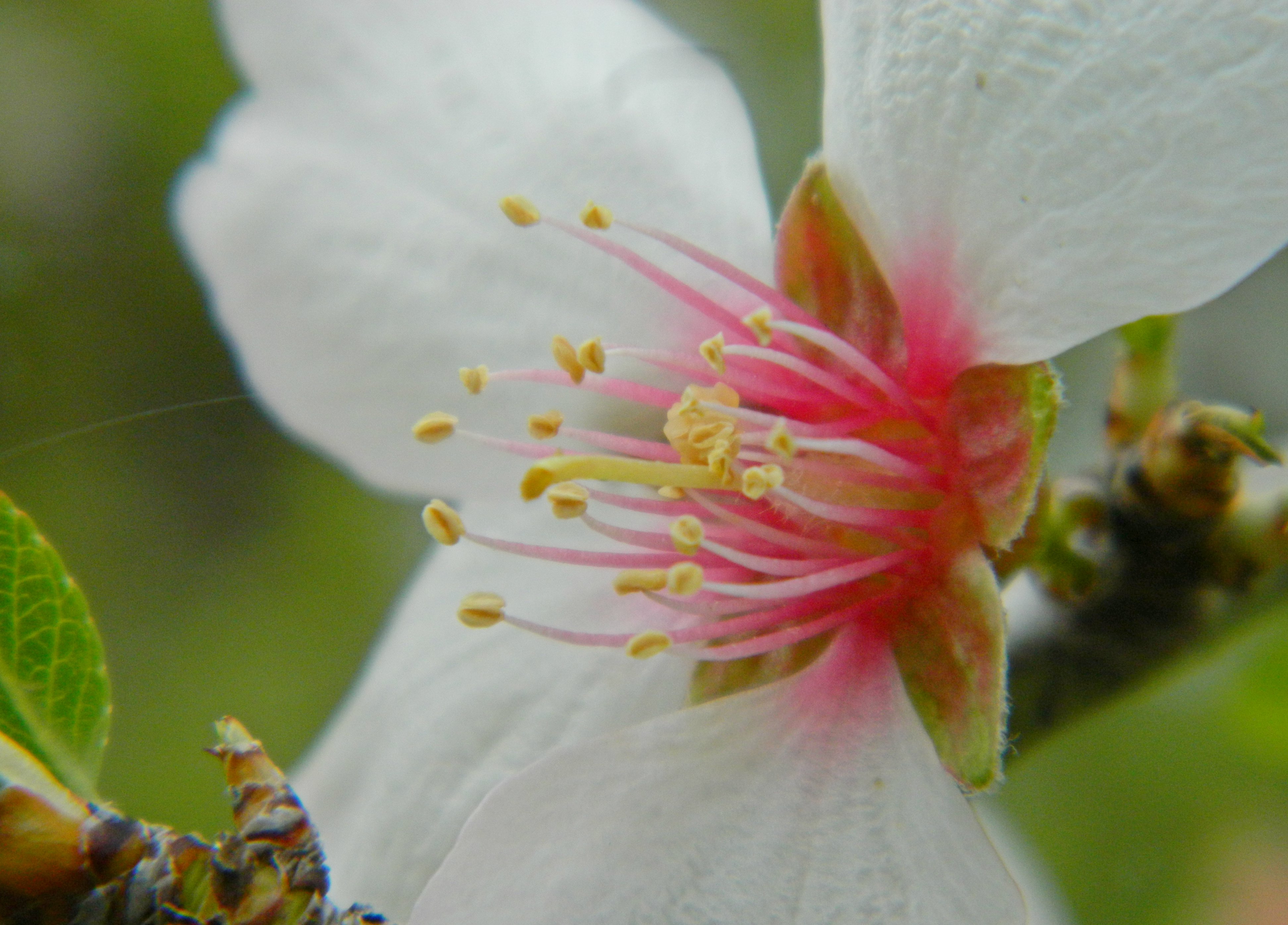
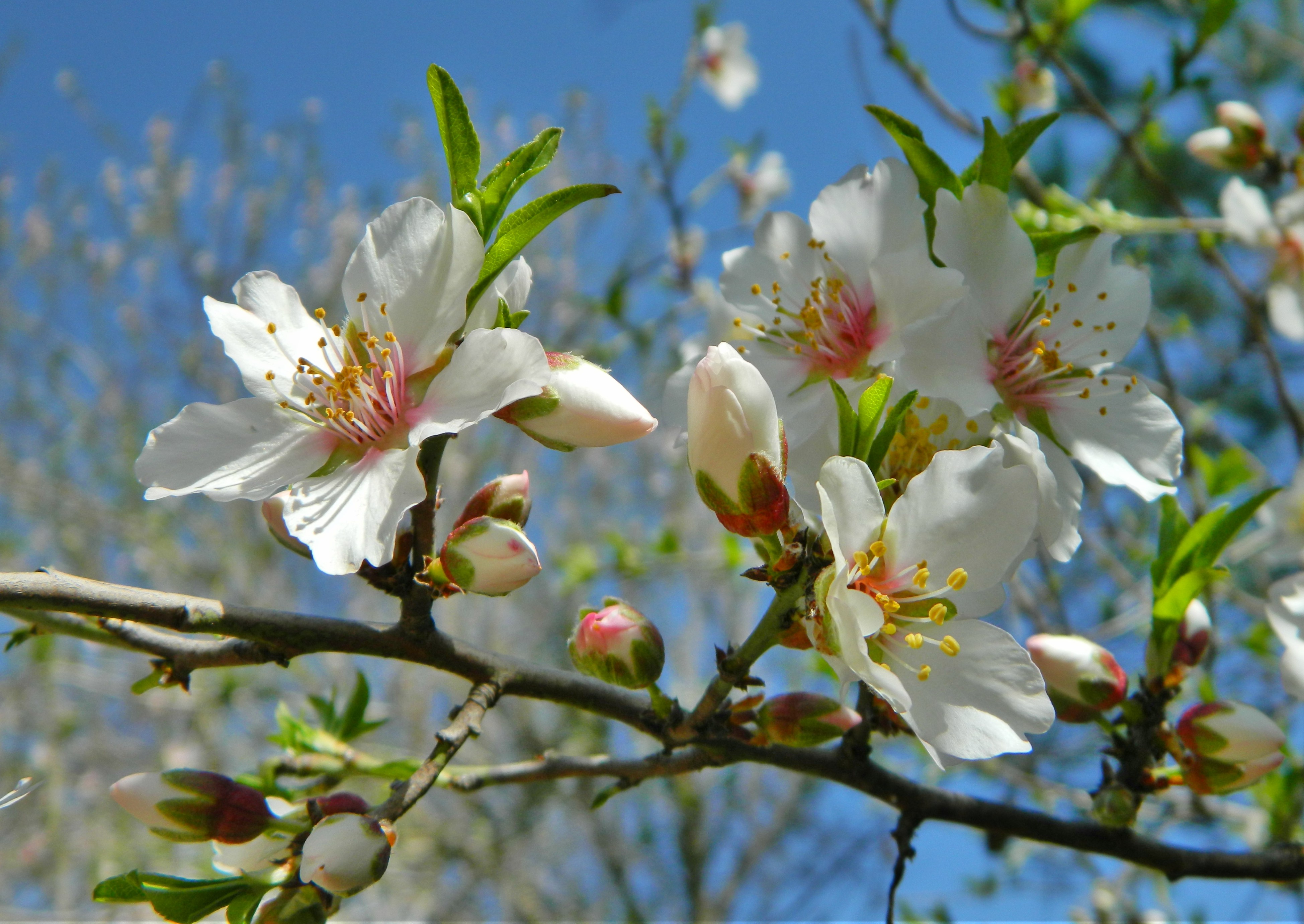
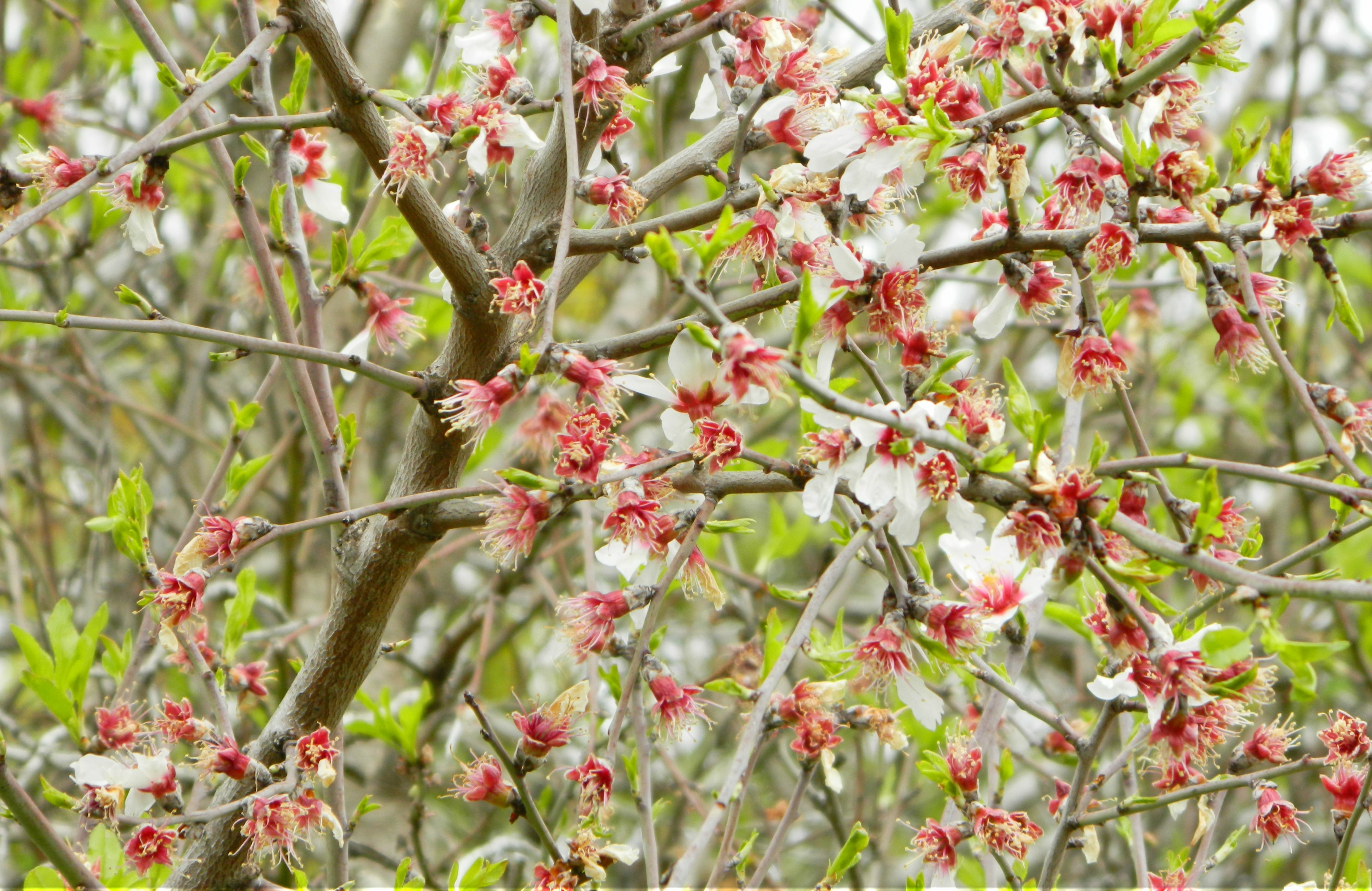
Almond blossoms

Almond blossoms

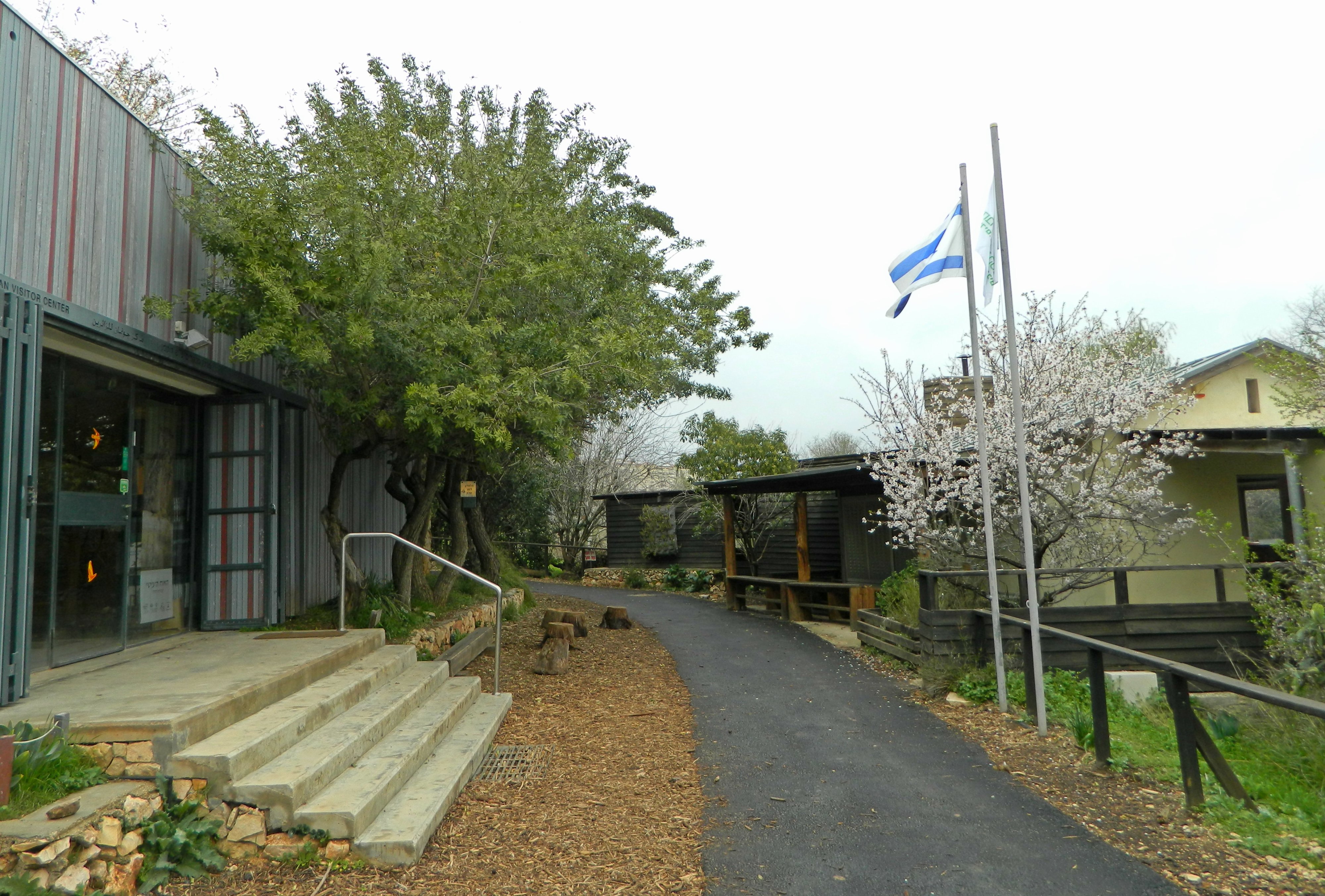
Walking down from the Ramot area, we passed a few blossoming almond trees as well as a few startled gazelles and some songbirds. After the Tur Sinai farm we made our way across the land bridge over Road 1 with a vantage point of the stone ruins of Lifta on the opposite hillside. Winding down the backroads, we passed a playground park and then found the offroad path to Lifta, with its blue trail marker.

Interesting trail marker

Interesting trail marker

We stopped every so often to take photographs of the beautiful blossoming almond trees dotting the hillside. Shortly we were walking below the houses and buildings of the northern end of Lifta, yet we continued on until we found a better place to climb up.

Lifta

Lifta

We started with a house and then the olive mill – unfortunately, I haven’t been able to find a straightforward source to identify what the different structures are, although some are obvious. In my searches for site identifications I found a really interesting collection of 3D scans of a handful of Lifta’s structures (see HERE).

Inside the olive mill

Inside the olive mill

Standing at the northern end of the old village’s nucleus, we were surrounded by stone walls, almond trees, cacti and an abundance of green grass growing everywhere. Within the village we explored the lower street heading north, so overgrown that we passed over, around and even through houses to progress further.

Exploring the ruins

Exploring the ruins

Pausing every now and then to marvel at the magnificence of the ruins, as well as the spotting of a black redstart perched on a nearby tree, we eventually made it to the end of the lower street area and climbed up to the upper street area, where a formidable building with ornate lintel inscriptions commanded our attention. If I’ve understood the Israel Antiquities Authority’s report correctly, the building is Ottoman era built on more ancient wall foundations, perhaps Crusader.

Looking out the windows

Looking out the windows

Entering the upper floor of the building we found the encampment of a homeless, but no homeless in sight. One of the things that we noticed in many of the two-floored structures was a large hole in the ceiling/floor – probably intentional to discourage potential dwellers. Reading antiquity reports, I learned that most of the two-floored houses in Lifta were of the “traditional rural house” design: the bottom floor for storage and livestock, the upper floor for the human residents.

The view from Lifta looking west

The view from Lifta looking west

Making our way back to the village nucleus along the upper street, we explored the various structures and then headed for the other half of the northern end of village. We looked down at one particularly interesting building with a grassy roof, which may have been the village’s mosque. With so many more impressive buildings it seems unusual that this would be a mosque, but the village mosque is described as a one-story structure with a walled courtyard, such as this one. We didn’t venture inside, so I wasn’t able to confirm with the presence of a mihrab (prayer niche).

Interestingly overgrown building

Interestingly overgrown building

Bearing in mind that it was Friday afternoon and we still had to get back to Givat Shmuel before Shabbat, we decided to put some pep in our step and breezed past many interesting – and curiously impressive looking – structures.

Too sunny for proper smiles

Too sunny for proper smiles

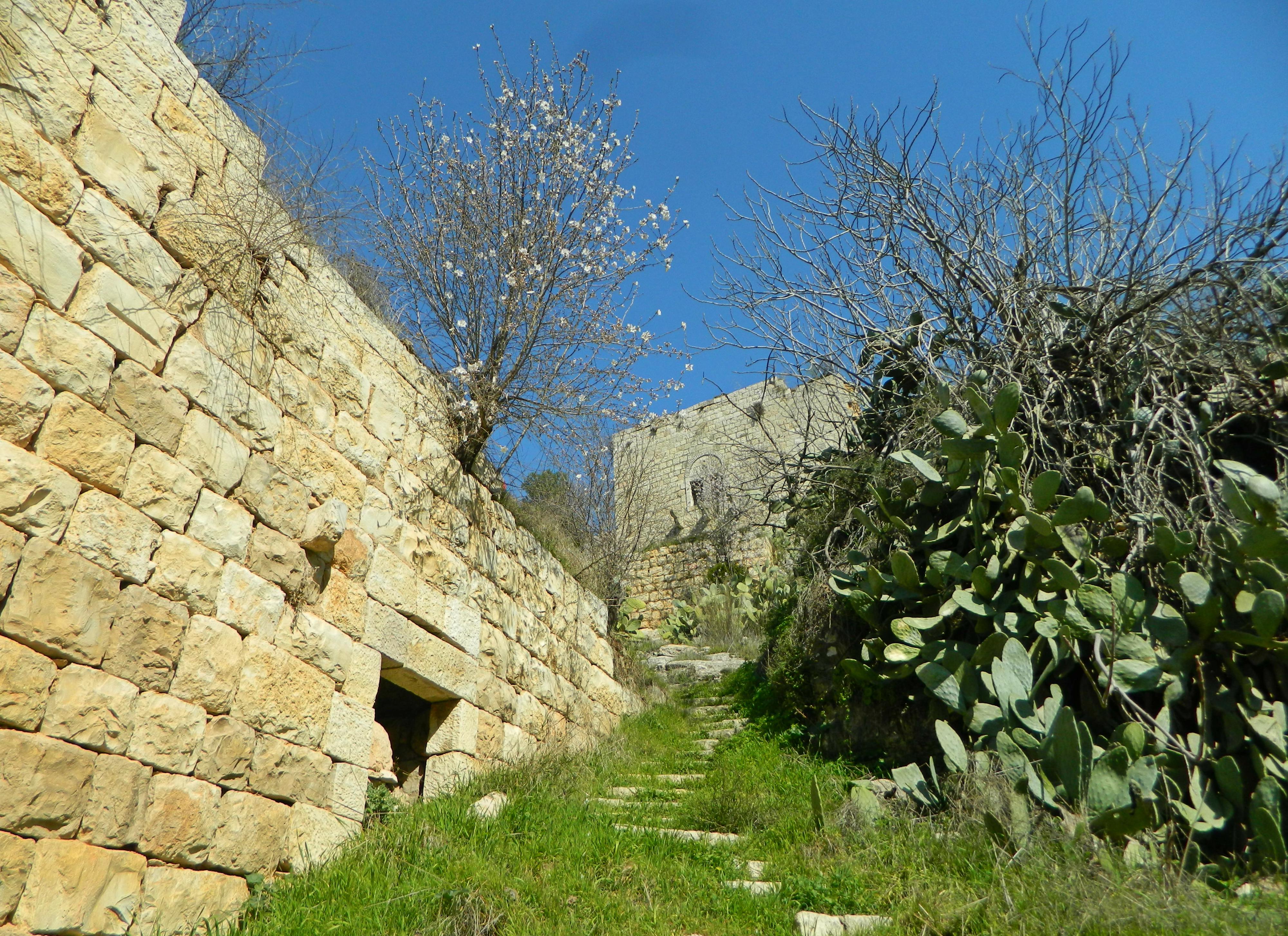
At one point I commented that it felt like we were walking through a medieval village, just without the people, the noise and the most likely offensive smell. One grassy set of stairs going uphill really found favour in my eyes.

Grassy stairs

Grassy stairs

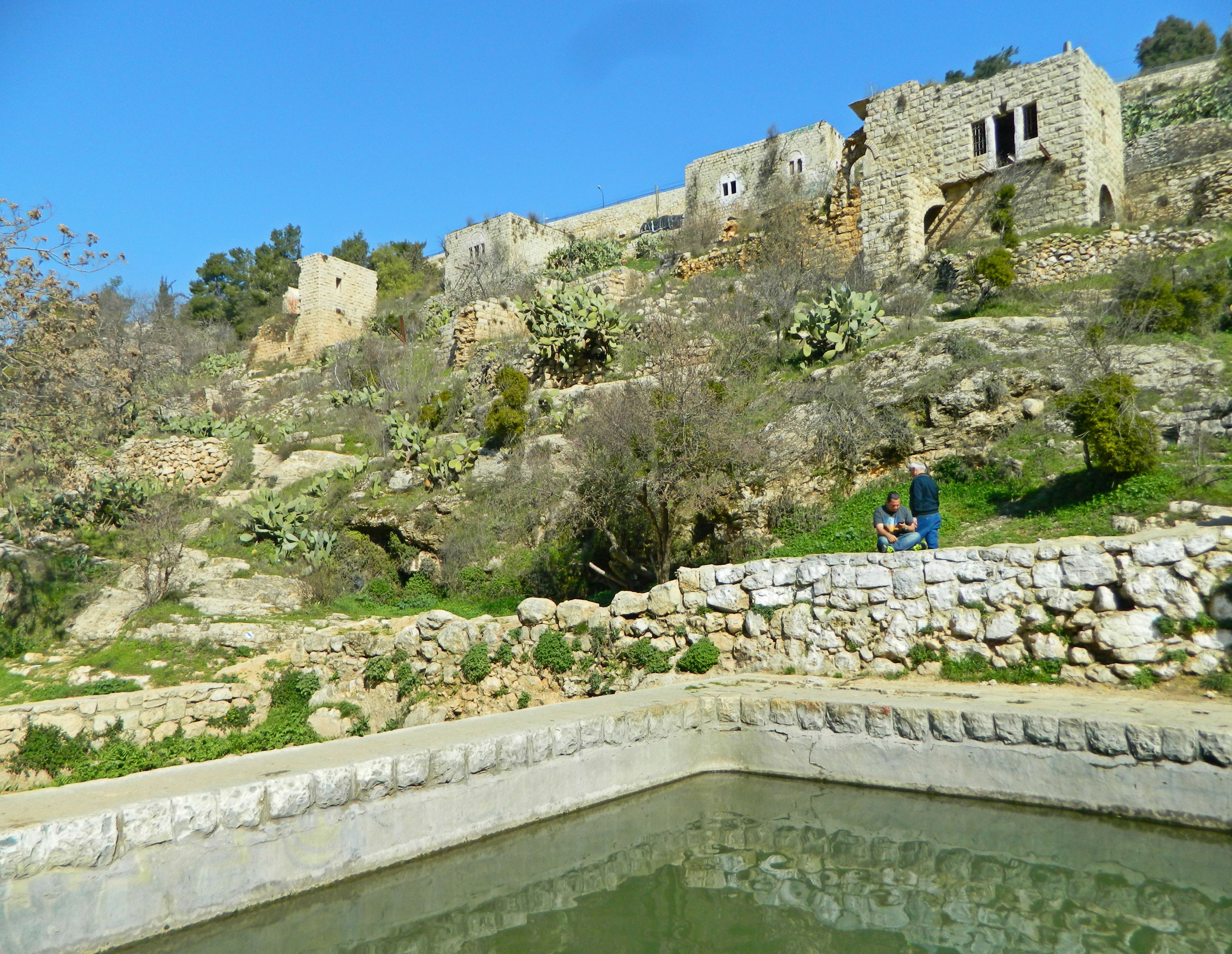
Before long the dirt trail turned into one of stone tiles and we noticed water gurgling to the right of us. Up ahead we set eyes on the famous Lifta spring, with its two pools. The outer pool was covered in a green layer of duckweed, with floating trash here and there. The inner pool was relatively clean with a small stream of water emanating from a walled spring, where some youth were preparing to swim.

Spring of Lifta

Spring of Lifta

We didn’t have enough time to explore the western side of the village, but thankfully the bulk of the interesting sites were where we were. From the spring we took the road up to Jerusalem, climbing at a rather steep angle to reach the road. Feeling a mite peckish, we then walked to the Central Bus Station and got schwarma wraps before catching the absurdly packed bus back to Givat Shmuel an hour of so before Shabbat began. Stay tuned for our next Jerusalem adventure!

Jerusalem: Ramot Forest

In Israel, Jerusalem on February 19, 2017 at 7:02 AM

The other week, on the Friday before Tu B’Shvat, I went on a nice guided tour of the Ramot Forest in northwest Jerusalem with my friend Adam Ota. Provided by Ramot for the Environment, a group dedicated to preserving the natural areas outside the Ramot neighbourhoods, this trip was under the guidance of Hilary Herzberger, a local resident and activist, and Shmulik Yedvab, a zoologist from the Society for the Protection of Nature in Israel (or, SPNI).

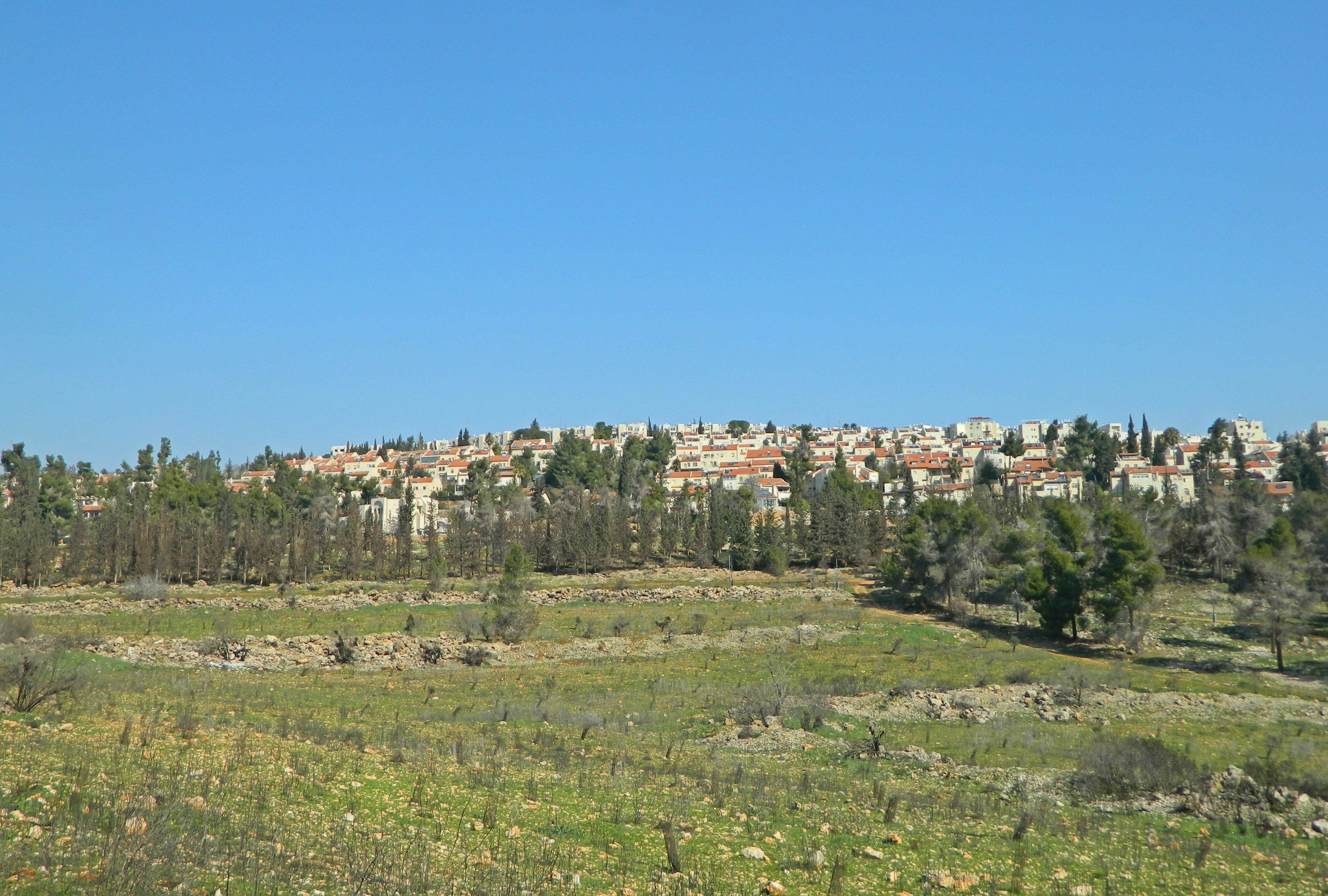
Ramot Forest with Ramot in the background

Ramot Forest with Ramot in the background

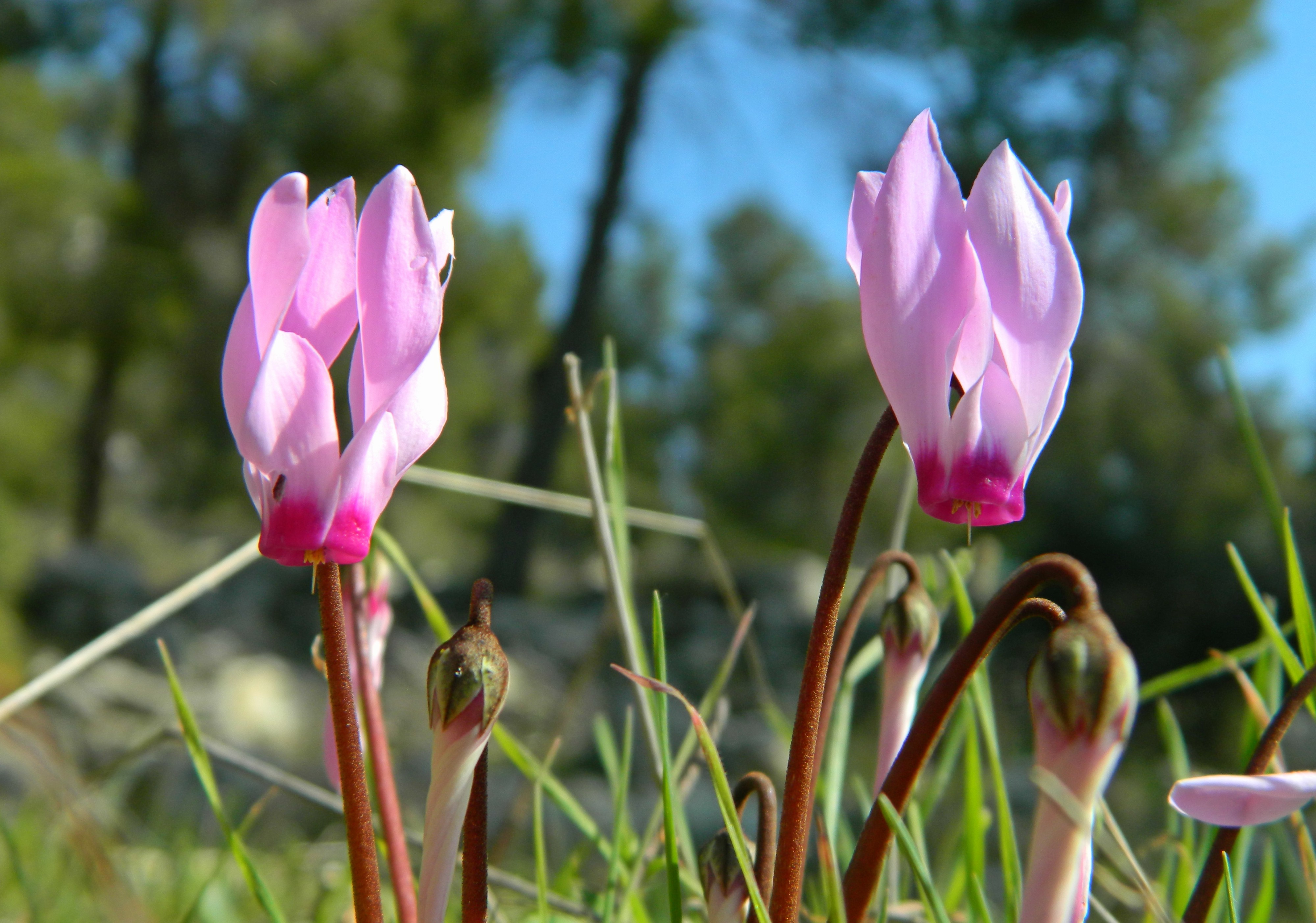
We gathered that morning at an interesting hedgehog-themed childrens park and then had an introductory talk before setting off into the urban-surrounded wilderness. We were all expecting to get a glimpse of the seventy or so mountain gazelles that call the park home, yet there was much more to be seen. We started off with glimpses of Eurasian jays, Persian cyclamens and then the upturned dirt mounds of an subterranean mole-rat in the area wooded with pine trees.

Persian cyclamens

Persian cyclamens

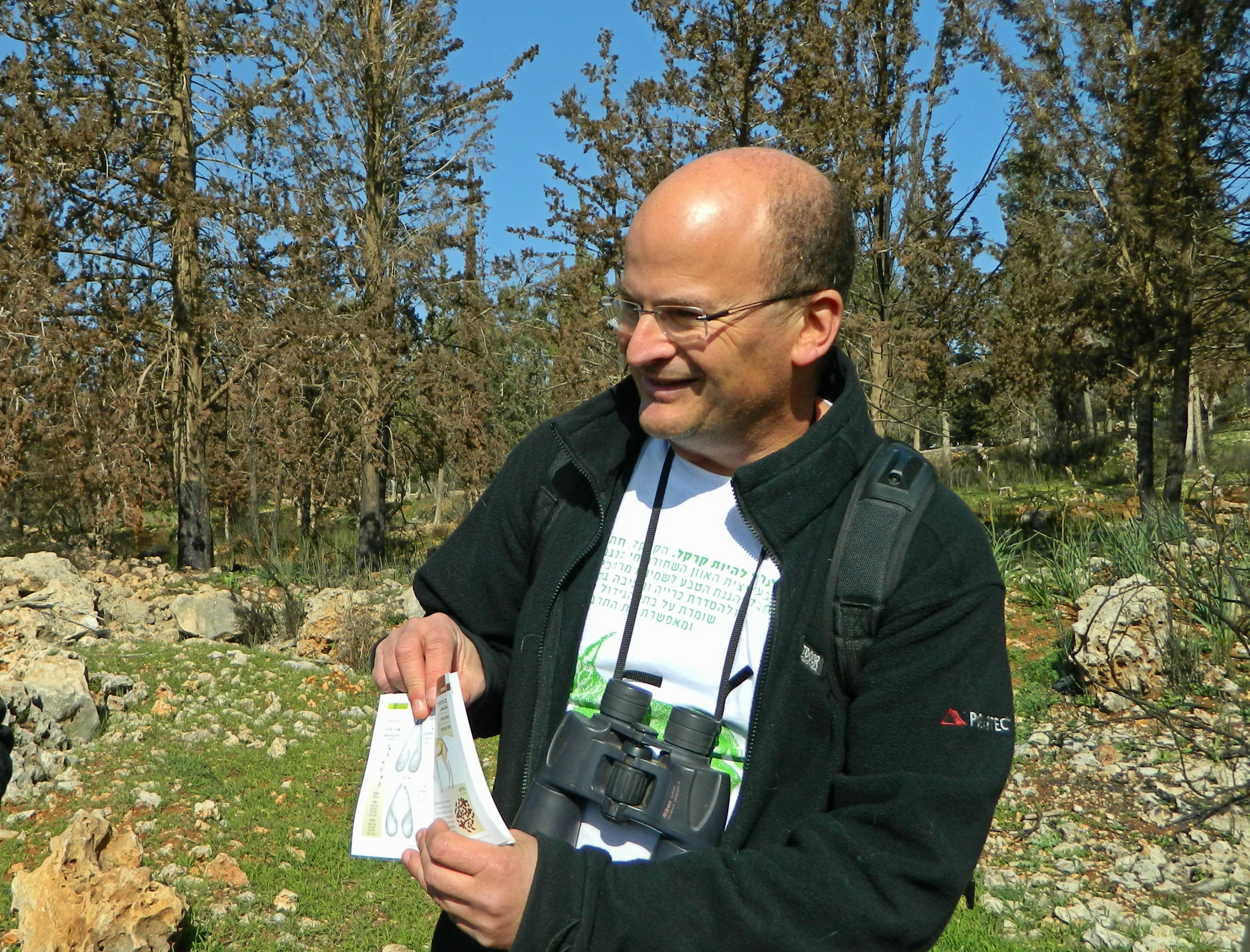
Leaving the pine trees, we ventured onto a dirt trail skirting the terraced land with planted olive tree saplings. Recently I learned that a large portion of the land surrounding Jerusalem is terraced for agricultural purposes, hard work done throughout history. Shmulik informed us that he had scouted ahead and found a small herd of gazelles, which we were heading to see, but paused along the way to show us elongated heart-shaped tracks in the soft orange-brown dirt.

Shmulik Yedvab showing us gazelle tracks

Shmulik Yedvab showing us gazelle tracks

We learned about a project that Shmulik was involved in with the setting up of trail cams in this area to document local fauna, with an infrared option for nighttime documentation. What surprised the researchers the most was the discovery of wild boars, which is interesting because wild boars are quite common is many parts of the country, yet hadn’t been spotted in this area before the trail cam footage reveal.

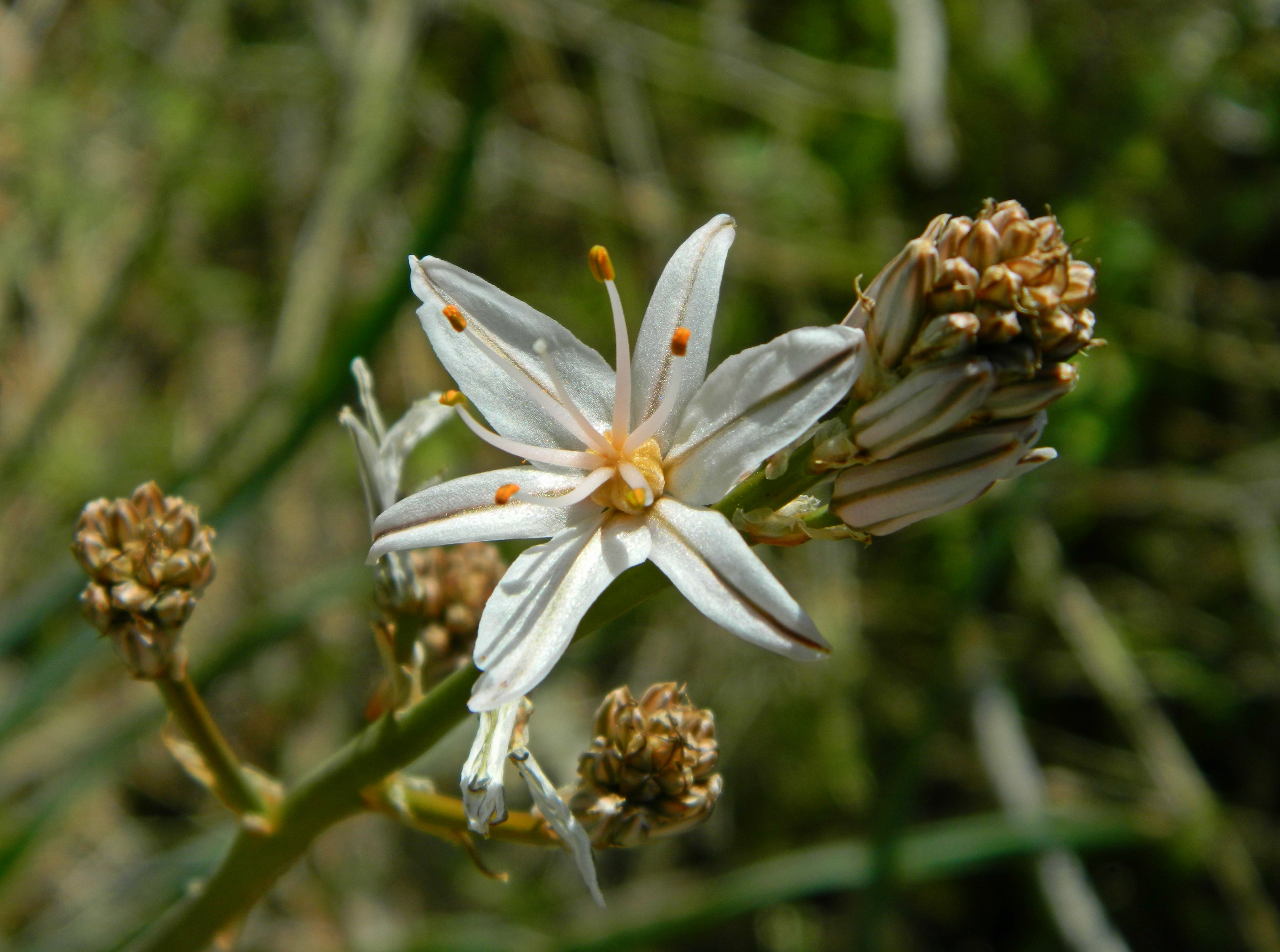
Branched asphodel

Branched asphodel

It was shortly after this that I pieced together who he was, and that I’ve been seeing his posts on the Israel wild mammals Facebook group for a good while now. Only three days before this trip, Shmulik posted a trail cam video clip with footage of a Blanford’s fox – an extremely elusive fox species that was only discovered in Israel in 1981, somewhere out in the Negev wilderness (see HERE). Speaking of videos, there’s a beautiful nature video of this very area from two winters ago, filmed by the talented Amir Balaban, naturalist and founder of the Jerusalem Bird Observatory (see the video HERE).

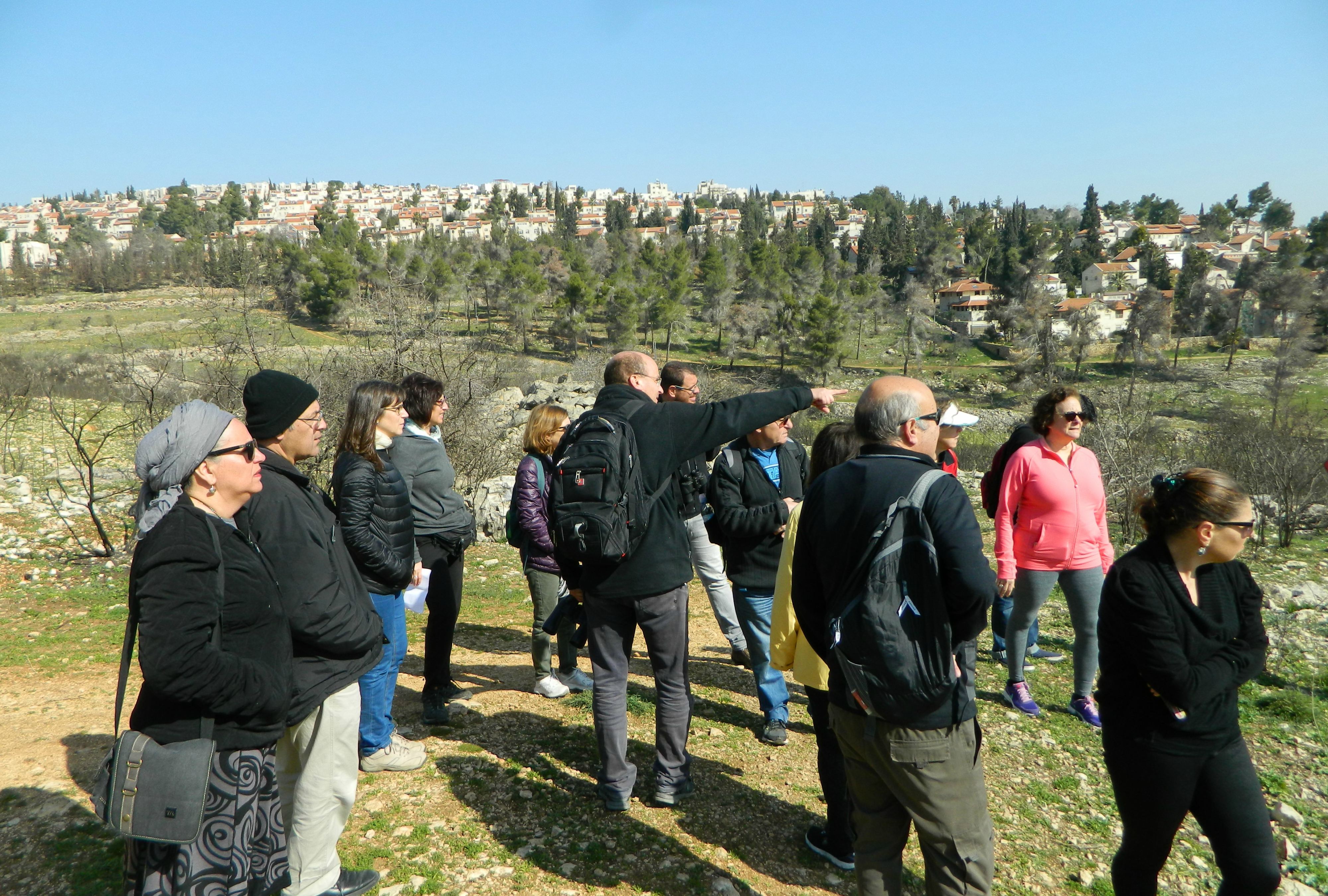
Our group of wildlife enthusiasts

Our group of wildlife enthusiasts

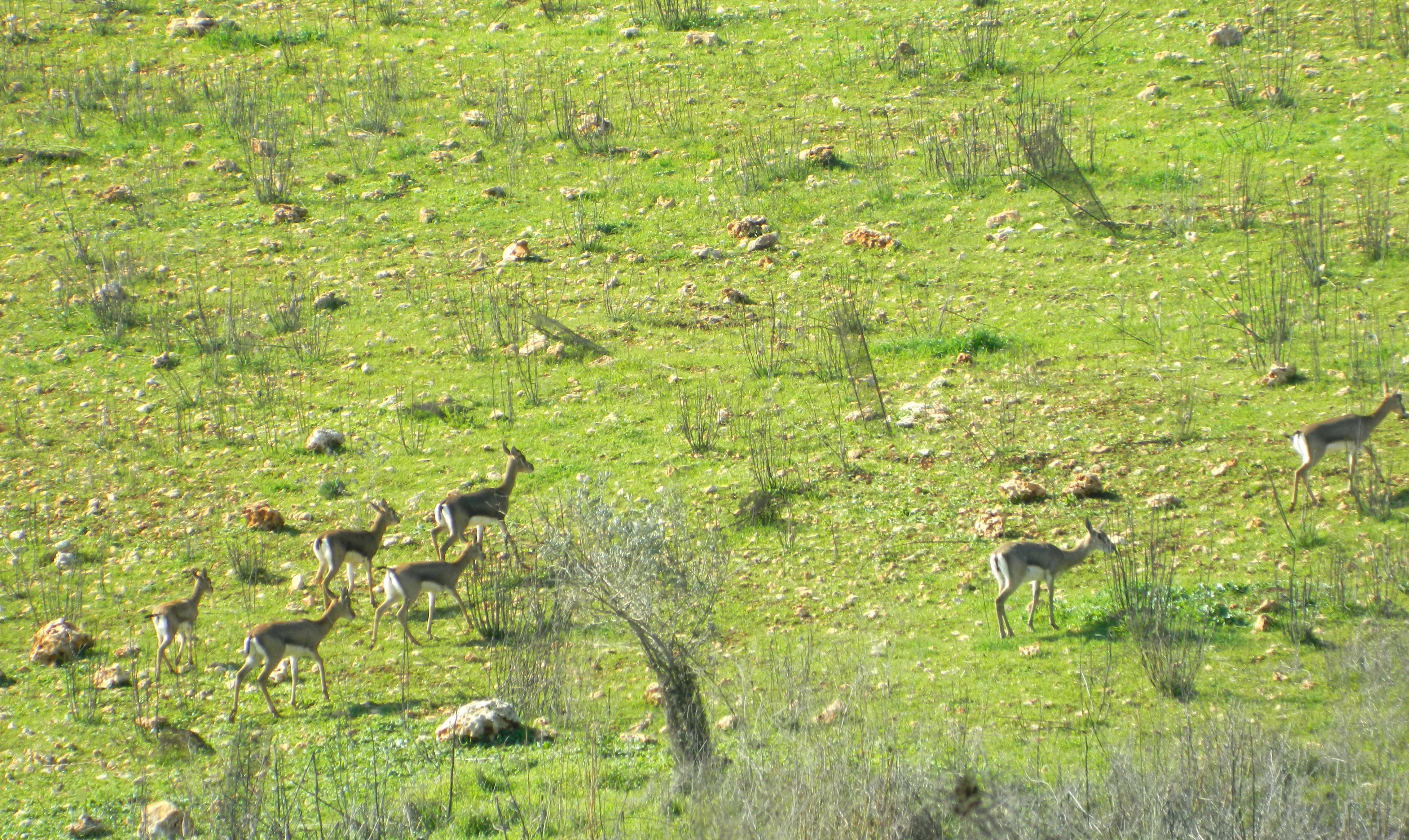
It was along this trail that Hilary pointed out the parasitic mistletoe adorned some of the trees. There was a bush fire a year or two before and, as a result, many of the trees were burnt and mistletoe seized the opportunity to flourish. Despite being Tu B’Shvat, and the plethora of blossoming seen all around the country, most of the almond trees that we saw were burnt beyond repair, some with burnt almonds adorning their blackened branches. Approaching the terraces on the right, with pine trees on the left, we spotted the small herd of gazelles grazing – with the dominant male on guard.

Gazelles on the move

Gazelles on the move

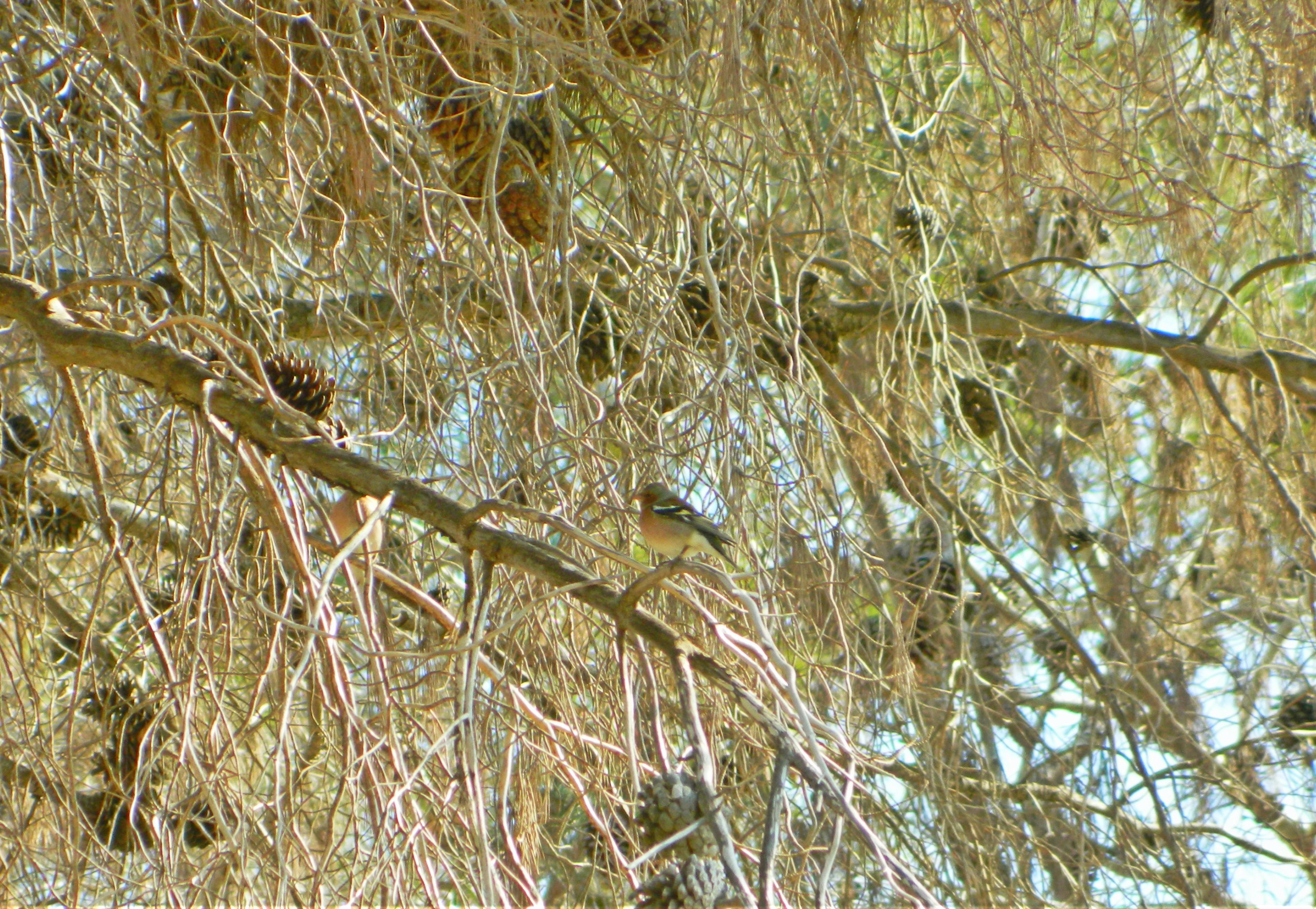
We learned about the importance of staying on the trails with these skittish creatures – and a tragic incident when a photographer ventured too close and scared off a male gazelle which “escaped” into the territory of a different male, and thereby met his death. We didn’t scare off any gazelles right then and there, but I did notice a fine looking male chaffinch in the pine trees.

Male chaffinch among the pinecones

Male chaffinch among the pine cones

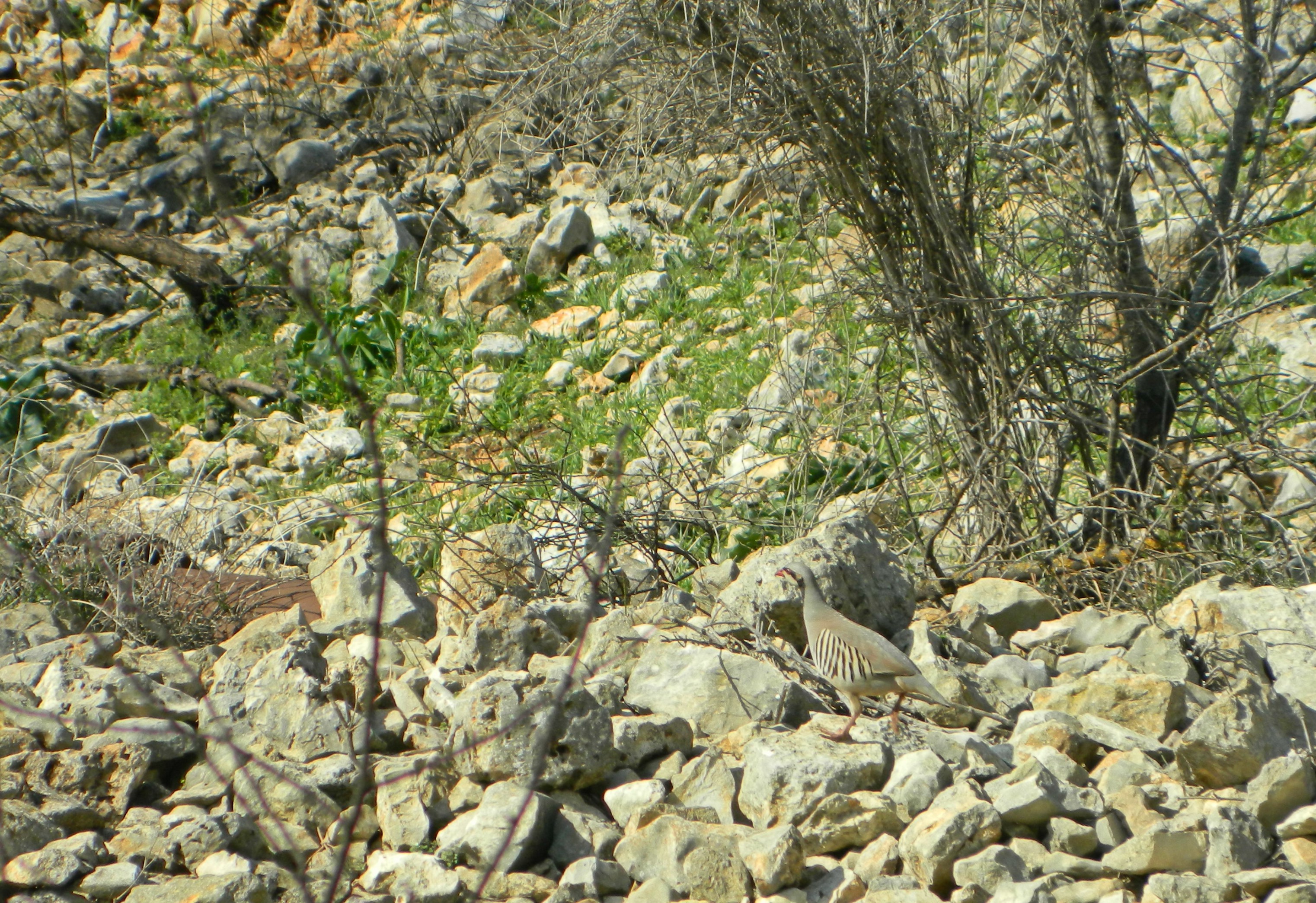
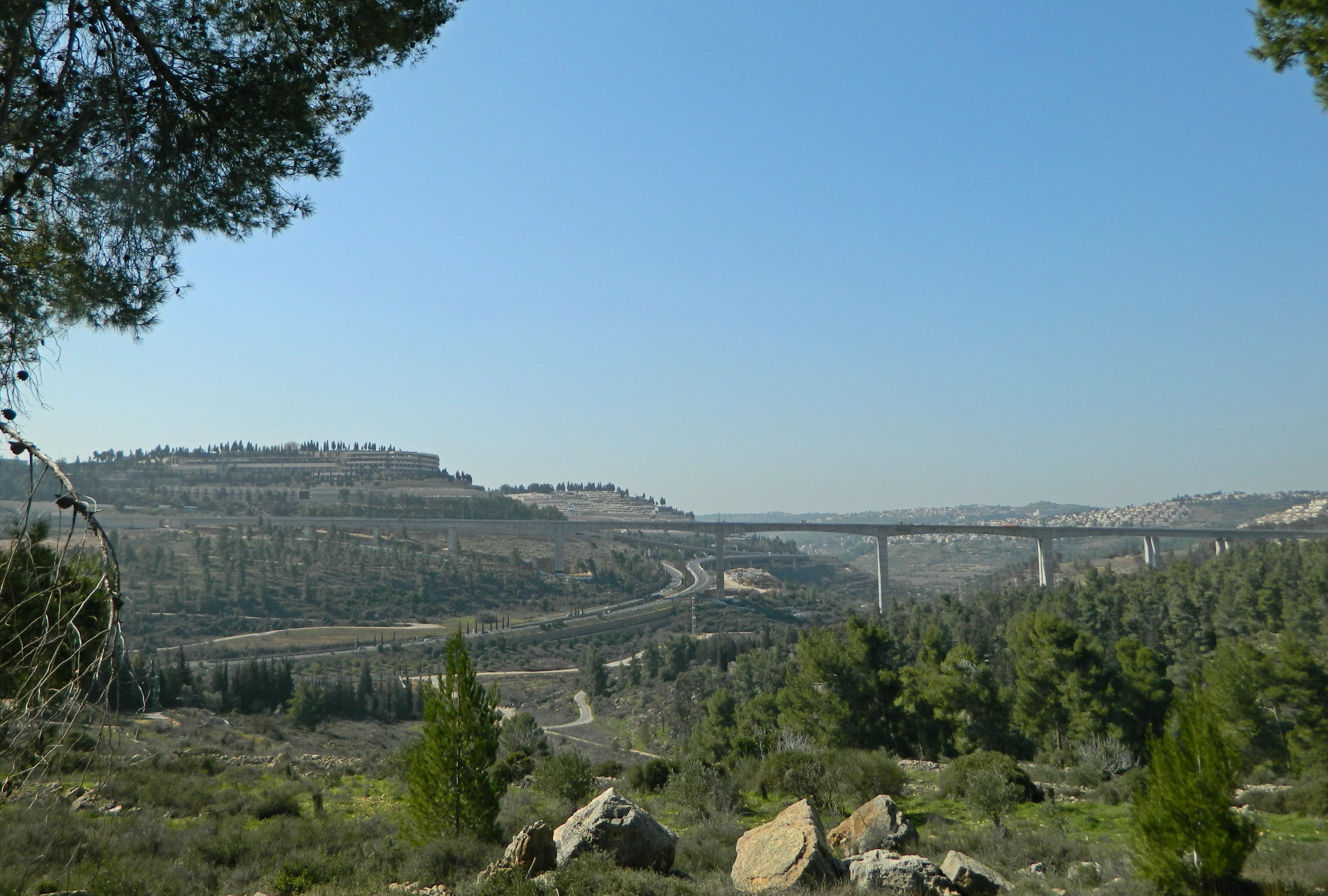
Continuing around to skirt the Neftuach lookout, we passed a few chukars, fennel plants and other interesting flora before reaching the end of the trail, with a view of the new rail bridge for the Tel Aviv-Jerusalem line, passing over Nachal Soreq.

Flushed chukar

Flushed chukar

To the right of the bridge in the Arab village of Beit Iksa, which we learned may have been named after the Roman Tenth Legion (or, Legio X in the original Latin) – the name meaning “House of Iksa” in Arabic, and “Iksa” meaning “X”.

New rail bridge entering Jerusalem

New rail bridge entering Jerusalem

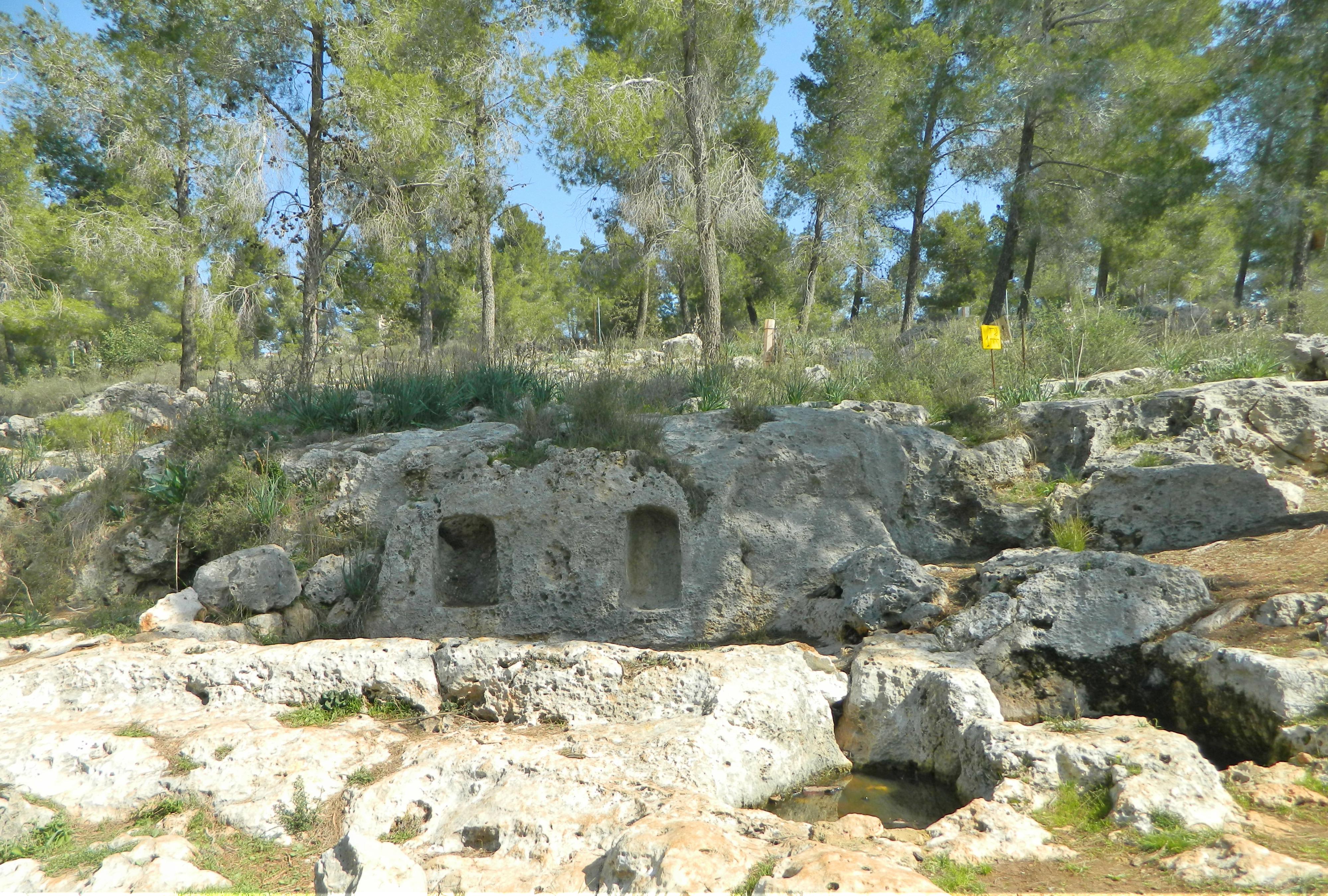
It was there that we said farewell to Shmulik and Hilary, and were taken over by another guide to see ancient ruins in the so-called Biblical Garden, in the pine forest area. We started with the first of six winepresses that date to the First Temple period – approximately 2,500 years ago. To make matters even more exciting, a Hasmonean coin was found in this particular winepress when rock-clearing was done to clean up the site.

Winepress

Winepress

The group settled down to hear more about the site, but Adam and I were still itching to get our adventure on. So we asked for directions and parted from our group to hike on over to the next site: the abandoned village of Lifta. But, before that, we owe a great thanks to Ramot for the Environment for providing us with a great morning trip full of wildlife sightings and information – we wish them much success in their ongoing battle with housing development projects in keeping the park a wildlife sanctuary, like the way it is now.

Israel Museum

In Israel, Jerusalem on May 1, 2016 at 5:55 AM

Several weeks ago I took the opportunity to visit the famed Israel Museum in Jerusalem, for the very first time. Not to be confused with the similarly-named Eretz Israel Museum in Tel Aviv, the Israel Museum is considered Israel’s national museum and is highly regarded worldwide. I bypassed a large group of soldiers and paid the necessary fee to gain entrance to the museum, excited to see what all of the fuss is about.
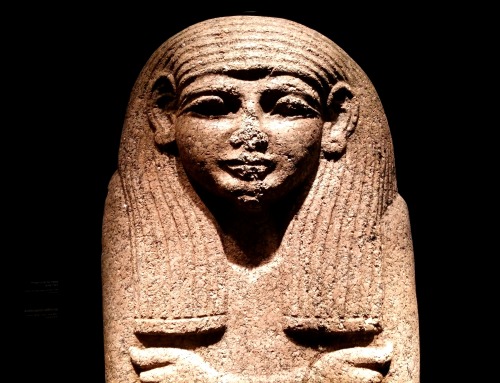
Anthropoid coffin lid

Anthropoid coffin lid

Slightly confused with the layout, I first inspected an extensive, ancient mosaic floor from Bet Shean before heading to the archaeology wing. Beginning with Egyptian-influenced anthropoid coffins I took a self-guided, and very disorganised, tour of the section. If I were to relay a play-by-play review of my visit this blog post would be far too long and tedious, therefore, I shall simply list some of the items and exhibits that I found most interesting – highlights of my trip.
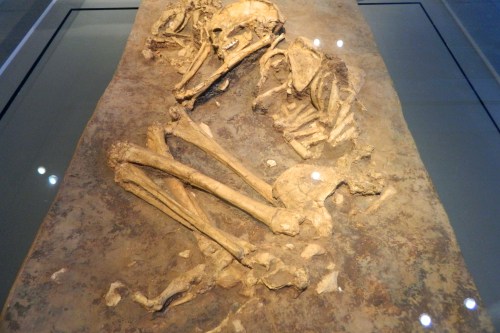
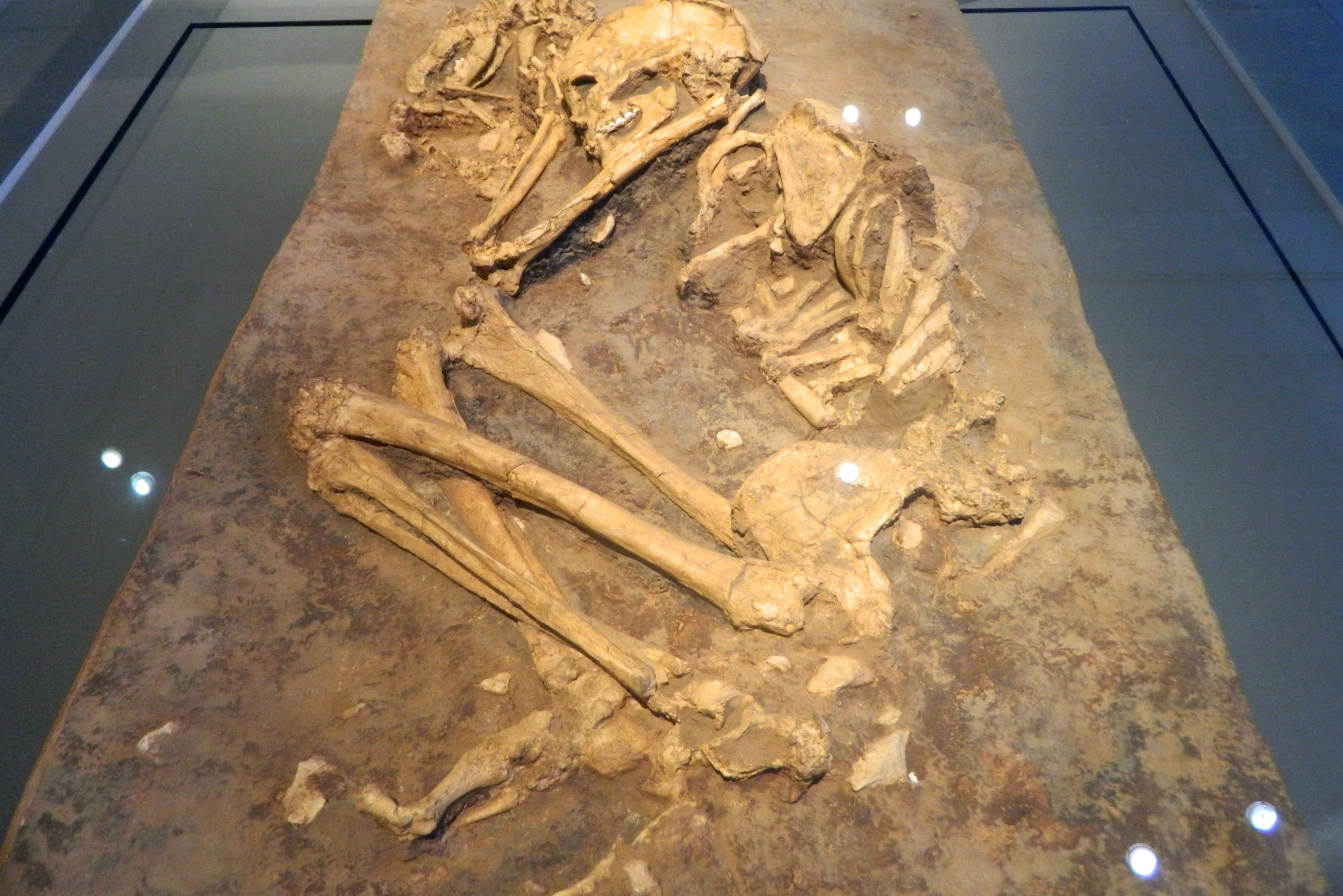
Burial of a woman and dog (cast) from the Hula Valley

Burial of a woman and dog (cast) from the Hula Valley

Within the archaeology wing I found a small exhibition dedicated to ancient glassware, where I learned about iridescence in ancient glass, simple deterioration resulting in what is known as silver weathering. Moving along, I came upon a collection of painted clay ossuaries (burial chests) dating back thousands of years discovered in caves around Peki’in, just minutes from my house in Ma’alot. A copper crown and sceptre from the Cave of the Treasure in the Judean Desert caught my attention next, likely used in cultic ceremonies thousands of years ago.
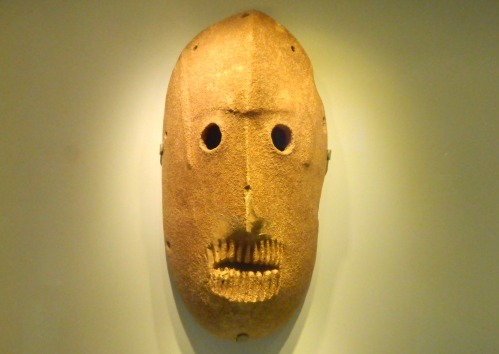
Tahunian mask from the Judean Hills

Tahunian mask from the Judean Hills

A collection of flint arrowheads from all over the country piqued my interest, as I am currently taking a class in technology and typology of flint tools. Next, a selection of ancient Tahunian masks made of limestone or chalk, believed to be the oldest masks in the world. Recalling my trip to the Ohalo site as mentioned in my first Kinneret post, preserved grains of wheat and barley as well as the reconstructed hut was on display in the same room. I then came across remains of ancient fauna, including hippopotamus, deer, tiger and ape bones and a set of horns belonging to an ancient bull. A full elephant tusk and molar brought back memories of the Golan Archaeological Museum where I had first learned about elephants roaming the Holy Land so long ago.
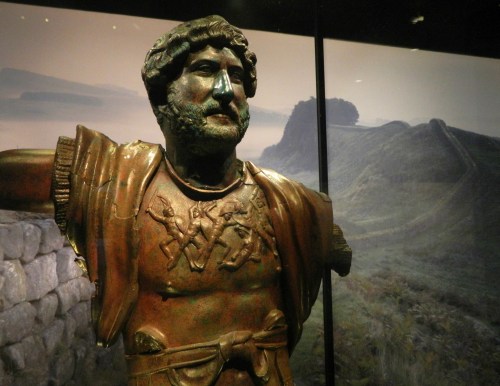
Bronze cuirassed statue of Hadrian from the Bet Shean Valley

Bronze cuirassed statue of Hadrian from the Bet Shean Valley

I entered a temporary exhibition on the Roman emperor Hadrian, and then found myself in another room looking at ceremonial dress of birth and death in different Jewish societies. I photographed a painted wood Torah scroll case from Maharashtra, India and then a wood and felt burial carriage from Hungary before continuing on to the next exhibit. Browsing the magnificent items on display from various foreign empires and cultures of antiquity I was surprised to see that the Israel Museum has such a rich collection of foreign artefacts, including a Akkadian bronze sword from Iran, a limestone relief featuring Iddin-Sin, King of Simurrun from Iraq, and ancient Egyptian funerary figurines of painted wood and stone – to name but a few of the fascinating items. But the local artefacts were also of great interest, including a stone inscription by Ottoman sultan Suleiman the Magnificent commemorating the rebuilding of the walls of Jerusalem in 1535-38, the same walls seen today surrounding the Old City.
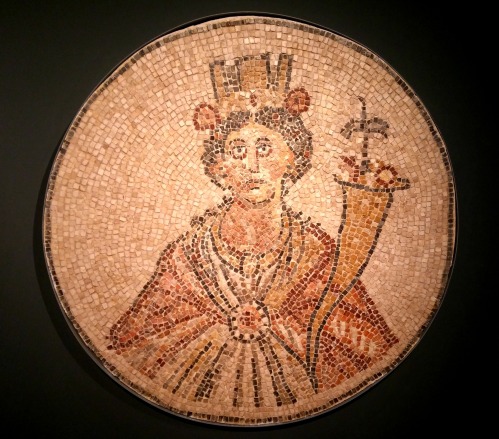
Mosaic of Greek goddess Tyche from Bet Shean

Mosaic of Greek goddess Tyche from Bet Shean

Entering a section dedicated to relics of the Crusader period, I found some wonderful things: a marble slab with the coat of arms of Sir Hugh Wake discovered in Ashkelon and a lithographic stone for stamping leather featuring the arms of the Grand Master of the Teutonic Order which was found in my favourite Crusader ruins, Montfort Castle. Articles of warfare from Tiberias and Akko were also on display, as well as a section of a Christian wall painting of plaster and pigment from a Crusader abbey in Jerusalem.
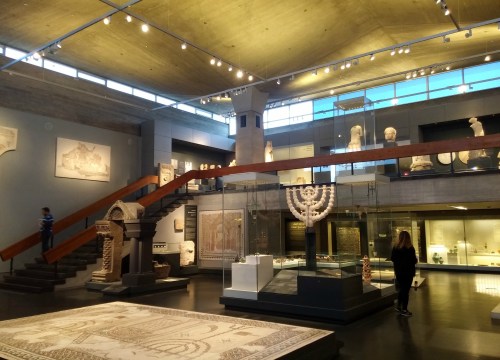
Greco-Roman remnants in the Holy Land

Greco-Roman remnants in the Holy Land

It was at this point that my camera battery died and I was forced to continue documenting my trip with my phone camera, arguably better in terms of photo quality yet lacking any real zoom (which worked out okay for museum photos). I entered a two-storey room with idolatrous statues, painted tombstones and funerary busts from the Greco-Roman period on the top floor. Descending, I spotted a familiar mosaic on the wall above me – the mosaic from the ancient synagogue at Wadi Hamam that I visited not long before – visible, albeit blurry, in the above photo.
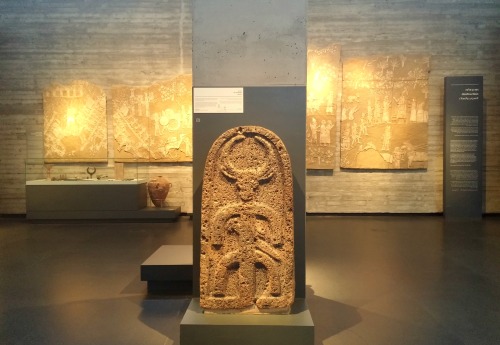
Aramean idolatry

Aramean idolatry

With exhibits on Samaritan artefacts and ruins, ancient Jewish synagogue mosaics, the floor of a Roman dining room in Shechem (Nablus) and even the birth of coinage, there’s simply too much to write about and so I will continue on with the next selection of antiquities, including weapons of war from numerous empires, and the scatterings of pagan idols and idolatrous devices, such as an Edomite shrine found in the Negev. In the photo above, a carved basalt slab featuring one of two pagan gods was found just north of the Kinneret at the ruins of an Aramean city gate. Another object of interest was a silver goblet featuring an artistic mythological design that was found at Ein Samia, a site in the Shomron that I had visited just two days prior.
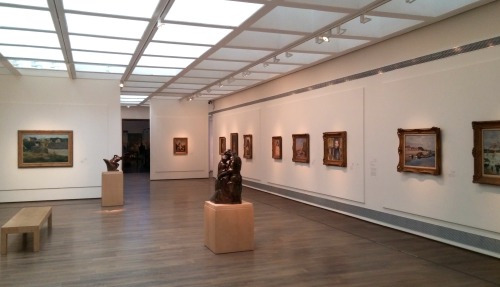
Inside the Fine Arts wing

Inside the Fine Arts wing

I then ventured across the main hall and entered a temporary exhibit titled “Pharaoh in Canaan: The Untold Story”, which I found quite interesting. Having visited a large handful of ancient sites throughout Israel I have noticed traces of Egyptian rule, something which isn’t always addressed when it comes to the standard “who’s who” in Holy Land chronology. There is no denying the influence brought about by the Ancient Egyptian culture and, to further cement in their historical importance, compelling relics were put on display (including a reconstructed sandstone gateway façade of a fortress of Ramesses II in Yafo, or Jaffa). For fear of being too long-winded, I shall end the archaeological report here and focus on the other wings of the museum, starting with the Fine Arts wing where I found some agreeable works by Hodler, Van Gogh, Monet, Pissarro and Corot. I browsed the Arnold Maremont Gallery of Pre-Columbian Art (of which I had seen I very similar collection at the Detroit Institute of Arts several months prior), and then the exhibit “Costume and Jewelry: A Matter of Identity” which covers traditional dress of Jews the world over.
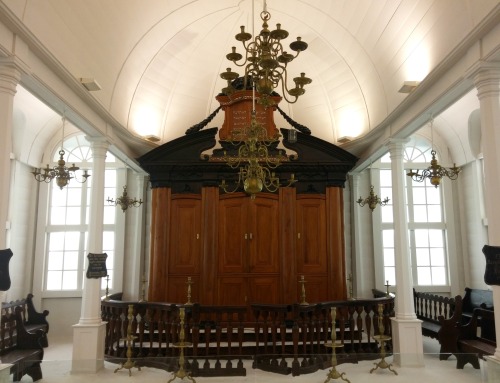
The Tzedek ve-Shalom Synagogue, Paramaribo, Suriname

The Tzedek ve-Shalom Synagogue, Paramaribo, Suriname

Entering the Wing for Jewish Art and Life, I was blown away at the incredibly rich and extensive collection of all things Judaica. It’d be quite a difficult undertaking to even list the highlights of the exhibit so I shall simply cover my favourite section, “The Synagogue Route”. Featuring four reconstructed synagogues, each to a different degree of restoration, the section really interested me from a religious and cultural, as well as architectural, standpoint. I first entered the sandy-floored Tzedek ve-Shalom Synagogue from Suriname, a small Caribbean country in South America just north of Brazil. Built in 1736 by Portuguese Jews who lived in the Netherlands before starting a new life in the New World, the synagogue has influences from both European cultures. Next I visited the Kadavumbagam Synagogue from Cochin, India, with its large carved wood aron (holy ark) and balcony. In terms of opulence, it was the small yet grand Vittorio Veneto Synagogue from Italy which was completed in 1700 that took the proverbial cake – a masterpiece of Italian Baroque style, reminiscent of an aristocratic palace. The final synagogue is the Horb Synagogue from Germany, which sadly didn’t stand the test of time since being built in the early 1700’s. All that remains are the walls and elaborately painted wooden ceiling, dating 1735 by Jewish Galician artist Eliezer Sussman, which is the last surviving synagogue artwork of its kind.
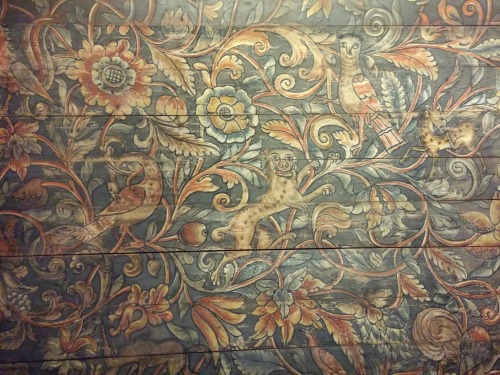
Detail from the Horb Synagogue's painted wood ceiling

Detail from the Horb Synagogue’s painted wood ceiling

Leaving the phenomenal Judaica department, I walked, and at times nearly ran, through the ghastly contemporary art wing – only a mere few pieces holding any redeeming value in my critical opinion. I dashed for the exit and passed some sculptures in the Art Garden outside as I made my way to the Holyland Model of Jerusalem, a 1:50 scale-model of what Jerusalem might have looked like during the Second Temple Period.
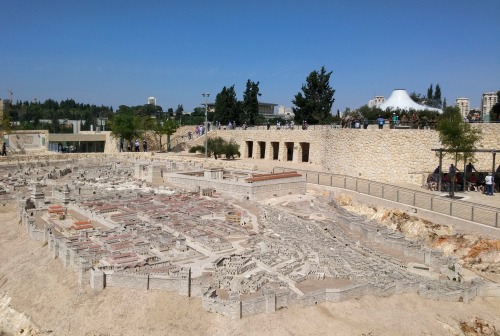
Holyland Model of Jerusalem

Holyland Model of Jerusalem

At last I reached the most iconic feature of the Israel Museum, the Shrine of the Book containing the Dead Sea Scrolls under a meringue-looking white dome. Unfortunately, photography is forbidden within the building and so I have nothing to show for, other than my [written] word itself. And so, after enjoying a look at the famous scrolls found in caves in and around Qumran, I bid farewell to the famous museum and rushed back to Bar Ilan University for a computers class…
Jerusalem Tour

In Israel, Jerusalem on January 19, 2016 at 6:42 AM

Several weeks ago, on a Thursday, my sister and I took part in a municipality-funded trip to Jerusalem, courtesy of the neighbouring city of Nahariya. We joined the group of fellow immigrants and boarded the bus just after 7am – the start of a blustery but interesting day. Picking up our tour guide, Anat Harrel, we continued on our merry way to the capital via Road 443 – the ancient route up to Jerusalem.

Aerial photo of Jerusalem by Ron Gafni

Aerial photo of Jerusalem by Ron Gafni

Entering Jerusalem from the north, we headed for our first destination, the Supreme Court of Israel. Located in the governmental sector alongside the Knesset and several Ministry buildings, the Supreme Court was built in the early 90’s funded by the Rothschild family. The architects, Rami Karmi and Ada Karmi-Melamede, implemented many contrasts in building design and interior composition. Once we passed through security we met our courthouse guide, Nir, who began with the contrasts of old and new, lines and circles, inside and out. We walked up a large staircase to a panoramic window looking out over the city and then headed for the pyramid and library.

Looking out from the Supreme Court

Looking out from the Supreme Court

At each stop Nir explained the architectural significance of the area and we then progressed to the foyer which leads to each of the five courtrooms. Like the tourists that we were, we eyed the black-robed lawyers curiously and peppered Nir with various questions of the inquisitive mind. Nir led us into the fourth courtroom, named “Daled”, and sat us down on the harsh wooden pews. Standing below the Justices’ dais, he first explained the traditional courtroom layout – pointing out the seats belonging to the court reporter, the clerk, the lawyers from both sides, the prisoner and the press (in the case that it’s a criminal case and newsworthy, respectively). Next, the nitty-gritty of the Israeli legal system was explained including an overview of the three levels of court systems, followed by a Q&A to address more specific inquiries.

Nir in Courtroom Daled

Nir in Courtroom Daled

Leaving the courtroom, we congregated in the foyer and I saw a window of opportunity open before my eyes. Robed individuals passed in and out of the third courtroom door (“Gimmel”), the largest of the five, and I decided to make my move. With my sister in tow I strode forward confidently and breached the chamber, hiding behind a column. I peered out and spectated an ongoing court case; three justices sat on the dais while standing lawyers argued fervently, protesting the words of the middle judge who was engaging them in dialogue. As I peeped from behind the pillar, clueless as to what was at stake, I was urged by my sister to return to the group lest we become abandoned. Unrelated, a week or two after this trip I attended a lecture by Deputy Attorney General (Criminal) Raz Nizri while visiting Bar Ilan University, something I found particularly interesting especially after just visiting the Supreme Court. Getting back to the tour of Jerusalem, our next stop was Ammunition Hill – a national memorial site dedicated after the Six Day War in 1967.

Anat the tour guide

Anat the tour guide

Without going into too much depth, as I have already covered this site (linked above) back in 2012, we basically went straight to the Six Day War Heritage museum, located inside a bunker-like building. Our tour guide, Anat, passed out lyric sheets and played for us the pulsating 60’s hit which commemorated and relived the Battle of Ammunition Hill – a moving moment. At the song’s finish we explored the museum and then headed over to the multimedia presentation of the Battle for Jerusalem, a phenomenal production. Afterwards we headed to the entrance lobby for a warm lunch donated to our tour group, and with lunch’s culmination we took a group photo:

Group photo

Group photo

Having visited the site where a bloody battle was fought between Israeli and Jordanian troops, the earlier notes that Anat has delineated concerning the old Israel-Jordan border made all the more sense – it seems hard to believe that there was a time when enemy snipers were a threat to unaware pedestrians. With one more stop on our list, the bus driver deposited us off at the entrance to Mount Herzl. I had also visited Mount Herzl back in the army, attending a memorial service for a soldier who was killed on the Lebanese border in 1985 in the “Safari Disaster”, which can be read about (linked above). This time we came not for the military cemetery but for the grave and museum of the mountain’s namesake, Theodore Herzl. Credited as the “Visionary of the State”, Herzl was one of the fathers of modern political Zionism and formed the World Zionist Organisation in 1897. Before we reached the plaza beside Herzl’s grave, Anat gave us a very clear picture of what modern political Zionism is and how it came about via the rise of nationalism throughout the world.

Learning more about ''Modern Zionism''

Learning more about ”Modern Zionism”

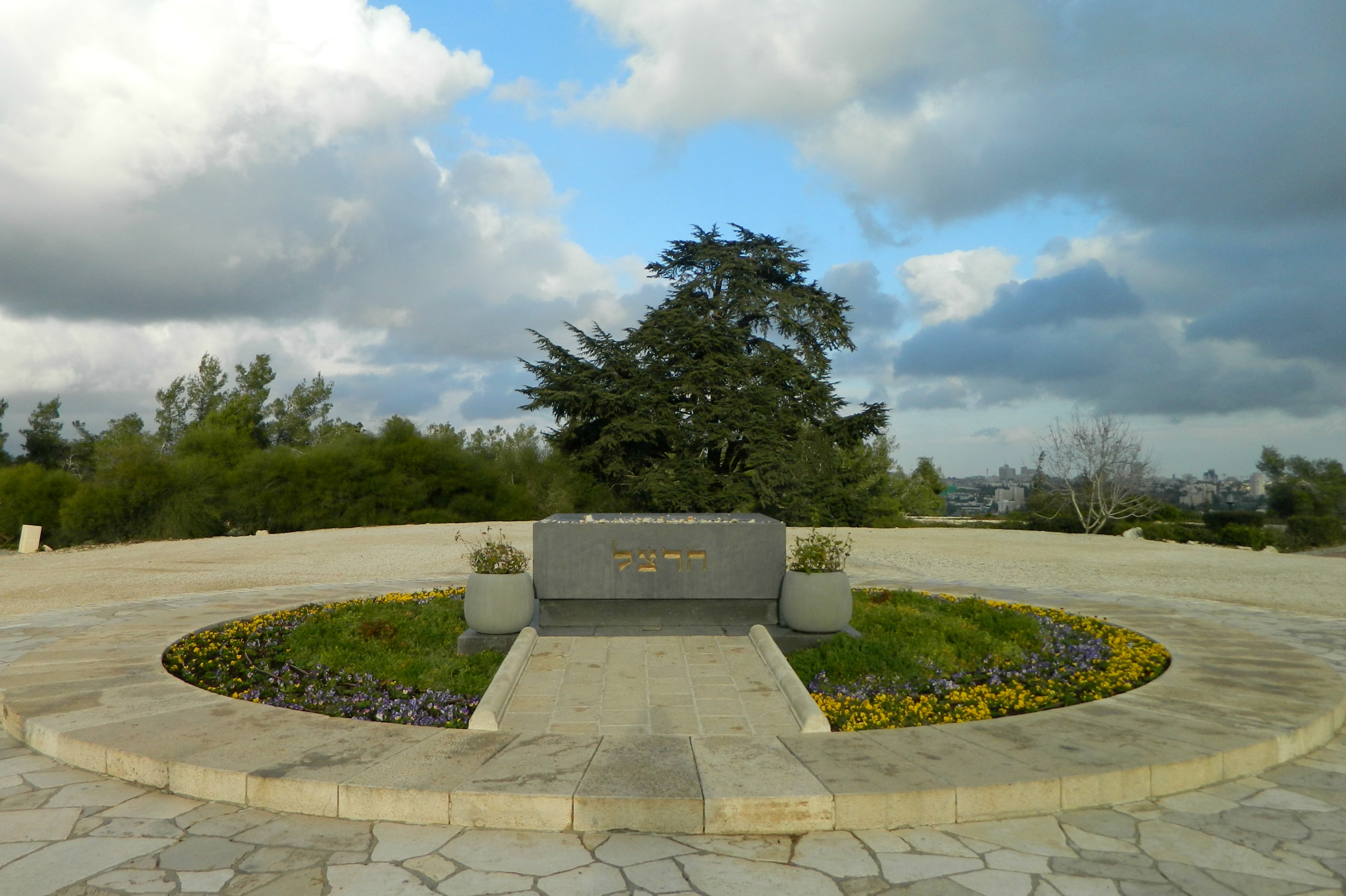
Armed with information, we crossed the plaza and spent a few minutes at the iconic gravesite, each of us in their own thoughts. While Herzl’s grave crowns the mountain, there is far more symbolism than just one burial site – on the northern slope is the military cemetery and on the western side is the famous Yad VaShem Holocaust museum (linked above under “Ammunition Hill”). The proximity of these two testaments of tragedy are not coincidental, but rather symbolic of the Jewish People’s constant fight for life and their own land, preferably both at the same time. Theodore Herzl died in 1904 and was buried in Vienna, but in 1949 he was interred in the land that he fought for, as he had requested in his will.

Herzl's grave

Herzl’s grave

With Herzl’s grave a national site, other political leaders were later buried in an adjacent cemetery dedicated to “Great Leaders of the Nation” and “Leaders of the World Zionist Organisation”. Passing through, we saw the graves of former Prime Ministers Levi Eshkol, Golda Meir and Yitzhak Rabin (buried alongside his wife) as well as others including Chaim Herzog and Yitzhak Navon. Turning back around we entered the new Herzl Museum, another multimedia presentation of many rooms which helps illustrate the life and struggle of Theodore Herzl.

Herzl's private office

Herzl’s private office

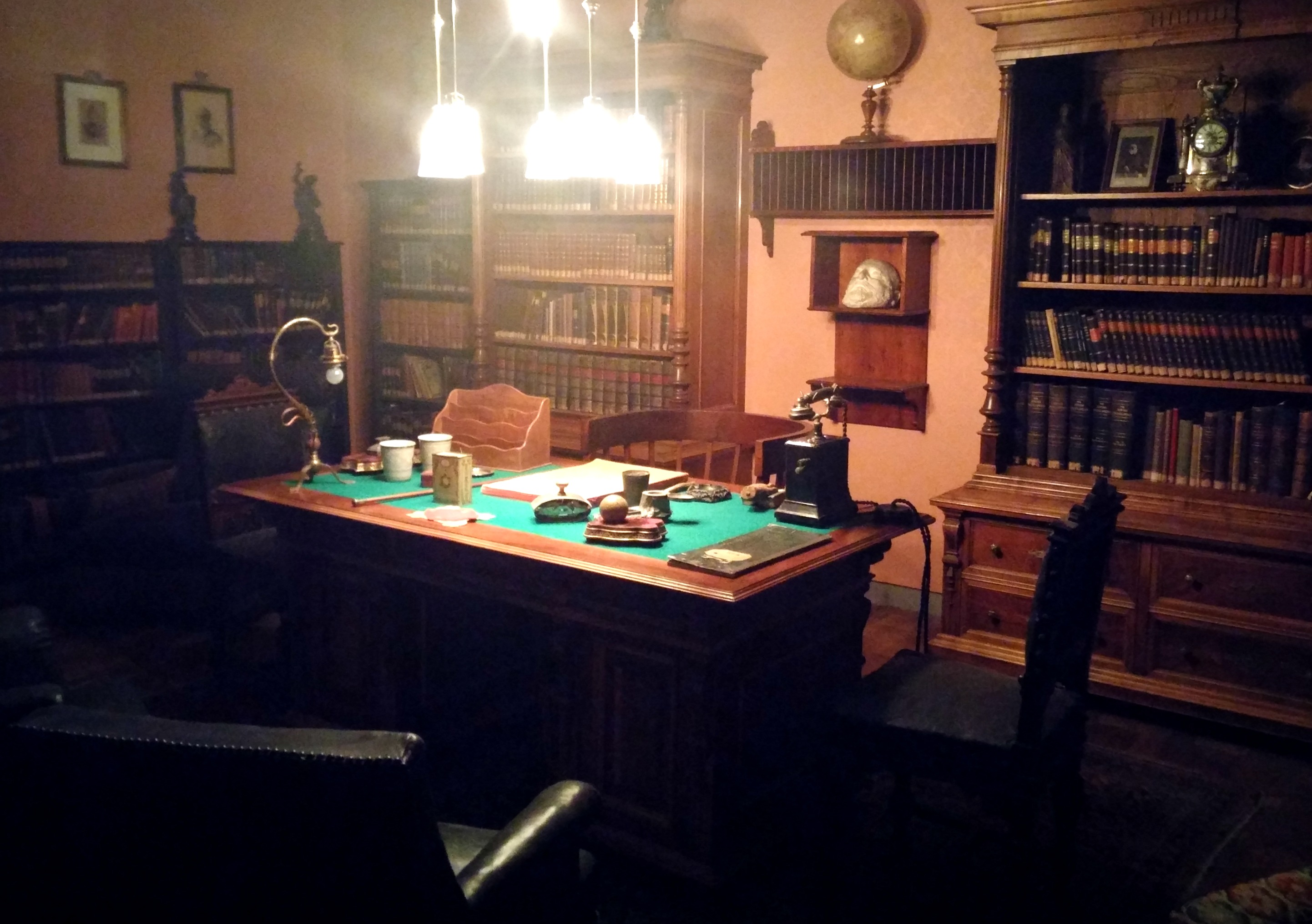
His study in Vienna was reconstructed and put on display, as well as many of his personal belongings mixed with gifts and awards of dignitary distinction. At the conclusion of our visit to the Herzl Museum we boarded the bus for the final time and were shuttled out of Jerusalem to be taken back from whence we came. I rather enjoyed our tour and I hope that the opportunity comes again, for I will seize it!


Gush Katif Museum

In Israel, Jerusalem on December 21, 2014 at 4:34 AM

The day following my trip to the Weizmann Institute of Science, the opportunity to visit Jerusalem arrived. I had a morning army meeting to attend and, upon completion, headed for Machane Yehuda shuk (bazaar) in search for craft beers unavailable where I live up north. Dodging the scattered rainshowers, I successfully procured some fine stouts and meandered through the bustling shuk until reaching the light rail. Glancing at the station map, I noticed that there was a museum just around the corner – the Gush Katif Museum.

Gush Katif Museum

Gush Katif Museum

Having moved to Israel in 2009, I missed the dark chapter that gripped the nation just four years earlier. I’m referring to the Israeli disengagement of the Gaza Strip in August 2005, the disbandment of Jewish towns and their inhabitants who called Gaza their home. Gush Katif is the Hebrew name for the area in the southern part of Gaza where Jews have been living on and off since Biblical times. The first recorded mentioning of Jews in the Gaza area was about Abraham settling in the Nachal Grar area (I have previously written about this in the Be’eri Forest post). Another notable Biblical period was the time of King Solomon, when he ruled “…from Tifsach to Gaza”. And then, during the times of the Romans and Byzantines, when Israel’s largest excavated synagogue was built.

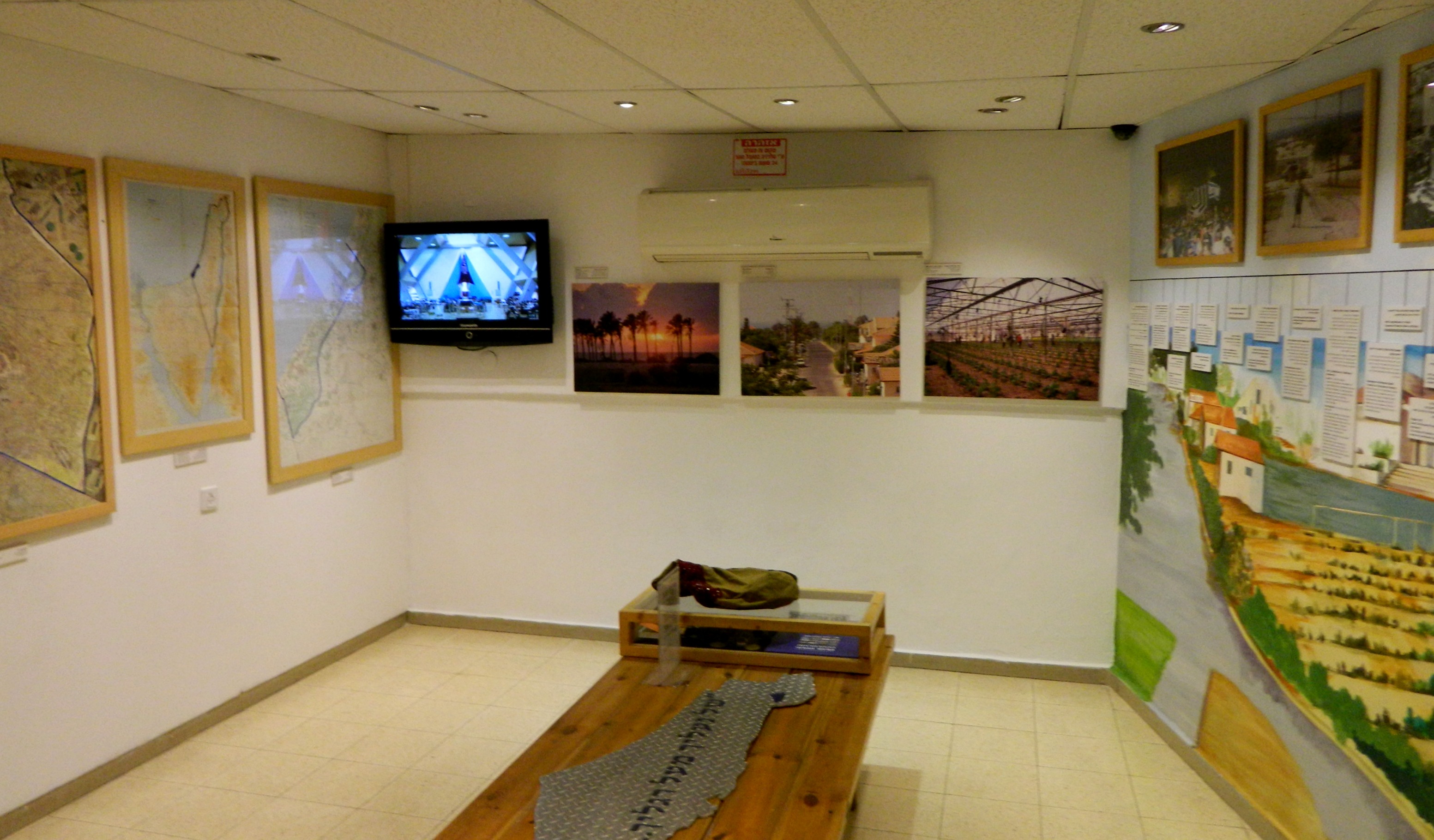
Inside the museum

Inside the museum

Fast-forward to relatively modern times and the Jews were expelled from their homes by the British following Arab rioting in 1929. It wasn’t until 1968 that Jews returned en masse and began to repopulate the area, eventually establishing 21 towns and creating a booming agricultural industry. At its peak, Gush Katif was exporting some $60 million of produce annually. Crops included lettuce, tomatoes, oranges, peanuts and potatoes, stemming from Gush Katif’s technologically advanced greenhouses. Quoting Wikipedia, “Economic consultants estimated that the closures [of the greenhouses] cost the whole agricultural sector in Gaza $450,000 a day in lost revenue.”

The Jewish towns in blue...

The Jewish towns in blue…

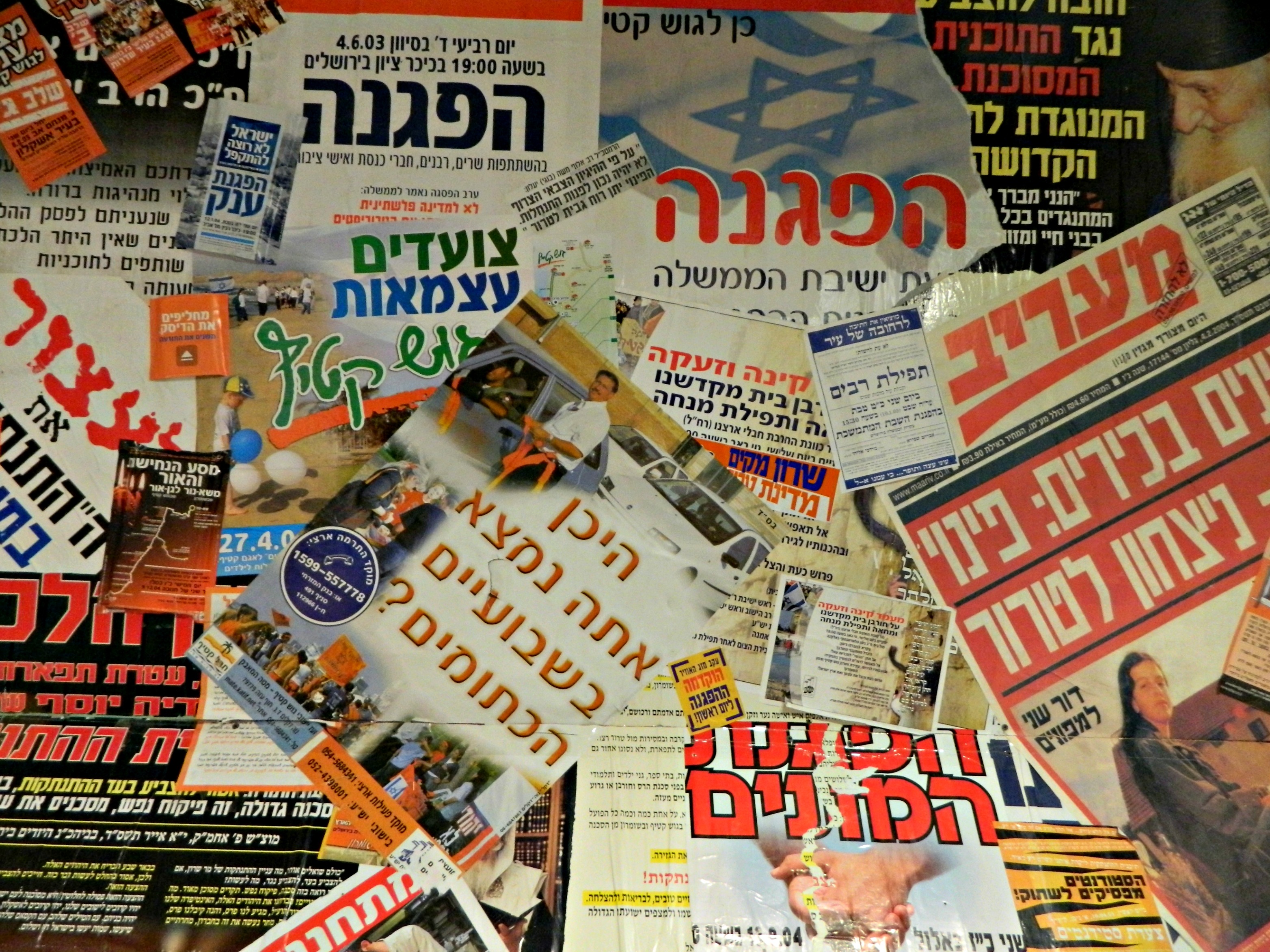
Once the Second Intifada began, the security situation became a bit dire, and the Jewish settlements of Gush Katif received 6,000 mortar and rocket attacks, resulting in tremendous property and psychological damage. Despite the heavy resistance (more than 60% of the general population opposed), the Sharon Administration decided to disengage from Gaza. What ensued was a period of hardship for the Israeli nation. The counter-movement to the disengagement was “The Orange Struggle” – orange representing Gush Katif. Tens of thousands of protestors – civilians, policemen, soldiers – all stood in solidarity against the disengagement, even creating a “Human Chain Demonstration” with 130,000 people stretching 100 kilometres.

Stickers and posters of the Orange Struggle

Stickers and posters of the Orange Struggle

Alas, on August 15, 2005, the forced evacuation began, and it continued throughout the towns, one by one, until the 18th, when the last town was cleared. Without getting into great detail, the evacuation had some hiccups but eventually the newly homeless Israelis were moved into temporary living places such as converted shipping containers. I once spent Shabbat in a town between Ashdod and Ashkelon called Nitzan which has a large population of Gush Katif refugees living in mobile homes. To this day, nearly ten years after the eviction, there are families still living in sub-standard housing.

A photo from Efrat Marks' "Mechila" exhibit

A photo from Efrat Marks’ “Mechila” exhibit

The Gush Katif Museum is both a memorial to what once was and a recognition of the ongoing movement in support of Jewish living not only in Gaza but in Judea and Samaria as well. Historical objects, photos and books help relay the message, one that I knew so little about. The short film about Gush Katif’s modern heyday and the tragic disengagement really brings the harsh reality to mind, but when I watched it I found myself distracted by a familiar face. I think an Armoured Corps NCO that I met during Operation Protective Edge was captured on video at a mournful synagogue scene, I’d like to ask him if I ever see him again. What a small world…

Army Trip: Jerusalem Tour

In Israel, Jerusalem on March 17, 2014 at 4:32 AM

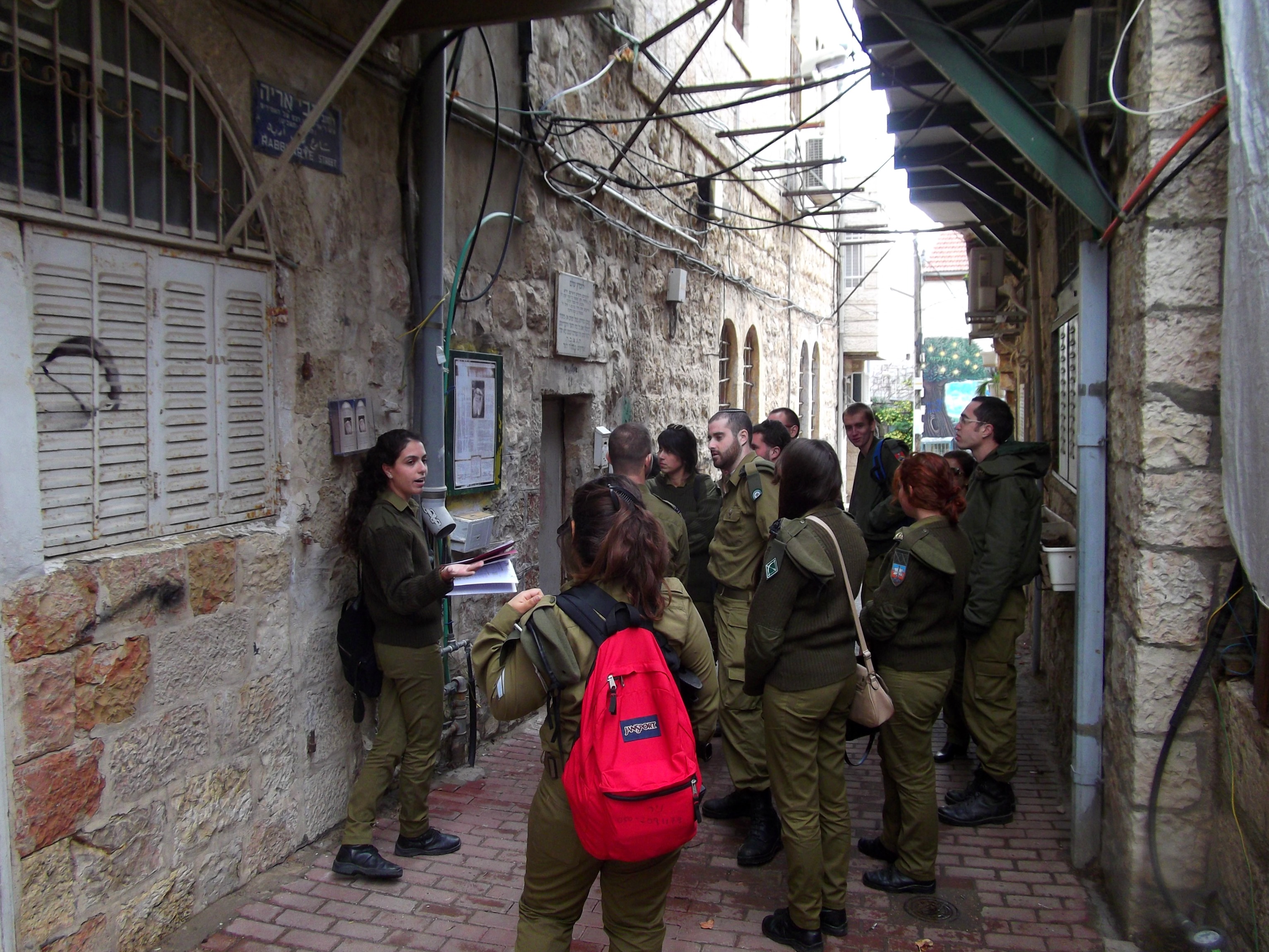
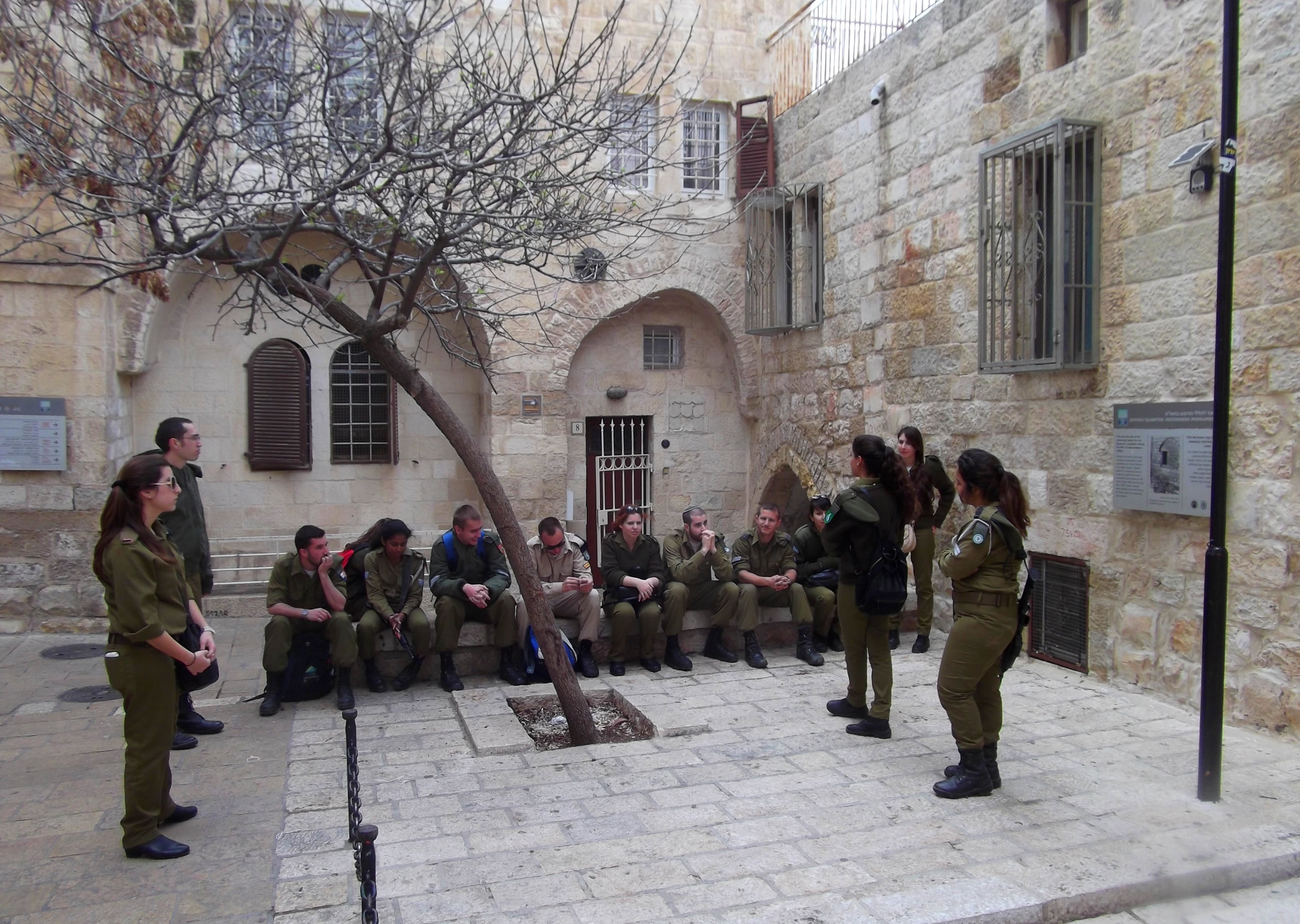
Another break in the traditional chronological format of my blog, this past Monday I went on a unique little educational army trip to the capital city, Jerusalem. As I’m currently attending a Hebrew language crash course, or “Ulpanit”, I was accompanied by a small group of new friends: fellow classmates and teachers alike. Leaving our base near Ben Gurion Airport, we entered the Holy City and began our tour with the old neighbourhoods of Mazkeret Moshe and Zichron Moshe (if I’m not mistaken). Walking through the quiet residential areas we learned the history of these streets, and who lived on them, from our Educational and Youth Corps tour guide.

Outside Rabbi Aryeh Levin's house

Outside Rabbi Aryeh Levin’s house

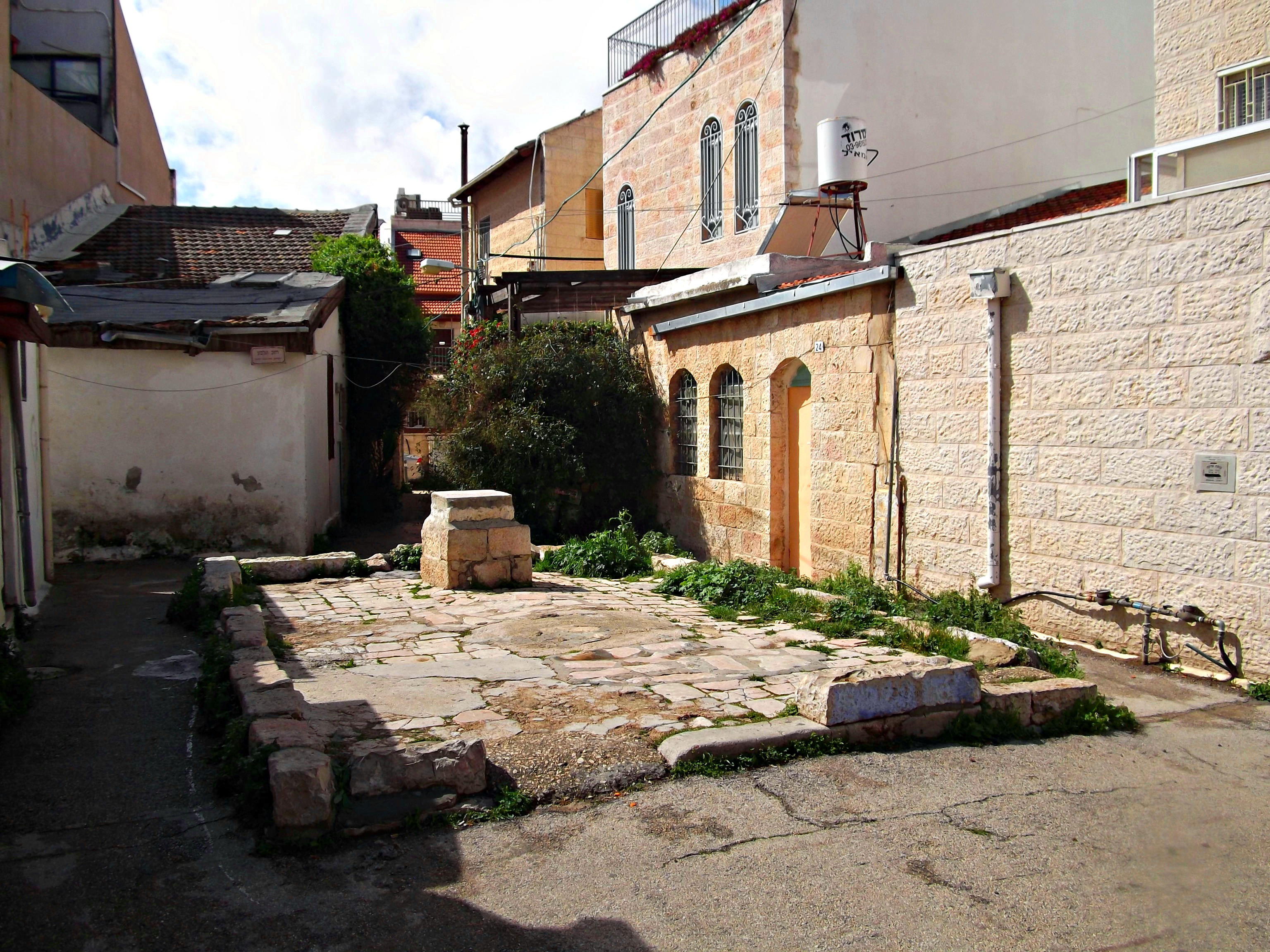
We learned how these neighbourhoods were inhabited after a realisation that there simply wasn’t enough room for the Jews in the Old City. In all the times I’ve been to Jerusalem, including the eight blog posts I’ve written about this holy city thus far, I’ve never seen nor heard about these little neighbourhoods. Then again, there’s a lot I haven’t seen in Jerusalem.

A sealed well

A sealed well

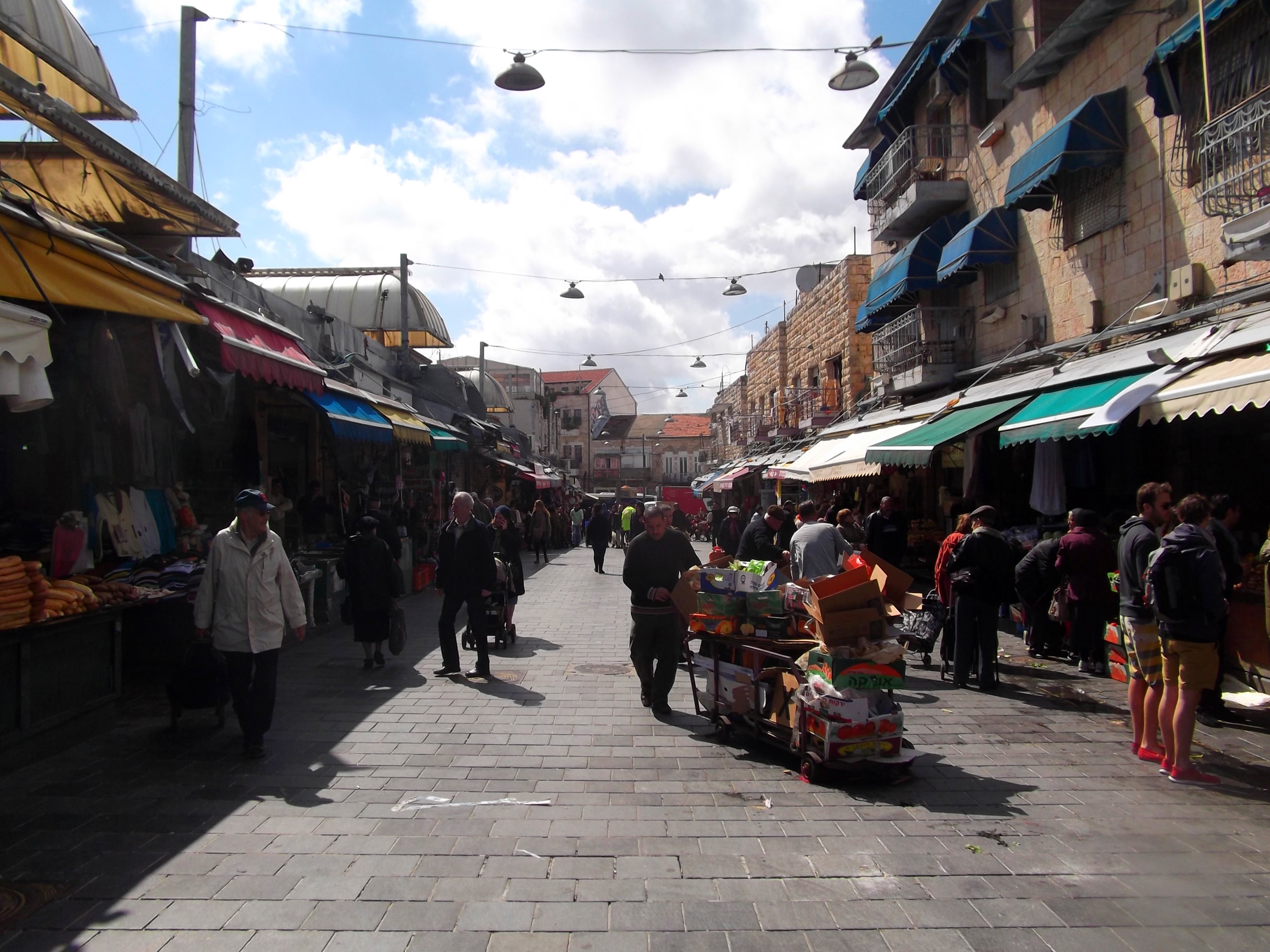
Bordering these neighbourhoods to the north is the famous Machane Yehuda shuk – a large marketplace which really comes to life every Friday. We stopped there for a few minutes and I got a falafel.

Machane Yehuda shuk

Machane Yehuda shuk

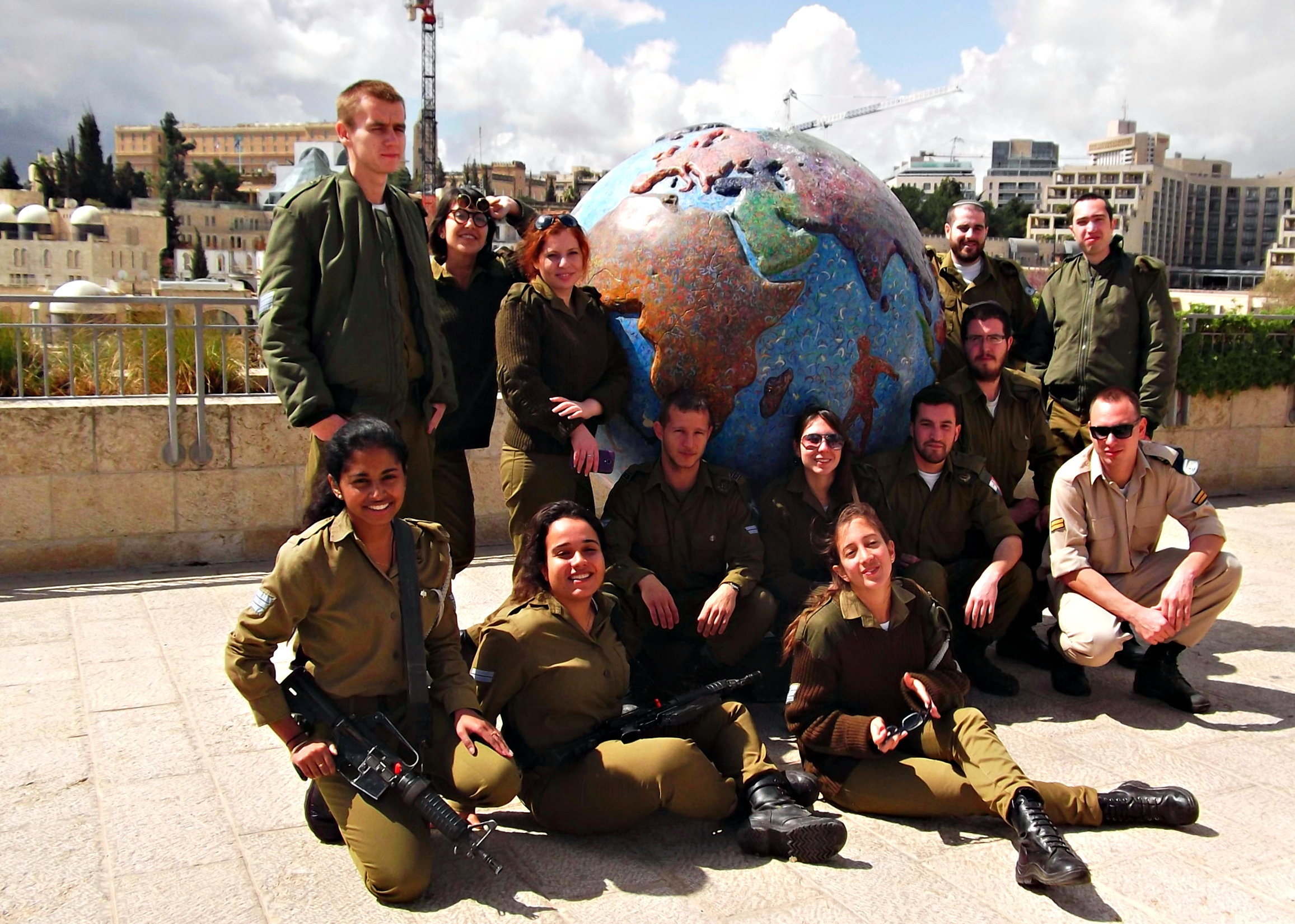
Getting back into our Mercedes-Benz minibus, we headed for the Old City and disembarked near the Jaffa Gate. Outside the walls, overlooking Mamilla Mall, we posed by a globe sculpture, symbolic of our collective status as immigrants.

Class picture

Class picture

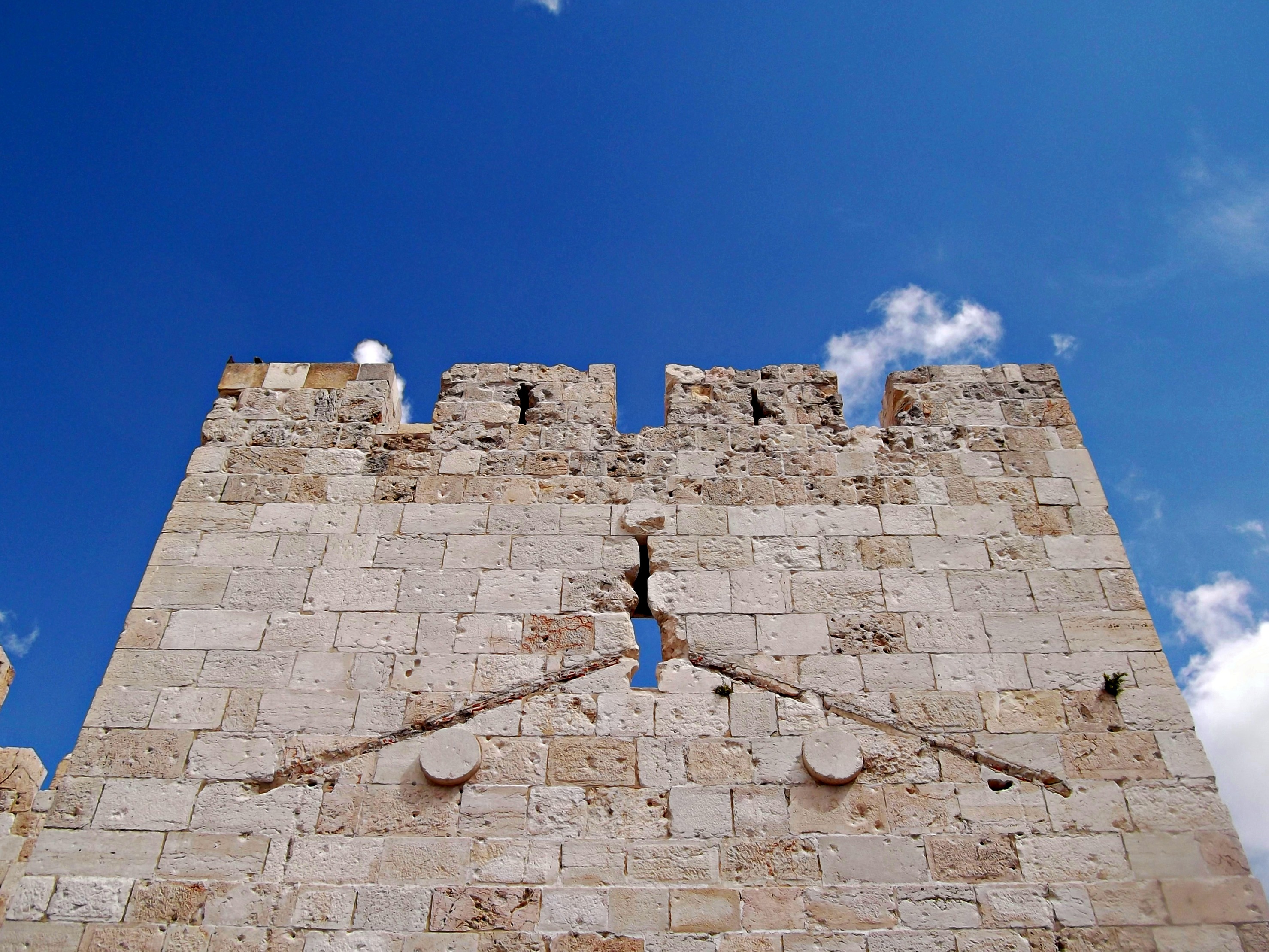
We then continued into the Old City entering via the Jaffa Gate, being told that the angled lines in the stonework below was intended to resemble the roof of a house – a story of homesickness.

Jaffa Gate wall

Jaffa Gate wall

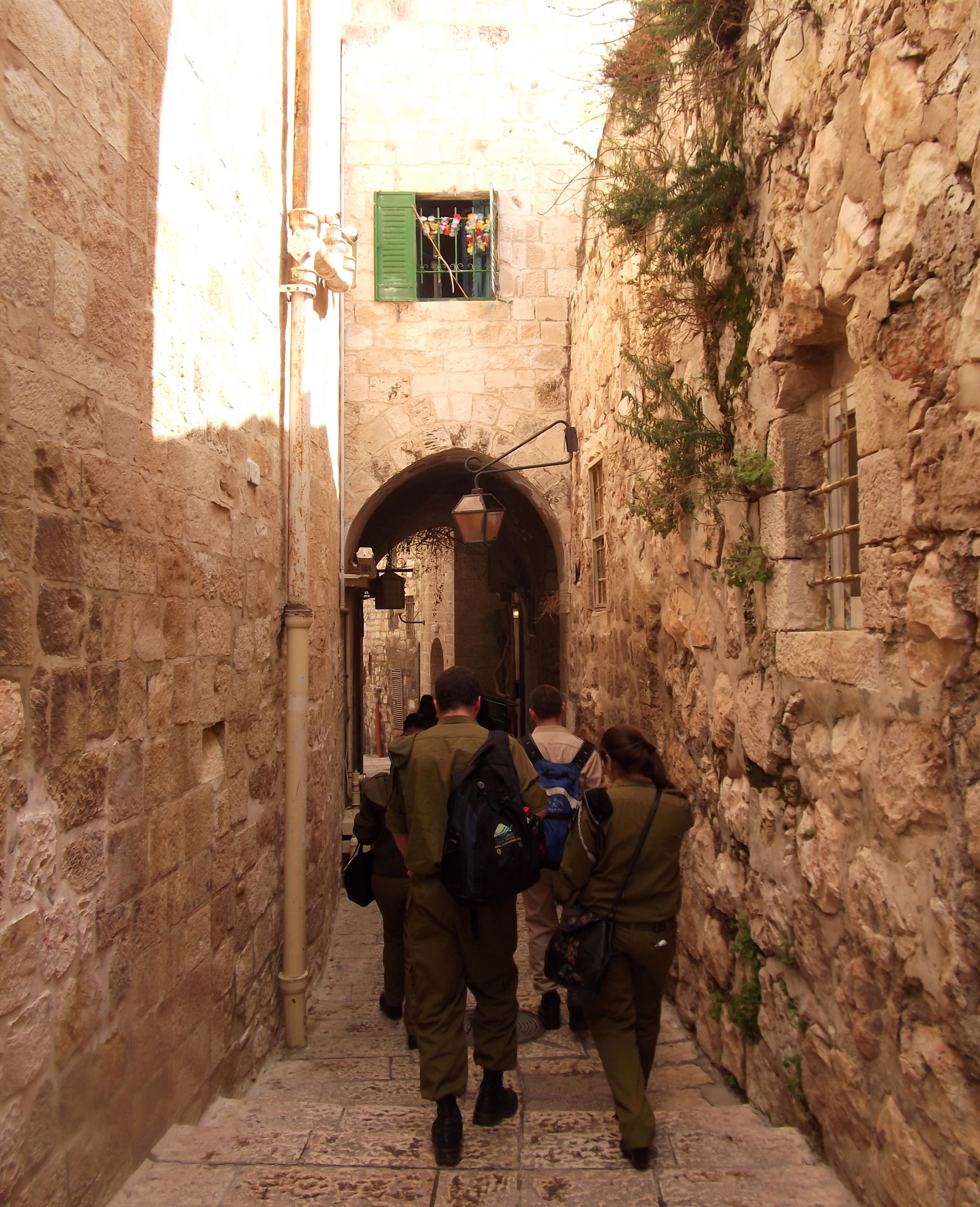
Within the Old City, our guide took us through the Armenian Quarter, snaking our way through narrow corridors and under graceful arches.

Walking through the Armenian Quarter

Walking through the Armenian Quarter

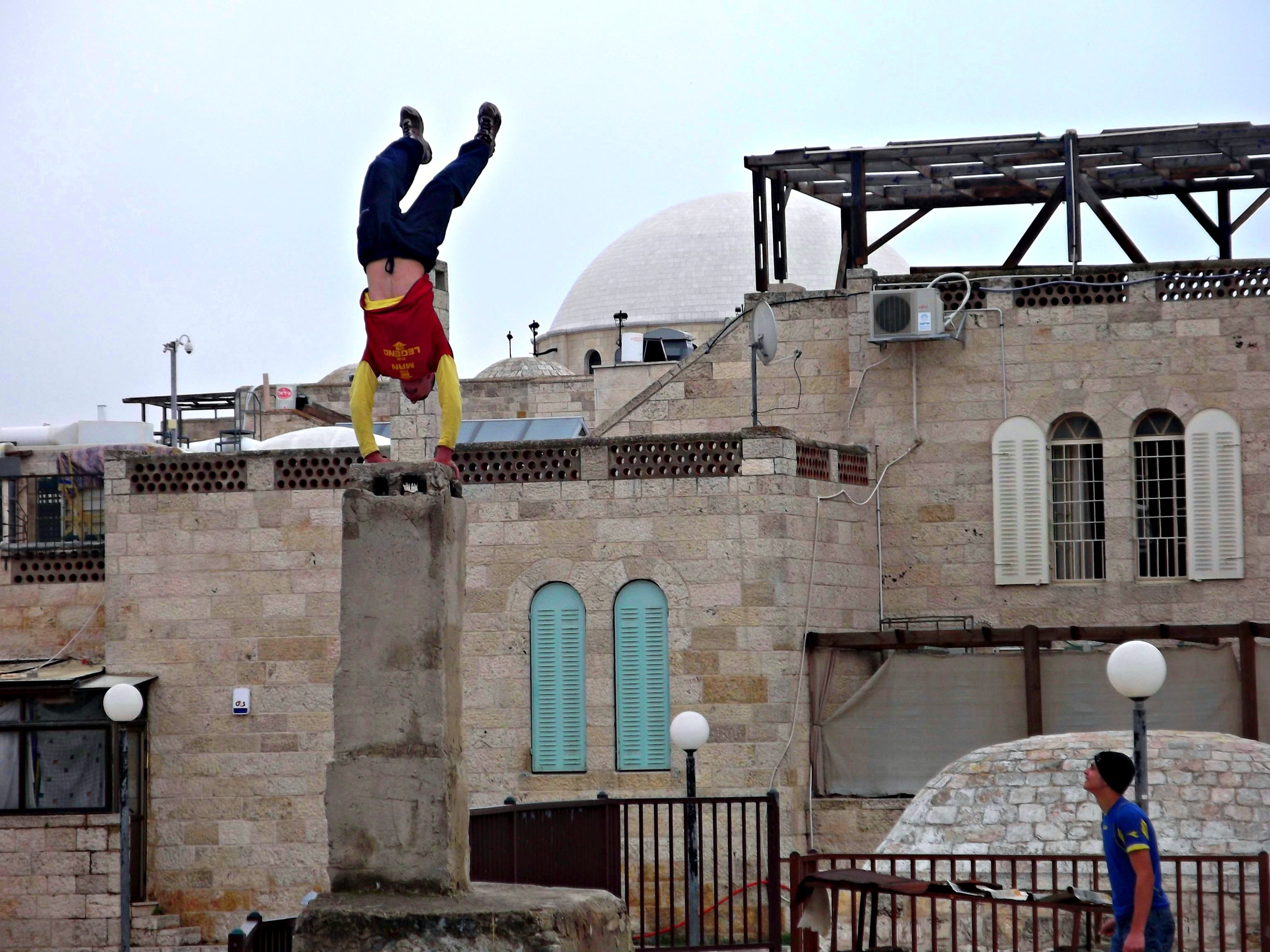
We climbed up onto a large rooftop and I realised that I had already done this exact segment years back when I was in regular Ulpan. We were pointed out the rooftops of various religious buildings around us, including the Dome of the Rock’s golden dome. In middle of our geographical lesson we were distracted by a small group of Arab youth who were leaping about performing some form of amateur parkour before a larger group of tourists.

Arab rooftop parkour

Arab rooftop parkour

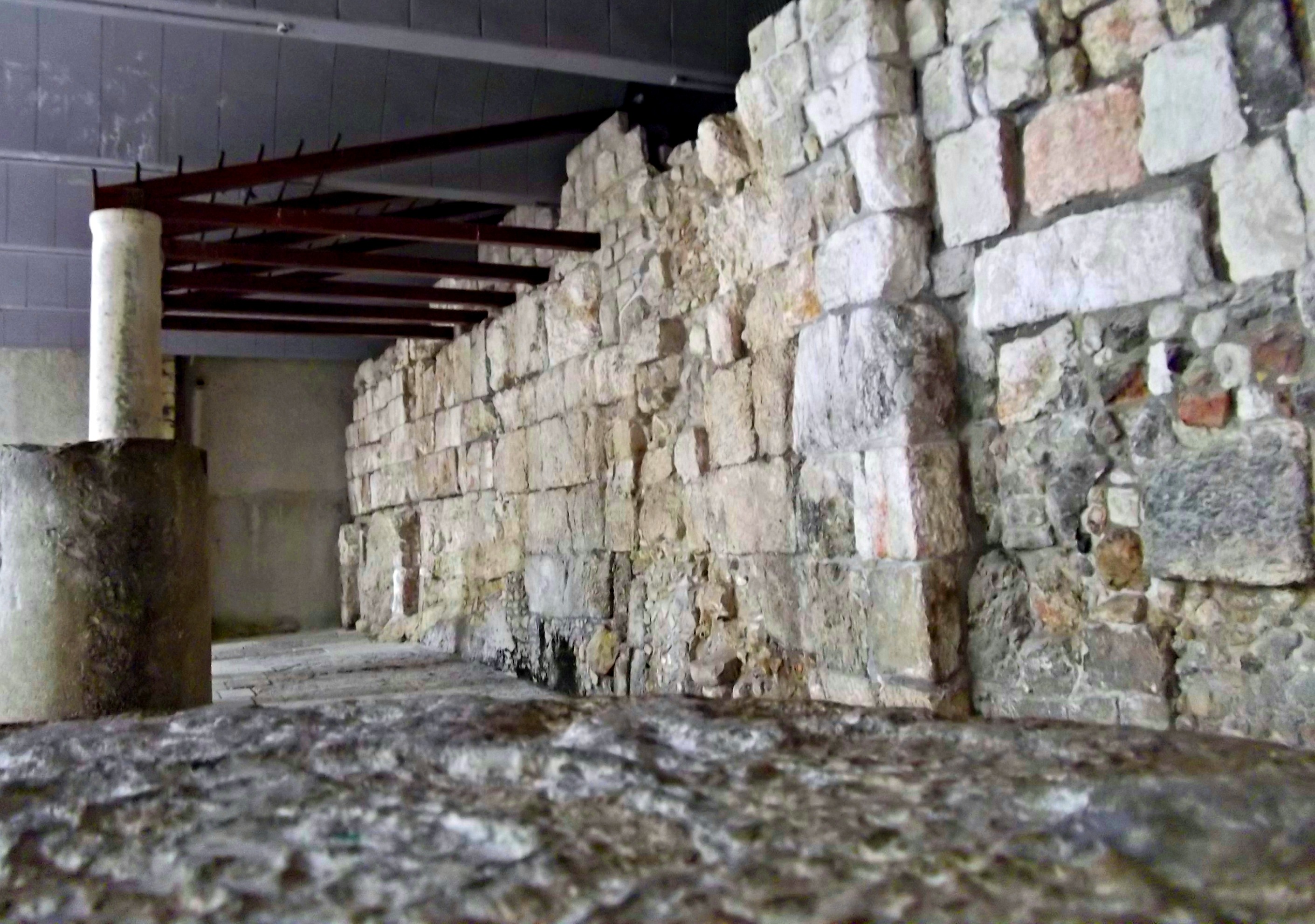
Next we found ourselves in the Cardo, the ancient main thoroughfare which was once lined with merchants and traders. Today, only some of the walls, pillars and floor can be seen – a far cry from a bygone glory.

The Cardo

The Cardo

After the Cardo, inching ever closer to the Kotel plaza, we sat down to hear about a memorial hearkening from the days of the Jerusalem’s reconquering. Throughout the raging battles for the Old City during the Six Day War, soldiers and civilians alike fell in battle but were unable to be buried due to the “siege” laid out by the surrounding Jordanian army. With no other options available, the living were forced to bury the dead temporarily within the city. After the paratroopers broke through and reclaimed Jerusalem, the bodies were transferred to cemeteries outside the Old City. A memorial replaced the grave and has remained there to this day, occupying a small corner near the Batei Machseh plaza.

Learning about the memorial

Learning about the memorial

Shortly after we ended up at the Kotel and then headed out to our minibus to be whisked off to lunch at the Israel Air Force’s Talpiot Program cafeteria at the Hebrew University. After lunch we attempted to re-enter the Old City where we ended, at the Kotel, but instead spent a while circling the Old City and driving through East Jerusalem. Eventually we disembarked and entered through the Dung Gate and then descended into the earth for a quick run at the Kotel Tunnel tour.

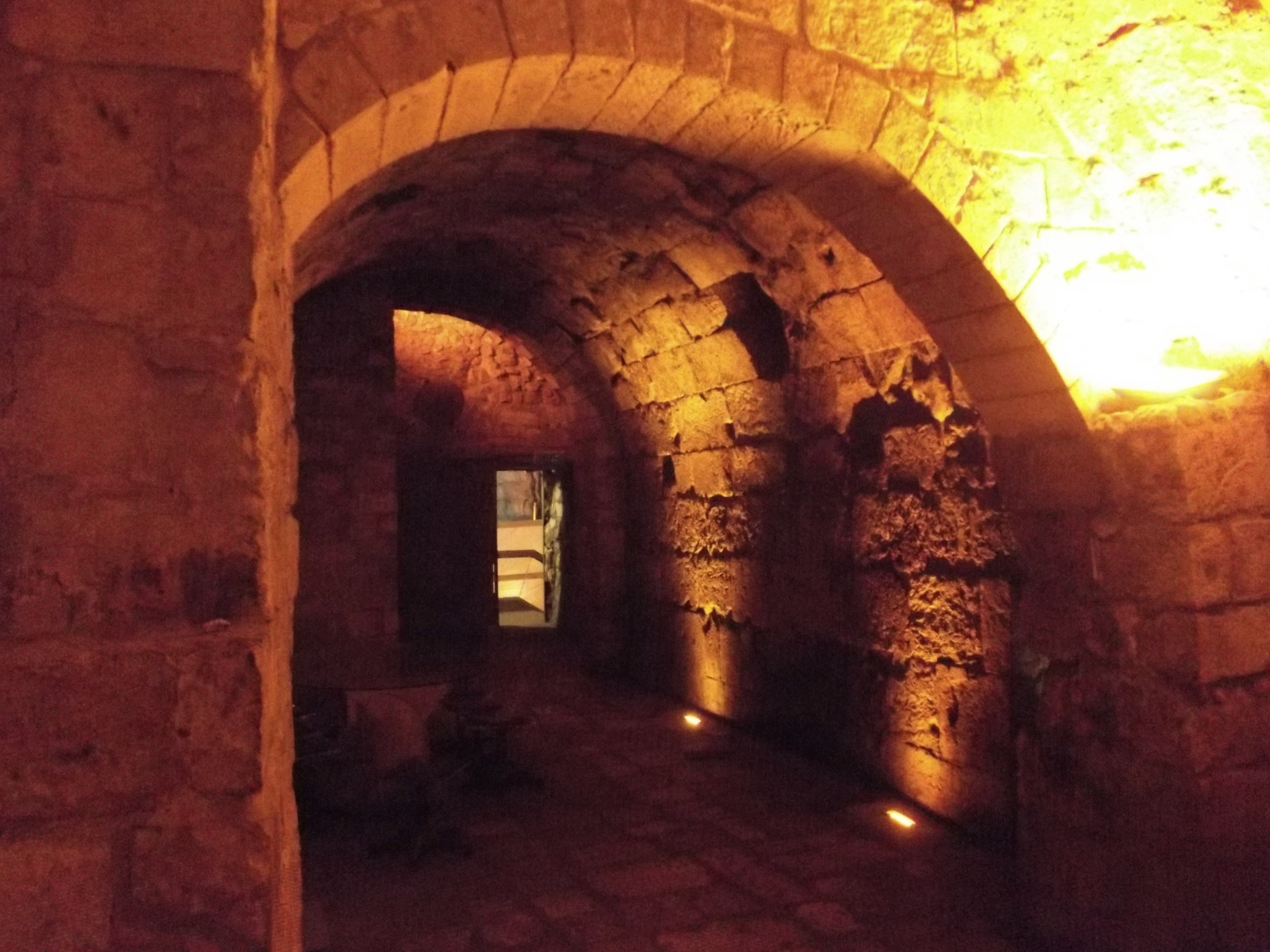
An excavated vault of the Great Bridge from the time of the Temple

An excavated vault of the Great Bridge from the time of the Temple

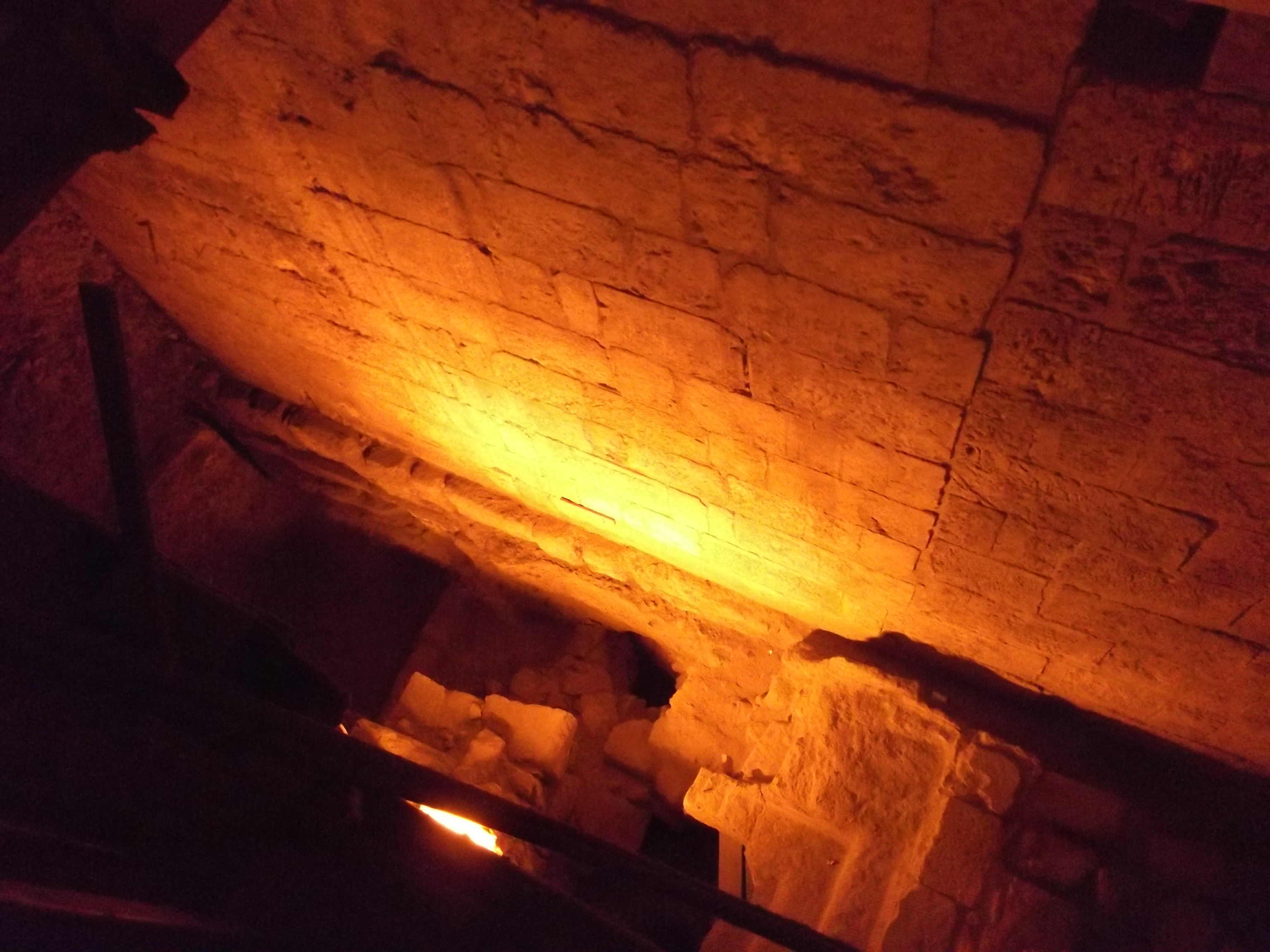
The subterranean excavations are, for want of a better word, fascinating. The incredible richness of the history of the Temple Mount can scarcely be appreciated with just a glance at the prepared archaeological findings. Every little while there is yet another deep plunge into the days of yore, the ancient stonework illuminated in a mellow yellow light.

A deep achaeological pit

A deep achaeological pit

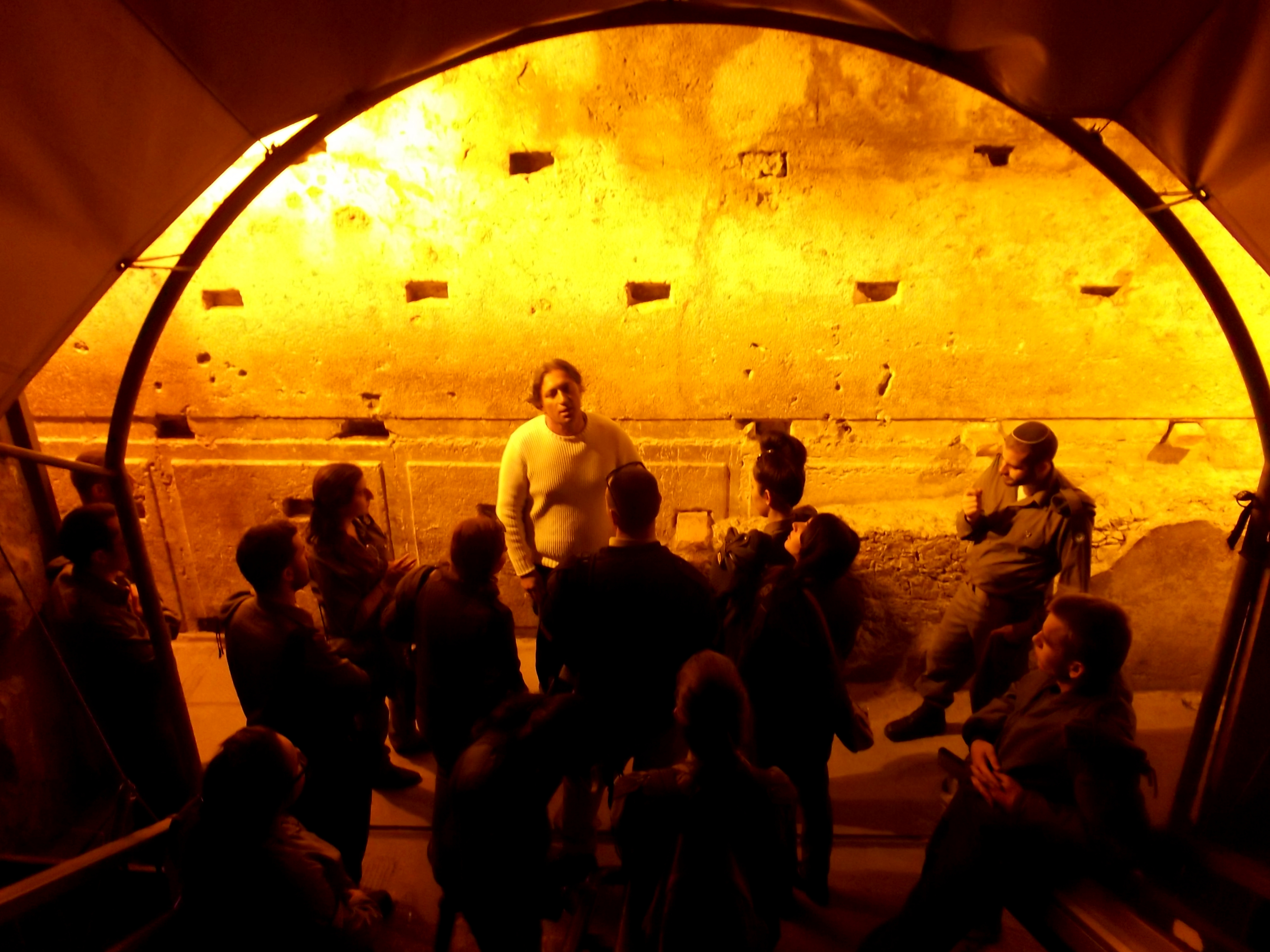
I think I’ve done the Kotel Tunnel tour twice before this trip and yet each time feels new. Our interesting tour guide, replacing the soldier who departed earlier, led us into the long causeway that runs the length of the Western Wall – the full wall, not just the small iconic section seen above ground.

Kotel Tunnel tour

Kotel Tunnel tour

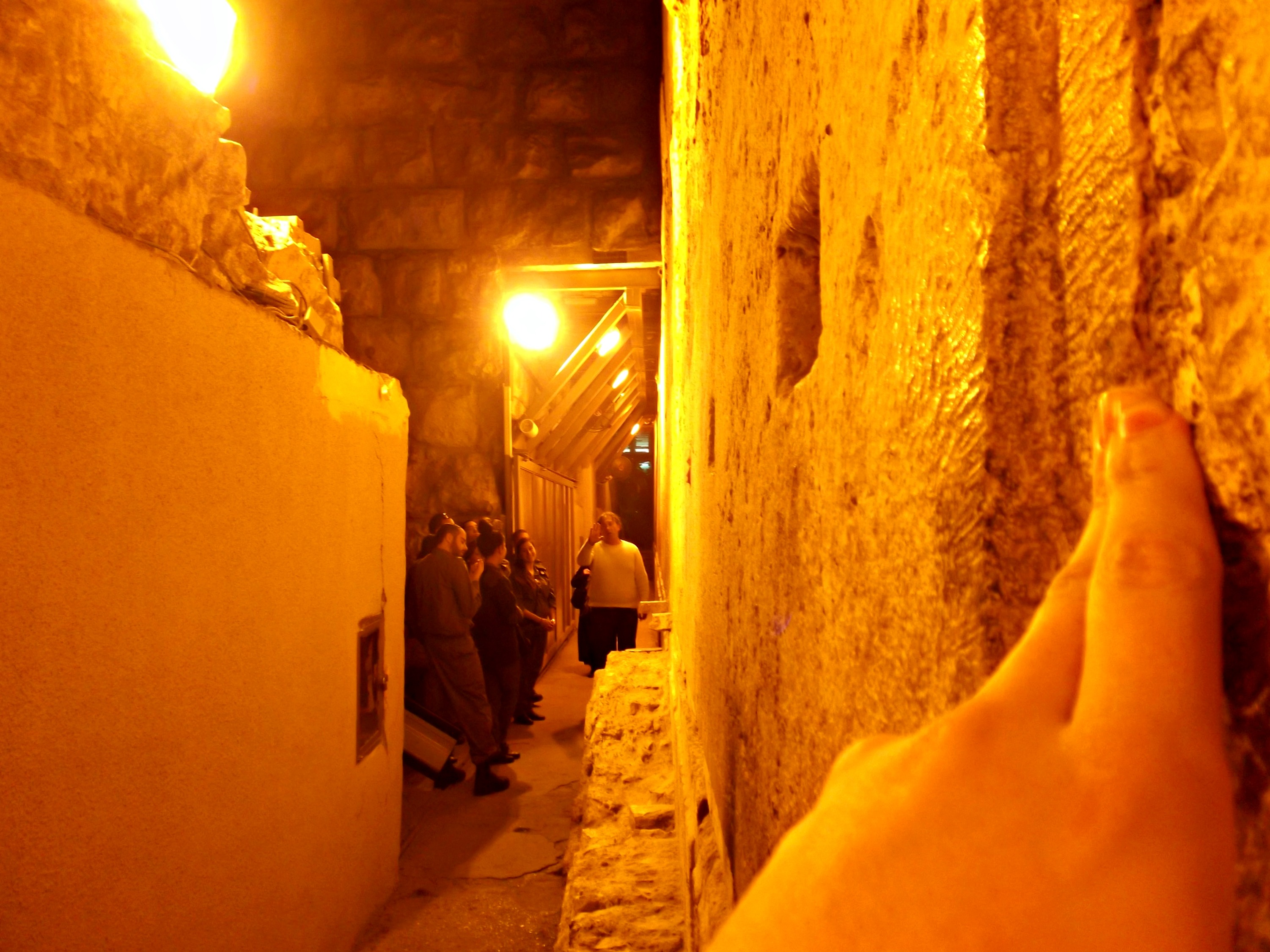
First, we were educated in the fine masonry of the Western Wall – the impeccable and vastly huge ashlars which were laid down and fit nearly perfectly one atop the other. In this picture, the guide and I stood at the two ends of the largest of the building stones which can also be seen above – a block that weighs an immense 570 tonnes (1.25 million pounds):

The length of the 570 tonne stone

The length of the 570 tonne stone

Continuing down the tunnel, hugging the Western Wall, we arrive at the place directly opposite the place where the Holy of Holies once was – a holy place, of course. With that our guide bid us farewell and encouraged us to pray while we were here. Upon prayer completion we headed out of the tunnel, back up the numerous sets of stairs and out into the Kotel plaza. There we photographed and were photographed, even providing excellent photos for a large group of schoolgirls from England. With the sun setting we got into our minibus one last time and headed back to the base. Gotta love free army trips!

Jerusalem: City of White Gold

In Israel, Jerusalem on December 17, 2013 at 6:45 AM

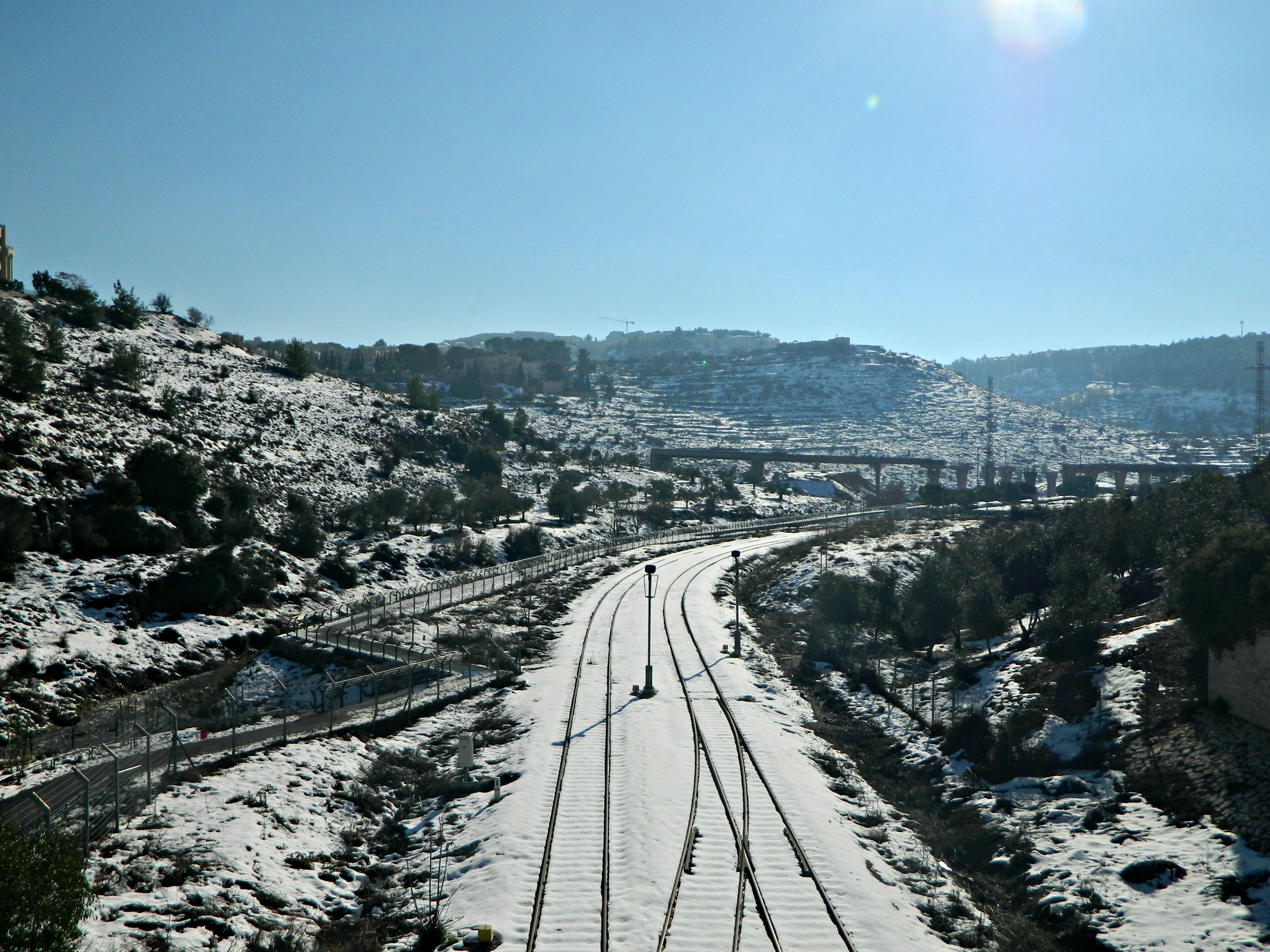
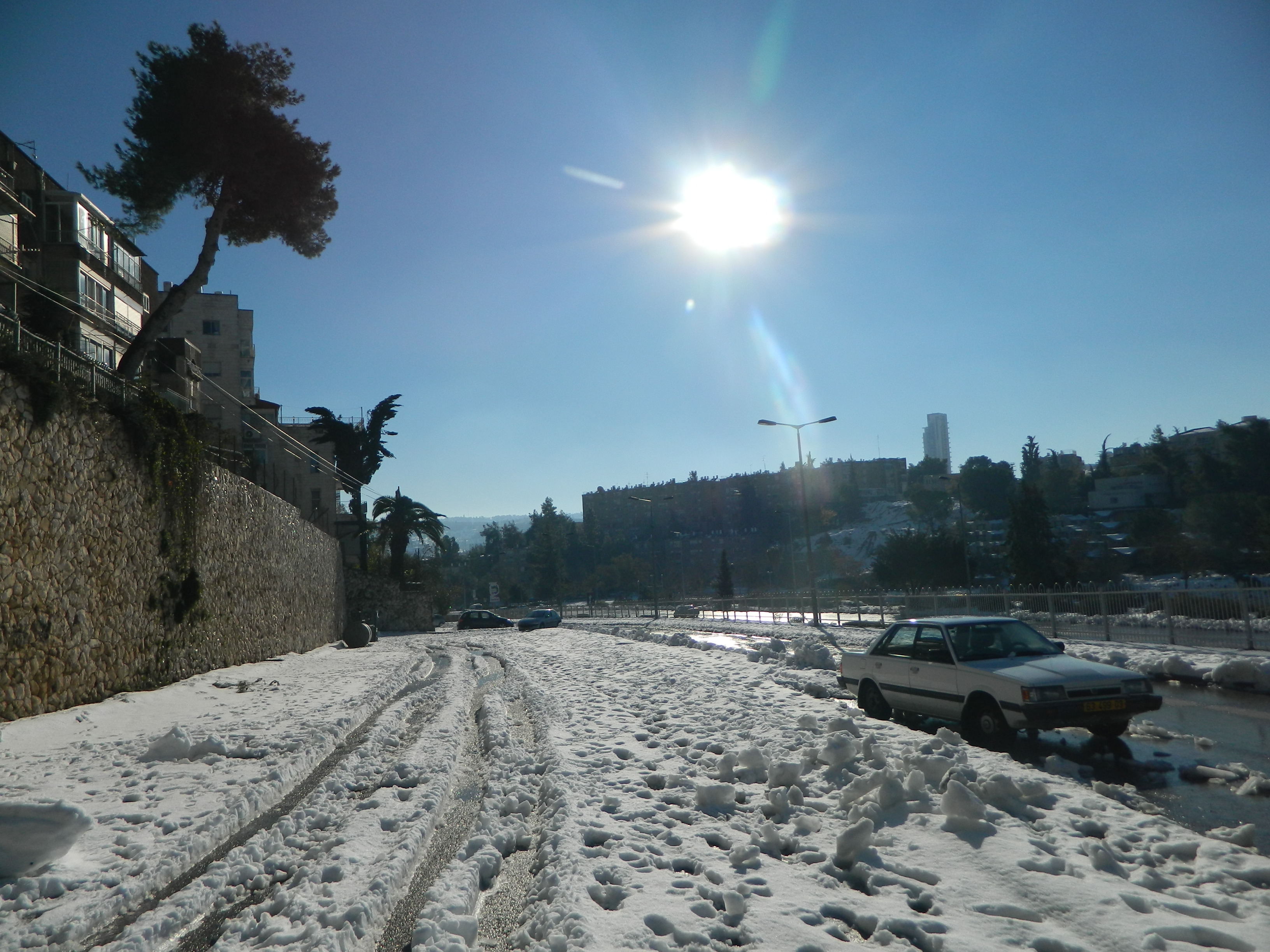
This blog post interrupts the three-part “desert adventure” (of which only Ben Gurion: Life and Death and Avdat have already been published, to date) to focus on an event which threw some of the country into shock and the media into a frenzy – the huge snowstorm that hit Jerusalem. We in Ma’alot got a little dabbling of snow over the weekend, but nothing like the two feet of snow the capital got. The snowstorm got so intense that the city was effectively shut down and isolated, the army (Homefront Command in particular) brought in and four people even died. Thousands if not more spent Shabbat without power and so, in the wake of the storm I did go, visiting “Jerusalem of White” to see it for myself.

Snow-covered train tracks in Jerusalem

Snow-covered train tracks in Jerusalem

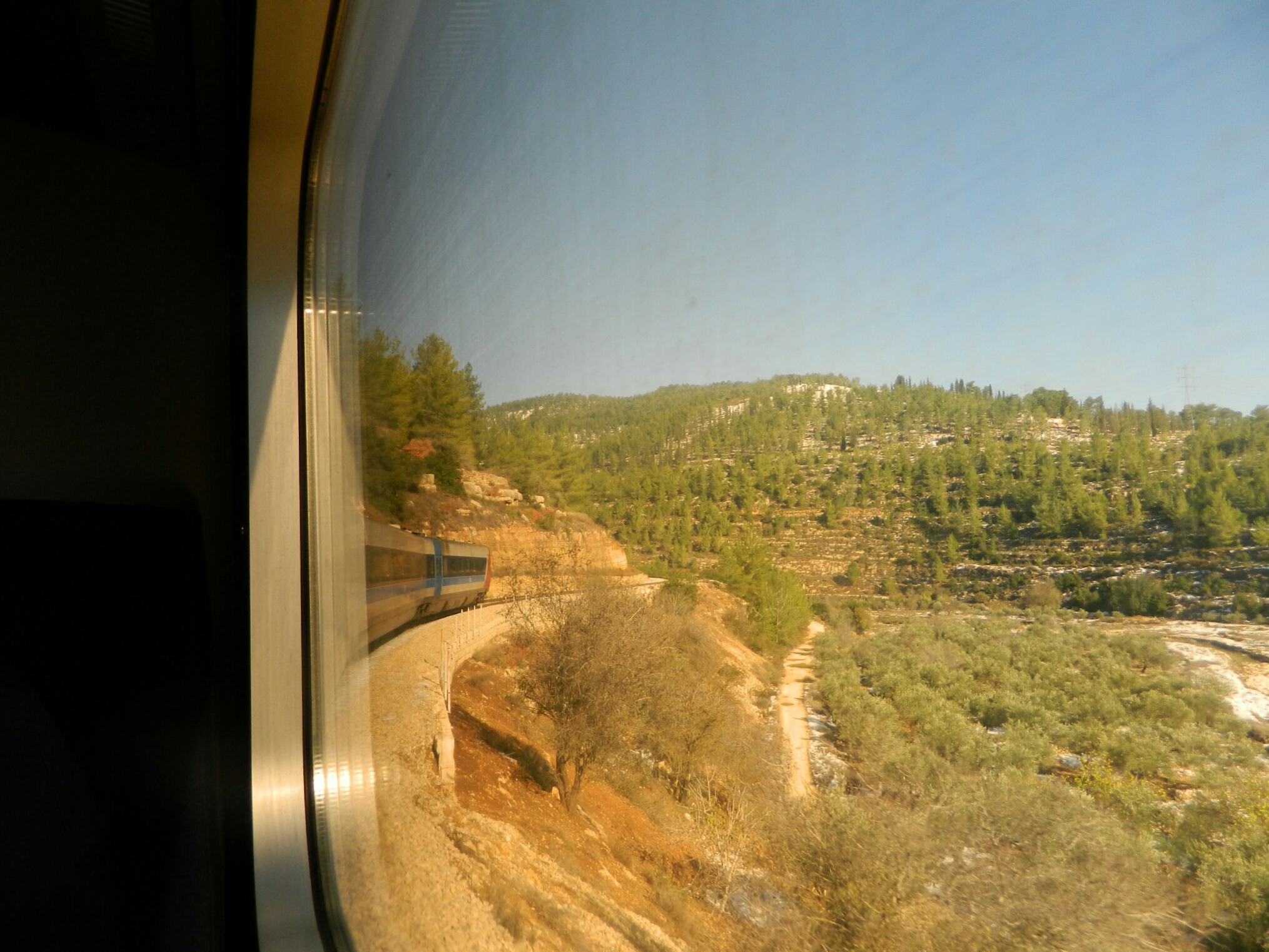
Part of a huge storm that hit the Middle East, the Golan and Upper Galilee region were hit with even more snow (those living in Tzfat had similar troubles to those in Jerusalem) but I was already headed down south on military business. I took the train from Tel Aviv to Jerusalem, hoping that the mountainous route would be spectacular but to my surprise there was almost no snow until we reached the Jerusalem Malcha station.

Approaching Jerusalem by train

Approaching Jerusalem by train

Waiting around to see whether or not the buses were running, I was asked by an American fellow for bus help. Then an Oriental tourist. Then an Israeli family. Pretty soon I was surrounded by a clamoring mass of cold, stranded people all looking to me for salvation. I had to explain that I was not in capacity as “helpers” like those soldiers wearing reflective orange vests from Homefront Command, and that I had no idea about the buses. I then hightailed out of the area, taking the road to the Old City on foot.

Idle Egged buses

Idle Egged buses

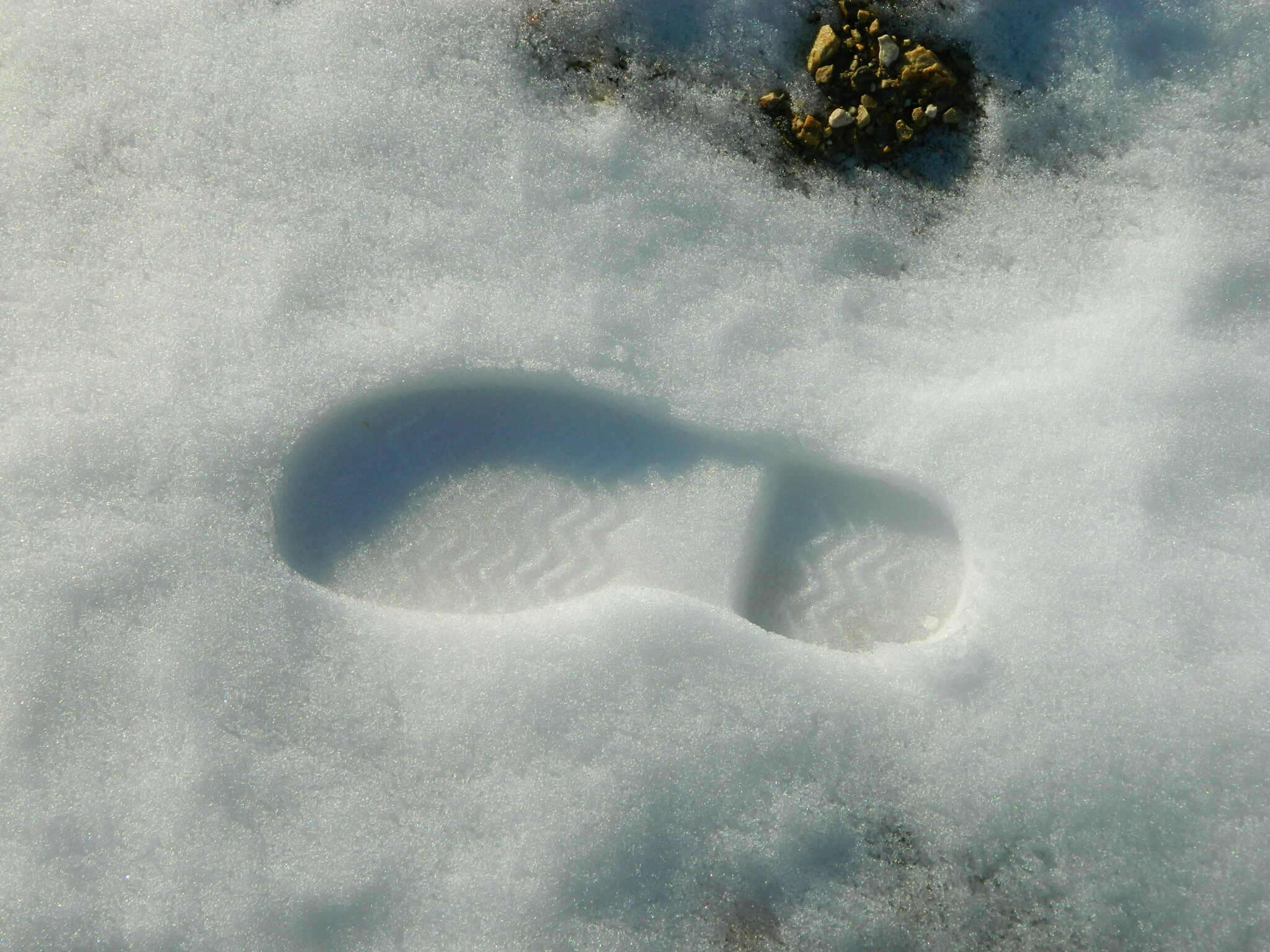
I noticed as I walked that the farther I penetrated the city, the deeper the snow got. I stopped along the side to mark my territory with a footprint – gotta love the feeling of untouched snow crunching underfoot.

Brill boot footprint

Brill boot footprint

I entered into the residential areas, not seeing anything familiar save the big green signs pointing me in the direction of the Old City. At one point, slipping in the snow sliced apart by slushy tire tracks, I turned around and took some pictures.

Snow in the residential areas

Snow in the residential areas

As I walked I passed by people playing in the snow. Whether children lobbing hunks of snow at one another, or rebellious youth carefully sculpting a snowman, the snow brought smiles to so many faces.

Playing in Independence Park

Playing in Independence Park

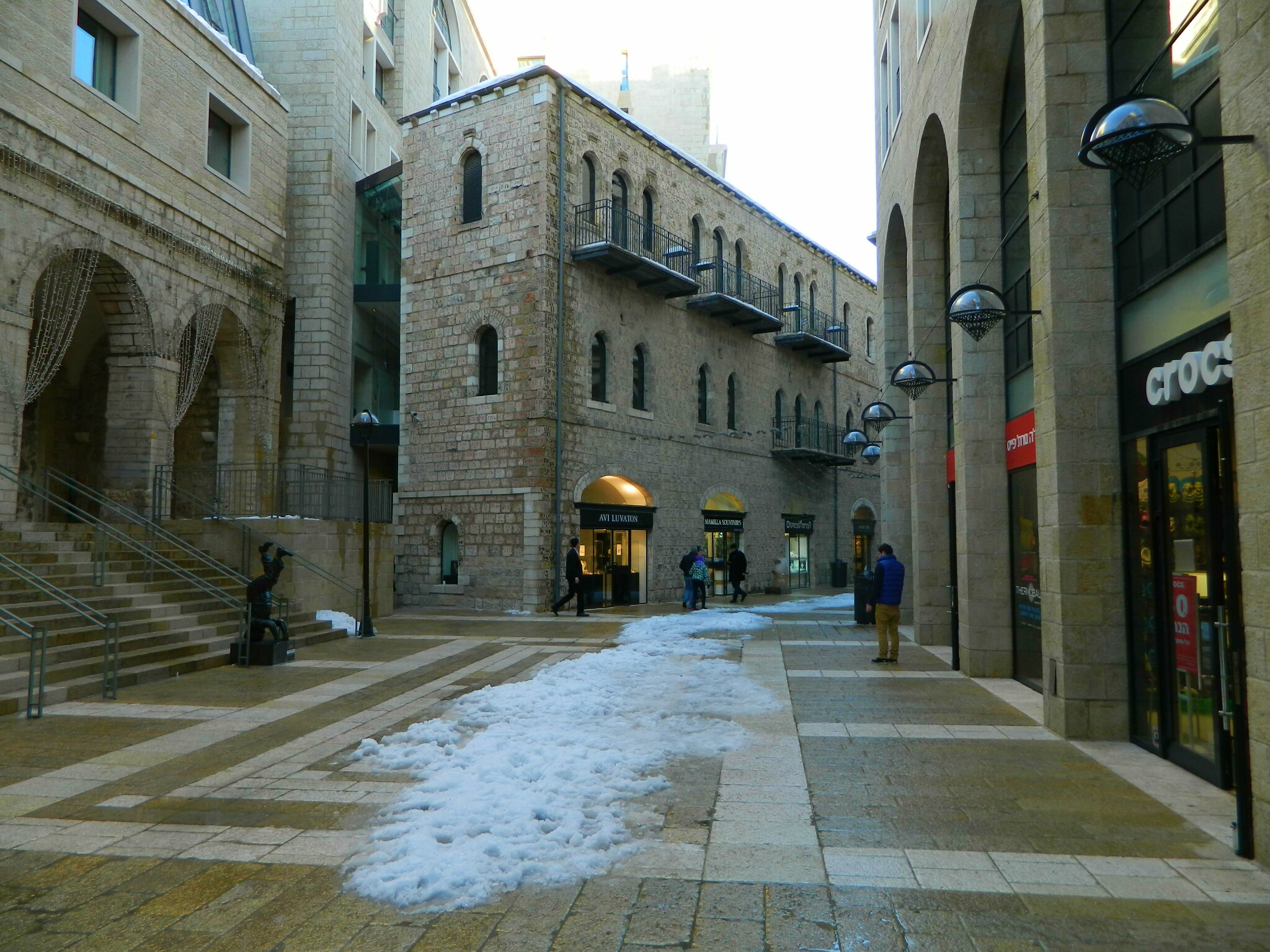
I got stopped by a US Consul guard who informed me that I wasn’t allowed to take pictures of their vehicles, their guard booths or their building. I explained to the cautious man that I was an American so it should be fine. We had a laugh and I found out he was stationed in the sister-base of mine down south, although in Givati (Infantry) Special Forces. With that I smiled, wished him a joyous guard shift and continued down the road to the Old City. Before long, I entered Mamilla Mall – from there it already feels like the Old City.

Mamilla Mall with some snow

Mamilla Mall with some snow

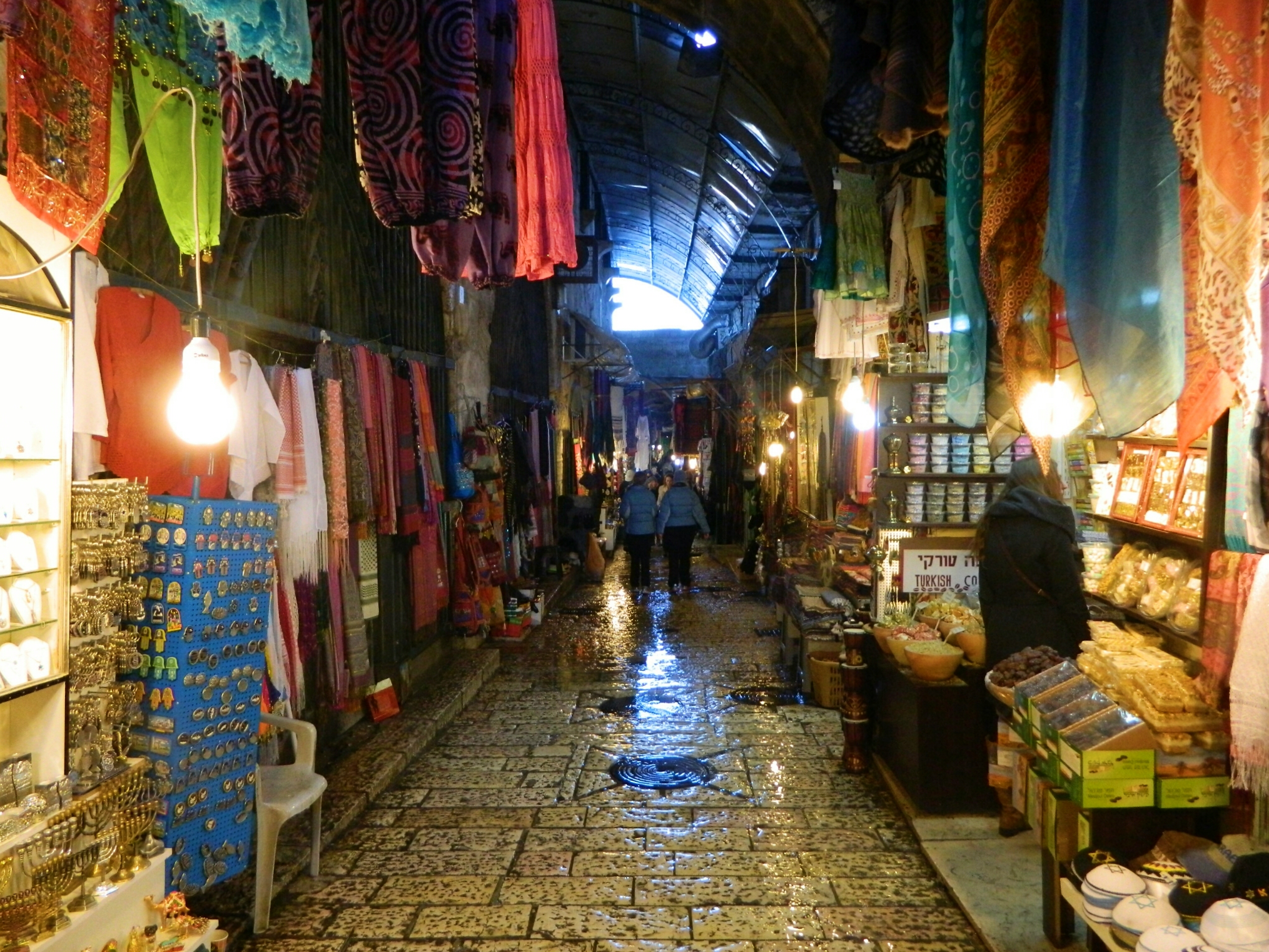
After slipping too many times to count in the snow/slush/ice I had a very close call in Mamilla, in front of a lot of people. Thankfully, I did not capsise and continued on to Jaffa Gate with honour intact. I entered the Old City and began the maze that leads to the Kotel (Western Wall). As I walked over the slippery wet stone floor  in the narrow alleys and corridors, I realised how nice the endless Arab shuk (or shall I say, souk) looked with everything all gleaming from the melted snow – here’s what I saw:

Glistening Arab shuk

Glistening Arab shuk

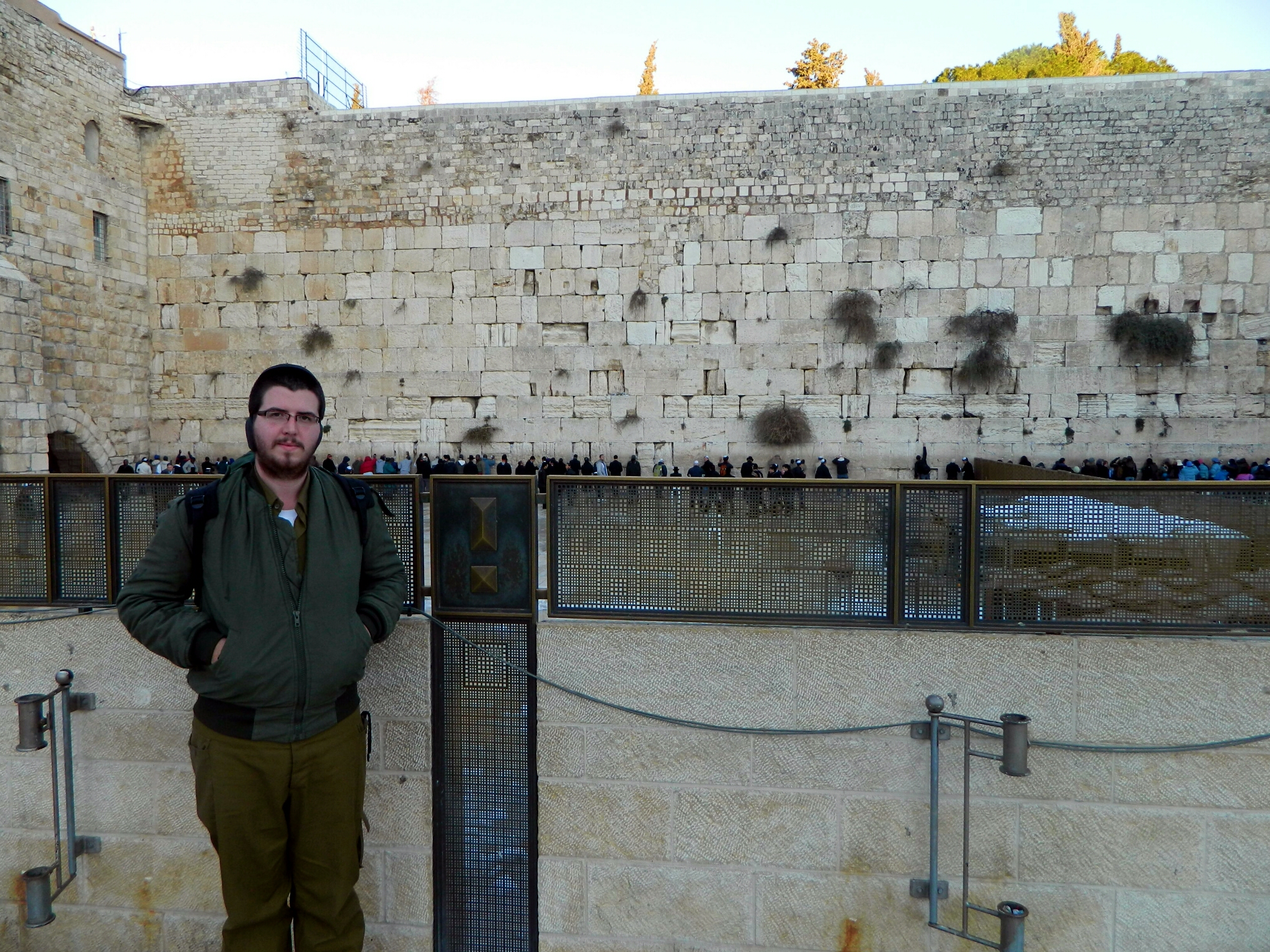
At last, after over seven kilometres (approx. four miles) of somewhat laborious walking, I reached the Kotel. There I relaxed, prayed and had some European guy take my picture. I was hoping to be able to see some snow in the photo but the local workers washed it all away with huge hoses (leading to another problem: ice).

Cold at the Kotel

Cold at the Kotel

Choosing this time to walk through the Jewish Quarter, I climbed up the stairs past groups of bundled-up tourists and stopped on a particularly icy landing to take this photo of the moon coming up over the mosque dome and minaret:

Moon over mosque

Moon over mosque

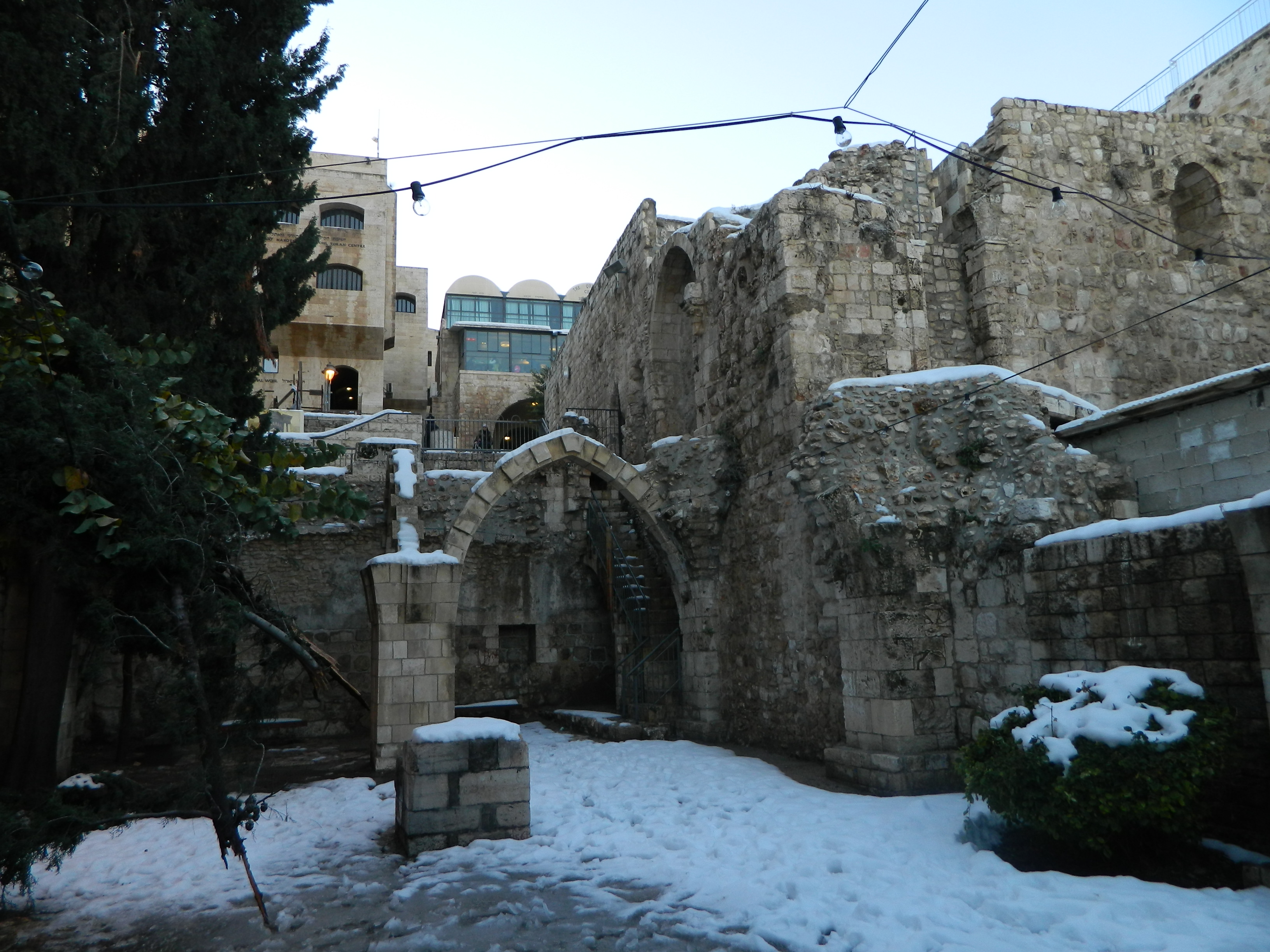
Moments later, I came upon something I was hoping I’d see, a chunk of old Jerusalem ruin covered with snow. The angles offered to shoot the arches weren’t promising but I tried to capture the setting the best I can:

Snow-covered ruins in the Old City

Snow-covered ruins in the Old City

I stopped for a bite to eat as the sun went down and then continued on through the Jewish Quarter, walking down the narrow corridors to the Jaffa Gate (I still don’t really know my way around the Old City and that usually results in me blindly following people as they turn corners here and there all willy-nilly).

Narrow corridors at dusk

Narrow corridors at dusk

Once I’d exited the Jaffa Gate I seized the opportunity to photograph the last moments of light standing over the traffic on the bridge that connects Mamilla to the Old City.

Traffic and snow in the last minutes of light

Traffic and snow in the last minutes of light

I then turned northwest and headed up Jaffa street, following the tracks of the light rail – closed down due to the weather. It was a cool feeling strolling with all walks of life down the partially cleared street; there was a quiet in the air and little clouds kept coming out from each and every face.

Jaffa Street and an idling light rail train

Jaffa Street and an idling light rail train

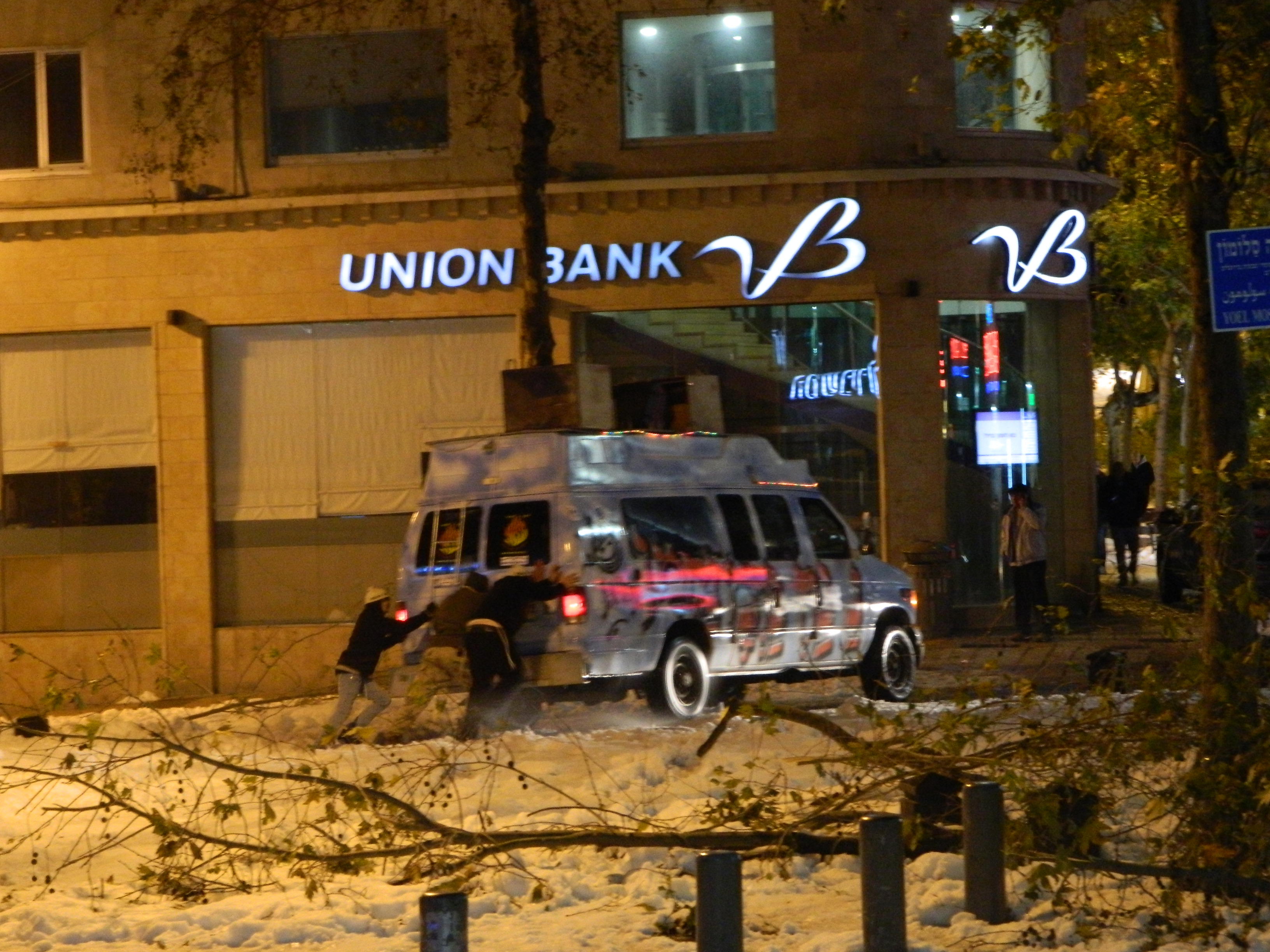
At one spot I noticed a commotion going on at the side. A Breslov “Na Nach” van had gotten stuck in the snow (or something) and they had to push it free – if only they would have worked to music, like they always play.

Breslov ''Na Nachs'' having car trouble

Breslov ”Na Nachs” having car trouble

After walking some four kilometres (2.5 miles) from the Kotel to the Central Bus Station, I reached the third floor where the 480 bus to Tel Aviv departs from, to hear an announcement that due to the weather and police advice all intercity buses have been canceled. That left me with just the train, which is in the far southwest corner of the city. With no energy to walk that, especially after already walking eleven kilometres (seven miles) that day in Jerusalem alone, I kinda lingered around waiting for a local bus that headed that way. Cold and tired I waited… and waited. At last I found a bus that eventually reached near the train station. I hopped aboard, found a seat and had an interesting conversation with some local youth. An hour later I was in the train station and 8.5 hours after my return trip began I was home. What a trip!

Army Trip: Mount Herzl

In Israel, Jerusalem on March 3, 2013 at 5:18 AM

Sometime in the middle of this past week I was taken on a little trip to the holy city of Jerusalem. The objective of the trip was one of honour, to attend the memorial of a fallen soldier. This soldier, by the surname of Avner (I am reluctant to divulge his full name without permission from the family), was a truck driver from my Logistics base, Tirah (“Northern Knights” 6910 battalion). A reservist returning for duty during the First Lebanon War, Sergeant Avner left Tirah base driving a “Safari” truck. For those who know their history, there was an “incident” known as the “Safari Disaster” where twelve soldiers were killed and fourteen were injured. The story, featuring our Sgt. Avner as the truck’s driver, goes as follows.

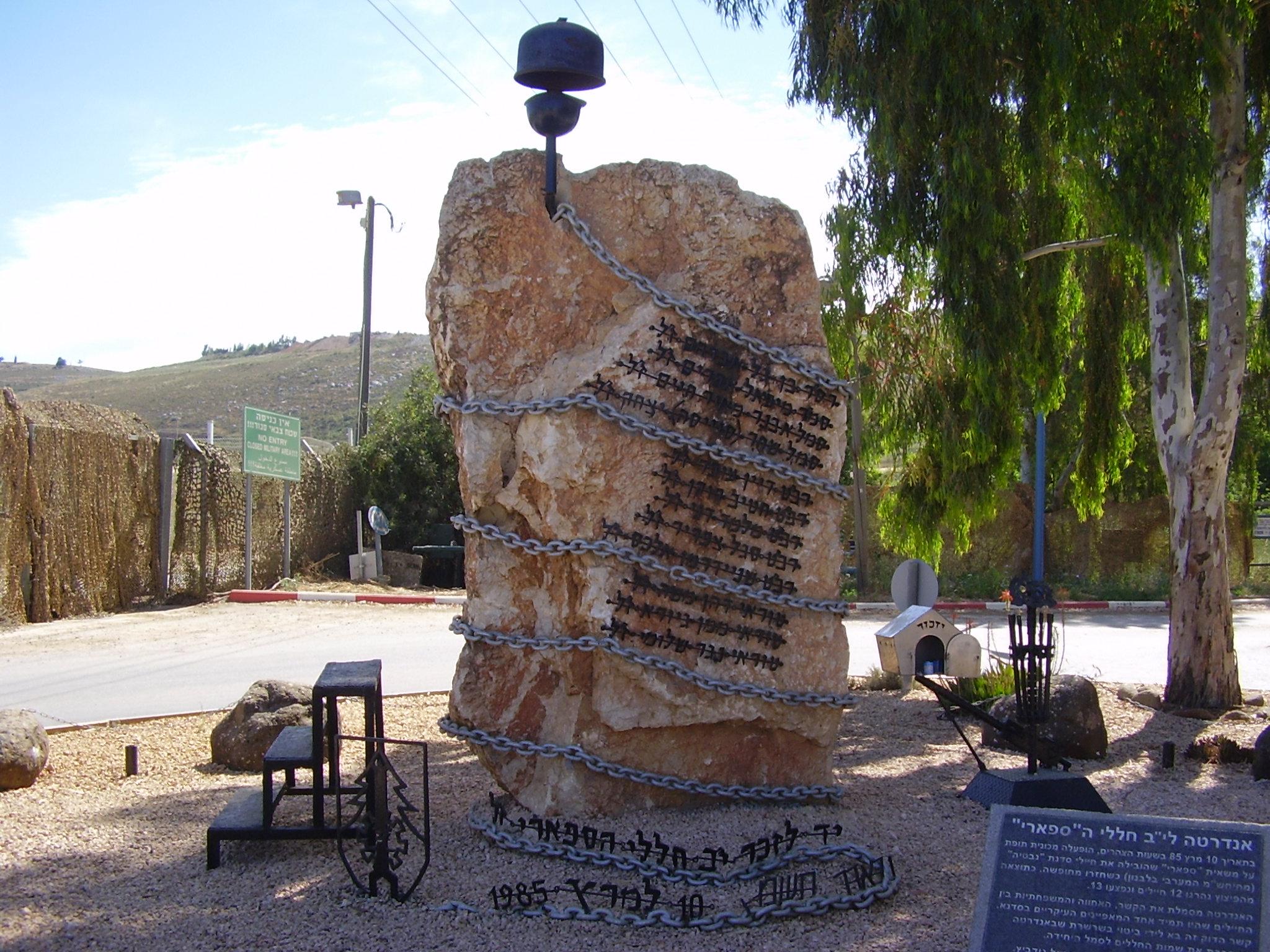
The Safari Disaster Memorial in Metula

The Safari Disaster Memorial in Metula

It was Sunday afternoon, March 10, 1985, and Sgt. Avner began his day at the Tirah Logistics base, as his older brother told me before the memorial service. His mission was driving his “Safari” troop carrier truck, loaded with combat soldiers dressed for battle, from the border town of Metula to the Lebanese village of Marjayoun. Already over the border, the convoy he was in encountered a red Chevrolet pickup. The driver of the pickup waited as the convoy passed, looking mighty friendly until he blew his car up – just as Sgt. Avner’s “Safari” was driving by. The huge explosion sent the seated soldiers flying through the air, and even windows back in Metula were shattered from the shock wave. As mentioned above, the death toll was severe. Speaking of explosions, an aquaintance of mine who served in the Combat Engineering Corps, related to me stories about the unassuming force of an explosion’s shock wave. With plenty of experience with explosives, this particular soldier would be an authoritative figure, as would anyone after blowing up piles of old mines – after removing them cautiously from the ground.

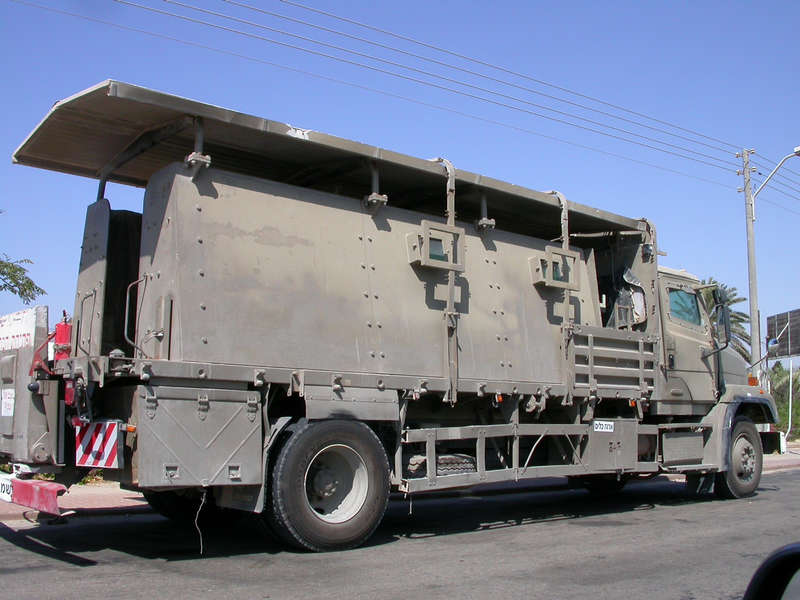
''Safari'' truck

”Safari” truck (not my photo)

Oddly enough, I had never heard of the “Safari Disaster” and was thereby quite intrigued when hearing a brief overview of the story during the ride. Being a representative of the IDF, to pay respects to our fallen heroes, is an experience that should be cherished – in fact, my CO knew I’d be interested and thus sent me along. After the pleasant drive from the base to Jerusalem, we – a handful of soldiers and an officer – drove through neighbourhoods that I recognised yet, despite my frantic crowd-scanning, I did not see anyone I knew. At last we arrived at the Mt. Herzl military cemetery and disembarked from the vehicle. We buffed our boots to a mild gleam and put on our berets, waiting patiently for the family and friends to amass.

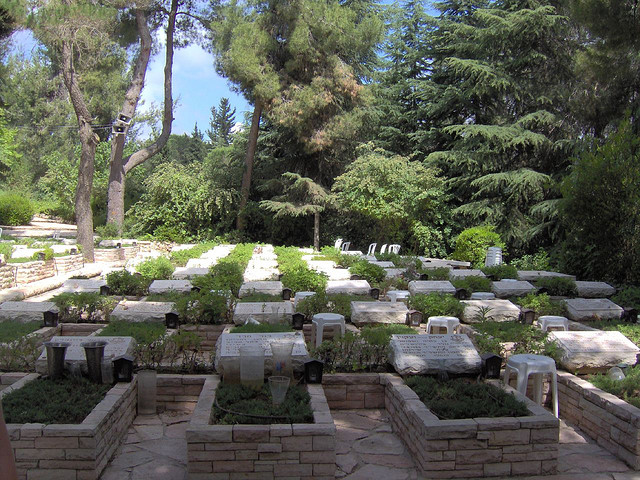
Military cemetery

Military cemetery

At last we entered the cemetery and headed for the plot belonging to Sergeant Avner. Standing a bit off to the side, the small group of us stood respectful and silent as the service began. A military man led the memorial, his deep voice lending to the somberness of the situation. As I looked around me, at the people – of wildly different appearances, at the gravestones, and at the peaceful surroundings, I wished I could whip out my camera and capture, somewhat, some of the experience. However, as a representative of the IDF, and, in particular, of my battalion, the photography would be breaking rank, and unprofessional. A few people said a few short words, a slightly choked kaddish was said and before long we were departing. But I had not had my fill. I happened to have noticed one of the attendees speaking Hebrew with an American accent (oh, how we stick out!) and so I approached her. After offering her a tissue, which she refused, I asked her about her connection to the family. She, as it turns out, is a sister-in-law of Sgt. Avner. I asked her about him and she told me that he was killed shortly after her wedding…

Mount Hertzl (photo by joshuapaquin, Flickr)

Mount Hertzl (photo by joshuapaquin, Flickr)

One thing that I found very interesting, and in fact took the time to mention it to a friend, is the sameness of the graves in a military cemetery. Soldiers, officers and even chiefs-of-staff are all buried in the same manner, all with the same headstone. Just a few plots over from Sgt. Avner was a Lieutenant Colonel – the rank of a battalion commander. We suggested that the ranks were only considered “important” for the living, because beneath the rank, beneath the uniform, lies an human – and a Jewish soul. Who’s to say who deserves more honour when all is said and done?

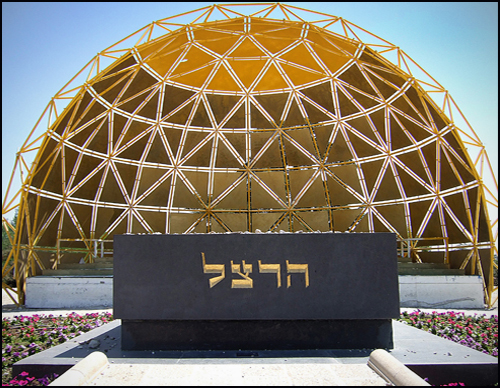
Herzl Memorial

Herzl Memorial (Flickr)

In the various sections of the cemetery, there were all sorts of memorials and such which I would have loved to have looked at. Who can resist such a intense glimpse into the past, into the blood-soaked history of modern-day Israel? Alas, such is the way of the free man – to gaze around at ease – however, I was on a “mission” and had to be on my way. Hopefully one day I shall return, on shall we say, a happier occasion.

Army Trip: IDF History Museum, Yad VaShem & Ammunition Hill

In Israel, Jerusalem, Tel Aviv on November 11, 2012 at 6:22 AM

During the course of the army, no matter how long one serves, he or she is going to be taken on a variety of trips around Israel. Many of these trips are to historical locations, others are culturally oriented and some are just random trips. This past week, still in basic training, we had the opportunity of visiting three interesting sites: the IDF History Museum in Tel Aviv, Yad VaShem Holocaust museum and Ammunition Hill both in Jerusalem. Due to the fact that I am in basic training, photography was difficult so I have culled most of the following photos from the Internet. The first of these trips was to the IDF History Museum in Tel Aviv, a museum I’ve been wanting to visit for some time now.

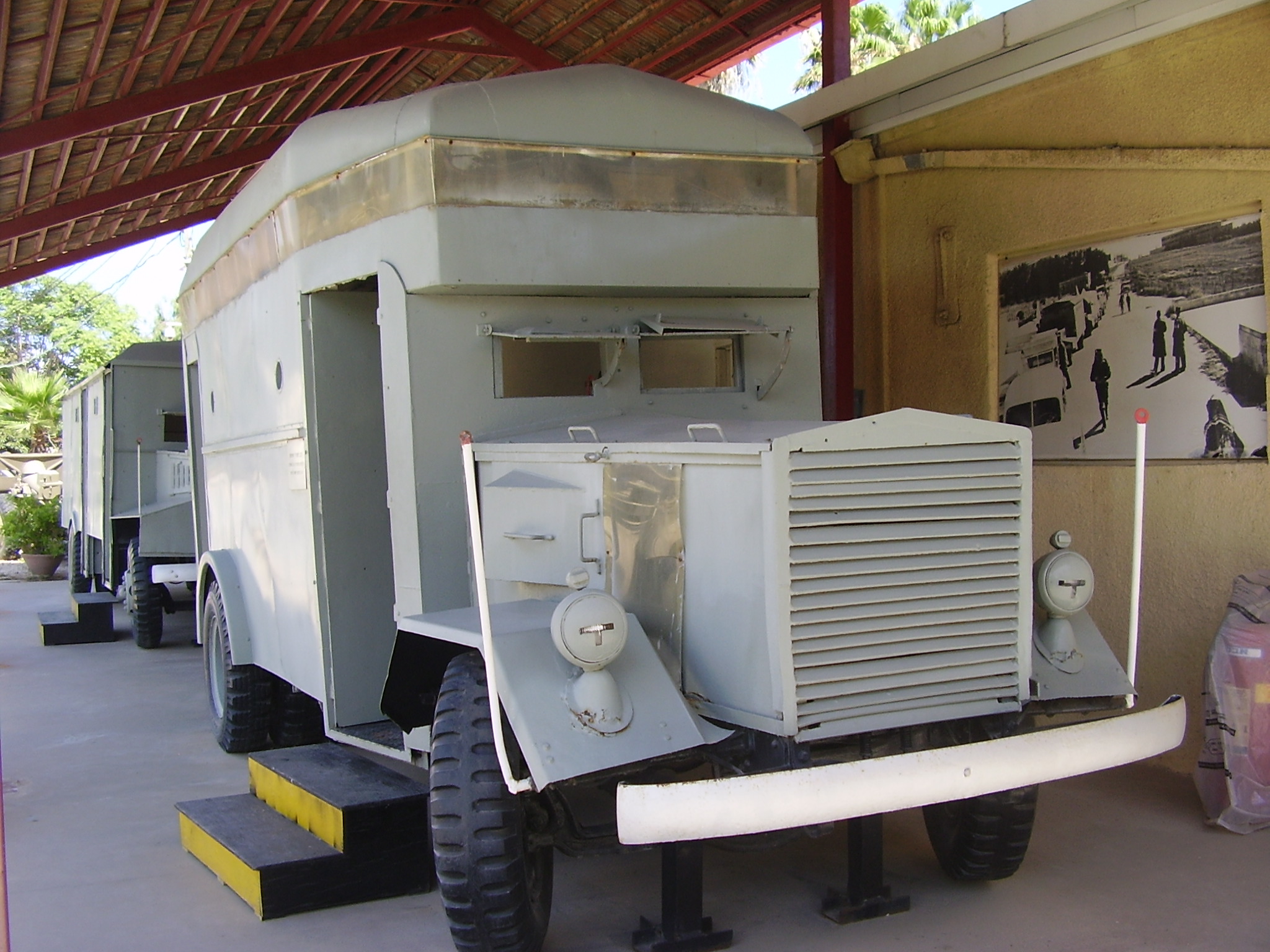
Armoured buses

We toured several exhibits of the large museum accompanied by a knowledgeable docent. Our platoon of 27 soldiers and four commanders/commanding officer was joined by similar numbers from two other army bases, the Central and Southern counterparts to our Northern base. We strolled through the museum’s grounds en masse, observing the numerous military artifacts.

Willys Jeep from the War of Independence

As we went from building to building, the docent relayed many interesting stories and historical tidbits which I found to be quite interesting. I would have gladly stayed much longer, to properly enjoy the museum but I was just a pawn on someone else’s schedule so I was limited to what was offered.

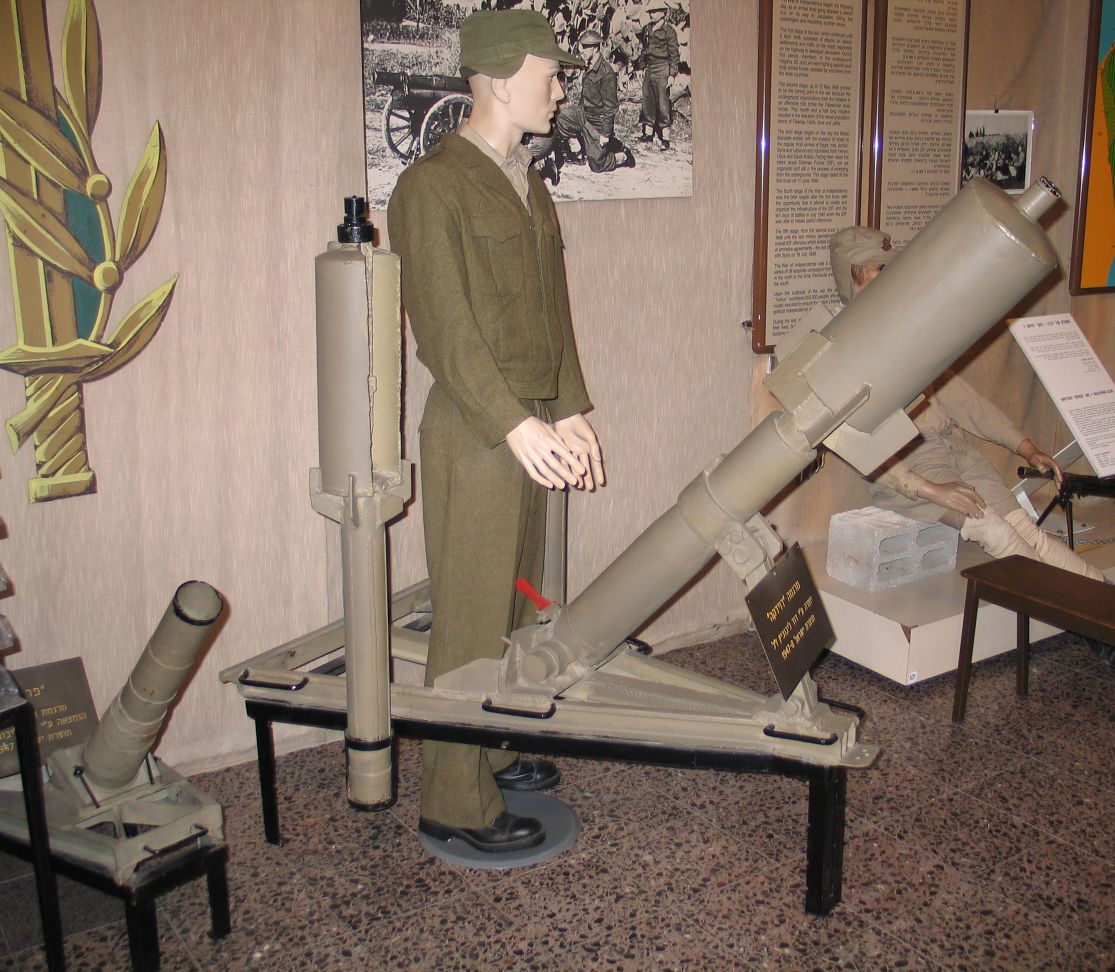
Museum display

We were rushed out of the museum prematurely and had to return to our respective bases but I plan on going back and catching up on what I’ve been remiss on seeing all these years that I’ve been here.

The next trip we took was to Jerusalem where we visited two sites, well really it was 1.5 due to time constrictions, and then headed back to the base. The most famous Holocaust museum, Yad VaShem, was first and there we had a great guide who zipped about from exhibit to exhibit pointing out the poignant details and shedding light on the great tragedy that many people don’t know much about. To clarify that last sentence, there are a few Bedouins and Druze sprinkled into our ranks, some of them volunteers and others conscripted along with the Jews. Here are two Muslim Bedouins from my platoon, the one on the left is quite the jester and told me after I took his photo that I can tell my parents I took a picture of an Arab. Speaking with a heavily accented Hebrew, that remark was quite humorous and we all laughed, some more awkwardly than others.

Two Muslim Bedouins in my platoon

Once inside the museum I was pleasantly surprised to see how much interest some of the Arab soldiers were taking in the sad tale of carnage and destruction. One particular Bedouin was quite engaged in the terrible stories the guide told us, but he wasn’t the only gentile in the building. Walking slightly behind us was an Italian admiral, his sidekick senior officer, an Italian non-com and the Israeli party of a naval captain, a lieutenant and a seaman taking pictures. This entourage was quite interesting to watch and I had to ask my commander which navy the foreigners were hailing from.

Yad VaShem memorial (Photo: Adam Jones, Flickr)

Despite the fact that this was my second time in Yad VaShem, I had an interesting experience. An American woman came over to us and seeked out an English speaker. Once I was her captive audience she began to tell me about how her father recently passed away and that after his death she found pictures and letters that pointed her past to the Holocaust, something she didn’t know beforehand. She showed me the photos of her family members and then ran off, not wanting to get too separated from her tour group.

Break time outside Yad VaShem

After the museum tour we went out and had lunch. During that time I took the liberty of getting a photo of me with my “dress” uniform on (there are two types of uniforms: dress and work):

Standing at Yad VaShem

After Yad VaShem we headed over to Ammunition Hill, an important battle site which helped secure the full re-capture of Jerusalem during the Six Day War in 1967. Due to time constraint we only got to see the interactive video about the war and the battle that took place below our feet. Having already seen the actual site (and not the video) when my Yeshiva here took us to Jerusalem, I was satisfied. However, I must say, the video presentation at Ammunition Hill is absolutely amazing, a work of art.

Ammunition Hill (Photo: Simnatic, Flickr)

As the video played lights and lasers danced on a large metal topographical display of 1967 Jerusalem. The fierce battles between the Israeli and Jordanian forces were shown out in full colour, the Israeli blue gradually conquering the Jordanian red. As we watched the light-created tanks climb up hills and enter the populated areas we looked up and saw actual footage from the battles for Jerusalem. The full excellence of the presentation is hard to put on paper, so to speak, so I strongly recommend a visit.

Tank from the battle (Photo: Simnatic, Flickr)

After quickly rushing back to our special white army bus, the non-com who brought us drove us back to our base for an early bedtime – something to look forward to in the army!

Jerusalem Woodstock Revival

In Israel, Jerusalem on August 3, 2012 at 6:50 AM

Thursday, the day that was yesterday (and the last day of my trip), revolved around one special event: the Jerusalem Woodstock Revival. The fourth one as of yet, these revivals have attracted local musicians who have great interest in the music of those days. On the evening’s program seven acts were listed, covers ranging from Neil Young to Jimi Hendrix to The Grateful Dead. As soon as I successfully managed to find the Kraft Stadium, the venue, I found that I wasn’t late as I suspected but that the performances were just beginning.

Jerusalem Woodstock Revival IV poster

Up first was Maya Johanna Menachem with Shai Tochner and friends. Performing a range of songs from the likes of Bob Dylan, Joan Baez and others, Maya sang and Shai strummed (occassionaly also treating us to simultaneous guitar and harmonica music). Sadly, many of the songs that she sang were unknown to me so I couldn’t tap my feet along. I guess it is my fault for having neglected these musical masterpieces, the hits of the 60s and 70s. Regardless of the lyrical content, Maya has a great voice and it was a really good, low-key opening act – as a teaser to open the eardrums for the heavier rock yet to come.

Maya Johanna Menachem

It was during the first act that the place began to fill. I was surprised at the diversity of the attending crowd; from the old people who may have actually been at the original Woodstock, to the young adults who grew up listening to this music and the children who mostly came for the activies, picnics and social camaraderie. It was a great blend, something that really made it interesting.

The crowd starts to build during the first act

As the crowd grew, and I was closed in on all sides, the sun’s daily setting procedure began to quicken in our eyes and the shadows grew long over the stage. Michael Greilsammer came onto the stage with his band members and began to belt out some Led Zeppelin. Starting with the raucous song “Black Dog” I began to actually “come alive” with the music. Listening to the original version now as I write, I must say that Michael was great, his voice seemed really well-trained in the exact vocal nuances that made his cover seem so authentic.

Michael Greilsammer

When Greilsammer was done, the crowd roared in cheer and someone announced that this was the first Led Zeppelin concert they have ever been to – possibly the greatest compliment one can give to a cover band. Following Michael’s enthralling performance was the biggest star of the evening, Geva Alon. Having played at the first Jerusalem Woodstock Revival, Geva was more than welcome to come treat the crowd with his covers of select Neil Young hits. I know very little of Neil Young’s work but I could appreciate the solo effort Geva made as he entertained the crowd on his lonesome. I really enjoyed his guitar riffs, done on a plugged-in acoustic.

Geva Alon

During Geva’s performance I had the brilliant idea of getting my program sheet autographed by the performing artists. I confronted Maya first and she was more than happy to sign her name. Michael has already gone so there was only Geva left and he was still onstage…

Maya Johanna Menachem signing my program sheet

When Geva was done he was also pleased to add his name (it is more like a scrawl than a legible name) to my proffered paper. After Geva’s signature I actually abandoned my quest in getting more signatures but at least I got two! Maybe one day it’ll be worth something…

Getting back to the festivities, the fourth act was The Elevators playing Grateful Dead music. Now, I know Grateful Dead but I didn’t know the music that I heard – and I am not really sure why not. With an indifference to my poor association skills regarding oldies, the crowd seemed to really liven up and the inner Deadhead seemed to come out of scores of hopping/dancing people. Photographs of crowds never come out good for me, but here you can see some excitement is involved:

The crowd getting lively with the songs of the Grateful Dead

The Elevators gave a long performance and the crowd didn’t seem to tire a bit. With a half circle formed around the stage several people thick, the barefooted revellers swayed and hopped and swung themselves around languidly. I guess the large quantity of cold beer that seemed to flow like water must have helped fuel the dancing stamina…

Aryeh Naftaly from The Elevators

When The Elevators reluctantly stepped down, the next band was announced: Crystal Ship. Named after one of The Doors’ songs, Crystal Ship was set out to cover none other than The Doors. Since my knowledge of The Doors is about as it as it is with Neil Young, I wasn’t tapping my feet along with the rhythm. But, other people did find themselves aligned with the music – throughout the concert I saw countless attendees just bobbing their heads lightly to the music, their eyes squeezed shut and their lips mouthing the lyrics along. I’m not that guy at the concert – I’m a listener. But, sadly, I couldn’t stay and listen forever – I had to get back to Tel Aviv and I wasn’t ready to wing it with the night-time bus routes.

Crystal Ship

I stayed for two songs from Crystal Ship and then reluctantly made my way out of the stadium. One thing that I didn’t mention before, simply because I don’t remember at what point in the concert it happened, was that I bumped into an Israeli guy who I met some two or three months ago on a bus headed for Meron. I was on a trip in either Tzfat or the Kinneret area (there is a blog post about it in the archives) and he was with his friends getting ready to hike Mount Meron. When I asked him if he’s been hiking there lately, it dawned on him and we both had a good time recalling that interesting bus ride. Such a small world!

Unfortunately for me, I was unable to hear all seven acts of this year’s Jerusalem Woodstock Revival. I missed half of the Crystal Ship act and then two full ones: Libi and the Flashback (playing Jimi Hendrix and Janis Joplin) and Ummagumma (playing Pink Floyd). I would have liked to see those… Perhaps at Woodstock Revival V or VI, or maybe VII, when I am out of the army. Until then, I’ll be forced to listen to recorded 60s/70s music.

Thus concludes my four-day trip “down south”, I hope you enjoyed the daily accounts.