Israel's Good Name

Horvat Hanut & Salvatio Abbey

In Israel, Judea on January 9, 2022 at 9:08 AM

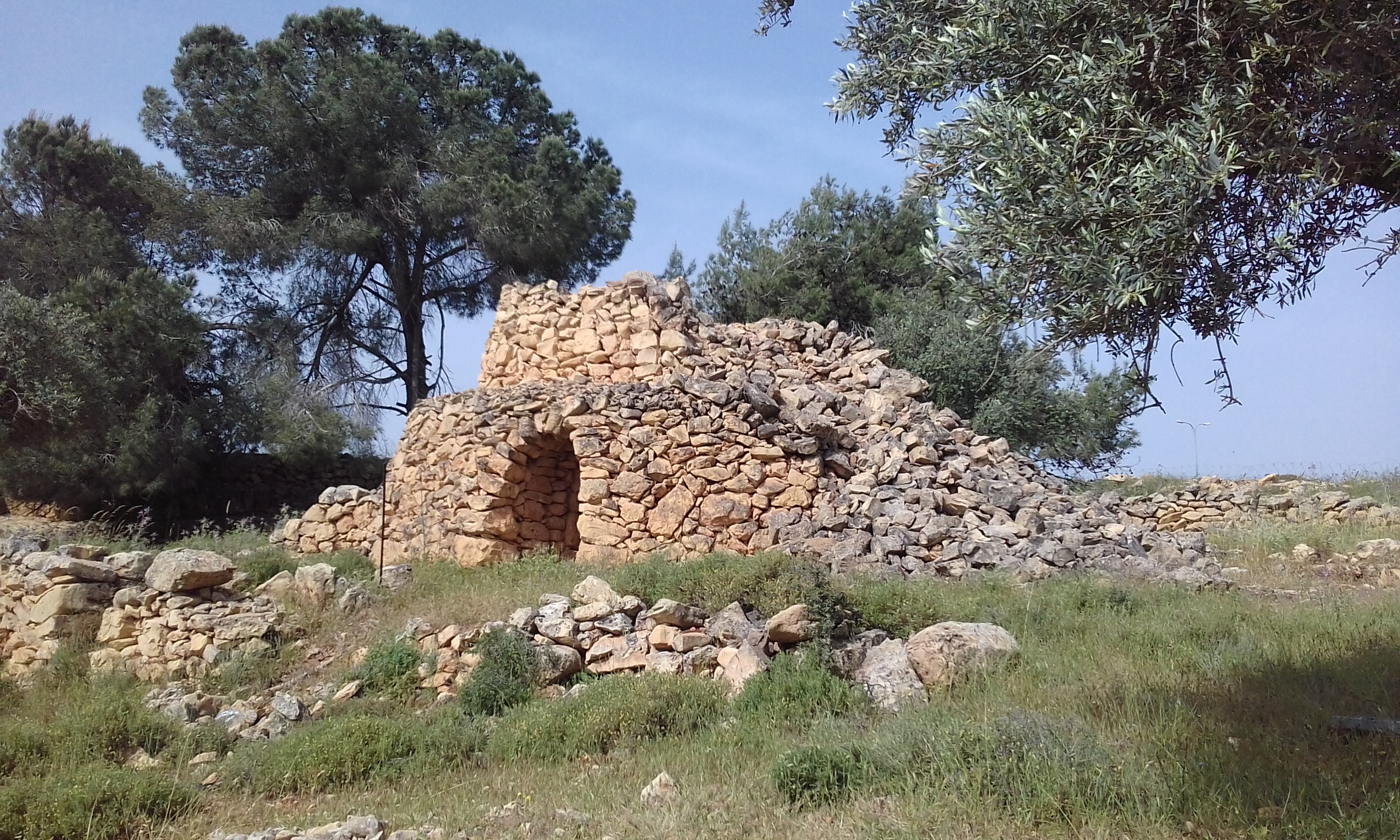
Continuing with my explorations with friend and fellow archaeologist Avner Touitou, we were so inspired by the rich archaeological finds of the region of our last trip – Beit ‘Itab – that we decided to go back. However, this time we fancied the scattered ruins just over two kilometres south, namely Horvat Hanut and the Salvatio Abbey, also known as Khirbet Matta or Horvat Tanur. And so, in early December, we took another Friday morning trip out to the Bet Shemesh region and zeroed in on the collection of intriguing sites.
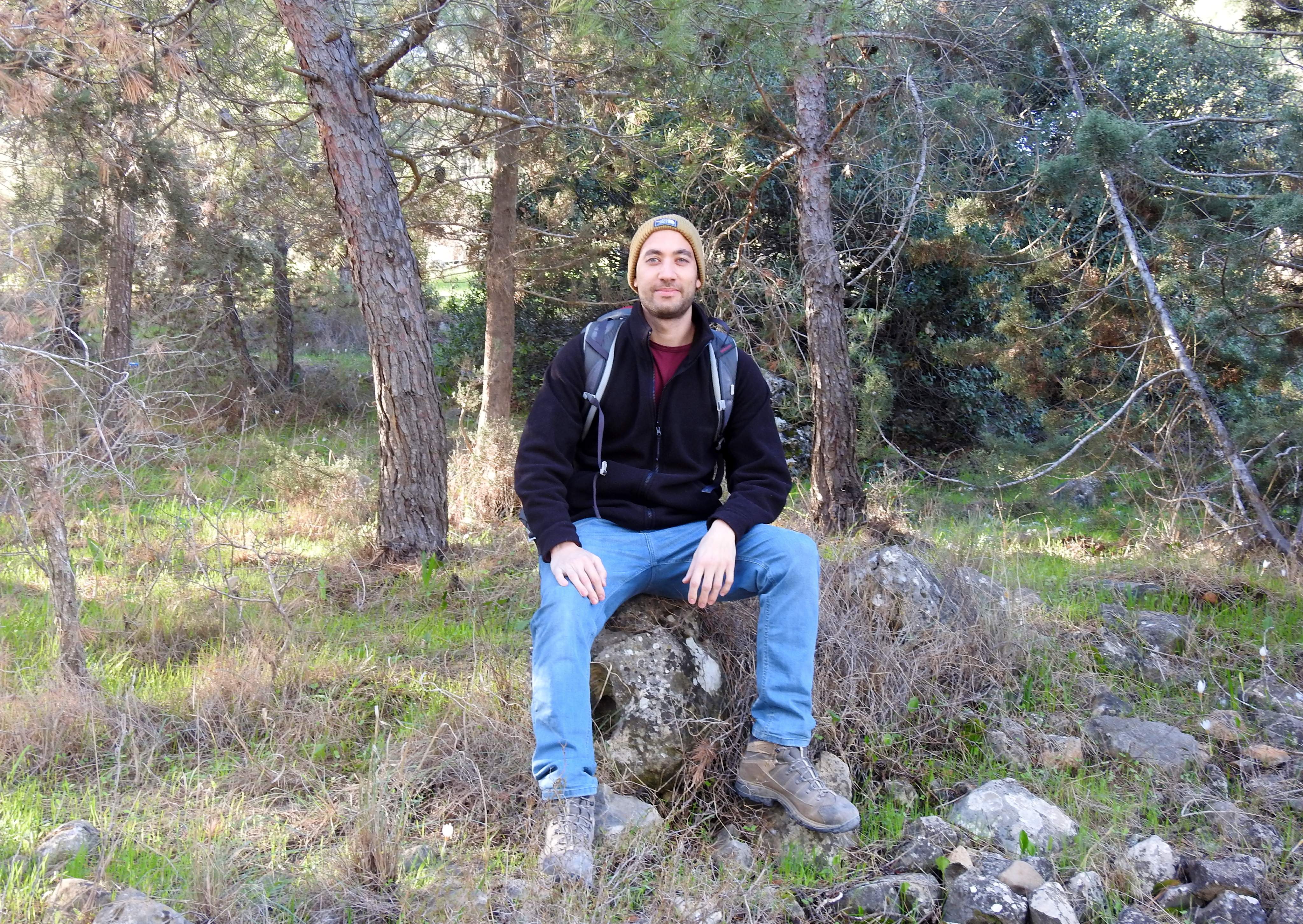
An adventure with Avner

An adventure with Avner

Parking at the KKL-JNF lot for the Matta Forest, we made our morning preparations and promptly began to explore the first site, Horvat Hanut. Also known as Khirbet el-Khan, the site was primarily occupied during the Byzantine period, following the local road being paved during the Roman period, and then rebuilt as a khan (caravanserai) during the Ottoman period.
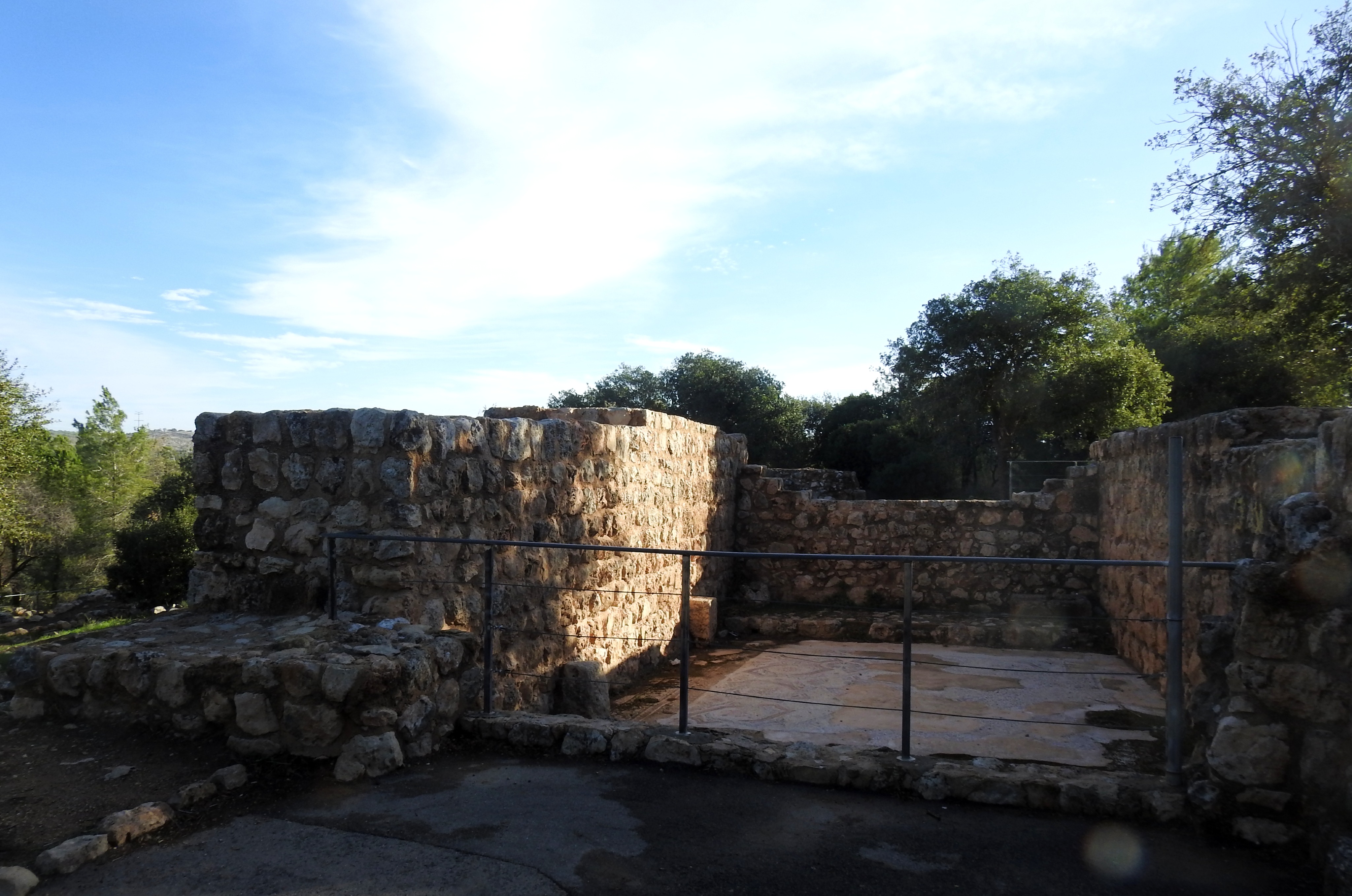
The Byzantine church turned Ottoman khan

The Byzantine church turned Ottoman khan

Of interest was a large plastered pool, a sizable winepress and a church that likely belonged to a monastery. While the Ottomans built their khan over the ruins of the church, the original ornate mosaic floor is still somewhat intact (after extremist vandalisation in 2012), and is wholly impressive.
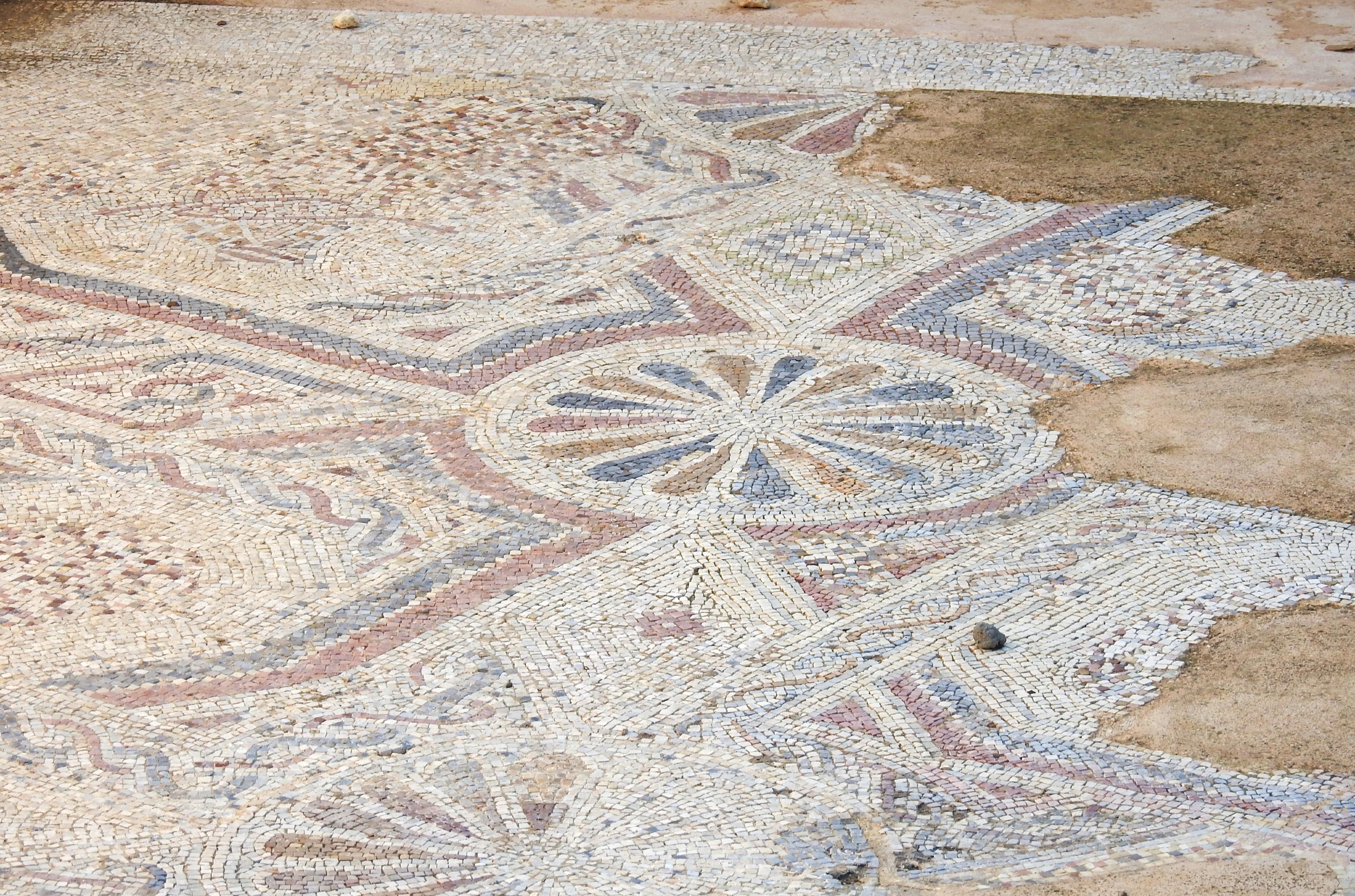
Detail of the Byzantine mosaic floor

Detail of the Byzantine mosaic floor

On one end of the mosaic there’s a Greek commemoration text stating that the floor was laid when Theodoros was head of the monastery, sometime in the 500s CE. Making our way to the far side of the church ruins, we found the crypt where a single sarcophagus was probably stored.
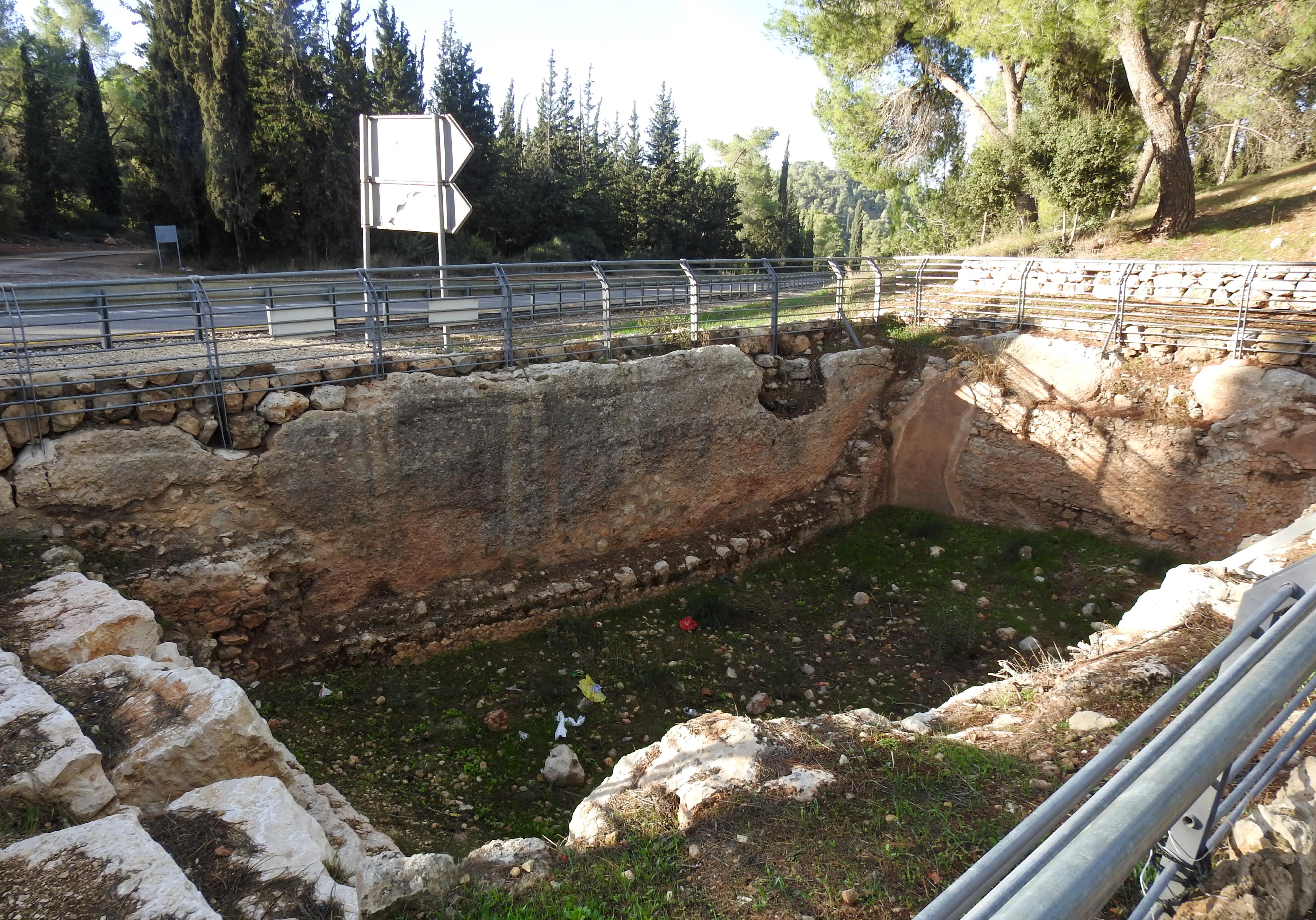
The large Byzantine pool

The large Byzantine pool

Just outside of the church is the extensive winepress installation, a collection of pools and treading floors which were used to help fund the monastery. In true Byzantine fashion, the floors of the winepress were also covered in a mosaic, albeit the simpler, less costly white one that is quite common.
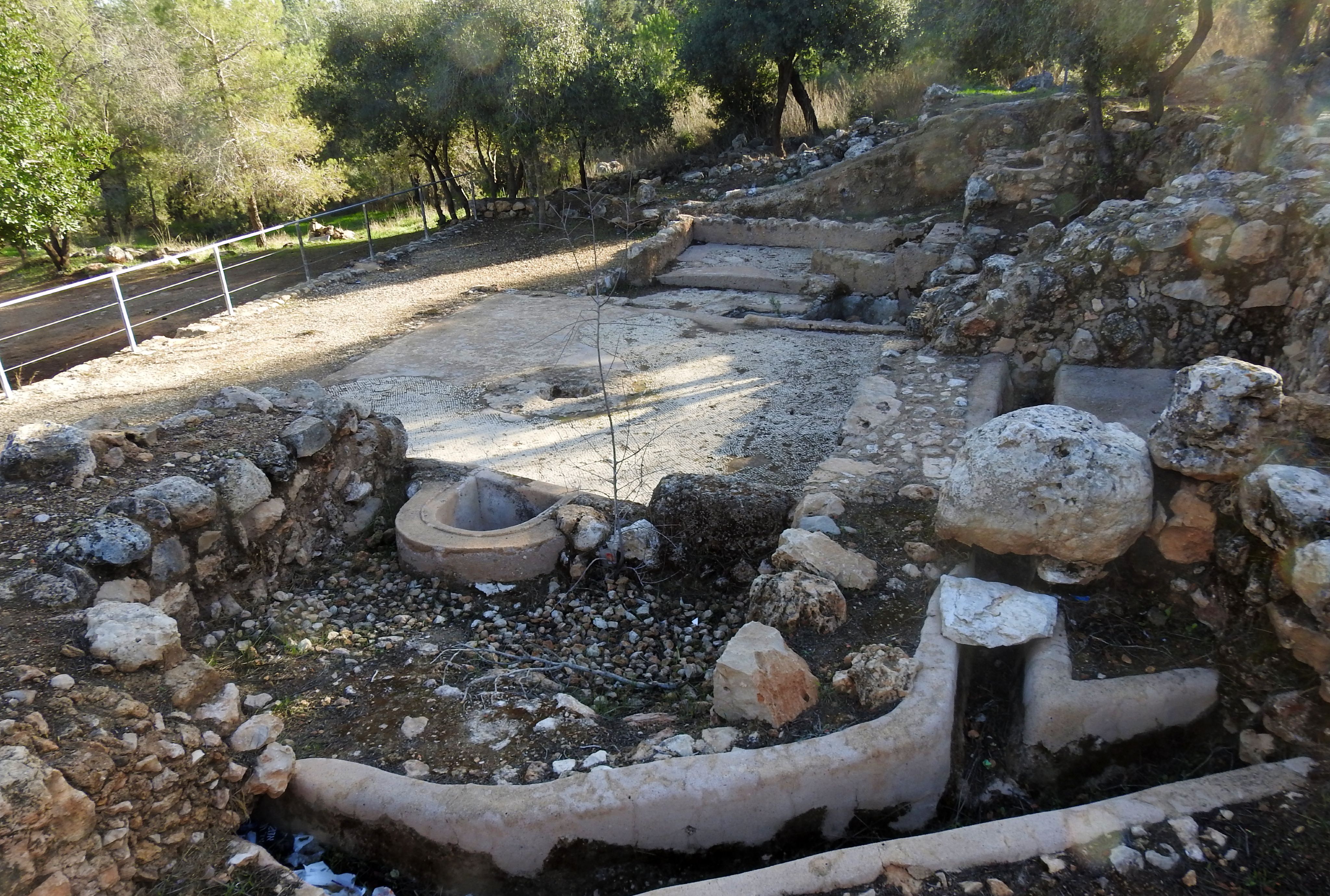
The Byzantine winepress

The Byzantine winepress

From the ruins of Horvat Hanut we began our descent of the hill, towards the other exciting destinations that awaited us. It had recently rained, and the rocks were particularly slick combined with the mud, so the going was slow. Hiking carefully, we breathed in the fresh mountain air and admired the various winter blossoms that had bloomed between the rocks and the trees. As we walked we could spot the various ruins of interest on the opposing slope, which we were soon to explore.
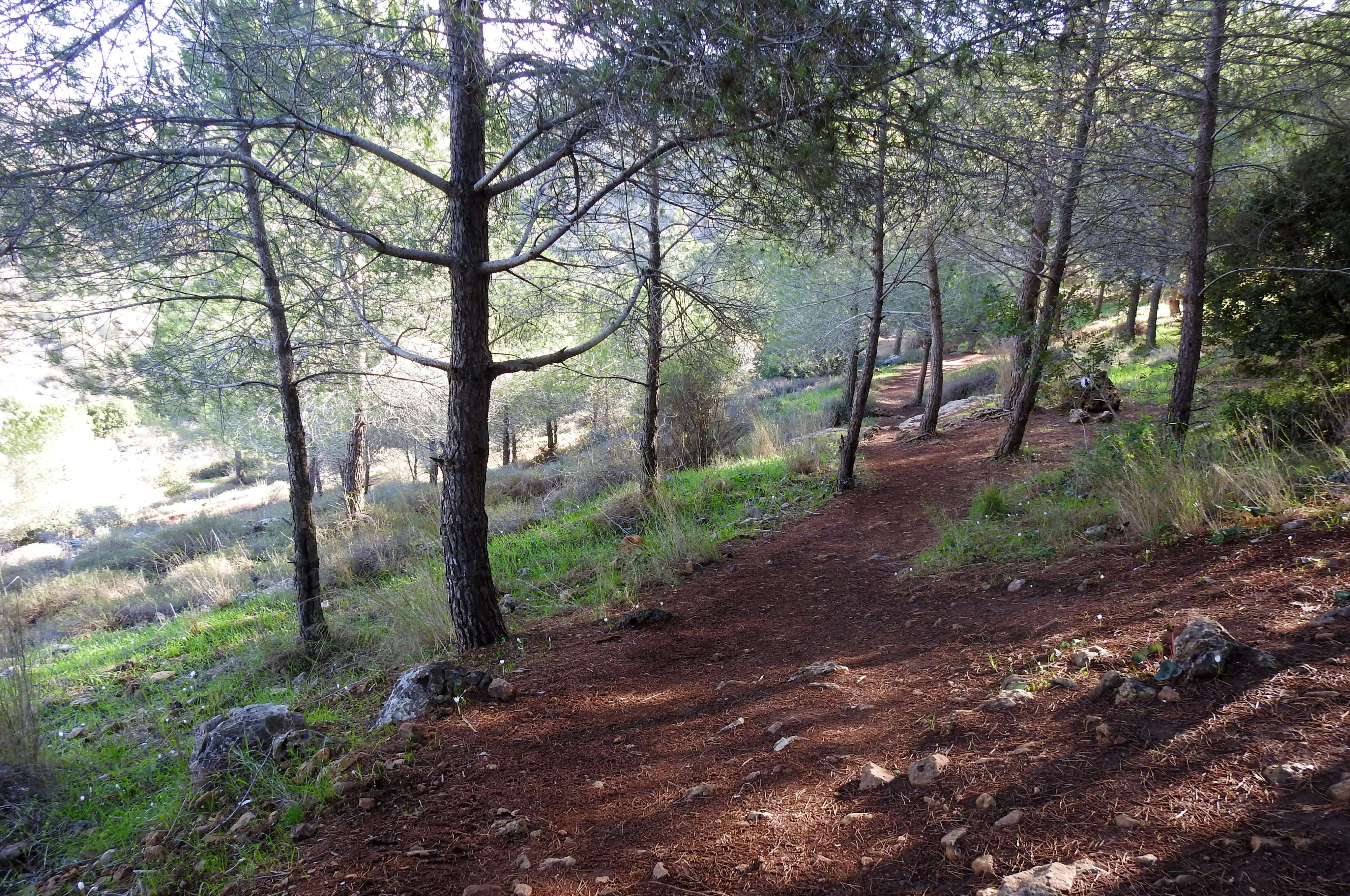
Hiking through the woods

Hiking through the woods

At last we made it to the valley, where Nachal Zanoach flows thanks to the numerous little springs. The first of these is Ein Matta, with its tiny pool of gurgling spring water. But, we did not come for the watery delights, for an old house commanded our attention and awakened our curiosity.
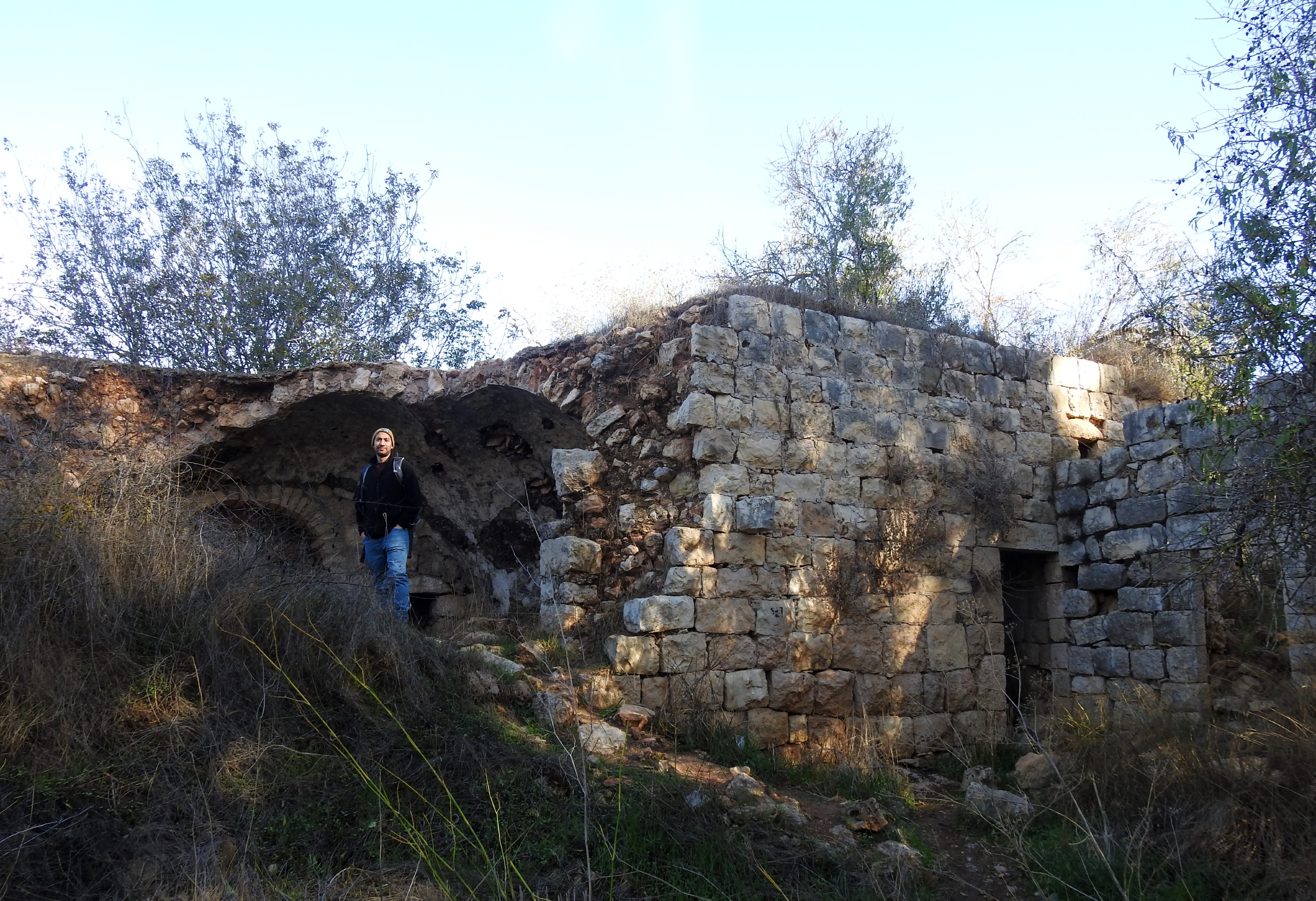
Outside the old house next to Ein Matta

Outside the old house next to Ein Matta

After a bit of research, this house appears to have been Crusader/Mamluk in origin, with visible signs of continued use and reconstruction in later, more modern periods. On site, we explored it and made note of its charming look and location, the idyllic home beside the bubbling brook.
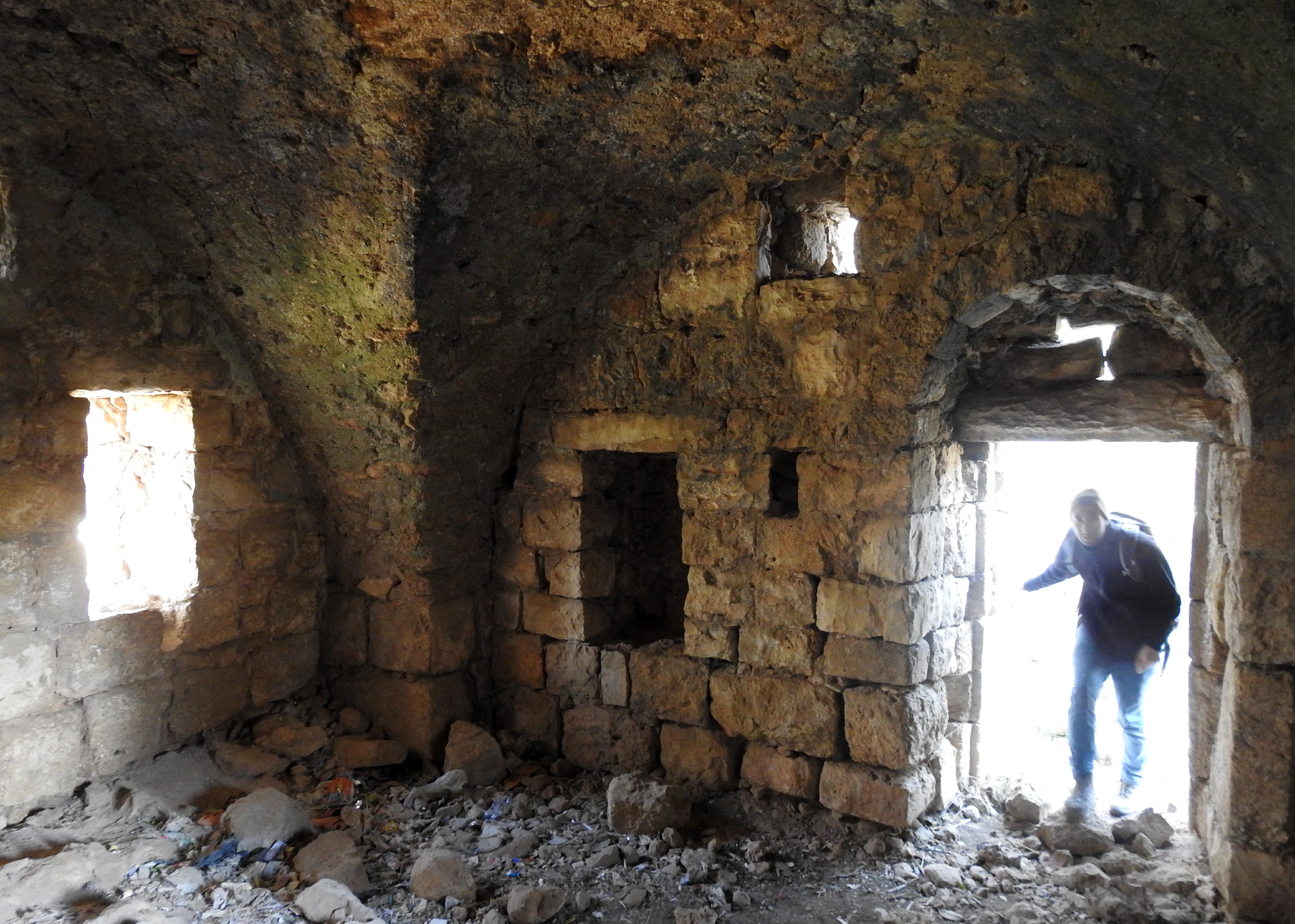
Inside the old house next to Ein Matta

Inside the old house next to Ein Matta

Poking up over the native trees, watching us tiny creatures below, towered the grove of robust washingtonia palms. These behemoths beckoned us closer, to be enchanted by their unnatural appearance in this cold, drippy valley. As we climbed over the bramble and onto the tiny clearing before the grove, I instantly was taken back into the spellbinding novels of Jules Verne, where primordial worlds still exist. We walked slowly through the grove, feeling miniature between the rows of blackened trucks, and proclaimed our wonderment of this place.
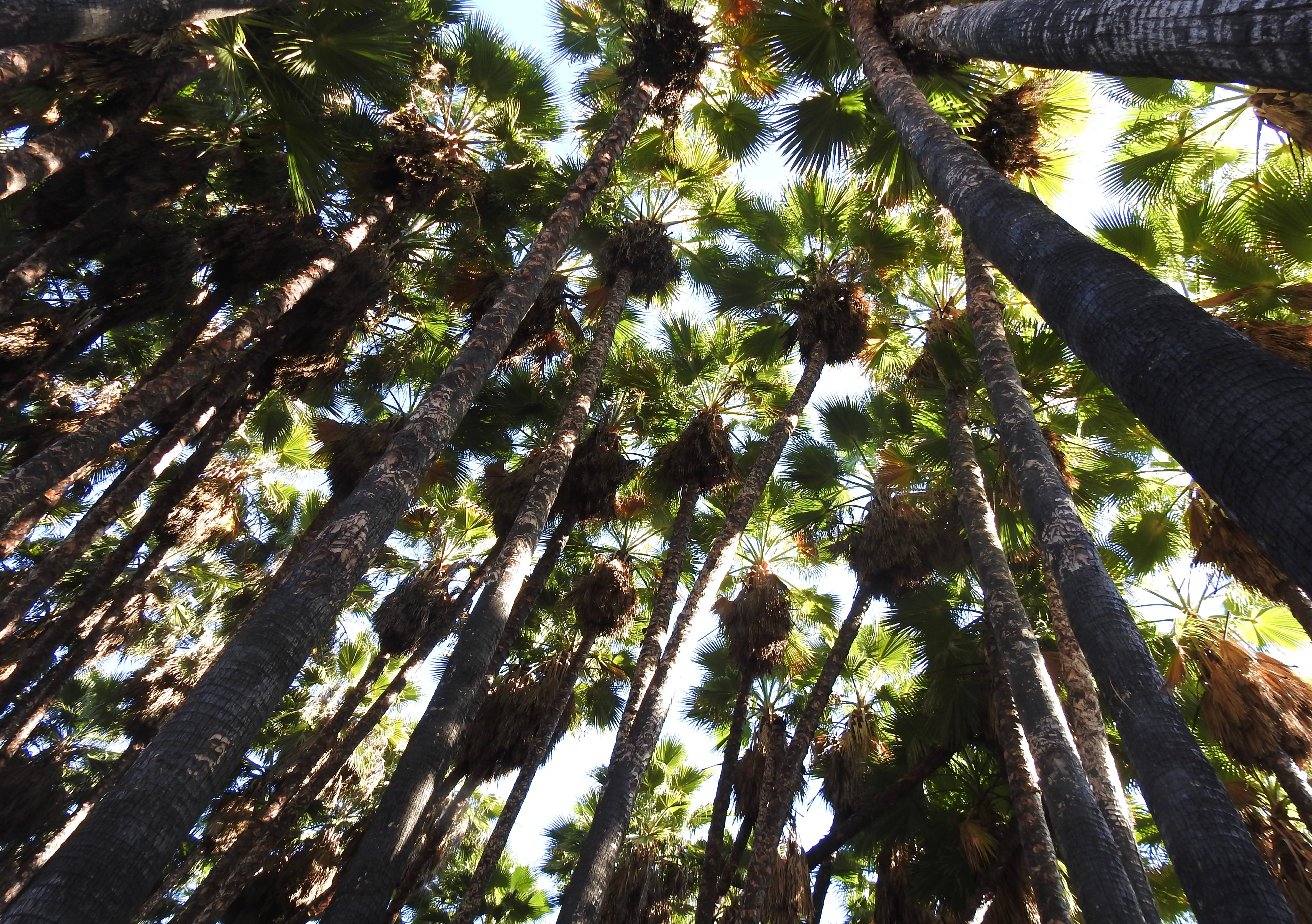
The towering washingtonia palms

The towering washingtonia palms

As we pondered as to why these trees were planted, and how they looked so ridiculous when they collapsed in a state of shriveled death, I felt another presence join us. I turned around to see an unsuspecting jackal loping towards us, yet when I saw him, he saw me and both of us reacted in alarm. I tried firing off a picture and it about-faced and fled from the scene, scarcely giving me time to even alert Avner of our furry visitor.
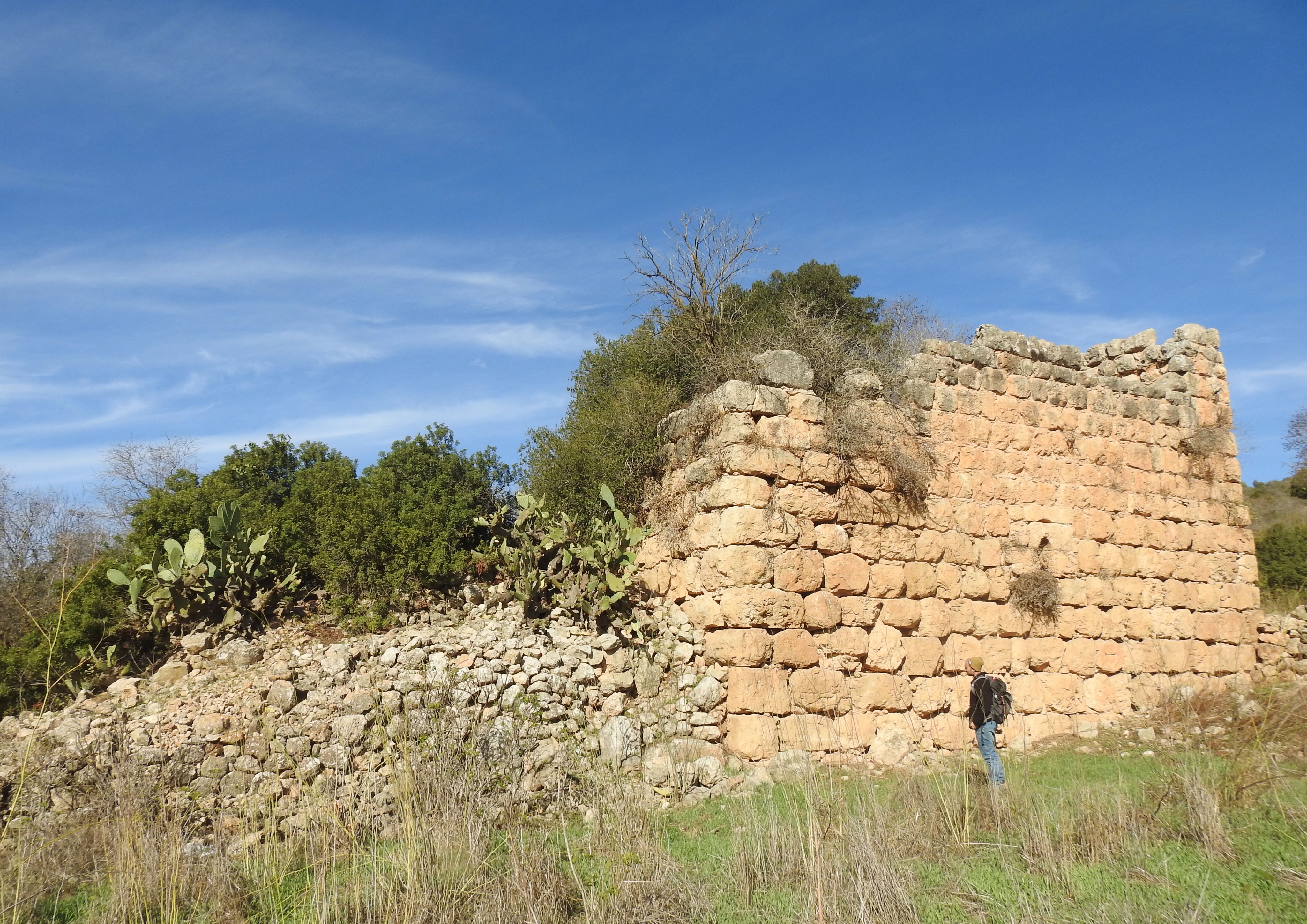
Salvatio Abbey from the outside

Salvatio Abbey from the outside

When we finished with the grove, we carried on and headed for the next attraction – the ruins of Salvatio Abbey. Built as a Cistercian Catholic monastery in 1161, it is believed that the several houses surrounding the grand central structure served as community housing, despite being built prior to the abbey. Our first glimpse of the complex was the great eastern wall of the abbey, built of ashlars and flanked by rubble walls on either side. With the onset of the Mamluk rule, and the European Christians leaving the land, the small village was resettled by Arabs and renamed ‘Allar al-Sifla, and then eventually abandoned permanently in more recent years.
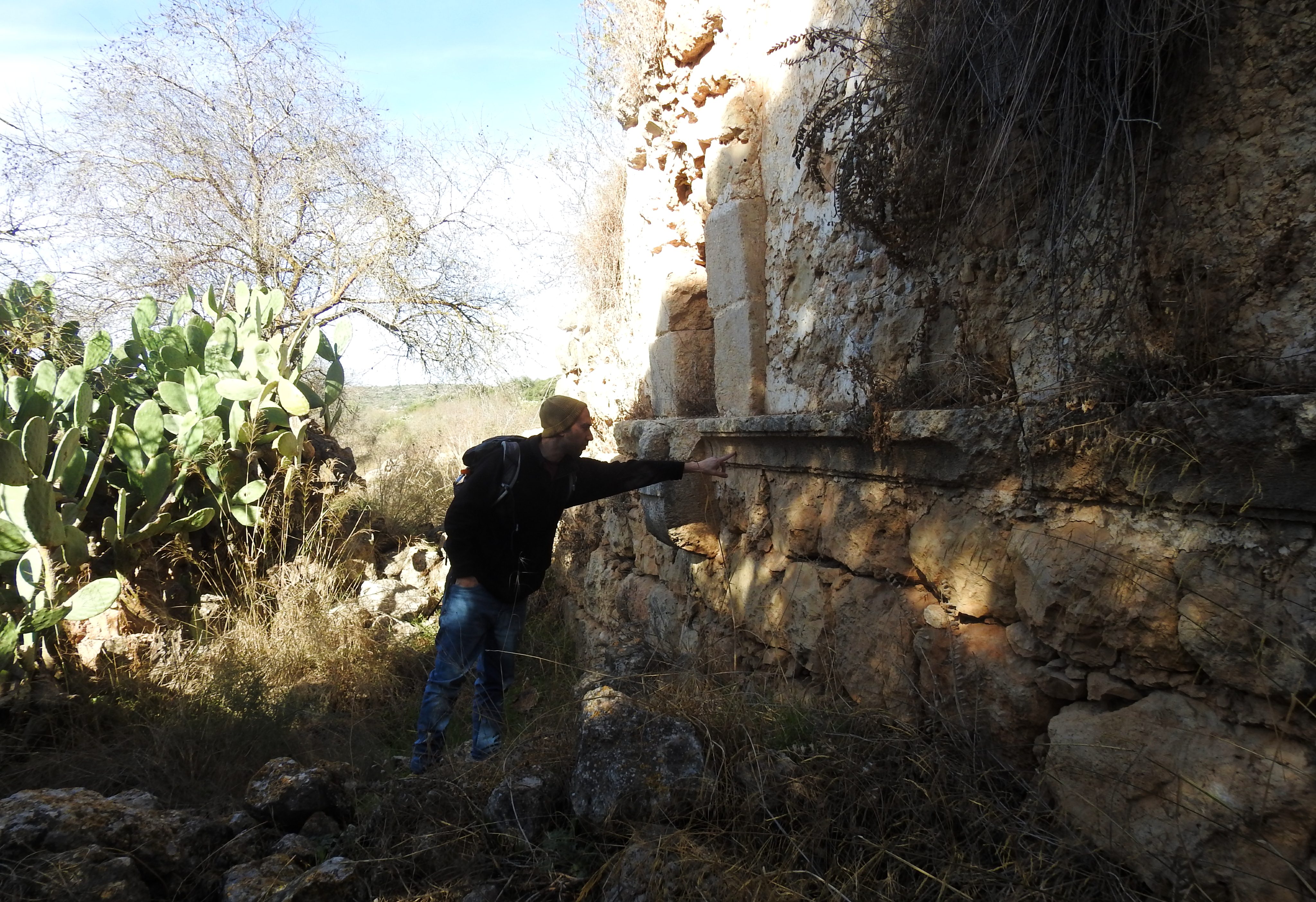
Avner admiring the fine masonry of the abbey chapel wall

Avner admiring the fine masonry of the abbey chapel wall

We gained entrance to the complex just outside the abbey, climbing over the fallen walls from where we surveyed our surroundings. The overgrown grass obscured some of our visibility, but we could clearly see the more elaborate architecture that the abbey boasted. We entered the ruined chapel, where elegant arched windows and a finely-cut ovolo corbel captivated our attention. Despite the vegetation and the rubble, the nearly untouched ruins filled us with imaginative ideas of excavations and discoveries – naturally, we both lament the general lack of interest in medieval archaeology in the country.
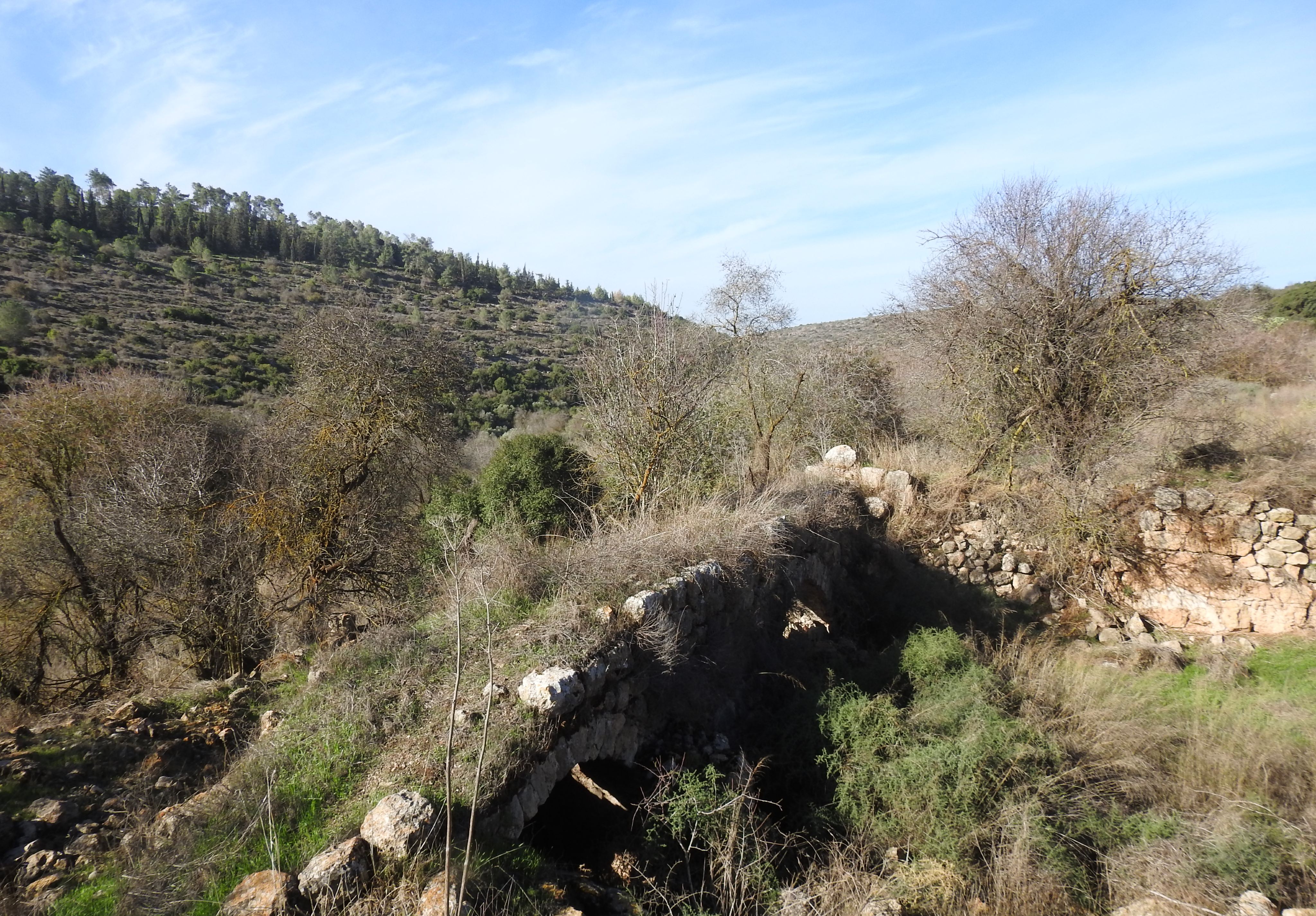
The overgrown ruins of the Salvatio complex

The overgrown ruins of the Salvatio complex

As Avner examined the grand wall with more detail, I climbed past the dried golden henbane and cactus to the top of the western wall, where I could see the other side of the chapel’s wall. Avner located a cistern, and we made a final sweep of the abbey area before making our way to the northern side. There, we admired the great walls once again and set off to find the final site of interest for the day, the arched tunnel of Ein Tanur.
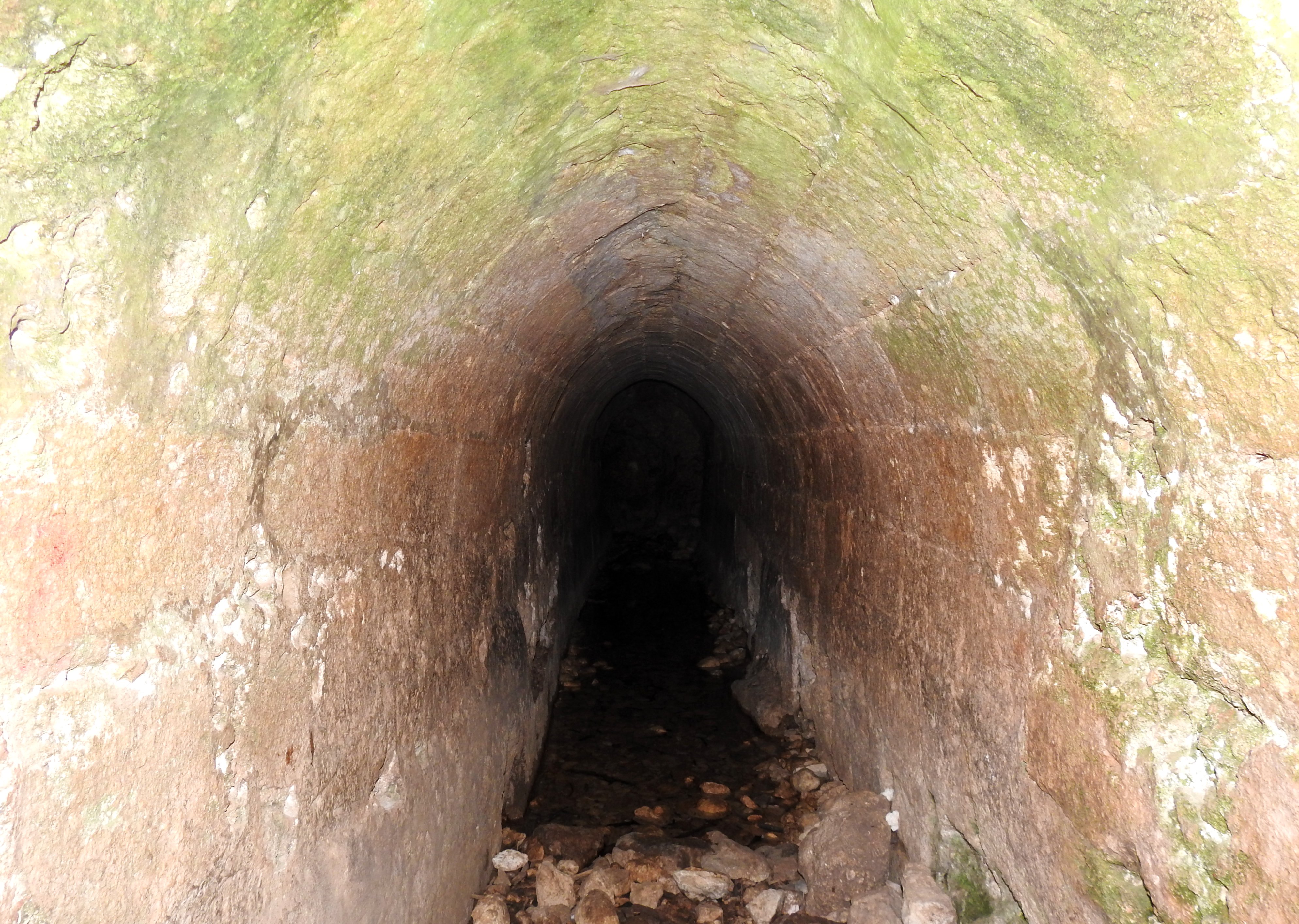
Within Ein Tanur's arched tunnel

Within Ein Tanur’s arched tunnel

Simply hiking down the gentle slope back to the bottom of the wadi, we chanced upon the spring in a tight cluster of fig and other fruit trees. While the water was solely located inside the expertly-crafted arched tunnel, we appreciated the amount of work that went into making the spring more usable for the local inhabitants in times of old. With that final thought, we headed back to the trail and made our laborious way back up the slippery path to the car lot. Unfortunately, we had no time to explore the delightful “Caesar Trail”, a Roman road with hewn steps believed to have been built during the reign of Hadrian, so that will have to be saved for another day.

Ruins around Givat Ze’ev

In Israel, Jerusalem on January 2, 2022 at 10:33 AM

This post is about two documented excursions to the ruins in the outskirts of Givat Ze’ev, a small city nestled between Jerusalem and Ramallah. I’ve become somewhat acquainted with the city and its outskirts in recent years, as my in-laws are residents of the Neve Menachem neighbourhood on the eastern side of the city. Avid walkers, my in-laws took me out on several undocumented visits to the various archaeological remains in the vicinity, located in open garrigue scrubland. Then, in August of 2020, I had the opportunity to document a trip to some ruins, accompanied by Bracha and our local guide, my father-in-law, David Berman.

Satellite view of the area (photo Google)

Satellite view of the area (photo Google)

We made our way through the construction sites to a stretch of concrete was once the main road north of Givat Ze’ev, since replaced by a larger road and a security checkpoint. Our destination was the ruins of Khirbet el-Lattatin, the ninth mile marker north of Jerusalem which even appears on the famous Madaba Map from the 6th century CE. Due to the site’s locational importance in antiquity, a wayfarer’s station was built in the Byzantine period, complete with a basilica plan church. As time progressed and the Arabs took control from the Byzantines, the church was somewhat repurposed as an agricultural installment, yet travelers still sought shelter on-site. The complex seemed to have gone out of use in the 9th century CE, according to archaeological finds such as pottery and coins.

The ruins of Khirbet el-Lattatin

The ruins of Khirbet el-Lattatin

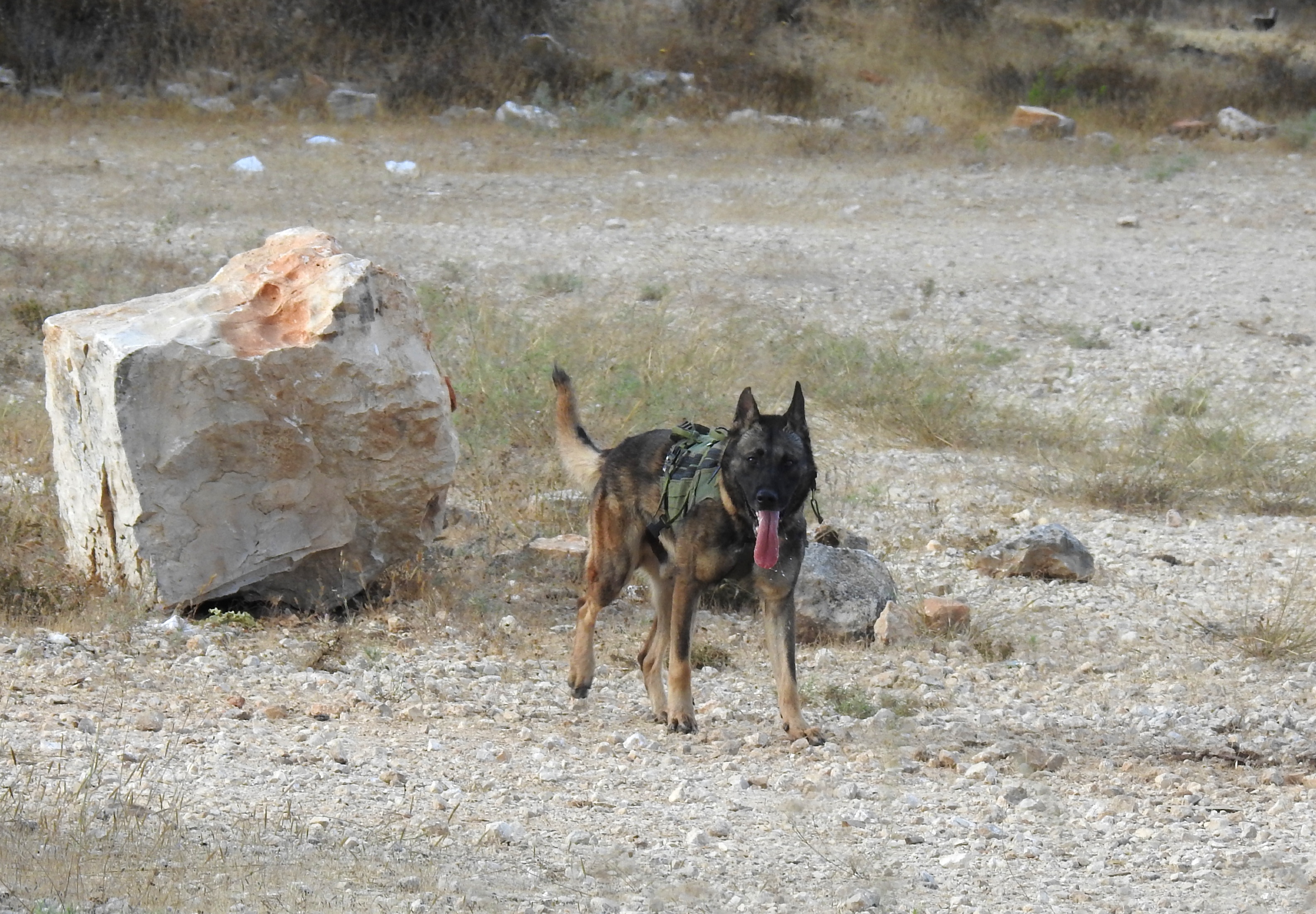
Upon approach we noticed two things: the remains of a nice ashlar wall, likely connected to the ruins, and a collection of IDF soldiers and dogs from the elite “Oketz” unit. Checking with the soldiers that we weren’t interrupting any important training session, we left the road and found the semi-concealed ruins of Khirbet el-Lattatin which were excavated in 1995. What we saw before us was a complex of rooms and partial walls, nothing quite discernable so we climbed down into the ruins.

Byzantine floor mosaic

Byzantine floor mosaic

A simple white mosaic floor from the Byzantine stage of construction was easily found, as were these round floor features which looked to have belonged to the Arab agricultural complex. We explored the rooms from below, walking in and out of the many rooms and making note of interesting things. I found a thickly plastered wall section, incised with a simple chevron motif, and of its origin and purpose I still don’t know. It was peculiar to the eye to see some different building styles, but due to the site’s dramatic change under new ownership, it only made sense.

What appears to be the apse of the Byzantine chapel

What appears to be the apse of the Byzantine chapel

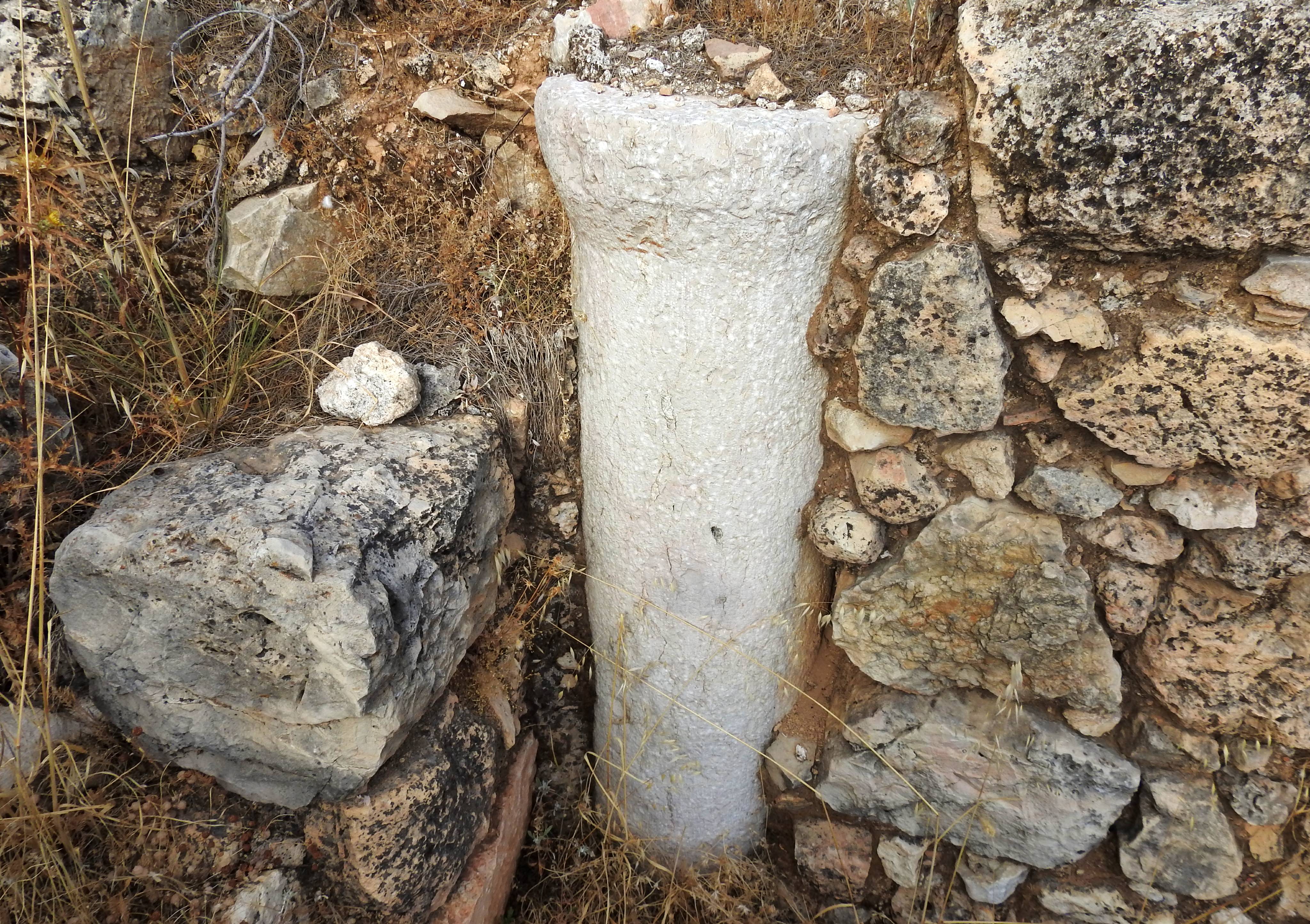
Also of interest were a collection of columns and bases, with one column still embedded in the sunken wall, which were originally part of the Byzantine church. In addition, we found the empty water cistern where a Sinai fan-fingered gecko was hiding, scampering away when I tried taking its picture. Overall, it was quite an interesting site, especially so close to home, so to speak. We headed back, finding a dried ram skull in the grass, bringing an end to the fun outing.

Basilica column still buried in the dirt

Basilica column still buried in the dirt

On a previous visit we had taken this abandoned road to the end, where a large agricultural watchtower is located, but this time it didn’t warrant the effort just for one photo (see HERE instead). There are other captivating ruins in the immediate area that we didn’t end up seeing, including other watchtowers, hewn mikvahs and a hewn burial cave.

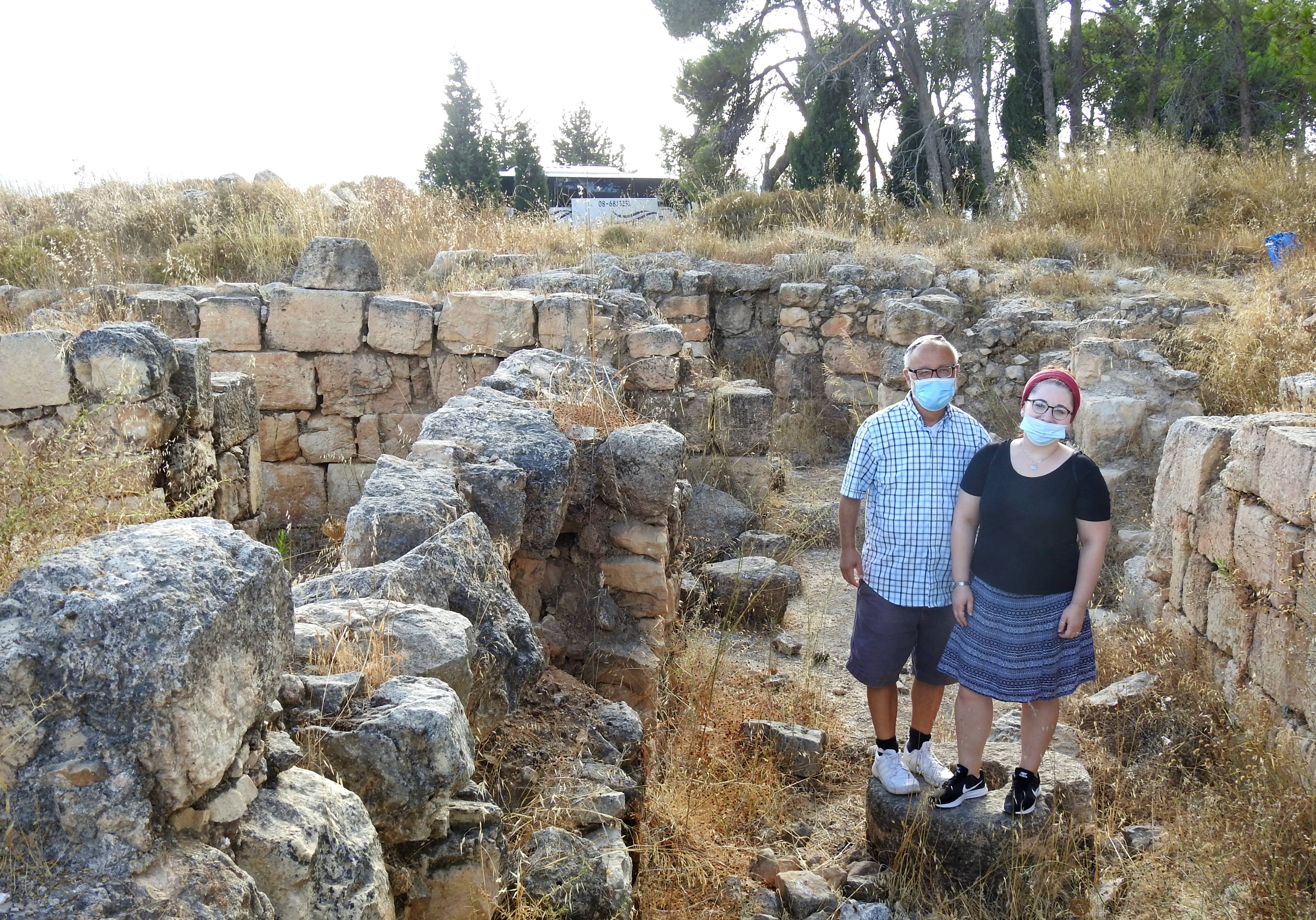
Happy adventurers in the ruins

Happy adventurers in the ruins

When researching Khirbet el-Lattatin I found a fascinating document (see HERE) from the archive of the Department of Antiquities of Mandatory Palestine detailing a local villager’s visit when he reported finding antiquities in a local burial cave (which seems to be the same one that we missed). Within the report, written in the Queen’s English, it says that the villager found and presented to the British part of a limestone ossuary, several bracelets and other jewelry that were actually found and looted from the bones within the ossuary, one of which he had initially gifted to his daughter!

Happy "Oketz" dog

Happy “Oketz” dog

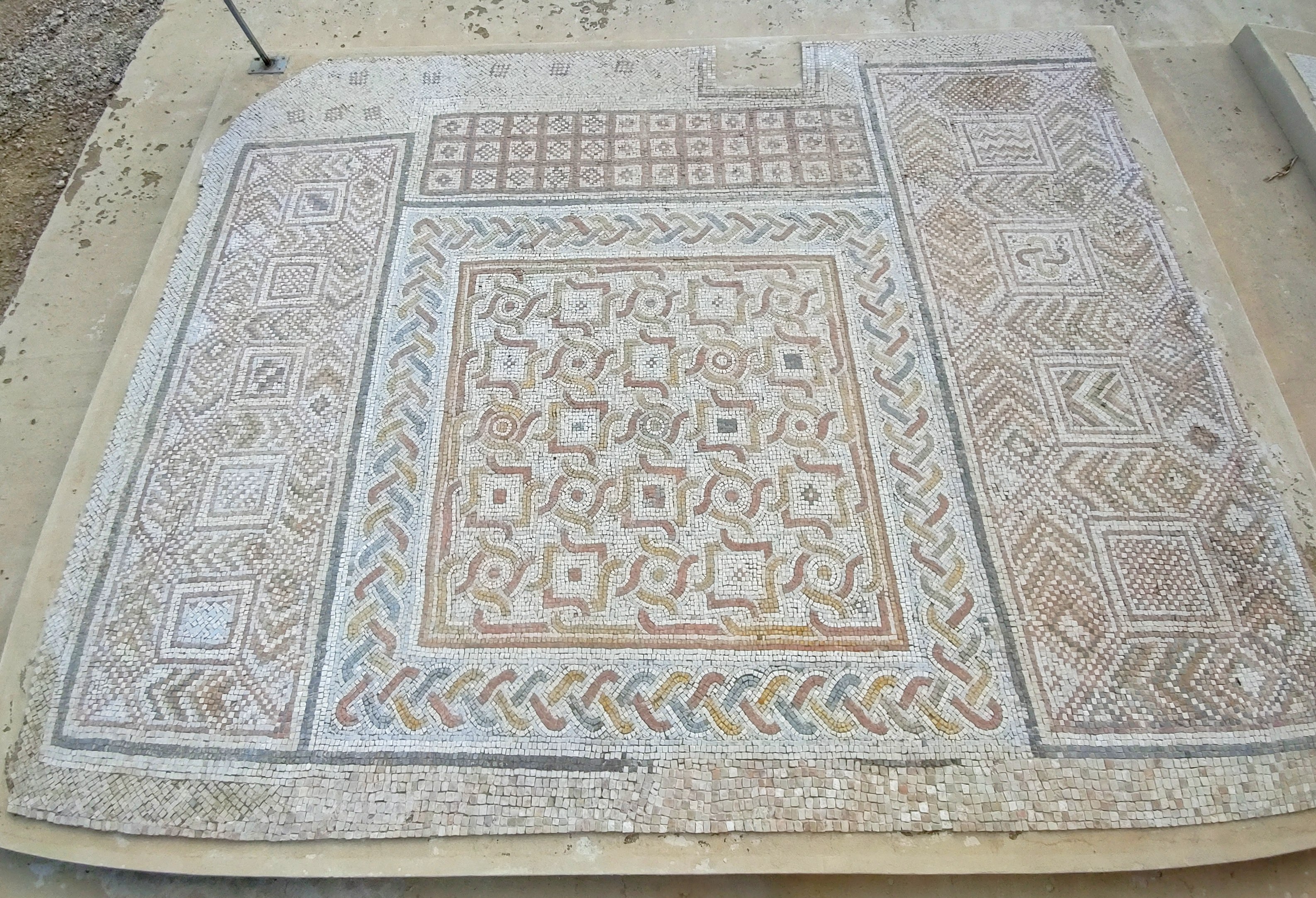
If that’s not enough post-adventure excitement, just after I had written this post I had gone on a field trip with my university department. Among the sites on the day’s itinerary was the Good Samaritan Museum, where assorted mosaics from around the country are preserved and displayed. To my surprise, one of the first mosaics that I saw there was one from Khirbet el-Lattatin – the original Byzantine church floor that was transplanted to the museum for safekeeping. Not having known of its existence in the first place, this finding was electrifying and so I’m adding a wide-angled photo of it to this post for maximum effect.

The fancy mosaic floor of Khirbet el-Lattatin displayed at the Good Samaritan Museum

The fancy mosaic floor of Khirbet el-Lattatin displayed at the Good Samaritan Museum

Excited by my first adventure, my next archaeological excursion took place only in the beginning of December, 2021, when I had a few hours on one particularly chilly afternoon to explore the local hill – named after a squad of Palmach fighters who set out on a mission only to fail and later be commemorated in various ways. The hill is just north of the Neve Menachem neighbourhood, and is home of a semi-active archaeological excavation, which I had tried to join two years ago, but it was being postponed due to the initial coronavirus outbreak.

Open garrigue scrubland outside of Givat Ze'ev

Open garrigue scrubland outside of Givat Ze’ev

With camera and binoculars safely secured around my neck, I set out for the slopes, happily seeing my first signs of wildlife in the form of a male black redstart and a handful of chirpy chiffchaffs in the conifer line that borders the city. Entering the open garrigue scrubland, I encountered the many tiny caves and visibly quarried bedrock along the southern side of the hill. The Steven’s meadow saffron was in blossom, as was the winter saffron, both classic winter wildflowers despite it being so cold.

Hewn bedrock atop the hill

Hewn bedrock atop the hill

The walk up the hill is best taken along the flat bedrock that wraps around the southern side, decorated with hewn cup marks and agricultural installations that were full of the last rain’s water. As I walked along the unintentional path, I kept scanning for birds but only a few stonechats were to be seen. Then, climbing up on some rocks, I saw a medium-sized bird fly out from shelter and managed to get it in my binoculars before it disappeared over the ridge. I was elated as I had just seen my first (living) woodcock, a very elusive bird that can be seen locally in the winter months.

Kestrel in the cold wind

Kestrel in the cold wind

With a smile on my face I then reached the archaeological excavation area, where ongoing efforts to learn more about this hill’s role in history have been happening. Thus far, it was revealed that a fortress was built in the Middle Bronze age (some 4,000 years ago), and that the site was also in use in the Iron Age, during the time of the First Temple. Frankly, there’s not much to see at surface level, save some stubby wall bases and scattered potsherds.

Recent excavation efforts

Recent excavation efforts

As I walked around the northern side of the hill I noticed more excavation areas, some with exposed walls, as well as more modern simple rock walls that divided the slope up into designated areas. With not much to see, I continued around to the eastern slope and made my way down into the flat area in the direction of the nearest Arab village. The bird situation didn’t improve much at first, with just more territorial stonechats perched hither and thither, but then I saw a nice long-legged buzzard who soared off into the distance.

A donkey friend

A donkey friend

When I reached the easternmost point of Givat Ze’ev, located to my right, I discerned a small flock of corn bunting on a small tree, which gave me hope. I continued along the dirt road outside the city, where ploughed fields and chilly orchards provided a change in scenery. The birding improved, if only by a little, with some starlings, greenfinches and another black redstart. With my free time running out, I turned back around and headed into the city, making my way back to my in-law’s place. These trips served as a successful and joyous preliminary reconnoitering of the immediate surroundings, but there is still more to be seen and documented in the days and years to come.

Agamon Rishon LeZion

In Central Israel, Israel on December 12, 2021 at 8:07 AM

In mid-October, after a flurry of birding trips to the field of Givat HaShlosha and Nachal Rabah, I decided to change the pace a bit and to explore some rich wetlands not too far away from where I live. Incidentally, there were a few choice birds that I had previously seen reported on eBird, and since I was keen to snatch up a few potential “lifers”, I rose in the predawn hours and arrived at my destination – the artificial lake just outside of Rishon LeZion – not long after sunrise.

Early morning at Agamon Rishon LeZion

Early morning at Agamon Rishon LeZion

I had been to a nearby Lake Nakik in the summer of 2019, when Adam and I explored the neighbouring dunes for the first time (see HERE), but somehow the Agamon had slipped through our fingers. My expedition began at the eastern banks where I used my binoculars to scan the lengths of the shorelines around me, finding an expected assortment of egrets, herons and shorebirds. Kingfishers and barn swallows zipped back and forth over the placid lake, completing the serene scene with their controlled flights.

Grainy photo of the African swamphen (right)

Grainy photo of the African swamphen (right)

My first exciting find came when I scanned the reeds a bit more carefully, and then noticed a bird that was bigger and more colourful than a common moorhen – it was an African swamphen! This was my first “lifer” of the day, and in retrospect I could confirm that there was a second one tucked back a bit further, and thus more obscured by the thick reeds. When it got a little brighter out, I was able to discern more species of waders in the muddy shallow section to the south, as well as a reed warbler that appeared in the reeds beside me.

Picturesque views from the deck

Picturesque views from the deck

Eager to see more of the small lake, and from different angles, I continued on my semi-circuit, walking past the FlyBox building where an intriguing, if pricey, weightless flying experience can be had. The trail took me through a small overgrown area and I emerged at the northern side of the lake, where the observation decks have been installed. The sun was still coming up through the dense cloud cover as I took in my new view, seeing more herons and egrets fishing in the shallows.

Grainy photo of the whiskered tern in flight

Grainy photo of the whiskered tern in flight

Another “lifer” appeared in the form of a whiskered tern – a graceful white acrobat skimming over the water’s surface in search of small fish to catch. The tranquility of the lake scene with the muted early morning colours filled me with inner peace, and I sat there basking in the moment. When I had moved on down to the deck, sitting in the western lookout, large raindrops started falling out of the sky. I sheltered my camera and enjoyed the light shower, feeling refreshed from my first rains of the season.

One of the more unusual bird sightings I've ever had

One of the more unusual bird sightings I’ve ever had

The rains brought out the birds, interestingly enough, and I watched a particularly plucky sedge warbler bounce about in search of food. A bluethroat and some white wagtails joined in on the fun, racing about in between the raindrops. When the rain ended I went back to the first lookout in hopes of finding a little bittern, which was actually waiting for me at the base of the structure – our encounter catching both of us off guard. Reflexes kicked in, I tried snapping some pictures while it tried escaping through the thick reeds. The sun eventually broke through the clouds and I decided it was time to head to work, but not without telling others of my relaxing, yet exciting, visit.

Revisiting the lake (photo Adam Ota)

Revisiting the lake (photo Adam Ota)

Sure enough, the following week I revisited the lake, but this time with company: Bracha, Adam and his girlfriend Vered. We retraced the steps that I had taken days before, seeing largely the same selection of birdy friends, minus the elusive swamphen. This time we popped into the large mall complex at the northern side of the lake to grab an iced coffee, and had a picnic as well.

Picnic at the lakeside (photo Adam Ota)

Picnic at the lakeside (photo Adam Ota)

We feasted on cheesy pastas and rich French toast that Adam cooked on his portable burner – more exciting culinarily than my previous tour. Such a delightful place to visit, and relatively easy to get to with public transportation, that I foresee more visits in the future.