Israel's Good Name

Archive for the ‘Central Israel’ Category

Qesem Cave Archaeogical Dig

In Central Israel, Israel, Samaria on December 23, 2025 at 8:29 AM

The summer of 2025 turned out to be quite productive in the adventure category, even with an intensive two-week war with Iran disrupting the flow. A mere week after my nature trip with Adam Ota to the Sharon Beach Nature Reserve, I found myself on another adventure, and much closer to home. On one morning’s commute, I happened to notice that excavations were being renewed at the famous Qesem Cave, a groundbreaking archaeological site discovered in 2000 that sheds light on prehistoric life in the Levant. A quick Google search put me in contact with Dr Ella Assaf, director of the excavations on behalf of Tel Aviv University, and arrangements were made for me to join the team as a volunteer one day in mid-July. Thankfully, Qesem Cave is only approximately 7 kilometres from my house, and thus an easy drop-off for Bracha on her way to work.

Qesem Cave excavations

One wouldn’t necessarily expect such an important archaeological site to be flush up against busy Road 5, the main artery connecting the Mercaz (or, Central Israel) with the Shomron (Samaria), yet it is. The cave itself was discovered when roadworks were underway, and that led to the road taking a bit of a turn to avoid the ancient, protected site. Today, the cave is housed in a large steel cage where a small team can toil away comfortably – as long as the honking is kept to a minimum. Entering the complex from the east, I found a small team of archaeologists, students and volunteers working quietly. First, I was directed to Ella who greeted me and gave me a little tour of the site.
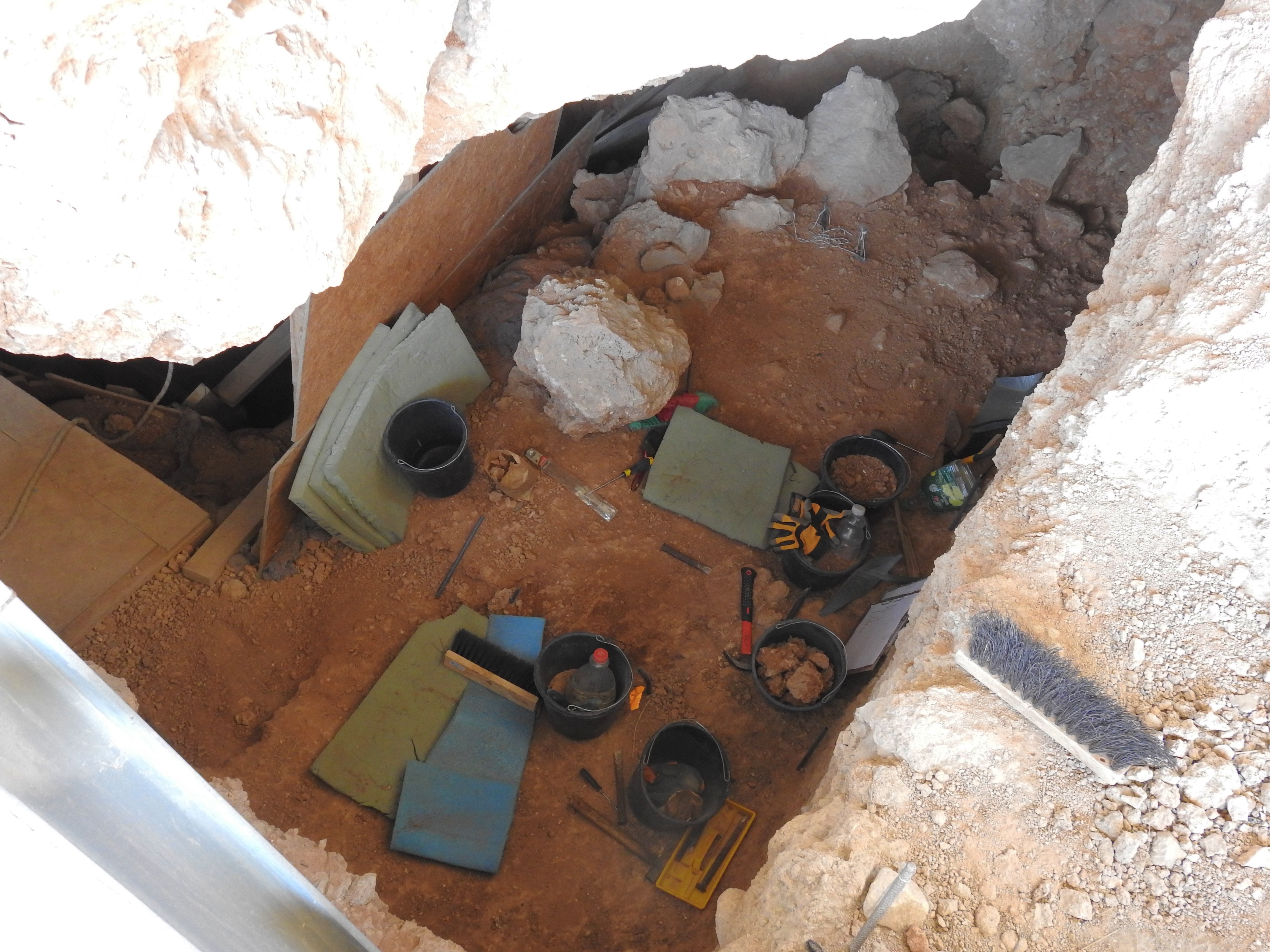
Looking down at an excavation shelf

While the term “cave” insinuates an underground cavern, Qesem Cave has been reduced to more of a pit. Construction on Road 5 had torn into the roof and initial chambers of the ancient cave, which had already been filled with soil thousands of years ago. Thus, what exists today is simply the excavated sections of the exposed cave interior, or the remains thereof.

Qesem Cave in 2001 (photo Gopher et al 2005*)

Research had learned that the cave was initially settled during the Lower Paleolithic, the stone tools aligning with the Acheulo-Yabrudian culture complex. Recent academic papers have focused on shaped stone balls being used as tools for smashing bones for marrow consumption – certainly an interesting pursuit. Unfortunately, with my academic interests focused on the medieval period, I frankly know little of prehistory and its culture beyond what I had learned in my BA coursework.
Back in the caves

After the short tour of the small dig site, it was time for some breakfast with the hardworking team. Having a gander at the table of food, I found bread, cheeses, cut vegetables, honey and jams, and some nice little borekas filled with either spinach or eggplant. I made myself a little plate and chatted with the friendly Tel Aviv University students as we feasted in unison. 
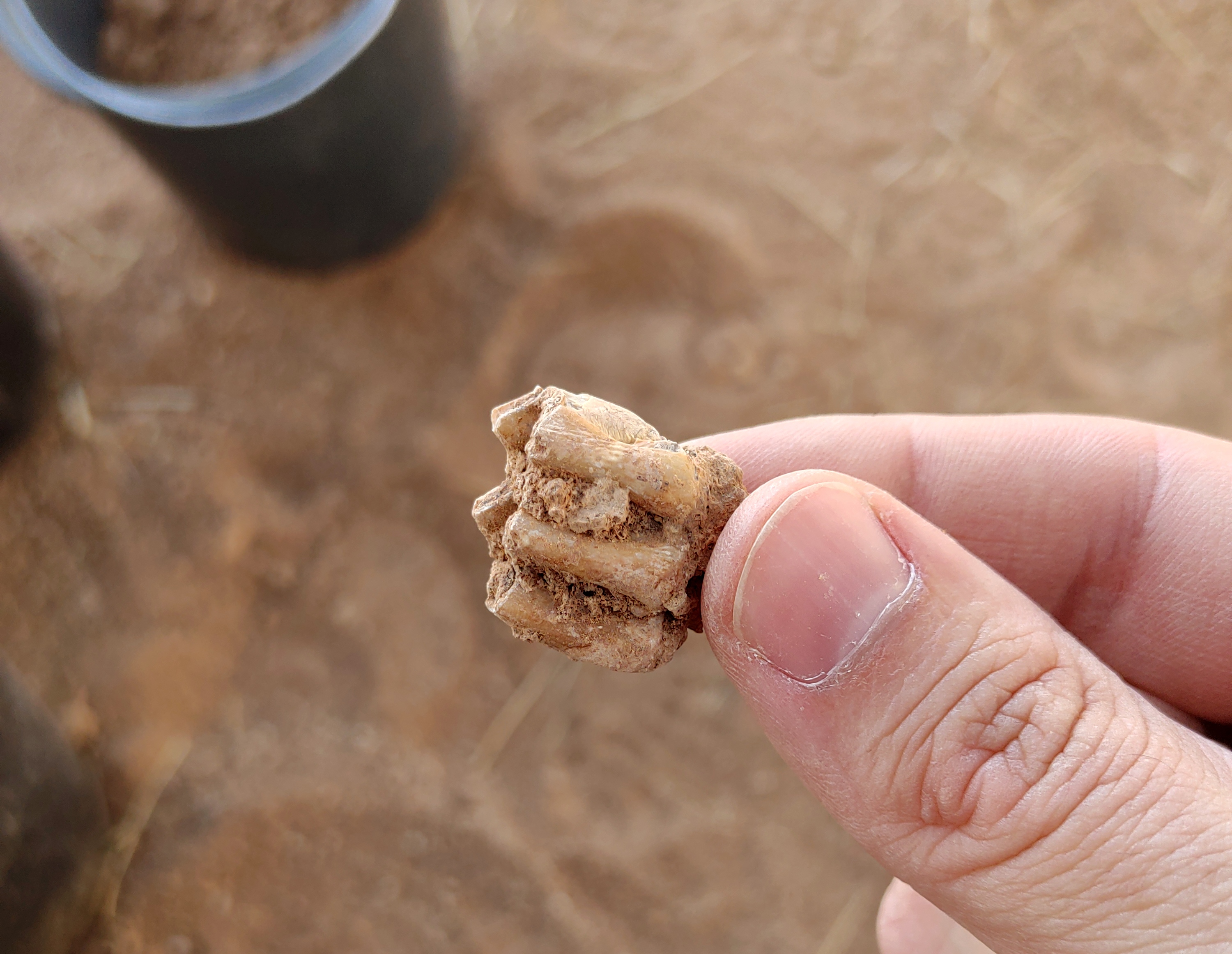
Ancient horse tooth scraped out of the earth

When breakfast fizzled out it was time for me to earn my keep. Ella handed me off to a young man who was working on sifting the excavated soil. Since I was volunteering on the last full day of the season, actual digging was kept at a minimum so that all of the finds could be properly processed. This being a prehistoric excavation, with soil that filled the cave so long ago, meant that each scoop of dirt might contain something important for research. So, doing our due diligence, we sifted buckets of dirt and picked our way through the larger pieces, pulling out bone fragments, shards of flint and the occasional tooth that belonged to a horse or similar ungulate species. It was an interesting experience, somewhat reminiscent of the sifting work we had done at the Tel es-Safi excavations in 2017 and 2018.
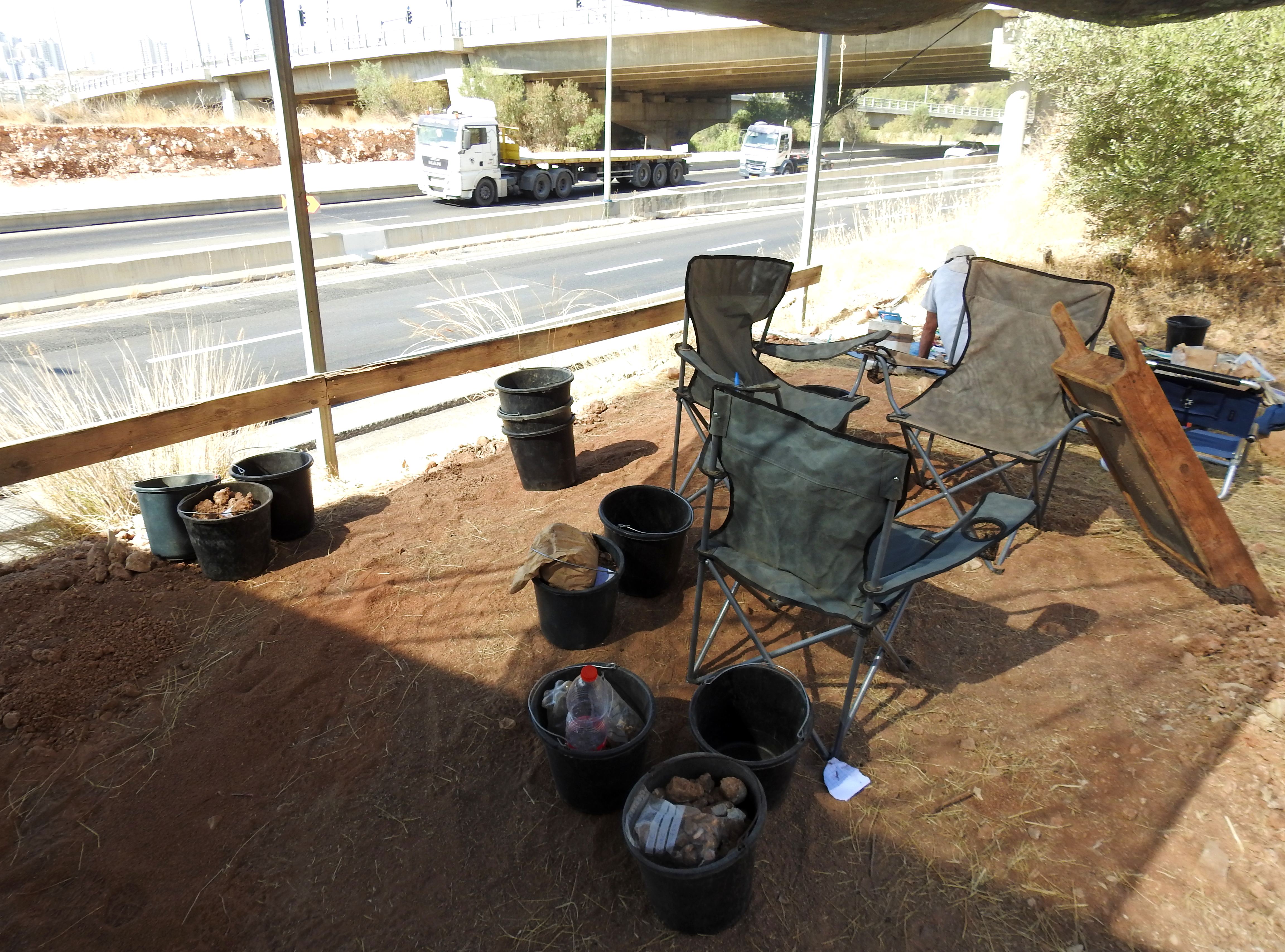
Time for some sifting and washing

After some time, I was redirected to assist a young woman who was washing stones and bones that had been extracted from the cave. Sitting uncomfortably on the uneven ground, we emptied buckets of dirty rocks into a large sieve and washed them in a bucket of muddied water. Working quickly, we did a preliminary cleaning and laid the stones and bones out to dry on newspapers. Some of the flint rocks were quite beautiful but it was one rock with a pattern of concentric circles that really caught our eye – alas, my geology knowledge is lacking.
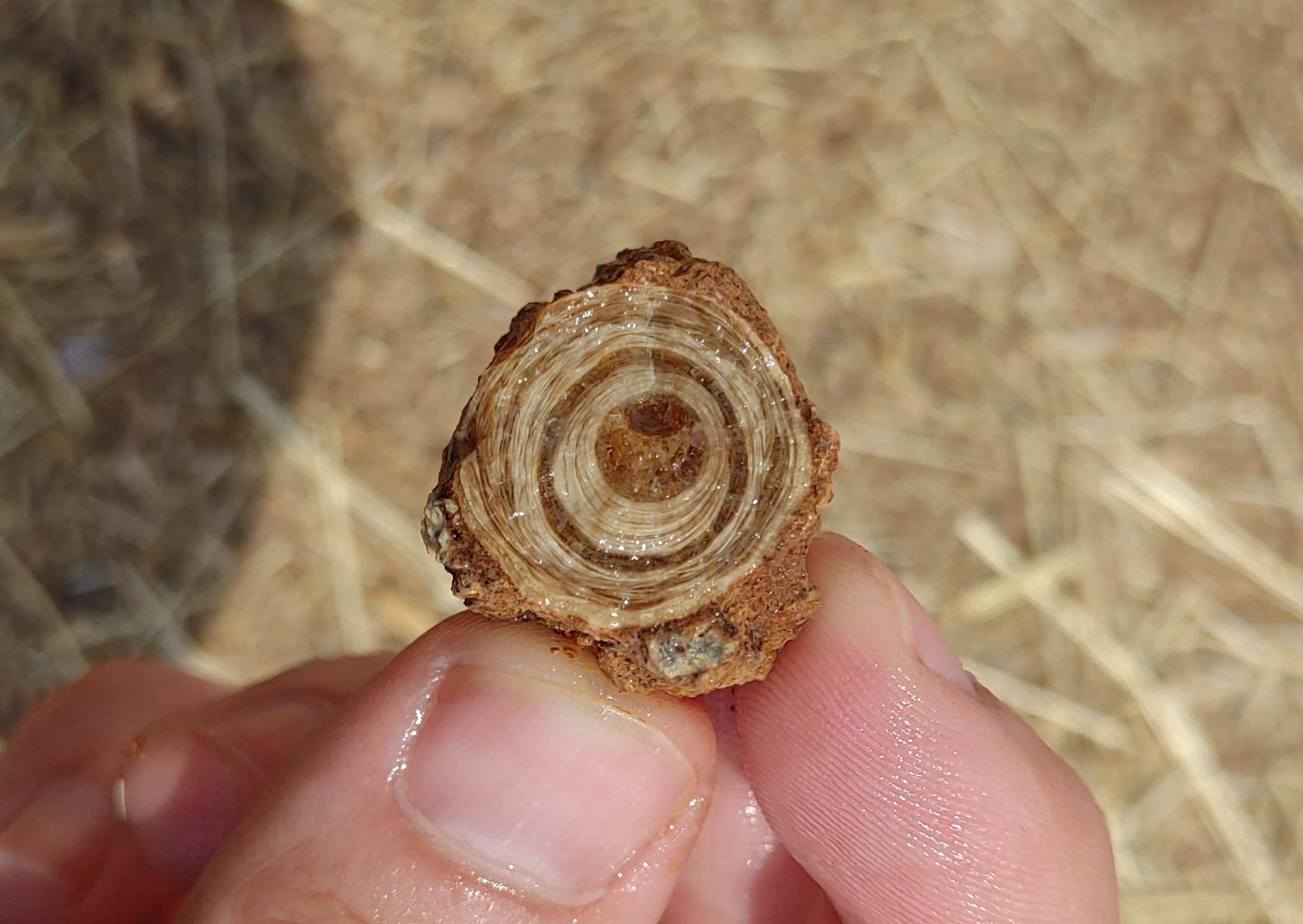
Interesting find

Getting up from the artefact washing, we broke into a juicy watermelon – the quintessential summertime archaeological excavation snack. Upon having our fair share of the sweet fruit, I shifted back into a sifting role and enjoyed sitting in a chair once again. That went on for twenty minutes or so, and included a visit by some representatives of the Israel Antiquities Authority, until it was time to start packing up.
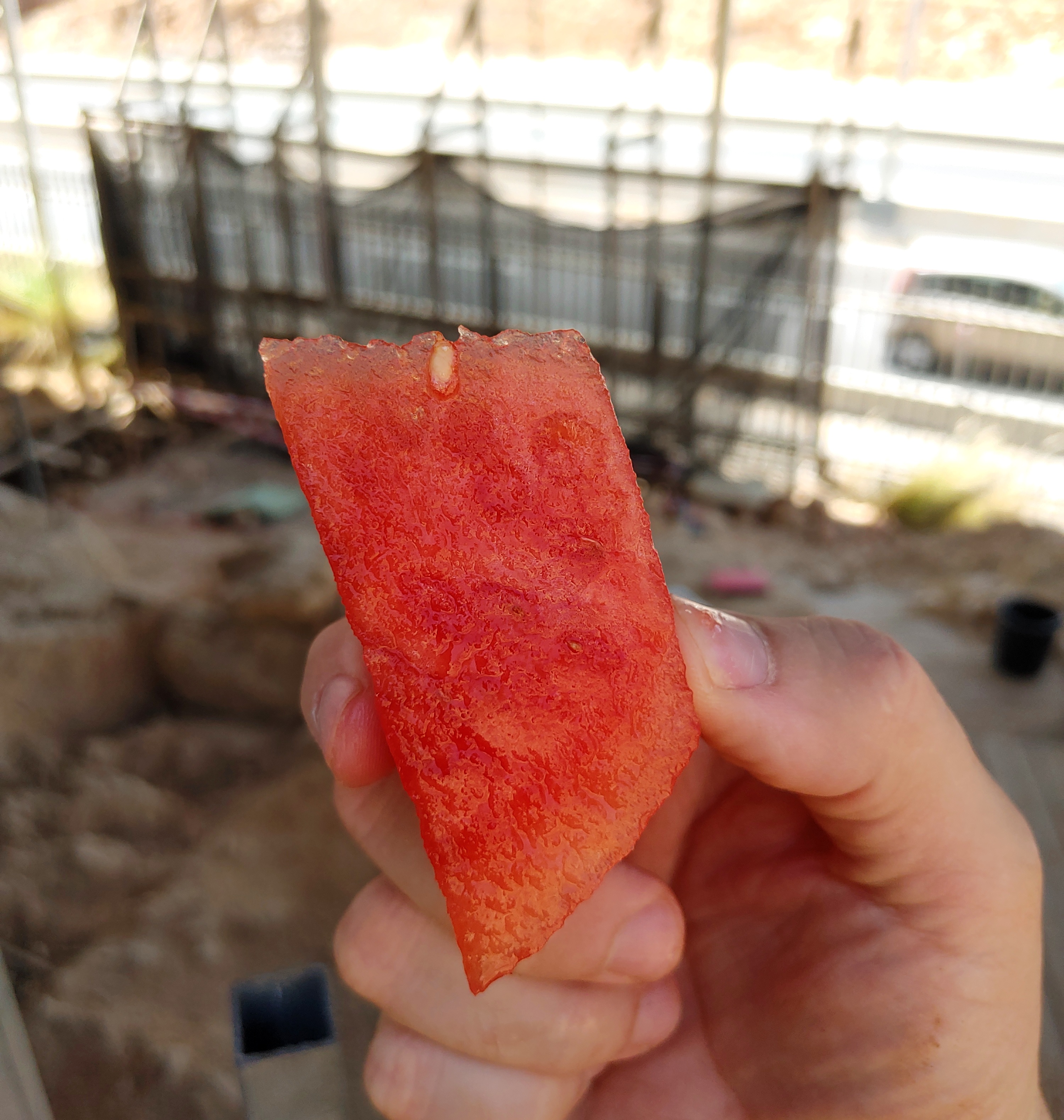
Quintessential excavation snack

Ella led a short tour for her diligent team, moving from dig site to dig site within the small cave’s confines and summarising the season’s efforts. With that we gathered up all of the relevant tools and supplies and made our way back to the parked cars along the 5. I nabbed a ride with one of the senior volunteers, who graciously dropped me off at Qesem Junction, where I took a bus back home.

*Gopher, A., Barkai, R., Shimelmitz, R., Khalaly, M., Lemorini, C., Hershkovitz, I. & Stiner, M., 2005, “Qesem Cave: An Amudian Site in Central Israel”, Journal of the Israel Prehistoric Society 35, p. 71.
Sharon Beach Nature Reserve

In Central Israel, Coastal Plain, Israel on November 12, 2025 at 1:57 PM

In the beginning half of July, fellow adventurer Adam Ota and I finally embarked on a trip we had planned since before the brief war with Iran at the end of June. Naturally, due to the circumstances, our rekindled adventures had to be put on hold, until further notice. So it was with much anticipation that we got into our respective motor vehicles and met at the destination of our choosing, the Sharon Beach Nature Reserve.
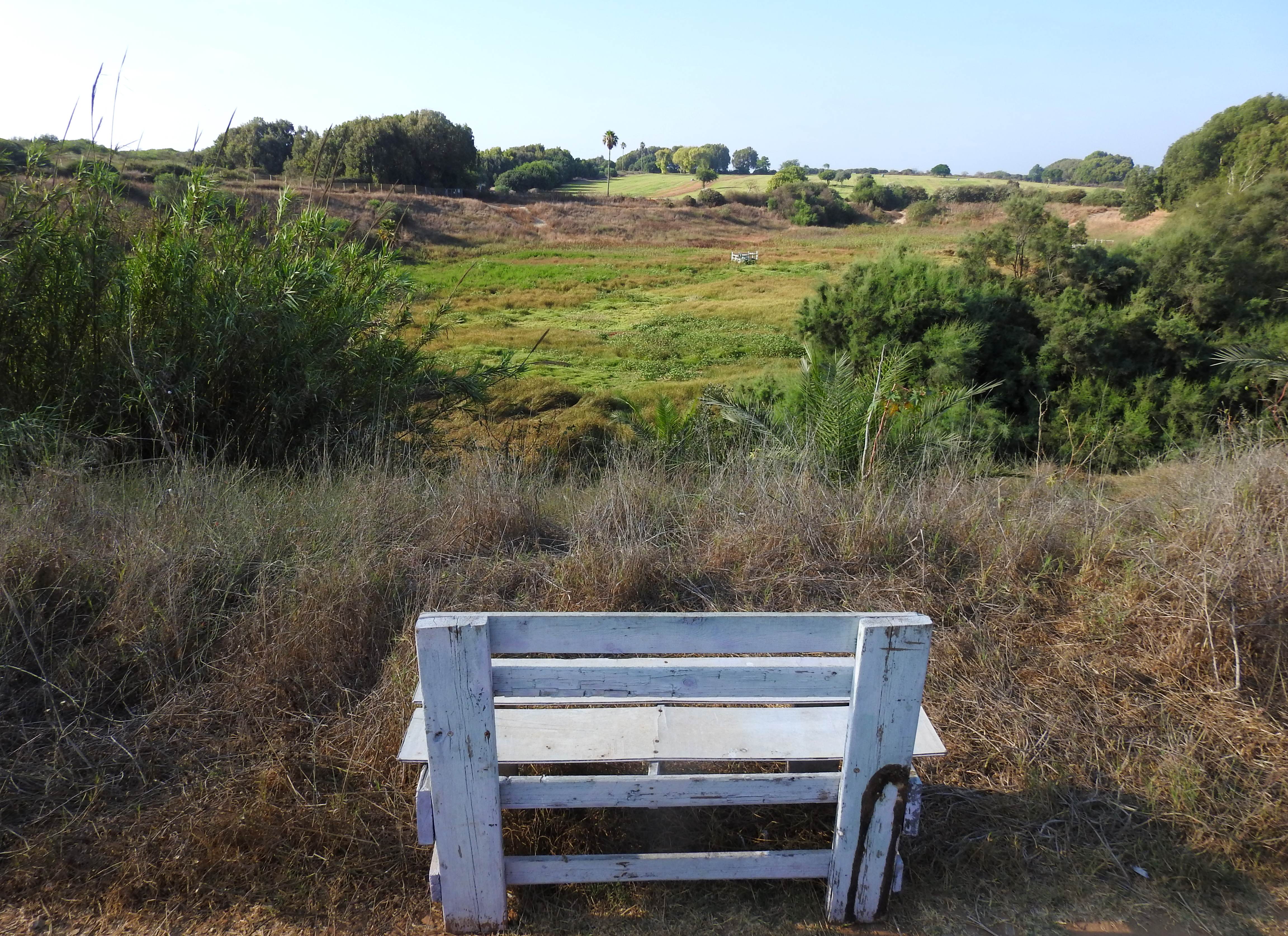
Looking out over the dried pond

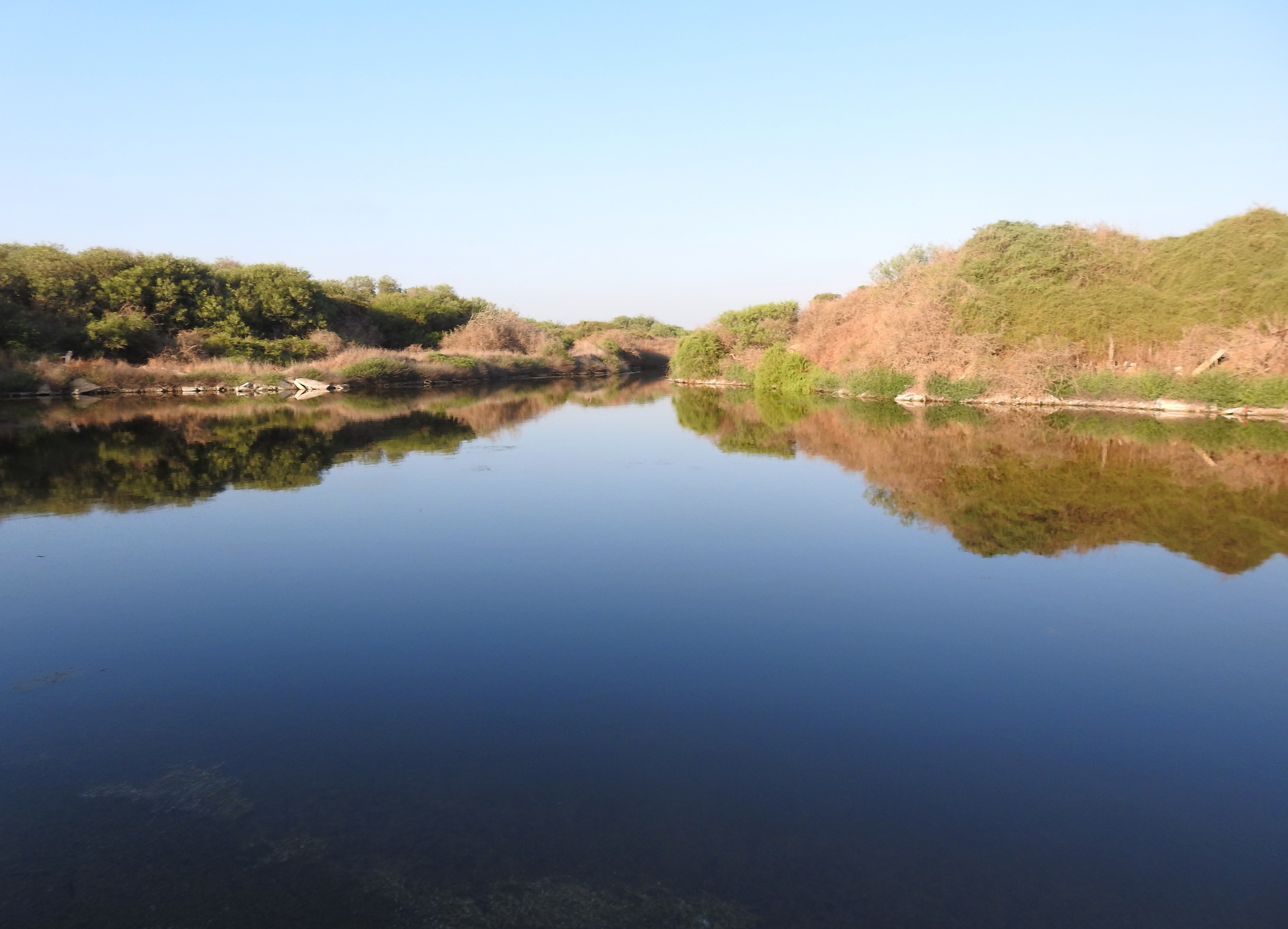
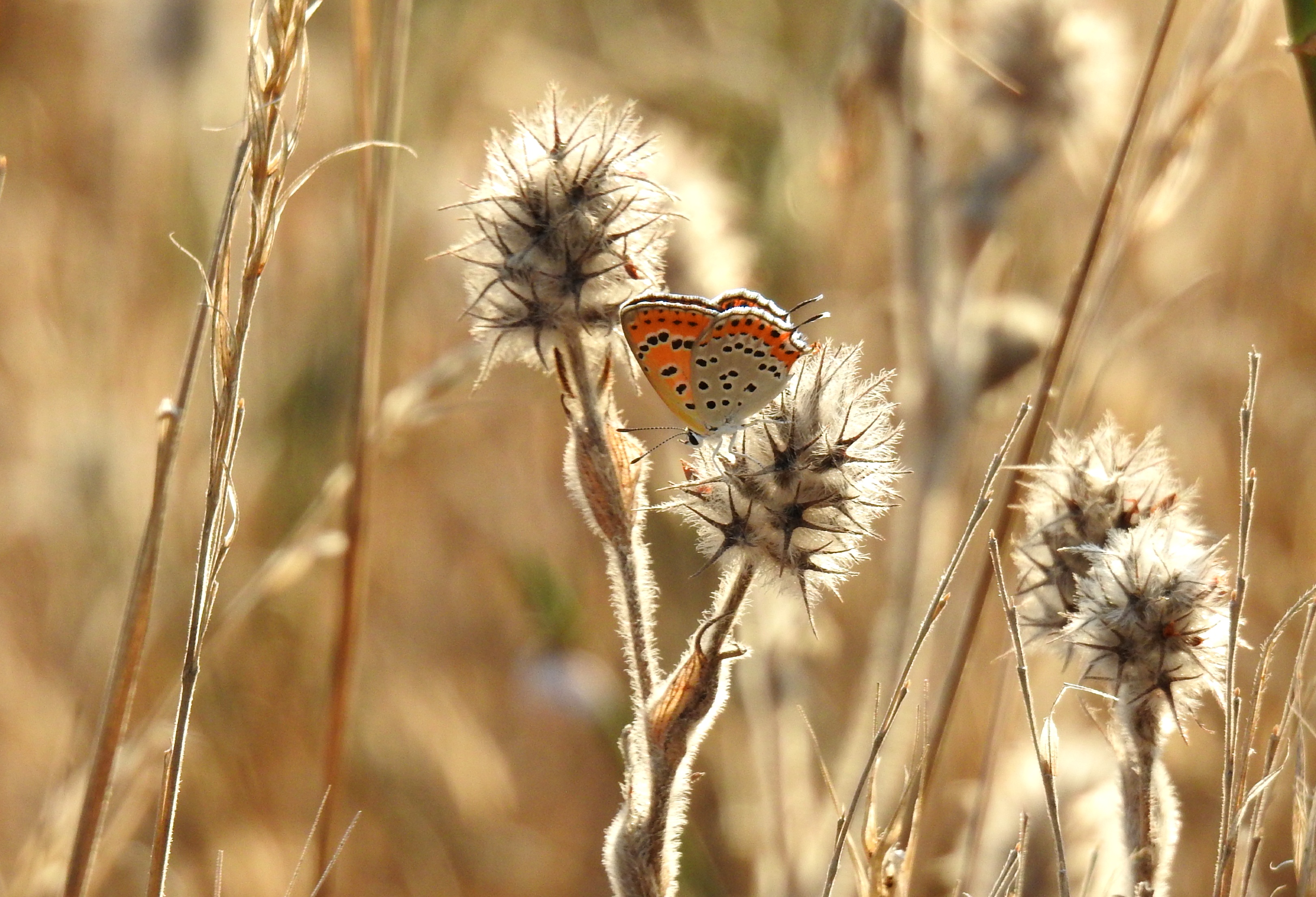
Much thought went into picking this location: it wasn’t terribly far away for either of us; neither of us had visited the place prior; and it was reported to have some sand dunes on the kurkar clifftops which could very well provide some fun creatures that, ordinarily, we would have to travel some distance to see. We met up in Kibbutz Ga’ash at the dirt parking lot about two hours before sunset and began to explore our surroundings, starting with the butterfly-rich vegetation beside a dried pond. There wasn’t much else to see there, so we navigated our way to the nature reserve entrance through a kibbutz perimeter fence.

Lesser copper butterfly

We took a liking to the place almost immediately, the calm sand paths crisscrossing the coastal foliage. It reminded us of other places that we had been before, such as the dunes at Yavne – a popular haunt of old. The faunal diversity wasn’t in its prime that late afternoon, with just a white-breasted kingfisher and the distinct calls of a turtledove.

The hidden pond

But then the path led to a hidden U-shaped pond, and biodiversity got more interesting. The western half of the pond opened up before us like a page out of a romanticised Victorian adventure novel. A lone stilt chided us noisily as we intruded on the cloistered paradise, warning the other waterfowl of our sudden, and rather undesired, appearance.

Israel National Trail

A handful of startled sandpipers flew away, as did the noisy stilt, leaving us to explore the quaint little pond in relative isolation. Much to our surprise, the “beach” part that we walked into was not made of sand or pebbles, rather a morbid collection of old, decaying snail shells. Thousands, if not millions, of tiny white shells formed an attractive-looking area, at least until closer scrutiny. But overall, the pond was delightful and I fantasised about bringing a trailcam to see what kind of fauna is wont to visit. Maybe one day…

Such a majestic sight

From the hidden pond we explored the kurkar ridge, making our way to the stabilised dunes overlooking the Mediterranean Sea. After a nice look at the coastline stretching out below us, we left our vantage point up on the cliff and continued exploring the sandy trails. At some point, we found ourselves on the Israel National Trail, the tri-coloured trail marker signs rusted from the salty sea breeze.

Artsy and unedited

With not much to see from a faunal point of view, we decided that we should spend the bulk of the remaining daylight exploring a bit inland. This proved to be a wise decision as we encountered some jackals as soon as we reached an abandoned golf course beside the kibbutz’s cemetery. Our further explorations didn’t fully justify our deviation from the nature reserve, so we headed back to the coastal cliff to watch the sunset.

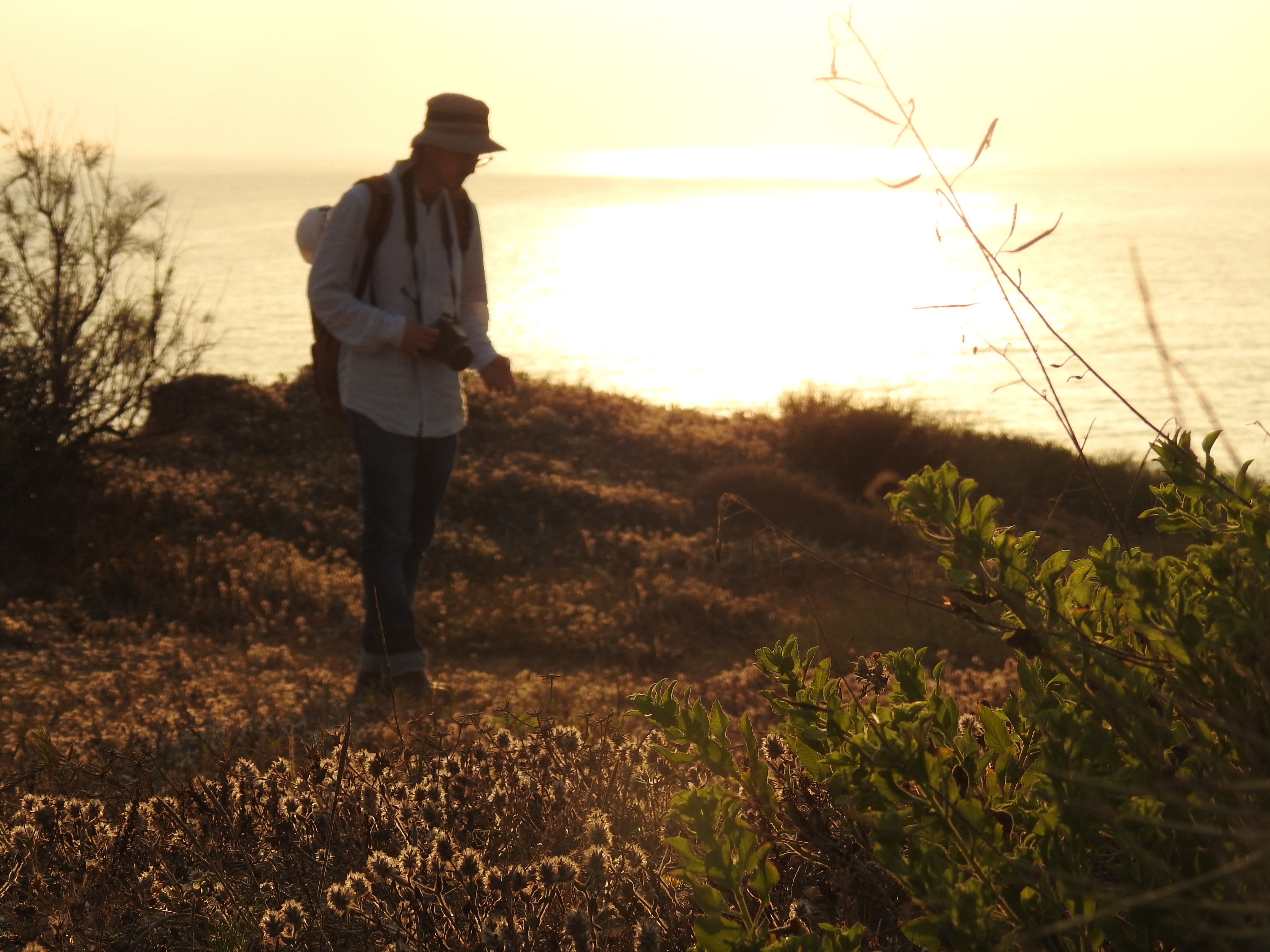
Sweaty and taking in the sunset (photo Adam Ota)

As expected, the sunset scenery was quite picturesque from on high. The kurkar cliffs that line the coast, a sharp rise in elevation rising up to 50 metres from the narrow strip of beach. In fact, two weeks after our adventure the Israel Nature and Parks Authority issued a warning about falling cliff chunks endangering visitors to both beach and cliff.

Being careful near the cliff edges

While we stood on high, looking out over the expanse, we noticed that there were two young men fully disrobed, lounging languidly in the warm sand. It was quite an unexpected sight, but perhaps they were just confused as to where the official nudist beach is – actually a bit further up the coastline.

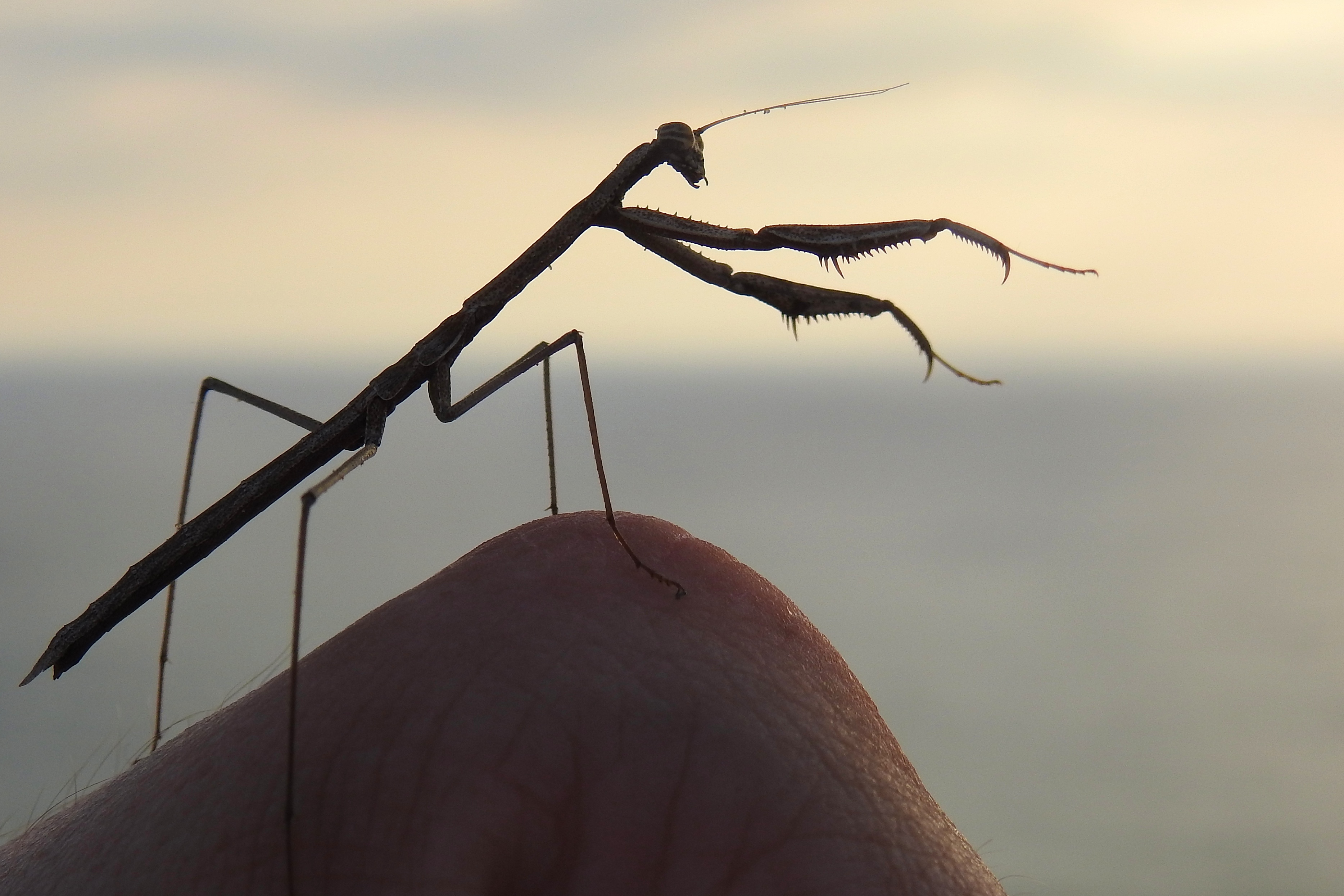
Eremoplana infelix mantis

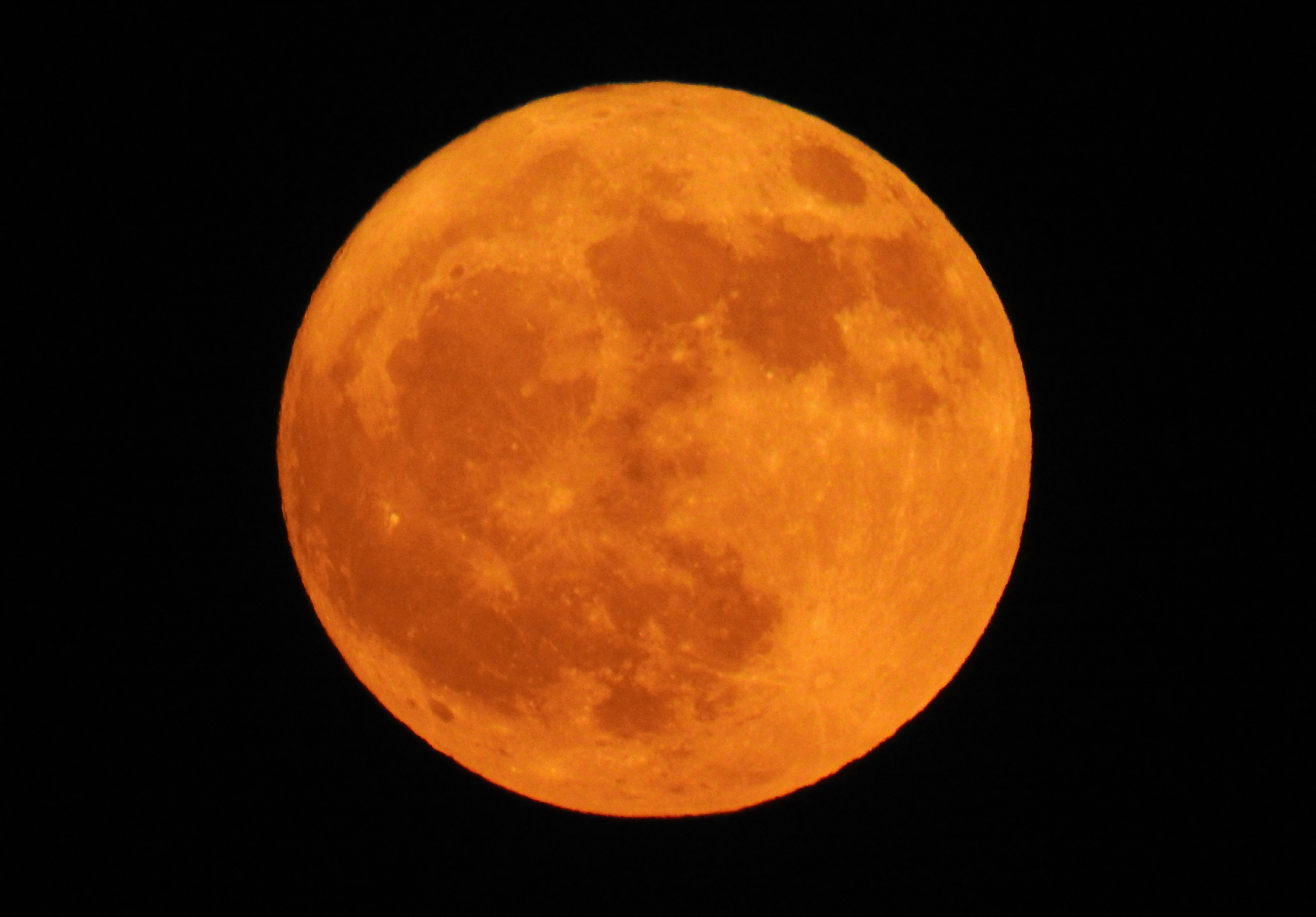
A full moon slowly rose behind us, and while we waited impatiently for darkness to settle, we shared a snack of some mini kabanos sausages. Once sufficiently dark, when the creatures of the night were presumed to have left their hidey-holes, we flicked on our flashlights and began traipsing around. I decided to start with the UV flashlight, its purple-blue light dancing over the sand and vegetation underfoot. It kind of felt like cheating as I spotted one scorpion after another with the greatest of ease. These were presumably all African fattail scorpions, but only one of the evening’s specimens allowed for a good enough photo required for proper identification.

Gorgeous moon coming up over the eastern horizon

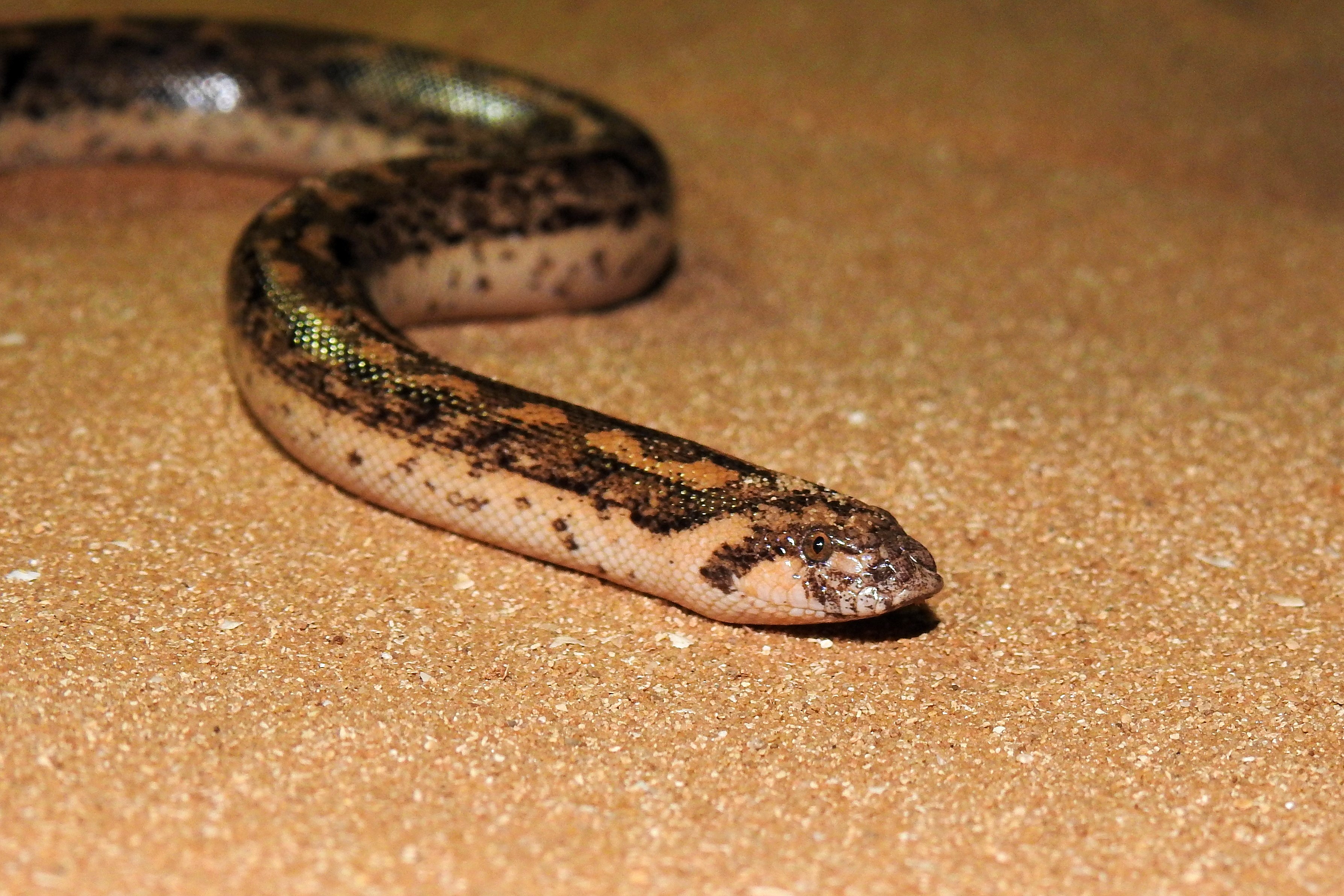
While I was finding scorpions, Adam slipped off another way with his regular flashlight. Suddenly there was a cry and Adam told me to come quickly – he had found a snake! This was no ordinary snake, it was a nicely-sized javelin sand boa, a snake species that we had been keen on seeing for years and years. Despite being relatively common, each and every attempt of ours failed and it became a source of frustration for us. Now, thanks to Adam’s keen eyes, a beautiful sand boa was now laying peacefully in the sand before us, waiting for us to get our fair share of photos.

A javelin sand boa!

While some of Israel’s snakes are venomous and all should be regarded as potentially dangerous without proper knowledge in identification, the javelin sand boa is a very mild mannered member of the boa family (related to anacondas and other constrictors), and not dangerous to humans in the slightest.

A closer look at the javelin sand boa

After a quick photo shoot, we put the sand boa down and let it escape into the shifty sand. It was quite amazing watching it slither so efficiently into the sand, making us wonder how many more sand boas were safely buried around us. Elated with this finding, we kept on searching for more wildlife, and found not very much for the next while.

Sea daffodil jutting out into the darkness

It was only once we started heading back for the cars that we found a Middle East tree frog in the parking lot, most unexpectedly. There was also a wedding taking place at the event hall adjacent to the lot, which filled the warm summer night air with the sound of music.

Middle East tree frog relaxing in the parking lot

Before bringing the trip to an end, Adam suggested we take one last look at the butterfly-rich vegetation beside the dried-up pond that we had explored in the very beginning. It turned out to be an excellent idea, as we found countless tree frogs all over the thorny thistle plants. It was decided there and then that a return trip was needed, but sometime later on in the winter, or wet season. Hopefully that can happen this winter, but, as always, time will tell.

Casel des Plains

In Central Israel, Israel on December 29, 2024 at 2:51 PM

While woefully missing out on bloggable adventures as of late, this past week I was off from work due to the Christmas holiday and did a bit of adventuring on my lonesome. It started with a drive down to Matash Ayalon for some convenient, and guaranteed, quality birding – a known hotspot for wintering duck species, which never fails. I was pleased that I chose this site, as I was able to tick off another new bird species – a reed bunting, an uncommon bird which appeared before me on a bare tree for a good minute or so. But, this post is not about my short birding trip, nor the bit of shopping that I did afterwards, but rather the meagre remains of an old Crusader castle that I happened to visit.

Casel des Plains

Casel des Plains

I had just finished shopping in Holon when I had a look at Google Maps to see what interesting places I had bookmarked for later perusal. Much to my surprise, there was a Crusader castle just a few minutes away in Azor, a site that I had plumb forgotten about in recent years. Truthfully, I had to do a bit of research before writing this post as my knowledge was lacking. Parking just outside of the municipal archaeological park, which contains Casel des Plains’ ruins and more, I made my way up to explore the tiny urban oasis.

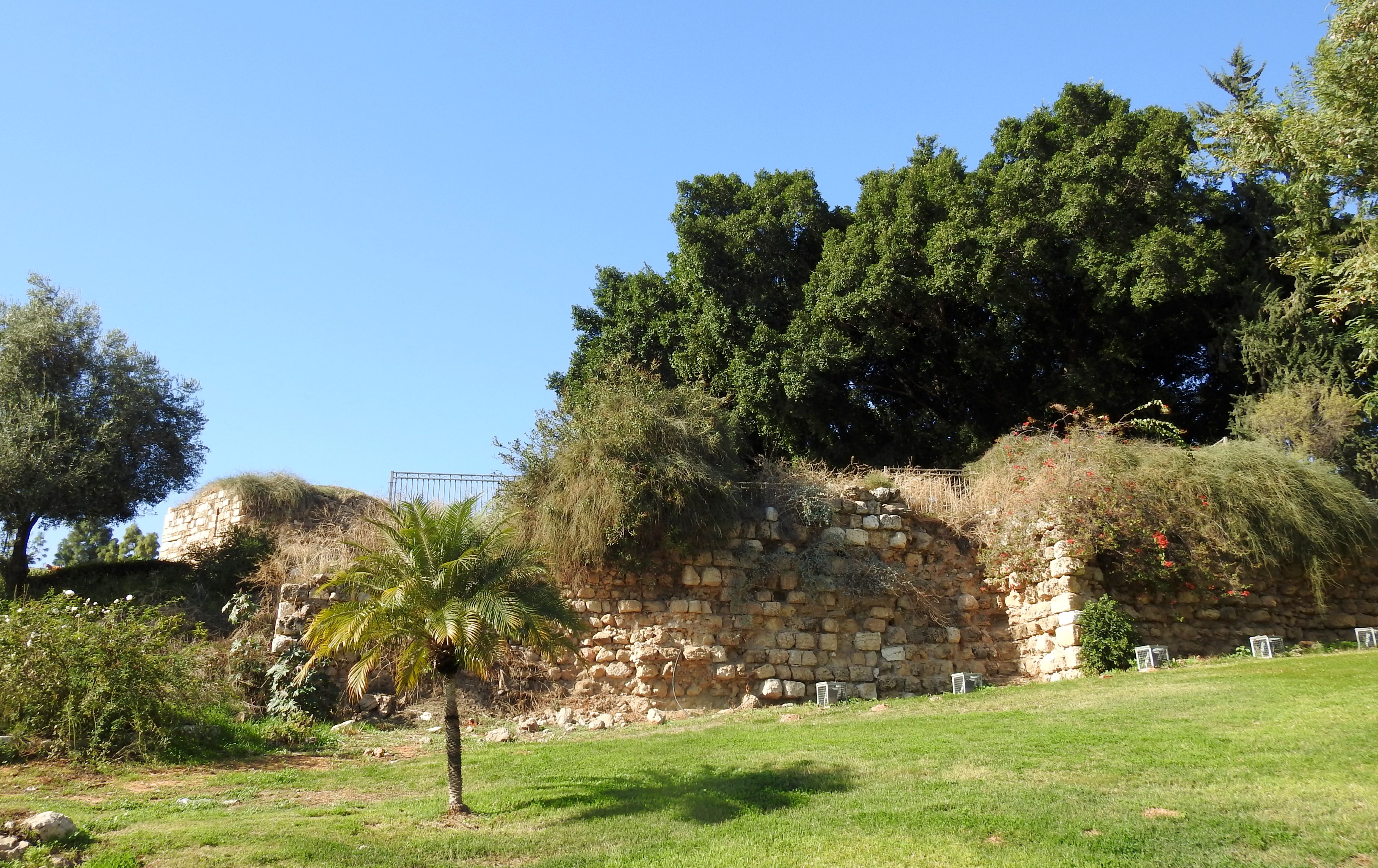
The fortress' enclosure walls

The fortress’ enclosure walls

From my understanding of the site, I passed some overgrown castle enclosure walls as I climbed Tel Azor before laying eyes on the fortress tower. Modern flags waved at me as I sized up the stout structure, taking a few pictures before encircling the remains. Casel des Plains (also referred to as Chateau du Plains and Casellum Balneorum) was built alongside the village of Yazur seemingly sometime during the 1100s by Crusaders, following their success and establishment of the Kingdom of Jerusalem. In 1191, the fortress was destroyed by the Ayyubid emir Saladin and subsequently refortified by the Templars later that year. In 1192, the castle was believed to have been the base of operations for Richard the Lion-hearted, one of the leaders of the Third Crusade, who abandoned the site when Saladin reappeared. Orders were then given by the emir to dismantle the fortress and that was the end of that.

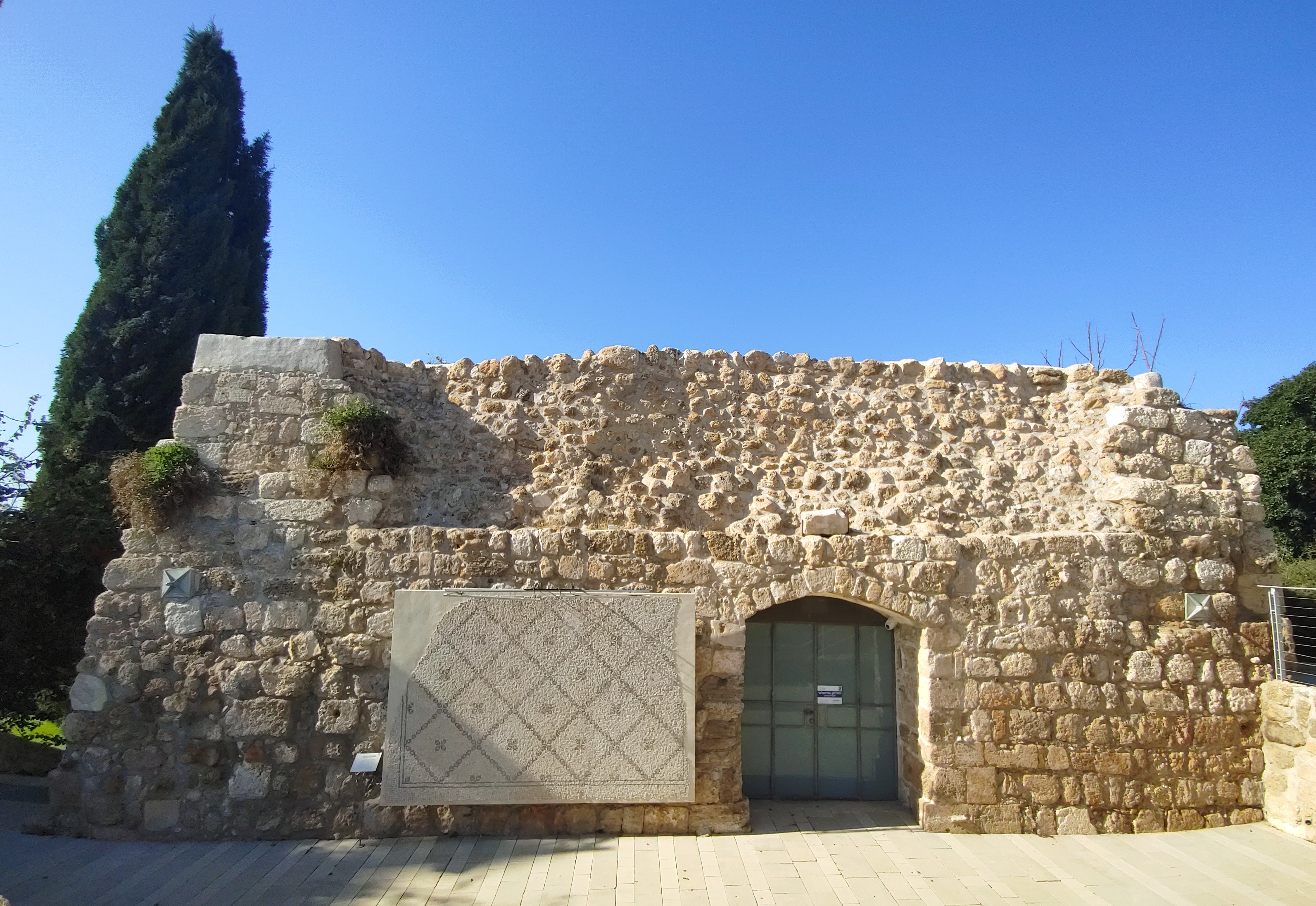
The Ottoman mosque building and displayed Byzantine mosaic

The Ottoman mosque building and displayed Byzantine mosaic

I admired the sturdy masonry and made my way to what looked like another part of the Crusader fortress. Yet, this structure was erected only in the Ottoman period, and served as a mosque. Today, it houses a local archaeological museum, which, unfortunately, is only open on Friday mornings. Eking out all that I could of my impromptu visit, I had a cheeky peek-in through the grated side door, and took a few pictures of the displayed artefacts. I sure would have liked to have had a bit of a closer look, but had to make due with my poor timing.

Inside Azor's archaeology museum

Inside Azor’s archaeology museum

The mosque structure also featured a sizable Byzantine mosaic, which was discovered just a bit further south on Tel Azor during salvage excavations in 2011-2012. The preliminary excavation report, published by the archaeologists on behalf of Israel’s Antiquities Authority, suggests that the mosaic may have belonged to a Byzantine church. Perhaps unconnected, a beautifully constructed church was periodically reported at Azor/Yazor by travelers and clergymen in the centuries following the fall of the Crusader fortress.

The archaeological garden

The archaeological garden

Looping back around, I admired a display of agricultural artefacts that make up the tel’s archaeological garden (created in 2008). A variety of stone presses, used to crush olives and grapes for their valuable juices – some of which were found in the region – posed plainly in a simple sequential layout. I gave them each a moment or two, and headed for Casel des Plains tower’s arched doorway. Inside, looking through the locked barrier, I found cases of soft drinks and construction materials. Surely, a better place could be sourced for so banal an existence.

Looking at the entrance of Casel des Plains

Looking at the entrance of Casel des Plains

While looking more closely, I noticed that there is what looks to be a marble column serving as a doorstep, as well as a drainage system within the wall to the left of the thick doorway. So, unable to enter the tower and explore more, I began my way back down the small tel. I passed a small patio area with a burnt-out coffee cart, which looked like it had been permanently abandoned there following the fiery incident.

We musn't forget the reed bunting

We musn’t forget the reed bunting

Great ficus trees shaded me as I had one last look at the fortress’s enclosure walls, and then I was off. I made a short detour to a highly-recommended hummus joint in Petach Tikva, where I enjoyed a dish of roasted chestnut-topped hummus, and headed homeward-bound.

Lod Mosaic Centre

In Central Israel, Israel on March 1, 2024 at 9:29 AM

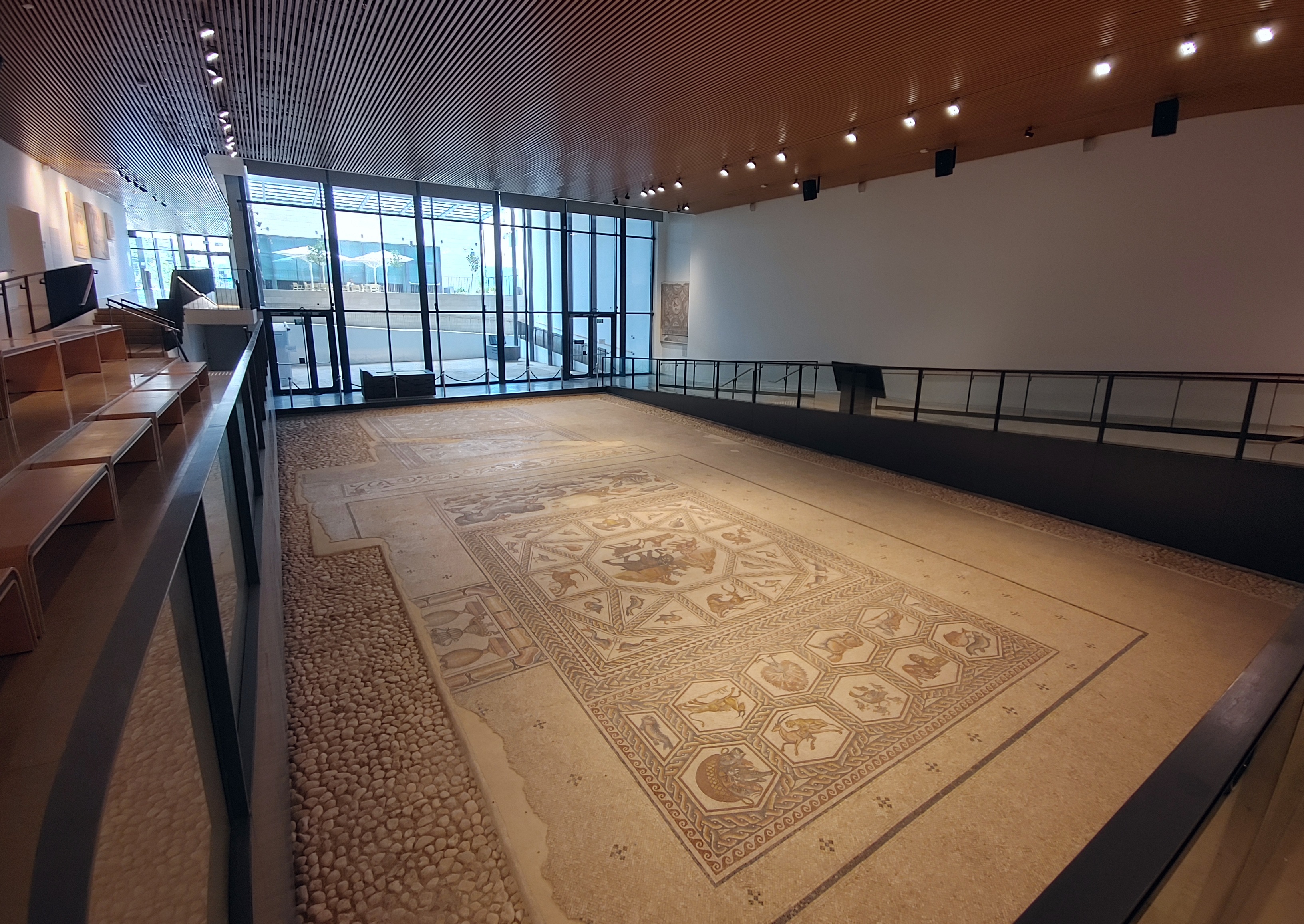
It was the final day of August last year and I had taken the day off from work. Coordinating with Bracha’s plans to go shopping for Amir’s first birthday, which was to take place in one week’s time, I decided on a spontaneous trip with the little boy. We were to visit the newly opened Lod Mosaic Centre, built to house none other than the famous Lod mosaic which was painstakingly unearthed starting in 1996.

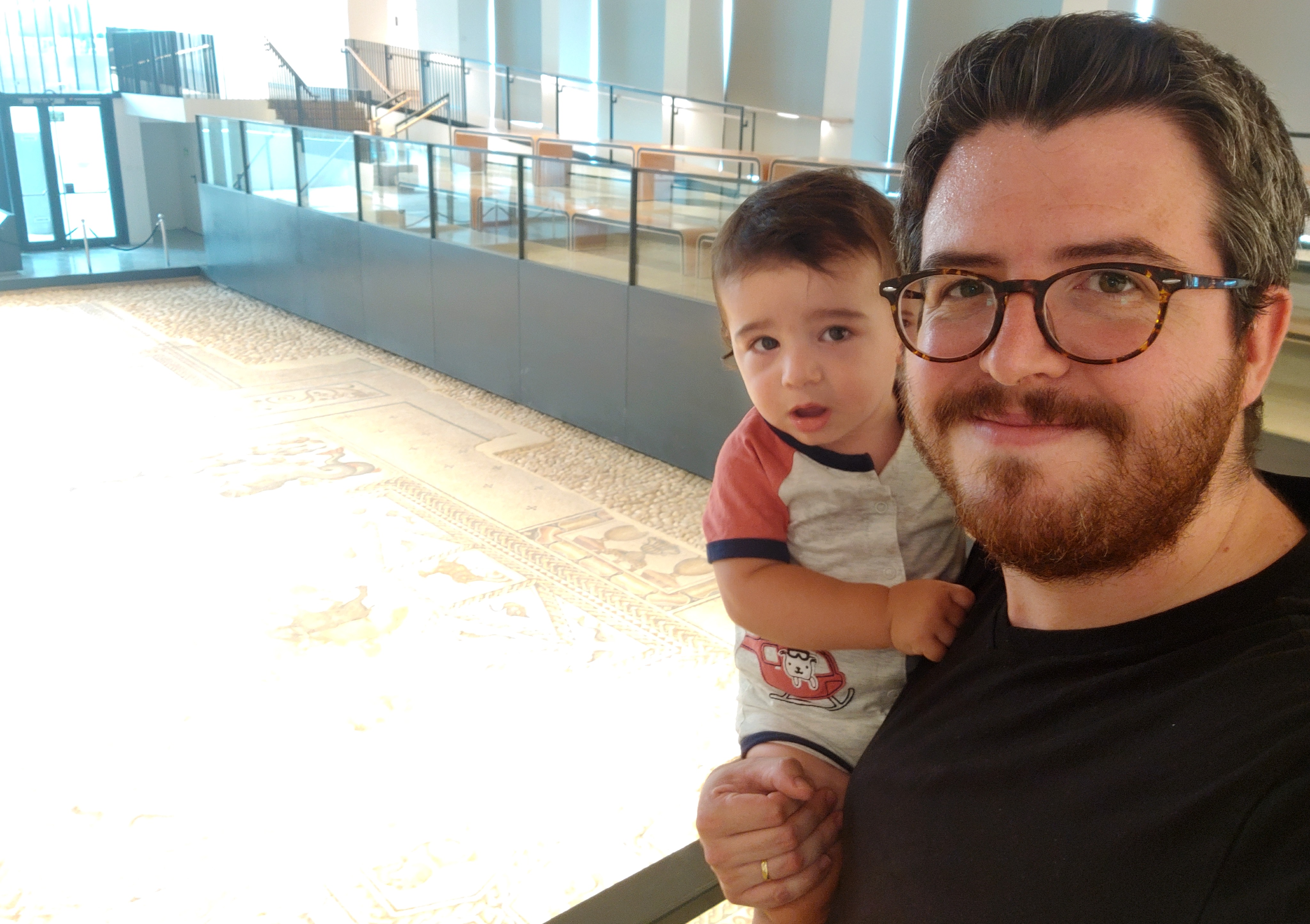
Father-son outing

Father-son outing

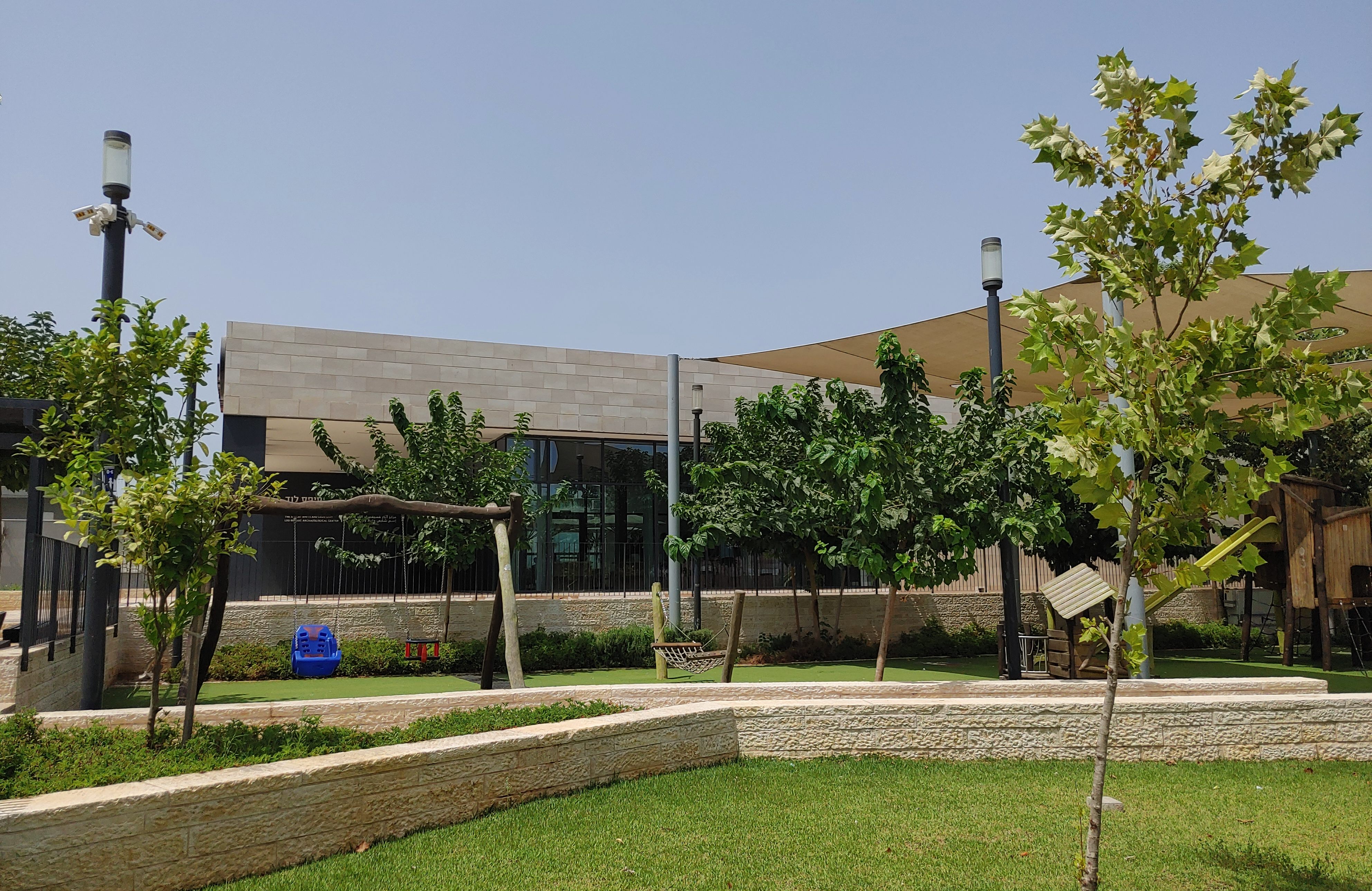
I had visited neighbouring Ramla back in 2017 with Adam Ota, and we had attempted to see all the main sites of interest, but the city of Lod had always escaped me. This was to be my first real visit to Lod, strangely enough, and I noted that there was even a playground just outside the centre – perfect for entertaining Amir even more.

Inside the museum

Inside the museum

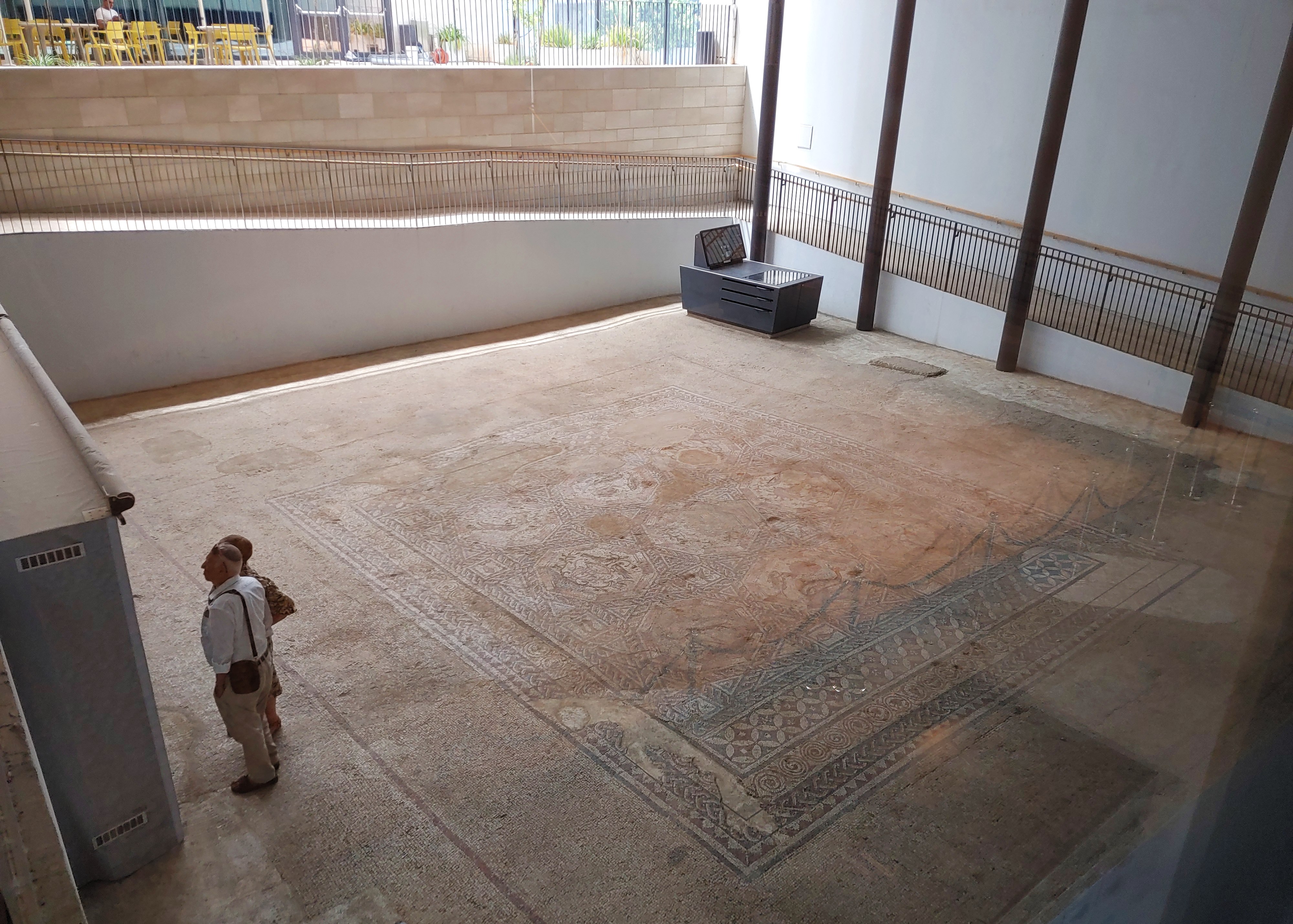
We arrived at the museum, entered and began our self-guided tour. At first, I was surprised at how small the place was (reminiscent of Beit Alpha national park), but it made perfect sense. The building was simply covering the site of the famous mosaic, which had been removed, restored, internationally displayed on tour, and finally replaced to the very earth it called home since the late Roman period some 1,750 years prior. There is really no need for a bigger building.

Gazing out at the spectacular work of art

Gazing out at the spectacular work of art

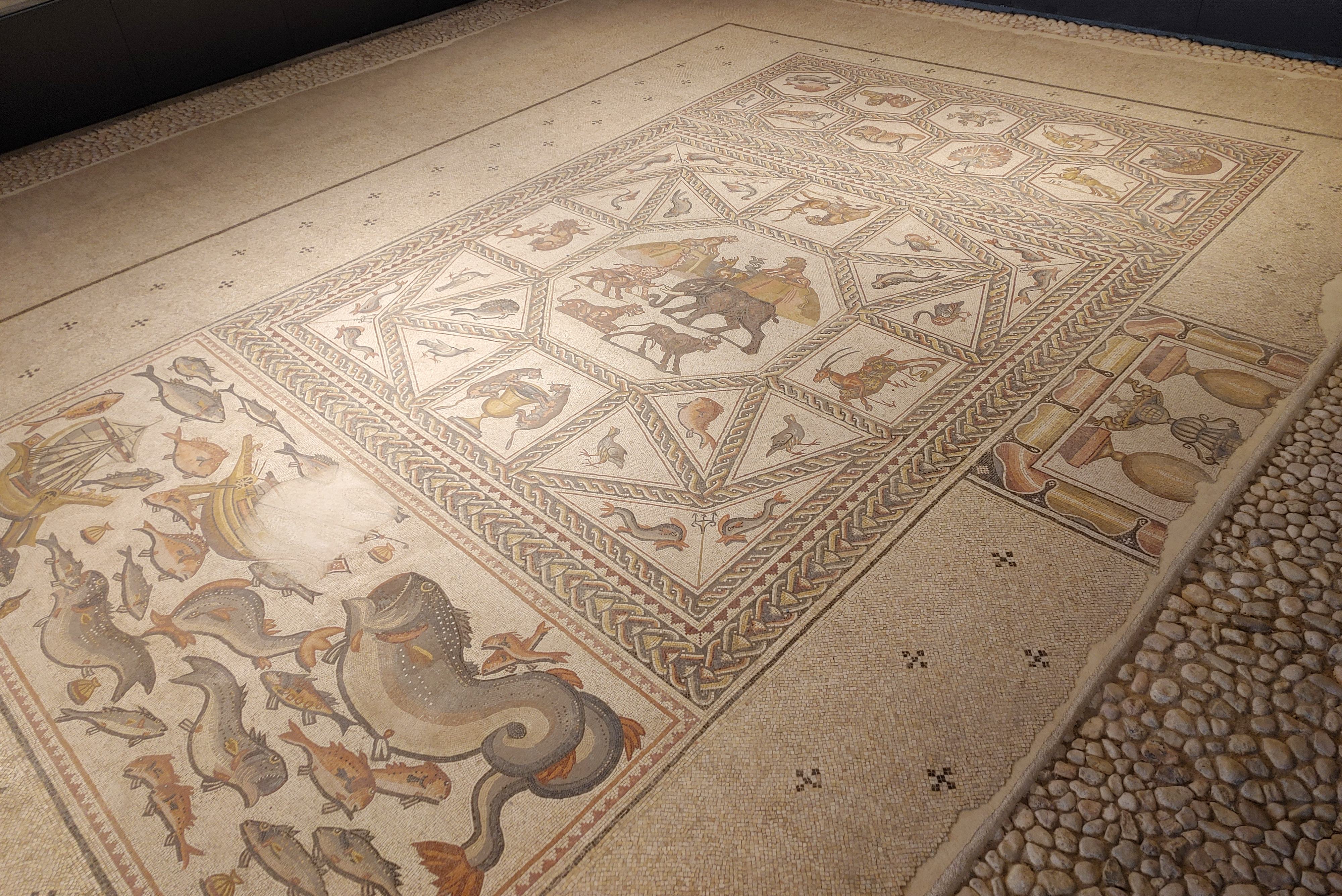
Passing some fragmented mosaics on display, we made our way through the tastefully-lit central room (or atrium, in this case) where the main mosaic is located. The museum structure mimics a typical upper class Roman villa, a recreation of sorts of the house that once existed on site. We gazed out at the vast central floor, covered in an intricate collection of mosaic motifs and patterns, and tried to take it all in.

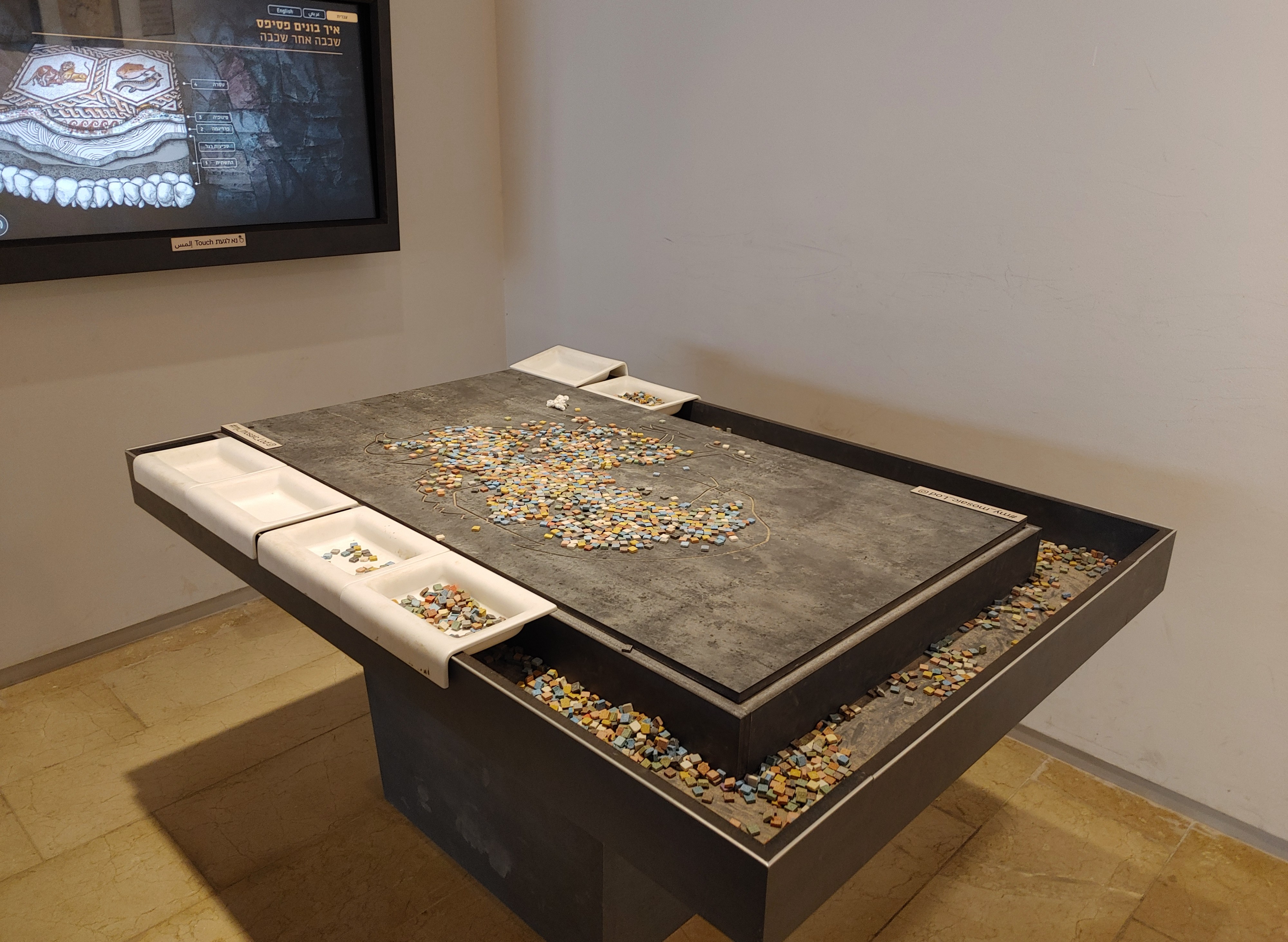
DIY mosaic tables

DIY mosaic tables

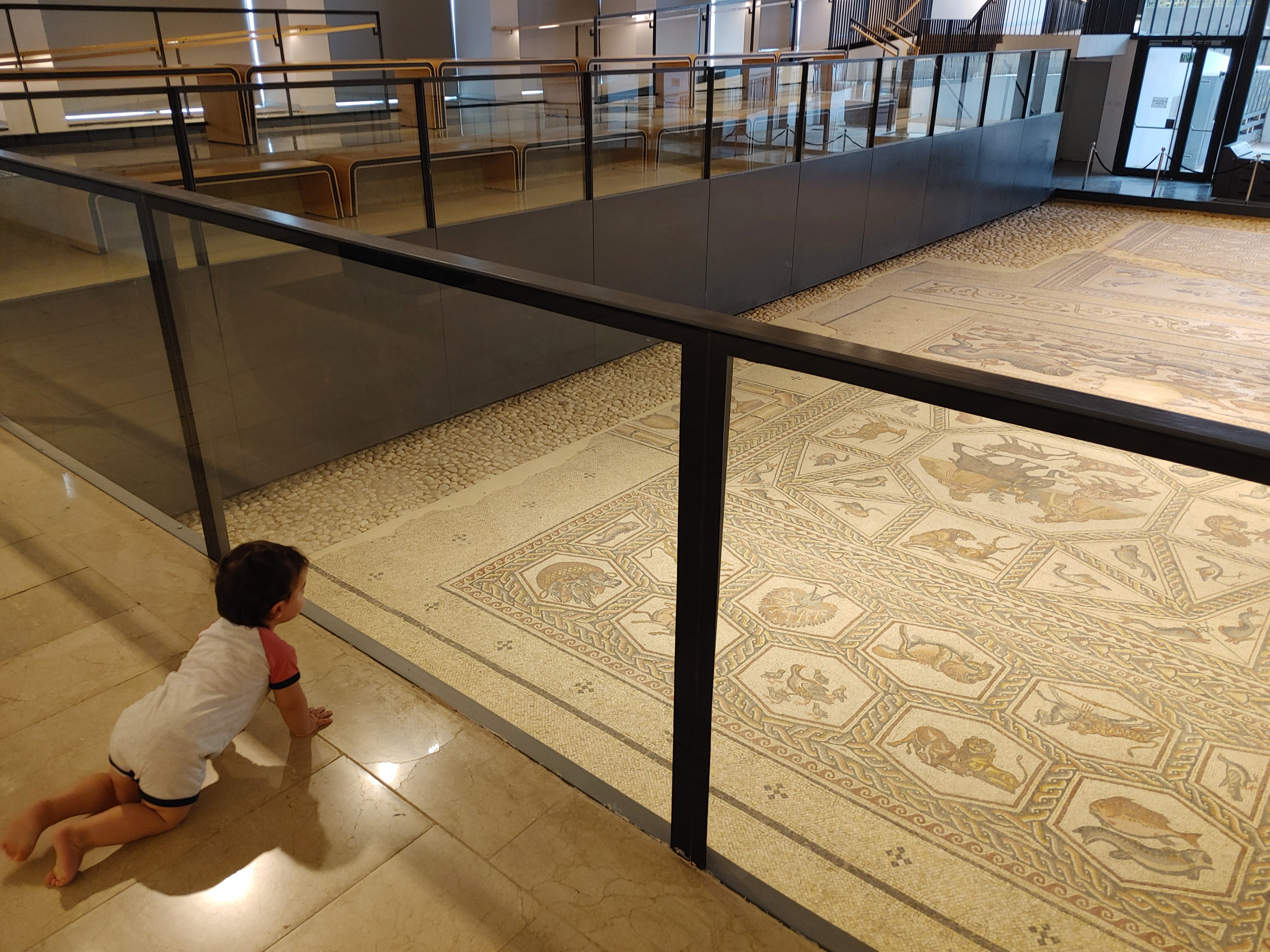
Amir was at that transitional age between crawling and cruising, so I let him down to explore as I took pictures and read the display signs. The focal point of the giant mosaic intrigued me most, being a montage of exotic and mostly African mammals posed together in a manner somewhat reminiscent of The Lion King. I pointed out the tiger to Amir, who was overall quite familiar with the striped beast, but I don’t think he quite caught on to my helpful intentions.

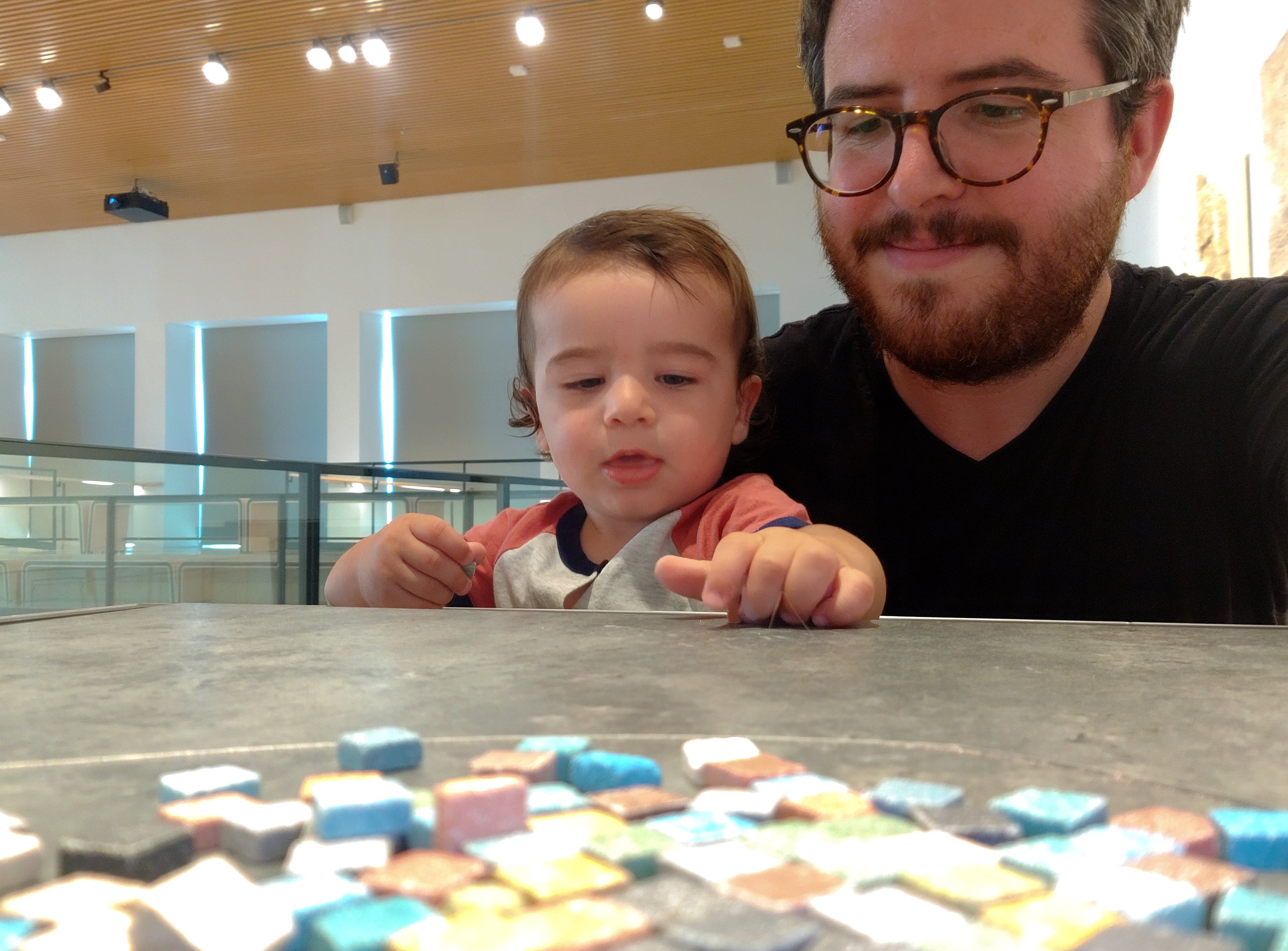
Amir playing with the mock mosaic tiles

Amir playing with the mock mosaic tiles

Perhaps what was more relevant for him was the DIY mosaic tables where trayfuls of small colourful tiles were to be placed in efforts to create mock mosaics. This was geared towards children and had innumerous choking hazards, so, naturally, Amir wanted to give it a try. Carefully, and under my supervision, he had a try at making his own mosaic as well.

A closer look at the magnificent handiwork

A closer look at the magnificent handiwork

Returning to the ancient masterpiece at our feet, we looped around to the far end of the floor mosaic and completed our circumnavigation with an appropriate amount of approving nods and low murmurs of admiration at the magnificent handiwork seen before us. We then popped outside into a small courtyard where another floor mosaic awaited us. While this one was far less preserved, it was only to be expected as this courtyard was identified as the original Roman villa’s peristyle courtyard. Albeit damaged, we were still able to make out some of the scenes described in the medallion-patterned layout.

The outer courtyard

The outer courtyard

Also featured outdoors was a chronological overview of Lod overall, ranging from the prehistoric Neolithic period until modern times. Naturally, I took particular interest in the Crusader period, which unfortunately was the only time period listed not to feature any artefacts on display. I settled for a collection of ancient ceramic vessels of other time periods and a neat Scottish military beret pin from the British Mandate period. One final exhibit caught my eye, and that was an interesting cabinet of drawers tucked into the far corner. Within, each drawer represented a different layer (or stratum, as it is known in archaeology) in the sample soil. This gave a very hands-on representation of archaeological work, and the expected results as one digs deeper and deeper into the past. Even with my hands-on knowledge of archaeology, I felt that this exhibition really hit the nail on the proverbial head and applauded the designers.

Outside the Lod Mosaic Centre

Outside the Lod Mosaic Centre

We finished our educational trip in the small playground outside, where Amir played a bit and enjoyed a sandwich for lunch. There was of course still more to see nearby, and I was fortunate enough to pick up a map and some tourist literature, but those sites will simply have to wait for another day.

Ramat Gan Safari

In Central Israel, Israel on June 26, 2023 at 7:38 AM

Recently, in the middle of May, I was invited to take my family to the Ramat Gan Safari, free of charge. This was an initiative spearheaded by some bureaucratic branch of the IDF, aiming to “give back” to civilians like myself who partake in active reserve duty. Since I had served a 16-day stint in the previous calendar year, I qualified for some quality time with the safari animals, free of charge and complete with free food and activities for the children.

Idyllic safari scene

Idyllic safari scene

Aiming to align our visit with our son Amir’s nap schedule, we only headed over in the mid-afternoon – but thankfully, we only live a few kilometres away, so the drive was decidedly quick. Arriving in our new-to-us Honda Civic, soldiers ushered us in and we began to drive through the safari segment of the park. I had been wanting to visit the safari for quite some years, and couldn’t wait to see what lay in store for us.

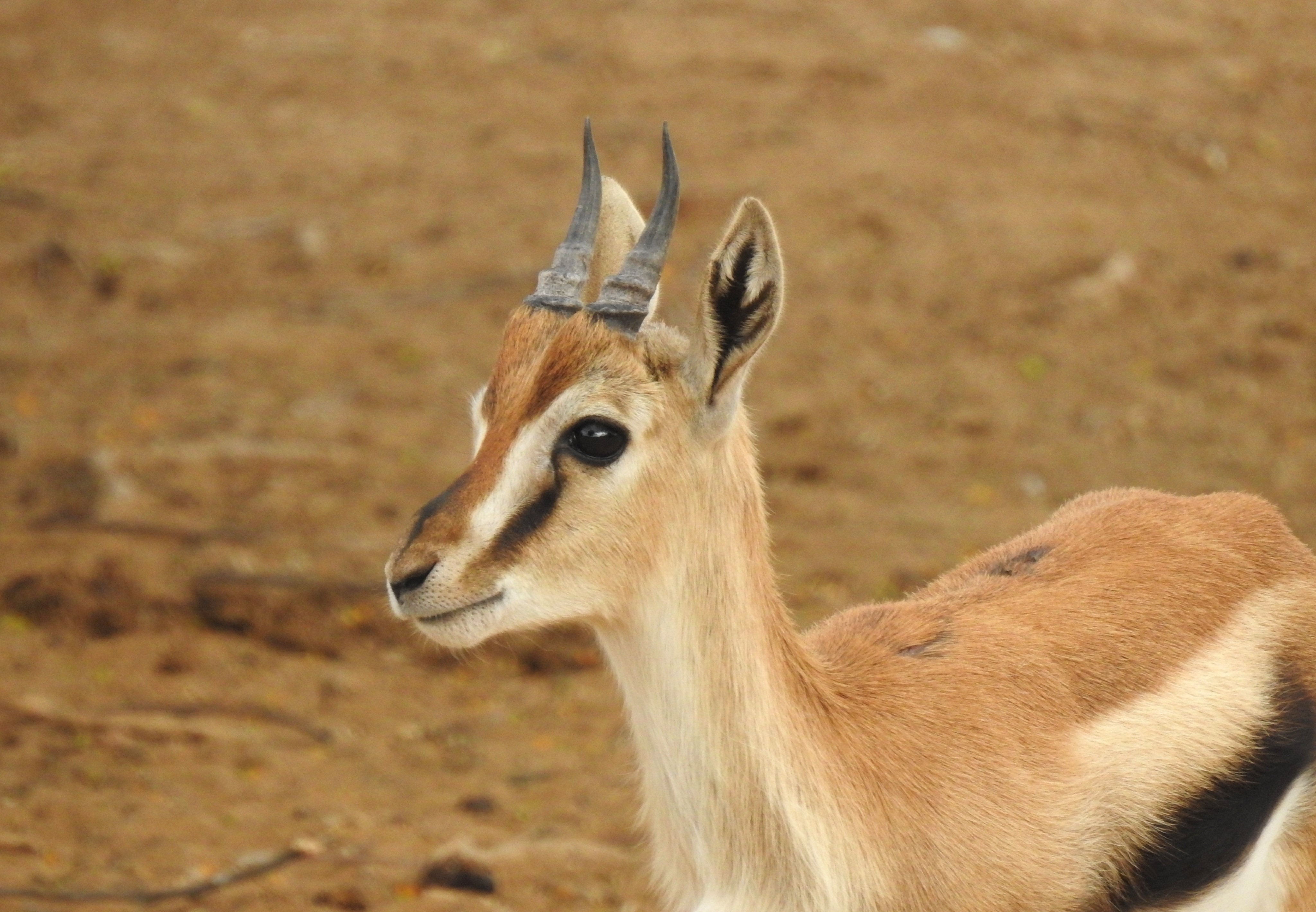
A cute Thomson's gazelle

A cute Thomson’s gazelle

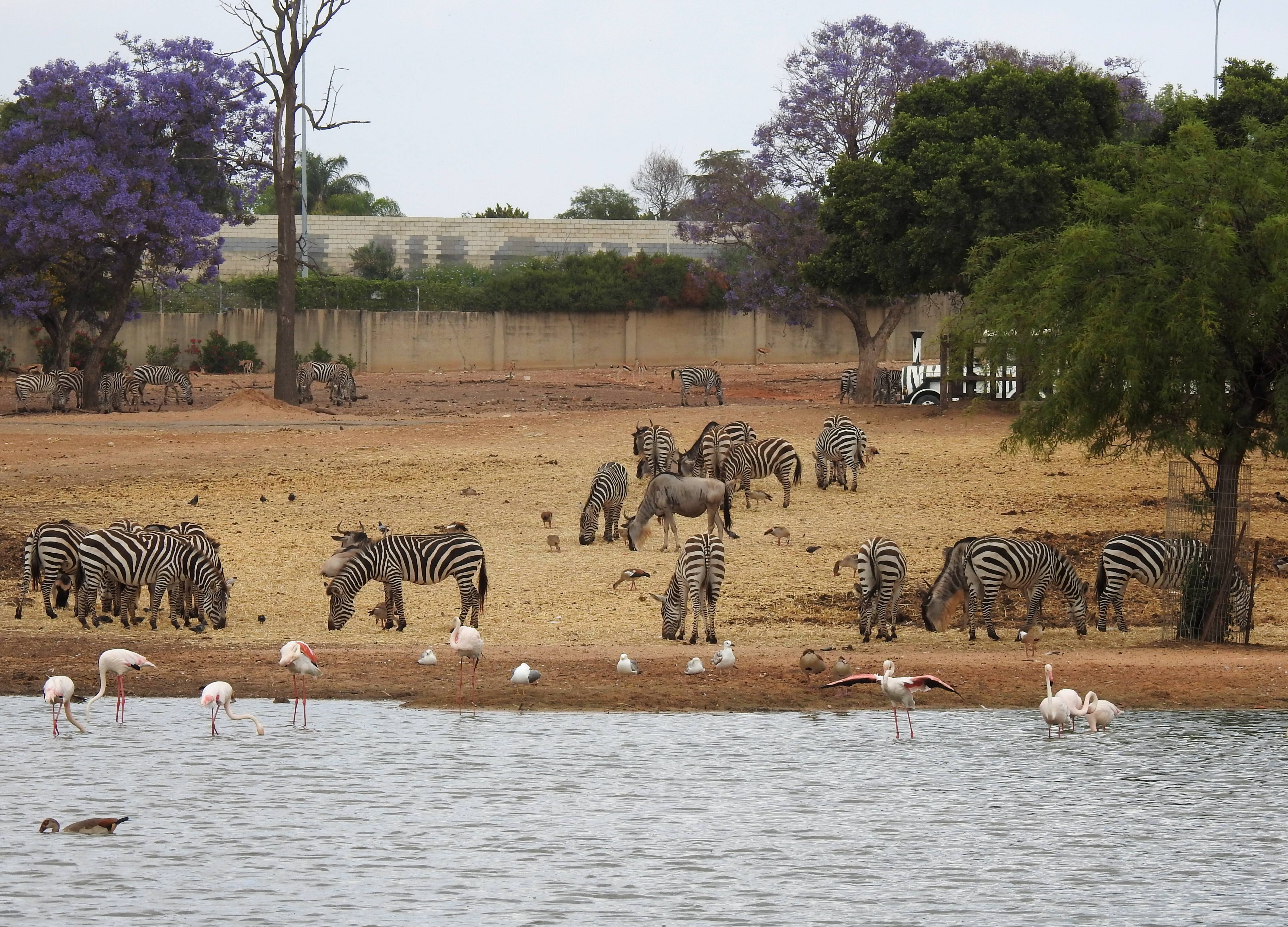
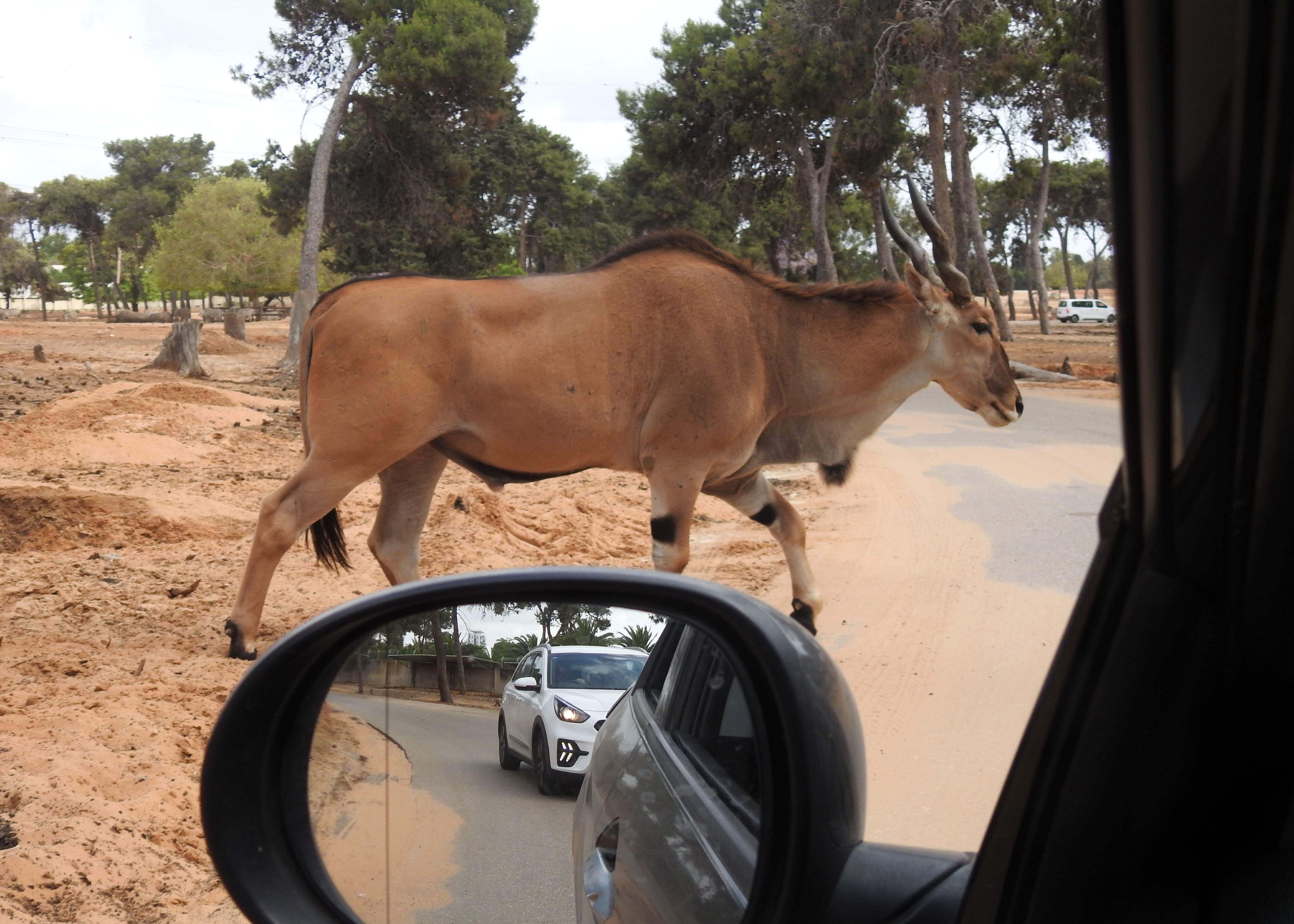
The first of the animals to be seen were a variety of herbivores, primarily giant elands and Thomson’s gazelles – a scene straight out of Africa. Some plains zebras and local spur-winged lapwings dotted the landscape too, keeping with the strict colour scheme of black, brown and white. A white rhinoceros or two added some grey to the mix, although the real colour was yet to come.

Typical safari moment

Typical safari moment

I snapped pictures here and there as we drove through the safari’s paved network of roads, hoping to spot something interesting. Some of the animals ventured relatively close by, some dashed out in front of the cars and some avoided us altogether. We kept hoping for something to be right up alongside the car, like one sees from Kruger and other parks, so that Amir would really get a good look with his little eyes. That animal was a plains zebra of sorts, can’t be too sure of the subspecies without more intensive research, and Amir got a good look as it ambled off.

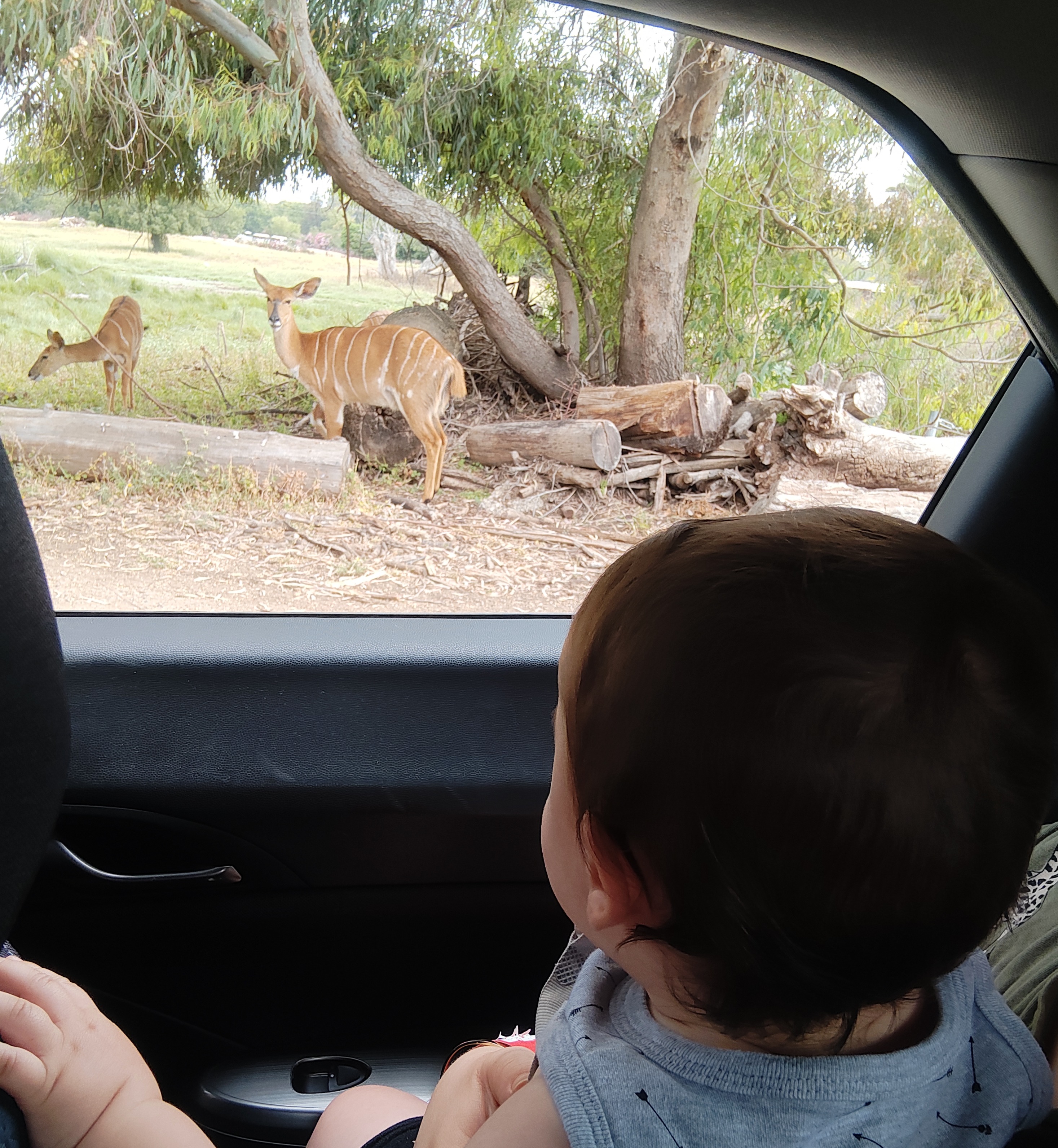
Amir getting a closer look at the kudu

Amir getting a closer look at the kudu

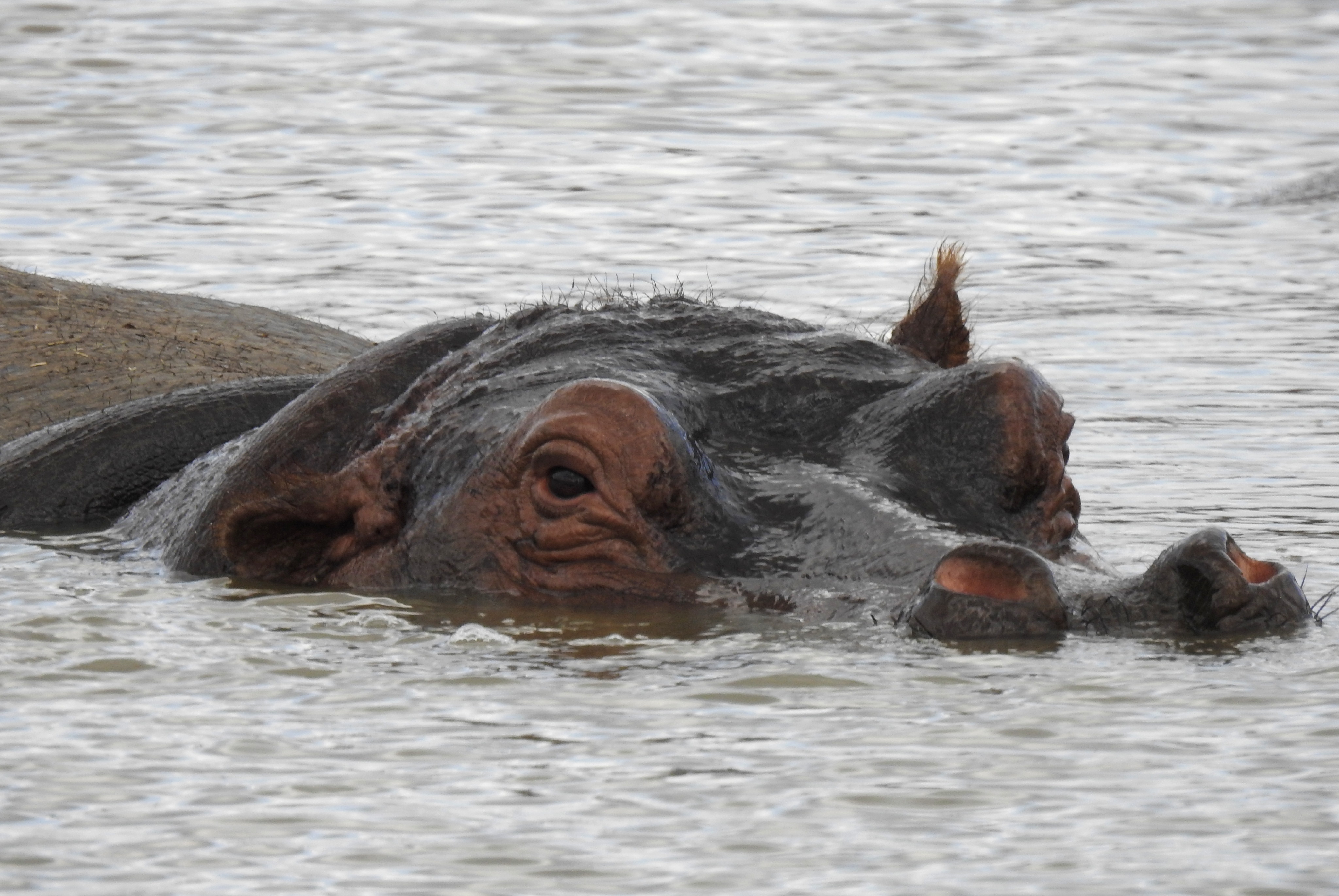
An upcoming watering hole held promise as I spotted both crowned cranes and marabou storks at the water’s edge. I’ve always been amused by marabou storks and it was so nice to finally see one semi-free, standing ominously with the grim appearance of a plague doctor-cum-undertaker. Some great white pelicans on the road seized our attention next, and suddenly one of the nondescript dirty lumps in the pond’s centre began to move – hippos!

Hippo emerging from the water

Hippo emerging from the water

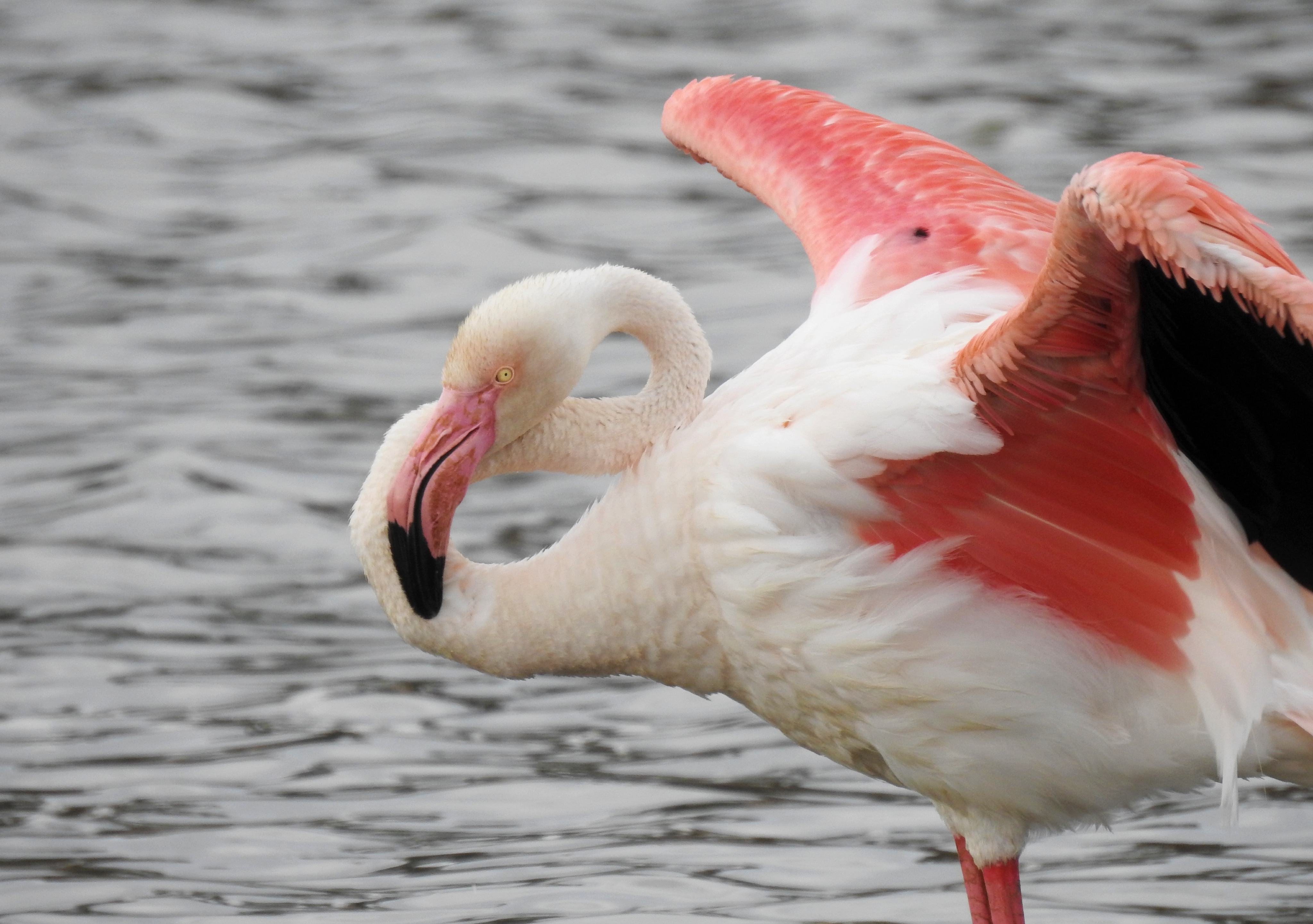
Greater flamingos danced in the background, flashing their rosy pink accents and brightening up the scene, a scene that was becoming more and more African. A handful of wildebeests and scimitar oryxes were seen next, mingling with the plains zebras and Thomson’s gazelles. As we progressed towards the lion enclosure, we began to see other species such as kudus and an undetermined species of giraffe.

A greater flamingo showing off

A greater flamingo showing off

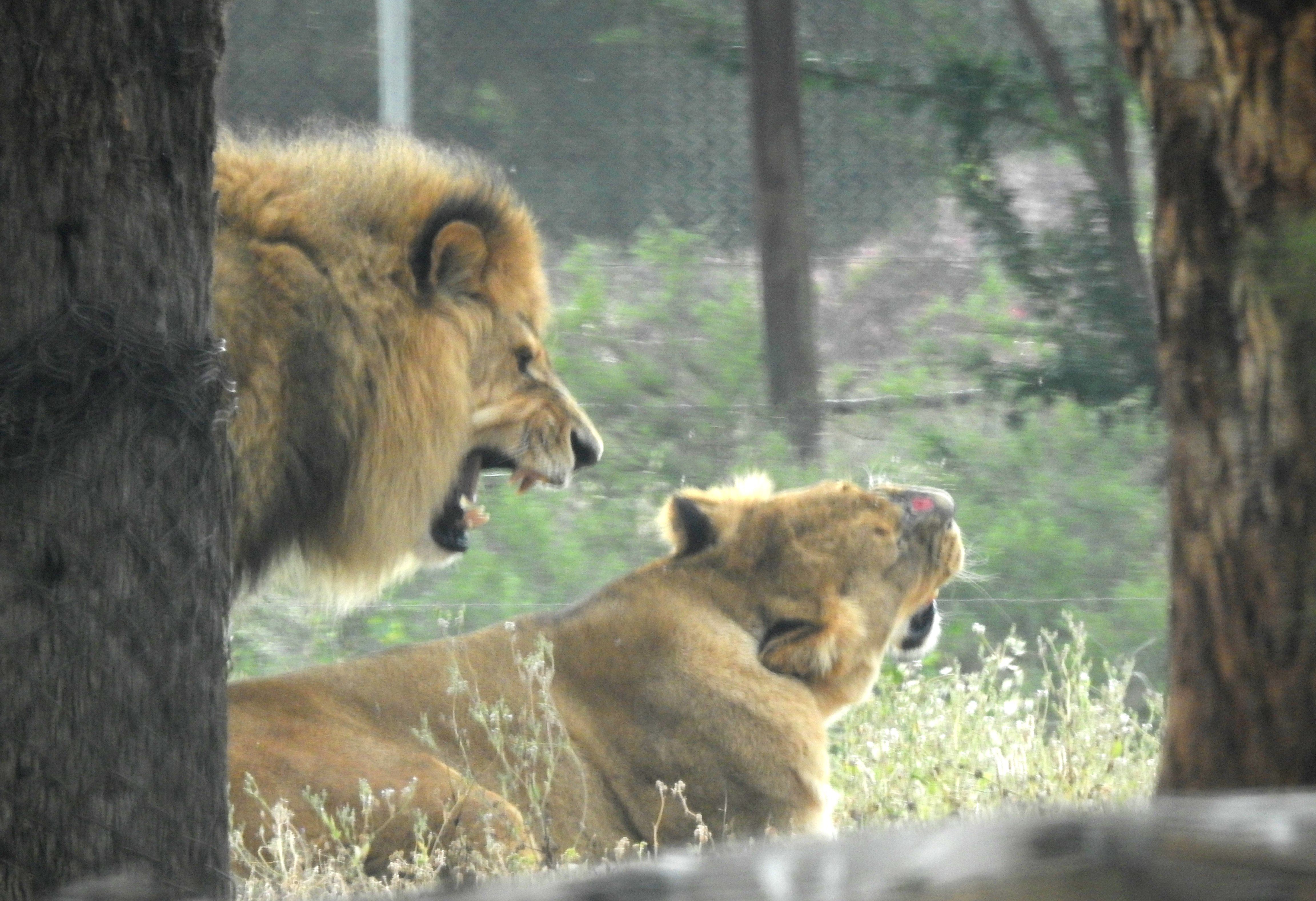
At last we reached the lion enclosure, protected by a double gate and manned watchtowers. We rolled up our windows and entered, peering about here and there in search of the yellow-furred predators. It was a relatively small enclosure so it didn’t take long before we found a pride of African lions lounging about the grassy hillock that was flanked by the paved road. A maned male was making some moves on one of the females, but it was atrociously difficult to take decent pictures through the glass.

Photographing the lions through the window

Photographing the lions through the window

With the rest of the lions in late afternoon stupor, we rolled on out with the rest of the cars and headed for the zoo section of the safari. Parking and entering by foot, we saw that the IDF reservist day event had practically taken over the park. We were handed water bottles and found tables of pastries just begging to be eaten. Amir chewed on a croissant as we headed for the animal enclosures, starting with the distinctly Australian kangaroos.

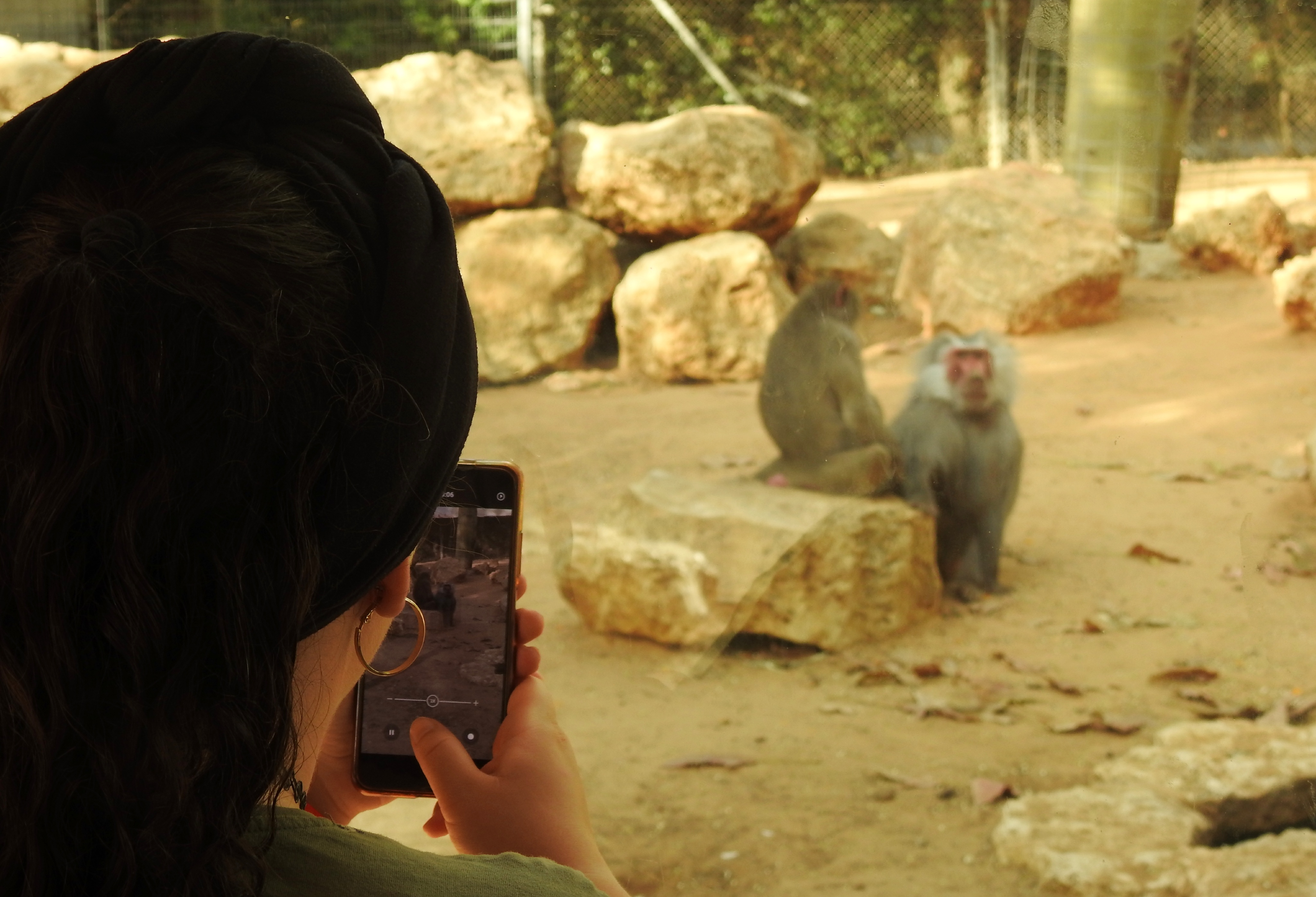
Bracha enjoying the grooming baboons

Bracha enjoying the grooming baboons

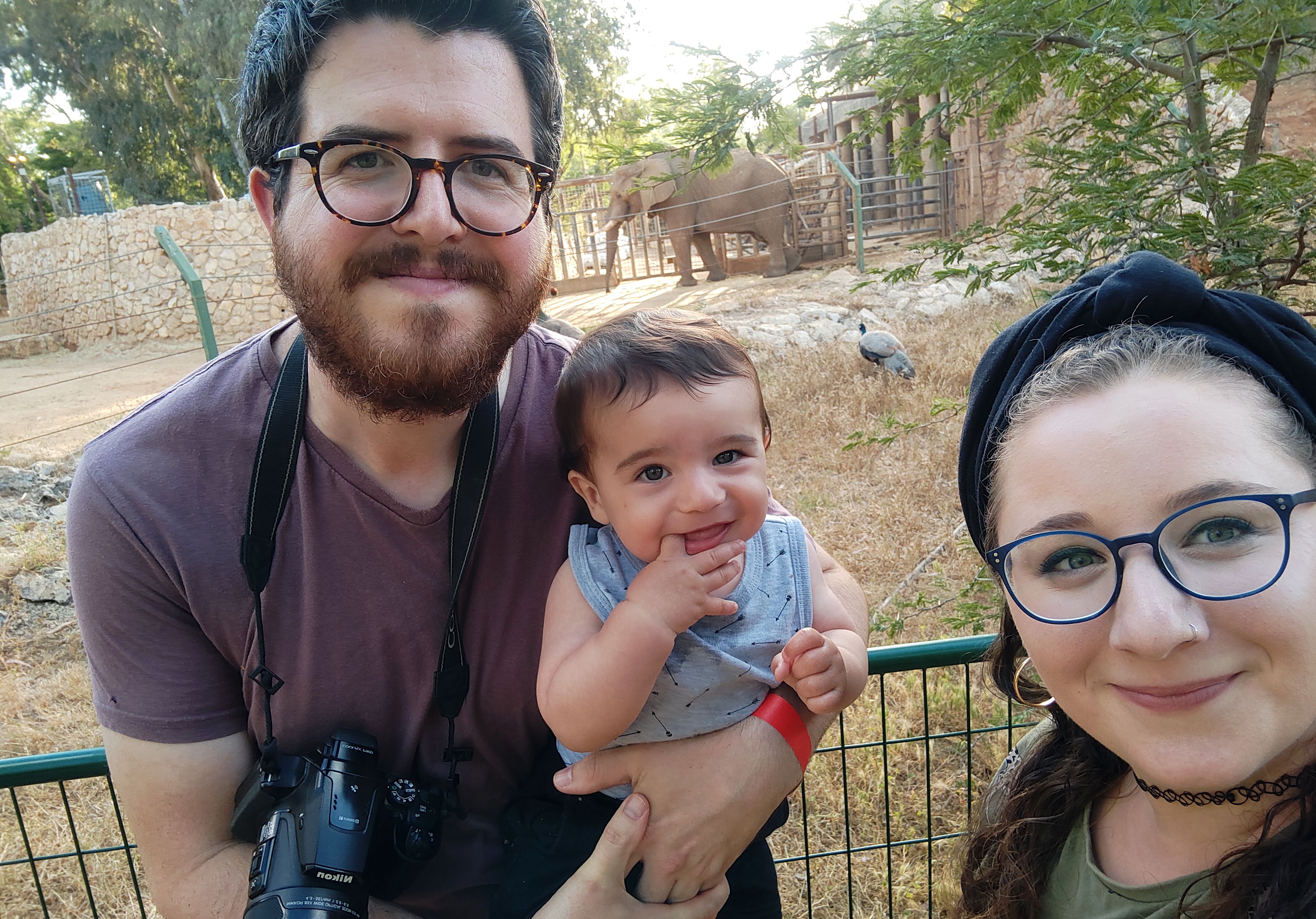
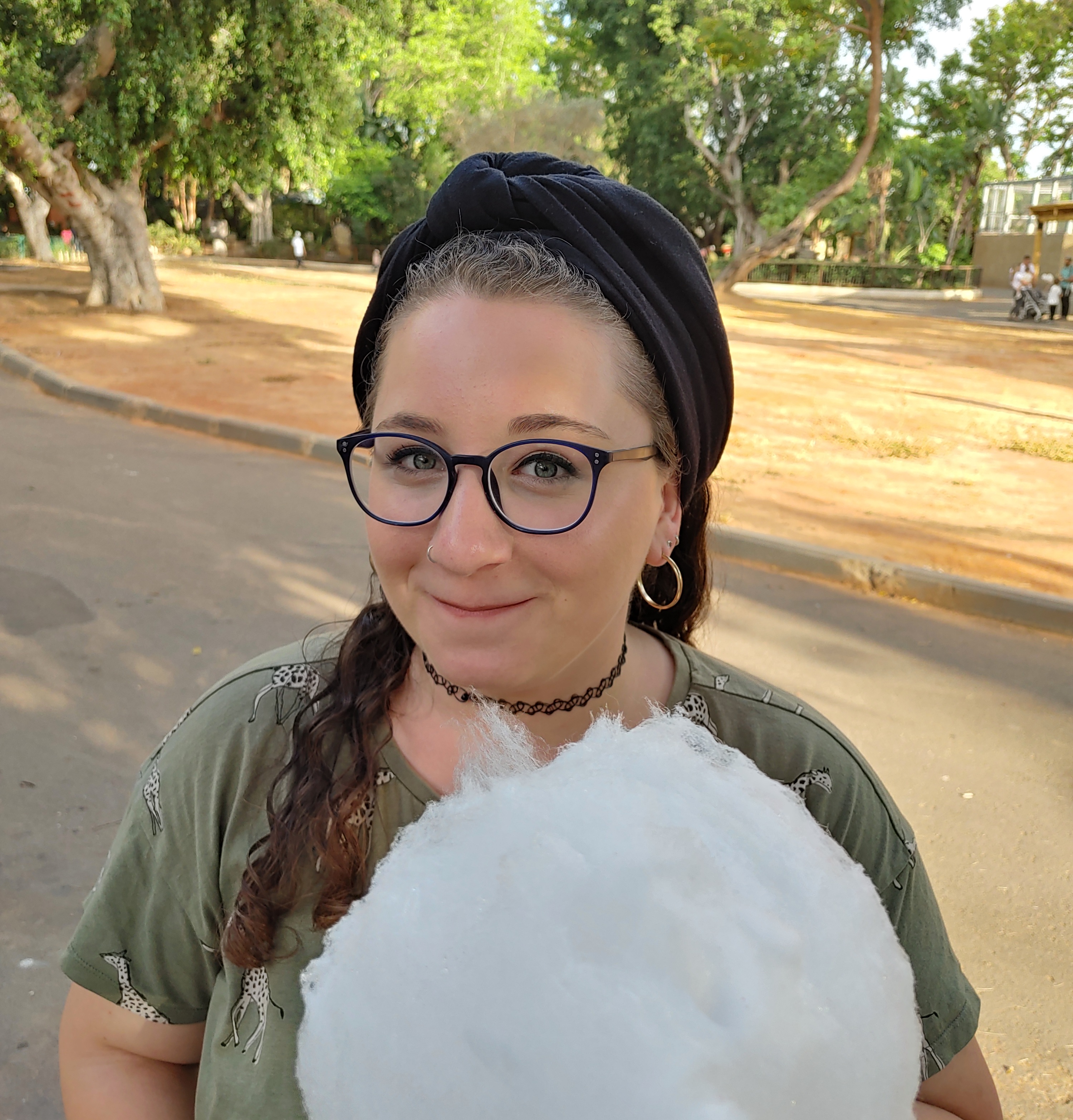
We moved on to African wild dogs and a variety of different primate species, including mandrills and baboons with their delightful seat cushions. In between the animal enclosures we found the time to get some popcorn and cotton candy (Bracha’s favourite), and then introduced Amir to some peacocks for educational and amusement purposes. We posed here and there, but for some reason Amir wasn’t having as much fun as we were, as the photos showed.

Capturing the moment as a family

Capturing the moment as a family

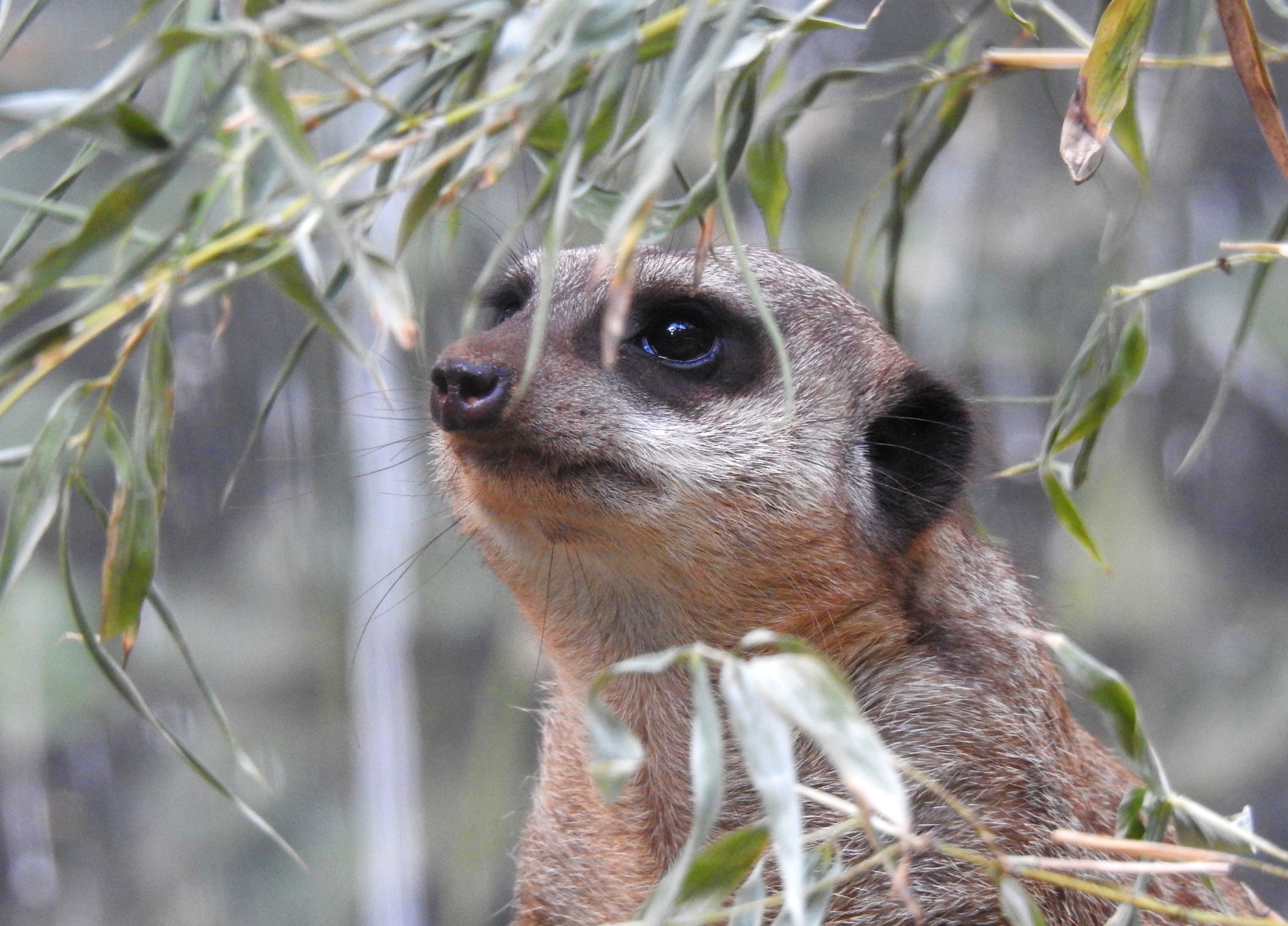
A quick stop at the playground, and some rejuvenating minutes on the swing, pumped new energy into Amir and Bracha alike. We moved on to the meerkats – such fun little creatures, an absolute joy to be around. One final stop at the Nile crocodile enclosure, where a behemoth of a lizard laid placid at the edge of a small murky pool, and we felt like we had seen enough.

The ever-watchful meerkat

The ever-watchful meerkat

It wasn’t that the zoo wasn’t nice – I was rather pleased by the leafy abundance all over, something that lended to a more natural feeling, despite the fences and cages. Certainly, it was more impressive than the Haifa Educational Zoo which Bracha and I had visited a year prior, but in the end it is still just a zoo.

Bracha and her cotton candy

Bracha and her cotton candy

For nature lovers, there feels to be something lacking when seeing the animals cooped up as such, even if these same animals can’t be reintroduced to the wild for many valid reasons. Nonetheless, I’m happy that I finally had the chance to visit the local safari, but with the same breath, I’m happy it was free.

Poleg Marshes

In Central Israel, Coastal Plain, Israel on October 27, 2022 at 4:11 PM

At times, updates on this travel blog become a rarity, usually when life gets busy, keeping me otherwise occupied. This past lull in posts is no different. After nine long months, on September 10th, my dear wife Bracha gave birth to our precious firstborn son, Amir. He is a handsome young fella who keeps his parents busy during the days, and sometimes awake during the nights. I’m sure that sometime soon he, too, will join in on some memorable and, perhaps even bloggable, adventures.

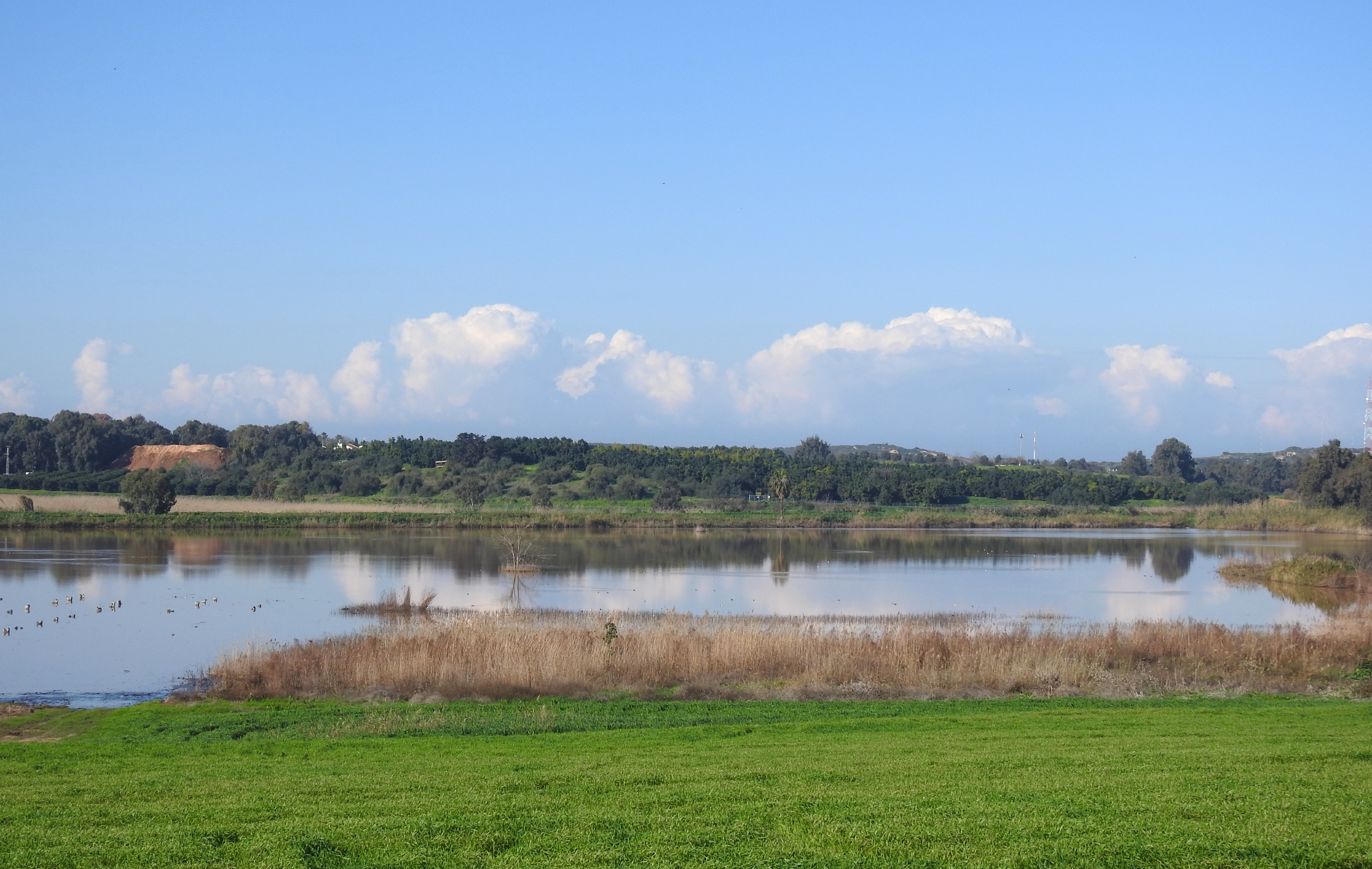
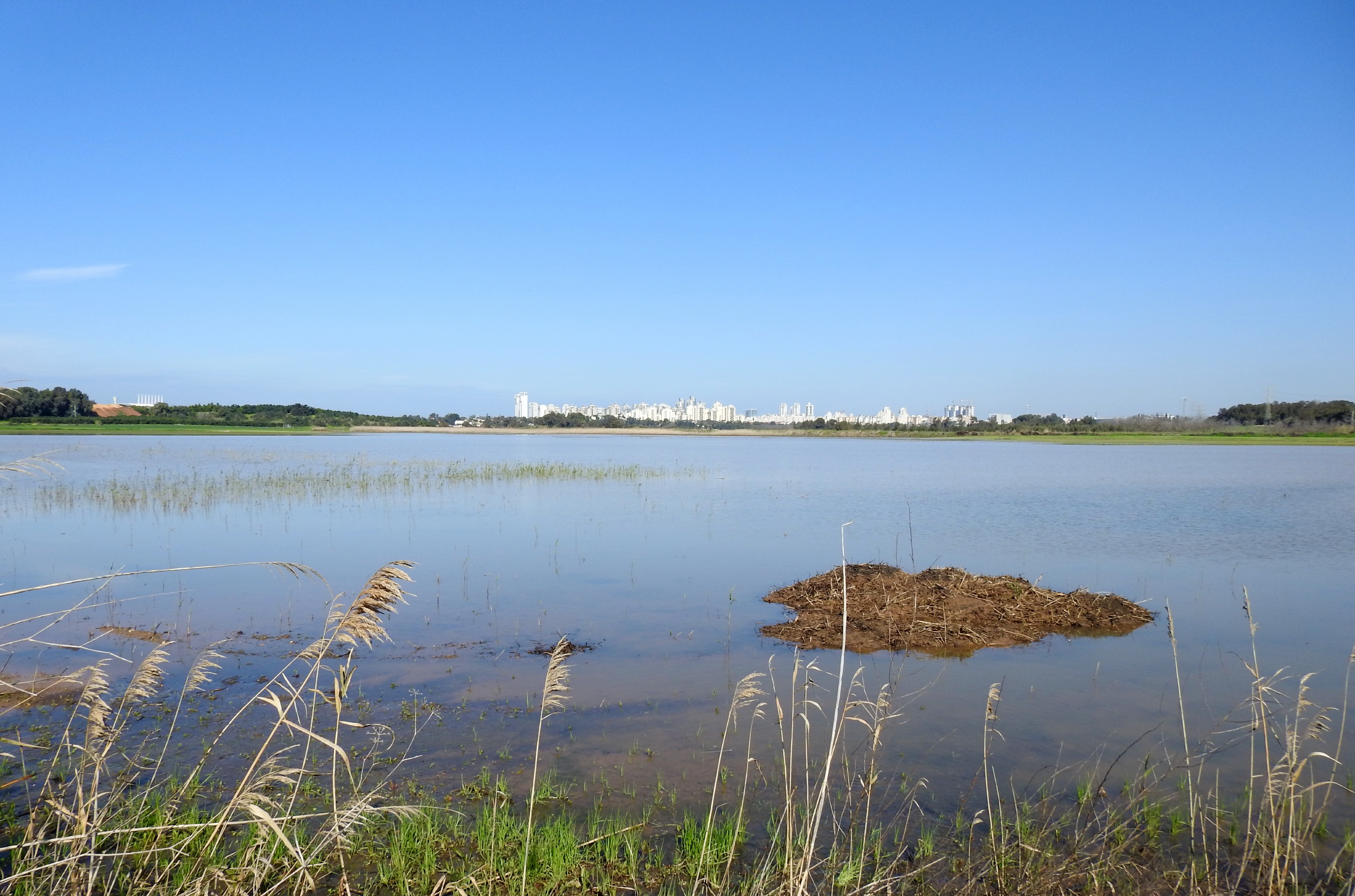
Our first sight of the Poleg marshes

Our first sight of the Poleg marshes

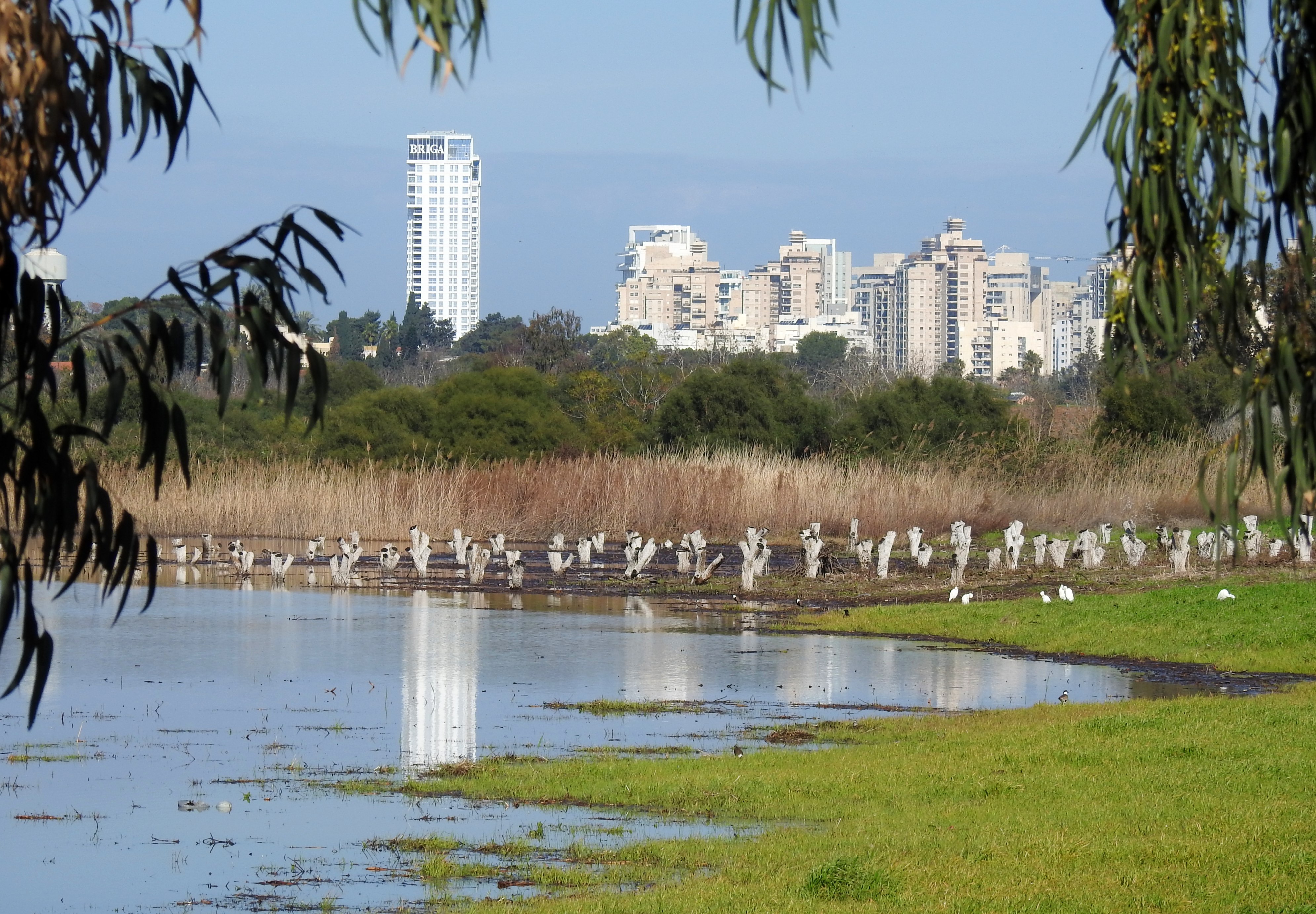
However, not writing blog posts as of late is certainly not for want of what to write. Harkening back to the end of January, when the winter’s plentiful rains had essentially flooded the country, fellow adventurer Adam and I decided it was time to visit some seasonal wetlands. There had been much commotion about one particular site which began to attract birders in the preceding months, and we felt an uncontrollable urge to explore the site as well. Located just south of Netanya is the open wetlands of the Poleg Marshes.

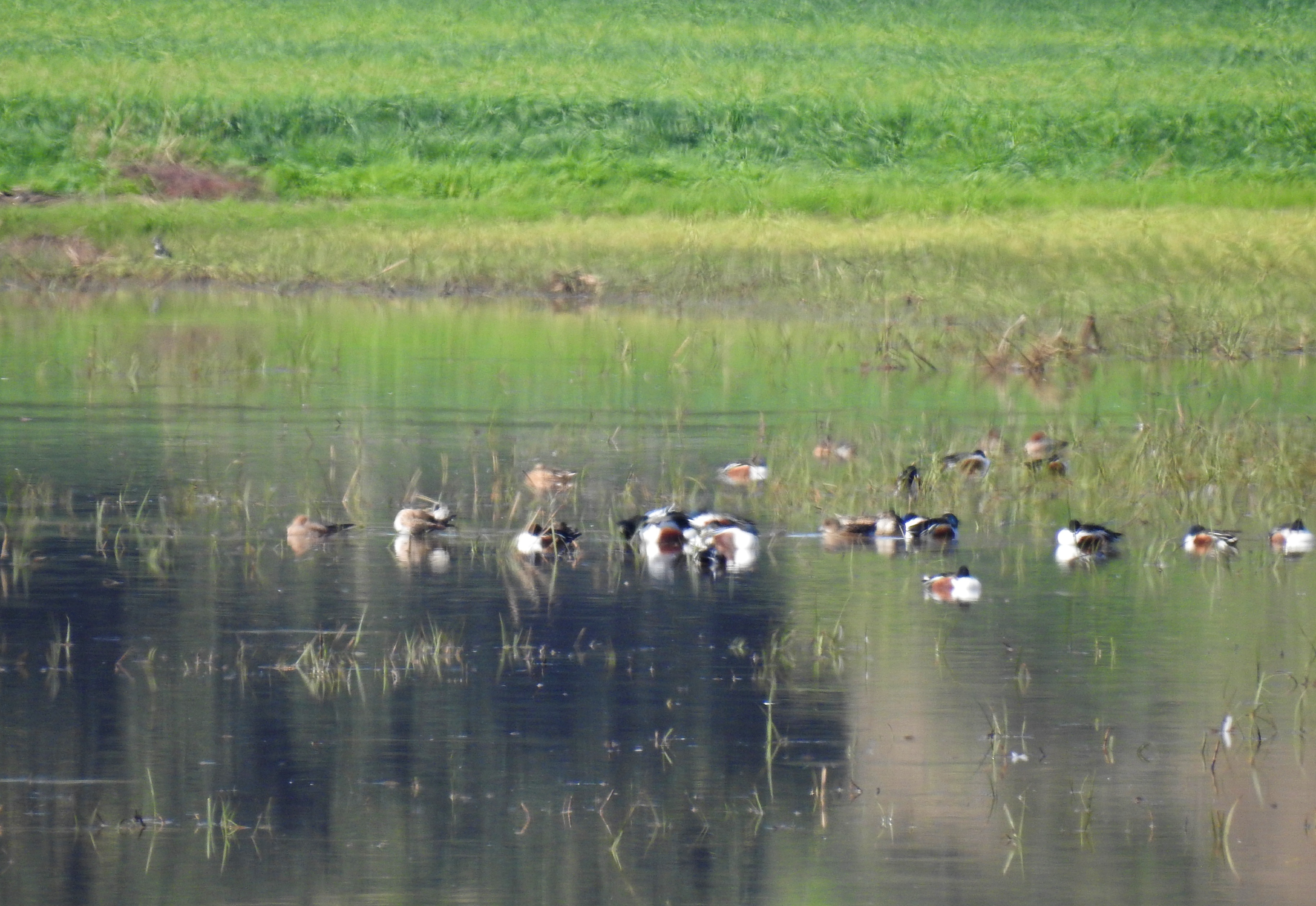
Resting waterfowl

Resting waterfowl

Still vehicular-less back then, we bussed to a nearby junction and walked our way to nature. It wasn’t long before we crossed a bridge into the natural area, and noticed a sign announcing Poleg Forest, surrounded by a whole slew of peeling eucalyptus trees. Yonder, just beyond the so-called forest was the first body of water – a large flooded area that formed a picturesque pond.

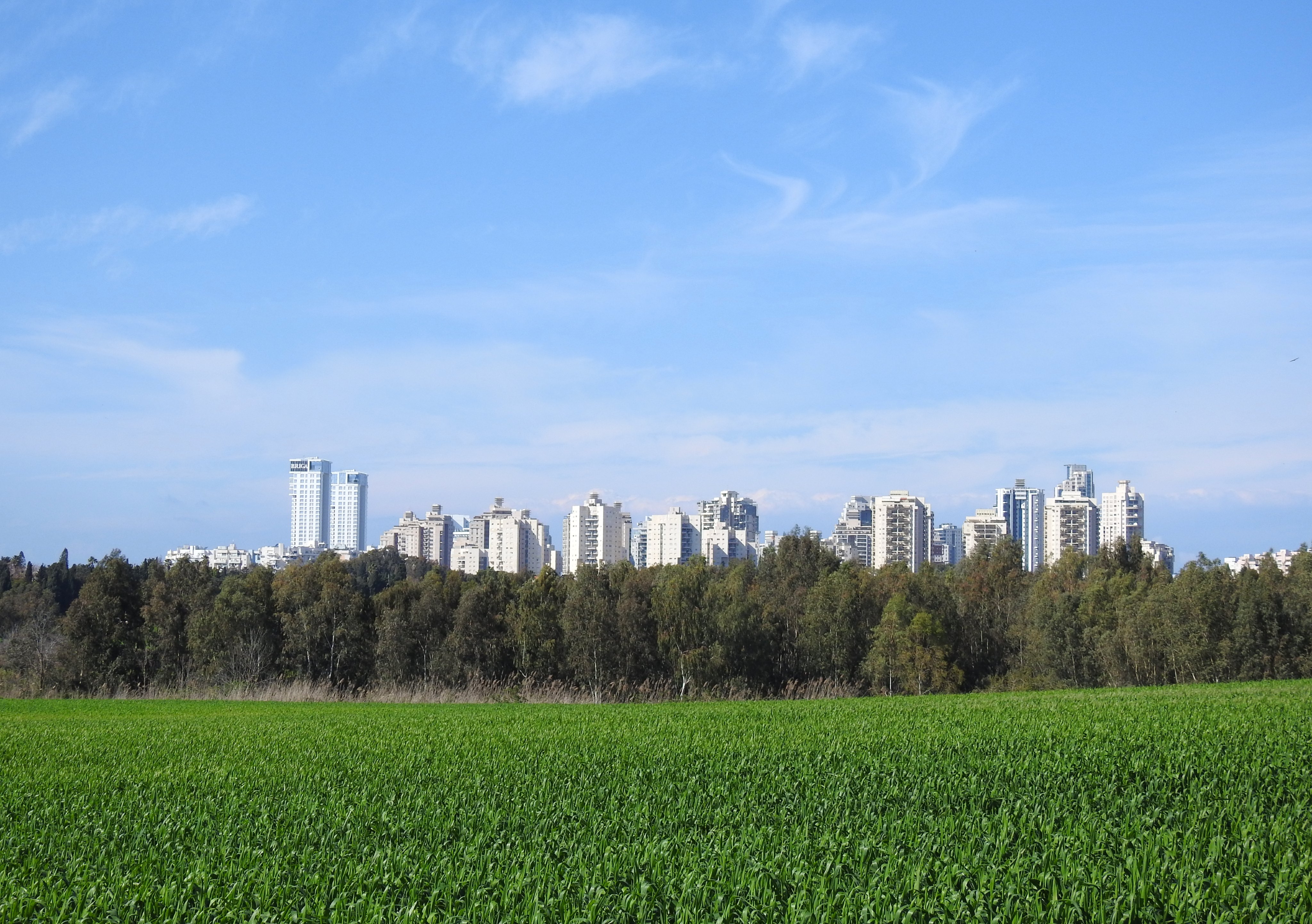
The marsh backdropped by Netanya

The marsh backdropped by Netanya

Scanning the water and waterline with both binoculars and camera, we were not disappointed. A good number of ducks were both traversing the pond, and dabbling along the edges. We identified a few species, including gadwalls, pintails, wigeons, shovelers, mallards and teals. A lone common buzzard sat pensively on some denuded branches, and a variety of songbirds flitted about here and there.

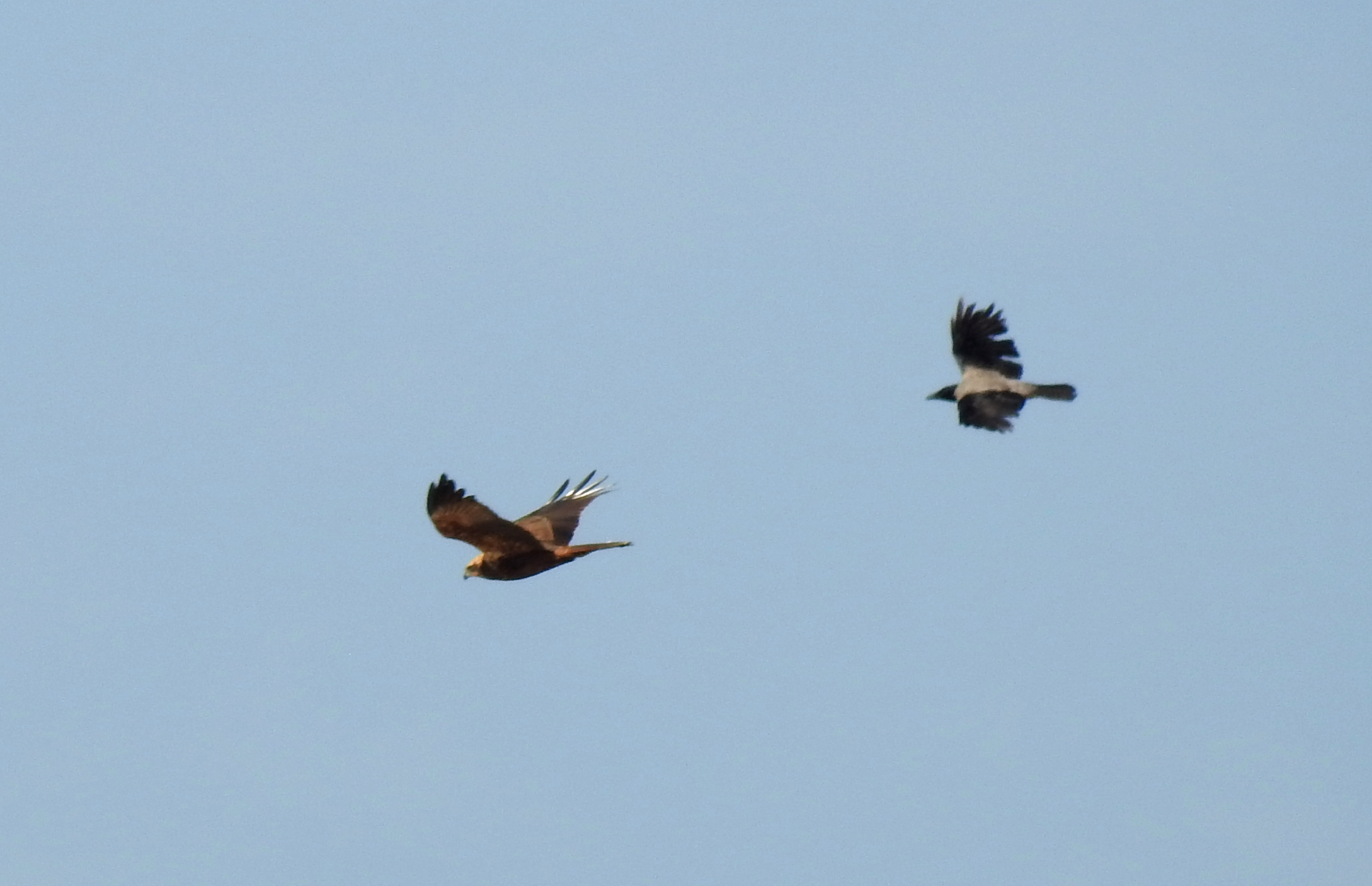
A hooded crow terrorising a marsh harrier

A hooded crow terrorising a marsh harrier

We continued down the muddy trail, dodging puddles and cyclists as we kept our eyes and ears peeled for signs of wildlife. A marsh harrier materialised overhead, as did a flock of rooks and a valiant robin, singing from the low trees. Up ahead was a large flooded field, hosting a variety of birdlife including waders such as northern lapwings, wood sandpipers and a black-tailed godwit.

The tranquil flooded field

The tranquil flooded field

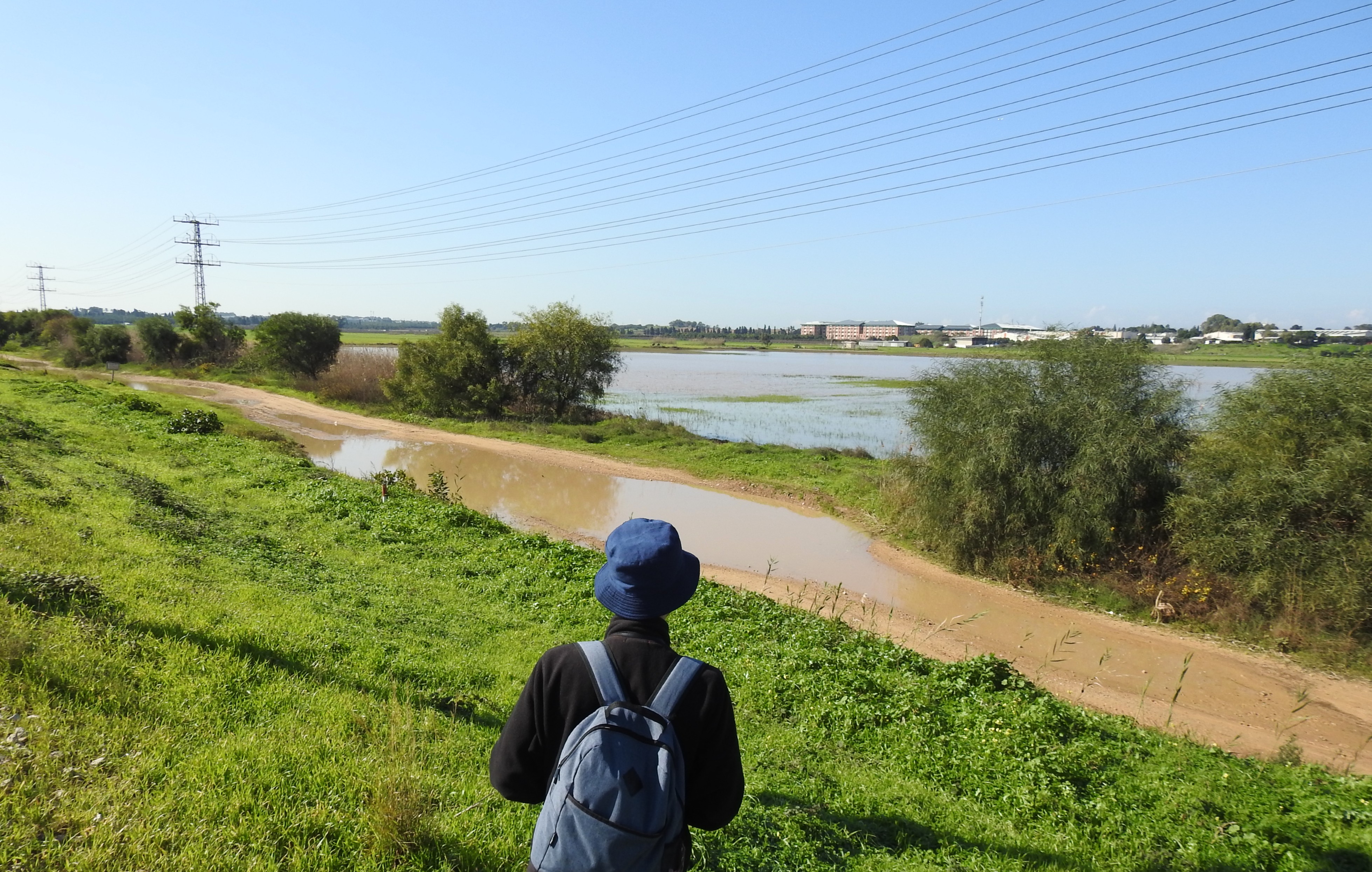
It was tranquil watching the birds dip and dab in the shallow waters, largely ignoring our presence from the safe distance that we were. The only disturbances were trains that came thundering by, blowing their ear-piercing whistles in hopes to keep us off the tracks. These very tracks, built on an elevated ridge, split the marshland in twain, the water joined by culverts, underground aquifers and, most naturally, Nachal Poleg.

Walking along the train line ridge looking southwest

Walking along the train line ridge looking southwest

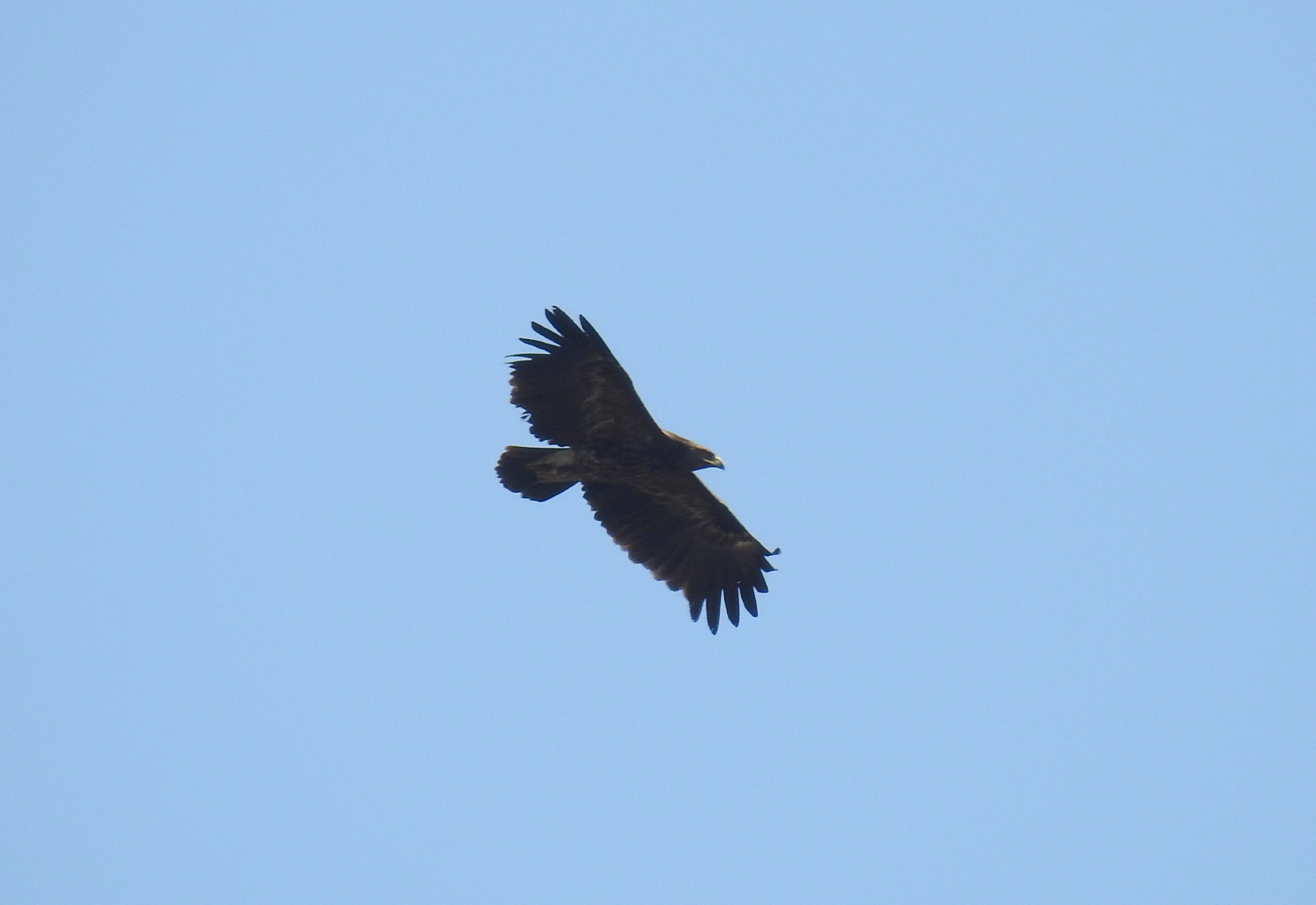
After seeing a small flock of skylarks feeding in the lush, wet grass, we crossed over the tracks to see the other – eastern – side of the marsh. Lo and behold, our efforts and wet feet were rewarded by a number of raptors, both perched and flying, before us. First, a greater spotted eagle swung by, and then a few more marsh harriers. A peregrine falcon whizzed by too, far too fast for me to photograph successfully.

Greater spotted eagle

Greater spotted eagle

Back on the western side, Adam decided to take a long look at the marsh water, hoping he could find some interesting molluscs or aquatic insects. I took the opportunity to wander off on a dirt road that traversed the flooded field.

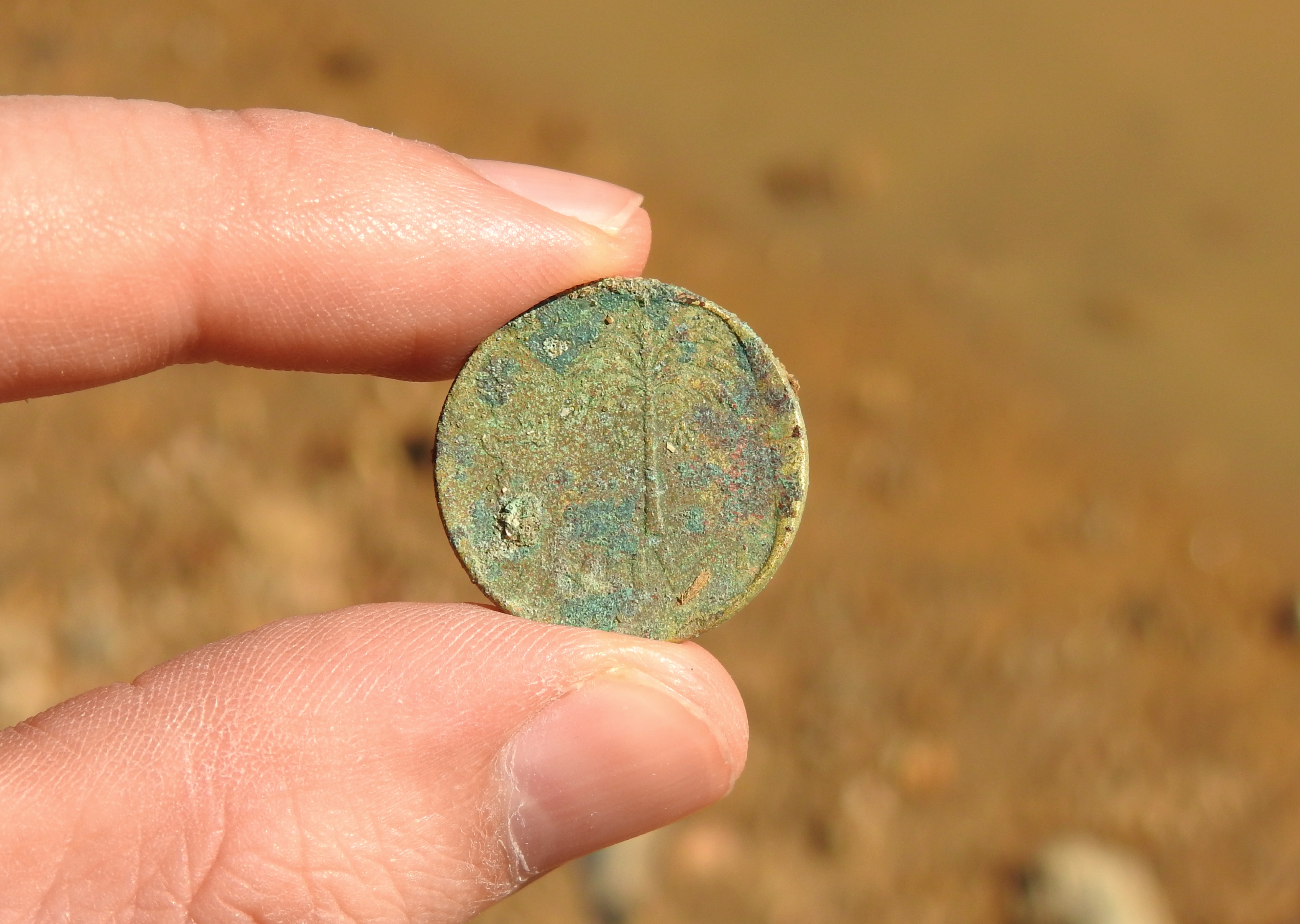
Some old Israeli coin

Some old Israeli coin

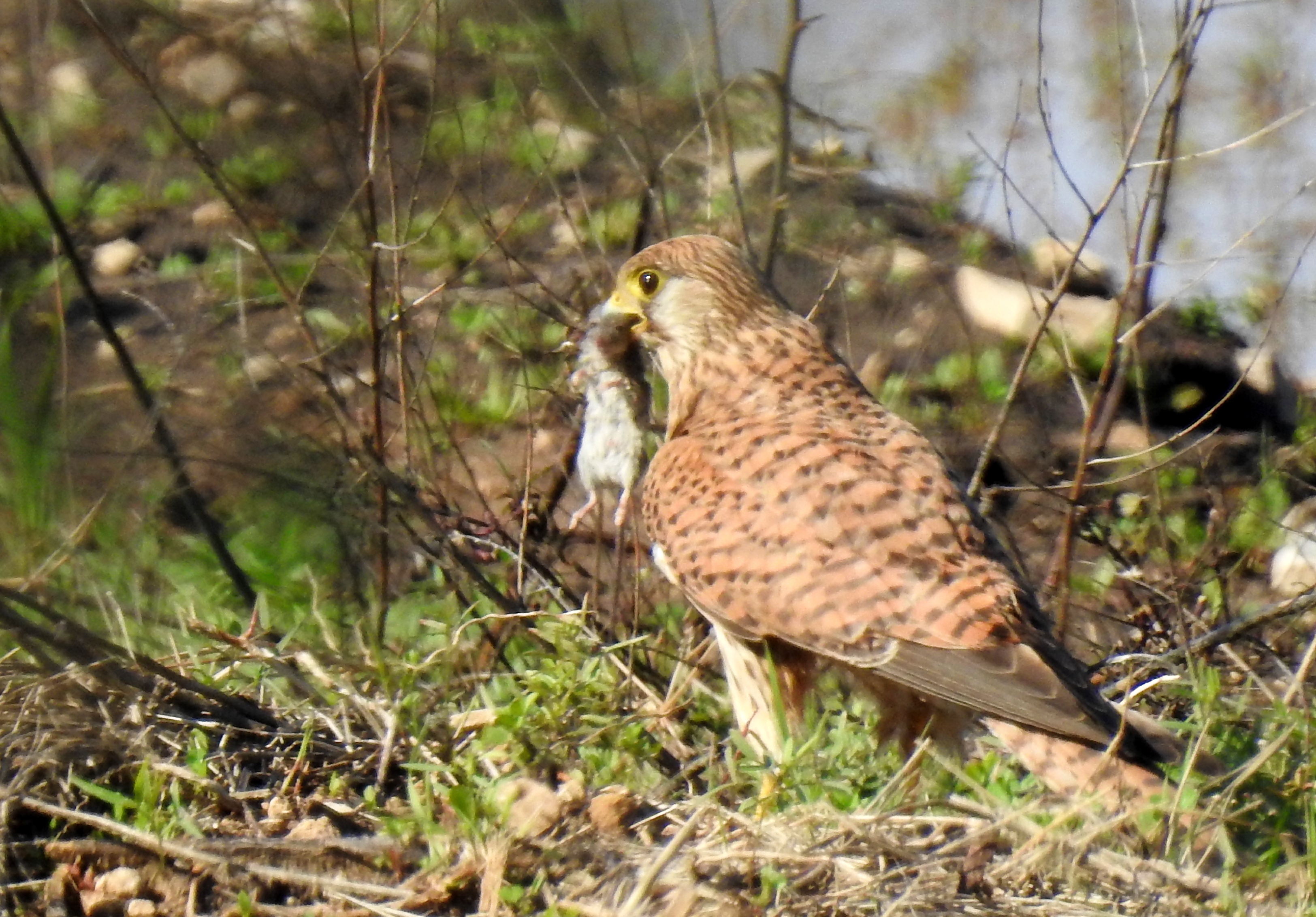
Upon finding an old, oxidised Israeli coin, I felt inspired to keep walking. Much to my excitement, I chanced upon a female kestrel catching a mouse – if only I was able to get some proper photographs of the moment.

Friends at play

Friends at play

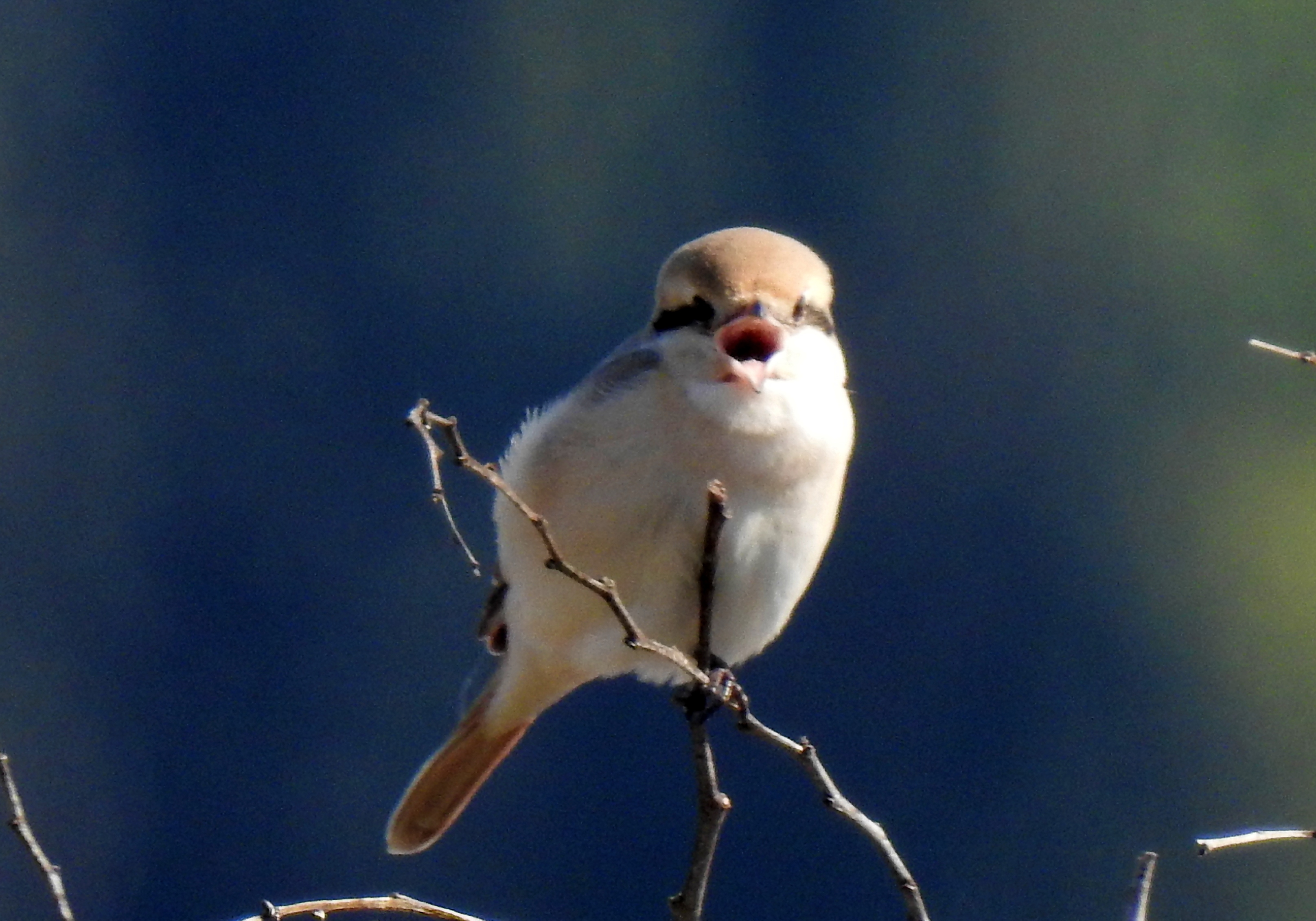
Some time passed before we crossed over once again to the eastern side, and so we enjoyed watching the wildlife carrying on before us. The herons squabbled in the channel, some Spanish sparrows clung nonchalantly to waving reeds, and some black-headed gulls passed overhead. Then, a shrike popped into view and revealed itself to be a moderately rare isabelline shrike – one which had been previously reported upon in local birding circles.

The isabelline shrike

The isabelline shrike

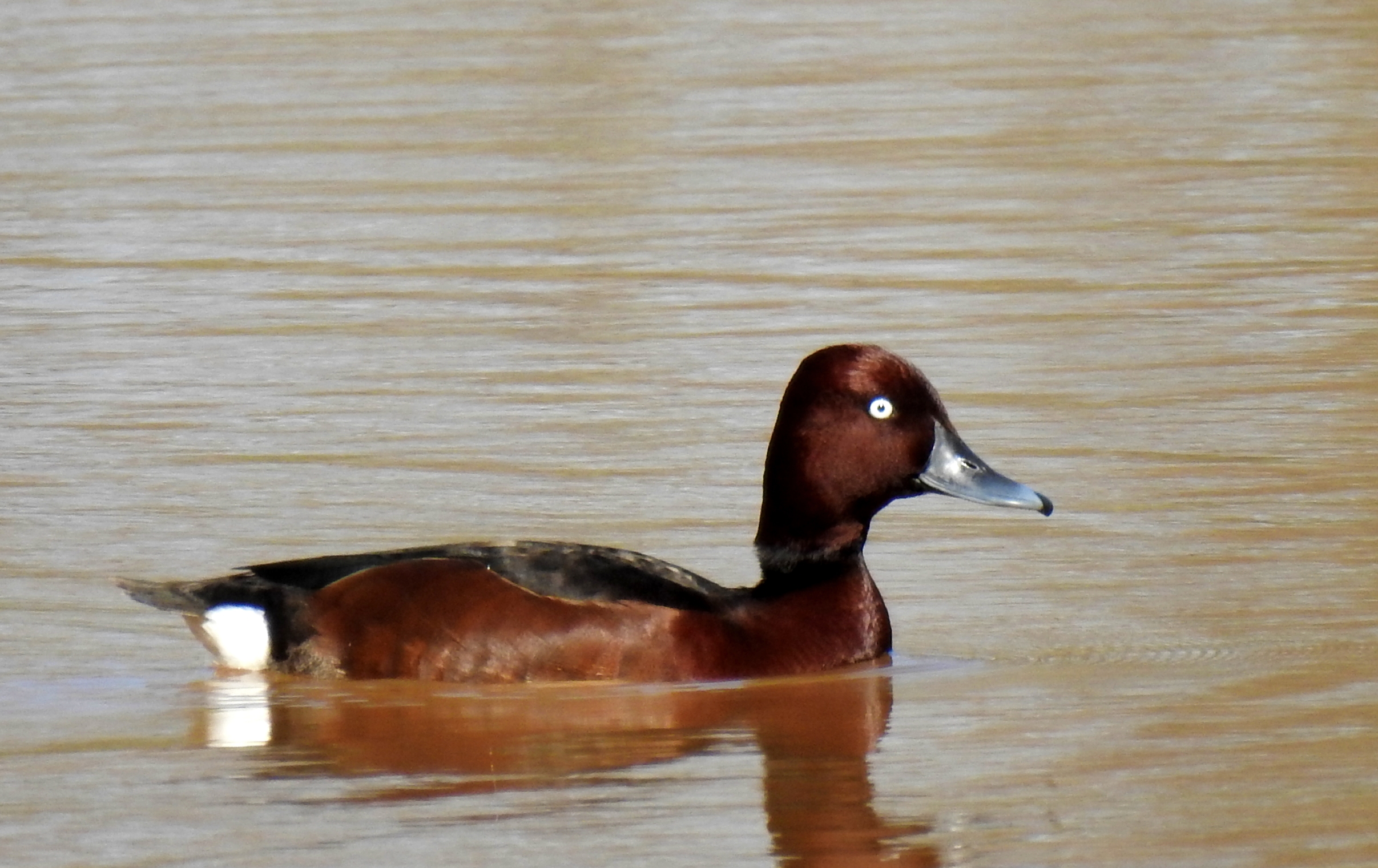
Looping back, walking back from whence we came, we crossed back over Nachal Poleg and made our way to the first flooded area we had seen. From there we followed a trail going north, and passed by a small nut grove, where handfuls of chaffinches were milling about. The trail continued westward, encircling the pond from the north. A few ferruginous ducks, spotted in gaps between the bushes, were an excellent addition to the day’s figurative checklist.

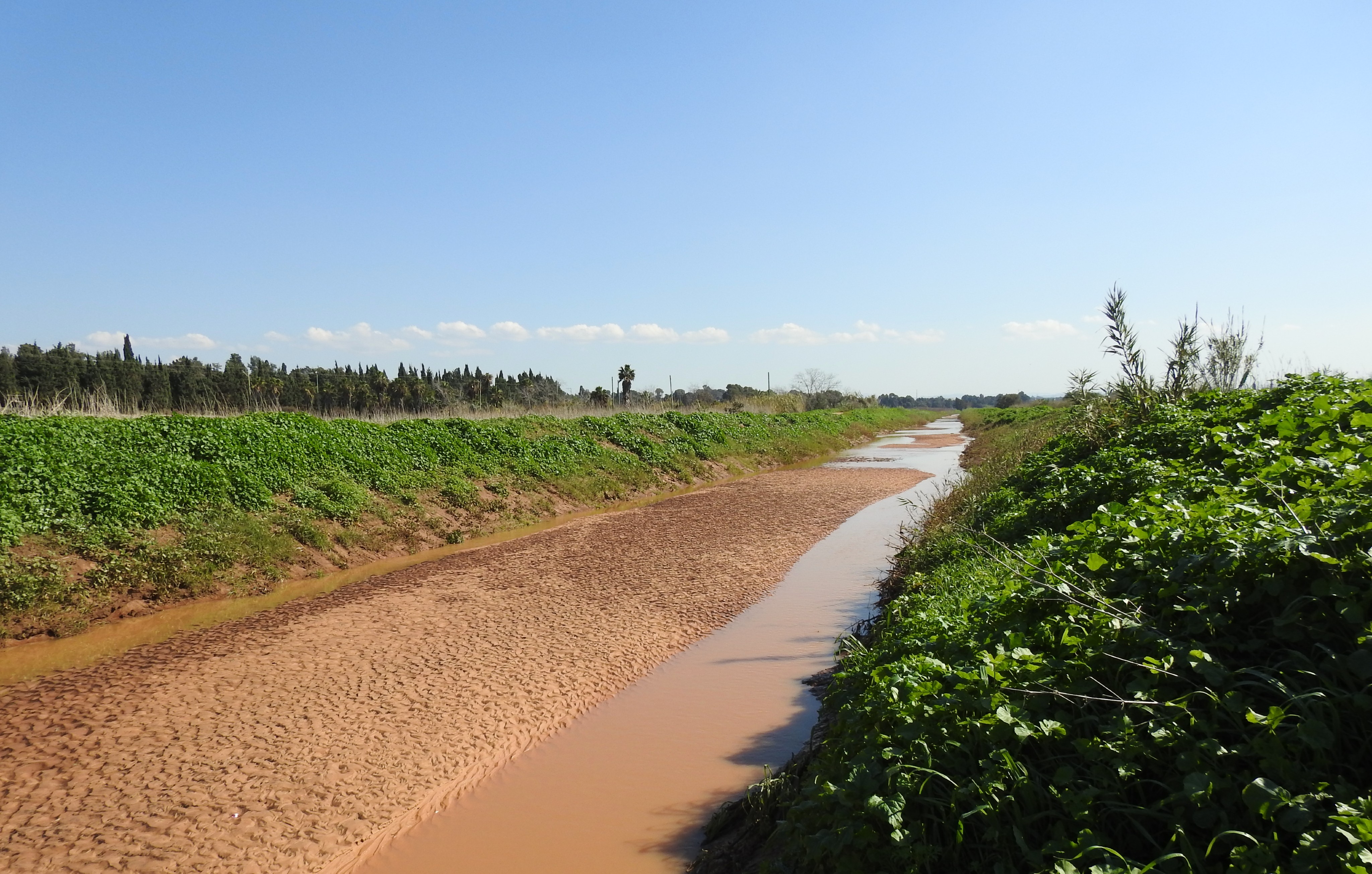
Muddy Nachal Poleg

Muddy Nachal Poleg

We scampered around the sludgy flooded bits, exploring the marsh’s northern extents. There wasn’t too much to see, but it was adventurous and that is what mattered most. When we had sufficiently wet our boots, we turned back around and began the hike back to a bus stop, this time choosing one further along the road to the north.

Ferruginous duck floating by

Ferruginous duck floating by

One thing about the Poleg marshes which interests me so much is the fact that this area, similar to others along the coastline, is essentially a basin in the sandstone bedrock infrastructure. With the coast being hemmed by a kurkar ridge, the winter’s rainwaters and surface runoff makes its way to the sea only to be trapped by the impervious ridge. This essentially turns the land east of the ridge into a seasonal marsh, which, throughout history, had hampered settlement opportunities.

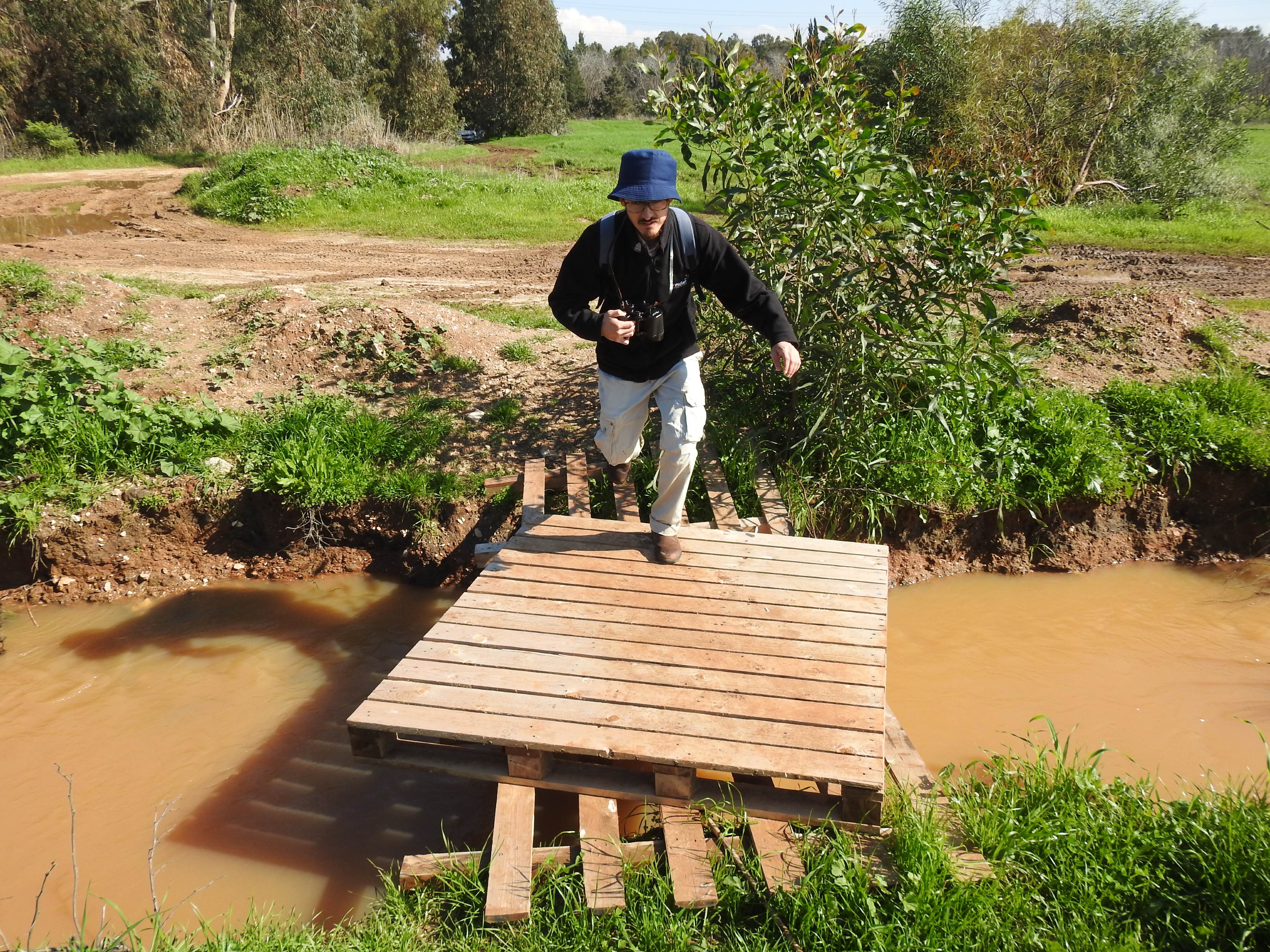
Practicing safe crossings

Practicing safe crossings

In efforts to alleviate the backed-up waters, a hole in the ridge along the course of the stream was carved out in ancient times. The Romans improved upon the structural work, and the site became known as Sha’ar Poleg in recent times. However, other neighbouring coastal regions still remained flooded. About ten kilometres to the south, in modern day Herzliya Pituach, the Byzantines had actually hewn an underground drainage passage in the ridge, thereby draining that area too.

Our final views before boarding the bus back home

Our final views before boarding the bus back home

While this trip only really focused on the marsh, I still hope one day to be able to get a closer look at both of these man made engineering feats of old. But, for now, I just have the memories from this episode and an excellent video produced by Kan (see HERE), which explained the water saturation issue that I had outlined above, as inspiration for future adventures.

Shoham Park

In Central Israel, Israel on February 6, 2022 at 9:43 AM

Taking a hiatus from a string of BIU field trips, the day after my trip to Doq and the Good Samaritan Museum I went on a nice little adventure with Adam Ota to the relatively nearby Shoham Park. It was the very beginning of January and a fair amount of rain had fallen as of late, resulting in renewed growth throughout the country. The seam between the coastal plains and the Shomron was no different, and we found ourselves getting off our bus at Nablat Junction with intentions to explore as far north as we had time for.

Looking down at the field beside Nachal Beit Arif (photo Adam Ota)

Looking down at the field beside Nachal Beit Arif (photo Adam Ota)

Once we had successfully navigated the busy roads and entered the so-called natural land just north of Nachal Beit Arif, we were amazed at how lush and green everything was. There was a cool crispness in the air as we slowly made our way up the cactus-dotted hill, having passed through a defunct military shooting range where we chanced upon our first of many wild asparagus shoots of the day.

In pursuit of wild asparagus shoots

In pursuit of wild asparagus shoots

The vibrant green around us was complemented by dying leaves in multiple shades of orange, yellow and lavender blossoms, and of course the rich brown mud. We followed the marked trail up the hill, merging onto the Israel National Trail and seeing a nice amount of chaffinches and meadow pipits along with the flora. Adam paused here and there to look for stick insects, something that has eluded him for a great number of years here.

Photographing the lush nature (photo Adam Ota)

Photographing the lush nature (photo Adam Ota)

We spotted some tiny caves among the hewn bedrock, but nothing of any particular interest, except for copious amounts of wild asparagus. It wasn’t until we reached the top of the hill that we saw something of note. Carved into the bedroom were a series of cup marks and larger indentations. According to the sign there, this was part of a cultic site where a small idol was placed and then tiny sacrifices were offered in these tiny hewn cups. The larger depressions served as mortars for grinding the sacrifice prior to offering. There also seemed to be a small olive oil press similarly hewn into the bedrock, perhaps related to the cultic affairs.

Cultic cupmarks from a time long past

Cultic cupmarks from a time long past

Heading down the northern slope, we left the rocky garrigue habitat and entered a small pine tree forest. In a clearing, we found a much larger agricultural installation – this time a winepress, also hewn into the grey bedrock. It was full of water after the rains, and no matter how much Adam peered into the murky depths, he couldn’t find any interesting lifeforms.

Peering into the watery winepress

Peering into the watery winepress

Right beyond the winepress was the remains of an ancient lime kiln, hardly recognisable in its current state of affairs. But it was the next site in the clearing that really excited me – the ornate ruins of the Church of St Bacchus with its stunning mosaic floor. Built sometime in the 400s CE, during the Byzantine period, the church was only discovered in 1986, and later excavated in 1995. It was then that the mosaic floor, with an inscription dedicating it to St Bacchus (who was quite popular during that era), was revealed and restored.

The Church of St Bacchus

The Church of St Bacchus

Built outside of the settlement confines, this is what is known as a field church – see an artistic reconstruction HERE. During the course of the excavations, a small broken marble medallion of goddess Tyche/Fortuna was found. According to the inscription encircling the figure, the medallion dates to the year 582-3 CE, during the reign of Byzantine emperors Tiberius II Constantine or Maurice.

Remains of the olive oil press beside the field church

Remains of the olive oil press beside the field church

Adjacent to the church is a large olive oil press, with some of its sections also featuring a modest mosaic floor. Just beyond the press is a large rock-cut pool which was used to store water, after having served as an on-site quarry for the construction projects there. All of these ruins, predominantly harkening back to the Byzantine period, are all affiliated with the nearby Horvat Tinshemet (or Khirbet Sheikh ‘Ali Malikina) which has been identified as Betomelgezis, a site that appears on the famous Madaba Map.

What appears to be Horvat Tinshemet

What appears to be part of Horvat Tinshemet

As we progressed to the vicinity of Horvat Tinshemet, we realised that this site – having never been excavated before – did not have much to look at, at surface value, of course. We found a series of low stone walls and what looks like a cairn of sorts, but nothing distinctly archaeological other than a few surface potsherds. Regardless, we enjoyed poking about in the company of some warblers and chaffinches, and a handful of flustered chukars.

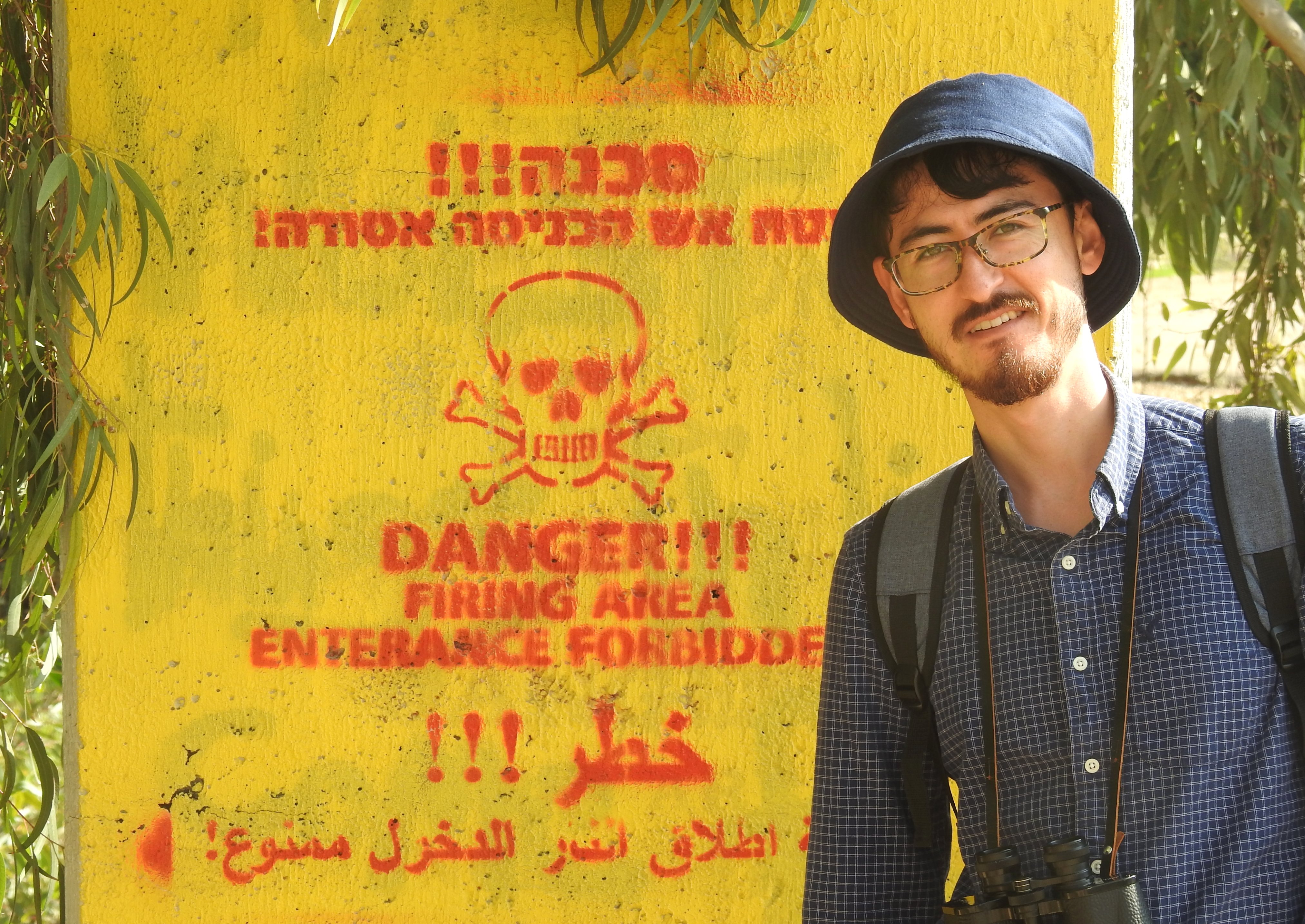
Avoiding the forbidden zone

Avoiding the forbidden zone

From there our next destination was the Bareket vernal pool, which was located on the far side of the Shoham industrial park that was sprawled out before us. Instead of simply walking down the convenient paved road, we decided to go the route less traveled and climbed up a steep hill to circumnavigate from the eastern side. It was a steep walk and required a short break at the peak, which allowed us to appreciate the views that we had of both the ongoing construction and Road 6 that was behind us.

Looking back from whence we came

Looking back from whence we came

Heading back down the northern slope, we found an usual little orchard and then an insurmountable construction site which made us take the paved road afterall. Looping around, we found the Bareket vernal pool looking rather neglected, yet brimming with water and tiny lifeforms. Adam immediately squatted at the water’s edge, trying to find some interesting waterbugs – and, of course, triops.

The Bareket vernal pool

The Bareket vernal pool

The Bareket vernal pool is the result of ancient quarrying, similar to what we had seen throughout the day, forming a nice body of water quite like a swimming pool with the hewn steps. Despite the searches, it was simply too early in the rainy season to find anything too interesting and we were consigned to just enjoying the deep pool for what it was.

Using the hewn steps to get closer to the water

Using the hewn steps to get closer to the water

There are a number of interesting sites located just north of the vernal pool, but it was getting a wee bit late and we were tired from the long hike, so we called it a day. We had successfully explored most of what Shoham Park has to offer, and each of us had a bountiful wild asparagus harvest – perhaps the best we’d ever had. The rest of the attractions will simply wait for another day, whenever that may be.

Agamon Rishon LeZion

In Central Israel, Israel on December 12, 2021 at 8:07 AM

In mid-October, after a flurry of birding trips to the field of Givat HaShlosha and Nachal Rabah, I decided to change the pace a bit and to explore some rich wetlands not too far away from where I live. Incidentally, there were a few choice birds that I had previously seen reported on eBird, and since I was keen to snatch up a few potential “lifers”, I rose in the predawn hours and arrived at my destination – the artificial lake just outside of Rishon LeZion – not long after sunrise.

Early morning at Agamon Rishon LeZion

Early morning at Agamon Rishon LeZion

I had been to a nearby Lake Nakik in the summer of 2019, when Adam and I explored the neighbouring dunes for the first time (see HERE), but somehow the Agamon had slipped through our fingers. My expedition began at the eastern banks where I used my binoculars to scan the lengths of the shorelines around me, finding an expected assortment of egrets, herons and shorebirds. Kingfishers and barn swallows zipped back and forth over the placid lake, completing the serene scene with their controlled flights.

Grainy photo of the African swamphen (right)

Grainy photo of the African swamphen (right)

My first exciting find came when I scanned the reeds a bit more carefully, and then noticed a bird that was bigger and more colourful than a common moorhen – it was an African swamphen! This was my first “lifer” of the day, and in retrospect I could confirm that there was a second one tucked back a bit further, and thus more obscured by the thick reeds. When it got a little brighter out, I was able to discern more species of waders in the muddy shallow section to the south, as well as a reed warbler that appeared in the reeds beside me.

Picturesque views from the deck

Picturesque views from the deck

Eager to see more of the small lake, and from different angles, I continued on my semi-circuit, walking past the FlyBox building where an intriguing, if pricey, weightless flying experience can be had. The trail took me through a small overgrown area and I emerged at the northern side of the lake, where the observation decks have been installed. The sun was still coming up through the dense cloud cover as I took in my new view, seeing more herons and egrets fishing in the shallows.

Grainy photo of the whiskered tern in flight

Grainy photo of the whiskered tern in flight

Another “lifer” appeared in the form of a whiskered tern – a graceful white acrobat skimming over the water’s surface in search of small fish to catch. The tranquility of the lake scene with the muted early morning colours filled me with inner peace, and I sat there basking in the moment. When I had moved on down to the deck, sitting in the western lookout, large raindrops started falling out of the sky. I sheltered my camera and enjoyed the light shower, feeling refreshed from my first rains of the season.

One of the more unusual bird sightings I've ever had

One of the more unusual bird sightings I’ve ever had

The rains brought out the birds, interestingly enough, and I watched a particularly plucky sedge warbler bounce about in search of food. A bluethroat and some white wagtails joined in on the fun, racing about in between the raindrops. When the rain ended I went back to the first lookout in hopes of finding a little bittern, which was actually waiting for me at the base of the structure – our encounter catching both of us off guard. Reflexes kicked in, I tried snapping some pictures while it tried escaping through the thick reeds. The sun eventually broke through the clouds and I decided it was time to head to work, but not without telling others of my relaxing, yet exciting, visit.

Revisiting the lake (photo Adam Ota)

Revisiting the lake (photo Adam Ota)

Sure enough, the following week I revisited the lake, but this time with company: Bracha, Adam and his girlfriend Vered. We retraced the steps that I had taken days before, seeing largely the same selection of birdy friends, minus the elusive swamphen. This time we popped into the large mall complex at the northern side of the lake to grab an iced coffee, and had a picnic as well.

Picnic at the lakeside (photo Adam Ota)

Picnic at the lakeside (photo Adam Ota)

We feasted on cheesy pastas and rich French toast that Adam cooked on his portable burner – more exciting culinarily than my previous tour. Such a delightful place to visit, and relatively easy to get to with public transportation, that I foresee more visits in the future.

Museum of Natural History

In Central Israel, Israel, Tel Aviv on September 1, 2021 at 8:20 AM

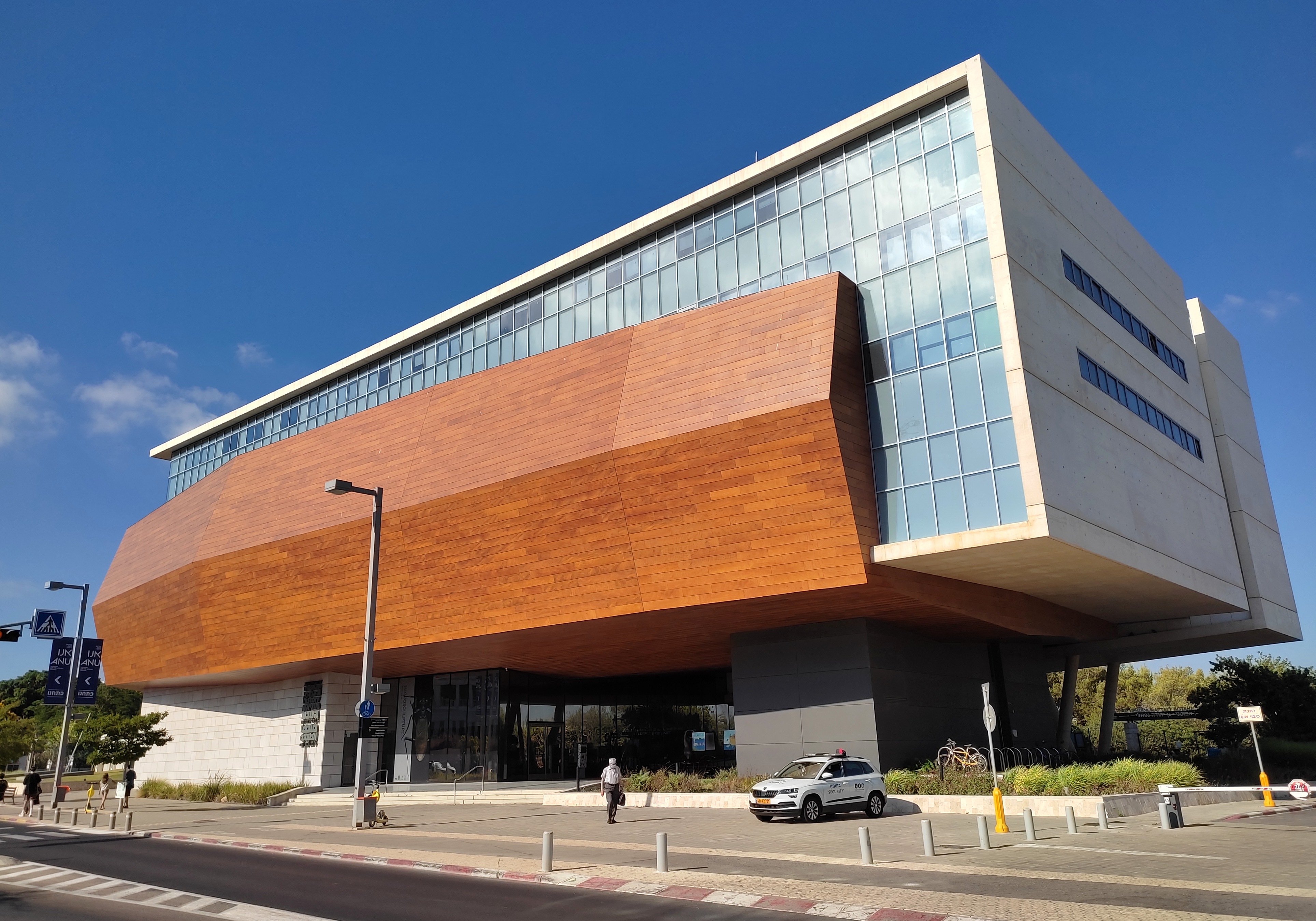
In the beginning of July, shortly after the semester ended, Bracha and I went on a short trip to Tel Aviv to visit the Steinhardt Museum of Natural History. This museum was opened just a few short years ago, and houses the country’s largest collection of flora and fauna, as well as an impressive collection of archaeological remains as part of a human history section. Ever since the iconic structure was built – shaped symbolically like Noah’s ark – I had been looking forward to a visit. Now, accompanied by Bracha, I was able to finally see the long-awaited natural treasures within the giant boat building.

The Steinhardt Museum of Natural History in Tel Aviv

The Steinhardt Museum of Natural History in Tel Aviv

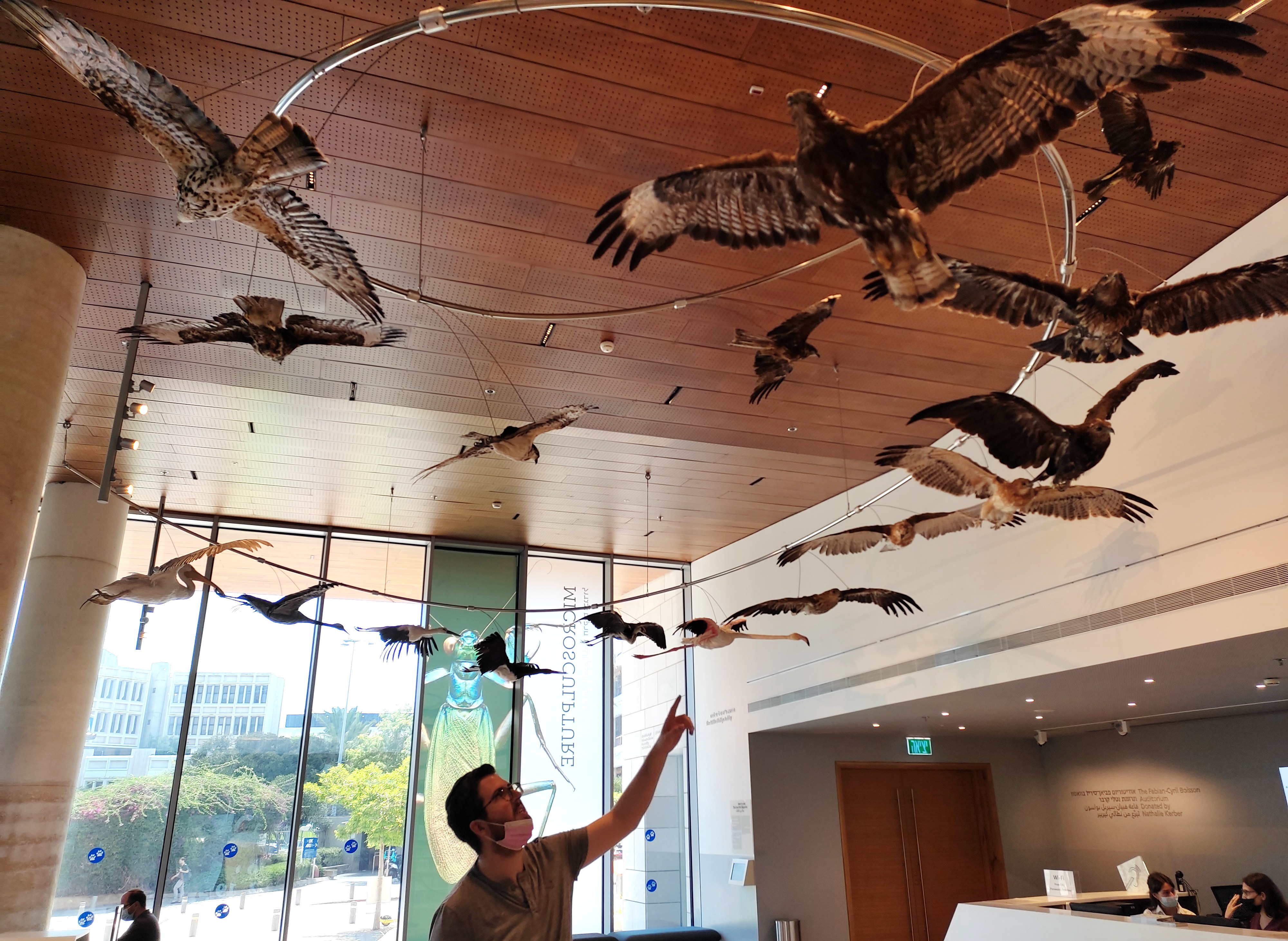
The museum is divided into some nine permanent exhibitions, of which two were my favourites – which I shall make note of in due time. Immediately upon entrance, our eyes delighted with the sight of scores of soaring birds, representing the great bird migration which takes place here in Israel biannually – in the spring and autumn seasons. These taxidermy birds dangled overhead, in a long curved line, ranked in order of size.

Picking out my favourite raptor

Picking out my favourite raptor

I must confess, it was a tad challenging identifying some of the birds as they were far closer than I’d even see them in the wild – and occasionally, taxidermists inadvertently manipulate the appearance of the model, distorting the natural look. That being said, it was a charming game trying to distinguish between the various eagles, buzzards and honey buzzards.

Habitat dioramas

Habitat dioramas

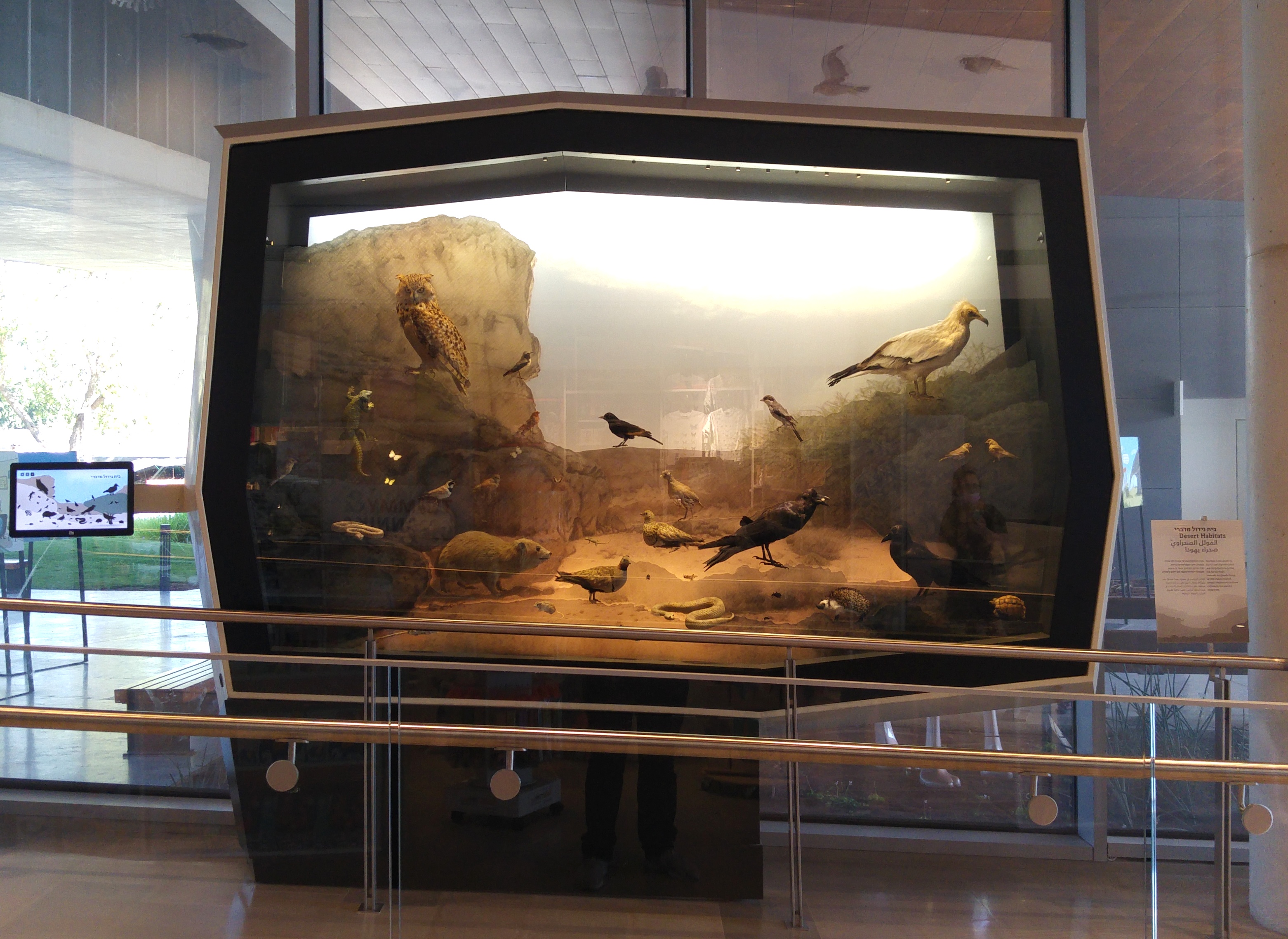
Another exhibition which was visible in the entrance hall was named “Israel’s Landscapes”, and consisted of a series of dioramas of different Israeli ecosystems. This exhibit was one of my two favourites, and I marveled at examining each and every preserved mammal, bird, reptile, amphibian and bug that found themselves representing their brethren out there in the wild. Having explored a great deal of different ecosystems in Israel, it was exciting to see which animals were represented – and like the exhibit before, we played the identification game. Bracha was able to show off her knowledge as she named a good number of animals and birds that she has grown acquainted with in recent years.

Desert habitat diorama

Desert habitat diorama

We progressed to the next floor, where we found the large “Form and Function” exhibit, showcasing the different skeletal forms of various animals. As one might suspect, each animal has a skeletal structure that allows it to perform its best in its given environment, while meeting its specific needs. One taxidermy model which really entertained us was a stuffed caracal leaping up, as they do, to catch a fleeing black francolin. Other exciting specimens included a dolphin skeleton, a stuffed albatross, and a stuffed bee-eater, one of Bracha’s favourite birds – and rightly so.

The caracal's eternal leap

The caracal’s eternal leap

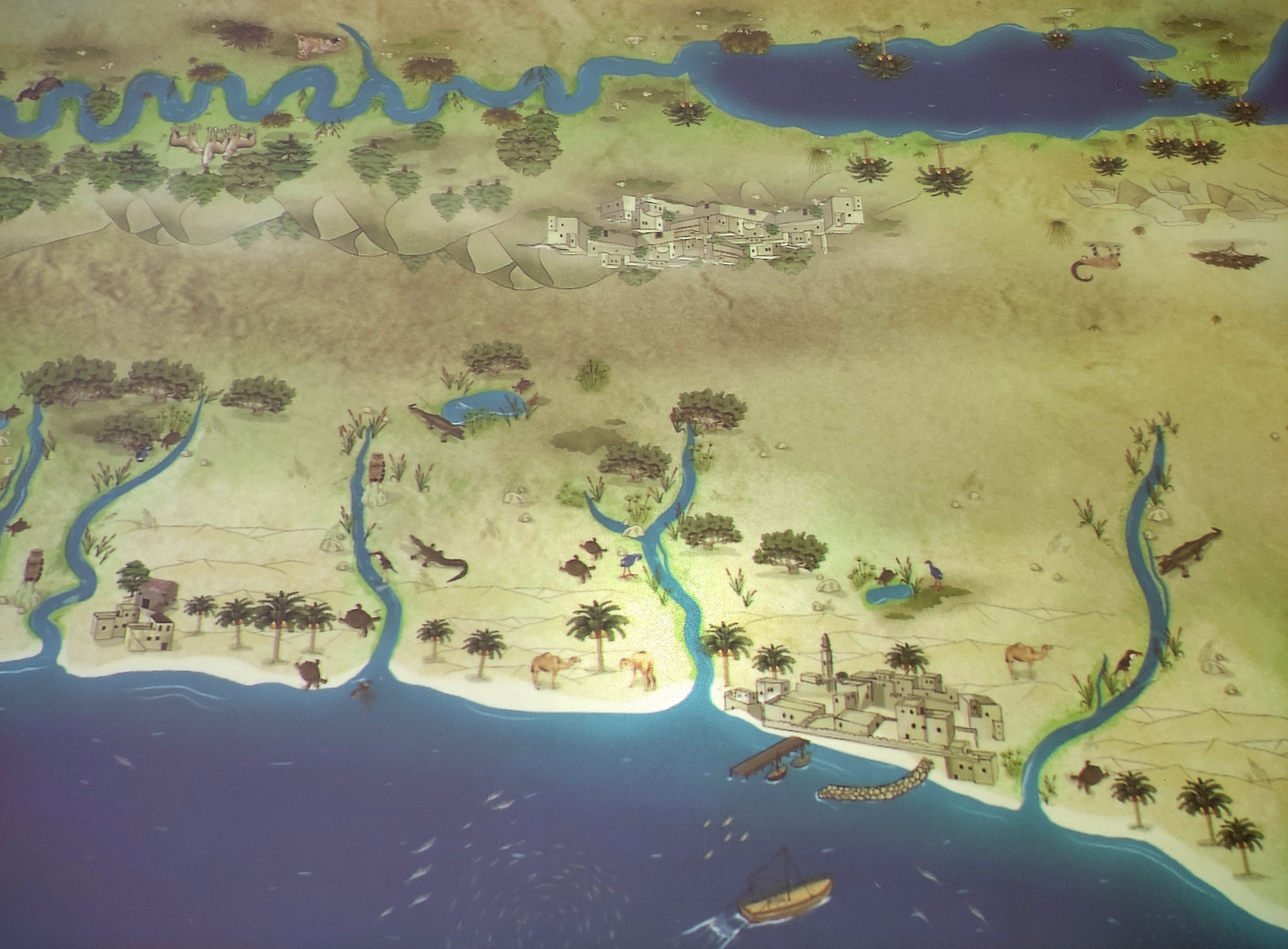
The next room was a step forward in modernity, with a state-of-the-art model of Israel with designated interactive sensor pads that begged to be pressed. Giving in to our curiosity, we moved around the giant table, activating the sensors to receive artistically-delivered information. With each palm-print, a different section of the country – representing different ecosystems – transitioned from the pristine nature to what could be if the human footprint is unchecked.

Interactive map of Israel

Interactive map of Israel

We watched as the area of Nachal Taninim, once a lush wetlands populated by Nile crocodiles, slowly morphed into the place that it is today. Likewise, the whole Tel Aviv region, the deserts, forests and seas, each adversely affected by the presence of man.

A glimpse into the past

A glimpse into the past

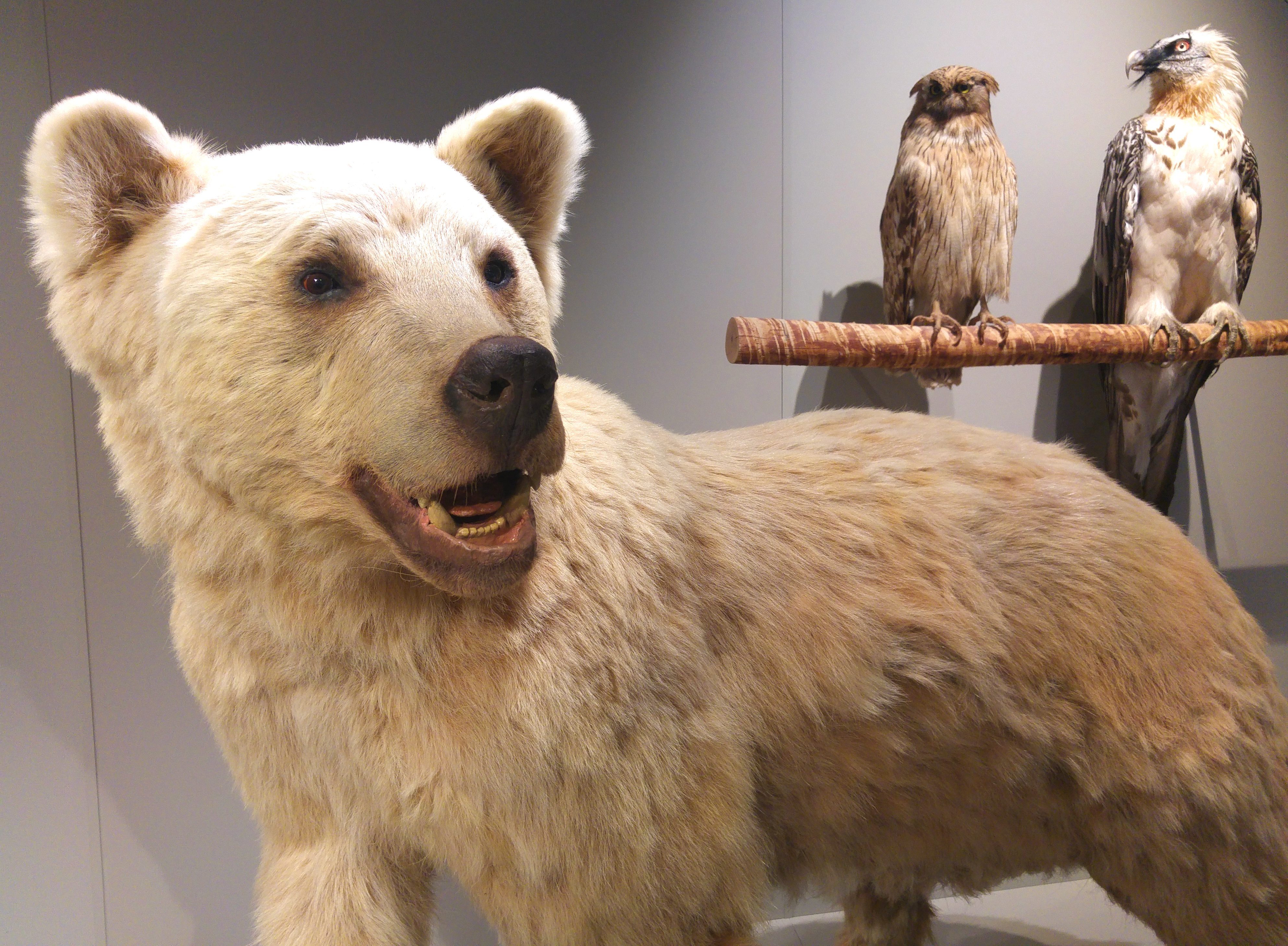
After that reflective moment, we gazed deep into the glassy eyes of two species that have since gone extinct in Israel – the lion, and the Syrian brown bear. Interestingly enough, it was during the Crusader period – the time period of my academic pursuits – that the lion was locally hunted into extinction. Perched behind the stuffed bear were two avian species with disapproval stamped on their faces – the bearded vulture (or lammergeier) and the brown fish owl. The owl was reported centuries ago in Nachal Kziv and in other water sources in the north, while the vulture has been reduced from a breeding local to a rare visitor.

Syrian brown bear

Syrian brown bear

From there we moved on towards a series of multimedia exhibitions about our human footprint on the nature around us, and then on to a more wholesome display. This featured an acacia tree, native of the arid desert, and an array of animals that live in and around this low tree. As to be expected, there were a nice handful of mammals and birds – such as the Arabian wolf, gazelle, Arabian babbler, bee-eater and more. I really appreciated seeing the impressive lappet-faced vulture represented in the diorama, especially since one was found in the desert back in April, perched atop what could very well be an acacia tree (see photos HERE).

Life around the acacia tree

Life around the acacia tree

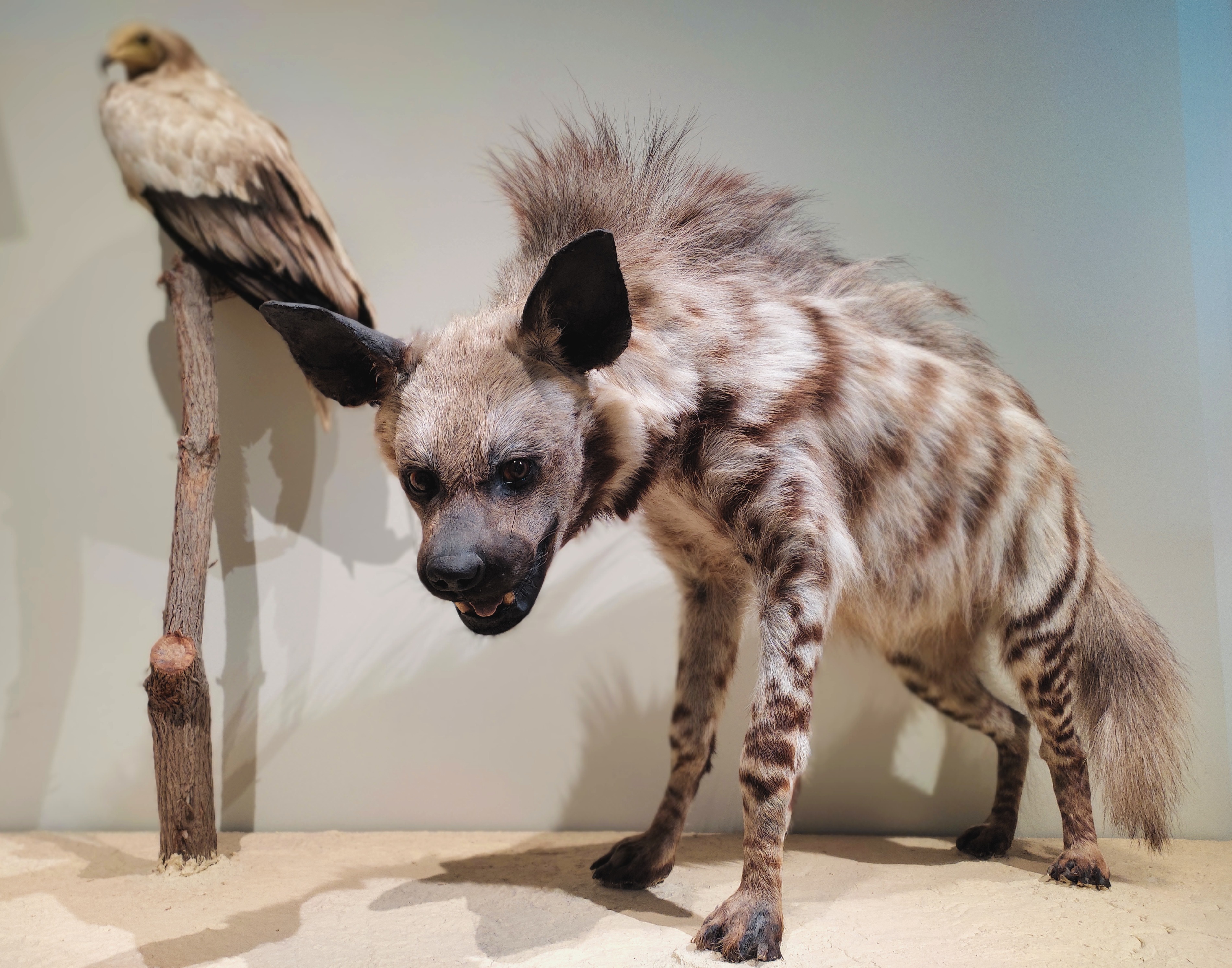
Moving along, the next bit was about nature’s scavengers which included the vulture species in Israel – the Griffon, Egyptian and occasional black, or cinereous vultures – as well as striped hyenas and ravens. There’s something so exciting about scavengers, rank odours aside, so I really appreciated being able to see stuffed versions from such a close, and intimate distance. One day it would be a real treat to be able to visit the desert feeding station near Sde Boker where the National Parks Authority provides safe carrion for these magnificent creatures (see some astounding footage HERE).

Striped hyena and Egyptian vulture

Striped hyena and Egyptian vulture

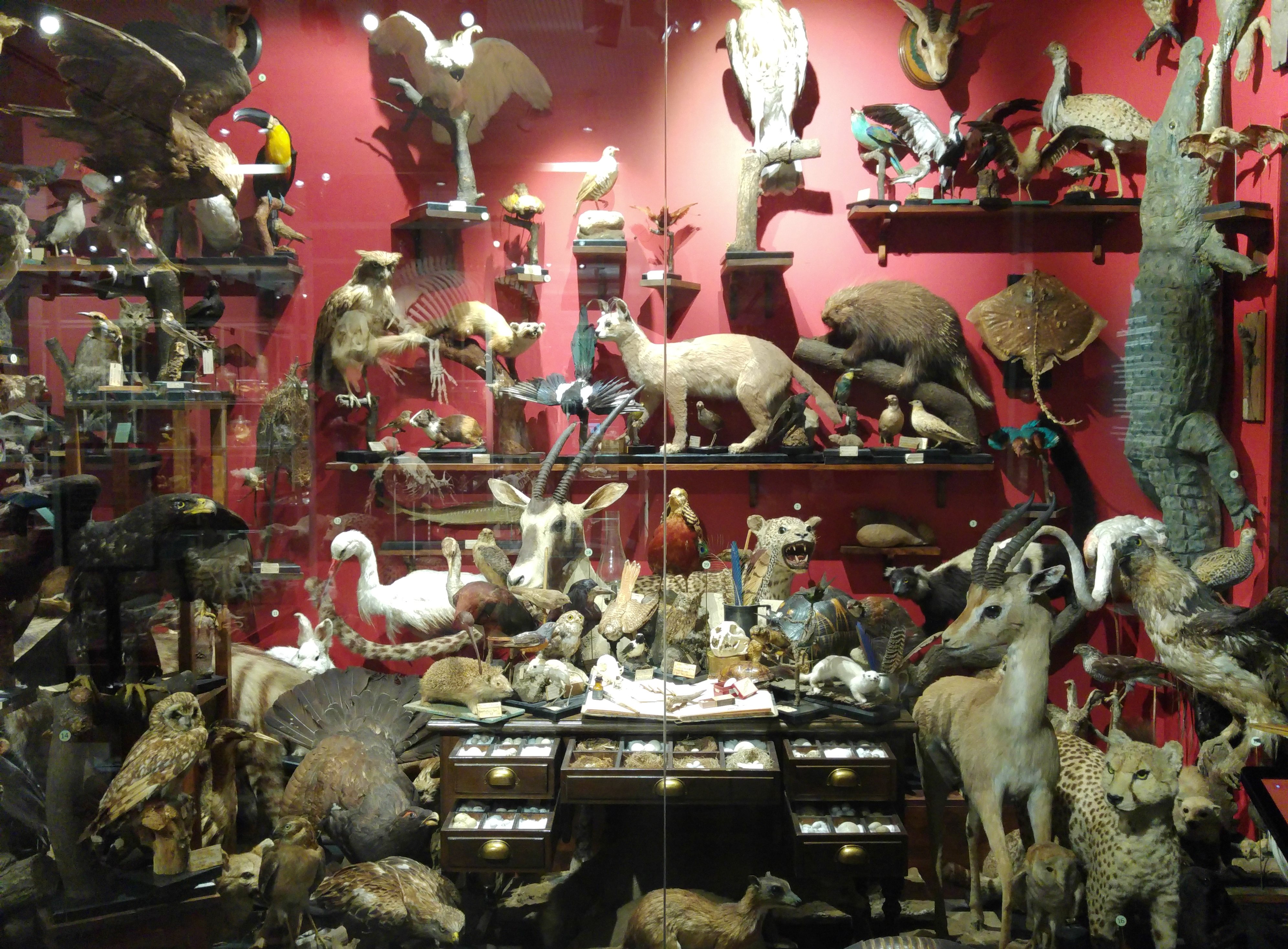
The next exhibition was another of my favourites, titled “Treasures of the Collections”, including the historical taxidermy collection of zoologist Ernst Johann Schmitz who moved to the Holy Land in 1908. This assortment of stuffed animals, presented in a well-appointed, if ludicrously overfilled, red-painted study amazed me to no end. Thankfully, there was a small interactive screen where more in-depth information could be accessed about specific specimens. The leopard on display was collected in 1910 in Beit Horon, not far from where Bracha’s folks live, and was, in fact, the last wild leopard to be hunted in the mountains of the Jerusalem area.

The Ernst Johann Schmitz collection

The Ernst Johann Schmitz collection

While the Schmitz collection did keep me occupied for a while, there were also other fine taxidermised specimens to be examined. We walked around the open displays, eyeing a wide range of animals from deer and large cats all the way to beetles and butterflies. It would take an exceptionally long time to retell all of the goodness that is this fascinating exhibit, so just a few select bits – those that caught my eye – shall be represented here. Firstly, I was enthralled by the simple, yet relatable, display of chukar partridges, portraying the subtle plumage differences between chukars found in the desert areas, to those found in the more wooded Mediterranean areas.

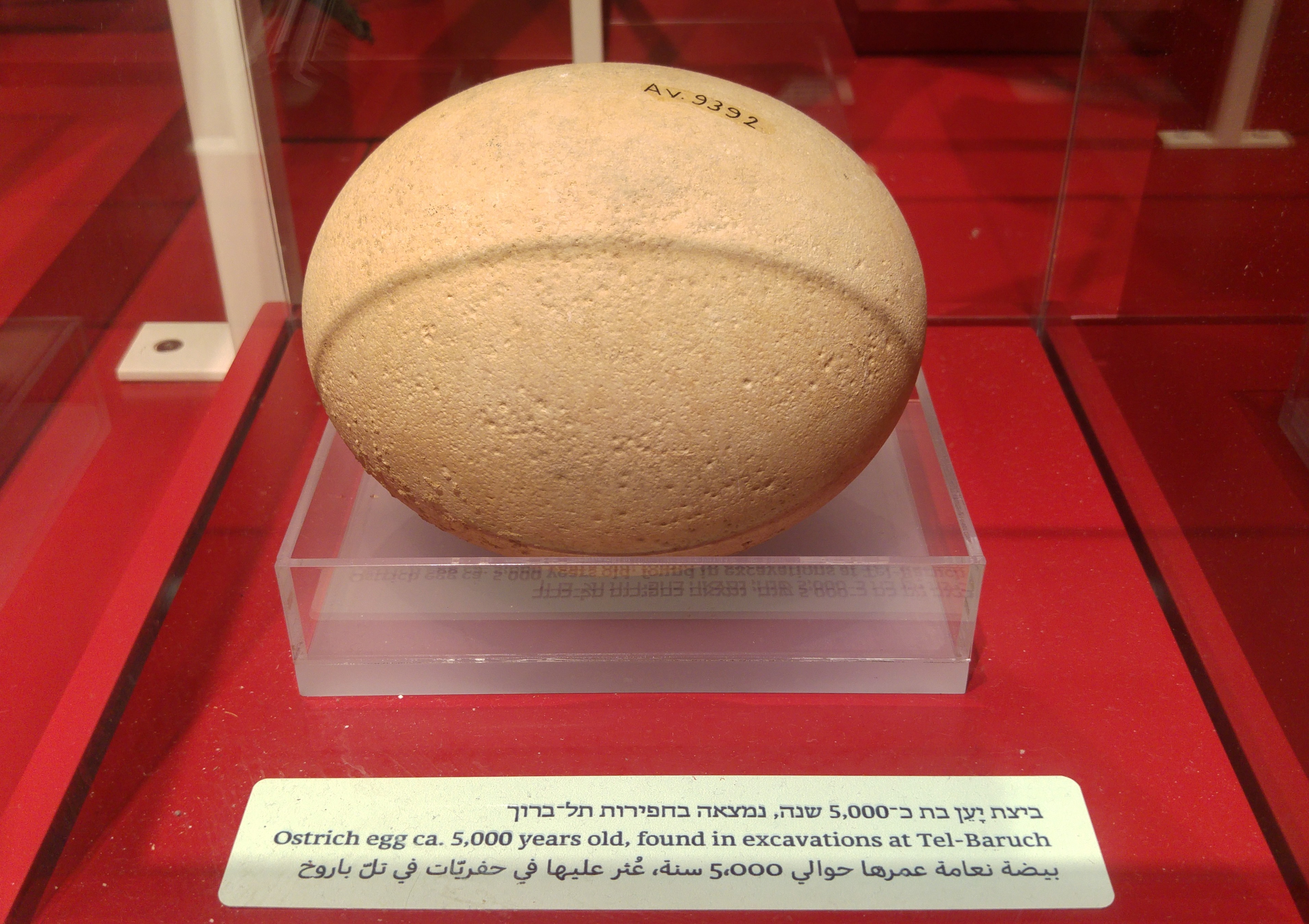
Fossilised ostrich egg

Fossilised ostrich egg

Next, an approximately 5,000 year old ostrich egg, fossilised over time and found in archaeological excavations at Tel Baruch. Lastly, a spotlight on the endemic Yarkon bream, a species of freshwater fish that nearly went extinct. It was the researchers involved in this museum which ran the breeding and reintroduction program to repopulate the Yarkon River and other streams in the area. I remember reading about the fish when I visited the Yarkon National Park, so here was an exciting window into the background of this fishy success story.

Getting some fresh air on the museum balcony

Getting some fresh air on the museum balcony

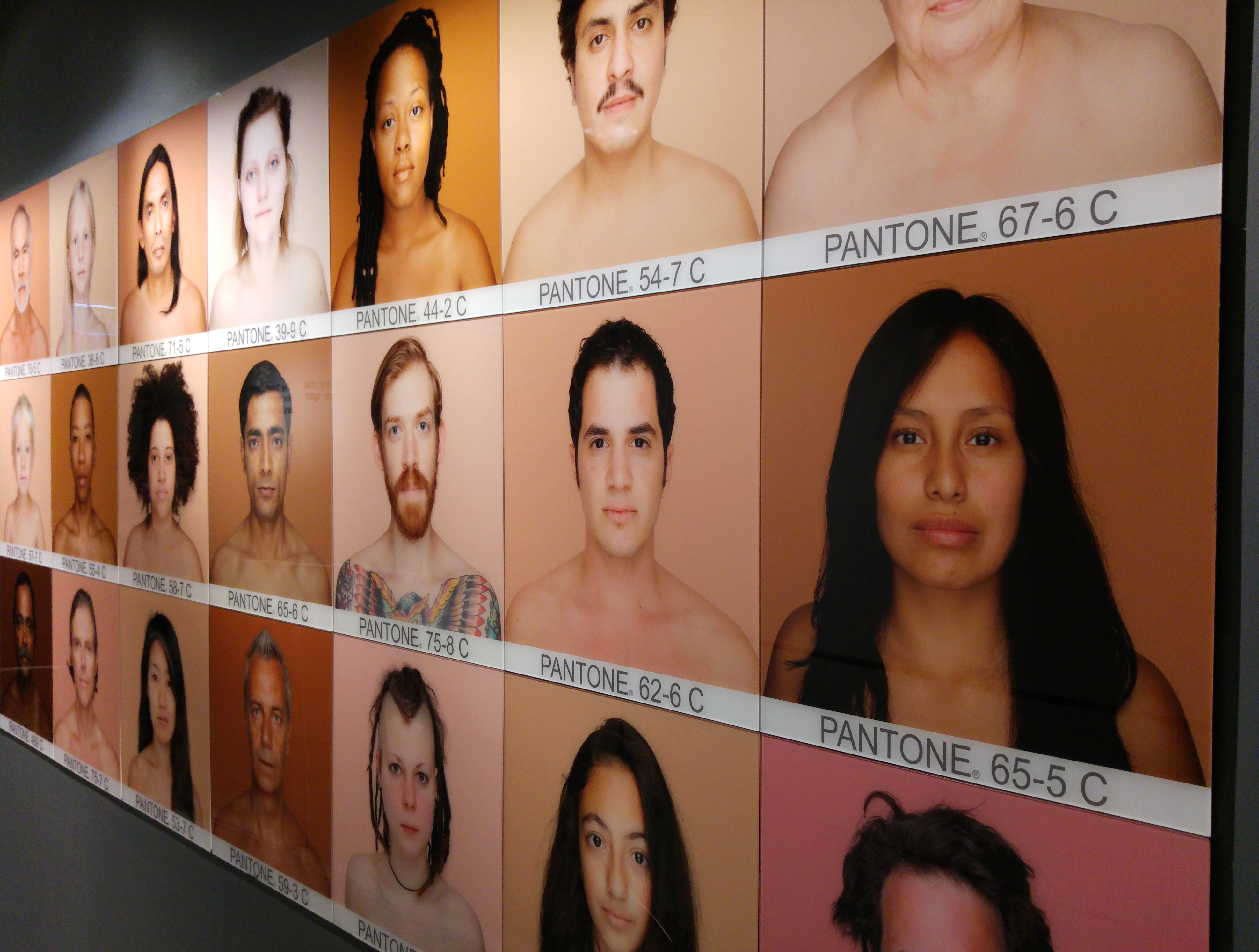
It was at the end of this exhibition that we took the chance to step out onto the balcony, a nice patio that overlooks Tel Aviv and, in the foreground, its Zoological Research Institute. We relaxed in the shade of the ark’s upper floors and happened to see a nice sprinkling of birds fly past, including ibises, egrets and a lone sparrowhawk. Back inside, we took the elevator up to the fourth floor where we embarked on a tour of what makes us human. It began with an eye-pleasing depiction of human diversity, a photographic project titled “Humanæ” by artist Angelica Dass. In this clever depiction of humanity, she matched the solid background of each snapshot with the precise colour palette shade of the subject’s skin.

''Humanæ'' by artist Angelica Dass

”Humanæ” by artist Angelica Dass

The transition of humanity and the era of early tools were subjects familiar to me from several classes on prehistory and flint tools. I was pleased to see that the museum portrayed the knapped stone hand tools in such an artistic way, which helped me enjoy what I’d ordinarily say is the least interesting time period of archaeology. Bracha then found a fun game to play where one spins a wooden dowel faster and faster in order to create a successful fire on the screen. This mimicry of fire-starting the old-fashioned way was fun, and a whole lot easier than doing it in real life.

Tools of the early humans

Tools of the early humans

Another game featured symbolism and what we, as the visitor-player, interprets each to be (i.e. the dove as a symbol of peace). Yet another version of this game, focusing on human facial expressions, was also fun and we scored similarly (545 vs 518). Moving along, we marveled at ancient chickpeas and other fun grains, before examining some interesting human bones that were displayed to show how anthropologic researchers learn more about individuals and societies of the past.

2,000 year old chickpeas from the City of David

2,000 year old chickpeas from the City of David

Finished with the museum, we headed downstairs and had a brief peek at the gift shop before continuing outside for some fresh air and chuckles at the animal-themed caricature exhibition outside. There we found witty cartoons of the animal world, some of which really tickled our fancy. It was with a smile that we bid farewell to the mighty ark and boarded a bus for central Tel Aviv.

Sunset at the beach

Sunset at the beach

We had a nice dinner at La Lasagna, a popular lasagna restaurant on Dizengoff street, before heading over to the beach to watch the sunset. The sinking sun painted the sky in the most vibrant shades of red before plunging our world into relative darkness. In true Anthropocene form, it was the intense wattage of Tel Aviv – the concurrent human footprint in the otherwise stark nychthemeron pattern – that illuminated our surroundings and made us extra mindful of our presence on this planet that we call home.

Babylonian Jewry Museum

In Central Israel, Israel on July 1, 2021 at 12:10 PM

Just over a month ago, towards the end of May, I took a bus over to nearby Or Yehuda to meet up with my wife, Bracha. A soon-to-be graduate of social work, Bracha was doing her third year of fieldwork at the Welfare Centre of Or Yehuda, where she tended to the social needs of the city’s citizens. Having heard about her place of work throughout the academic year, it was finally time to visit – and to check out some of Or Yehuda’s star attractions together.

The Babylonian Heritage Centre

Bracha met me at the bus stop across from our first destination of the day, the titular Babylonian Jewry Museum. An impressive building, the Babylonian Heritage Centre commands the respect deservant of such an interesting topic and we were excited to see what was in store for us. Inside, we secured tickets and began our tour of the two-storied museum. But first, a few anecdotes which proved to make our experience all the more poignant. Or Yehuda began as a grouping of immigrant and refugee absorption camps, where mass immigration from countries such as Libya, Turkey and Iraq took place in the 1940-50s. As such, Bracha’s clients belonged largely to that very same demographic. Additionally, in the course of this academic year’s curriculum, she  took a class on the Ben Ish Hai, the famous rabbi of Baghdad from the turn of the last century. Now, the pieces can all fit together nicely.

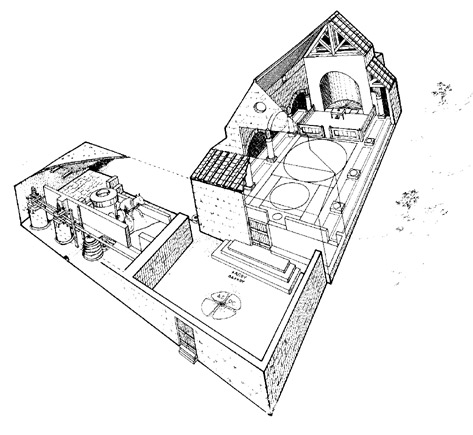
Model of a Babylonian yeshiva during the 7th-13th centuries

The museum’s layout began us on a chronological tour of the Babylonian community, with an exhibition on the first Jews who were exiled by Nebuchadnezzar. A beautifully animated video gave us a historically-based perspective of exiled Jews who had grown accustomed to life in Babylon, and were offered the idea of returning to the Holy Land – as was the case starting in 538 BCE. Alongside this video were artefacts and replicas to help illustrate life so long ago.

Antique Torah scroll cases

The exhibition then merged into more modern times, with artefacts and information about the Babylonian Jewish community in the 18th-20th centuries, which had spread to the nearby lands such as India and Singapore. The highlights were a handful of ornate Torah scroll boxes, as well as a transplanted aron (or ark, where the scrolls are kept in a synagogue). Naturally, life extended beyond the religious and the exhibition continued into the daily life of the community – full of interesting facts and artefacts alike.

A glimpse down the alley

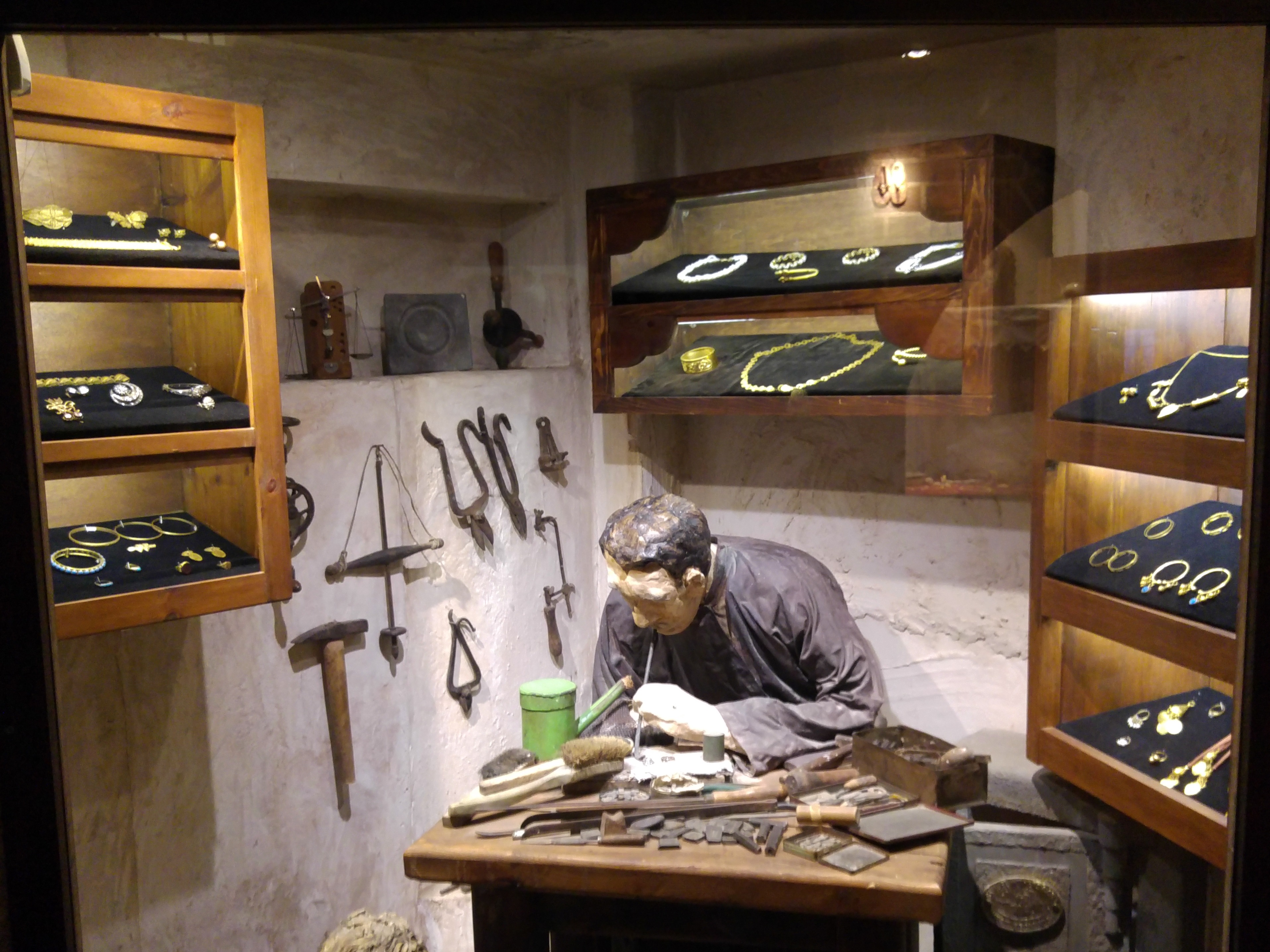
The next bit was my favourite, a fine example of how to properly present historical still life. The museum painstakingly recreated an old Baghdad alley, complete with windows peering into the various stores and workshops that would have existed then. We walked down the dim alley, admiring the mannequin tailor and jeweler as they toiled away timelessly in their neat shops. I particularly enjoyed the intricate detail given to the setting beyond the exhibited shops and storefronts, such as the beautiful wooden dormers which poked ever so elegantly over the quiet street.

The jeweler hard at work

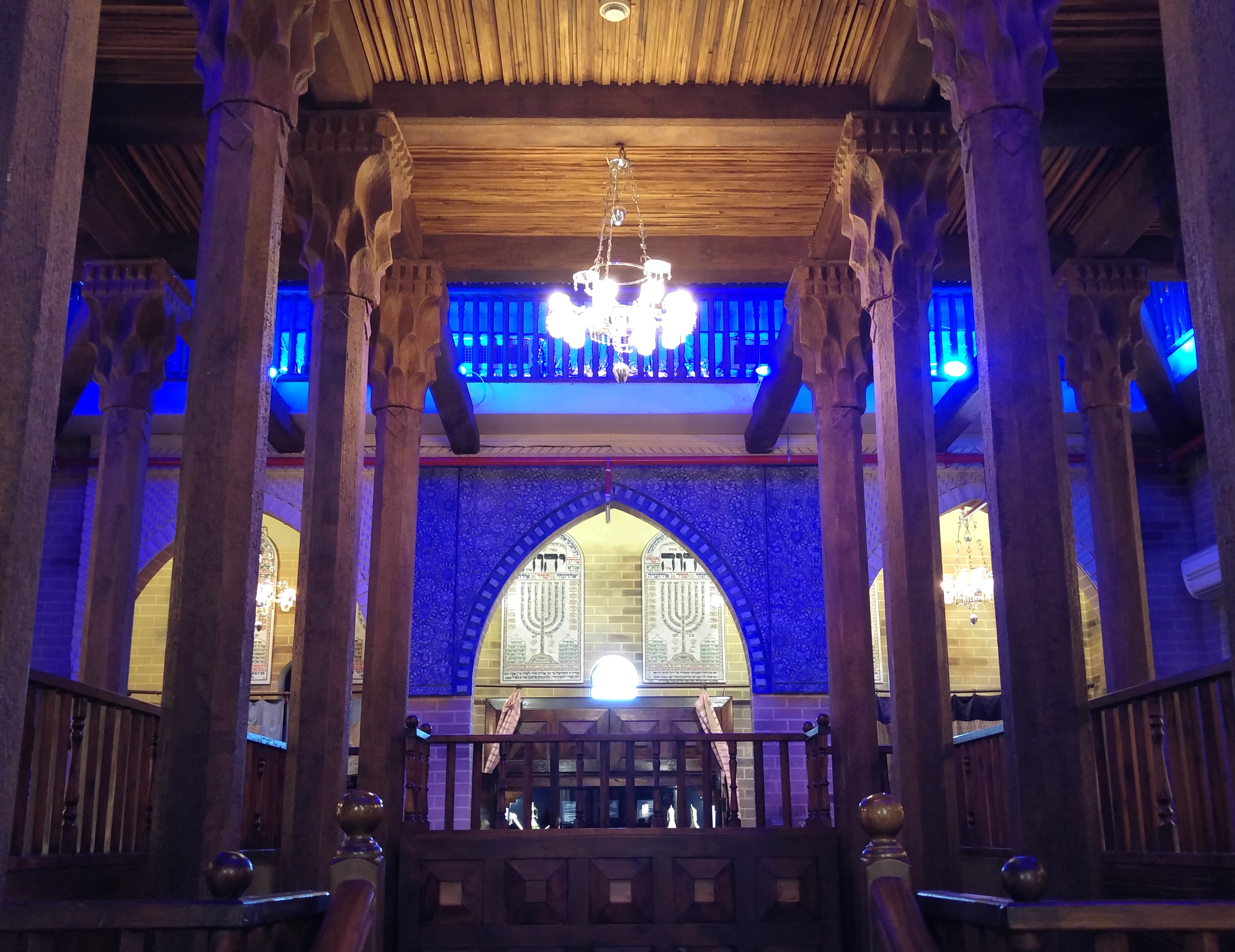
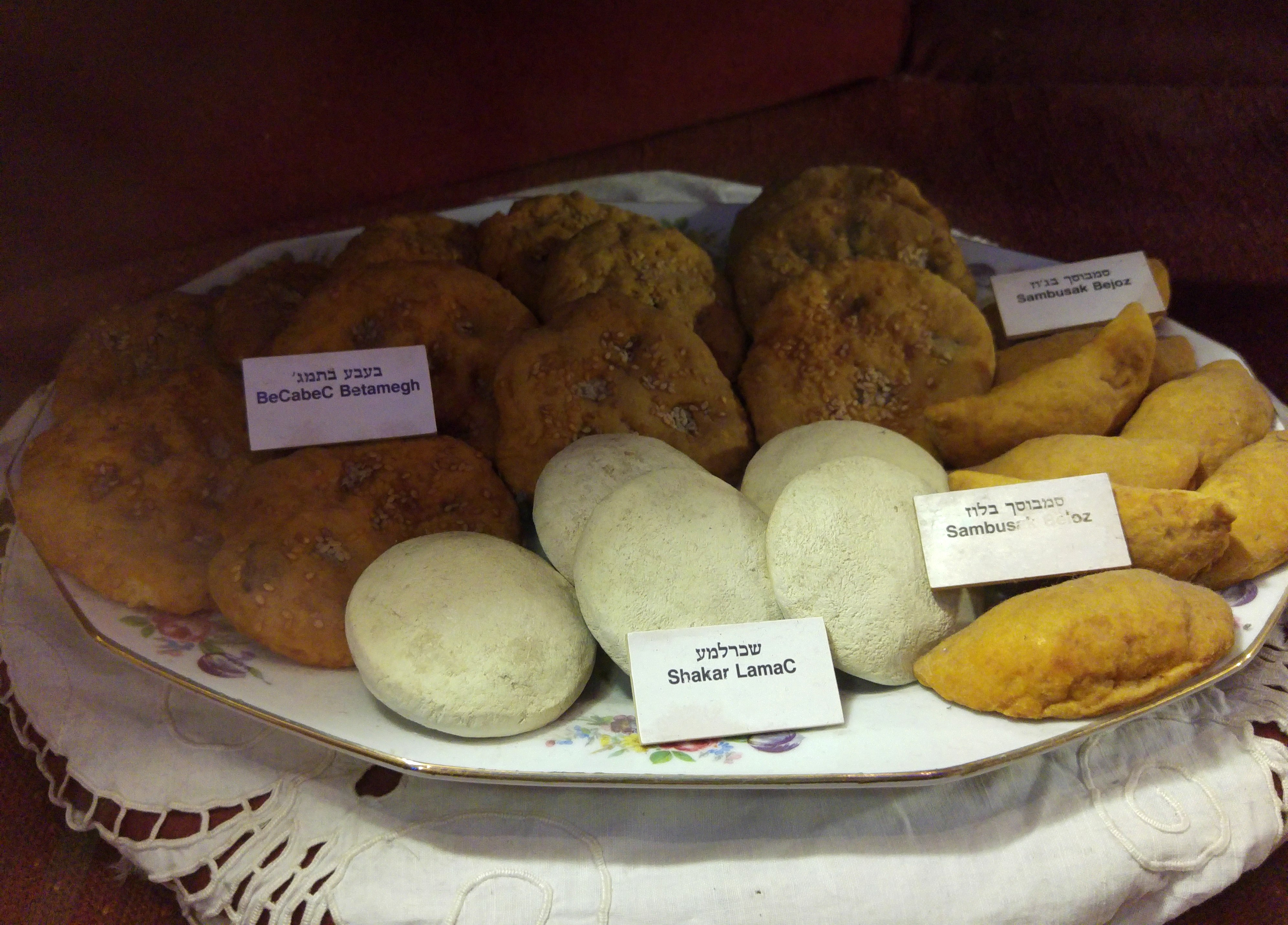
The end of the quaint alley led us into a recreated synagogue, with the grand wood teva (or, central platform from which the services were led) serving as a worthy centerpiece. This teva originally belonged in the Great Synagogue of Baghdad, where the famed and aforementioned Ben Ish Hai gave his cherished sermons. Encircling the teva were windows into the circle of Jewish life, and likewise the various annual holidays. We particularly enjoyed looking at the ethnic foods that were served at the different social events that took place in the synagogue.

The teva of the Great Synagogue

From there the subsequent exhibitions focused on the more modern, from the tragic Farhud pogroms in 1941, which served as a catalyst to the brave efforts that the Jewish community made to reach the Holy Land after the founding of the State of Israel. It was humbling to read about the many Jews who lost their lives both within Iraq and on their way to Jerusalem, so much senseless loss.

Fun Iraqi foods

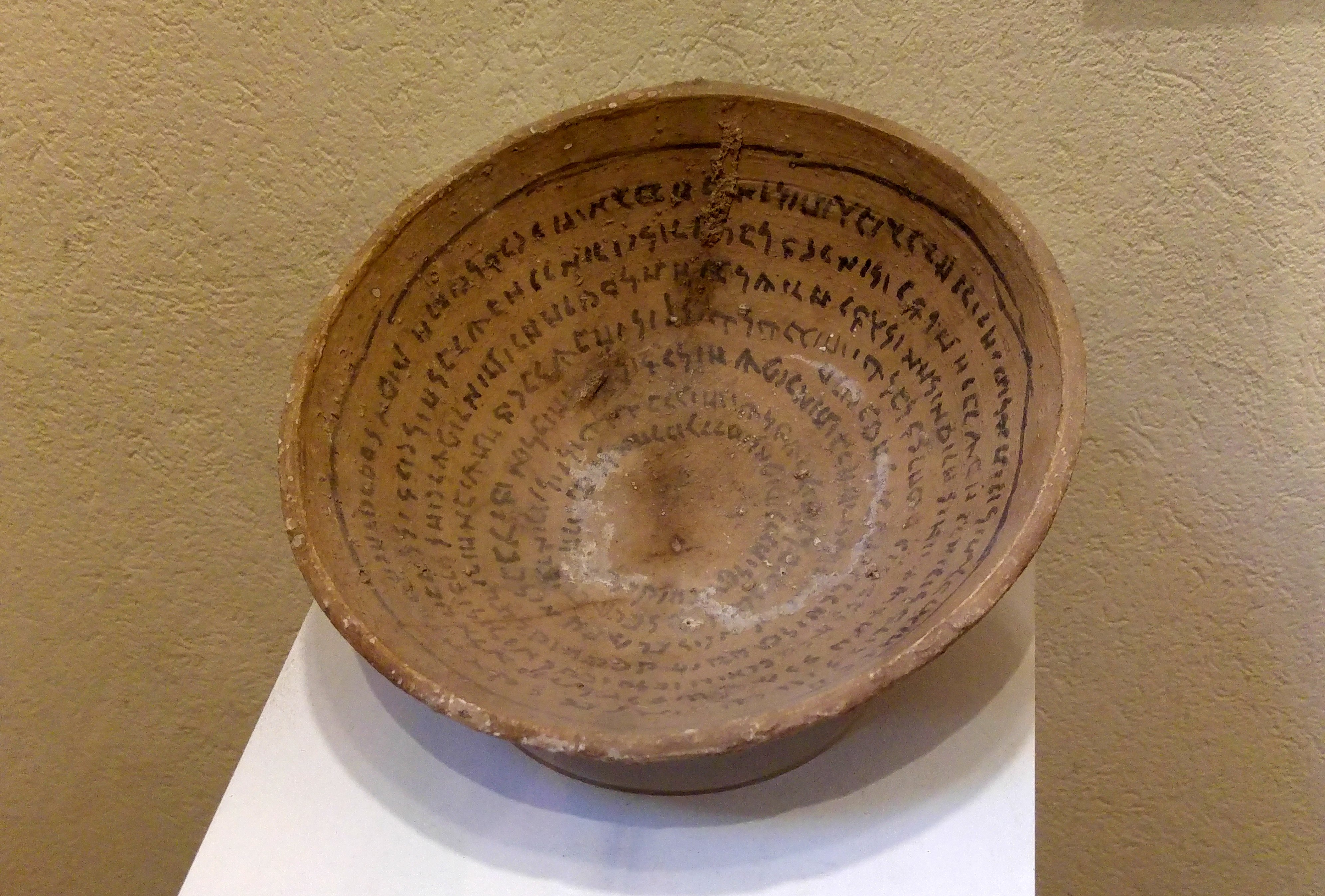
Our tour continued on with a display of superstitious talismans, a tradition that somehow still clings to some community members to this very day. Next, we went upstairs and saw relics of the time when Or Yehuda consisted of immigrant and refugee absorption camps. Representations of that hard life filled a corner of the large room, including a temporary tent home for fresh immigrants, and a small shop of canned and dry goods to feed the newcomers. From there we took a jump back in time with the exhibition of traditional Iraqi homes, starting with a comfy sitting room overlooking the bustling Or Yehuda street outside. Next, a more upscale sitting room – the most ornate room in a traditional home, where guests would be entertained.

Incantation bowl against demons from Mesopotamia in the 5th-8th centuries

The final exhibits concerned marriage and the glamorous outfits that the bride and groom wore to their wedding ceremonies. We laughed as we imagined ourselves wearing such exciting brocade robes, being cheered on by an imaginary crowd of proud Iraqi Jews. A chronologically-arranged display of ketubot (traditional Jewish marriage contract), each of which was handwritten on a beautiful sheet of what appeared to be parchment. A quick look at the temporary photographic exhibit titled “Family and its Many Faces” and we finished our grand tour of the excellent museum. When we had left, having thanked the staff for our lovely visit, we explored the town a bit more. It was certainly fun to see where Bracha spent so many of her weekdays, getting a glimpse into the life that I had heard so much about throughout the year.

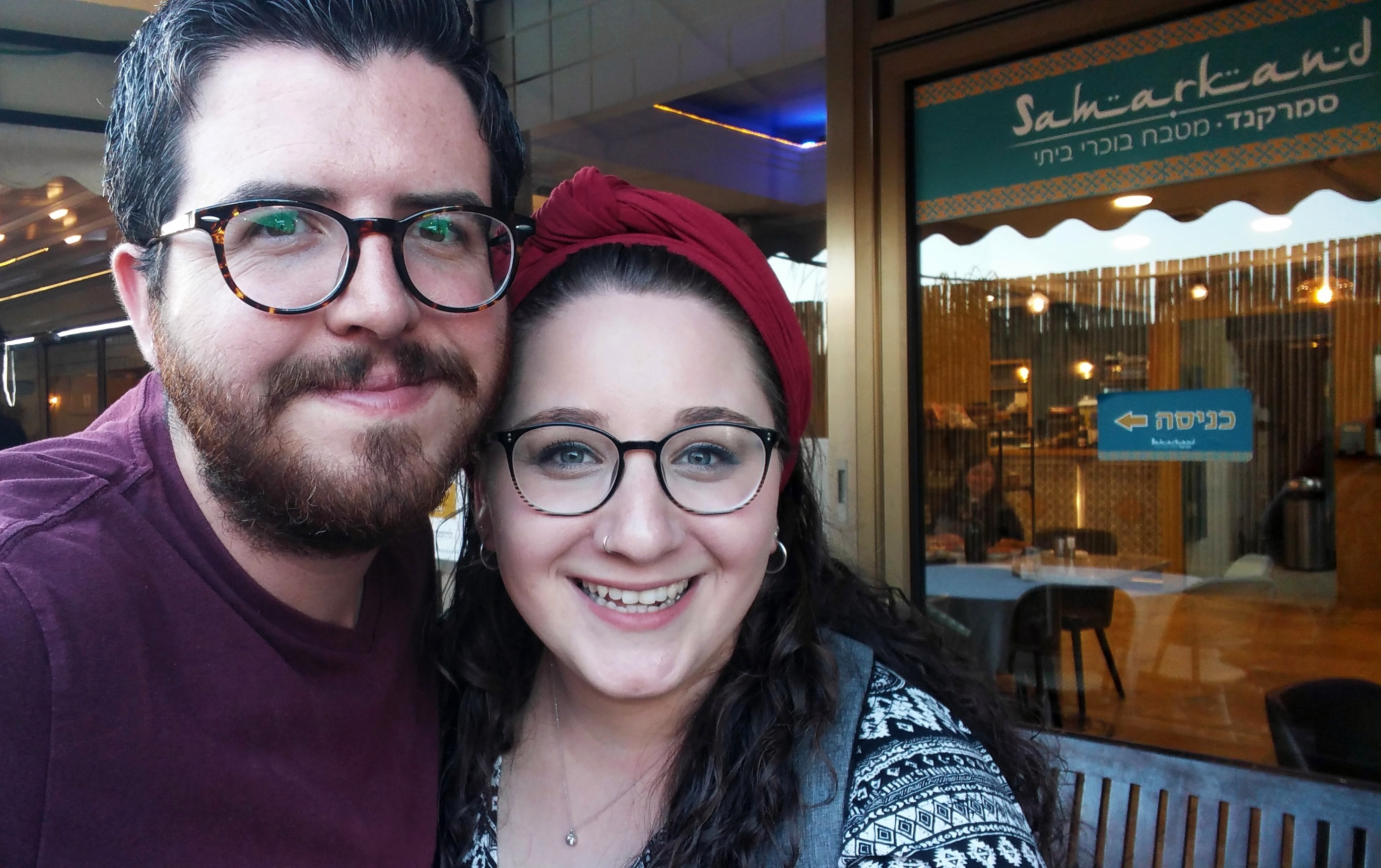
Dinner at Samarkand

Feeling a bit hungry, it was time for dinner and so we headed for a Libyan restaurant which we had pre-designated months prior. To our dismay, the restaurant was closed for the day, so we settled for an ethnic restaurant or another kind: Samarkand, a server of Uzbek and Bucharian food. It was enjoyable going out for dinner, but we both realised pretty quickly that this Central Asian cuisine wasn’t quite what we were looking for. Regardless, it was a nice ending to an exciting visit to the charming Or Yehuda. Perhaps another visit is in order…